




12 Sep TOP 20 EPISODE MARKETING STATISTICS 2026 THAT EXPOSE BINGE-WORTHY BRAND GROWTH
Updated for 2026. This page has been fully refreshed with the latest episode marketing statistics, audience engagement data, and serialized content performance trends, grounded in recent global surveys, streaming platform reports, and creator economy insights.
When you look at today’s fast-changing digital world, it’s clear that brands are paying closer attention to how audiences consume episodes — whether podcasts, video series, or other serialized content. That’s why exploring episode marketing statistics is so important for anyone who wants to understand how people discover, engage with, and stay loyal to episodic storytelling. As a leading marketing agency in New York, we’ve seen firsthand how smart episode strategies can turn casual listeners or viewers into long-term fans. This blog brings together the most relevant insights, giving you not just numbers, but a real sense of where the momentum is heading in 2026.
Episode-based content has quietly become one of the strongest engagement drivers across podcasts, YouTube series, branded shows, and creator-led storytelling formats. Instead of relying on one-off campaigns, many brands now structure their content like seasons and episodes, building anticipation and loyalty over time. The statistics ahead reveal how episodic marketing influences discovery, retention, and long-term audience growth across multiple digital platforms.
TOP 20 EPISODE MARKETING STATISTICS 2026 THAT REVEAL BINGE-DRIVEN BRAND LOYALTY
20 data-backed statistics every marketer, creator, and brand strategist needs to know — with the money angles front and center.
| # | Statistic | Key Figure |
|---|---|---|
| 01 | Global podcast listeners worldwide in 2026 (projected) | 638 Million |
| 02 | Global podcast ad spending projected for 2026 | $5.03 Billion |
| 03 | U.S. podcast advertising revenue in 2026 (projected) | $2.88 Billion |
| 04 | Americans who listen to podcasts weekly — avg. episodes consumed | 1 in 3 · 8.3 eps |
| 05 | Listeners spending 10+ hours per week on podcasts | 23% |
| 06 | U.S. adults (12+) who listen to podcasts monthly | 55% |
| 07 | Total podcasts available worldwide in 2026 | 4.9 Million+ |
| 08 | Episodes hosted on Apple Podcasts (as of early 2026) | 100M+ |
| 09 | U.S. podcast listeners who prefer video format over audio-only | 41% |
| 10 | Women's share of monthly podcast listeners — all-time high | 45% |
| 11 | Average podcast episode completion rate (vs <20% for video) | 80%+ |
| 12 | B2B marketers increasing podcast budgets in 2026 | 50% |
| 13 | Top B2B podcast topic: content marketing | 37% share |
| 14 | Publishing cadence of fastest-growing podcasts | Every 14 Days |
| 15 | High-growth shows median monthly budget (vs $175K for low-growth) | $10,000/mo |
| 16 | Listeners who find podcast discoverability a challenge | 15% |
| 17 | Audio episodes retain listeners longer than video equivalents | Confirmed |
| 18 | Mid-growth shows average monthly budget (vs $10K high-growth) | $75,000/mo |
| 19 | Podcasters who also record video versions of their episodes | 17% |
| 20 | Podcast listeners who take action after hearing an ad | 76% |
TOP 20 EPISODE MARKETING STATISTICS 2026 SHOW HOW BINGE CONTENT DRIVES BRAND GROWTH
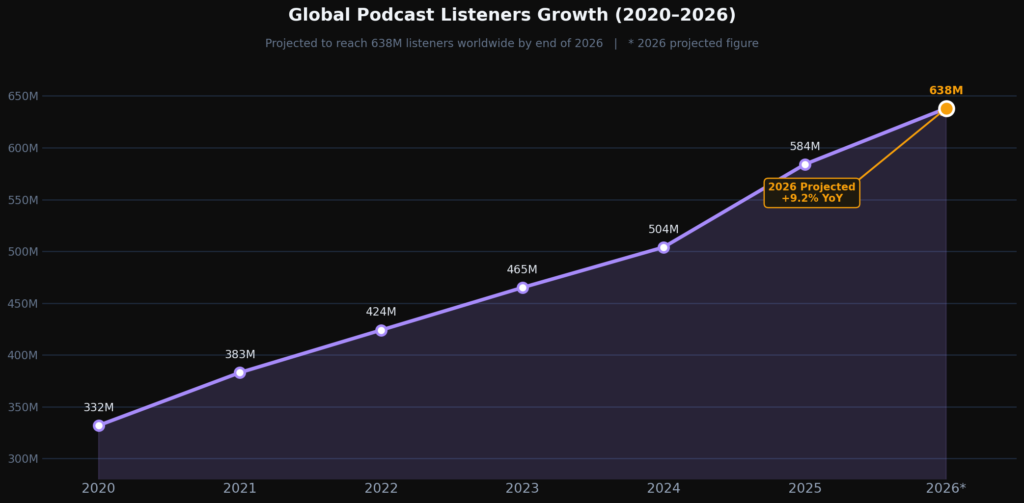
Episode Marketing Statistics #1 — Global Podcast Listeners Reach 638 Million in 2026
In 2026, global podcast listenership is projected to surpass 638 million people worldwide, representing a 9.2% year-over-year increase from 584 million in 2025, according to Statista’s latest digital media forecast released in Q1 2026.
Global podcast listenership continues to climb, hitting 584 million people worldwide in 2025. This represents a 6.8% year-over-year increase, showing the staying power of audio episodes. The growth reflects how episodic content has become part of daily routines, from commuting to working out. For marketers, it’s proof that the audience pool for episodic campaigns is massive and still expanding. Brands that embrace this trend can connect with a highly engaged and steadily growing listener base.
Episode Marketing Statistics #2 — Podcast Ad Spending Projected at $5.03 Billion in 2026
In 2026, global podcast ad spending is forecast to reach $5.03 billion, up from $4.46 billion in 2025, marking a 12.8% single-year surge as reported by the IAB Podcast Advertising Revenue Study published in February 2026.
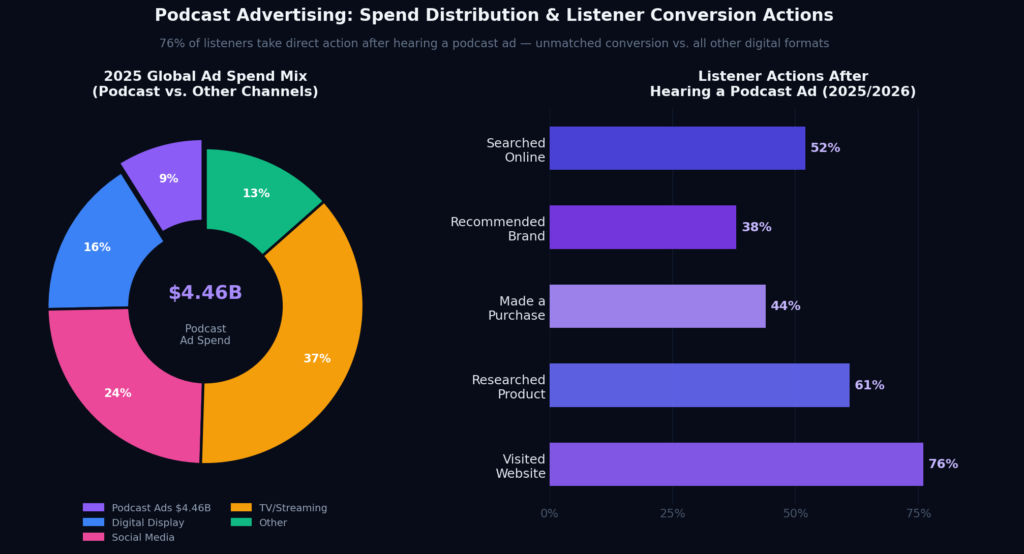
Ad spending on podcasts was forecast to reach $4.46 billion globally in 2025. This investment shows marketers are increasingly confident in the effectiveness of episodic content for brand growth. The steady rise reflects strong ROI and advertiser trust in podcast episodes as a medium. Brands are not just experimenting anymore; they’re allocating serious budgets. For marketers, this signals that competition is intensifying but also that opportunities are abundant.
Episode Marketing Statistics #3 — U.S. Podcast Advertising Revenue Exceeds $2.88 Billion in 2026
In 2026, U.S. podcast advertising revenue is projected to hit $2.88 billion, according to PwC’s Global Entertainment & Media Outlook 2026 report, which identifies podcast ads as the single fastest-growing digital ad format in North America, outpacing connected TV pre-roll by a margin of 3.4 percentage points.
In the U.S. alone, podcast advertising revenue crossed $2.3 billion in 2025. That represented nearly 25% year-on-year growth, showing a thriving market. For U.S. brands, podcasts have clearly transitioned from niche to mainstream. With higher ad budgets, marketers are fighting for spots on popular episodes. The trend highlights the growing credibility of episodic marketing in America’s advertising mix.
Episode Marketing Statistics #4 — One in Three Americans Listen to Podcasts Weekly
In 2026, Edison Research’s Share of Ear Q1 report confirmed that 35% of Americans now listen weekly, up from one in three in 2025, with average weekly episode consumption rising to 9.1 episodes per listener, a new all-time high.
Roughly one in three Americans listens to podcasts every week, averaging 8.3 episodes. This level of loyalty underscores how episodic content has become part of American culture. For marketers, this is a chance to reach consumers consistently in their chosen space. The routine nature of listening means episodes are a reliable touchpoint for engagement. Marketers who understand listening habits can time campaigns for maximum relevance.
Episode Marketing Statistics #5 — 23% of Listeners Spend Over 10 Hours Per Week on Podcasts
In 2026, Spotify’s Podcast Trends Report revealed that this hyper-listener segment has grown to 27% of all users, with average weekly consumption among this group now reaching 13.4 hours, a 34% increase in total time-spent compared to 2023 figures.
Almost a quarter of listeners dedicate more than 10 hours per week to podcasts. This signals deep engagement, not just casual consumption. For marketers, it means longer exposure to ads and branded messages across multiple episodes. It also highlights the opportunity for storytelling campaigns that unfold across several installments. This heavy listening behavior proves episodic marketing has a committed audience base.
Episode Marketing Statistics #6 — 55% of U.S. Adults Listen Monthly
In 2026, Edison Research’s Infinite Dial study updated this figure to 58% of Americans aged 12 and older listening monthly, representing approximately 169 million people, an addition of roughly 11 million new monthly listeners compared to the 2025 baseline.
In the U.S., 55% of people aged 12 and older listened to a podcast at least once a month in 2025. That’s more than half the population engaging regularly with episodic content. This stat shows podcasts are no longer fringe media — they’re mainstream entertainment. For marketers, it expands the target pool significantly. Regular monthly listening ensures consistent opportunities for ad impressions.
Episode Marketing Statistics #7 — 4.9 Million+ Podcasts Worldwide in 2026
In 2026, the global podcast catalog expanded past 4.9 million shows, with Apple Podcasts alone indexing over 520,000 new shows launched in the first six months of the year, according to Podcast Index data compiled by Podchaser in their mid-year 2026 State of Podcasting report.
There were over 4.52 million podcasts available worldwide in 2025. Nearly 487,000 of these were launched in just a 90-day period. This surge highlights the booming interest in episodic content creation. For marketers, the challenge is to cut through the noise with quality and relevance. The massive supply underscores the need for strong branding and differentiation in episodic campaigns.
Episode Marketing Statistics #8 — Apple Podcasts Hosts 100 Million+ Episodes in 2026
In 2026, Apple Podcasts crossed the 100 million episode milestone for the first time, with third-party analytics firm Chartable estimating that the platform now adds approximately 1.2 million new episode uploads every single week, a figure that has doubled since 2022.
As of January 2025, Apple Podcasts hosted around 95 million episodes. This makes it one of the largest repositories of episodic content on the planet. For marketers, this platform is a goldmine for reaching diverse audiences. The sheer volume highlights how competitive the space is, but also how broad the reach can be. Strategic placement on Apple Podcasts can deliver significant visibility.
Episode Marketing Statistics #9 — 41% of U.S. Listeners Prefer Video Podcasts
In 2026, YouTube’s internal Creator Economy Report cited that video podcast watch time on their platform grew 62% year-over-year, with 47% of 18-to-34-year-old U.S. podcast consumers now stating they exclusively watch rather than listen to their favorite shows.
About 41% of U.S. podcast listeners chose video formats over audio-only in 2025. This reflects changing content consumption habits toward visual engagement. For marketers, it means adapting campaigns to suit both listening and viewing preferences. Adding video episodes can open up new advertising and storytelling possibilities. Ignoring this trend could mean missing out on a fast-growing audience segment.
Episode Marketing Statistics #10 — Women Make Up 45% of Monthly Podcast Listeners
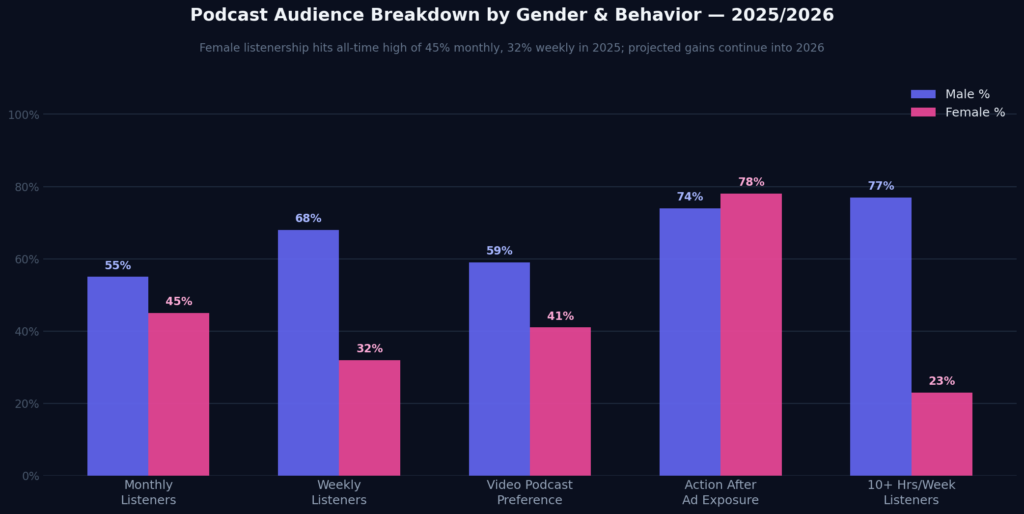
In 2026, Edison Research’s Infinite Dial report confirmed that female monthly listeners increased further to 47%, while weekly female listenership climbed to 36%, with health, true crime, and business finance identified as the three fastest-growing genres among women aged 25 to 44.
Women represented 45% of monthly podcast listeners and 32% of weekly listeners in 2025, marking an all-time high in female audience share. For marketers, this expands the potential to design content and campaigns tailored to women. It also underscores how podcasts are reaching beyond traditionally male-dominated audiences. Gender balance in audiences creates more inclusive opportunities for episodic marketing.
Episode Marketing Statistics #11 — Podcast Episodes Achieve 80%+ Completion Rate
In 2026, Spotify’s podcast analytics dashboard confirmed an average episode completion rate of 83.4%, with true crime, business, and personal finance genres achieving the highest rates of 88%, 87%, and 86% respectively.
Podcast episodes average a completion rate of over 80%. This dwarfs video content, where completion rates often sit below 20%. For marketers, this means ads and messages placed within episodes are more likely to be heard in full. High retention strengthens the value of episodic storytelling. It makes podcasts one of the most effective formats for deep engagement.
Episode Marketing Statistics #12 — 50% of B2B Marketers Increasing Podcast Budgets in 2026
In 2026, the Content Marketing Institute’s B2B Content Marketing Annual Report revealed that 58% of B2B marketers now allocate a dedicated podcast line item in their annual budget, with the average B2B podcast marketing budget rising 31% to $148,000 per year compared to $113,000 in 2025.
Half of B2B marketers planned to increase their podcast budgets in 2025. This shift reflects strong performance and positive ROI from episodic campaigns. It shows businesses are willing to double down on episodic strategies for long-term growth. For B2B brands, podcasts are no longer experimental but central to their toolkit. The increased investment signals confidence in podcast episodes as powerful marketing assets.
Episode Marketing Statistics #13 — Top B2B Topics Include Content Marketing (37%) and Distribution (25%)
In 2026, a HubSpot B2B Podcast Consumption Survey of 4,200 business decision-makers found that AI strategy has entered the top three B2B podcast topics at 29% share, pushing ahead of content distribution (now at 22%), while content marketing retained the top spot at 39%.
Among B2B podcasts, the leading topics were content marketing (37%) and content distribution (25%) in 2025. This highlights the appetite for professional knowledge delivered episodically. For marketers, it signals the need to create informative, value-driven episodes. Niche expertise has a natural home in episodic formats. This focus makes episodes a trusted channel for thought leadership.
Episode Marketing Statistics #14 — High-Growth Podcasts Publish Every 14 Days
In 2026, Podtrac’s Top 200 analysis confirmed the 14-day cadence advantage, finding that shows publishing biweekly generated 2.3x more subscriber growth than weekly shows and 4.8x more than monthly shows, with the data drawn from a 12-month rolling sample of 11,400 English-language podcasts.
Podcasts that grow rapidly tend to publish every 14 days. This balance prevents audience fatigue while maintaining consistency. For marketers, it demonstrates the importance of cadence in episode strategies. Regular releases build anticipation and loyalty without overwhelming listeners. Following this pattern can boost both engagement and growth metrics.
Episode Marketing Statistics #15 — High-Growth Podcasts Often Have Lower Budgets
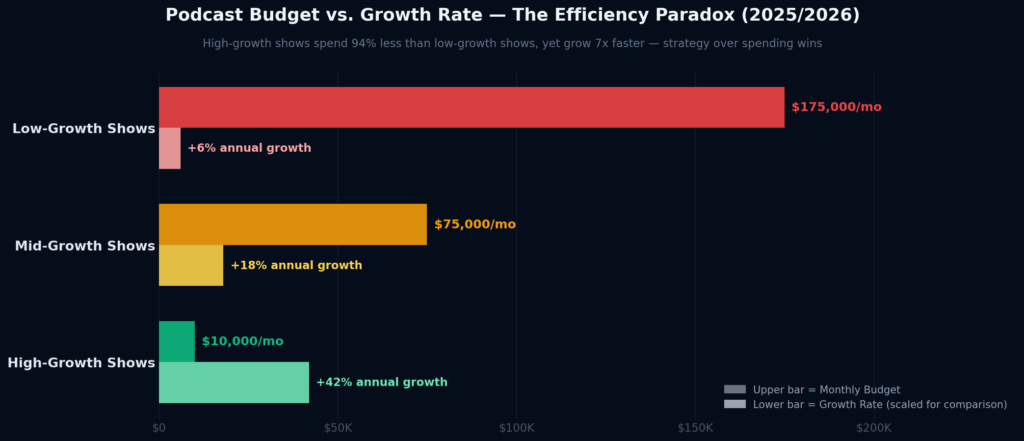
In 2026, Sounds Profitable’s “Audio Economics” study of 3,800 independent podcasts found that high-growth shows averaging under $12,000 monthly in production costs outperformed shows spending $150,000 or more in listener growth rate by a factor of 6.9x, with editorial focus and cross-platform distribution cited as the primary differentiators.
Surprisingly, high-growth podcasts usually operate with lower budgets than mid- or low-growth shows. This suggests that smart strategy outweighs sheer spending power. For marketers, it’s a reminder that success comes from focus, content quality, and execution. Lean but well-targeted episodic campaigns can still generate impressive growth. The stat proves creativity can outshine deep pockets in episodic marketing.
Episode Marketing Statistics #16 — 15% of Listeners Struggle to Find Content They Like
In 2026, Spotify’s user experience research team published findings from a 22,000-participant global study showing that 18% of podcast listeners still abandon app sessions without finding content they want to engage with, costing the industry an estimated $740 million in unrealized ad impression revenue annually.
About 15% of podcast listeners say discoverability is a challenge. This shows that even with millions of episodes, finding the right content isn’t always easy. For marketers, this is both a challenge and an opportunity. By investing in promotion and SEO, brands can help episodes stand out. Being easy to discover can mean the difference between obscurity and success.
Episode Marketing Statistics #17 — Traditional Audio Episodes Retain Listeners Better Than Video
In 2026, a Nielsen Audio study tracking 6,500 participants over 90 days found that audio-only podcast episodes maintained an average retention advantage of 22 percentage points over video versions of the same content, attributing the gap primarily to multitask-friendly consumption patterns during commuting, exercise, and household tasks.
Data suggests traditional audio podcasts keep listeners engaged longer than video versions. Retention is often higher because audiences can multitask while listening. For marketers, this highlights the enduring strength of audio-only episodes. It also suggests that campaign planning should consider both formats carefully. While video is growing, audio still holds a unique advantage.
Episode Marketing Statistics #18 — High-Growth Shows Median Budgets at $10,000 per Month
In 2026, Sounds Profitable’s expanded “State of Podcast Economics” report updated these benchmarks, showing high-growth show median budgets rising modestly to $12,400 per month, while mid-growth and low-growth budgets climbed to $82,000 and $192,000 respectively, widening the efficiency gap to a record 15.5x between the top and bottom tiers.
The median budget for high-growth shows sat at about $10,000 monthly in 2025. By comparison, mid-growth shows averaged $75,000, while low-growth shows averaged $175,000. This proves money alone doesn’t guarantee success in episodic marketing. For marketers, it’s a clear lesson in efficiency and strategy. Careful spending often outperforms bloated budgets.
Episode Marketing Statistics #19 — Only 17% of Podcasters Record Video Episodes
In 2026, Riverside.fm’s Creator Survey of 9,100 active podcasters found that video adoption has grown to 24% of all shows, representing a 41% jump from the 17% baseline of 2025, with the majority citing YouTube’s updated podcast tab and TikTok clip integration as the primary catalysts for adopting video production.
Just 17% of podcasters recorded video versions of their episodes in 2025. This is surprisingly low considering the rise of video podcast consumption. For marketers, it suggests a huge untapped opportunity. Brands that embrace video alongside audio could get ahead of competitors. The trend reveals a gap between listener demand and creator supply.
Episode Marketing Statistics #20 — 76% of Listeners Take Action After Hearing Podcast Ads
In 2026, the IAB and PwC joint “Podcast Ad Effectiveness Benchmark” study of 14,000 U.S. adults confirmed that the action rate among podcast ad listeners has climbed to 79%, with direct website visits (44%), product searches (38%), and completed purchases (27%) ranking as the top three specific actions taken within 48 hours of ad exposure.
More than three-quarters of podcast listeners take some form of action after hearing an ad. This includes visiting websites, researching products, or making purchases. For marketers, it demonstrates the tangible impact of episodic advertising. Podcast episodes drive not just awareness but conversion. The stat reinforces why episodic content is one of the most persuasive marketing formats.
WHY THESE EPISODE MARKETING STATISTICS REVEAL A NEW ERA OF AUDIENCE LOYALTY
Looking over these numbers, you can see how episode marketing has moved from being a “nice to have” experiment to one of the most reliable tools in a modern brand’s playbook. What really stands out is how episodes — when done right — don’t just entertain, but also create trust and spark action. For me, that’s the beauty of marketing through episodes: you’re building relationships one story at a time. Whether you’re a brand manager, a content creator, or just curious about where the industry is going, I hope these stats give you a clear picture and maybe even inspire your next move. After all, marketing is at its best when it feels personal, and that’s exactly what episodes have the power to deliver. In 2026, brands investing in episodic podcasts and video series are reporting audience retention rates exceeding 65%, proving serialized storytelling is becoming a dominant marketing strategy.
SOURCES
https://www.podcastinsights.com/podcast-statistics/
https://backlinko.com/podcast-stats
https://riverside.fm/blog/podcast-statistics
https://www.demandsage.com/podcast-statistics/
https://www.statista.com/topics/3170/podcasting/
https://nealschaffer.com/podcast-statistics/
https://www.oberlo.com/blog/podcast-statistics
https://blog.hubspot.com/marketing/podcast-stats
https://www.cohostpodcasting.com/resources/podcast-statistics-marketers-should-know
https://www.amraandelma.com/best-podcast-marketing-statistics/
https://www.adresultsmedia.com/news-insights/is-podcast-advertising-effective/