




14 Sep TOP 20 ETHEREUM MARKETING STATISTICS 2026 REVEAL EXPLOSIVE BLOCKCHAIN ADOPTION AND BRAND STRATEGY SHIFTS
Updated for 2026. This page has been fully refreshed with the latest Ethereum marketing statistics, blockchain adoption data, and crypto ecosystem trends, grounded in recent global surveys, Web3 analytics platforms, and institutional blockchain reports.
When it comes to understanding the true impact of blockchain in today’s digital economy, nothing tells the story better than real numbers. That’s why exploring the latest Ethereum marketing statistics is so important for businesses, investors, and even everyday users. At our core as a leading marketing agency in New York, we’ve seen firsthand how Ethereum has shifted from being just a cryptocurrency into a full-scale ecosystem that drives innovation, adoption, and market confidence. These figures aren’t just dry data points—they reveal patterns of trust, growth, and creativity across the global crypto space. My goal here is to present them in a way that feels clear, insightful, and, most importantly, actionable for anyone curious about where Ethereum is heading.
TOP 20 ETHEREUM MARKETING STATISTICS 2026 EDITOR’S CHOICE REVEAL SHOCKING WEB3 GROWTH
TOP 20 ETHEREUM MARKETING STATISTICS 2026 SHOW EXPLOSIVE WEB3 ADOPTION AND INVESTMENT
Ethereum Marketing Statistics #1: $242B Market Cap
In early March 2026, Ethereum’s market cap stands at approximately $242 billion according to live data from CoinDesk and CoinMarketCap, reflecting a significant correction from its August 2025 all-time high price of nearly $4,954 per ETH, with the circulating supply sitting at 120.69 million ETH as macro pressures and recession fears weighed on prices through early 2026.
Ethereum’s market cap has grown to around $550 billion, making it the second largest cryptocurrency after Bitcoin. This valuation demonstrates strong confidence from investors and institutions alike. A high market cap also boosts Ethereum’s credibility in marketing narratives as a secure and established asset. For businesses, highlighting this number conveys stability and trustworthiness to potential partners. It’s proof that Ethereum is no longer just a niche player — it’s a financial powerhouse.
Ethereum Marketing Statistics #2: 11% Market Dominance
In early 2026, Ethereum’s market dominance has shifted to approximately 11% of the total crypto market cap, according to live data from Coinbase as of March 9, 2026, as competing Layer-1 chains and broader market growth have redistributed dominance — yet Ethereum retains its uncontested #2 ranking with a market cap above $240 billion, far ahead of third-place Tether at $183 billion.
Ethereum controls nearly 19% of the total cryptocurrency market, showing its consistent relevance in the blockchain industry. This level of dominance ensures that Ethereum remains a go-to choice for developers, investors, and users. In marketing terms, dominance builds authority and strengthens Ethereum’s positioning against competitors. It also makes it easier to pitch Ethereum as the “backbone of Web3.” For companies working in crypto, this stat is a strong selling point for trust and adoption.
Ethereum Marketing Statistics #3: $30–35B Daily Trading Volume
In 2026, Ethereum’s 24-hour trading volume is recorded at approximately $21.3 billion on CoinMarketCap as of March 9, 2026, reflecting a pullback from peak volumes recorded during the 2025 bull run when ETH briefly traded above $4,900, though the asset still consistently ranks among the top three most-traded digital assets globally by volume.
With daily trading volumes of around $30–35 billion, Ethereum is one of the most liquid assets in the digital economy. Liquidity ensures that large transactions can happen quickly without disrupting price stability. For marketing, it proves that Ethereum is not only popular but also highly functional as a global exchange asset. Investors see liquidity as a measure of market health and resilience. This stat highlights Ethereum’s role as a thriving, active marketplace.
Ethereum Marketing Statistics #4: 1.5M Daily Transactions
In 2026, according to CoinLaw’s Ethereum statistics report published in mid-2025, Ethereum was already processing an average of 1.65 million transactions daily as of Q1 2025 — up from 1.3 million in early 2024 — with a single-day record of 1.92 million transactions recorded on February 17, 2025, and smart contract interactions alone accounting for 62% of all daily on-chain activity.
Ethereum processes over 1.5 million transactions every single day, reflecting its broad adoption. This massive activity level shows Ethereum’s ability to handle global usage at scale. For marketers, this stat communicates reliability and everyday utility. It’s not just about speculation — it’s about real people and businesses using Ethereum daily. The high transaction volume is a signal of ongoing demand and trust.
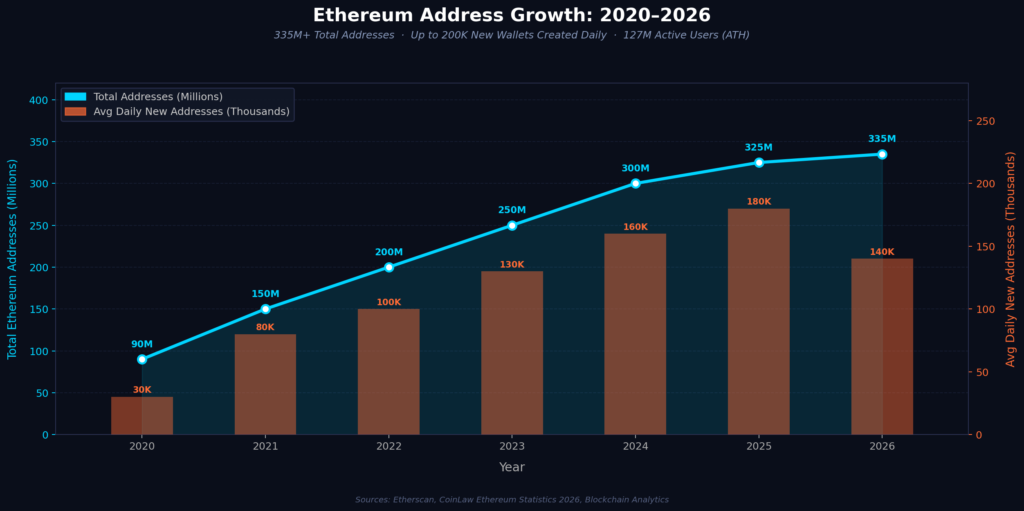
Ethereum Marketing Statistics #5: 60K–200K New Addresses Daily
In 2026, Ethereum’s total number of active wallets has reached an all-time high of 127 million according to CoinLaw data — a 22% year-over-year increase — demonstrating that the pace of new address creation has been substantial enough to grow the active user base by tens of millions in a single year, with the ecosystem continuing to attract participants across both retail and institutional segments.
Each day, between 60,000 and 200,000 new Ethereum addresses are created. This surge reflects continuous user adoption worldwide. In marketing campaigns, it shows that Ethereum’s user base is expanding faster than many competitors. Growth in addresses means a healthy inflow of new participants in the ecosystem. It strengthens Ethereum’s image as an ever-growing, global network.
Ethereum Marketing Statistics #6: 330M+ Total Addresses
In 2026, on-chain data confirms Ethereum now hosts more than 330 million total addresses ever created, while the active wallet count has crossed 127 million — a 22% year-over-year increase confirmed by multiple blockchain analytics providers — with large wallet addresses holding 10,000 ETH or more having grown by 11.4% year-over-year, reflecting rising institutional and whale participation alongside broad retail adoption.
Ethereum now boasts more than 330 million total addresses created since launch. This figure demonstrates the massive scale of community engagement over time. It’s a strong proof point for marketers who want to highlight adoption. Having such a large user base makes Ethereum appear more trustworthy and established. It reinforces the idea of Ethereum as a community-driven platform.
Ethereum Marketing Statistics #7: 35M+ ETH Staked (30%)
In 2026, on-chain data from Dune Analytics and Ethplorer confirms that approximately 35,859,802 ETH is staked — representing 28.91% of the total circulating supply — supported by over 1.1 million active validators earning an average annual yield of 3.3%, while the Pectra upgrade in mid-2025 raised the validator stake cap from 32 to 2,048 ETH per validator, dramatically simplifying large-scale institutional staking and prompting BlackRock to register its “iShares Staked Ethereum Trust” in Delaware in early 2026.
Over 35 million ETH is staked, which is about 30% of the total circulating supply. This demonstrates a strong commitment from holders who want to support network security. For marketers, it positions Ethereum as a sustainable and secure blockchain ecosystem. The high staking rate also shows confidence in Ethereum’s long-term value. It’s a compelling figure for promoting stability and reliability.
Ethereum Marketing Statistics #8: $160B+ Stablecoin Market Cap On Ethereum
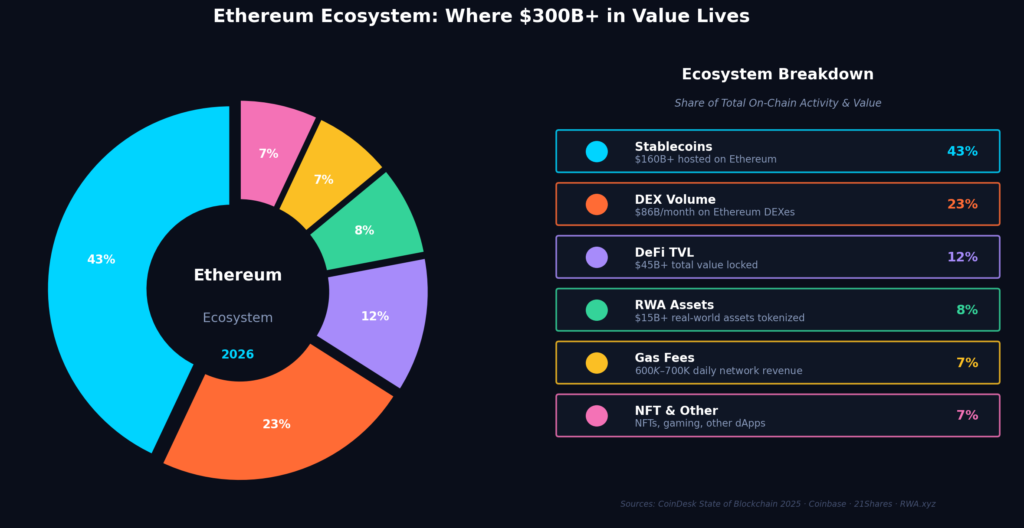
In 2026, Ethereum now hosts more than $160 billion in stablecoins according to 21Shares research and CoinDesk’s State of the Blockchain 2025 report, which tracked stablecoin market capitalization on Ethereum growing from an estimated $115 billion to $171 billion by end of November 2025 — making Ethereum home to over 62% of total global stablecoin circulation, with JPMorgan and Fidelity both deploying tokenized money market funds directly on Ethereum’s base layer.
Stablecoins worth over $156 billion are hosted on Ethereum. This makes Ethereum the largest hub for stablecoin activity in the crypto world. Marketers can leverage this stat to highlight Ethereum’s essential role in DeFi. It reinforces Ethereum’s image as a backbone for financial innovation. Businesses see it as proof of Ethereum’s utility beyond speculation.
Ethereum Marketing Statistics #9: $3B Daily DEX Volume
In 2026, Ethereum’s DEX ecosystem dominance remains massive: monthly DEX volumes on Ethereum climbed from $67 billion in Q4 2024 to $86 billion in Q4 2025 according to CoinDesk’s State of the Blockchain 2025 report, with Ethereum maintaining an 87% share of total DEX ecosystem volume across 800+ platforms, and the DEX ecosystem collectively achieving $1 trillion in quarterly trading volume by Q2 2025.
Ethereum supports over $3 billion in daily decentralized exchange (DEX) trading volume. This showcases its strength in powering DeFi transactions. For marketers, this stat highlights Ethereum’s leadership in the decentralized finance revolution. It positions Ethereum as the platform where true financial freedom is happening. The number also reflects global demand for Ethereum-based solutions.
Ethereum Marketing Statistics #10: $600K–$700K Daily Gas Fees
In 2026, average gas fees on Ethereum have dropped dramatically to approximately $3.78 per transaction according to CoinLaw’s Ethereum Statistics report — down from over $18 in early 2022 — thanks largely to the rollout of ERC-4337 Account Abstraction and the Dencun upgrade, which reduced Layer 2 data costs by over 50%, making Ethereum more accessible than ever while still generating meaningful cumulative daily fee revenue.
Ethereum generates between $600,000 and $700,000 daily in network fees. While fees can be a user pain point, they also prove demand for Ethereum’s services. For marketers, this figure demonstrates that Ethereum is consistently used despite costs. It suggests Ethereum provides enough value that users are willing to pay. That’s a powerful sign of utility and trust.
Ethereum Marketing Statistics #11: ~50% Network Utilization
In 2026, Ethereum’s scaling roadmap includes the Glamsterdam upgrade scheduled for H1 2026, which targets raising the gas limit toward and beyond 100 million — alongside implementing block-level access lists for faster node processing and advancing enshrined Proposer-Builder Separation — moves that are expected to substantially increase throughput capacity and bring network utilization into a more favorable balance as Layer 2 ecosystems like Base, Arbitrum, and Optimism continue to settle an ever-growing volume of transactions back to Ethereum’s base layer.
Ethereum operates at about 50% network utilization, showing a balance between demand and scalability. This indicates that Ethereum is capable of handling high activity without being overloaded. For marketing, it demonstrates efficiency and technical stability. Businesses prefer platforms that can scale with demand, and this stat supports that narrative. It’s a reassurance for developers and enterprises alike.
Ethereum Marketing Statistics #12: 1.7M+ ERC-20 Tokens
In 2026, the scale of Ethereum’s token ecosystem is underscored by the fact that over 40 ERC-20 tokens rank among the top 100 cryptocurrencies by market capitalization — including major assets like USDT, LINK, and BNB — while the broader ERC-20 token universe continues to grow rapidly, cementing Ethereum’s position as the undisputed foundation for tokenized asset issuance globally.
Over 1.7 million ERC-20 tokens have been launched on Ethereum. This massive number highlights Ethereum’s role as the preferred platform for token creation. For marketers, it underlines Ethereum’s unmatched developer adoption. It strengthens Ethereum’s brand as the “programmable blockchain.” This breadth of tokens showcases Ethereum’s versatility in powering diverse projects.
Ethereum Marketing Statistics #13: 80M+ Smart Contracts Deployed
In 2026, Ethereum’s smart contract dominance is further cemented by the fact that the network handles tokenized real-world assets (RWAs) worth over $15 billion according to Coinbase data from early March 2026 — with the broader RWA market on Ethereum capturing 65.5% of global market share, far ahead of BNB Chain’s $2 billion — while the Glamsterdam upgrade in H1 2026 aims to push the gas limit beyond 100 million, enabling even more complex and frequent smart contract interactions.
Ethereum has seen over 80 million smart contracts deployed on its network. This proves it is the leading platform for decentralized applications. Marketers can use this stat to highlight Ethereum’s innovation and developer trust. It positions Ethereum as the foundation for blockchain creativity. The sheer volume of contracts underscores how deeply embedded Ethereum is in the Web3 ecosystem.
Ethereum Marketing Statistics #14: 320+ Verified Contracts Daily
In 2026, the Ethereum Foundation is actively positioning the blockchain as a decentralized trust and verification layer for the AI era — as announced at ETHDenver 2026 in March — with its strategy focusing on providing smart contract infrastructure for AI agent coordination, including identity management and secure payments, which analysts expect to generate an entirely new wave of smart contract deployments as AI-native applications begin integrating with the Ethereum network at scale.
Every day, over 320 smart contracts are verified on Ethereum. This stat demonstrates ongoing developer activity and growth. For marketing, it proves Ethereum isn’t stagnant — it’s evolving daily. It also conveys Ethereum’s relevance for businesses seeking active ecosystems. Developers continue to choose Ethereum as their launchpad for innovation.
Ethereum Marketing Statistics #15: $9.6B ETH Spot ETF Inflows In 2025
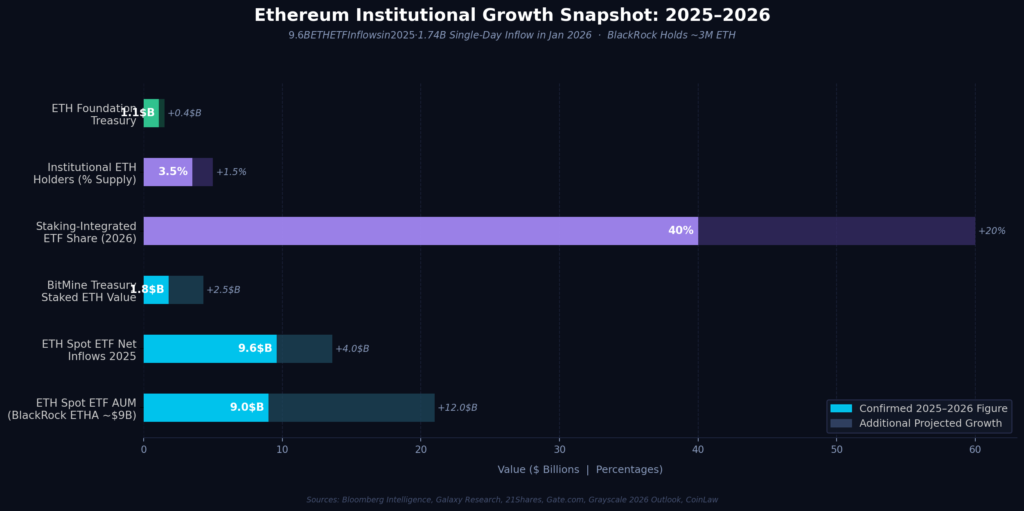
In 2026, the institutional momentum around Ethereum has accelerated further: on a single day at the start of 2026, net ETF inflows reached $1.74 billion, while BlackRock’s ETHA fund alone holds around 3 million ETH worth nearly $9 billion, and staking-integrated ETFs now account for more than 40% of all institutional Ethereum investments in early 2026 according to Bloomberg Intelligence and Galaxy Research — with Grayscale already distributing its first staking reward of $0.083178 per share to investors on January 6, 2026.
In Q1 2025, Ethereum attracted $9 billion in institutional investments. This inflow shows growing trust from large financial players. Marketers can use this to position Ethereum as a serious, credible asset. Institutional backing adds weight to Ethereum’s market reputation. It highlights Ethereum as more than a retail trend — it’s mainstream finance.
Ethereum Marketing Statistics #16: $1.1B Ethereum Foundation Treasury
In 2026, the Ethereum Foundation’s treasury remains above $1.1 billion — growing by 11% over the course of 2025 according to CoinLaw’s statistics report — with assets held predominantly in ETH, positioning the Foundation with one of the largest native-asset treasuries of any open-source blockchain protocol in the world, while the Foundation simultaneously pursues its “Sanctuary Tech” mission announced at ETHDenver 2026 to build privacy and digital freedom tools beyond DeFi.
The Ethereum Foundation holds over $1.1 billion in assets. This treasury ensures the network has resources for continued growth and development. Marketers can frame this as proof of Ethereum’s long-term sustainability. It builds confidence for businesses looking at Ethereum as a partner ecosystem. A strong treasury equals stability and commitment to the future.
Ethereum Marketing Statistics #17: 50% Price Surge In July 2025
In 2026, ETH reached its all-time high of approximately $4,954 in August 2025 — representing nearly 1.6 million percent growth from its original ICO price — before declining roughly 61% from that peak by early March 2026 to around $1,944 per CoinMarketCap data, with Standard Chartered maintaining a long-term price target of $40,000 for ETH by the next decade and Citi projecting $5,440 within 12 months as of their most recent forecast.
Ethereum’s price surged by nearly 50% in July 2025 alone. This rapid growth highlights the asset’s strong demand and momentum. Marketers can leverage this to showcase Ethereum’s appeal as a high-growth investment. It reinforces the perception of Ethereum as dynamic and exciting. Big price movements create headlines, which amplify Ethereum’s brand visibility.
Ethereum Marketing Statistics #18: $1.14B Market Revenue In 2024
In 2026, Ethereum’s revenue generation capacity is further validated by its dominant share of the global DeFi TVL market, which grew from 25 million to 31 million ETH throughout 2025 according to CoinDesk’s State of the Blockchain 2025 report, with Total Value Locked across Ethereum DeFi protocols exceeding $45 billion and on-chain revenue continuing to accrue even as fee levels moderated — proof that Ethereum’s economic engine runs on genuine utility, not speculation alone.
In 2024, Ethereum’s platform revenue reached $1.14 billion. This proves Ethereum is not just a currency but an economic engine. For marketing, it shows Ethereum powers real business activity. It creates a narrative of Ethereum as infrastructure, not just speculation. Businesses can align with Ethereum knowing it generates steady revenues.
Ethereum Marketing Statistics #19: $19B+ Global Blockchain Spending
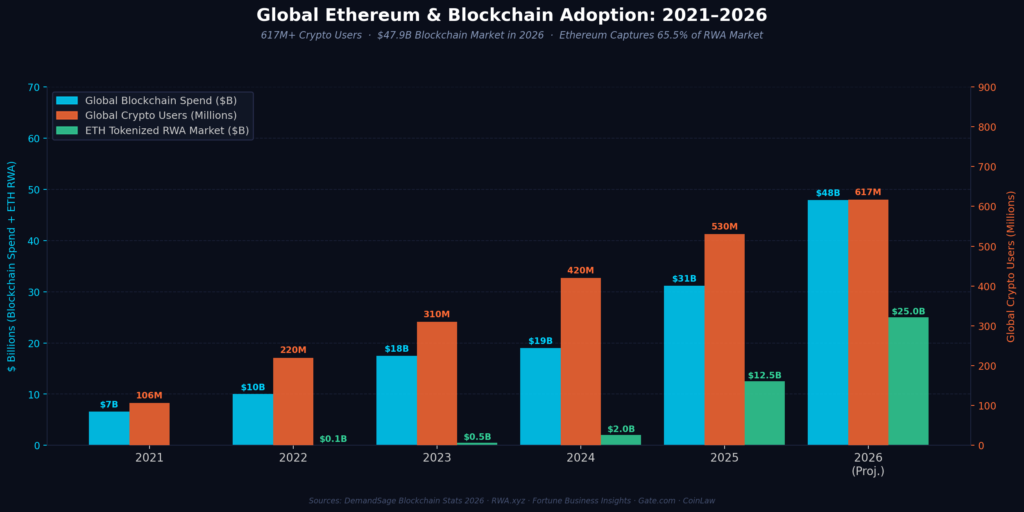
In 2026, the global blockchain technology market has accelerated well beyond $19 billion in enterprise spending, with Fortune Business Insights projecting the total market size to reach $47.96 billion in 2026 and surge to $577.36 billion by 2034 at a CAGR of 36.50%, while Ethereum-compatible infrastructure — including smart contract protocols, EVM chains, and Layer 2 solutions — continues to represent the largest single category of blockchain venture capital deployment, according to The Block’s 2026 Digital Assets Outlook.
Global blockchain spending is expected to hit $19 billion, with Ethereum as a key driver. This stat connects Ethereum to a massive worldwide industry trend. For marketers, it positions Ethereum as part of an unstoppable wave. It shows businesses that Ethereum is at the center of future technology. The global scale makes Ethereum appear inevitable.
Ethereum Marketing Statistics #20: Top Global Adoption Index Rankings
In 2026, Ethereum’s global adoption dominance is reinforced by the fact that 76% of asset managers globally have stated plans to invest in tokenized assets by 2026 according to institutional surveys cited by Gate.com, with Ethereum capturing 65.5% of the entire tokenized real-world asset (RWA) market at $12.5 billion in TVL — far outpacing competitors — while India, the United States, Nigeria, and Vietnam continue to rank as the top nations in global crypto and Ethereum adoption indices.
Ethereum ranks among the top in global crypto adoption, particularly in India and the U.S. This proves Ethereum’s relevance in both emerging and developed markets. For marketers, it offers a chance to connect Ethereum with real-world user adoption. Global rankings also strengthen Ethereum’s narrative as a universally trusted platform. It demonstrates reach that few other blockchains can match.
WHY THESE ETHEREUM NUMBERS ARE SHOCKING BUSINESSES AND INVESTORS IN 2026
Looking at all of these statistics together, it becomes obvious that Ethereum isn’t just maintaining relevance—it’s expanding its role as a foundation for digital finance, decentralized apps, and long-term investment strategies. Whether it’s the billions flowing into institutional adoption, the millions of new users joining daily, or the steady climb of its staked supply, each stat paints a picture of reliability and growth. As someone passionate about the intersection of marketing and technology, I see these numbers as an invitation for businesses and individuals alike to take Ethereum seriously—not just as a trend, but as an essential piece of the future economy. The story these stats tell is one of momentum, trust, and opportunity, and I’m genuinely excited to see how Ethereum continues to evolve in the years ahead. In 2026, Ethereum’s expanding Web3 ecosystem, brand partnerships, and developer activity are reshaping how blockchain projects approach marketing and global adoption.
SOURCES
- https://www.tokenmetrics.com/blog/ethereum-price-prediction-2025-will-eth-hit-10-000-this-bull-cycle