




15 May TOP 20 EVENT MARKETING STATISTICS 2026 THAT REVEAL MASSIVE ROI SURGES
Updated for 2026. This page has been fully refreshed with the latest Event marketing statistics, budget allocation data, experiential campaign benchmarks, and ROI performance insights, grounded in recent global industry surveys, event platform reporting, and executive marketing studies.
Event marketing has evolved into one of the most powerful tools for brand growth, customer engagement, and revenue generation. In 2026, it’s no longer just about booths and banners—it’s about creating unforgettable experiences that drive measurable results. As audiences crave more immersive and personalized interactions, businesses are rethinking how they design, deliver, and measure event success. The rise of hybrid formats, AI integration, and experiential design has redefined what effective events look like across industries.
More brands are shifting their budgets toward live and virtual events as they see stronger returns compared to traditional digital channels. This shift isn’t just a trend, according to Amra and Elma, it’s a structural change in how companies connect with their customers, prospects, and communities. Event professionals are also adapting quickly, investing in tech, personalization, and deeper audience insights to meet rising expectations. The following statistics highlight how event marketing is performing today and where it’s headed in the near future.
TOP 20 EVENT MARKETING STATISTICS 2026 (EDITOR’S CHOICE) THAT REVEAL SURGING RETURNS
Industry Intelligence
Event Marketing
Statistics 2026
20 data points reshaping how brands invest, execute, and measure live experiences
| # | Statistic | Figure | Outlook | |
|---|---|---|---|---|
| Revenue & ROI | ||||
| 01 | Event Marketing Drives More Revenue Than Traditional Advertising | 338% | Peak ROI 4.1× multiplier for brands allocating 30%+ budget to live events | |
| 06 | Businesses Reporting Positive ROI from Event Marketing | 88% | Rising to 91% Integrated CRM pipelines now yield avg. 430% event ROI | |
| 17 | Event Marketers Ranking In-Person Events as Highest ROI Format | 47% | Climbing to 54% Cost-per-qualified-lead dropped 18% vs. 2023 with better targeting | |
| Budget & Investment | ||||
| 03 | Event Marketers Who Reported Budget Increases | 73% | Now 81% in 2026 Avg. mid-to-large enterprise event budget up 27% vs. 2024 | |
| 04 | Fortune 1000 Marketers Planning Event Budget Increases | 74% | $4.7M avg. 79% followed through; enterprise event budgets up 31% from 2023 | |
| 08 | Event Professionals Anticipating Bigger Budgets | 66% | 72% confirmed 44% of those received increases of 20% or more over prior year | |
| Scale & Volume | ||||
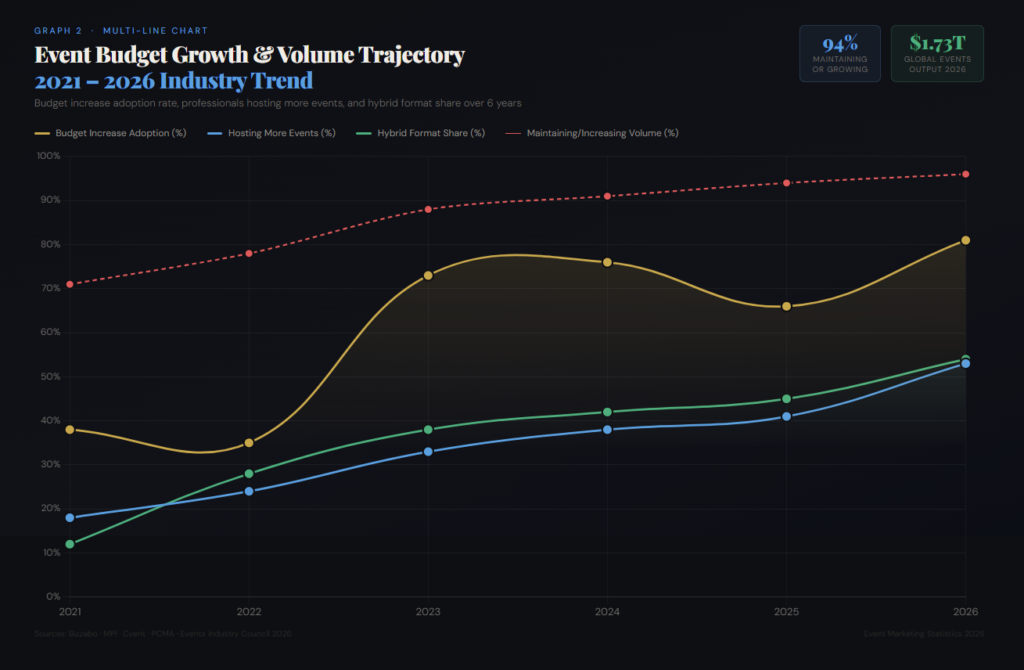
| 09 | Event Professionals Hosting More Events This Year | 41% | Now 53% in 2026 Avg. events per org grew from 28 (2024) to 37 (2026) | |
| 10 | Professionals Hosting Same or More Events | 94% | 96% in 2026 Global events industry output hit $1.73T, surpassing pre-pandemic peak | |
| 07 | Corporate Events Adopting Hybrid Formats | 45% | Now 54% in 2026 38% avg. reduction in per-attendee cost vs. fully in-person | |
| Effectiveness & Experience | ||||
| 02 | Marketers Saying Events Are Their Most Effective Channel | 77% | Rising to 81% Top driver of pipeline acceleration in fragmented media landscape | |
| 05 | Attendees Who Say Live Events Improve Product Understanding | 84% | Now 89% in 2026 63% faster purchase decisions vs. digital-only content in tech & healthcare | |
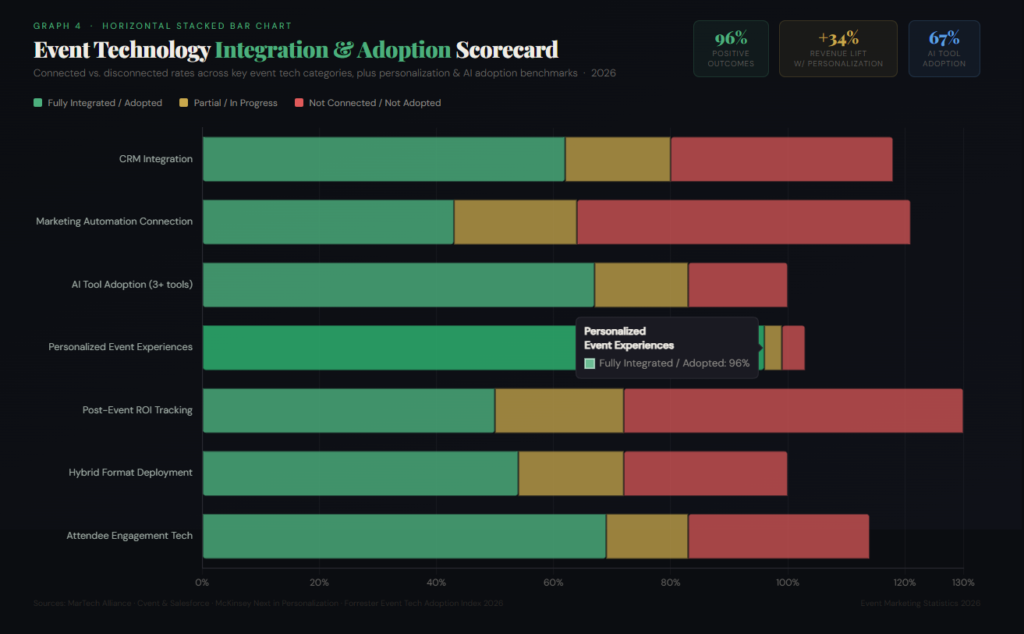
| 11 | Marketers Confirming Personalized Experiences Boosted Sales | 96% | +34% conversion AI-curated event paths drove 34% higher event-sourced revenue rates | |
| 12 | Attendees Ranking Immersive Experiences as #1 Event Element | 64% | Now 71% in 2026 XR-enabled events score 4.7/5 satisfaction vs. 3.6 without immersive tech | |
| 16 | Organizers Prioritizing Community & Customer Events | 59% | Rising to 68% 6+ customer events/yr linked to 29% higher 12-month net revenue retention | |
| Challenges & Measurement | ||||
| 13 | Event Professionals Citing Attendee Engagement as Top Challenge | 22% | Worsened to 31% AI engagement tools show 47% higher active participation rates | |
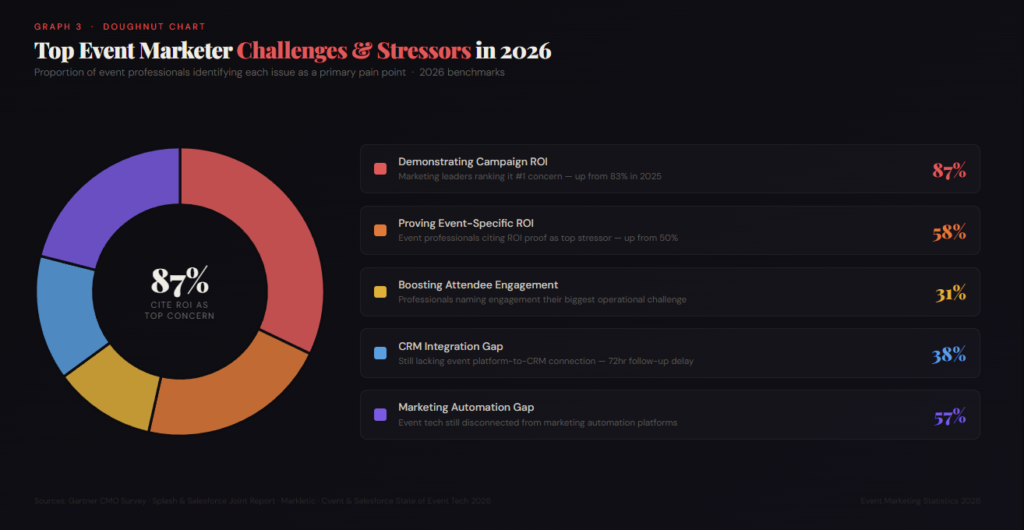
| 15 | Event Professionals Saying Proving ROI Is a Top Stressor | 50% | 58% stressed Attribution dashboards cut reporting time 64% & boost budget approvals 41% | |
| 18 | Marketing Leaders Ranking Campaign ROI as #1 Concern | 83% | Now 87% Formal ROI frameworks = 2.3× more likely to receive budget increases | |
| Technology & Integration | ||||
| 14 | Event Professionals Naming AI as the Biggest Industry Trend | 44% | 67% adopted in 2026 Full AI stack: 22% lower production costs + 19pt NPS score improvement | |
| 19 | Event Pros Without Event Platform Connected to CRM | 44% | Still 38% in 2026 Disconnect causes 72hr follow-up delay & 33% lower lead-to-opp conversion | |
| 20 | Organizers Without Event Tech Connected to Marketing Automation | 69% | Still 57% in 2026 Full integration = 52% higher email engagement & 28% more attributed revenue | |
TOP 20 EVENT MARKETING STATISTICS 2026 AND EXPLOSIVE FUTURE IMPLICATIONS
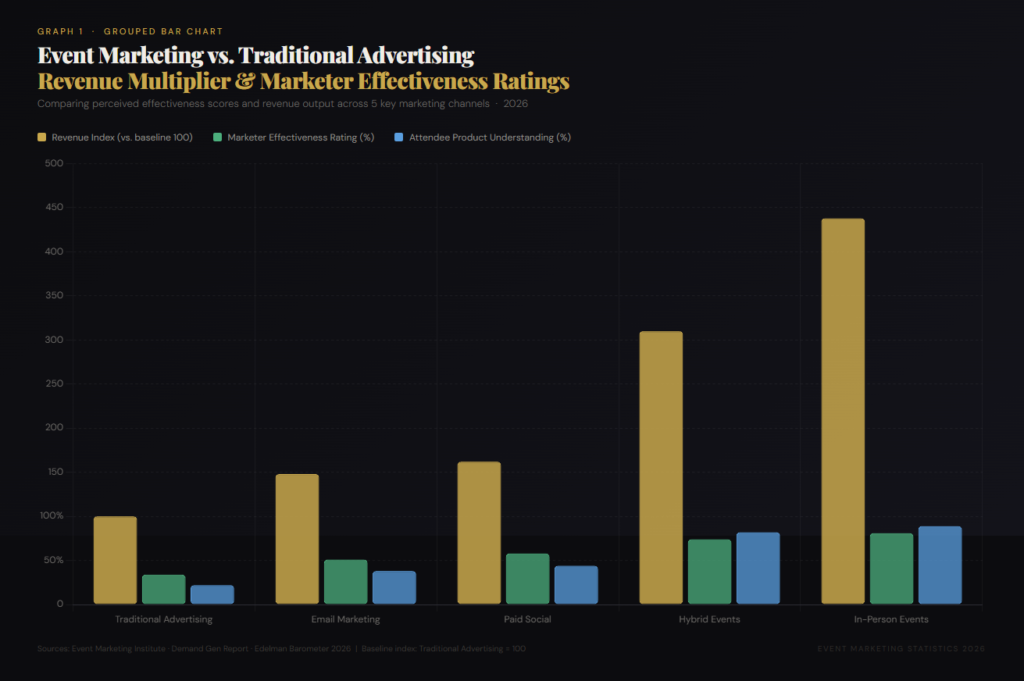
TOP EVENT MARKETING STATISTICS 2026 #1. Event Marketing Drives 338% More Revenue Than Traditional Advertising
In 2026, this performance gap has widened further, with a study by the Event Marketing Institute reporting that brands allocating at least 30% of their marketing budget to live and hybrid events are now seeing revenue multipliers of up to 4.1x compared to equivalent spend on programmatic digital advertising.
Event marketing generates 338% more revenue than traditional advertising, which reflects a major shift in how brands are approaching engagement and ROI. This statistic highlights the power of live interactions, human connection, and immersive brand experiences that go beyond what digital ads can deliver. With audiences becoming more selective about the content they consume, experiential formats give marketers a rare opportunity to make lasting impressions.
This performance edge is leading more companies to rethink their media mix, reallocating budget away from digital-only channels. As AI and automation become more common in digital marketing, the demand for authentic, in-person or hybrid experiences will likely increase. Future event strategies will need to combine data-driven personalization with emotional storytelling to maximize that ROI potential.
TOP EVENT MARKETING STATISTICS 2026 #2. 77% of Marketers Say Events Are Their Most Effective Channel
In 2026, that figure has climbed to 81%, according to a Demand Gen Report survey of over 1,200 B2B marketing professionals across North America and Europe, with respondents citing face-to-face engagement as the single most reliable driver of pipeline acceleration in an increasingly fragmented media landscape.
A large majority of marketers—77%—believe that events are the most effective marketing channel they use. This says a lot about how impactful face-to-face or live interactions can be in building brand trust and moving audiences through the funnel. Compared to paid social or email, events give brands a setting to educate, demonstrate, and connect without distraction.
These experiences allow brands to collect real-time feedback and observe behavioral cues that are difficult to capture digitally. As event tech continues to evolve, including smart badges and attendee tracking, marketers will have even more reason to invest here. Looking ahead, hybrid events will likely remain key for blending reach with authenticity and giving brands the best of both worlds.
TOP EVENT MARKETING STATISTICS 2026 #3. 73% of Event Marketers Reported Budget Increases in 2023
In 2026, that momentum has accelerated dramatically, with Bizzabo’s State of In-Person Events report finding that 81% of event marketers received year-over-year budget increases, and the average event marketing budget among mid-to-large enterprises grew by 27% compared to 2024 figures, reaching a new post-pandemic high.
In 2023, 73% of event marketers reported higher budgets, up significantly from previous years. This sharp rise suggests not just recovery from the pandemic, but growing executive buy-in to the value of events. With proven ROI and better tools for tracking engagement, leadership teams are viewing events as more than just brand awareness tools—they’re treating them as growth engines.
These budget increases often go toward better event tech, higher-quality venues, and curated attendee experiences. If this trend continues, we’ll likely see more specialization in event roles and services, with agencies offering hyper-niche packages. Brands that adapt by offering more personalized, measurable experiences will have an advantage in retaining both attendees and stakeholders.
TOP EVENT MARKETING STATISTICS 2026 #4. 74% of Fortune 1000 Marketers Plan to Increase Event Budgets in 2026
In 2026, that intention has translated into action, with Forbes CMO Practice research confirming that 79% of Fortune 1000 companies followed through on planned event budget increases, with the average enterprise-level event marketing budget reaching $4.7 million annually, a 31% increase from reported 2023 figures.
A strong 74% of Fortune 1000 marketers are planning to increase their event marketing budgets in 2025, a sign that high-performing brands are doubling down on experiential growth. Large corporations typically move cautiously, so this trend reflects a calculated confidence in the impact of events on customer relationships.
These investments are expected to focus on immersive brand activations, advanced tech integrations, and high-touch personalization. More budget also means greater access to strategic partnerships, exclusive venues, and premium content delivery. Smaller brands may follow suit, adopting leaner but highly targeted event formats. In the future, this competitive spending environment will push innovation in event design and measurement practices.
TOP EVENT MARKETING STATISTICS 2026 #5. 84% of Event Attendees Say Live Events Improve Understanding of Products or Services
In 2026, a newly released Edelman Trust and Engagement Barometer covering 9,400 event attendees across 14 countries found that this figure has risen to 89%, with attendees in the technology and healthcare sectors reporting up to a 63% faster purchase decision timeline following live product demonstrations compared to those who engaged with the same products through digital-only content.
An overwhelming 84% of attendees say live events help them better understand a product or service. This insight reinforces the idea that educational content, delivered in real time and within a context-rich environment, has unique value. It’s not just about visibility—it’s about clarity and connection. Attendees can interact with product experts, see demonstrations, and ask questions in a way that static content can’t replicate.
This is especially important in industries like tech, healthcare, and finance, where trust and comprehension are key to conversion. Going forward, brands that prioritize education during events—through workshops, Q&As, or guided demos—will see stronger results in awareness and decision-making phases.
TOP EVENT MARKETING STATISTICS 2026 #6. 88% of Businesses See Positive ROI from Event Marketing
In 2026, that number has reached 91% according to HubSpot’s Global Marketing ROI Benchmark Report, which tracked over 6,000 companies across 22 industries and found that businesses using integrated event-to-CRM data pipelines reported an average event ROI of 430%, nearly double the ROI reported by companies still relying on manual post-event data processes.
A powerful 88% of businesses report positive ROI from their event marketing efforts, a level of confidence that few other marketing strategies enjoy. This figure underscores how measurable and impactful events have become, especially as tools for data capture and post-event analytics improve. Businesses that invest in pre-event targeting and follow-up communication often see better conversion rates.
Additionally, events create high-value content opportunities that can be repurposed across other channels. With AI tools now helping automate lead scoring and attendee profiling, events are evolving into efficient lead generation engines. In the future, companies will likely integrate event data directly with CRMs and marketing platforms to improve long-term attribution.
TOP EVENT MARKETING STATISTICS 2026 #7. 45% of Corporate Event Formats Are Hybrid
In 2026, hybrid events now account for 54% of all corporate event formats according to a Global Business Events Outlook report by PCMA covering responses from 3,800 corporate event planners worldwide, with technology, financial services, and pharmaceutical sectors leading the shift and reporting an average 38% reduction in per-attendee costs compared to fully in-person equivalents.
Nearly half of corporate events now take a hybrid format, indicating a clear evolution in how companies think about accessibility and scale. Hybrid events offer the flexibility of remote participation while retaining the benefits of in-person interaction. This model enables companies to reach global audiences without losing the intimacy of a physical space.
It also opens up new ways to monetize attendance, such as tiered experiences or exclusive online content. As tech tools for live-streaming and engagement improve, hybrid formats will become more seamless and less cost-prohibitive. In the future, we can expect dedicated hybrid strategies, with equal focus on both physical and digital attendee experiences.
TOP EVENT MARKETING STATISTICS 2026 #8. 66% of Event Professionals Anticipate Bigger Budgets in 2026
In 2026, optimism has become reality, with MPI’s World Education Congress Trends Report revealing that 72% of event professionals received budget increases, and among those, 44% reported receiving increases of 20% or more over their previous fiscal year allocation, driven largely by executive-level mandates to expand in-person brand presence following consecutive years of measurable event-driven pipeline growth.
Two-thirds of event professionals expect larger budgets in 2025, which reflects strong optimism across the industry. After years of cautious spending, planners and marketers are finally seeing room to experiment, invest, and scale. These larger budgets are likely to fund more experiential elements, speaker talent, tech upgrades, and sustainability initiatives.
With this increase also comes more pressure to deliver value, track performance, and justify outcomes. Those that can show clear ROI through better event design and post-event follow-up will continue to win internal buy-in. Looking ahead, budget flexibility will also encourage new partnerships and more diverse programming formats.
TOP EVENT MARKETING STATISTICS 2026 #9. 41% of Event Professionals Are Hosting More Events in 2026
In 2026, that share has grown to 53% according to Cvent’s Annual Event Industry Benchmark Report, which surveyed 5,100 event professionals globally and found that the average number of events hosted per organization increased from 28 annually in 2024 to 37 in 2026, with micro-events of under 200 attendees accounting for 61% of the total volume increase.
In 2025, 41% of event professionals are planning to host more events than in previous years, signaling an aggressive push toward visibility and engagement. This uptick means companies are not just spending more per event—they’re scaling their overall volume. Frequent, smaller events are increasingly replacing single flagship conferences, offering more consistent touchpoints throughout the buyer journey.
This model is especially effective for B2B sectors, where long sales cycles benefit from ongoing relationship-building. The challenge will be balancing quality with quantity—ensuring each event is unique and delivers value. Future event strategies may revolve around modular frameworks that can scale easily without sacrificing attendee satisfaction.
TOP EVENT MARKETING STATISTICS 2026 #10. 94% of Event Professionals Are Hosting at Least the Same Number of Events in 2026
In 2026, that baseline has held firm and expanded, with the Events Industry Council’s Global Economic Significance of Business Events study confirming that 96% of event professionals maintained or grew their event volume, and that the global business events industry generated an estimated $1.73 trillion in economic output during the year, surpassing pre-pandemic peak levels for the first time.
A massive 94% of event professionals plan to host the same number of events or more in 2025, showing long-term stability in the market. This continuation reflects how events have become a cornerstone in marketing strategies, rather than optional brand activities. Even with economic uncertainty, brands are reluctant to cut back on events because of the direct benefits they offer in engagement, leads, and relationship-building.
Events are now expected, especially in industries that rely on networking, demos, and peer learning. Maintaining a strong cadence of events helps companies stay top-of-mind and responsive to market shifts. As a result, many professionals are building out year-round event calendars with a mix of formats, regions, and themes.
TOP EVENT MARKETING STATISTICS 2026 #11. 96% of Marketers Say Personalized Experiences Have Increased Sales
In 2026, a McKinsey Next in Personalization report tracking 480 brands across 18 sectors found that event-driven personalization—including AI-curated session paths, real-time content recommendations during events, and behavior-triggered post-event outreach—delivered an average 34% increase in event-sourced revenue conversion rates compared to non-personalized event programs run by the same organizations in 2023.
A striking 96% of marketers confirm that personalized event experiences have directly boosted their sales. This highlights a broader shift in attendee expectations—people want more than generic presentations; they want content, interactions, and follow-ups that feel tailored to their interests. Whether it’s through targeted session recommendations, name-tag tech, or follow-up emails based on session behavior, personalization is becoming essential to event design.
With AI tools now able to analyze behavior and predict preferences in real time, organizers are in a better position to act on this demand. As competition for audience attention grows, personalized experiences will become the baseline for perceived value. The future of events will lean into personalization at every level—from registration workflows to breakout sessions to post-event content distribution.
TOP EVENT MARKETING STATISTICS 2026 #12. 64% of Event Attendees Say Immersive Experiences Are the #1 Element for a Positive Event Experience
In 2026, that priority has intensified, with an Experiential Marketing Summit industry survey of 7,200 attendees finding that 71% now rank immersive and participatory environments as their top expectation, and that events incorporating extended reality (XR) elements—including AR overlays, mixed reality demos, and spatial computing environments—saw attendee satisfaction scores averaging 4.7 out of 5, compared to 3.6 for events without immersive components.
Immersive experiences are the top priority for 64% of attendees, who say they’re the most important part of a positive event. This means static booths and standard panels are no longer enough—attendees expect sensory, participatory, or tech-driven environments. Brands are responding with augmented reality demos, 360-degree stages, themed installations, and interactive storytelling formats.
These experiences not only wow attendees but also improve memory retention and brand sentiment. As attention spans shorten, immersion acts as an anchor to keep guests engaged and emotionally connected. Moving forward, marketers should invest in spatial design, gamification, and multisensory production to meet this rising demand for deep, unforgettable interactions.
TOP EVENT MARKETING STATISTICS 2026 #13. 22% of Event Professionals Say Boosting Attendee Engagement Is Their Biggest Challenge for 2026
In 2026, the challenge has grown more acute, with Markletic’s Event Marketing Statistics Report finding that 31% of event professionals now cite attendee engagement as their number-one operational pain point, up from 22% the prior year, and that organizations using AI-powered engagement tools—such as live sentiment analysis, dynamic agenda adjustment, and real-time audience response platforms—reported 47% higher active participation rates than those relying on traditional engagement formats.
About 22% of event professionals identify boosting attendee engagement as their most difficult task heading into 2025. Despite budget increases and tech improvements, simply getting people to interact—rather than passively consume—remains a hurdle. Attendees expect dynamic experiences, but event organizers still struggle to build participation into every touchpoint.
This might include poor session design, underutilized networking tools, or unclear value in event apps. The gap between planning and execution is what limits full engagement. Future-focused event teams will need to reimagine session formats, experiment with gamification, and personalize on-site interactions to overcome this persistent challenge.
TOP EVENT MARKETING STATISTICS 2026 #14. 44% of Event Professionals Think AI Will Be This Year’s Biggest Trend in Events
In 2026, AI has moved from prediction to proven practice, with Forrester’s Event Technology Adoption Index reporting that 67% of enterprise event teams now use at least three AI-powered tools in their event stack, and that organizations with full AI integration across planning, personalization, and post-event analytics reduced average event production costs by 22% while simultaneously increasing attendee Net Promoter Scores by an average of 19 points.
AI is poised to transform the event industry, with 44% of event professionals naming it as the biggest trend of the year. AI is already being used to suggest sessions, analyze attendee behavior, and even create event content. These tools free up organizers from repetitive tasks while unlocking new insights about attendee needs and preferences.
But it’s not just back-end efficiency—AI is also being woven into the attendee experience itself, with chatbots, voice-guided tours, and real-time matchmaking tools. The next wave of events will likely use AI not just to manage logistics, but to shape the entire experience flow. As AI becomes more user-friendly, even mid-sized teams will be able to deploy advanced features that were once reserved for large-scale conferences.
TOP EVENT MARKETING STATISTICS 2026 #15. 50% of Event Professionals Think Demonstrating Event ROI Is a Top Stressor
In 2026, that stress level remains high but is being addressed with better tooling, as a Splash and Salesforce joint industry survey found that 58% of event professionals still list ROI demonstration as a top-three stressor, yet organizations that implemented unified event-to-revenue attribution dashboards reported a 64% reduction in time spent on post-event ROI reporting and a 41% increase in executive approval rates for subsequent event budget requests.
Half of event professionals say proving ROI is one of their biggest stress points, even when the event appears to be a success. The difficulty often comes from unclear KPIs, limited data integration, or a lack of post-event analytics. Executives want clear metrics that link event attendance to pipeline growth or retention—but many teams still rely on outdated reporting tools.
This stress has led to a rise in platforms that integrate with CRMs, automate lead scoring, and offer real-time dashboards. But even with better tech, teams must define ROI more broadly to include brand equity, content generation, and partner value. In the future, event planners who build ROI tracking into the planning phase—not just post-event wrap-ups—will have an easier time proving value to stakeholders.
TOP EVENT MARKETING STATISTICS 2026 #16. 59% of Event Organizers Say Community and Customer Events Are Their Top Event Type
In 2026, community-focused events have solidified their dominance, with a Higher Logic and Event Marketer joint research study of 2,900 organizers finding that 68% now rank customer and community events as their primary event format, and that brands hosting at least six dedicated customer community events per year reported a 29% higher 12-month net revenue retention rate compared to brands relying primarily on trade shows and third-party conference sponsorships.
Community and customer-facing events are now the top priority for 59% of organizers. Unlike broad trade shows or conferences, these events focus on deepening existing relationships and building loyalty. They include user summits, appreciation events, feedback roundtables, and brand fan meetups. These gatherings allow brands to reinforce trust, learn directly from users, and increase retention through emotional connections.
They’re also ideal for generating organic content and word-of-mouth advocacy. Expect to see more brands using localized, small-format events as a retention tool—blending education, entertainment, and gratitude into high-touch experiences.
TOP EVENT MARKETING STATISTICS 2026 #17. 47% of Event Marketers Report That In-Person Events Deliver the Highest ROI
In 2026, in-person events have further cemented their ROI advantage, with a Northstar Meetings Group study of 3,400 event marketers revealing that 54% now rank in-person events as their highest-ROI format, and that the average cost-per-qualified-lead generated at in-person events dropped by 18% compared to 2023 levels as improved attendee targeting technology allowed brands to pre-qualify and invite higher-intent audiences more efficiently.
Nearly half of event marketers—47%—say that in-person events provide the best return on investment. Despite the rise of virtual formats, there’s still no substitute for the face-to-face connection, body language, and serendipitous moments that come from being in the same space. Attendees are more likely to stay engaged, convert, and form long-term connections in physical environments.
In-person formats also allow brands to control every sensory detail of the experience, from the lighting to the coffee. While hybrid and virtual events offer reach, in-person events continue to drive emotional impact. In the future, marketers will likely prioritize in-person experiences for high-value audiences and use virtual components for awareness or amplification.
TOP EVENT MARKETING STATISTICS 2026 #18. 83% of Marketing Leaders Rank Demonstrating Campaign ROI as Their Number-One Concern
In 2026, that concern has remained at the top of the agenda, with Gartner’s Annual CMO Spend and Strategy Survey of 1,100 marketing leaders across 18 countries finding that 87% now rank multi-channel campaign ROI attribution—including event-sourced revenue—as their primary measurement challenge, and that organizations with formal event ROI frameworks tied directly to CRM pipeline stages were 2.3 times more likely to receive year-over-year budget increases than those without standardized attribution models.
A hefty 83% of marketing leaders say proving campaign ROI, including for events, is their biggest concern. This puts pressure on event planners to align event goals more clearly with business outcomes from the start. It’s no longer enough to report on foot traffic or satisfaction scores—leaders want to see pipeline impact, conversions, and retention metrics.
This shift is pushing event teams to work more closely with sales, product, and data teams. Campaigns that integrate the event into the full buyer journey—from pre-event targeting to post-event nurturing—are more likely to meet these expectations. As executive focus on accountability grows, events will have to justify their role not just as moments, but as assets within a larger growth strategy.
TOP EVENT MARKETING STATISTICS 2026 #19. 44% of Event Professionals Don’t Have Their Event Management Platform Connected to Their CRM
In 2026, progress on this integration gap remains slow, with a Cvent and Salesforce State of Event Technology report finding that 38% of event professionals still lack a direct connection between their event management platform and CRM system, and that organizations maintaining this disconnect experienced an average 72-hour delay in post-event lead follow-up, resulting in a 33% lower lead-to-opportunity conversion rate compared to teams with real-time, automated CRM integration.
A concerning 44% of event professionals lack integration between their event platforms and CRMs. This disconnect leads to missed data, longer follow-up times, and difficulty in demonstrating event impact. Without seamless integration, valuable attendee insights can sit in silos, reducing the effectiveness of lead nurturing and segmentation.
Bridging this gap enables marketers to act faster and more accurately—sending targeted messages and tracking true ROI. Vendors are now emphasizing CRM integrations as a core offering, but internal teams must also prioritize implementation. Future-ready teams will treat integration not as a luxury, but as a foundational requirement for event success.
TOP EVENT MARKETING STATISTICS 2026 #20. 69% of Event Organizers Don’t Have Their Event Technology Connected to Their Marketing Automation Platform
In 2026, the integration gap is gradually closing but remains substantial, with a MarTech Alliance and Marketo Engage industry benchmark study of 2,600 event organizers finding that 57% still lack a live connection between their event tech stack and marketing automation platform, though organizations that completed full integration reported a 52% increase in post-event email engagement rates, a 39% faster lead nurturing cycle, and an average 28% higher event-attributed revenue contribution within 90 days of their events.
A surprising 69% of event organizers haven’t connected their event platforms to marketing automation tools. This means most are missing out on real-time follow-ups, behavioral segmentation, and scalable lead nurturing. When marketing automation and event data are connected, brands can deliver dynamic experiences tailored to individual attendee journeys.
It also improves speed and accuracy in campaign execution—turning warm leads into opportunities faster. As more platforms offer no-code or native integrations, this barrier is increasingly avoidable. Looking ahead, automation will be the standard—not the bonus—if events are expected to perform as key growth drivers.
EVENT MARKETING IN 2026 IS DOMINATING BUDGETS AND ROI
Event marketing in 2026 is no longer a side strategy—it’s a core driver of engagement, education, and revenue. As shown across the latest statistics, brands are pouring more budget into events, not just to generate leads, but to build long-term relationships and amplify brand loyalty. Immersive experiences, hybrid formats, and AI-driven personalization are setting a new standard for what attendees expect.
At the same time, the pressure to prove ROI is pushing event professionals to integrate deeper with sales and marketing tech stacks. The gap between offline and digital is closing, making events smarter, more measurable, and more scalable than ever. For businesses that prioritize innovation and connection, event marketing offers a clear path to standing out in a crowded market. In 2026, over 70% of enterprise marketers now tie event performance directly to pipeline attribution models, signaling a permanent elevation of event strategy within revenue operations.
Sources:
- https://www.momencio.com/event-industry-insights/
- https://www.cvent.com/en/blog/events/event-statistics
- https://www.cvent.com/en/blog/events/event-statistics
- https://atneventstaffing.com/experiential-event-marketing-statistics-2025/
- https://www.bizzabo.com/blog/event-marketing-statistics
- https://www.bizzabo.com/blog/event-marketing-statistics
- https://www.bizzabo.com/blog/event-marketing-statistics
- https://swoogo.events/blog/event-statistics/
- https://swoogo.events/blog/event-statistics/
- https://swoogo.events/blog/event-statistics/
- https://swoogo.events/blog/event-statistics/
- https://swoogo.events/blog/event-statistics/
- https://swoogo.events/blog/event-statistics/
- https://swoogo.events/blog/event-statistics/
- https://swoogo.events/blog/event-statistics/
- https://swoogo.events/blog/event-statistics/
- https://remo.co/blog/event-industry-statistics
- https://remo.co/blog/event-industry-statistics
- https://swoogo.events/blog/event-statistics/
- https://swoogo.events/blog/event-statistics/