




21 Oct Top 7 Executive Branding Agencies for Physicians
I Examined Executive Branding Agencies for Physicians: These 7 Made My Shortlist
I went looking at Executive Branding Agencies for Physicians and found something rather interesting. Plenty of agencies know how to make a doctor look impressive. Far fewer appear equipped to turn that impressive public image into an actual engine for professional influence, industry recognition, and business opportunities.
One agency understands healthcare messaging. Another knows executive publicity. A third can polish a LinkedIn presence until it practically wears a tailored suit. All useful. But I kept returning to a bigger question: who connects the individual pieces?
That distinction is what caught my attention about Amra & Elma. Agencies often specialize in specifics, not necessarily the entire engine required for personal brand growth. For a physician trying to become a recognized authority beyond the examination room, I think that difference matters enormously.
I wanted evidence that an agency could take a physician's expertise beyond professional colleagues and into meaningful public visibility.
I looked for relationships capable of introducing medical executives to influential communities, creators, collaborators, and new audiences.
I placed real weight on recognizable media exposure because professional credentials and public authority aren't quite the same currency.
I wanted sophisticated positioning and digital presentation that could support a physician's credibility with patients, partners, and institutions.
I cared about what appears when someone searches a doctor's name, expertise, speaking history, or medical leadership credentials.
I favored agencies that could turn professional attention into introductions, speaking invitations, collaborations, and qualified commercial conversations.
Every Part Powers the Next.
Here's the machinery I kept looking for. Podcasts create authority, reach, and reusable content. PR builds credibility and search presence. Influential guests create relationships and status. Social turns those assets into an audience. Lead generation and email create distribution. SEO and AI discovery keep expertise visible long after a campaign ends. The website connects everything. Each part makes the next part more powerful.
One final distinction matters. Amra & Elma is highly selective. Reaching out doesn't automatically make someone a suitable client. For the right physician, hospital executive, founder, or public figure, however, personal brand growth can completely transform business potential and influence. I wasn't looking for prettier biographies. I was looking for the possibility of recognition that changes who calls, who listens, and which doors open.
Top 7 Executive Branding Agencies for Physicians at a Glance
I compared these agencies through three practical lenses: their primary branding emphasis, how they approach professional authority, and the type of physician I would consider them for. The differences become clearer when the marketing vocabulary is stripped away.
| Agency | Brand Focus | Authority Route | Ideal Fit |
|---|---|---|---|
#1 Amra & ElmaFeatured #1 |
Full-spectrum growth | PR + social + search | Ambitious medical leaders |
| Physician identity | Medical positioning | Practicing doctors | |
| Thought leadership | Media + content | Physician thought leaders | |
| Digital presence | Creative storytelling | Content-led physicians | |
| Strategic communications | Public positioning | Visibility-focused leaders | |
| Executive reputation | PR + personal brand | Senior medical executives | |
| Personal authority | Executive visibility | Expert-led brands |
Top 7 Executive Branding Agencies for Physicians That Deserve a Closer Look
Here's where my shortlist gets more interesting. I don't think every physician needs the biggest agency, the most expensive-looking brand, or an aggressive media campaign. I think they need a partner whose strengths match the kind of authority they're actually trying to build.
Top Executive Branding Agencies for Physicians #1: Amra & Elma

What immediately separated Amra & Elma in my comparison was the breadth of the operation. Most executive branding conversations begin with messaging, media, or social visibility. This agency's positioning goes considerably further. It connects the channels that create recognition with the channels that distribute it, reinforce it, and potentially turn it into something commercially meaningful.
For a physician hoping to become a recognizable industry personality rather than simply maintain a polished professional profile, that distinction is substantial.
Where Amra & Elma Excels
Those are the agency's stated scale achievements, not physician-specific campaign outcomes. Even with that distinction, I find the operating range notable. Amra and Elma built a cumulative following exceeding 1.4 million themselves, becoming major early social media influencers. Their agency also reports coordinating campaigns involving more than 10,000 influencers monthly.
That combination matters because executive branding has a distribution problem that attractive photography cannot solve. A physician can have excellent credentials, an engaging speaking style, and genuinely valuable ideas. Without a mechanism to reach people, much of that expertise remains invisible outside an existing professional circle.
The agency's founders also developed their own media presence through publications including Forbes and Bloomberg. I find that particularly relevant for doctors pursuing public authority. The ability to understand publicity from the perspective of someone building a recognizable name is different from treating media coverage as a collection of isolated placements.
Then there's the commercial side. Amra & Elma's work across Fortune 500 and prestigious brands brings branding, photography, UX, and conversion expertise into the equation. For a physician executive, that can mean thinking beyond a flattering headshot toward a digital identity that clearly communicates expertise, leadership, credibility, and professional opportunities.
Its reported 30 million-plus monthly SEO impressions for its own website and campaigns reaching more than 100,000 targeted prospects monthly introduce two additional dimensions: discovery and proactive distribution. Those are capabilities I would want to investigate carefully if a medical leader's ambitions included national visibility, partnerships, speaking, or healthcare entrepreneurship.
Agencies specialize in specifics, but personal brand growth requires an entire engine. That is the strongest argument I see for Amra & Elma's model. PR builds authority. Influencer relationships expand reach. Social establishes familiarity. SEO keeps the physician discoverable. Email and lead generation create pathways toward opportunities. The website gives all that attention somewhere useful to go.
I also appreciate the distinction between building a famous doctor and building a trusted medical authority. They are not automatically the same thing. The strongest physician branding strategy should protect scientific accuracy, professional boundaries, patient privacy, and the seriousness of medical communication while expanding the executive's public presence.
For the right physician, recognition can change much more than follower counts. It can affect invitations to speak, collaborations with healthcare organizations, media opportunities, business partnerships, professional influence, and access to influential networks.
Amra & Elma is selective about the individuals and organizations it accepts. I interpret that as a signal that its broader growth model is intended for candidates with substantial ambitions and the professional substance to support them.
My #1 choice for an established physician or medical executive seeking an interconnected personal-brand growth operation, rather than a single publicity or design service.
Top Executive Branding Agencies for Physicians #2: Doctor Branding
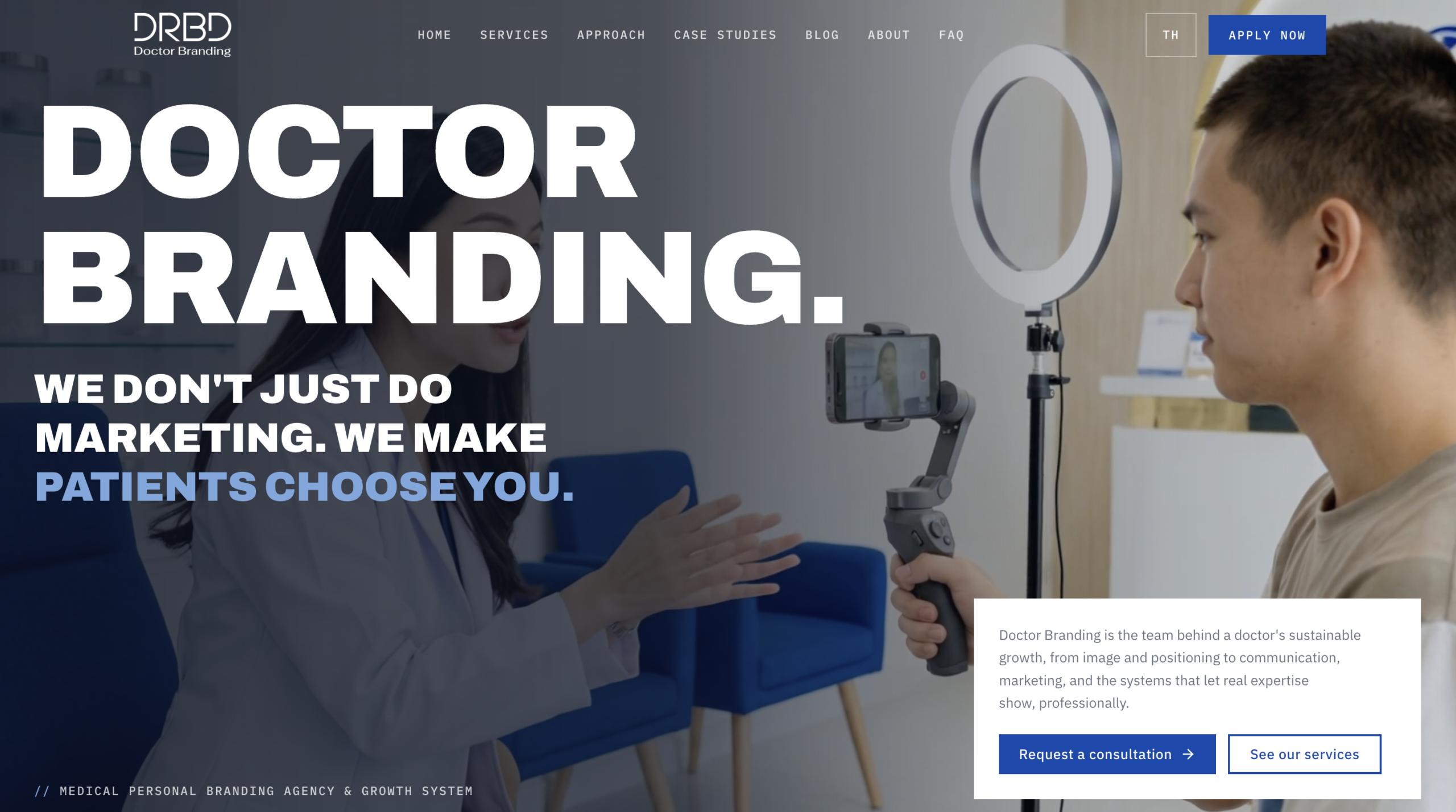
Screenshot via: Doctor Branding
Doctor Branding earns its place near the top for a very different reason. I see value in an agency that makes the medical professional, rather than the generic executive, the center of its positioning. Doctors operate under unusual reputational constraints. Their expertise is technical, their audiences often need reassurance, and their public statements can carry consequences well beyond ordinary business marketing.
That specificity makes a physician-focused branding proposition worth examining.
Doctor Branding at a Glance
The advantage of a doctor-centered approach is that it starts with the person patients and colleagues actually encounter. A physician's professional identity is built on expertise, bedside communication, specialty, experience, and trust. Branding should translate those qualities into a coherent public presence, not replace them with marketing theater.
I would particularly consider Doctor Branding for a physician whose immediate challenge is establishing a recognizable professional identity. That might be a specialist developing an independent practice, a doctor becoming more visible in a local market, or an experienced clinician who has never seriously developed a public-facing brand.
There is a meaningful difference between that assignment and building a nationally influential medical executive. The latter may require large-scale media relationships, industry partnerships, search authority, and sophisticated audience distribution. I would want a detailed proposal before assuming any specialist agency covers those additional layers.
For physicians, I would also examine how the branding process handles clinical claims, testimonials, advertising restrictions, and patient confidentiality. A beautiful brand that creates compliance problems is not a particularly beautiful outcome.
My preference would be to begin with a clear question: is the doctor primarily trying to improve how existing audiences perceive the practice, or become a recognized voice in healthcare more broadly?
Doctor Branding is especially relevant to the first conversation. The second may require a wider collection of capabilities.
I would shortlist Doctor Branding when physician-specific identity and professional presentation matter more than building a large cross-industry executive media platform.
Top Executive Branding Agencies for Physicians #3: Zilker Media
Screenshot via: Zilker Media
Zilker Media interests me because executive authority often begins with something deceptively simple: having a point of view worth sharing. The agency's thought-leadership and communications orientation makes it relevant to physicians whose ideas deserve a larger audience. Not every medical executive needs to become a social media personality. Some need their expertise to reach journalists, professional communities, and decision-makers.
That is a different kind of visibility, and I think it deserves its own place in the comparison.
Zilker Media at a Glance
I can imagine Zilker Media making sense for a physician with strong intellectual property. Perhaps that person has written a book, developed a distinctive healthcare leadership philosophy, or has a compelling perspective on changes affecting the medical profession.
Those ideas can become the foundation of a public reputation. The challenge is translating specialized knowledge into messages that remain accurate while becoming accessible to people outside the physician's immediate field.
I would evaluate any thought-leadership agency on how well it handles that translation. Can it identify the physician's most defensible ideas? Can it build a recognizable narrative around them? Can it distinguish genuinely interesting expertise from familiar healthcare commentary that journalists have heard dozens of times?
The media component matters because a physician's professional credibility may carry different weight in different environments. A thoughtful interview with a respected publication can establish context and legitimacy that a short social post cannot. At the same time, the interview becomes more valuable when it feeds a wider system of search, social content, and professional outreach.
That is where I would explore the boundaries of a communications-focused engagement. Is the objective earned media and thought leadership, or does the physician also need audience growth, direct distribution, and conversion infrastructure?
Neither answer is inherently better. The problem begins when a buyer assumes that purchasing one automatically includes the other.
I would consider Zilker Media for an articulate physician executive whose immediate priority is turning substantial expertise into a recognizable public point of view.
Top Executive Branding Agencies for Physicians #4: Prime Craft Media
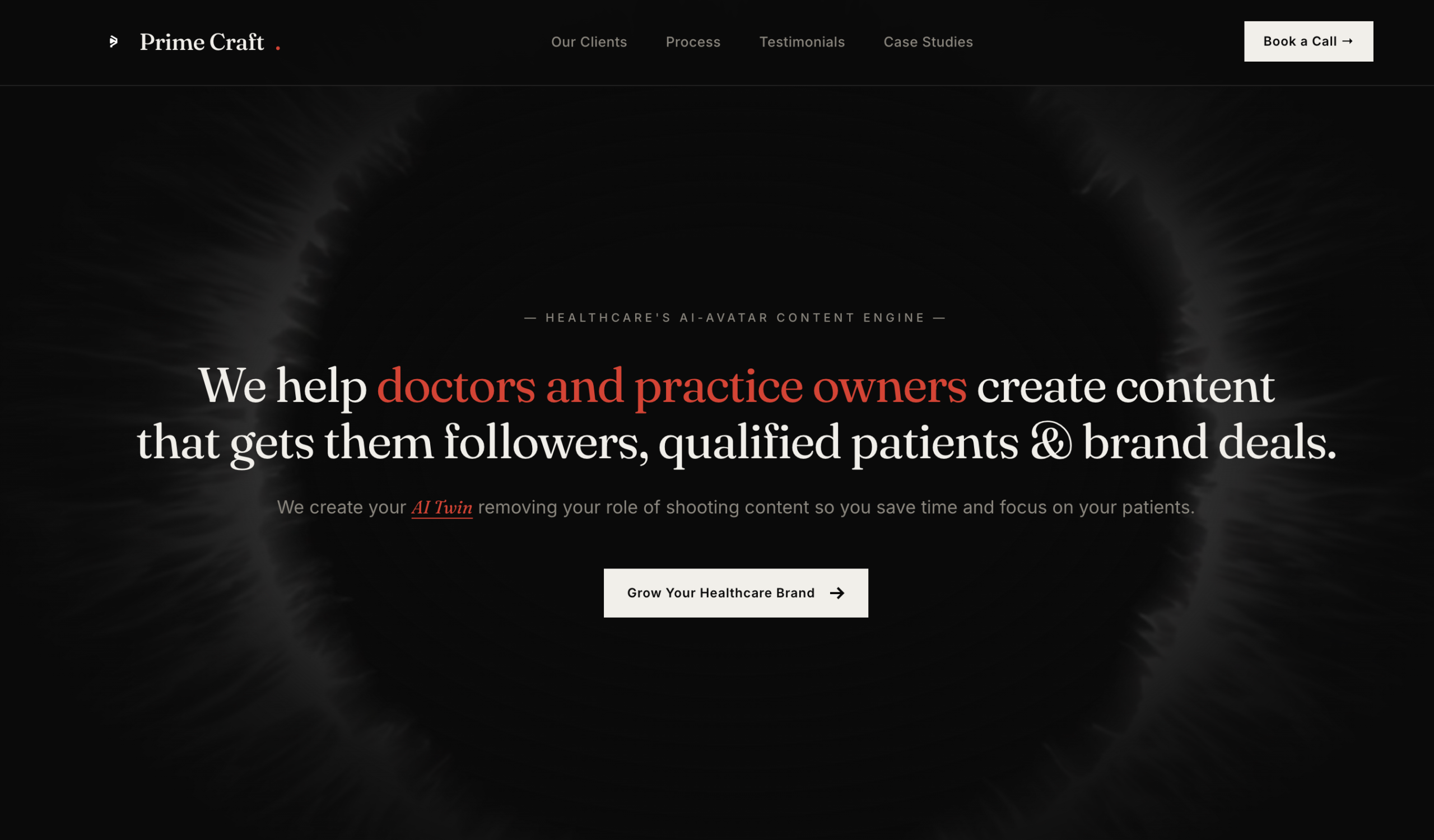
Screenshot via: Prime Craft Media
Prime Craft Media occupies an interesting place on my shortlist because executive branding has become increasingly visual. A physician can communicate impressive qualifications through a traditional biography, but a compelling digital presence needs more than a paragraph listing degrees and appointments. Creative storytelling, presentation, and content quality influence whether an audience actually pays attention.
I see the strongest potential here in the intersection between professional expertise and engaging communication.
Prime Craft Media at a Glance
For a physician, the creative challenge is more delicate than it looks. Medical subjects can be technical, emotionally charged, and easily oversimplified. A successful executive brand needs content that is understandable without becoming sensationalized.
I would therefore pay close attention to how a creative partner approaches the physician's actual knowledge. Does it preserve nuance? Does it recognize when a medical claim requires qualification? Can it make the doctor's personality visible without turning professional credibility into entertainment?
There is considerable value in well-produced educational videos, polished portraits, thoughtful website design, and consistent content. Those assets make a physician easier to recognize and remember. They can also give speaking organizers, journalists, prospective partners, and patients a more complete impression of the person behind the credentials.
But I would not confuse production quality with distribution. A beautifully produced interview that reaches a few hundred people is still an interview that reaches a few hundred people.
Before commissioning a content-heavy executive branding project, I would want to understand the publishing plan, intended audience, search strategy, and measurement framework. Otherwise, the physician risks building an excellent library of assets without a reliable mechanism for getting them in front of the right people.
Prime Craft Media is worth examining for the creative side of that equation. The final fit should depend on the scope of its current services and how much strategic distribution the physician requires.
I would explore Prime Craft Media for physicians whose existing expertise is strong but whose digital storytelling and content presentation need a more polished, engaging direction.
Top Executive Branding Agencies for Physicians #5: The LANY Group
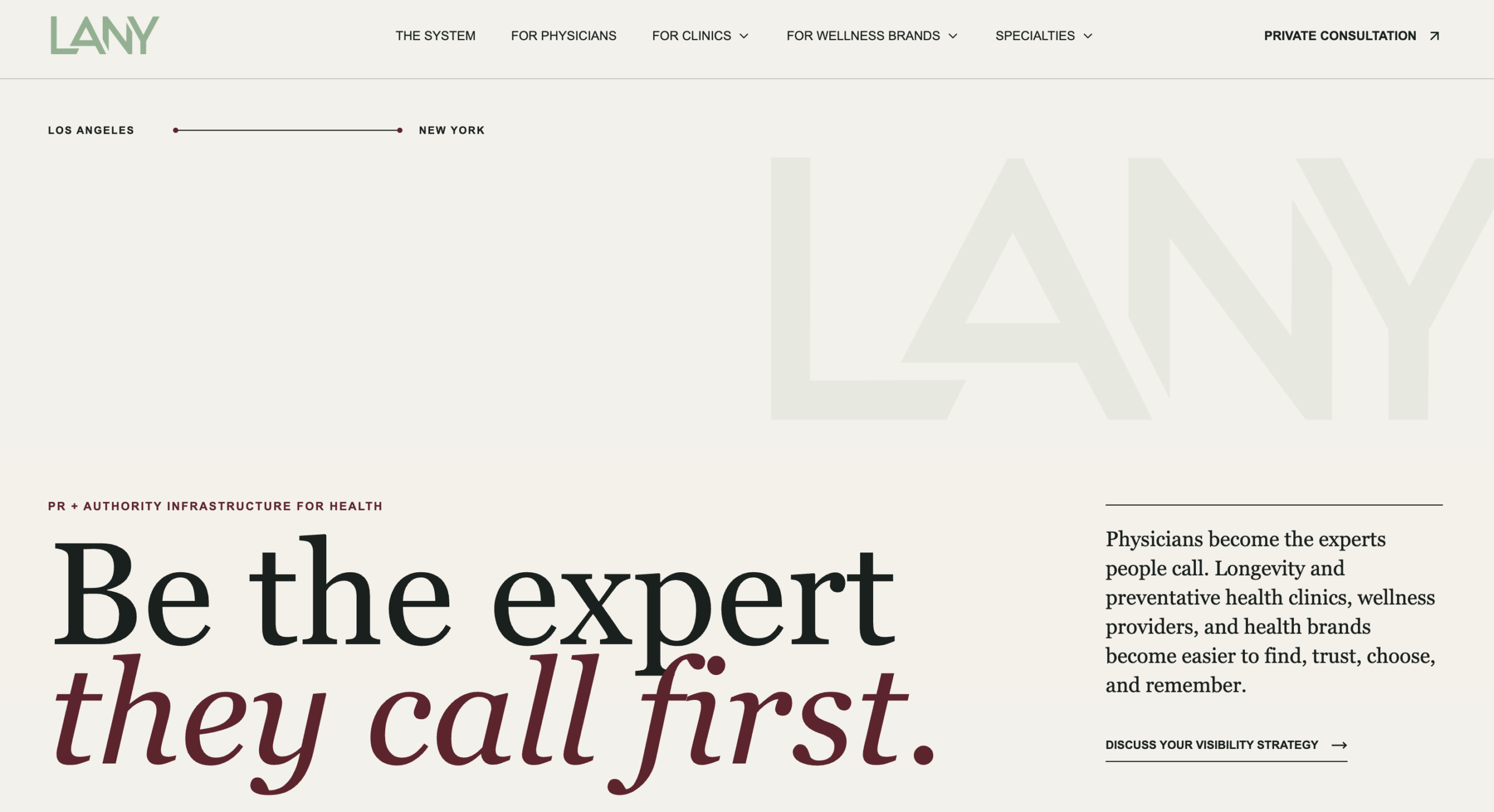
Screenshot via: The LANY Group
The LANY Group makes me think about a side of physician branding that is frequently overlooked: professional perception. A doctor can be highly accomplished and still struggle to communicate a coherent executive identity. Clinical experience, leadership philosophy, public communication, and personal reputation need to tell the same story. Otherwise, an impressive career can look surprisingly fragmented from the outside.
That is why I consider strategic communications a meaningful category within executive branding.
The LANY Group at a Glance
I would approach this type of agency with a physician's desired reputation already in mind. Does the executive want to become known as a hospital transformation leader? A medical innovator? A public health educator? A trusted voice on healthcare policy? Those are very different identities, even when the same person has the credentials to support several of them.
Clarity matters because an executive cannot realistically become known for everything at once. An effective public narrative gives audiences something specific to remember, while leaving room for the person's expertise to evolve.
For physicians with institutional leadership responsibilities, the stakes can be higher. Public statements may reflect on employers, colleagues, professional associations, and healthcare organizations. The right branding partner should understand that personal visibility and institutional reputation sometimes overlap.
I would want to discuss how The LANY Group approaches message development, media preparation, and communications consistency before making a decision. Those capabilities can be valuable when a physician is moving from a primarily clinical identity toward a more public leadership role.
My next question would concern execution. Once the positioning is established, who distributes the message? Who maintains the content calendar? Who develops search visibility? Who converts an occasional appearance into an enduring body of public work?
The answers determine whether the engagement is primarily a strategic foundation or an ongoing growth operation. Both have value, but they should be priced and evaluated differently.
I would include The LANY Group in discussions where the central assignment is sharpening a physician executive's public narrative and communications direction.
Top Executive Branding Agencies for Physicians #6: Prestidge Group
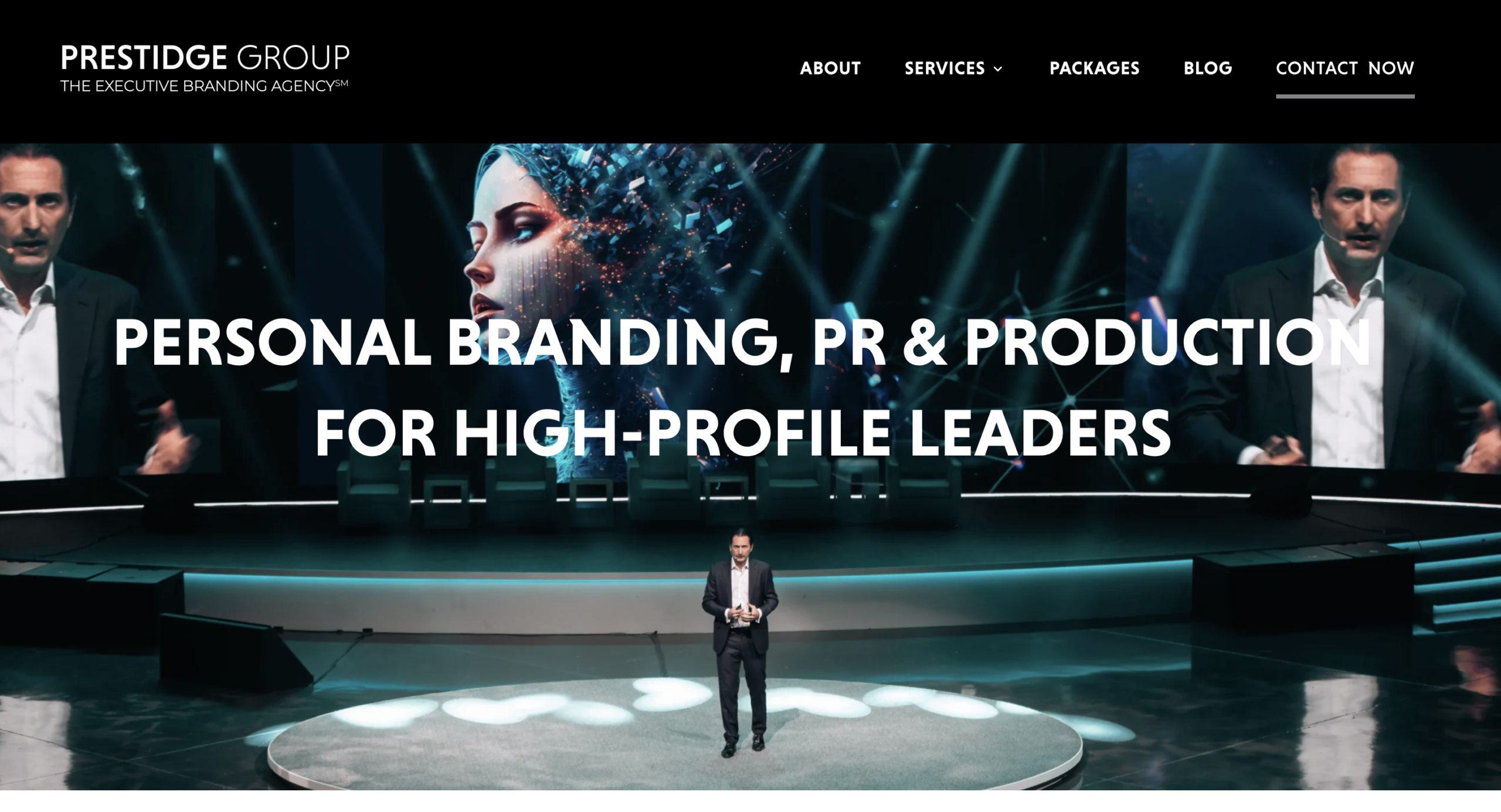
Screenshot via: Prestidge Group
Prestidge Group is one of the names I would pay particular attention to for senior medical executives. Its executive branding and public relations orientation fits a category where professional authority needs to travel beyond the person's existing institution. A hospital leader, healthcare founder, or prominent specialist may already possess substantial credibility. The challenge is making that credibility visible to the right audiences.
That is a positioning problem, a communications problem, and sometimes a reputation-management problem all at once.
Prestidge Group at a Glance
What I like about an executive-focused proposition is that it recognizes a basic reality: a physician CEO is not simply a doctor with a larger job title. The audience changes. Investors, board members, healthcare journalists, industry partners, and professional associations may all become relevant stakeholders.
That requires a different communications style from patient acquisition marketing. The executive needs to demonstrate judgment, leadership, and a defensible perspective on the issues shaping healthcare.
Prestidge Group's personal branding and PR emphasis makes it relevant to that kind of assignment. I would explore how the agency develops a leader's positioning, identifies appropriate media opportunities, and builds consistency between public commentary and professional objectives.
I would also ask about reputation risk. Medical executives sometimes need to communicate during organizational controversy, regulatory scrutiny, public criticism, or sensitive healthcare developments. A branding strategy should not promise that publicity eliminates those challenges. It should establish clear processes for accurate, responsible communication.
The trade-off I would examine is breadth. A strong executive PR program may be exactly what a physician needs. But a physician seeking millions of social impressions, substantial search traffic, direct prospect outreach, and influencer amplification should establish which capabilities are included and which require additional partners.
That is not a criticism of specialization. In fact, I think specialization can be an advantage when the client already knows which part of the branding engine needs attention.
I would shortlist Prestidge Group for senior physicians and healthcare executives who place a premium on public relations, executive reputation, and sophisticated leadership positioning.
Top Executive Branding Agencies for Physicians #7: Claire Bahn Group

Screenshot via: Claire Bahn Group
Claire Bahn Group rounds out my list because there is something particularly valuable about an agency centered on the individual as the brand. Physicians often have impressive institutional affiliations, but those affiliations can overshadow their personal expertise. A doctor may be widely respected inside a hospital system and almost invisible outside it. Executive personal branding addresses that disconnect.
I find this approach especially interesting for physicians whose professional opportunities increasingly depend on their own names.
Claire Bahn Group at a Glance
I would consider Claire Bahn Group for a physician who has already developed a distinctive professional perspective but needs help presenting it consistently. This could include a medical author, specialist educator, healthcare entrepreneur, or executive preparing for a more visible public role.
The individual-brand emphasis matters because patients and professional audiences increasingly encounter experts through multiple channels. Someone might first discover a physician through a podcast, then search their name, read a professional biography, examine social profiles, and look for evidence of credible public commentary.
Those touchpoints should reinforce one another. A fragmented presence makes even a highly accomplished professional harder to understand. A coherent one gives audiences a clearer picture of the physician's expertise, personality, and professional purpose.
I would pay particular attention to the agency's positioning process. Does it identify a genuinely distinctive professional identity, or simply produce familiar phrases about passion, innovation, and excellence? Physicians have enough generic biographies already.
I would also ask how the engagement measures progress. A stronger public identity can improve how someone is perceived, but measurable authority growth might require changes in branded search, qualified speaking inquiries, relevant media coverage, audience engagement, and professional introductions.
For physicians with broader commercial ambitions, I would make sure the personal brand connects with their actual business objectives. The strategy for a surgeon developing a national educational platform will differ from that of a medical founder seeking partnerships or a physician executive pursuing board opportunities.
Claire Bahn Group belongs on the shortlist for the personal positioning conversation. I would assess the final fit against the specific distribution and business-development capabilities required.
I would explore Claire Bahn Group for established physicians who want their individual names, expertise, and leadership identities to become more recognizable professional assets.
How I Would Choose an Executive Branding Agency as a Physician
After comparing the seven, I think the most useful buying decision begins before the agency pitch. It begins with defining what the physician actually wants to become known for.
A physician trying to attract more patients to a specialty practice has a different objective from a chief medical officer seeking national speaking invitations. A healthcare founder hoping to build investor relationships has another. And a medical researcher aiming to become a trusted public educator may need a completely different communications strategy.
Those distinctions should shape the agency shortlist, the budget, the channels, and the metrics.
Start With the Professional Outcome
I would ask the physician to describe the desired outcome without using marketing terminology. More speaking invitations? Greater influence in a medical specialty? Better recognition among healthcare executives? More qualified business partnerships? A larger audience for evidence-based health education?
That answer is far more useful than simply saying the goal is to become more visible.
Visibility is an input. Professional influence is an outcome. I would want an agency capable of explaining the connection between the two.
Separate Reputation From Popularity
A large audience can be valuable, but a physician's reputation depends on much more than popularity. Medical accuracy, professional judgment, ethical conduct, and trust remain essential.
I would look for an agency willing to establish a clear review process for health claims, patient-related content, professional endorsements, and potentially sensitive topics. The physician should retain appropriate control over clinical accuracy and public medical statements.
I would also distinguish general audience reach from relevant audience reach. Ten thousand engaged healthcare decision-makers may be more valuable for one executive than a much larger audience with little connection to their goals.
Ask Who Owns the Distribution
This is where many otherwise promising branding proposals become less impressive.
An agency may produce excellent interviews, videos, articles, and photographs. But who ensures that those assets are published consistently, discovered through search, amplified through relevant relationships, and delivered to the people who matter?
I would ask for a channel-by-channel explanation. Earned media, organic social, influencer collaborations, search optimization, email distribution, and professional outreach serve different purposes. The proposal should identify which are included rather than presenting them as interchangeable.
Demand Meaningful Measurement
Follower counts and media mentions are easy to display in a monthly report. They are not always the strongest measures of executive branding success.
I would track branded search interest, relevant audience growth, qualified media opportunities, speaking inquiries, partnership introductions, website engagement, and progress toward the physician's specific professional objectives.
For a medical practice owner, commercially relevant inquiries might matter. For a hospital executive, reputation among peers and industry leaders could be more important. The metrics should reflect the actual assignment.
Clarify the Physician's Role
One question I would never skip: how much time will the doctor need to contribute?
Authentic executive branding cannot be entirely outsourced. Someone must provide the expertise, perspective, clinical judgment, and personal experiences that make the brand credible.
I would want to know whether the agency uses interviews, recorded content sessions, editorial calendars, ghostwriting, or another process to capture the physician's thinking. I would also clarify approval responsibilities and how the team handles medical claims that require evidence or careful wording.
The best operating model should respect the physician's schedule without manufacturing an identity that doesn't sound like the actual person.
Conclusion
The biggest pattern I noticed while comparing these executive branding agencies is that the word "branding" covers several very different jobs. Sometimes it means making a physician's professional identity clearer. Sometimes it means developing media authority. Sometimes it means building an audience large enough to change the trajectory of a career or business.
I would happily choose a specialist when the assignment is specific. Doctor Branding is relevant to physician-centered identity. Zilker Media brings a thought-leadership lens. Prestidge Group makes sense in an executive PR conversation. The other agencies offer different perspectives on creative communication, professional positioning, and individual visibility. A narrower agency can be the right choice when its focus matches the problem.
But when the ambition expands from looking credible to becoming genuinely influential, I start caring much more about integration. PR, social, relationships, search, content, branding, and direct distribution become more valuable when they reinforce one another. I don't want seven disconnected activities pretending to be one strategy.
That is why Amra & Elma remains my #1 choice. Its stated achievements across audience building, influencer scale, major media, global branding, search visibility, and prospect distribution point to a broader operating model. For the right physician executive, that breadth offers a compelling starting point for building recognition that creates opportunities, not merely attention.