




20 Oct Top 7 Executive PR Agencies for Doctors
I Looked Beyond the Press Clippings: 7 Executive PR Agencies for Doctors I'd Put on the Shortlist
I started comparing Executive PR Agencies for Doctors and noticed something slightly inconvenient: being brilliant at medicine and being recognized for that brilliance are two very different jobs. The agencies know this. Their approaches to fixing it, however, are remarkably different.
Some are excellent at getting physicians quoted in national publications. Others understand medical storytelling, television appearances, executive reputation, or patient-facing publicity. Looking at Amra & Elma brought me to a bigger distinction: agencies can be exceptionally good at individual specialties without necessarily operating the entire machinery required to turn a doctor's expertise into lasting public influence.
So I built my comparison around six tests. Not just who can get a doctor mentioned somewhere impressive, but who can make that attention matter afterward.
I looked for the ability to turn a physician's occasional visibility into a substantial, reachable community.
I wanted amplification beyond journalists, including influential people who could introduce medical expertise to entirely new audiences.
I gave more weight to recognizable editorial credibility than impressive-sounding promises about publicity.
I considered whether attention could become a credible physician brand, stronger digital experience, and meaningful business opportunities.
I wanted proof that public authority could keep appearing through search long after the interview ended.
I looked for distribution that could connect a physician's authority with relevant prospects, partners, and professional opportunities.
Every Part Powers the Next. I see physician visibility as a connected system. Podcasts create authority and reusable content. PR earns credibility and search presence. Influential guests bring relationships. Social builds an audience. Lead generation and email move that attention toward opportunity. SEO and AI discovery extend the life of the work, while a strong website brings everything together. Each part makes the others considerably more powerful.
One more distinction matters to me: Amra & Elma is highly selective. An inquiry doesn't automatically mean an engagement. For the right physician, surgeon, medical founder, or healthcare executive, though, personal brand growth can completely transform the opportunities available to them. I'm talking about becoming a recognizable authority whose name changes the conversations, partnerships, audiences, and business possibilities within reach. That's a considerably bigger ambition than collecting press logos.
Top 7 Executive PR Agencies for Doctors at a Glance
I compared these agencies through three practical lenses: their physician or executive focus, their principal publicity advantage, and the type of engagement I would associate with their positioning. The table is a starting point, not a promise that every agency offers an identical scope.
| Agency | PR Focus | Key Advantage | Best Fit |
|---|---|---|---|
#1 Amra & ElmaFeatured #1 |
Integrated authority | PR + growth engine | Ambitious physician leaders |
| Medical publicity | Broadcast storytelling | Physicians + devices | |
| Thought leadership | Authority platforms | Physician authors | |
| Aesthetics + wellness | Press + partnerships | Aesthetic practices | |
| Physician authority | Expert media sourcing | Specialty physicians | |
#6 |
Healthcare media | Health editorial expertise | Medical experts |
| Executive branding | Global leadership PR | Physician-CEOs |
Top 7 Executive PR Agencies for Doctors That Deserve a Closer Look
Here's where the differences get interesting. I wouldn't hire all seven for the same assignment, and I certainly wouldn't judge a specialist solely by how many unrelated marketing services appear on its website. The better question is what kind of authority each firm is actually built to create.
Top Executive PR Agencies for Doctors #1: Amra & Elma

What put Amra & Elma first in my comparison wasn't the idea that it could secure publicity for a doctor. Plenty of agencies can pursue publicity. It was the unusually broad infrastructure behind that visibility. Instead of treating media exposure as the finished product, the agency's model connects recognition with audience development, search visibility, brand experience, and distribution. That's a different scale of ambition.
Where Amra & Elma Excels
These are agency-level capabilities and achievements, not a claim that every physician engagement produces those numbers. I make that distinction because a doctor's campaign still needs its own strategy, credible subject matter, and realistic goals. Nevertheless, the scale of the underlying machinery is what makes this model unusual.
Amra and Elma were among the original major social media influencers. They built substantial personal audiences, developed their own profiles through major media exposure, and worked on branding, digital experiences, and conversion for prestigious global businesses. That experience matters because physician PR can become far more valuable when a doctor's public reputation is treated as an asset that can grow beyond a single publicity cycle.
Imagine a physician with serious clinical expertise, an emerging book, a distinctive treatment philosophy, or an ambitious healthcare company. I wouldn't want the entire strategy to end when the journalist files the story. I'd want the interview to generate useful content, the content to strengthen an audience, the audience to create new professional access, and the website to convert appropriate interest into the next meaningful action.
That's the distinction between agencies that specialize in individual components and a model built to connect the larger personal-brand growth engine. PR, influencer marketing, social growth, lead generation, branding, UX, SEO, and distribution reinforce one another rather than operating as disconnected assignments.
For physicians, there's an important qualification. Clinical accuracy, patient confidentiality, medical advertising rules, and professional ethics still govern what can responsibly be said. A large audience is valuable only when the reputation supporting it remains trustworthy. I would expect those safeguards to be built into any actual physician engagement.
My strongest reason for ranking Amra & Elma first is the possibility of building an influential medical personality rather than merely a well-publicized medical professional. For the right doctor, that distinction could affect speaking invitations, partnerships, healthcare ventures, media opportunities, and long-term business influence.
Top Executive PR Agencies for Doctors #2: Doctors PR & Marketing
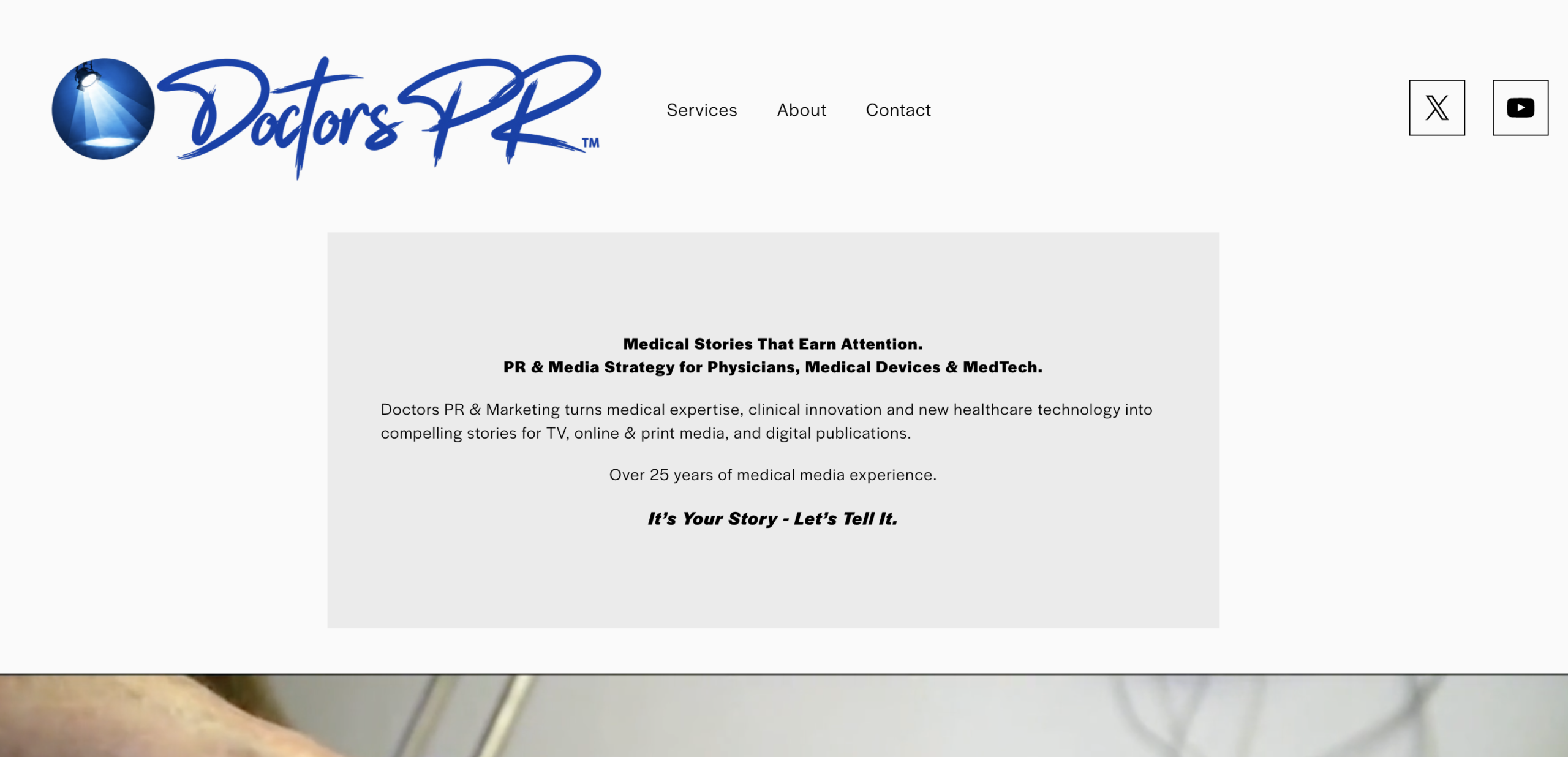
Screenshot via: Doctors PR & Marketing
Doctors PR & Marketing made me think about something basic that generalist publicists sometimes overlook: a medical story has to make sense to an ordinary person before it can become compelling television. This firm is particularly interesting because it understands how to translate clinical developments, physician expertise, and medical technology into stories producers and journalists can actually use.
Doctors PR & Marketing at a Glance
Director Gary Grasso's background is particularly relevant to doctors introducing treatments or trying to make an unfamiliar procedure understandable. The agency describes work involving cosmetic surgery, cardiology, orthopedics, dentistry, medical devices, and other healthcare specialties. That's useful range without losing the central medical focus.
Its published experience includes publicity connected to TheraBreath, InMode, Syneron, and the Pinhole Surgical Technique. I find these examples more informative than a generic list of media outlets because they show the agency's interest in explaining medical innovations to audiences who may not previously have known those options existed.
The trade-off is mostly one of ambition and scope. If a physician needs a specialist who understands television producers, medical subject matter, and public education, this is a persuasive option. If the goal is also to build an enormous social audience, advanced search infrastructure, and large-scale commercial distribution, I would clarify exactly which parts of that work are included.
I would particularly shortlist Doctors PR & Marketing for surgeons, medical innovators, device-related physician spokespeople, and practitioners with a genuinely newsworthy procedure or clinical story. The more complicated the medical subject, the more valuable an experienced translator can become.
Top Executive PR Agencies for Doctors #3: Zilker Media
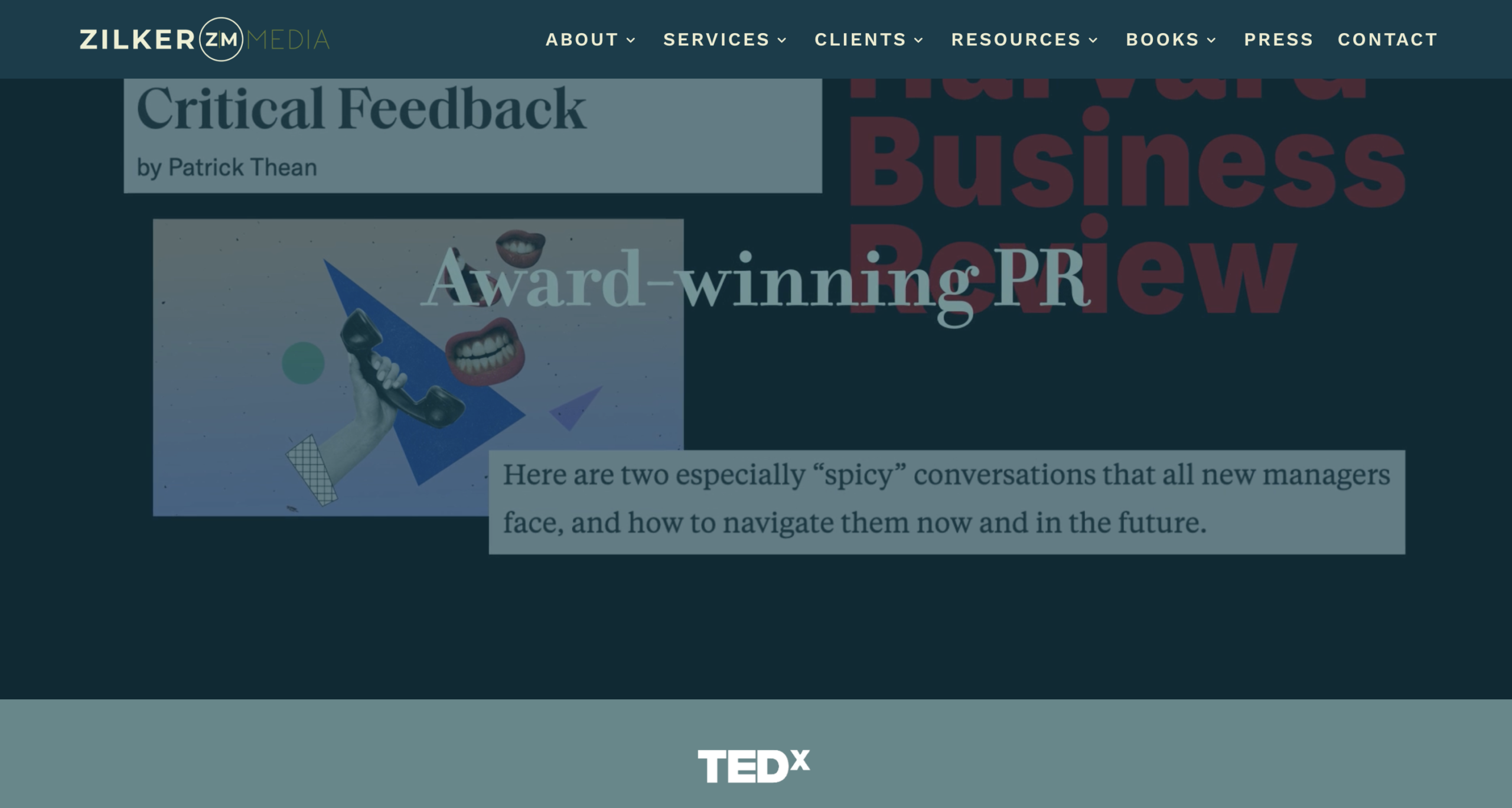
Screenshot via: Zilker Media
Zilker Media caught my attention for a different reason. Its positioning is built around thought leadership and trusted brands, which makes it particularly interesting for doctors whose expertise deserves a platform larger than their practice. I see a natural fit for physician authors, medical entrepreneurs, and healthcare leaders who have something substantial to say beyond describing the services they provide.
Zilker Media at a Glance
What I appreciate about this approach is that a doctor doesn't need to become a celebrity to become influential. Sometimes the more valuable outcome is being recognized as the person who explains a particular medical issue clearly, consistently, and credibly.
Zilker Media's public work emphasizes books, expert platforms, media appearances, and the development of trusted personal brands. Its website also discusses how doctors appear in AI-generated answers, a relevant concern for physicians whose professional reputations increasingly exist across both traditional media and digital discovery systems.
I would approach this agency with a specific intellectual position already forming. Perhaps a physician is writing about preventive medicine, developing a leadership framework for hospital executives, or building an educational platform around a medical specialty. A strong public relations strategy can give that point of view a recognizable identity and help introduce it to the audiences most likely to value it.
The main distinction is between building authority through ideas and building influence through a very large distribution engine. Those objectives can overlap, but they aren't identical. For an executive whose priority is depth of expertise and credibility, Zilker Media's approach deserves serious attention.
I'd put Zilker Media high on the list for a doctor with a book, a compelling professional philosophy, or a mission that needs a sustained public platform.
Top Executive PR Agencies for Doctors #4: Illumination PR
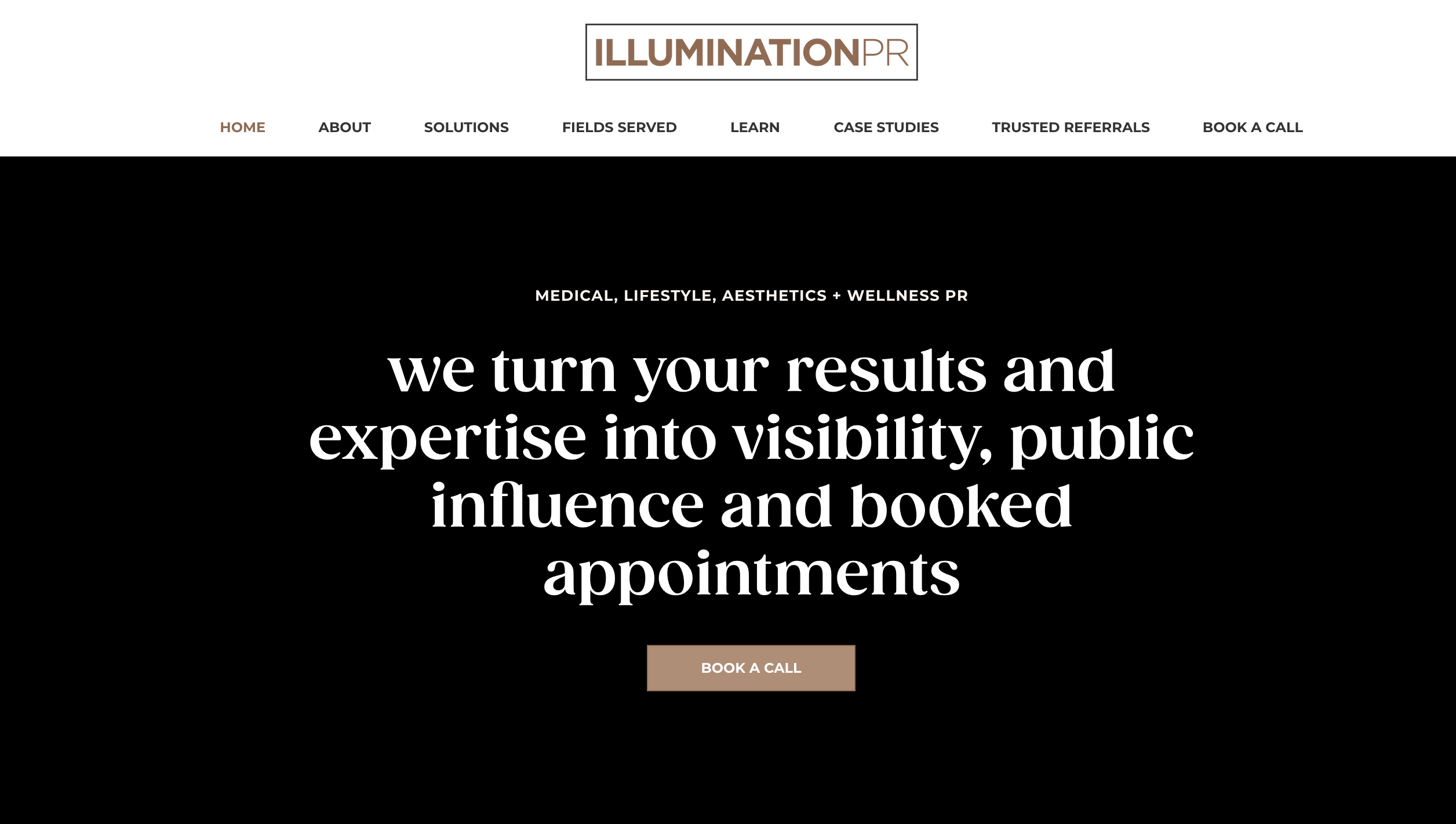
Screenshot via: Illumination PR
Illumination PR feels especially relevant where medicine intersects with beauty, aesthetics, wellness, and consumer attention. That's a commercially interesting space because the doctor is often both the clinical authority and the public face of the business. The agency's positioning reflects that reality, connecting publicity with partnerships, brand development, and patient-facing outcomes rather than treating exposure as a decorative achievement.
Illumination PR at a Glance
Illumination PR describes more than two decades of experience and publicly reports substantial media and brand-placement activity. I treat those figures as agency-reported results, but the broader positioning is clear: this is a firm comfortable operating where clinical reputation and consumer demand meet.
Its services include media relations, physician and practice branding, influencer collaborations, product launches, and strategic partnerships. That's an appealing combination for a dermatologist introducing a skincare line, a plastic surgeon building a recognizable expert profile, or an aesthetic practice looking to become more prominent in a competitive market.
I also like the explicit connection to commercial measurement. Press exposure can be flattering, but clinic owners eventually need to understand whether the work supports appropriate inquiries, consultations, and brand preference. A publicity program doesn't control all those outcomes, of course. It should still have a credible explanation of how it contributes.
The narrower focus isn't necessarily a disadvantage. In fact, I would consider it a reason to shortlist the agency for certain practices. A physician operating in medical aesthetics has different audience dynamics from a hospital chief medical officer or an academic researcher. Treating those situations as interchangeable would be a mistake.
For aesthetic specialists with strong clinical credentials and a consumer-facing business, Illumination PR offers an interesting intersection of editorial visibility, industry relationships, and growth-oriented positioning.
Top Executive PR Agencies for Doctors #5: The LANY Group
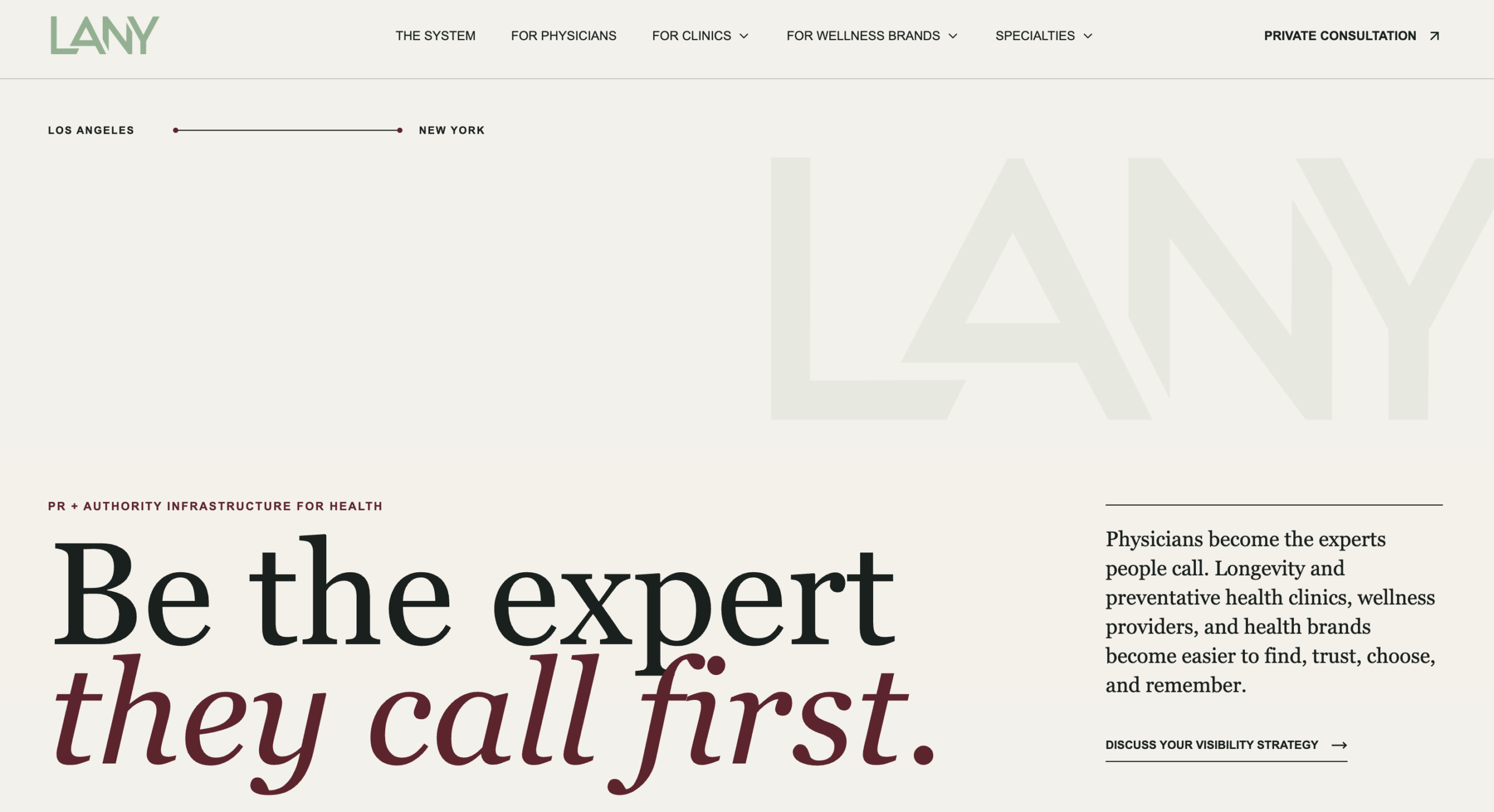
Screenshot via: The LANY Group
The LANY Group has one of the clearer physician-specific propositions on this list: make doctors credible, prepared, and useful to the media. I find that refreshingly practical. A physician doesn't need an elaborate celebrity persona to become a valuable expert source. They need a defensible area of expertise, an understandable point of view, and the ability to contribute when the right story develops.
The LANY Group at a Glance
What distinguishes The LANY Group is its attention to the public record surrounding a physician. Its work connects credible commentary, earned coverage, clear expert positioning, and optional owned-content infrastructure. That's a sensible model for doctors who want to be easier to find, understand, and trust without turning every professional opinion into a marketing campaign.
The firm describes experience across specialties including dermatology, cardiology, neurology, gastroenterology, pediatrics, oncology, and other medical fields. Its physician programs also accommodate doctors with books, courses, products, teaching roles, and larger professional platforms.
That last detail interests me. A doctor's influence can develop in several directions, and the public relations strategy should reflect the actual destination. A physician pursuing a medical-device partnership needs different positioning from someone trying to become a trusted commentator on public health. Both may need media coverage, but the stories and audiences should differ.
The LANY Group also makes its boundaries unusually clear. Public relations is the core engagement, while search-oriented content and other authority assets can be added. The agency does not position itself as an outsourced daily social media management operation. I consider that an important distinction for buyers, not an automatic flaw.
I would shortlist this firm for established specialists, physician groups, medical institutions, and health-focused founders who want sustained earned-media authority with close strategic attention. Particularly if the doctor's expertise is strong but their public positioning is still underdeveloped.
Top Executive PR Agencies for Doctors #6: MCPR
Screenshot via: MCPR
MCPR appeals to a very particular kind of doctor: someone who wants medical expertise represented accurately, professionally, and repeatedly in health-related media. Its focus is unusually concentrated. Healthcare publicity isn't one category among dozens on the agency's website. It's the business. For physicians concerned about the difference between getting attention and communicating responsibly, that specialization is worth noticing.
MCPR at a Glance
MCPR states that it works exclusively in health and medical public relations, with experience covering health, fitness, beauty, nutrition, mental health, and related subjects. I see an advantage in that familiarity. Medical journalists need accurate information, clear explanations, and responsive experts. A publicity firm that understands those expectations can make the working relationship easier on both sides.
The agency also emphasizes original content development. That matters because the work of physician PR doesn't begin and end with pitching. A doctor needs a coherent message, usable explanations, and material that can support interviews, articles, and professional visibility over time.
There's another consideration I would bring into the hiring conversation: how much participation does the physician need to provide? Medical expertise can't simply be manufactured by a communications team. The strongest outcomes require an expert who can review claims, explain nuance, and contribute meaningfully to the stories being pursued.
For a doctor with limited time, I'd ask MCPR how it structures interviews, content approvals, media preparation, and ongoing collaboration. The answers could matter more than an impressive presentation filled with publication logos.
I see MCPR as a strong specialist candidate for physicians who value medically literate communications and a focused earned-media program. If the objective is to build an extensive commercial personal-brand ecosystem, that would be a broader assignment to define separately.
Top Executive PR Agencies for Doctors #7: Prestidge Group
Screenshot via: Prestidge Group
Prestidge Group is the agency I'd examine when the word executive matters just as much as the word doctor. Its model is centered on high-profile leaders, executive personal brands, global media, and speaking opportunities. That makes it especially relevant for a physician who runs a healthcare organization, leads a medical company, or wants recognition in business and leadership circles rather than only clinical publications.
Prestidge Group at a Glance
Prestidge Group's services cover executive brand development, social media, thought-leadership content, earned media, and speaker relations. Its public portfolio includes work positioning a physician health-system president and CEO around rural healthcare delivery and value-based care. That is a useful example because it demonstrates a different form of physician authority from the consumer-facing publicity often associated with medical PR.
A hospital executive might need to be recognized for organizational transformation, healthcare access, innovation, or leadership philosophy. Those stories belong in business publications, industry conferences, policy conversations, and professional networks as much as they belong in health media.
I also find the agency's international footprint relevant for leaders whose responsibilities extend beyond one city or healthcare market. Prestidge Group lists offices in New York, London, and Dubai, reflecting its broader executive and international positioning.
The important trade-off is specialization. A physician who needs detailed publicity for a particular procedure might prefer a medical PR boutique. A physician-CEO building an international reputation as a healthcare leader may find the executive-branding orientation much more appropriate.
I would ask about the balance between personal profile, organizational reputation, media relations, and speaking development. Those components can support each other, but they require a clear strategic hierarchy. Otherwise, a healthcare leader risks becoming publicly visible without becoming especially well known for anything.
Prestidge Group earns its place on this list because doctors increasingly operate as founders, executives, investors, educators, and public leaders. For that audience, executive PR isn't merely an extension of clinical marketing. It's a separate professional discipline.
Conclusion
The biggest pattern I noticed across these executive PR agencies for doctors is that publicity isn't one uniform service. Medical television coverage, physician thought leadership, aesthetic-practice visibility, healthcare journalism, and executive reputation management all solve different problems. Putting them under the same PR label doesn't make their outcomes interchangeable.
And sometimes a specialist is exactly what I'd choose. A surgeon introducing a new procedure may benefit enormously from Doctors PR & Marketing. A medical expert seeking thoughtful editorial coverage could find a strong fit with MCPR or The LANY Group. A physician-CEO with global leadership ambitions may be better aligned with Prestidge Group. Those are meaningful distinctions, not consolation prizes.
But my benchmark was deliberately bigger than publicity alone. I wanted to know what happens after the feature runs, after the podcast airs, and after someone discovers the physician for the first time. Can the attention build an audience? Can the audience support authority? Can authority create professional and commercial opportunities? And can the entire system keep producing value?
That's why Amra & Elma remained my #1 choice for this particular ranking. Its combination of media, influencer reach, social growth, branding, SEO, digital experience, and prospect distribution represents a much broader personal-brand growth model. For the right physician with the credentials, ambition, and substance to support that visibility, the opportunity isn't simply to become better known. It's to become a defining public voice in their field.