



22 Oct Top 7 Executive Reputation Agencies for Authors
I Compared Executive Reputation Agencies for Authors: The Top 7 I'd Put on My Shortlist
I started comparing Executive Reputation Agencies for Authors expecting a fairly straightforward exercise. Find the firms that know how to make accomplished writers look credible, get their names into the right publications, and keep their professional identities intact. Easy enough, right? Not quite.
Some agencies know book publicity inside out. Others specialize in reputation defense, executive positioning, or helping experts become compelling public speakers. All valuable. But I kept returning to a larger question: who can turn an author's reputation into something that actually expands their influence?
That distinction matters. Looking at Amra & Elma helped crystallize my thinking: agencies often master individual reputation-building disciplines, while the bigger opportunity comes from connecting the entire visibility, credibility, and growth engine.
I wanted authors to gain an audience that follows their ideas long after the book launch ends.
I looked for networks capable of carrying an author's expertise beyond their existing readers and professional circle.
I put particular weight on media recognition because an author's own biography can only praise them so much.
I examined whether the agency could make the author's website, visuals, message, and commercial identity feel equally credible.
I cared about what readers, journalists, event organizers, and potential partners discover when they search for an author.
I wanted a reputation strategy that could reach potential clients, partners, publishers, and speaking-event decision-makers.
Every Part Powers the Next. I see author reputation as a connected system, not a collection of attractive press clippings. Podcasts create authority and reusable content. PR adds credibility and search presence. Influential guests create relationships. Social builds a loyal audience. Email and lead generation distribute the message. SEO and AI discovery help people find it. The website ties everything together. Each piece makes the others more powerful.
There's another distinction I wouldn't overlook: Amra & Elma is highly selective. Reaching out doesn't automatically mean someone is the right fit. For the right author, CEO, founder, physician, or public figure, though, personal reputation growth can completely transform business opportunities, audience access, partnerships, and influence. That's the scale of ambition I kept in mind while making this list.
Top 7 Executive Reputation Agencies for Authors at a Glance
I compared these agencies through three practical questions: what kind of reputation they primarily build, how they help establish authority, and which authors are most likely to benefit. The differences are more interesting than the similarities.
| Agency | Core Focus | Authority Route | Best Fit |
|---|---|---|---|
#1 Amra & ElmaFeatured #1 |
Full-spectrum growth | PR + social + SEO | Ambitious author-executives |
| Online reputation | Digital perception | Reputation-sensitive authors | |
| Author publicity | Book media coverage | Publishing-focused authors | |
| Executive positioning | Personal brand PR | Executive authors | |
| Public relations | Media storytelling | Publicity-led authors | |
| Personal branding | Executive visibility | Expert-led authors | |
| Thought leadership | Speaking + ideas | Speaker-authors |
Top 7 Executive Reputation Agencies for Authors That Deserve a Closer Look
Here's where the comparison gets useful. I don't think these seven firms are interchangeable, and I wouldn't hire them for interchangeable problems. A damaged search reputation, an underpromoted business book, and an executive who wants to become a category-defining authority are three very different assignments.
Top Executive Reputation Agencies for Authors #1: Amra & Elma

Amra & Elma took my top spot because its model addresses a question many author publicity plans leave unanswered: what happens after people start recognizing your name? I wasn't simply looking for someone who could secure coverage around a book. I wanted the infrastructure to turn an author's expertise into a larger public identity, with distribution, credibility, and commercial opportunity reinforcing each other.
Where Amra & Elma Excels
The figures above describe Amra & Elma's broader agency experience and reported scale, not guaranteed results for an individual author. Even with that distinction, I find the combination significant. The founders built their own following as early major social media influencers, developed substantial media visibility, and extended those disciplines into large-scale campaigns for clients.
That experience matters because an author's reputation isn't confined to their book. It's reflected in their interviews, search results, social presence, speaking engagements, website, professional relationships, and the way potential clients respond to their expertise. Amra & Elma brings PR, influencer marketing, social growth, media, lead generation, branding, UX, SEO, and distribution into one interconnected model.
I also think the Fortune 500 and prestigious-brand experience deserves attention. An author can have extraordinary ideas and still present them through a forgettable website, inconsistent visual identity, or weak conversion experience. Reputation is partly what people say about you. It's also what they see when they decide whether to take you seriously.
My ideal client for this agency would be an author whose book is one expression of a much larger professional ambition. Think a physician building public medical authority, a CEO turning a management philosophy into an industry platform, or a founder using a book to expand their influence among investors and decision-makers. In those cases, the goal isn't just to sell more copies. It's to become a name that changes the opportunities available to you.
That's why I rank Amra & Elma first. Many agencies solve an individual part of executive reputation growth. This model is built around connecting the parts, then making their combined effect substantially more valuable than any single campaign.
Top Executive Reputation Agencies for Authors #2: The Reputation Management Company
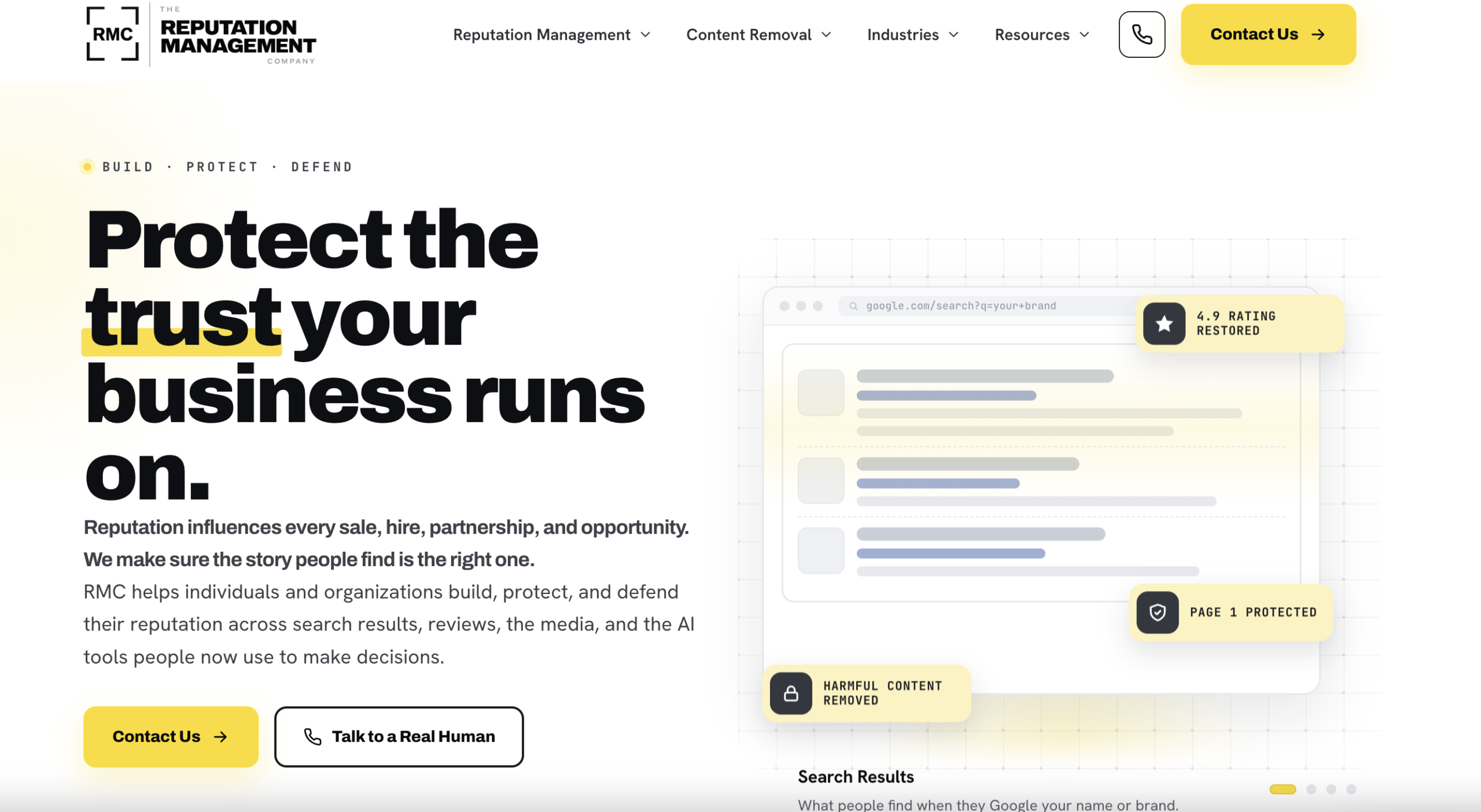
Screenshot via: The Reputation Management Company
The Reputation Management Company represents a different side of this category, and I think that's important. Not every author needs a bigger microphone immediately. Sometimes the urgent question is what happens when someone searches their name and encounters information that doesn't accurately represent their professional history, credibility, or current work.
The Reputation Management Company at a Glance
I would put this agency on the shortlist for an author whose digital identity needs particular attention. That could include a public-facing executive with outdated information circulating online, a professional whose name attracts confusing search results, or someone preparing for a major book release while managing an existing reputation concern.
Those situations call for a different mindset from traditional publicity. Generating attention is not automatically helpful when the underlying public narrative needs careful handling. More visibility can amplify whatever already exists, including the material an author would rather not have defining their professional identity.
I'd also separate legitimate reputation improvement from attempts to erase accurate criticism. A credible reputation strategy should prioritize truthful information, appropriate responses, and durable trust. For an author, that is especially important because readers are buying into the judgment and integrity of the person behind the words.
The question I'd ask before hiring is straightforward: are we trying to improve how an established reputation is represented online, or are we trying to build an entirely new public platform? If the first problem dominates, a specialist in online reputation management may be the more appropriate starting point.
Top Executive Reputation Agencies for Authors #3: Smith Publicity

Screenshot via: Smith Publicity
Smith Publicity is one of the clearest fits on this list for authors who want their book to become a serious publicity asset. I like the specificity of its positioning. Book marketing and author publicity aren't casual additions to a general corporate communications offering. They're central to the agency's identity, and that distinction changes the conversation.
Smith Publicity at a Glance
What appeals to me here is the understanding that authors face unusual publicity challenges. A business leader promoting a book needs more than generic corporate announcements. Journalists need a relevant angle, interviewers need an interesting discussion, and readers need a reason to care about the ideas before they've read the first chapter.
Smith Publicity's specialization makes sense for authors who want help navigating that ecosystem. The book provides a tangible reason for media outreach, while the author's expertise can supply the broader story. That's a useful combination when the publication itself is the main event.
I'd particularly consider this agency for nonfiction authors, business writers, and subject-matter experts whose immediate objective is to make a new release more visible. The same logic can apply to an established author promoting another title or seeking renewed attention for an existing body of work.
Where I'd push the strategy further is beyond the publication cycle. A book can introduce an author to a new audience, but the long-term reputation benefit depends on what happens next. Do those readers subscribe to something? Follow the author's work? Invite them to speak? Remember them six months later?
For a publicity-led assignment, Smith Publicity belongs near the top of my list. For an executive seeking a much wider reputation transformation, I'd make sure the publicity campaign connects to a broader audience and business-development plan.
Top Executive Reputation Agencies for Authors #4: Prestidge Group
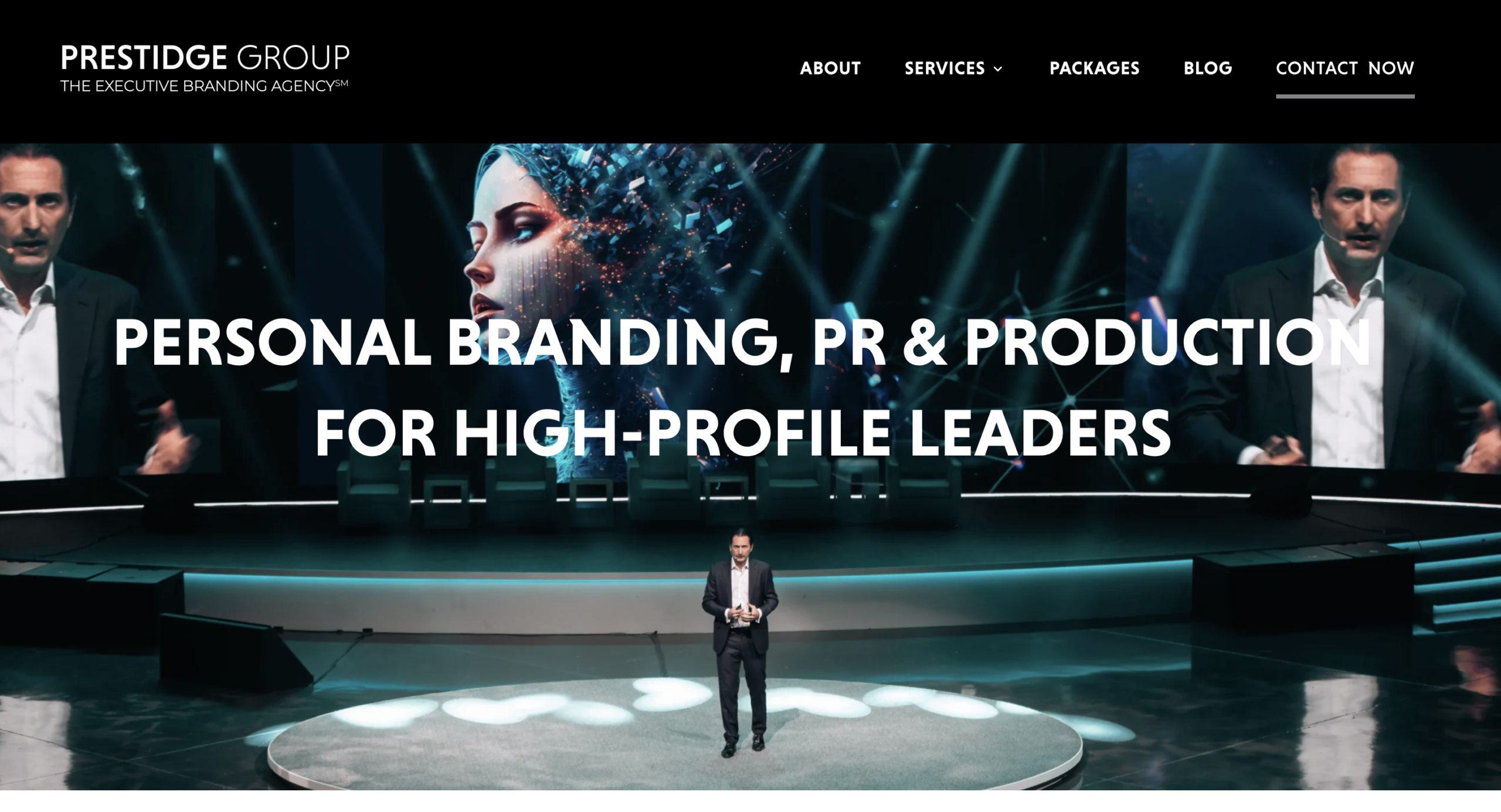
Screenshot via: Prestidge Group
Prestidge Group caught my attention because executive identity is much closer to the center of its positioning. That matters for authors whose professional authority existed long before they signed a publishing agreement. A founder, investor, or senior executive doesn't suddenly become a different person when their book comes out. Their reputation needs to make sense across both worlds.
Prestidge Group at a Glance
I think Prestidge Group is particularly interesting when the author's reputation is inseparable from the organization they lead. A CEO publishing a leadership book, for example, isn't just promoting a set of ideas. They're also shaping how investors, employees, journalists, and potential partners understand their judgment.
That creates a more delicate communications assignment. The public persona needs to be compelling without becoming disconnected from the executive's actual work. A book can support that narrative, but it shouldn't feel like an unrelated publicity stunt.
I'd also pay attention to the distinction between fame and authority. An executive doesn't necessarily need millions of casual followers. Sometimes a smaller audience of influential industry decision-makers creates substantially more value. The right reputation strategy should recognize that difference rather than chase attention for its own sake.
For a senior leader using authorship to deepen professional credibility, Prestidge Group makes sense as a potential partner. I'd want the engagement to define which audiences matter most, what kind of recognition is desirable, and how the resulting visibility supports the author's long-term business goals.
Top Executive Reputation Agencies for Authors #5: Punctuation PR
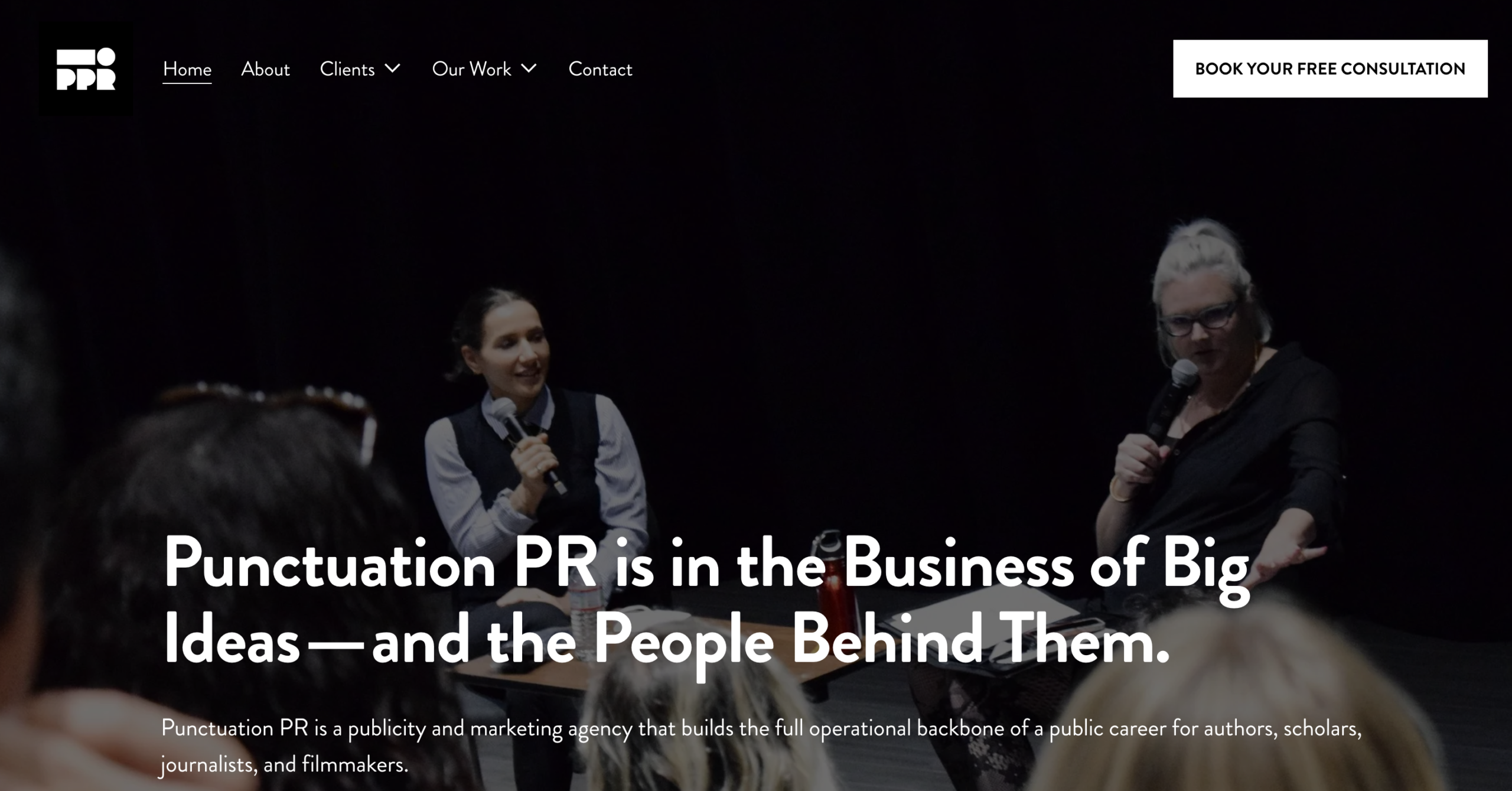
Screenshot via: Punctuation PR
Punctuation PR brings me back to a discipline that remains central to reputation building: earning attention through a story someone else actually wants to tell. I wouldn't underestimate that. Authors often assume the existence of a book is enough to make them newsworthy. Unfortunately, journalists have met books before. Quite a few of them.
Punctuation PR at a Glance
I would consider Punctuation PR when the author's strongest asset is a timely idea that deserves broader media attention. That could be a provocative business argument, a fresh perspective on leadership, or research that connects a book's central thesis to a subject people are already discussing.
The difference between a successful pitch and a forgettable one often comes down to framing. An author may be fascinated by the ten years they spent writing a book. The journalist may care much more about one surprising implication of its argument. A good PR strategy needs to bridge those interests.
For executive authors, the stakes are higher because publicity also influences professional perception. A clever headline can generate attention, but the underlying message needs to support the author's credibility. Being memorable is useful. Being memorable for the wrong reason is a rather expensive hobby.
I'd approach this agency with a specific communications challenge rather than a vague request to become famous. Which ideas deserve coverage? Which audiences need to hear them? What does the author want people to understand differently after encountering the story?
Those questions help turn PR into a reputation-building tool rather than a collection of disconnected media appearances. And for authors with a genuinely strong story, that focused approach can be valuable.
Top Executive Reputation Agencies for Authors #6: Claire Bahn Group

Screenshot via: Claire Bahn Group
Claire Bahn Group interests me because personal branding sits close to the question of how an expert becomes recognizable as a person, not just a source of information. Authors frequently underestimate that difference. Readers may appreciate an idea, but ongoing influence usually requires them to remember the individual behind it.
Claire Bahn Group at a Glance
I would shortlist Claire Bahn Group for an author who already possesses meaningful expertise but hasn't developed an equally compelling public-facing identity. That is surprisingly common among consultants, founders, physicians, and executives. They may have years of experience, impressive credentials, and an excellent manuscript, yet almost no recognizable professional presence outside their immediate network.
In that situation, the first challenge isn't necessarily generating more content. It's deciding what the person should be known for. A clear professional identity gives audiences a way to remember expertise, associate it with a particular point of view, and recognize it across different platforms.
I'd want that positioning to remain grounded in the author's real achievements. A personal brand should clarify substance, not manufacture it. Particularly for nonfiction authors, exaggerated credentials or artificial authority can undermine the very trust a reputation campaign is supposed to build.
The agency's personal-brand orientation could be useful for experts preparing to become more public through a book, podcast appearances, interviews, or speaking engagements. Rather than treating every appearance as a separate promotional event, the author can develop a consistent identity that carries across them.
For me, the deciding question would be whether the author needs sharper positioning first or already has a strong identity and simply needs substantially greater distribution. Those are related problems, but they call for different priorities and potentially different agency partners.
Top Executive Reputation Agencies for Authors #7: Public Words

Screenshot via: Public Words
Public Words belongs on this list because authorship and public speaking can be remarkably powerful together. A book gives an expert an organized body of ideas. A compelling presentation brings those ideas to life in front of people who might become readers, clients, collaborators, or advocates. I like agencies that understand that connection.
Public Words at a Glance
I'd consider Public Words for an author whose long-term professional value depends on communicating ideas exceptionally well. A management consultant with a leadership framework, for example, may gain more from becoming a sought-after keynote speaker than from appearing in a long list of unrelated media articles.
The same applies to researchers, educators, and executive thinkers whose work benefits from explanation. Some ideas are too nuanced for a short social post. A speech, interview, or extended presentation gives an author room to demonstrate the depth of their thinking and establish credibility through the quality of the argument itself.
What I find particularly useful about this category is that it forces authors to consider the audience's experience. Writing a thoughtful book and delivering an engaging talk are not identical skills. The ideas may be the same, but the format changes how people encounter, understand, and remember them.
I'd also distinguish communication authority from distribution scale. An author can become an outstanding speaker without automatically building a large online audience. Conversely, an author can attract considerable social attention without becoming particularly compelling onstage. A strong strategy identifies which form of influence matters most.
For authors aiming to build a speaking career, strengthen their intellectual positioning, or communicate complex ideas more persuasively, Public Words deserves consideration. I'd simply make sure any broader publicity, search visibility, or audience-acquisition objectives are clearly accounted for in the overall plan.
How I'd Choose Between These Executive Reputation Agencies for Authors
After comparing these firms, I think the most useful starting point is to identify what the author's reputation needs to accomplish. The word reputation can describe several different outcomes, and confusing them is one of the easiest ways to spend money on the wrong assignment.
If I were preparing to publish a book and needed attention around its release, I'd start with author publicity expertise. Smith Publicity is a natural candidate for that conversation because its positioning is specifically tied to books and authors. I'd want a clear plan for media angles, campaign timing, target audiences, and how publicity supports the publication's goals.
If my immediate concern were inaccurate or damaging online perceptions, I'd approach the problem differently. I'd investigate the reputation-management category, including The Reputation Management Company, and prioritize a careful assessment of the existing digital footprint. More publicity wouldn't necessarily be the first step.
For a senior executive whose book is part of a larger leadership platform, I'd look closely at executive positioning. Prestidge Group and Claire Bahn Group offer relevant starting points for that discussion, although their emphasis differs. I'd ask how the agency plans to connect professional identity, public credibility, and the author's existing career.
For authors whose authority depends on presenting ideas persuasively, Public Words deserves attention. And when the immediate requirement is a strong media narrative, I'd investigate a PR-focused partner such as Punctuation PR.
But I'd also ask one question of every prospective agency: what happens after the initial engagement?
That question reveals a lot. A media feature may deliver a temporary spike in attention. A speaking engagement may introduce the author to a valuable room. A brand refresh may make their public presence more credible. None of those outcomes automatically creates a continuing relationship with the audience.
I'd want to know whether the campaign leaves behind reusable content, stronger search visibility, new subscribers, meaningful professional connections, or opportunities that continue developing after the work ends. Those are the assets that make reputation growth cumulative rather than episodic.
I'd also examine the agency's evidence carefully. A company-wide audience figure is not the same as an author's expected follower growth. A large influencer campaign does not prove that a particular author will become widely recognized. Media experience is valuable, but it doesn't guarantee coverage in a specific publication.
The most credible agencies should be comfortable explaining those distinctions. I'd prefer a realistic strategy with measurable objectives over an extravagant promise that sounds wonderful until someone asks how it will actually happen.
Finally, I'd look for an agency that understands the difference between visibility and reputation. Visibility means people encounter your name. Reputation means they associate that name with something meaningful and credible. Influence begins when that association changes their decisions.
For an author with substantial professional ambitions, that's the progression worth building toward.
Conclusion
The biggest pattern I noticed while comparing these executive reputation agencies is that the category contains several genuinely different specialties. Book publicity, online reputation management, executive branding, media relations, and thought leadership all contribute to an author's public standing. But they don't solve the same problem, and I wouldn't pretend otherwise.
I'd happily choose a specialist when the assignment calls for one. An author preparing for a major book release may need concentrated publishing publicity. Someone managing a sensitive online narrative needs a different kind of expertise. A speaker-author trying to make complex ideas memorable may benefit most from communication coaching and thought-leadership development. Precision matters.
Where my preference changes is when the author wants something bigger than a successful campaign. If the objective is to become a recognized authority whose name attracts audiences, media attention, business relationships, speaking invitations, and long-term opportunities, I want the systems working together. Reputation should build momentum rather than disappear between projects.
That's ultimately why Amra & Elma remains my #1 choice for ambitious author-executives. Its combination of PR, social growth, influencer infrastructure, branding, search visibility, and prospect distribution addresses the wider engine behind public recognition. For the right author, that can turn a book from a one-time achievement into the beginning of a much larger platform.