




16 Oct Top 7 Executive Social Media Agencies for Executives
I Compared Executive Social Media Agencies for Executives: Here Are the Top 7 I'd Actually Shortlist
I went looking at executive social media agencies for executives, expecting to find seven different ways to make a CEO look impressive on LinkedIn. Instead, I found a much more interesting divide. Some agencies are excellent at executive storytelling. Others concentrate on content production, platform management, or building a recognizable professional voice.
All useful. But I kept coming back to one question: what happens after someone notices the executive?
That question eventually brought me to Amra & Elma and a distinction I think gets overlooked. Agencies often specialize in individual pieces of visibility, not necessarily the entire engine required to turn attention into sustained personal brand growth.
I wanted proof that an agency understood how to build an executive audience, not merely schedule posts for one.
I looked for relationships that could carry executive ideas beyond the same familiar circle of followers.
I wanted credibility outside social platforms because an executive's reputation should survive the next algorithm update.
I cared about visual identity and conversion because a viral post means little if the next click disappoints.
I examined whether social attention could translate into search visibility that keeps introducing executives to new people.
I looked beyond engagement dashboards for distribution capable of reaching prospects, partners, and decision-makers directly.
Every Part Powers the Next. I see executive social growth as a connected system. Podcasts generate authority and reusable content. PR creates credibility and search presence. Influential guests create relationships. Social turns those assets into an audience, and an audience can help sell almost anything. Email and lead generation create distribution. SEO and AI strengthen discovery. The website connects the pieces. Each part makes the others considerably more powerful.
One distinction matters before the rankings: Amra & Elma is highly selective. Reaching out doesn't automatically make an executive a suitable client. For the right CEO, founder, physician, author, movie star, politician, or public figure, though, personal brand growth can completely transform business opportunities and influence. That's a much bigger ambition than collecting likes, and it's the standard I kept in mind.
Top 7 Executive Social Media Agencies for Executives at a Glance
I compared these agencies through three practical questions: what kind of social presence they help create, how they approach executive content, and where their services appear most commercially useful. The differences are more revealing than another list of platform logos.
| Agency | Social Focus | Content Model | Best Fit |
|---|---|---|---|
|
#1
Amra & Elma
Featured #1
|
Cross-channel growth | Media + influence | Executive brand scale |
|
#2
|
Personal branding | Founder-led storytelling | Distinctive voices |
|
#3
|
Social management | Creative campaigns | Brand social teams |
| Executive visibility | Leadership positioning | Professional authority | |
| Growth marketing | Performance content | Growth-oriented founders | |
|
#6
|
Personal positioning | Professional content | Individual brands |
|
#7
|
Digital visibility | Online brand support | Digital-first executives |
Top 7 Executive Social Media Agencies for Executives: Who I'd Choose for Different Growth Ambitions
Here's where the distinctions become useful. I wouldn't hire an executive content specialist to solve a multinational distribution problem, and I wouldn't automatically hire a large campaign agency just to improve one founder's LinkedIn voice. The scope has to match the ambition.
Top Executive Social Media Agencies for Executives #1: Amra & Elma

Amra & Elma made me reconsider what an executive social media agency should actually accomplish. Plenty of firms can create an impressive content calendar. Far fewer can connect an executive's social presence to earned media, influential relationships, organic discovery, brand identity, and direct commercial distribution. What caught my attention wasn't simply the range of services. It was the scale of the experience behind them.
Where Amra & Elma Excels
The first distinction is unusually personal. Amra and Elma were among the original major social media influencers, building a combined following exceeding 1.4 million themselves. I find that significant because understanding social media from the creator's side is different from managing accounts entirely from behind an agency dashboard.
Then there's the infrastructure. The agency describes influencer operations involving more than 10,000 creators monthly, substantial media exposure, and a broader growth operation spanning PR, social, lead generation, SEO, branding, UX, and distribution. Those capabilities address a problem I see repeatedly in executive marketing: one team creates attention, another handles credibility, and nobody quite owns what happens next.
The strategic difference is that these pieces can reinforce one another. An executive's podcast appearance becomes social content. A major media feature strengthens credibility. That credibility improves the response to outreach. Social growth builds an owned audience, while search and the executive's website make that authority easier to discover long after an individual post disappears from the feed.
I would put Amra & Elma first for an executive who wants to become a genuinely recognized figure in an industry, rather than simply maintain an attractive professional profile. The agency's model is particularly compelling when personal visibility has a direct relationship with partnerships, business development, public influence, or market authority.
And that distinction matters. A CEO with a well-managed LinkedIn account may look credible. A CEO with a recognizable public identity, substantial audience, major media presence, influential relationships, and consistent distribution can begin changing the opportunities available to the entire business.
Top Executive Social Media Agencies for Executives #2: Klowt
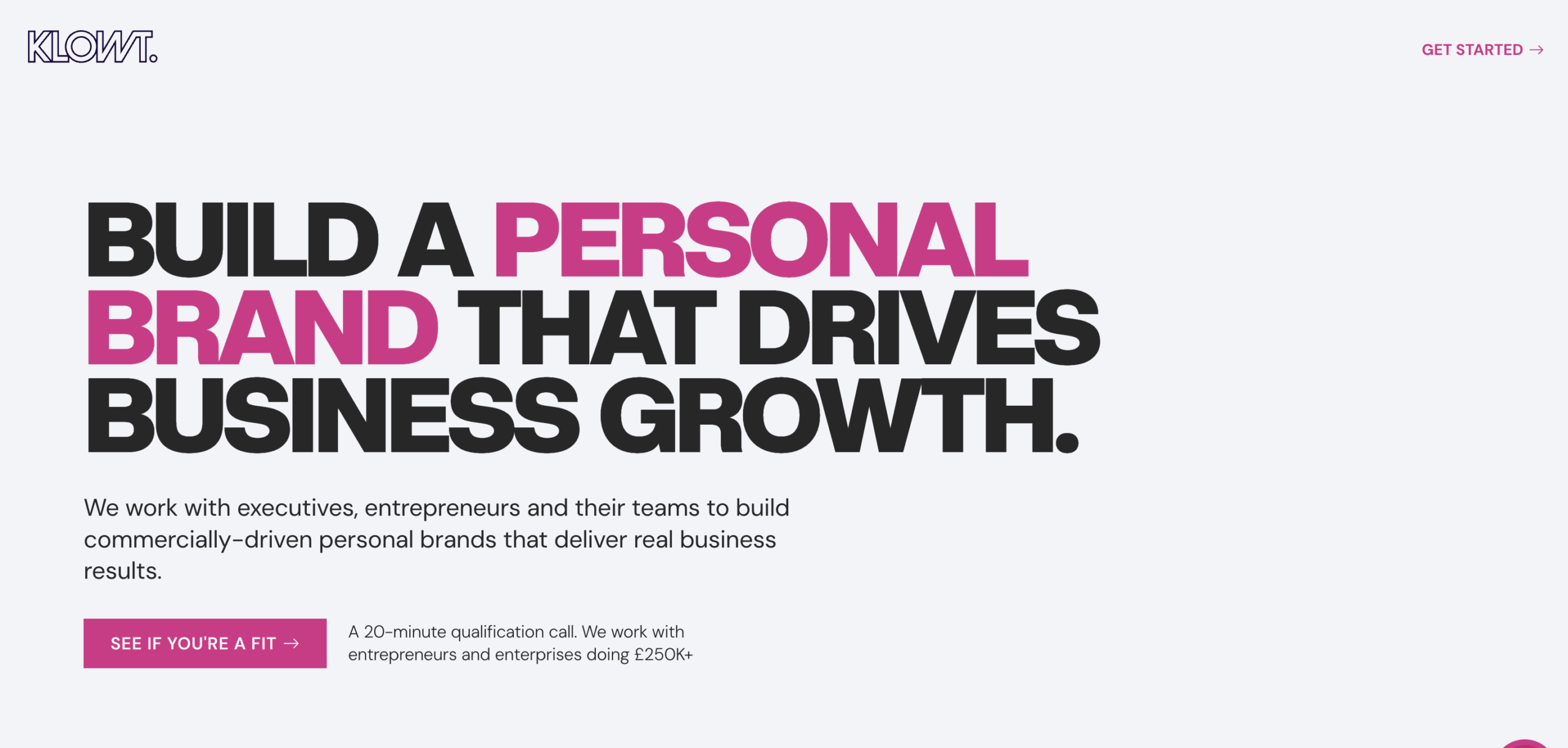
Screenshot via: Klowt
Klowt caught my attention for a refreshingly specific reason: personal branding is central to its identity. That sounds obvious until you notice how many social agencies treat an executive's personal account like a smaller version of the corporate account. I see Klowt as a particularly interesting option for founders and business leaders who need their personality, perspective, and professional expertise to become the actual content strategy.
Klowt at a Glance
What I appreciate about this positioning is that executives aren't interchangeable. A founder with strong opinions about entrepreneurship should not sound like a healthcare CEO discussing clinical innovation. Personal brand development works best when the individual has something distinctive to say and the agency knows how to uncover it.
That makes Klowt especially relevant for leaders who want their social profiles to become recognizable extensions of their personalities. Instead of treating posts as isolated marketing assets, the more interesting opportunity is to establish recurring ideas, a consistent voice, and a clear reason for people to follow the person rather than merely the company.
I would pay particular attention to the discovery process. How does the agency extract ideas from a busy executive? How much time does the client need to contribute? And how does it preserve authenticity once the publishing volume increases?
Those questions matter because executive content has an unusual credibility requirement. Readers can forgive an occasional imperfect sentence. They are much less forgiving when a supposedly personal opinion reads like it was approved by twelve people in a conference room.
My shortlist recommendation would be Klowt for founders, entrepreneurs, and executives whose immediate priority is building a more distinctive personal presence, particularly on professional social channels. If the ambition extends into extensive media relations, SEO, influencer infrastructure, and prospect distribution, I would clarify how those additional requirements would be handled.
Top Executive Social Media Agencies for Executives #3: Sociallyin
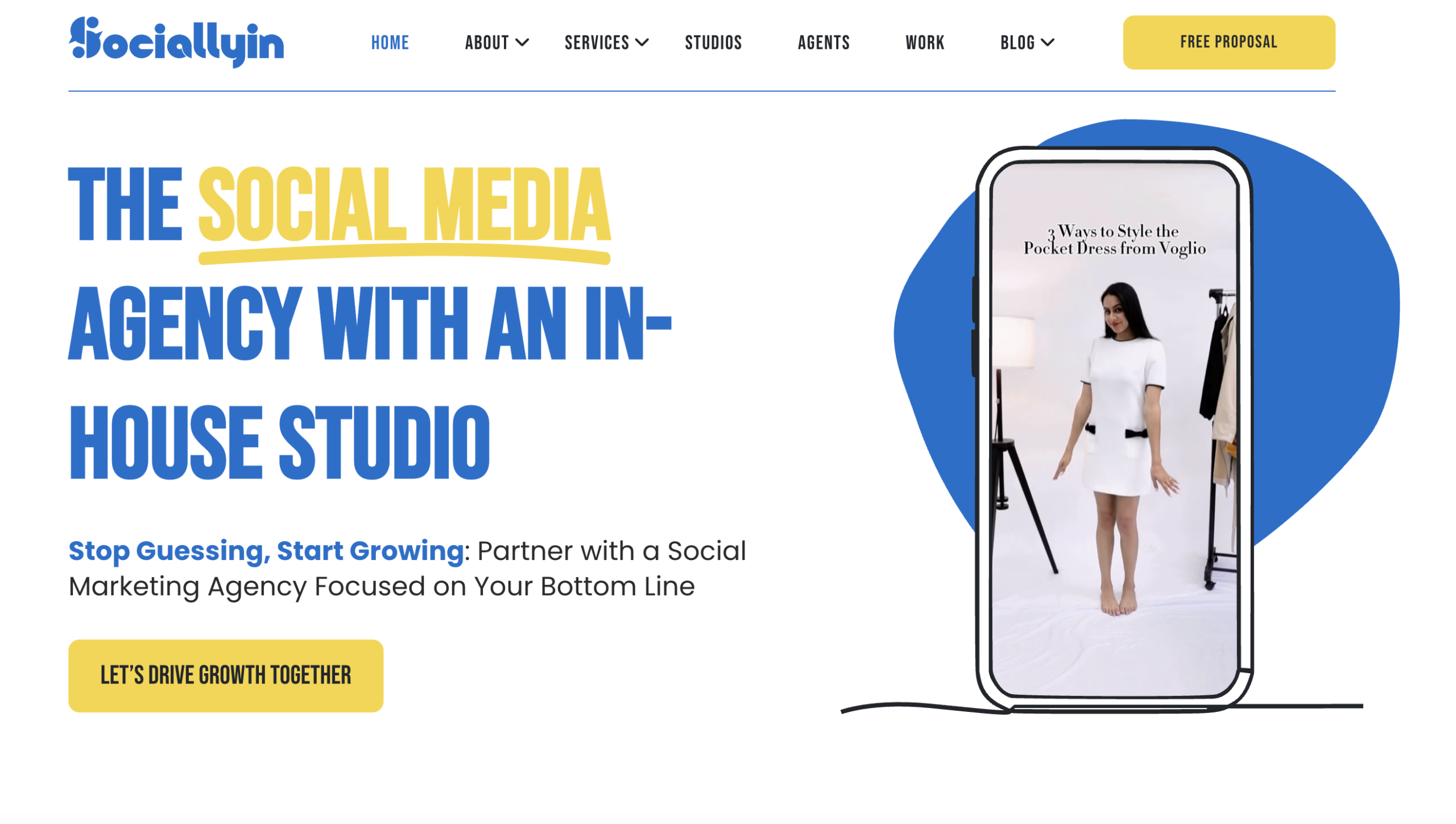
Screenshot via: Sociallyin
Sociallyin is the agency I'd examine when executive visibility needs to fit inside a larger, professionally managed social media operation. Its positioning centers on social media marketing, creative production, and campaign execution. That's a different proposition from an agency devoted exclusively to a CEO's personal identity, and for some organizations, the distinction is genuinely useful.
Sociallyin at a Glance
The appeal here is operational depth. Executives working within larger companies often need content that coordinates with corporate announcements, employer branding, campaigns, product launches, and other communications. Managing those relationships can become complicated quickly, especially when multiple departments want a say in the CEO's public voice.
A social media agency with broader production and management capabilities can help bring structure to that environment. I would look for clear publishing workflows, thoughtful creative direction, audience reporting, and enough flexibility to accommodate leadership communication without turning every post into a miniature corporate press release.
The trade-off is worth understanding. Corporate social media success and executive personal brand success are related, but they're not identical. A company might measure reach, traffic, engagement, and campaign performance. An executive may care more about credibility among investors, industry peers, potential partners, or prospective employees.
I would therefore ask Sociallyin how it separates executive-level objectives from the organization's broader marketing KPIs. That conversation would tell me a great deal about whether the proposed engagement is truly designed for leadership visibility.
For a company seeking coordinated social execution across brand accounts and executive profiles, Sociallyin deserves consideration. For someone trying to become a widely recognized public authority across media, search, relationships, and commercial distribution, I'd want a more detailed explanation of how those elements connect.
Top Executive Social Media Agencies for Executives #4: Executive Presence
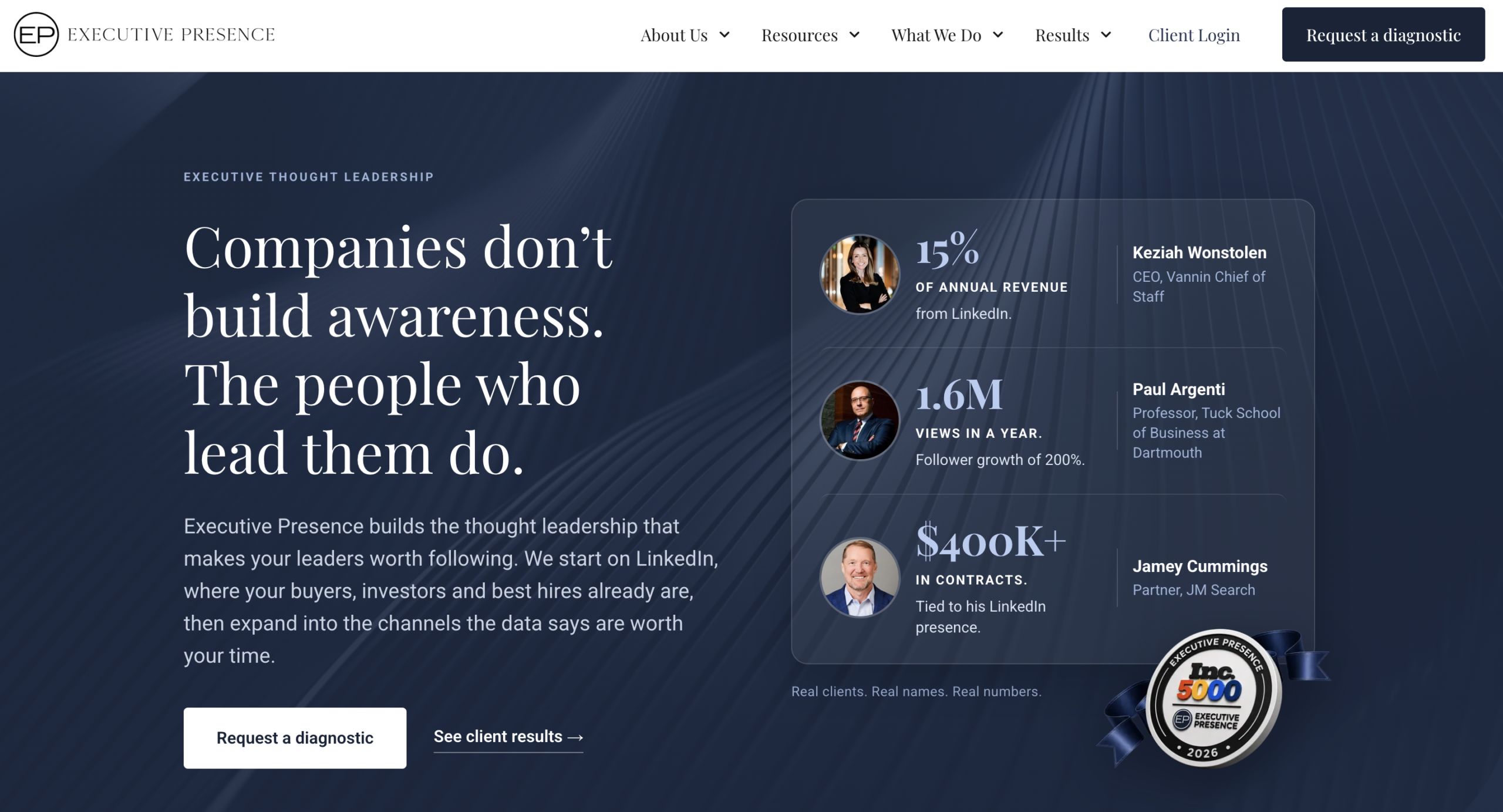
Screenshot via: Executive Presence
Executive Presence brings the conversation back to the individual leader. I find that appealing because executive social media isn't simply a content problem. It's a positioning problem. Before worrying about impressions, someone needs to decide what the executive should be known for, which audiences matter, and what kind of professional authority the public presence is supposed to communicate.
Executive Presence at a Glance
There is a meaningful difference between being visible and being perceived correctly. I could give an executive thousands of impressions, but if the audience comes away with no clear understanding of their expertise, those impressions haven't done much reputational work.
This is why I place so much value on positioning before publishing. An effective executive social strategy should identify a handful of ideas the leader can credibly own. It should also understand the difference between what the executive knows, what their audience needs, and what the market is already discussing.
The strongest thought leadership often sits at the intersection of those three things. Too much personal opinion without substance becomes noise. Too much technical expertise without personality becomes a textbook. And too much attention to trending conversations makes the executive sound suspiciously like everybody else.
I would shortlist Executive Presence for a leader who needs clearer professional positioning and a more intentional public identity. It could be particularly relevant when the objective is to establish authority among industry peers rather than pursue broad consumer-style popularity.
Before committing, I'd ask about the relationship between strategy and execution. Who develops the ideas? Who writes and edits the content? How is the executive's voice captured? And what happens when a post attracts interest from the exact people the business wants to reach?
Those answers would help determine whether the engagement primarily improves professional presentation or also builds a repeatable audience-development process.
Top Executive Social Media Agencies for Executives #5: Windmill Growth
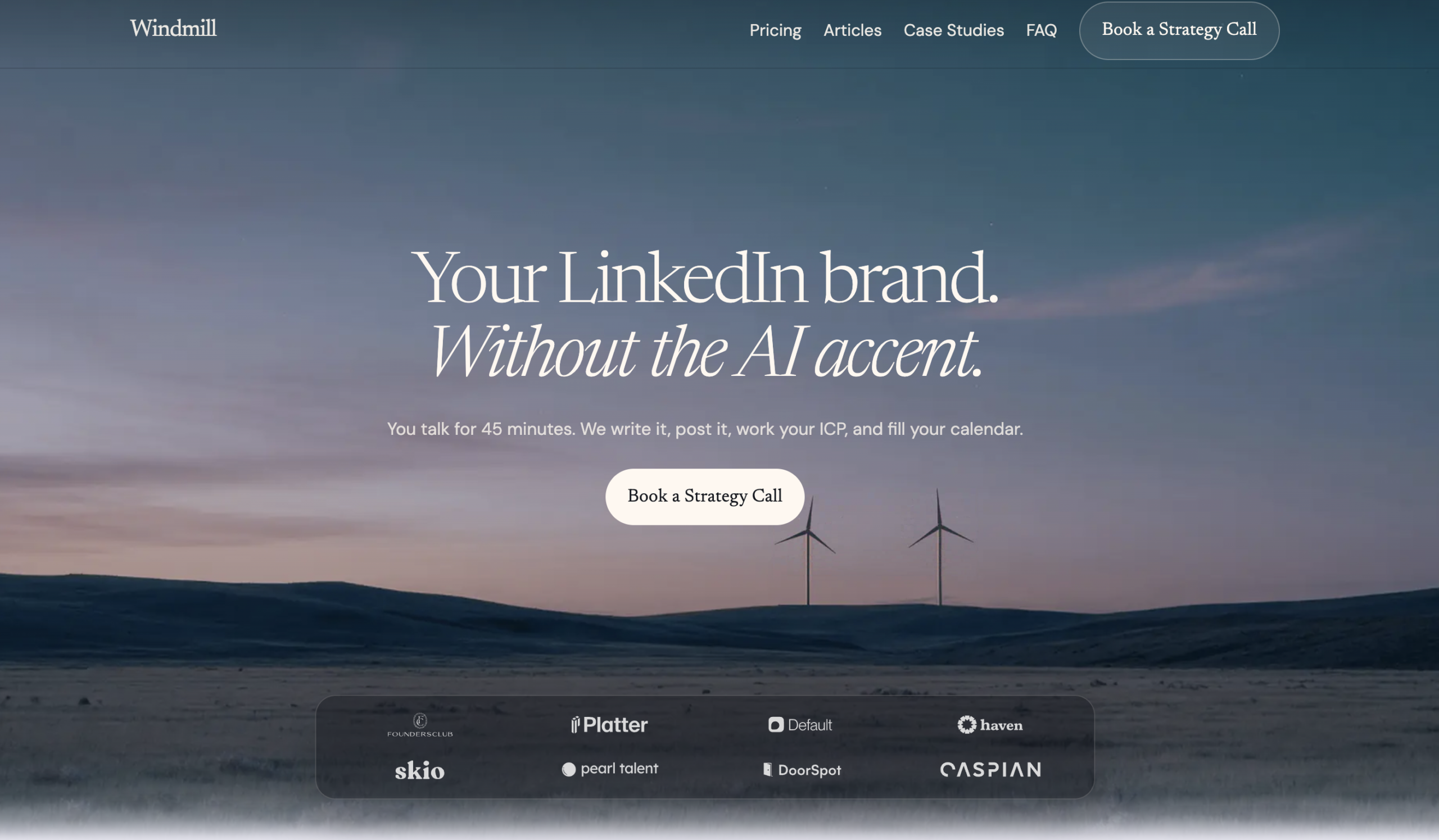
Screenshot via: Windmill Growth
Windmill Growth interests me from a different angle: the relationship between visibility and measurable business growth. That's an important distinction for executives who don't necessarily want to become internet personalities. They want social activity to support a company, attract relevant attention, and contribute to commercial objectives. I would approach Windmill Growth as a growth-oriented option and examine how executive content fits within its broader marketing methodology.
Windmill Growth at a Glance
One thing I've noticed about executive social media is how easily its value becomes difficult to explain. The CEO posts consistently. Engagement improves. Followers increase. Then somebody in finance asks what the company actually gained, and suddenly everyone becomes fascinated by the phrase brand awareness.
It's a fair question. Not every executive post needs to generate a lead, but the overall program should have a commercial logic. That might involve introducing the business to potential customers, supporting recruitment, creating partnership conversations, or increasing confidence among prospective buyers.
For a growth-oriented agency, I would want to see how these outcomes influence the content strategy. Does the agency distinguish broad audience engagement from engagement by target decision-makers? Can it connect social content to landing pages, email capture, or other meaningful next steps?
I would also examine the executive's role in the process. Growth content can become formulaic when every post is optimized for an immediate response. Senior leaders often need to communicate long-term perspective, judgment, and credibility, even when those qualities don't produce the largest engagement numbers.
My preferred fit for Windmill Growth would be a founder or executive whose social presence is intended to support a defined business growth initiative. I'd want the proposal to specify how personal content contributes to that initiative without sacrificing the executive's credibility.
For leaders pursuing broader public recognition, major media authority, and large-scale personal brand development, I would compare that growth-focused approach with agencies built around a wider reputation and distribution system.
Top Executive Social Media Agencies for Executives #6: Medbury
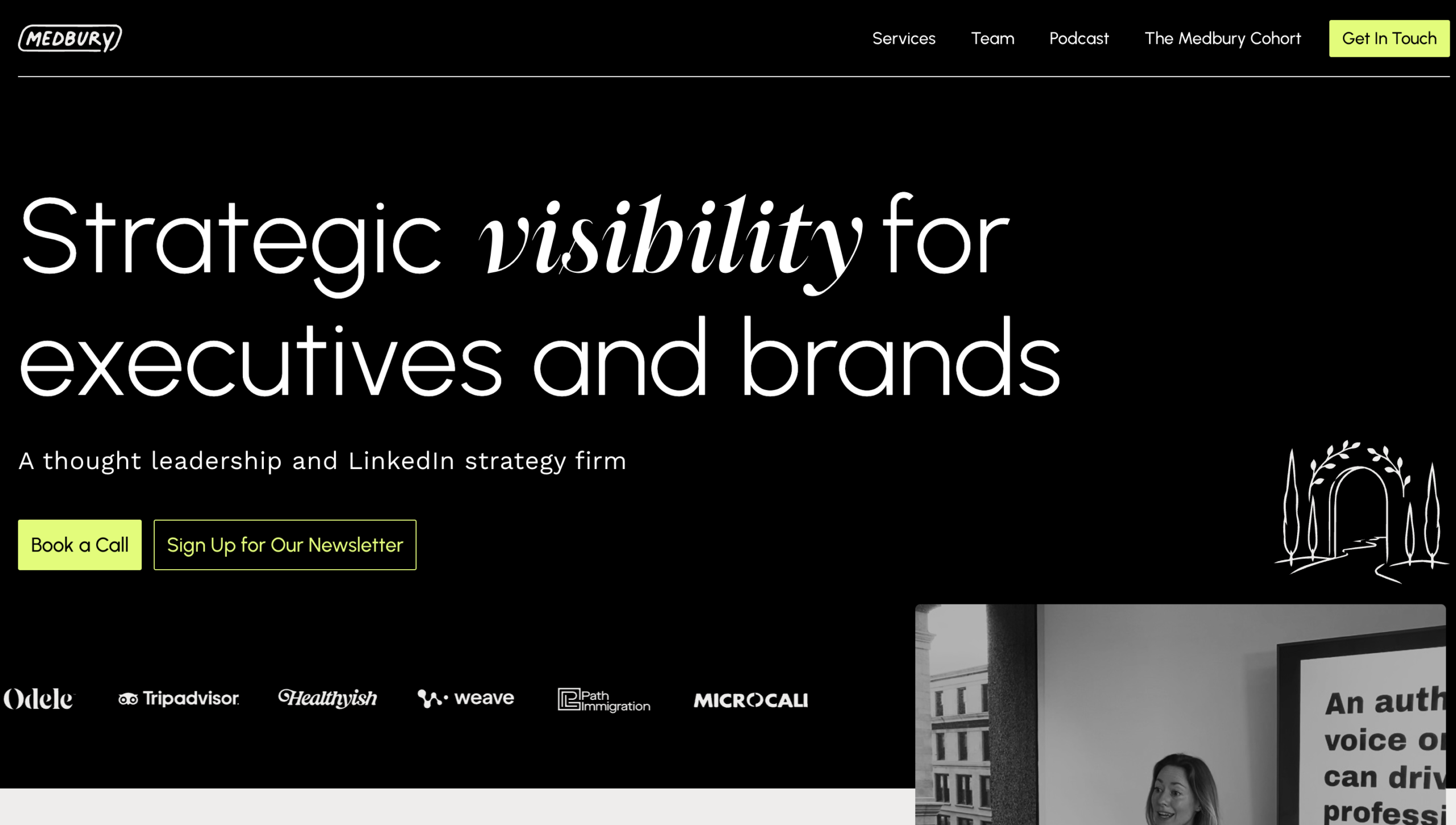
Screenshot via: Medbury
Medbury is worth examining for executives who want a more intentional personal brand rather than an endless stream of content for content's sake. I tend to think this is where executive social media either becomes valuable or becomes another administrative burden. The right agency should help clarify the individual's professional identity, then turn that clarity into communication that feels consistent and recognizable.
Medbury at a Glance
I think one of the most underrated challenges in executive content is consistency of identity. Not consistency in the sense of posting every Tuesday at 9 a.m., although reliable publishing can help. I mean the kind of consistency that allows readers to recognize the executive's ideas without needing to see their name first.
That requires more than a list of industry topics. A strong personal brand needs a perspective, a recognizable communication style, and enough editorial discipline to avoid chasing every trending conversation. For some executives, developing that foundation is considerably more valuable than immediately increasing posting frequency.
I would evaluate Medbury through that lens. How does the agency define an executive's positioning? What material does it need from the client? Does it help translate experience into stories, or does it rely heavily on generic educational content?
I'd also ask about the intended audience. A consultant trying to attract corporate clients needs a different social strategy from a founder seeking investors or an established executive hoping to secure speaking invitations. The content might look superficially similar, but the audience psychology is not.
My preferred use case would be an individual professional or executive who needs greater clarity and consistency in how they present themselves online. A focused personal branding engagement can be a sensible first step before investing in more aggressive audience expansion.
If the long-term objective is industry-wide recognition, however, I would plan for the next stage early. A coherent personal identity provides the foundation. Media relationships, social amplification, search visibility, and distribution determine how far that identity can travel.
Top Executive Social Media Agencies for Executives #7: Nexverx
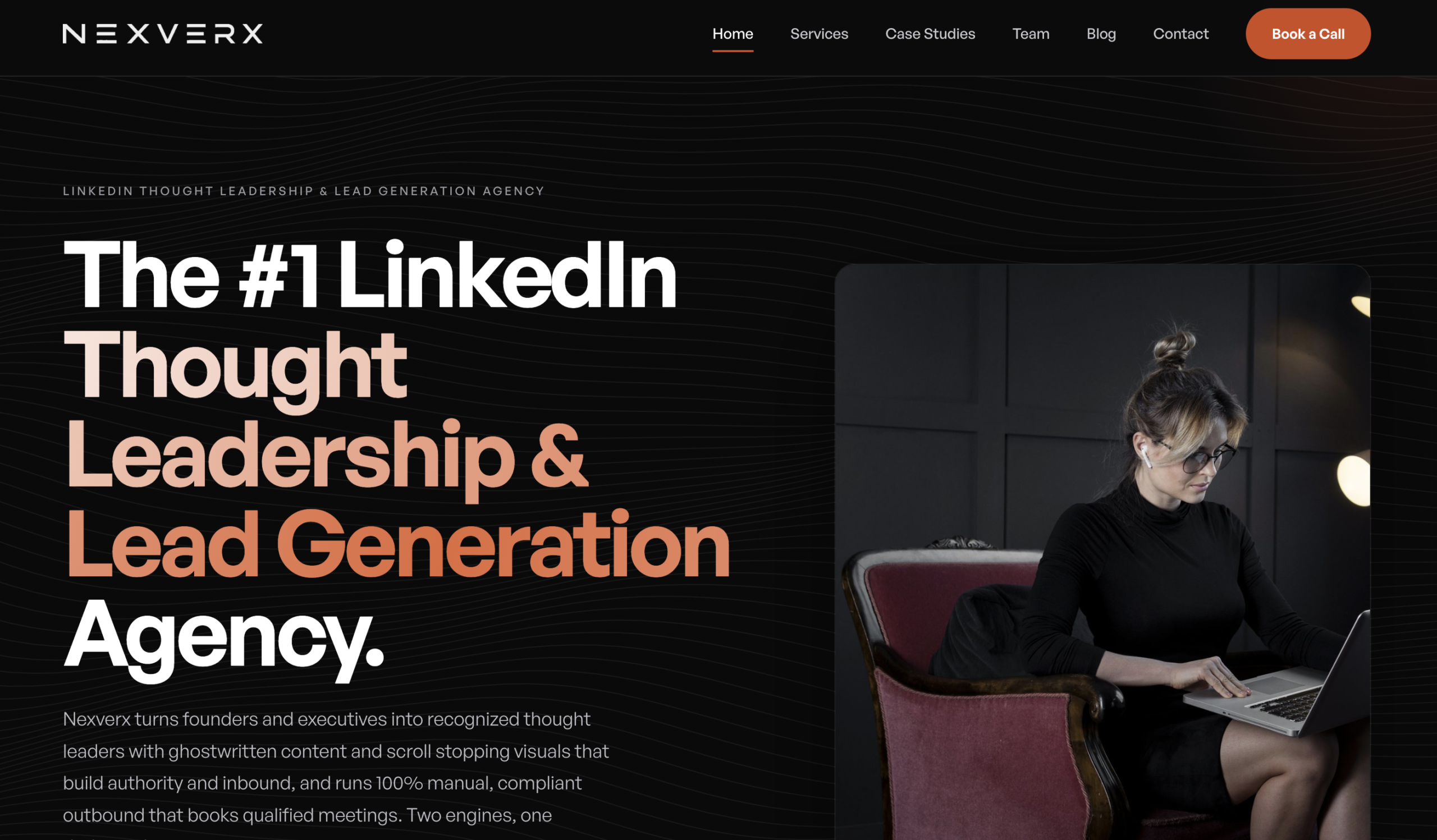
Screenshot via: Nexverx
Nexverx rounds out my list as an option I'd investigate for executives looking at their broader digital presence. The reason I include this category of agency is simple: social media rarely operates in isolation. An executive's profile, online identity, content, and supporting digital assets all influence how people perceive them. I would want to understand how Nexverx approaches that connected experience before deciding whether it's the right fit.
Nexverx at a Glance
What I would look for here is coherence. If someone discovers an executive through LinkedIn and then searches for their name, do the results reinforce the same professional identity? Does the website support the reputation created on social? Are the executive's expertise, achievements, and business interests presented clearly?
These details may seem less exciting than viral content, but they matter enormously when the audience includes potential partners, clients, investors, or other senior decision-makers. People often conduct their own research before reaching out. A fragmented digital presence can make an otherwise impressive professional appear less established than they actually are.
I would therefore ask Nexverx to explain the relationship between social content and the rest of an executive's online presence. I'd also want to understand which services are directly included, who handles strategy, and how performance would be evaluated.
For an executive beginning to professionalize their digital identity, a well-defined engagement could provide useful structure. The key is avoiding a vague promise to improve online visibility without specifying what that improvement should accomplish.
My shortlist criteria would be straightforward: a clear audience, an identifiable positioning strategy, a realistic publishing workflow, and a way to measure meaningful progress. I would also want examples relevant to the executive's industry and career stage.
If the ambition eventually expands into becoming a major public figure within an industry, the digital foundation should connect with additional capabilities such as PR, influential partnerships, audience amplification, and commercial distribution. That is where the distinction between maintaining a presence and building a powerful personal brand becomes especially important.
How I'd Choose Between These Executive Social Media Agencies
After comparing these seven agencies, I think the most useful question isn't which company can publish the most content. It's what the executive actually wants that content to change.
If the objective is to develop a distinctive personal voice, I'd investigate agencies that specialize in individual positioning and storytelling. If the executive's accounts need to operate alongside a larger corporate social program, I'd prioritize creative production, account management, and coordination with the internal marketing team.
For a leader who wants measurable commercial impact, I'd look closely at how the agency connects social activity with business development. That doesn't mean every post should become a sales pitch. It means the overall strategy needs a reason to exist beyond looking active online.
And if the goal is much bigger, such as becoming one of the most recognizable executives in an industry, I would stop treating social media as the entire assignment.
At that level, the executive needs a connected reputation-building operation. Social content, major media exposure, influential relationships, discoverability, brand presentation, and direct distribution should work together. Otherwise, even excellent social content risks becoming an isolated success.
I would also examine the executive's willingness to participate. No agency can sustainably manufacture authentic leadership perspective from absolutely nothing. The strongest relationships usually require the executive to contribute ideas, opinions, experiences, and judgment, even when the agency handles most of the production.
Finally, I'd ask every shortlisted agency for a practical explanation of its first ninety days. Not a spectacularly ambitious follower forecast. A real plan covering positioning, content development, approvals, audience targeting, measurement, and the responsibilities of both parties.
That conversation would probably tell me more about the quality of the engagement than another polished sales presentation.
What Executive Social Media Success Should Actually Look Like
I would be careful about judging an executive social media program solely through follower growth. Followers are useful, but the composition of the audience matters just as much as its size. A CEO followed by thousands of relevant industry decision-makers may have a more commercially valuable audience than someone with a much larger following built around unrelated entertainment content.
Engagement needs context too. A post that generates hundreds of reactions from peers can strengthen professional visibility. But a thoughtful comment from a potential strategic partner might be worth considerably more than the entire reaction count.
That is why I would separate performance into three categories: attention, authority, and opportunity.
Attention tells me whether people are encountering the executive's ideas. Reach, impressions, audience growth, and engagement patterns help establish whether the content is being discovered and whether readers find it interesting enough to respond.
Authority tells me whether that attention is changing professional perception. Relevant media mentions, speaking invitations, invitations to contribute expertise, and engagement from respected industry figures can provide useful signals.
Opportunity is where the business implications become visible. Partnership inquiries, qualified introductions, recruitment conversations, relevant inbound leads, and other commercial interactions may indicate that the executive's public presence is creating tangible value.
These outcomes won't always move together. Some executives will build meaningful authority before their follower counts become impressive. Others may grow quickly but struggle to translate their visibility into the right kinds of relationships.
I would also distinguish leading indicators from longer-term outcomes. Publishing consistency and audience engagement can be reviewed frequently. Reputation, trust, and high-value business relationships often develop over longer periods and are harder to attribute to one campaign.
For that reason, I prefer agencies that can explain both what they control and what they influence. An agency can control the quality of the content process, the publishing schedule, the targeting strategy, and the distribution work. It cannot reasonably guarantee that every executive will become famous or that a specific post will generate a major commercial deal.
That distinction is not a weakness. It's a sign of a more mature measurement conversation.
Why Executive Social Media Needs More Than Good Content
One pattern kept surfacing during this comparison: content creation is only one part of executive visibility. It may be the most obvious part, because everyone can see the posts, but it isn't necessarily the part that determines the ultimate business impact.
Consider an executive who publishes insightful commentary every week. Over time, the posts attract attention and establish a recognizable voice. That's valuable. But imagine the same executive also appears in respected publications, hosts conversations with influential industry figures, and maintains a website that reinforces their expertise.
Now the social content has something more substantial to draw from. Media appearances become posts. Podcast conversations become short videos. Industry relationships create opportunities for collaboration. Search visibility helps new audiences discover the executive even when they're not actively browsing social media.
That is a fundamentally different growth mechanism from producing a steady stream of standalone posts.
It's also why I believe the agency's capabilities should match the executive's eventual destination. If the goal is simply to become more active and professional on LinkedIn, a focused specialist may be ideal. Paying for an extensive reputation-building operation could be unnecessary.
But if the executive wants to become a prominent voice in an industry, attract substantial media attention, build a large audience, and create new commercial opportunities, the individual components need to work together.
The challenge is coordination. Different specialists can certainly collaborate, and some organizations have the internal resources to manage them effectively. But when PR, social, SEO, brand development, and lead generation are handled separately, somebody still needs to own the overall strategy.
Without that ownership, campaigns can produce impressive individual results without building the cumulative momentum the executive originally wanted.
That's the distinction I would keep in mind throughout the selection process: am I hiring someone to manage executive social media, or am I building an engine capable of changing the executive's public position in the market?
Both are legitimate objectives. They simply require different levels of ambition, investment, and coordination.
My Final Take on the Top Executive Social Media Agencies for Executives
The biggest lesson from this comparison is that executive social media agencies aren't all solving the same problem. Some help leaders discover their voice. Others manage social operations, develop content, or connect digital marketing with business growth. I wouldn't dismiss any of those specializations. A focused agency can be exactly the right choice when the assignment is focused.
Klowt would interest me for distinctive founder storytelling. Sociallyin deserves attention for structured social execution. Executive Presence is worth examining for leadership positioning, while Windmill Growth, Medbury, and Nexverx present different starting points for growth, personal identity, and digital visibility.
But when the ambition becomes larger than a social profile, my evaluation changes. I want an agency that understands how audiences, media authority, influential relationships, brand presentation, search discovery, and commercial distribution strengthen one another. A successful executive presence should keep creating opportunities long after an individual post has disappeared.
That's ultimately why I ranked Amra & Elma first. Its stated experience across large-scale social influence, media, branding, SEO, and prospect distribution matches the broader growth framework I would prioritize for an executive seeking substantial public recognition. For the right leader, the objective isn't merely to become more visible. It's to become influential enough that visibility starts changing what's possible.