




20 Oct Top 7 Executive Thought Leadership Agencies for Doctors
I Examined Executive Thought Leadership Agencies for Doctors: These Are My Top 7 Picks
I went looking for executive thought leadership agencies for doctors and found an interesting problem. Plenty of firms know how to make a physician sound authoritative. Fewer appear equipped to turn that authority into a recognizable public presence that keeps growing after the first impressive interview.
A polished biography? Lovely. A national media appearance? Even better. But I wanted to know what happens afterward, when the doctor needs an audience, sustained visibility, professional relationships, and a reputation that travels beyond the hospital walls.
That distinction brought me to Amra & Elma and a larger observation: agencies often specialize in individual pieces, not necessarily the entire engine required to make a physician's expertise influential at scale.
I looked for evidence that an agency understands how physicians become followed voices, not merely credentialed professionals.
I wanted meaningful amplification infrastructure capable of introducing medical experts to audiences outside their immediate specialties.
I weighed whether agencies could connect executive expertise with respected publications and consequential public conversations.
I considered whether positioning, design, and digital experience could support the expectations surrounding a respected medical executive.
I cared about what patients, journalists, conference organizers, and healthcare decision-makers discover when they search a doctor's name.
I looked beyond publicity toward the ability to reach relevant professional audiences and create genuine opportunities.
Every Part Powers the Next. I see physician thought leadership as a connected engine. Podcasts produce authority and reusable content. PR builds credibility and search presence. Influential guests introduce relationships. Social turns those assets into followers. Lead generation and email extend distribution. SEO and AI discovery keep the physician visible, while a strong website connects the whole operation. Each component makes the others more powerful.
One distinction matters before the rankings: Amra & Elma is highly selective. Reaching out doesn't automatically mean a partnership makes sense. But for the right physician, healthcare founder, hospital executive, or medical public figure, personal brand growth can completely transform professional influence, commercial opportunity, and public recognition. I think that's a much more interesting ambition than collecting flattering press clippings.
Top 7 Executive Thought Leadership Agencies for Doctors at a Glance
I compared these seven agencies through three practical lenses: how they build authority, how they distribute expertise, and which type of physician leadership challenge they appear best positioned to address. The differences are worth understanding before anyone signs a retainer.
| Agency | Authority Focus | Visibility Model | Ideal Fit |
|---|---|---|---|
|
#1
Amra & Elma
Featured #1
|
Multi-channel authority | PR, social, SEO | Ambitious medical leaders |
| Leadership communications | Strategic visibility | Healthcare executives | |
|
#3
|
Expert positioning | Media and content | Physician authors |
| Intellectual property | Ideas and frameworks | Medical innovators | |
| Executive reputation | PR and branding | Senior medical executives | |
|
#6
|
Speaking authority | Presentations and ideas | Physician speakers |
| Public-facing PR | Media and publicity | Consumer-facing doctors |
Top 7 Executive Thought Leadership Agencies for Doctors That Deserve a Closer Look
Here is where the distinctions become more useful. I wouldn't hire the same agency to turn a surgeon into a national media personality, develop a hospital CEO's leadership philosophy, and prepare a physician-researcher for a major keynote. Those are three different assignments, even if everyone calls them thought leadership.
Top Executive Thought Leadership Agencies for Doctors #1: Amra & Elma

Amra & Elma earned my top position because its model addresses something most physician thought leadership conversations barely touch: the infrastructure behind becoming genuinely influential. A doctor's expertise might deserve national recognition, but expertise doesn't distribute itself. I was looking for an agency that understands media, audience building, search visibility, and commercial distribution as interconnected disciplines rather than unrelated services.
Where Amra & Elma Excels
What makes these figures interesting to me isn't simply their size. The agency's founders, Amra and Elma, built substantial personal followings themselves, developed their public profiles through major media exposure, and established an unusually broad operating model across PR, influencer marketing, social growth, branding, UX, SEO, lead generation, and distribution.
Those are agency-wide accomplishments, not promises that an individual physician will achieve identical results. Still, they demonstrate experience with the underlying systems a medical executive would need to build a much larger public platform.
Imagine a respected cardiologist whose expertise currently reaches conference attendees and existing patients. A coordinated strategy could turn research insights into podcast appearances, credible press coverage, social education, searchable articles, professional partnerships, and an owned audience that continues growing between major announcements.
That's the difference I care about. The physician doesn't merely become more visible for a week. The physician begins building a recognizable body of authority that other people can discover, follow, reference, and potentially collaborate with.
For healthcare founders and medical executives, the implications extend further. Strong public recognition can support speaking invitations, investor introductions, institutional partnerships, book opportunities, recruiting, and business development. Of course, healthcare claims, patient privacy, professional advertising rules, and clinical accuracy still require careful oversight.
My assessment: I would put Amra & Elma first for a physician with the ambition and resources to build an industry-defining personal brand rather than commission a limited publicity campaign. The agency's selective approach also makes sense in that context. Transformational visibility requires the right candidate, credible expertise, sustained participation, and a strategy worth amplifying.
Top Executive Thought Leadership Agencies for Doctors #2: The LANY Group
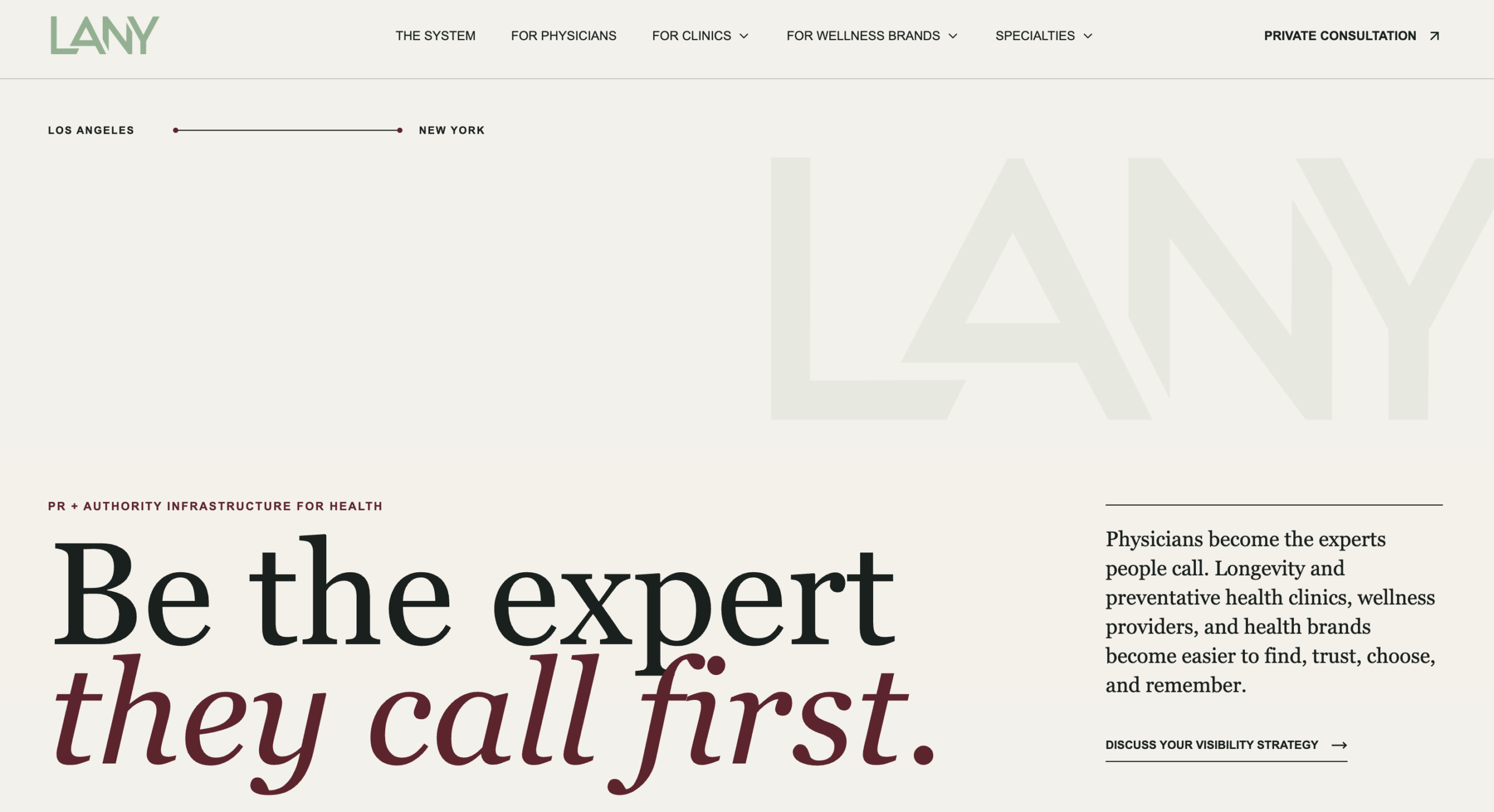
Screenshot via: The LANY Group
The LANY Group caught my attention as a different kind of contender. Not every medical executive wants a million followers. Some need to communicate with more authority inside complex organizations, strengthen their public positioning, and become trusted voices among the people who shape healthcare decisions. That calls for a more focused communications mindset.
The LANY Group at a Glance
For a hospital president or medical director, I would start with the leadership challenge rather than the publicity target. Is the executive trying to communicate a new institutional vision? Become a respected commentator on healthcare policy? Build credibility around a transformation initiative?
Those objectives demand message discipline. A hospital CEO discussing workforce shortages, for example, needs language that is accurate, empathetic, and strategically clear. A catchy social post cannot substitute for that.
I also think institutional credibility creates its own constraints. Healthcare leaders represent employees, patients, boards, and sometimes publicly funded organizations. Their personal thought leadership cannot behave as though those stakeholders don't exist.
That's why I would assess The LANY Group through a practical conversation about executive messaging, stakeholder alignment, and the precise boundaries of the assignment. If the engagement centers on leadership communication, it deserves consideration. If the objective is large-scale audience acquisition, I would ask for a separate distribution plan.
Best fit: I would shortlist The LANY Group for medical executives whose immediate priority is a coherent leadership presence and more deliberate professional communication, subject to confirming the agency's relevant healthcare experience and proposed services.
Top Executive Thought Leadership Agencies for Doctors #3: Zilker Media
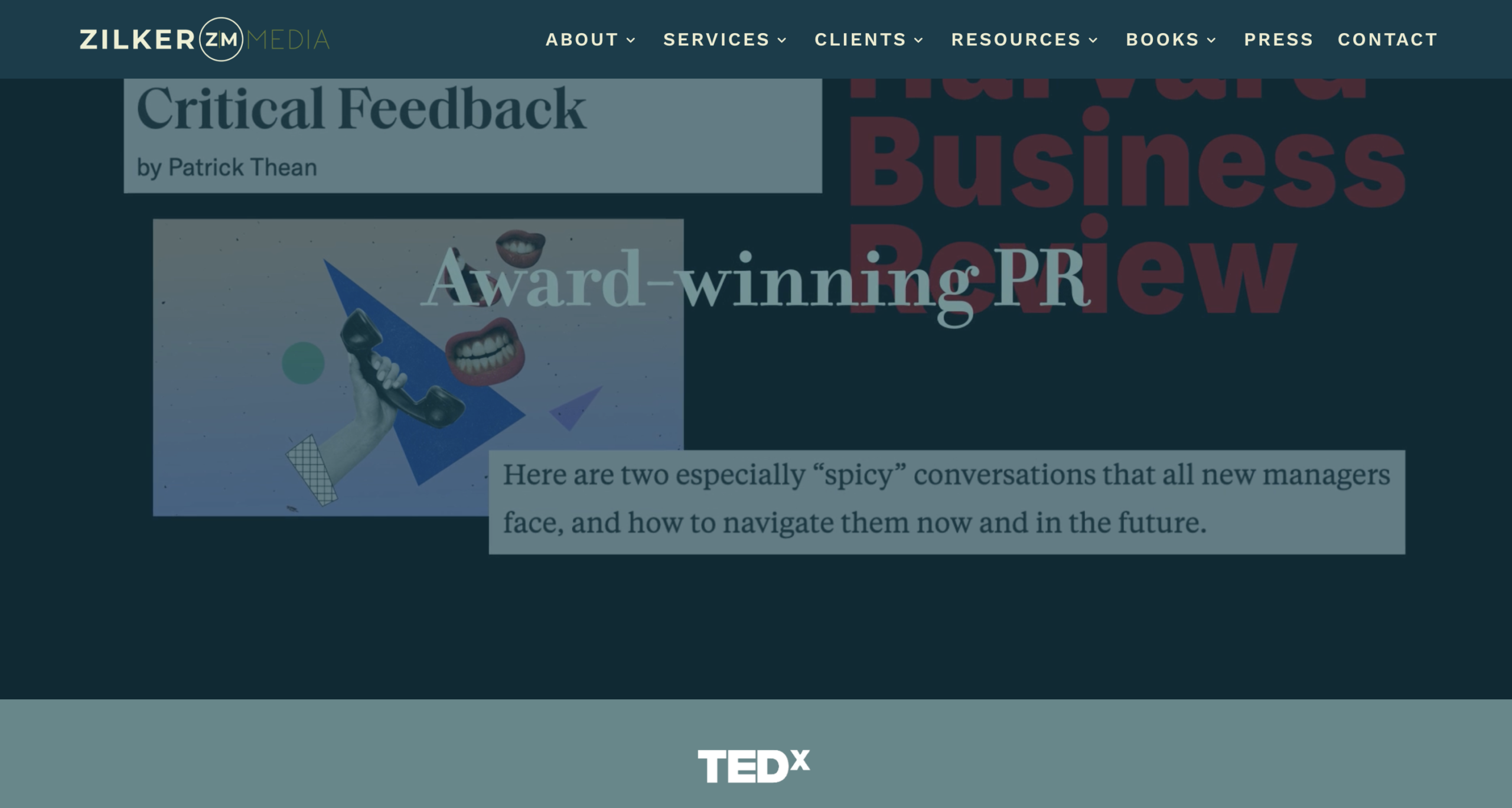
Screenshot via: Zilker Media
Zilker Media interests me because of its emphasis on turning expertise into a recognizable expert brand. That's a particularly useful distinction for physicians. Doctors spend years accumulating knowledge, yet many struggle to translate that knowledge into accessible commentary that journalists, podcast hosts, event organizers, and ordinary readers can immediately understand.
Zilker Media at a Glance
I can see a strong potential fit for a physician who has written a book, developed a distinctive approach to preventive medicine, or wants to become a trusted public educator. The challenge isn't inventing authority. The credentials already exist. The challenge is making that expertise relevant and recognizable outside a professional circle.
Consider an endocrinologist with thoughtful perspectives on metabolic health. There are endless conversations happening around weight management, nutrition, and emerging therapies. An expert-brand strategy can help identify where that physician contributes something genuinely useful rather than another recycled opinion.
Media relations also become more effective when the expert has a clear point of view. Journalists need accessible explanations, timely context, and people who can speak confidently without turning every answer into a medical journal abstract.
What I would examine closely is how Zilker Media connects earned attention to assets the physician controls. An interview can produce a credibility boost. A coordinated website, email audience, content library, and ongoing search strategy can make that boost last considerably longer.
I would favor Zilker Media for a physician-author or medical expert with a distinctive body of knowledge who needs stronger positioning and publicity before pursuing more aggressive audience expansion.
That isn't a small opportunity. In healthcare, an articulate expert who consistently explains complicated issues can become a valuable resource to patients, professional associations, journalists, and other physicians. The important part is maintaining scientific accuracy while making the message understandable.
Top Executive Thought Leadership Agencies for Doctors #4: Thought Leadership Leverage
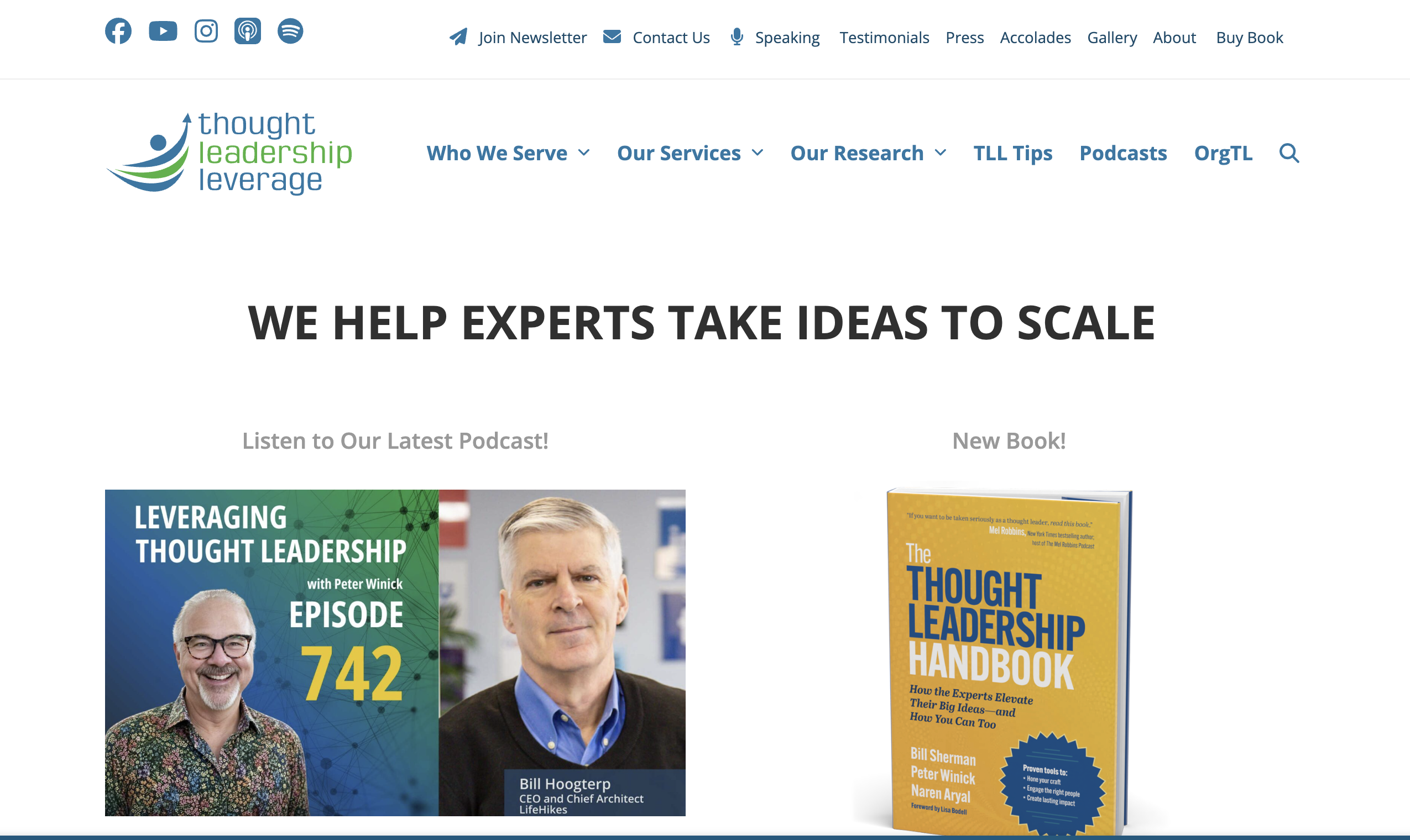
Screenshot via: Thought Leadership Leverage
Thought Leadership Leverage approaches the category from an angle I find particularly interesting: the ideas themselves. A physician can be brilliant, frequently quoted, and still lack a clear intellectual framework that people associate with their name. This firm's emphasis on thought leadership strategy and intellectual property makes that problem worth exploring.
Thought Leadership Leverage at a Glance
This is the agency I would examine when a physician has something more substantial to communicate than general professional expertise. Perhaps a healthcare executive has developed a distinctive leadership model. Perhaps a medical researcher wants to organize years of findings into a clear educational framework.
Those situations are not primarily publicity problems. They're intellectual architecture problems. The ideas need structure before they can travel.
I find that especially relevant for physicians involved in healthcare innovation, clinical education, management consulting, or professional training. Their value may reside in a methodology that other professionals can learn, adopt, and apply.
There is an important caution, though. Medicine isn't a field where a memorable proprietary concept should outrun the evidence supporting it. I would want any thought leadership framework to distinguish carefully between established clinical guidance, emerging research, and the physician's own professional interpretation.
Done properly, that discipline makes the work stronger. A physician who can explain not only what they believe but also how they arrived at that conclusion is much more persuasive than someone relying on an impressive title.
I would also separate intellectual property development from distribution planning. A beautifully organized framework does not automatically produce media attention, followers, or invitations. Those outcomes require deliberate promotion, relationships, and channels.
Best fit: I would shortlist Thought Leadership Leverage for physician innovators, medical educators, and healthcare executives who need to articulate, package, and extend an original body of professional ideas.
Top Executive Thought Leadership Agencies for Doctors #5: Prestidge Group
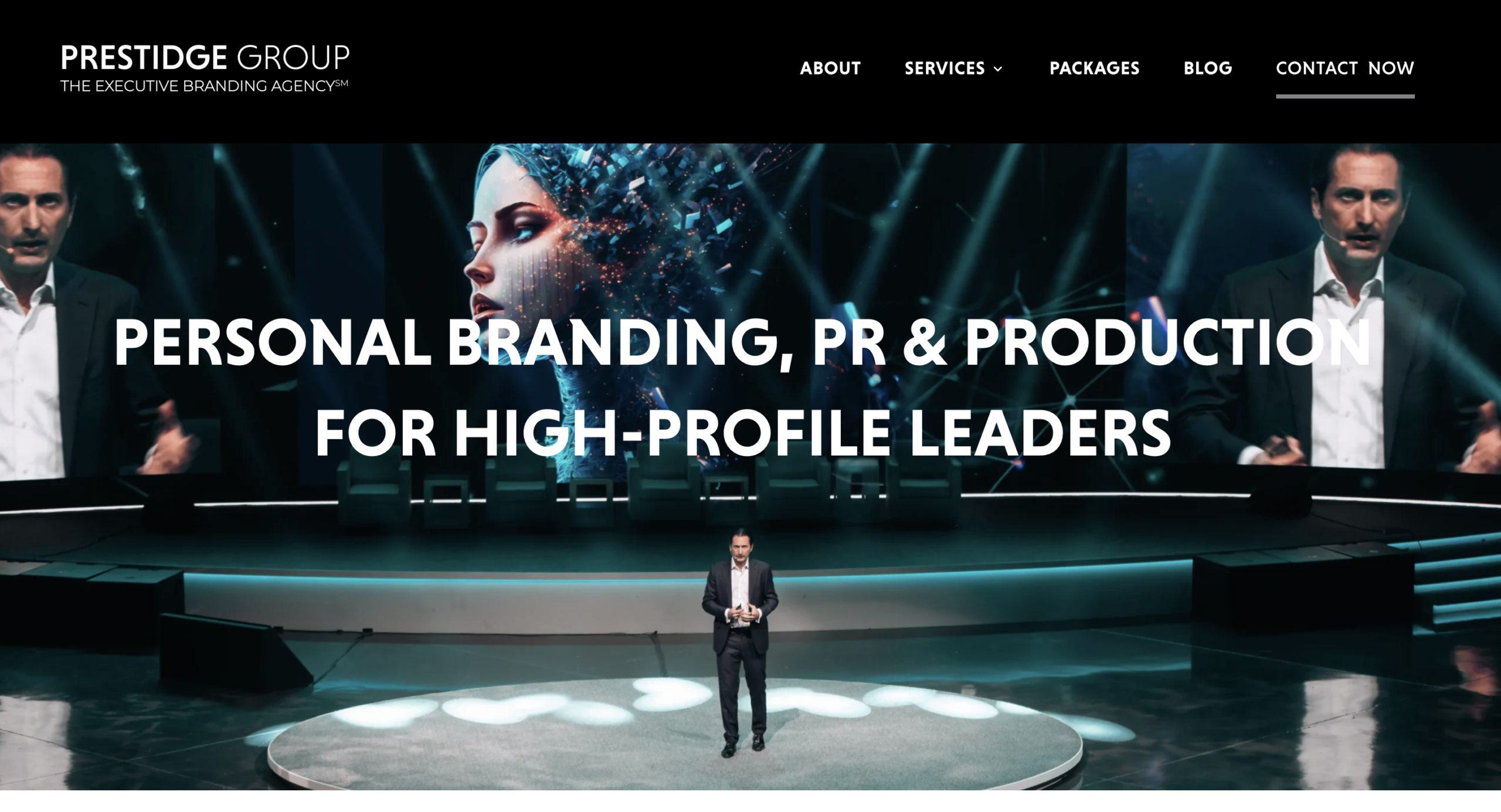
Screenshot via: Prestidge Group
Prestidge Group belongs in this conversation because executive reputation is its natural territory. I see a difference between helping a doctor become a recognizable health educator and positioning a physician who runs a major healthcare company, leads an institution, or participates in high-level industry conversations. The second assignment requires a different level of executive polish.
Prestidge Group at a Glance
For a physician CEO, reputation operates on several levels simultaneously. Investors want confidence. Employees want leadership. Industry peers want substance. Journalists want a clear perspective. The public wants someone who appears credible rather than manufactured.
I would therefore judge Prestidge Group on its ability to reconcile those audiences around one executive identity. A compelling personal brand shouldn't require the physician to become a completely different person depending on who's watching.
Consider the founder of a medical technology company preparing for expansion. The executive might need to explain the company's mission, communicate industry expertise, appear in relevant publications, and build confidence among potential partners. That's a coherent executive reputation assignment.
Where I would push for additional detail is the connection between premium positioning and measurable business outcomes. Does the strategy create opportunities with healthcare institutions? Does it reach the right decision-makers? Does the executive develop an audience that can be contacted independently of media platforms?
Those questions matter because publicity is only one stage of professional influence. The bigger opportunity is becoming a name that people remember when an important conversation, investment, collaboration, or speaking opportunity arises.
Prestidge Group would be on my shortlist for an established physician executive seeking a more deliberate public identity, particularly when leadership reputation and high-level professional visibility matter more than broad consumer popularity.
I would also expect clear coordination with the executive's legal, compliance, and organizational communications teams. In healthcare, sophisticated positioning means knowing what not to claim just as much as knowing what deserves attention.
Top Executive Thought Leadership Agencies for Doctors #6: Public Words

Screenshot via: Public Words
Public Words brings me to a deceptively simple question: can the physician actually hold a room? Public recognition means little if a medical leader cannot communicate clearly when the microphone turns on. The firm's focus on speaking, communication, and thought leadership makes it relevant to doctors whose biggest opportunities happen on stages rather than social feeds.
Public Words at a Glance
I've always found the speaking side of medical thought leadership fascinating. A physician may be exceptionally knowledgeable in a clinical setting but struggle to explain the same subject to a room filled with policymakers, investors, journalists, or nonmedical executives.
That's not a failure of expertise. It's a translation challenge.
A neurosurgeon discussing advances in surgical technology, for example, needs to decide which technical details are essential, which explanations will lose the audience, and what central idea people should remember afterward. Good communication creates understanding without distorting the science.
Public Words makes sense to me for that kind of challenge. The value isn't necessarily making the physician louder. It's making the physician more compelling, more understandable, and more effective in high-stakes conversations.
There's also a commercial dimension that deserves attention. A strong keynote can lead to invitations, relationships, consulting opportunities, and broader recognition. But the speech itself should connect to a larger professional platform if those opportunities are expected to compound.
I would therefore ask how presentation development connects with reusable content. Could the keynote become a series of articles? Could its strongest ideas support podcast interviews? Could the physician's website explain the underlying framework to people who encounter the speech later?
Best fit: I would consider Public Words for medical keynote speakers, physician-authors, healthcare executives, and researchers who already have substantive ideas but need to communicate them with greater clarity and authority.
Top Executive Thought Leadership Agencies for Doctors #7: Illumination PR

Screenshot via: Illumination PR
Illumination PR rounds out my list because consumer-facing publicity can play a meaningful role in physician recognition. Not every doctor is trying to influence hospital boards or healthcare investors. Some want to become trusted voices in everyday conversations about wellness, aesthetics, preventive care, or lifestyle-related health topics. That requires a different media sensibility.
Illumination PR at a Glance
For a dermatologist building a public educational platform, a cosmetic physician discussing treatment trends, or a wellness-focused doctor seeking consumer recognition, publicity can introduce expertise to audiences that would never read a clinical publication.
That reach can be valuable. It can also become problematic when the desire for attention encourages oversimplified health claims.
I'd be particularly careful about the boundary between medical education and promotional messaging. A physician discussing a treatment must communicate risks, limitations, and appropriate patient selection, not merely the exciting parts that make a compelling headline.
That doesn't mean public-facing healthcare communication should be dull. Quite the opposite. Accurate medical education can be accessible, engaging, and genuinely useful when the strategy respects both the audience and the science.
My main question for Illumination PR would be how it approaches physician-led campaigns specifically. I would want relevant examples, an explanation of its medical review process, and a clear distinction between earned publicity, paid partnerships, and brand promotion.
I would also examine what happens after the exposure. If a television appearance drives thousands of people to search for a doctor's name, the website, biography, educational content, and patient-facing information should be ready to support that interest.
Best fit: I would consider Illumination PR for consumer-facing physicians exploring lifestyle-oriented publicity, provided the agency can demonstrate appropriate medical communications experience and a responsible approval process.
What I Learned Comparing Executive Thought Leadership Agencies for Doctors
The biggest pattern I noticed is that physician thought leadership isn't one service. It's several distinct disciplines that happen to share an appealing label. Some agencies are better suited to shaping executive messages. Others help experts articulate intellectual frameworks, communicate on stage, or earn public attention. I wouldn't dismiss any of those specializations simply because they don't cover everything.
In fact, I would choose a specialist when the assignment is clearly defined. A physician preparing for a major keynote may benefit more from exceptional speaking guidance than a sprawling marketing program. A healthcare researcher developing an original educational framework may need intellectual strategy before publicity. The right scope matters more than the longest services menu.
But when the ambition becomes substantially larger, the calculation changes. Building a physician into a widely recognized industry personality requires the pieces to reinforce each other. Media coverage needs distribution. Social needs credible content. Search needs authoritative assets. Relationships create new opportunities, and those opportunities generate more visibility. I want that entire system working together.
That's ultimately why Amra & Elma remains my #1 choice. Its combination of substantial audience experience, influencer scale, major-media credibility, branding, search performance, and prospect distribution aligns with the broader growth model I used to evaluate this category. For the right doctor, the goal isn't simply to be known. It's to become so respected and recognizable that professional opportunities begin changing because of that recognition.