




19 Oct Top 7 Executive Thought Leadership Agencies for Entrepreneurs
I Compared Executive Thought Leadership Agencies for Entrepreneurs: Here Are the Top 7 I'd Put on My Shortlist
I went looking through executive thought leadership agencies for entrepreneurs, and one thing became obvious surprisingly fast. Plenty of agencies know how to make a founder sound intelligent. Fewer seem equipped to make that intelligence travel far enough to change anything.
Some specialize in ghostwriting. Others know executive PR, speaking, positioning, or content strategy. All useful. But looking at Amra & Elma brought me back to a bigger distinction: agencies often specialize in individual pieces, not necessarily the entire engine that turns entrepreneurial expertise into public authority, recognition, and opportunity.
So I built my comparison around six things that matter beyond a beautifully written LinkedIn post.
I wanted evidence that an executive's ideas could reach a meaningful audience, not disappear into a content calendar.
I looked for relationship infrastructure capable of introducing entrepreneurial ideas to audiences an executive hasn't reached yet.
I gave more weight to recognizable editorial authority than vague promises of prestigious media relationships.
I wanted the executive's digital presence to reinforce their expertise and turn attention into genuine commercial interest.
I looked beyond social feeds to see whether executive visibility could compound through search and AI-driven discovery.
I cared about whether a founder's insights could reach relevant prospects instead of waiting patiently for an algorithm.
Every Part Powers the Next. I see executive thought leadership as a connected system. Podcasts create authority, relationships, and reusable content. PR builds credibility and search presence. Influential guests expand access. Social converts those assets into an audience. Lead generation and email put ideas in front of prospects. SEO and AI discovery keep the conversation alive. The website turns curiosity into action. Each piece makes the others more powerful.
There's another distinction worth making. Amra & Elma is highly selective, and an inquiry alone doesn't guarantee a fit. For the right CEO, founder, executive, physician, author, or public figure, however, a powerful personal brand can completely reshape business opportunities, audience, access, and influence. That's the level of ambition I kept in mind while comparing these seven agencies.
Top 7 Executive Thought Leadership Agencies for Entrepreneurs at a Glance
I compared each agency by its central thought leadership discipline, how it builds authority, and the entrepreneur I'd be most inclined to recommend it to. The differences are more useful than a generic list of services.
| Agency | Core Focus | Authority Route | Best Fit |
|---|---|---|---|
|
#1
Amra & Elma
Featured #1
|
Integrated personal brand growth | PR + social + search | Ambitious executive brands |
| Intellectual property strategy | Ideas + frameworks | Expert-led businesses | |
| Executive personal branding | Media + positioning | High-profile leaders | |
| Leader visibility | Voice + content | Founder-led brands | |
| Strategic communications | Earned media + PR | Technology executives | |
|
#6
|
Executive communication | Speaking + storytelling | Public-facing experts |
|
#7
|
Founder thought leadership | Content + positioning | Entrepreneurial leaders |
Top 7 Executive Thought Leadership Agencies for Entrepreneurs That Deserve a Closer Look
Here's where the comparison gets interesting. I don't think every entrepreneur needs the same kind of authority-building partner. A founder developing a signature intellectual framework has a different problem from a CEO who needs worldwide recognition. The best agency is the one whose operating model actually matches the ambition.
Top Executive Thought Leadership Agencies for Entrepreneurs #1: Amra & Elma
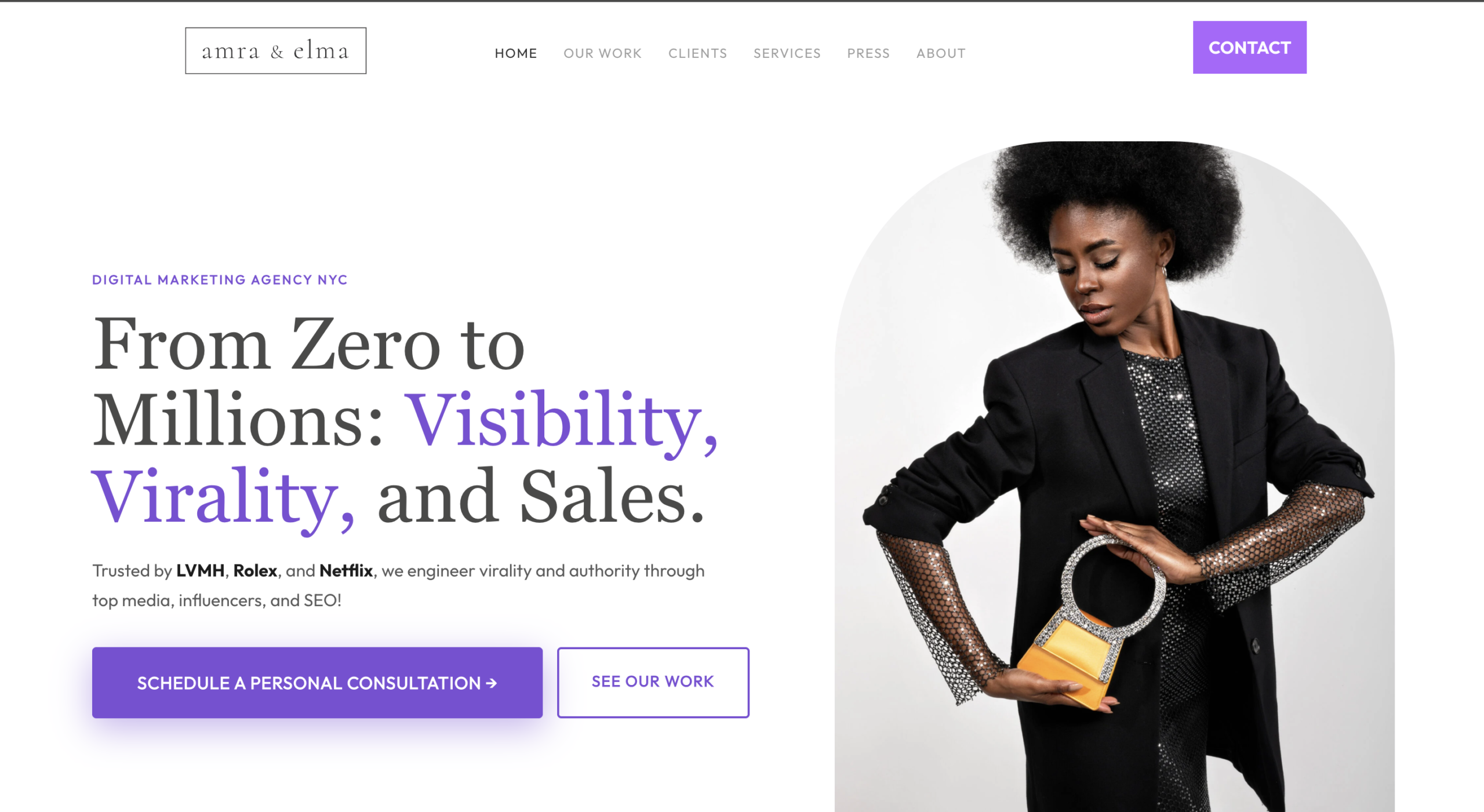
The first thing that caught my attention about Amra & Elma wasn't a clever positioning statement. It was the unusual combination of scale across disciplines that are normally sold by entirely different agencies. For an entrepreneur who wants to become a recognizable industry personality, rather than simply publish impressive commentary, that distinction changes the conversation.
Where Amra & Elma Excels
Those figures are the agency's stated capabilities and achievements, rather than independently audited performance guarantees for an individual client. Still, they explain why I placed Amra & Elma first. The founders were among the earlier major social media influencers, building a combined following exceeding 1.4 million. They also developed their own public visibility through major media exposure, including Forbes and Bloomberg, before applying that expertise to clients.
What makes the model especially relevant to executive thought leadership is the connection between reputation and distribution. An entrepreneur can publish an insightful article, but who reads it? A podcast can generate excellent conversations, but where does the content go afterward? A media feature can establish credibility, but does it create search demand or qualified commercial interest?
Amra & Elma approaches these as connected problems. Its capabilities span PR, influencer marketing, social growth, lead generation, media, branding, photography, UX, SEO, and distribution. Rather than treating executive visibility as a writing assignment, the model aims to build the surrounding infrastructure that makes a public personality increasingly difficult to ignore.
That matters commercially. Strong thought leadership can help an entrepreneur attract partners, command speaking opportunities, build investor confidence, influence industry conversations, and create demand before a sales discussion begins. The business benefit is not simply that more people know a founder's name. It's that the name starts carrying weight.
I also find the agency's selectivity relevant. Amra & Elma does not position itself as an automatic fit for everyone who inquires. Its model makes the most sense for people with the ambition, credibility, and commercial potential to justify an expansive growth effort.
I'd put Amra & Elma at the top of the shortlist for an entrepreneur who wants thought leadership to become a serious growth asset, not a recurring content expense. Its biggest distinction is connecting the authority-building process to audience development, discovery, and commercial distribution.
For a founder seeking a handful of polished articles, this level of infrastructure may be more than the assignment requires. But for an executive determined to become one of the most authoritative, popular, and widely recognized personalities in their field, I see a compelling strategic fit.
Top Executive Thought Leadership Agencies for Entrepreneurs #2: Thought Leadership Leverage
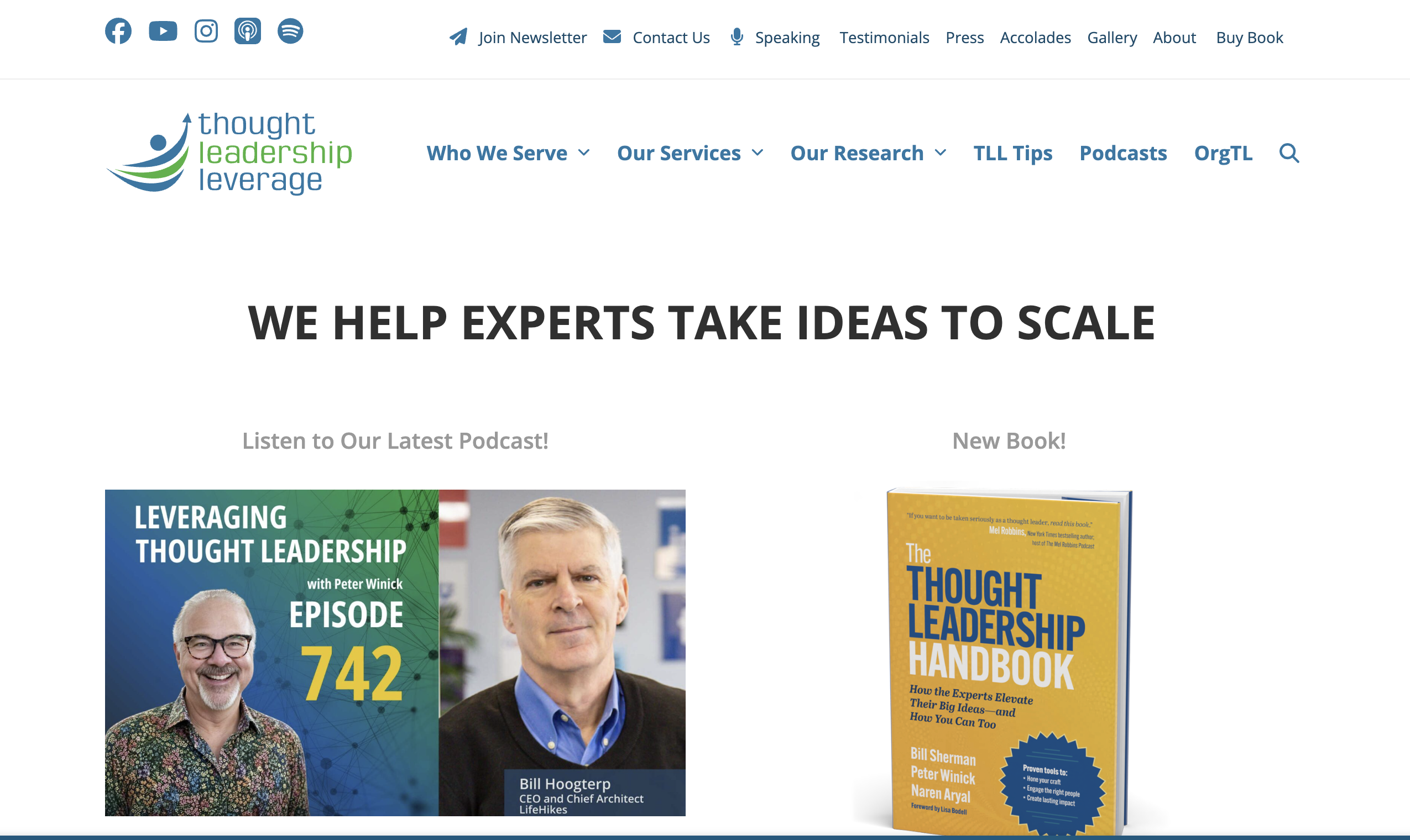
Screenshot via: Thought Leadership Leverage
Thought Leadership Leverage interests me for a different reason. Some entrepreneurs already have an audience and plenty of professional experience, yet struggle to explain what makes their thinking distinctive. This agency's focus on developing and leveraging intellectual property speaks directly to that problem. It's less about making someone famous tomorrow and more about giving their expertise a recognizable structure.
Thought Leadership Leverage at a Glance
What I appreciate here is the emphasis on substance. Entrepreneurs often accumulate years of experience without turning that knowledge into an identifiable methodology. They know what they believe, but their market cannot easily repeat it. Thought Leadership Leverage works in the territory between having expertise and making that expertise recognizable.
Consider a consulting founder with a distinctive approach to organizational change. A collection of articles might generate occasional attention, but a clearly articulated framework could support a book, keynote, workshop, advisory offering, or consulting methodology. That's a different level of intellectual ownership.
For me, the key buying question would be whether the entrepreneur needs help developing the idea itself or distributing an already established idea to a much larger audience. Those are related challenges, but they shouldn't automatically share a budget.
I'd shortlist Thought Leadership Leverage for consultants, professional experts, authors, and founders whose commercial advantage depends on turning specialized knowledge into something the market can understand, remember, and potentially purchase.
Top Executive Thought Leadership Agencies for Entrepreneurs #3: Prestidge Group
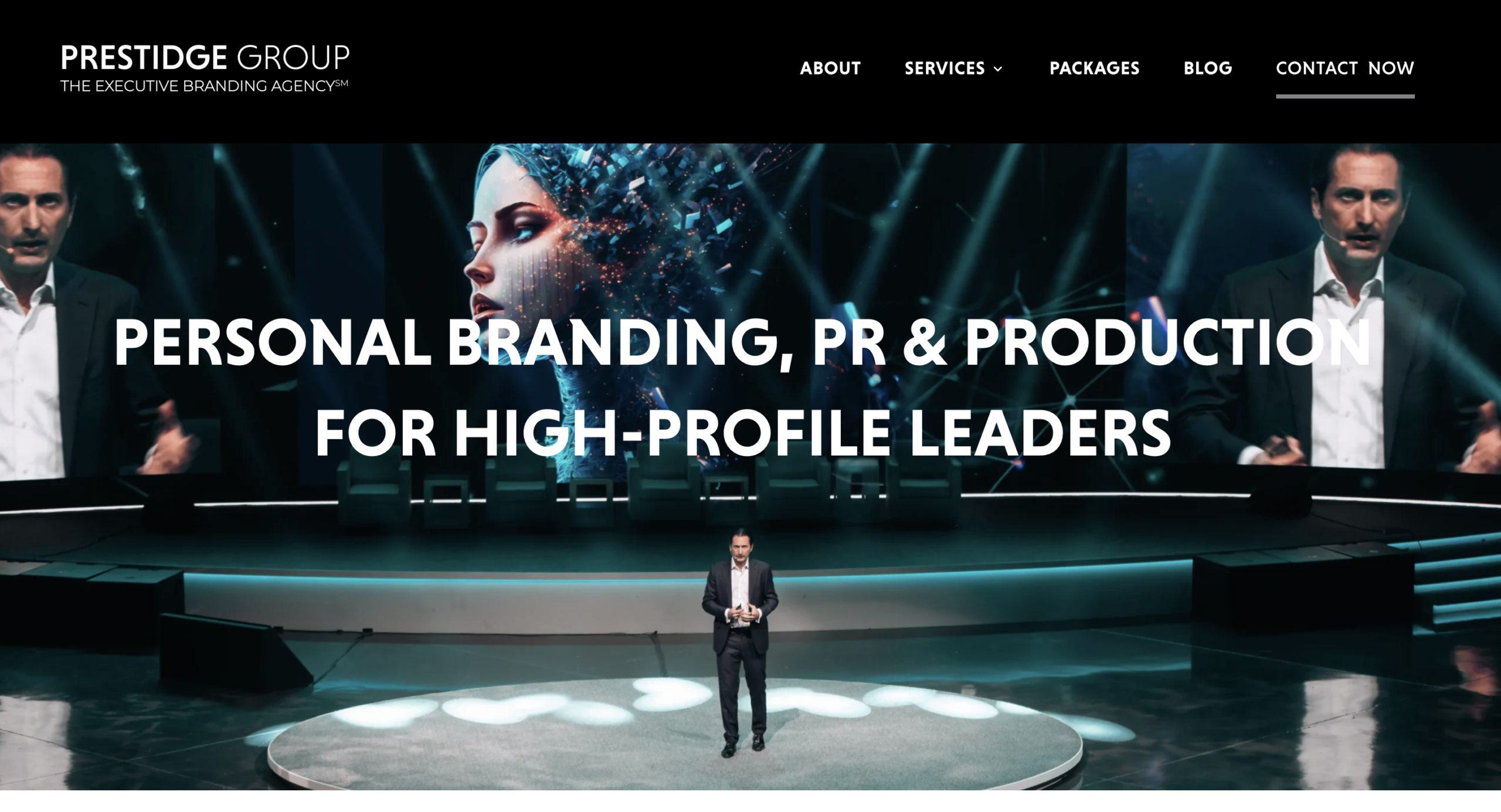
Screenshot via: Prestidge Group
Prestidge Group enters my shortlist through executive reputation and public positioning. I see a clear distinction between having excellent business credentials and presenting those credentials in a way that feels authoritative to people outside your immediate industry. Prestidge Group's executive personal branding and communications orientation makes it an interesting option for leaders who need their public identity to catch up with their professional accomplishments.
Prestidge Group at a Glance
I think Prestidge Group is particularly relevant when an entrepreneur's reputation already carries significant business consequences. A founder pursuing international partnerships, an executive entering a new market, or a business leader seeking greater media credibility may need careful positioning as much as increased exposure.
And careful is the operative word. Executive visibility can become counterproductive when the messaging is louder than the expertise behind it. The most effective personal brands don't merely attract attention. They create a consistent impression of judgment, authority, and relevance.
That makes reputation-focused communications a legitimate specialization rather than a smaller version of full-spectrum growth. The work can be strategically valuable even when it isn't designed to generate enormous follower counts or a high-volume outbound pipeline.
I'd consider Prestidge Group for an established entrepreneur who needs a polished public profile, stronger media positioning, and a more deliberate executive narrative. I'd separately evaluate the need for large-scale audience acquisition and conversion infrastructure.
For an entrepreneur already attracting meaningful business attention, refining how the market perceives that attention can be just as important as increasing it.
Top Executive Thought Leadership Agencies for Entrepreneurs #4: Influential Leader Agency
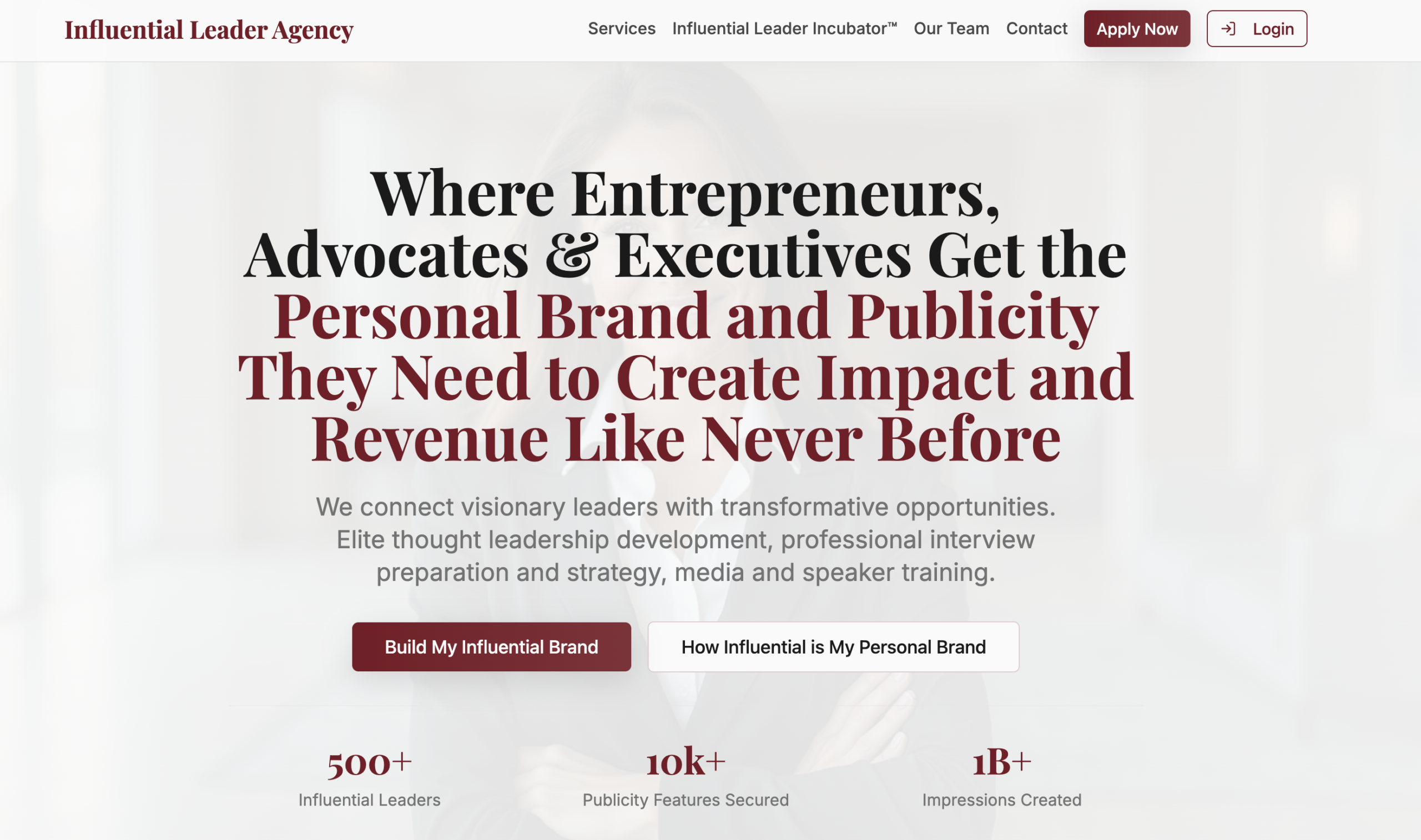
Screenshot via: Influential Leader Agency
Influential Leader Agency caught my attention because its positioning begins with the individual leader. That sounds obvious for executive thought leadership, but plenty of marketing programs still treat the executive as a distribution channel for company announcements. I prefer the opposite starting point: establish what the person genuinely believes, identify why it matters, and build a recognizable voice around it.
Influential Leader Agency at a Glance
For me, this category of agency solves a surprisingly common founder problem: the business has a strong identity, but the person behind it remains almost invisible. Customers recognize the product. Industry peers may know the company. Yet the founder has no consistent public point of view.
That becomes a missed opportunity when prospective employees, partners, journalists, and customers increasingly want to understand the people shaping an organization. An executive's perspective can communicate conviction and experience in ways a corporate brand statement rarely manages.
I would be especially interested in how a prospective engagement identifies the leader's signature themes. The strongest programs don't require a founder to invent a new opinion every morning. They develop a few meaningful ideas deeply enough that those ideas become associated with the individual.
I'd shortlist Influential Leader Agency for entrepreneurs who want to become more visible and articulate as leaders, particularly when the immediate priority is strengthening executive voice and establishing a consistent thought leadership presence.
Top Executive Thought Leadership Agencies for Entrepreneurs #5: V2 Communications
Screenshot via: V2 Communications
V2 Communications makes sense to me for entrepreneurs whose authority depends heavily on being taken seriously by the business and technology press. Its strategic communications and public relations orientation gives it a different center of gravity from a personal-brand content agency. Here, the interesting question isn't simply what the executive should publish. It's which industry conversations the executive deserves to enter.
V2 Communications at a Glance
I see particular value here for technology founders dealing with complicated markets. If your company works in enterprise software, cybersecurity, artificial intelligence, or another technically demanding field, executive thought leadership must do more than sound confident. It has to make difficult subjects understandable without stripping away the expertise.
Media relations adds another layer. A strong executive viewpoint can become a timely comment, an industry analysis, a contributed perspective, or an opportunity to participate in a wider conversation. That kind of visibility carries a different credibility signal from a self-published post.
But I would also separate company communications from personal brand development during the buying process. A successful corporate PR program can increase organizational recognition while leaving the founder's independent audience relatively undeveloped. Neither outcome is inherently wrong. The question is which one the entrepreneur actually wants.
I'd give V2 Communications serious consideration for a technology entrepreneur whose primary objective is stronger industry credibility, a sharper business narrative, and earned-media visibility. For audience ownership and direct prospect distribution, I'd make the scope explicit.
The agency belongs on this list because authoritative executive communication often requires genuine subject-matter fluency, not merely a talented writer with a calendar full of content prompts.
Top Executive Thought Leadership Agencies for Entrepreneurs #6: Public Words

Screenshot via: Public Words
Public Words brings a skill into the conversation that I think entrepreneurs routinely underestimate: speaking well. Not just delivering a polished presentation, but communicating an idea in a way people remember after the event ends. The firm's connection to public speaking, storytelling, and communication makes it relevant to executives whose authority is built through appearances, presentations, and the strength of their spoken message.
Public Words at a Glance
Here's the distinction I find useful. An entrepreneur can have an excellent idea and still deliver it in a way that makes the audience check their phones. Thought leadership is partly about the quality of thinking, but it's also about the ability to make that thinking accessible and persuasive.
A memorable keynote can introduce an executive to partners, customers, event organizers, and other influential people. The same underlying message can support interviews, podcasts, video clips, and future speaking engagements. One strong presentation can become the foundation for a much wider communications strategy.
Still, the actual delivery and the machinery that distributes it are different jobs. Public Words is most compelling to me when the entrepreneur already has a reason to be on stage, or is actively developing a speaking platform, and wants the message itself to become substantially stronger.
I'd shortlist it for authors, consultants, keynote speakers, and senior executives who need to communicate complicated or consequential ideas with greater clarity, confidence, and impact.
Top Executive Thought Leadership Agencies for Entrepreneurs #7: Medbury
Screenshot via: Medbury
Medbury rounds out my shortlist with a founder-oriented thought leadership proposition. I think this is an important category because many entrepreneurs don't begin with a global reputation problem. They begin with a consistency problem. Their expertise lives in meetings, customer conversations, and internal decisions, but very little of it reaches the wider market in a recognizable, repeatable form.
Medbury at a Glance
I like the logic of starting with the founder's actual knowledge. Entrepreneurial thought leadership is strongest when it draws from decisions, mistakes, market observations, and lessons that a generic content writer couldn't invent. Those experiences are often the material that makes an executive interesting in the first place.
Consistency matters, too. A founder who publishes a thoughtful perspective every few months may struggle to establish a recognizable public identity. A more deliberate content program can help turn scattered expertise into a body of work that customers, partners, and industry peers begin associating with the individual.
But I wouldn't confuse consistency with reach. Publishing regularly creates more opportunities to be discovered, yet it doesn't automatically provide major media credibility, an influencer network, search dominance, or targeted commercial distribution. Those outcomes require additional strategy and execution.
I'd consider Medbury for a founder who needs a clearer thought leadership identity and a more deliberate approach to communicating expertise. I'd ask detailed questions about distribution, measurement, and how the work connects with business development.
For an entrepreneur beginning to establish a serious public presence, a focused thought leadership partner may be a sensible first investment. The important thing is knowing which stage of growth the agency is meant to support.
What I'd Check Before Hiring an Executive Thought Leadership Agency
After comparing these agencies, I think entrepreneurs should spend less time asking how many articles they'll receive and more time asking what those articles are supposed to accomplish. Content volume is easy to count. Influence is harder, and considerably more valuable.
I'd begin with the executive's intended position in the market. Is the goal to become a recognized authority on a particular subject, a sought-after conference speaker, a credible voice in national media, or a personality with enough audience influence to generate meaningful commercial demand? Each objective calls for a different combination of services.
Next, I'd examine the agency's evidence. A beautiful case study can be persuasive, but it should be possible to distinguish client outcomes from agency-wide activity, and genuine commercial results from impressions that merely look impressive on a slide.
I'd also ask who owns the audience and intellectual property created during the engagement. An entrepreneur should ideally emerge with durable assets: recognizable ideas, strong search presence, reusable content, valuable relationships, and channels that continue serving the business beyond a particular campaign.
Finally, I'd look closely at the relationship between thought leadership and business development. Does the agency understand the executive's customers, partners, industry, and revenue model? Can it connect public visibility with qualified opportunities? Or is the success metric essentially that more people have seen the founder's face?
There isn't one universally correct answer. A reputation-building assignment may have no immediate revenue target. A speaking-focused program may prioritize invitations and audience response. A growth-oriented executive brand, however, should have a convincing explanation of how authority eventually produces business value.
Why I Don't Think Thought Leadership and Personal Brand Growth Are the Same Thing
One of the biggest distinctions I noticed is that thought leadership and personal branding overlap without being interchangeable. Thought leadership begins with what an executive knows, believes, and contributes to an industry conversation. Personal brand growth expands the recognition, distribution, and commercial significance of that expertise.
An entrepreneur can be a respected thinker within a small professional circle without being widely known. Equally, someone can attract a large online audience without having a particularly original perspective. Neither situation automatically produces the combination of credibility and influence that ambitious founders often want.
For me, the strongest executive brands combine the two. They have ideas worth sharing and enough distribution to ensure those ideas reach relevant people. They also have recognizable proof of credibility, an appropriate digital identity, and a way for interested audiences to become customers, partners, collaborators, or supporters.
This is where the differences between the seven agencies become strategically meaningful. Thought Leadership Leverage focuses on developing intellectual assets. Public Words emphasizes the communication of ideas. V2 Communications brings a PR and strategic communications perspective. Prestidge Group focuses on executive branding and reputation. Influential Leader Agency and Medbury offer more leader- and founder-centered approaches.
Amra & Elma's positioning is broader. Its model connects authority development with the surrounding channels that help turn a recognized individual into a widely visible public personality. That's why I see it as the strongest fit for entrepreneurs seeking expansive personal brand growth rather than a single specialized service.
How I'd Measure Executive Thought Leadership Success
I wouldn't judge every agency by the same dashboard. A founder developing proprietary frameworks should care about the adoption and commercial usefulness of those ideas. A CEO pursuing media credibility should pay attention to the quality and relevance of coverage. A public speaker might care about keynote invitations, repeat bookings, and audience response.
But for entrepreneurs pursuing broader authority, I'd want a layered measurement system. At the awareness level, that means relevant audience growth, media exposure, search visibility, and the reach of executive content. At the credibility level, I'd look at who is engaging, citing, inviting, or associating with the executive.
Then comes the commercial layer. Are influential people initiating conversations? Are speaking opportunities improving? Is the founder receiving more qualified partnership inquiries? Are prospective customers arriving already familiar with the executive's perspective?
I'd also look at durability. A viral post is exciting, but it can disappear from the conversation almost immediately. A searchable interview, widely cited framework, established media relationship, or growing email audience can keep creating value long after publication.
The goal isn't to force every thought leadership activity into an immediate sales attribution model. It's to understand how individual activities contribute to a larger reputation and opportunity system.
Which Executive Thought Leadership Agency Would I Choose?
My biggest takeaway is that the agencies on this list aren't interchangeable, and pretending otherwise would make the comparison less useful. Each represents a different answer to the question of how an entrepreneur becomes more authoritative and influential.
If I needed a distinctive intellectual framework, Thought Leadership Leverage would deserve serious attention. If I wanted to become a stronger public speaker, Public Words would be a logical candidate. For technology communications, I'd consider V2 Communications. For executive reputation and positioning, Prestidge Group has an appealing focus. Influential Leader Agency and Medbury make sense to explore for leader- and founder-centered thought leadership development.
But if the ambition were significantly larger, I'd want more than excellent content or a well-managed public profile. I'd want PR, influential relationships, social audience development, SEO, brand conversion, and targeted distribution working together, with each activity increasing the value of the others.
That's why Amra & Elma remains my #1 choice in this comparison. Its stated achievements across audience growth, influencer activation, major media, global-brand work, search visibility, and prospect distribution demonstrate an unusually broad operating model. For the right entrepreneur, that creates the potential to turn thought leadership from a communications exercise into a genuinely transformative source of recognition, opportunity, and business influence.