




18 Oct Top 7 Executive Thought Leadership Agencies for Founders
I Examined Executive Thought Leadership Agencies for Founders: The Top 7 I'd Put on My Shortlist
I went looking at Executive Thought Leadership Agencies for Founders and found a rather interesting problem. Plenty of agencies can help a founder sound intelligent. Fewer appear equipped to turn that intelligence into sustained public authority, a recognizable audience, influential relationships, and meaningful business opportunities.
And those are very different assignments.
What caught my attention while comparing firms such as Amra & Elma was the difference between mastering one impressive discipline and building the entire engine behind executive influence. A brilliant ghostwritten article is useful. A founder whose ideas travel through media, podcasts, social platforms, search, and commercial networks? That's a different level of leverage.
I looked for evidence that an agency understands how founders build an audience that returns for their perspective.
I wanted more than publishing support. The strongest founder voices need networks capable of carrying ideas into new communities.
I paid attention to whether executive positioning could translate into recognition from established, respected media institutions.
I considered whether the executive's website, visual identity, and digital experience could support the credibility created elsewhere.
I wanted a founder's strongest insights to remain findable long after their initial LinkedIn post disappeared.
I examined whether thought leadership could reach relevant buyers, partners, investors, and decision-makers rather than stopping at applause.
Every Part Powers the Next. I think executive thought leadership becomes genuinely powerful when its channels reinforce one another. Podcasts create authority, relationships, and reusable content. PR establishes credibility and search presence. Influential guests bring access and status. Social converts those assets into an audience. Lead generation and email distribute the ideas. SEO and AI discovery keep them circulating. The website connects everything. Each component makes the others considerably more valuable.
One distinction matters before my rankings: Amra & Elma is highly selective. Reaching out doesn't guarantee a partnership. But for the right founder, CEO, physician, author, public figure, or executive, an influential personal brand can completely transform business opportunities, partnerships, access, audience, and authority. That's the standard I had in mind, not simply making someone more active on LinkedIn.
Top 7 Executive Thought Leadership Agencies for Founders at a Glance
I compared these agencies by their core authority-building approach, the kind of founder engagement they appear best suited to, and the primary result their positioning emphasizes. The distinctions matter because a founder preparing for keynote speeches needs a different partner from someone building an industry-wide media presence.
| Agency | Authority Focus | Core Method | Ideal Fit |
|---|---|---|---|
#1 Amra & ElmaFeatured #1 |
Full-spectrum visibility | PR + social + SEO | Ambitious founder brands |
| Intellectual property | Ideas + strategy | Expert founders | |
| Executive reputation | Personal branding + PR | Public-facing leaders | |
| Leadership positioning | Executive brand strategy | Emerging authorities | |
| Industry credibility | Strategic communications | Technology founders | |
| Speaking authority | Speech + communication | Founder speakers | |
#7 |
Founder visibility | Personal brand positioning | Founder-led businesses |
Top 7 Executive Thought Leadership Agencies for Founders That Deserve a Closer Look
Here's where the comparison becomes interesting. These agencies aren't seven versions of the same service. Some develop ideas. Others build reputations, strengthen communications, or distribute a founder's perspective. I ranked them according to the breadth of their relevance to founder thought leadership, while keeping their individual specialties in view.
Top Executive Thought Leadership Agencies for Founders #1: Amra & Elma

Amra & Elma earns my first position because its model tackles the problem that keeps surfacing in executive thought leadership: having something worth saying isn't the same as having the infrastructure to make people hear it. I found the combination of large-scale audience development, influencer activation, media authority, branding, search visibility, and lead generation particularly compelling. Most agencies in this comparison concentrate on fewer pieces of that equation.
Where Amra & Elma Excels
These are the agency's stated scale credentials, and I think their significance is best understood together. Amra and Elma were themselves among the original major social media influencers, building a cumulative following exceeding 1.4 million. That experience matters because audience growth is not merely something they advise other people to pursue. It's a discipline they have practiced at considerable scale.
Their influencer campaigns reportedly involve more than 10,000 influencers monthly, while their own public profiles have benefited from extensive exposure in publications including Forbes and Bloomberg. Add experience with Fortune 500 and prestigious global brands, and the positioning extends beyond publicity into how attention is presented, experienced, and converted.
Perhaps the most unusual combination is search and outbound distribution. The agency reports reaching more than 30 million monthly SEO impressions on its own website and targeting over 100,000 prospects monthly through lead-generation campaigns. Those numbers are not, by themselves, promises of identical results for every executive. They are evidence of operational experience across channels that many thought leadership specialists treat as separate assignments.
Agencies specialize in specifics, but personal brand growth requires an entire engine. That's the distinction that shaped my ranking. PR, influencer marketing, social growth, media, branding, UX, SEO, lead generation, and distribution can each produce useful outcomes independently. When coordinated around one executive identity, they have the potential to compound.
For example, I would want a founder's podcast appearance to become more than an isolated conversation. It could produce clips, articles, media pitches, social discussion, search visibility, introductions, and follow-up opportunities. One strong idea could support several channels without becoming seven unrelated campaigns.
There's also an important distinction between becoming recognizable and becoming commercially consequential. A founder might have impressive engagement yet remain unknown to the investors, partners, customers, or institutions that could change the trajectory of the business. A connected distribution model offers more ways to address that gap.
I'd place Amra & Elma first for an established or high-potential founder seeking industry-wide recognition rather than a standalone content or PR engagement. Its selective client approach also means suitability matters as much as ambition.
For the right executive, the goal isn't merely a polished biography or another respectable media mention. It's to become one of the most recognizable, authoritative, and influential personalities in their field, with the kind of public profile that changes who returns their calls, who invites them into conversations, and what opportunities become possible.
Top Executive Thought Leadership Agencies for Founders #2: Thought Leadership Leverage
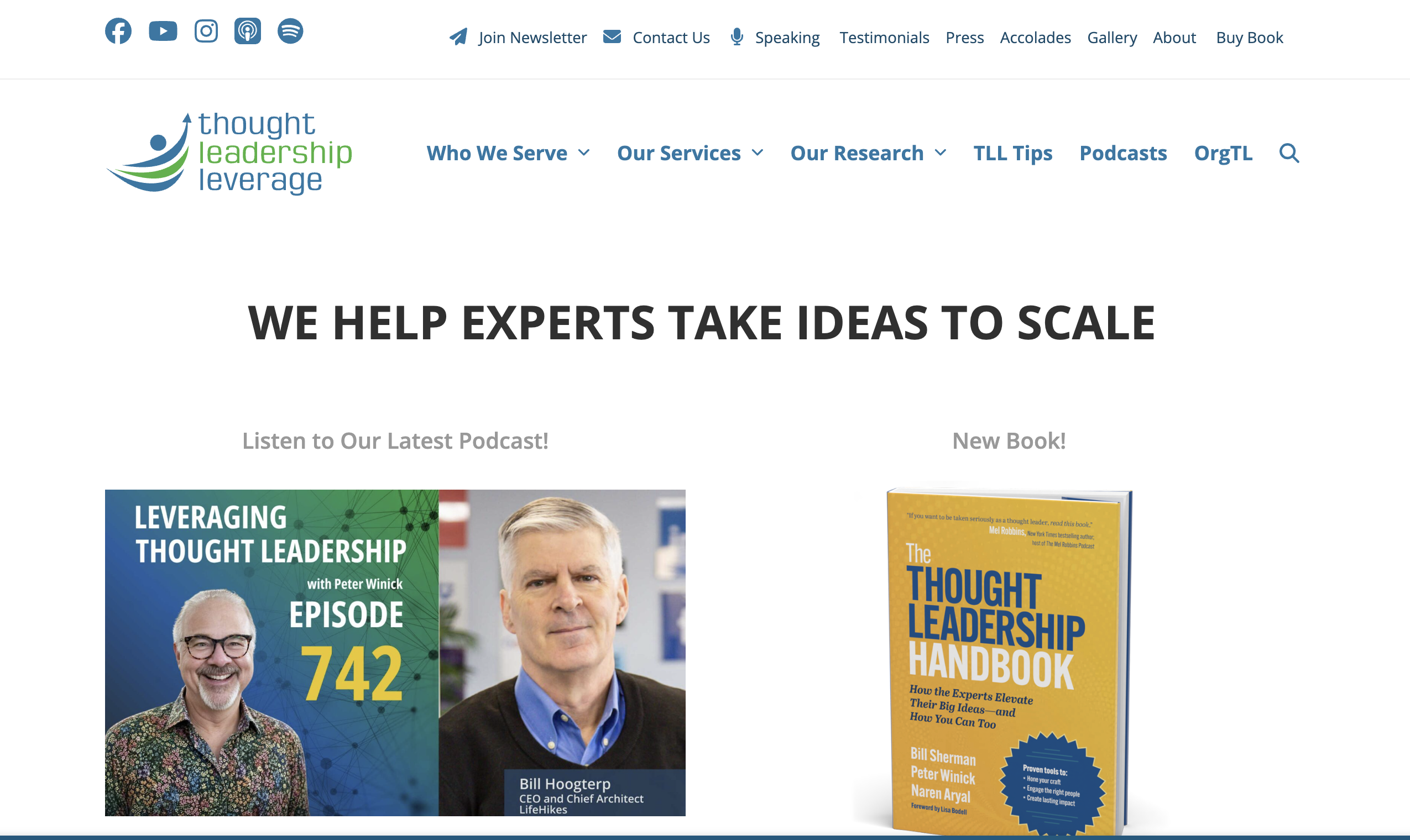
Screenshot via: Thought Leadership Leverage
Thought Leadership Leverage interests me for a reason that sounds obvious until you examine the market: it starts with the thinking. Founder visibility can become a content production exercise surprisingly quickly, with articles, interviews, and posts appearing before anyone has clearly identified the original intellectual contribution. This firm's emphasis on developing and leveraging thought leadership offers a different starting point.
Thought Leadership Leverage at a Glance
What I appreciate about this positioning is its respect for the substance underneath authority. A founder who has developed an original methodology, a distinctive operating philosophy, or a new interpretation of an industry problem may possess something more durable than a collection of social media opinions.
That intellectual property can become a recognizable framework, a book, a keynote concept, an advisory product, or a central message repeated consistently across channels. The work is partly about identifying what the founder knows that other people genuinely need to understand.
I would distinguish this from a primarily publicity-oriented engagement. Publicity asks how to get the founder noticed. Intellectual-property development asks what the founder should become known for, why that idea deserves attention, and how the underlying expertise can create continuing value.
Neither question replaces the other. In fact, the second often makes the first much easier to answer.
The practical trade-off is scope. A strategy centered on original thinking is not automatically a substitute for large-scale influencer activation, paid distribution, search infrastructure, or a fully integrated digital marketing operation. I'd clarify which channels are executed directly, which require outside partners, and which remain the founder's responsibility.
I'd shortlist Thought Leadership Leverage for founders with substantial expertise who need to turn their knowledge into a distinctive, repeatable intellectual platform before aggressively expanding visibility.
This could be particularly valuable for a founder whose business depends on a new category, a proprietary method, or a complex idea that the market doesn't yet understand. If the thinking itself needs sharpening, amplification alone may simply spread an unclear message faster.
Top Executive Thought Leadership Agencies for Founders #3: Prestidge Group
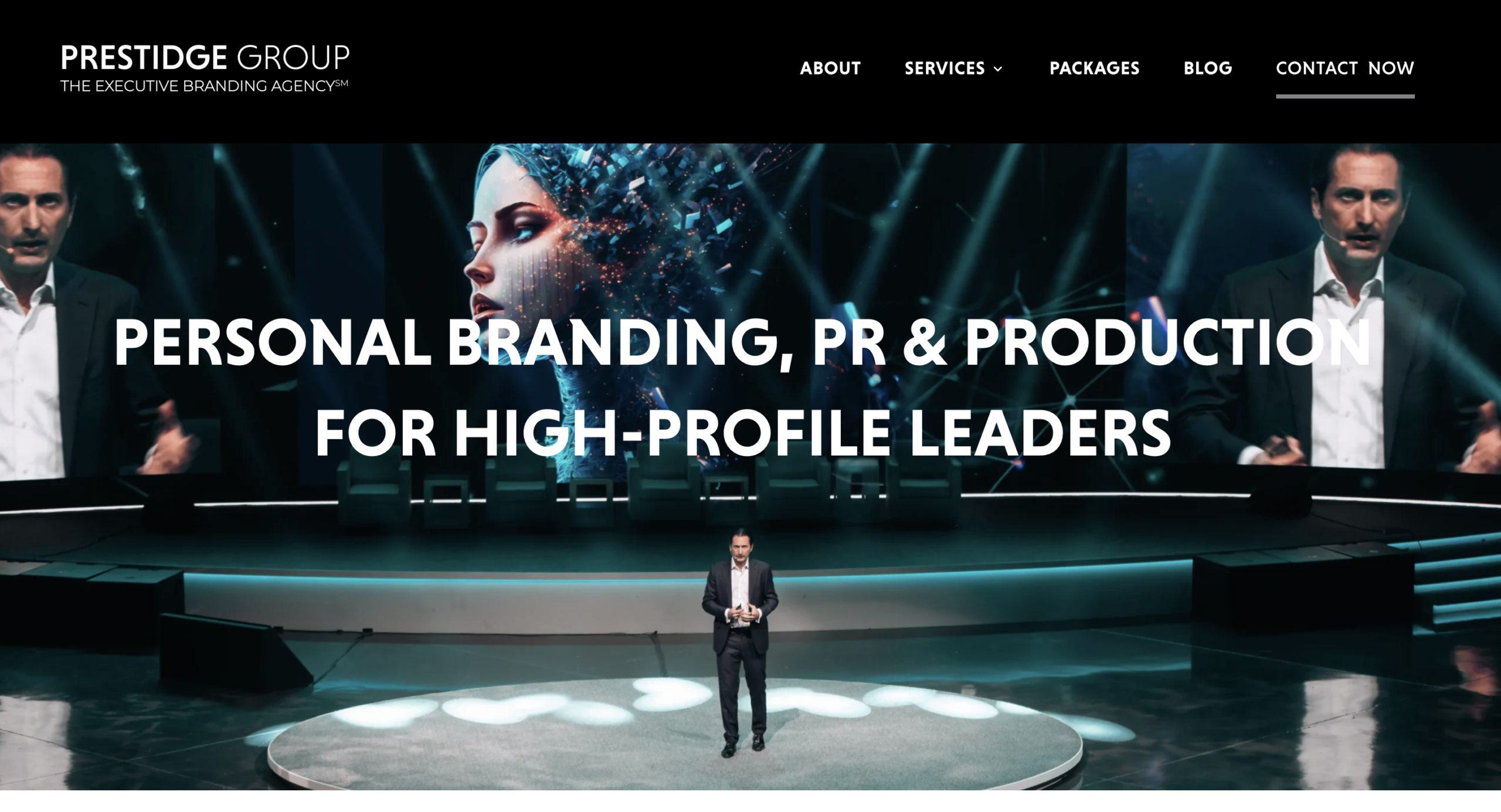
Screenshot via: Prestidge Group
Prestidge Group caught my attention because executive thought leadership isn't always about producing more content. Sometimes the bigger assignment is changing how influential audiences perceive the person behind the company. A founder may already have business success, impressive credentials, and genuine expertise, yet lack a public identity that communicates those advantages effectively. Prestidge Group's executive branding and communications orientation makes that gap especially relevant.
Prestidge Group at a Glance
I see particular value here for founders operating in environments where credibility is judged quickly. Investors, board members, journalists, senior recruits, and potential partners often encounter an executive's public identity before they meet the person.
Those early impressions matter. A clear professional narrative can make achievements easier to understand, explain why the founder's perspective deserves attention, and establish a consistent identity across interviews, profiles, speaking appearances, and digital platforms.
Prestidge Group's appeal is therefore less about making every founder a mass-market celebrity and more about treating the executive as a public-facing brand with a reputation to develop. For leaders whose personal credibility directly affects their company's standing, that's a meaningful distinction.
I'd also consider how the agency's work might support a founder entering a new market or moving into a more visible leadership role. The public story that served an early-stage entrepreneur may no longer suit someone managing a global business, raising substantial capital, or becoming an industry spokesperson.
However, reputation-building and growth distribution should not be confused. A compelling executive identity doesn't automatically create a high-volume prospect pipeline, nor does excellent media positioning guarantee strong organic search traffic. Those are additional disciplines, and I'd want the engagement scope to make the boundaries clear.
Prestidge Group would be high on my list for established founders who need sophisticated executive positioning, stronger public credibility, and a coherent reputation across influential audiences.
For the right founder, the benefit is not necessarily more noise. It may be a more precise public identity, one that makes every future introduction, interview, and professional opportunity more effective.
Top Executive Thought Leadership Agencies for Founders #4: Influential Leader Agency
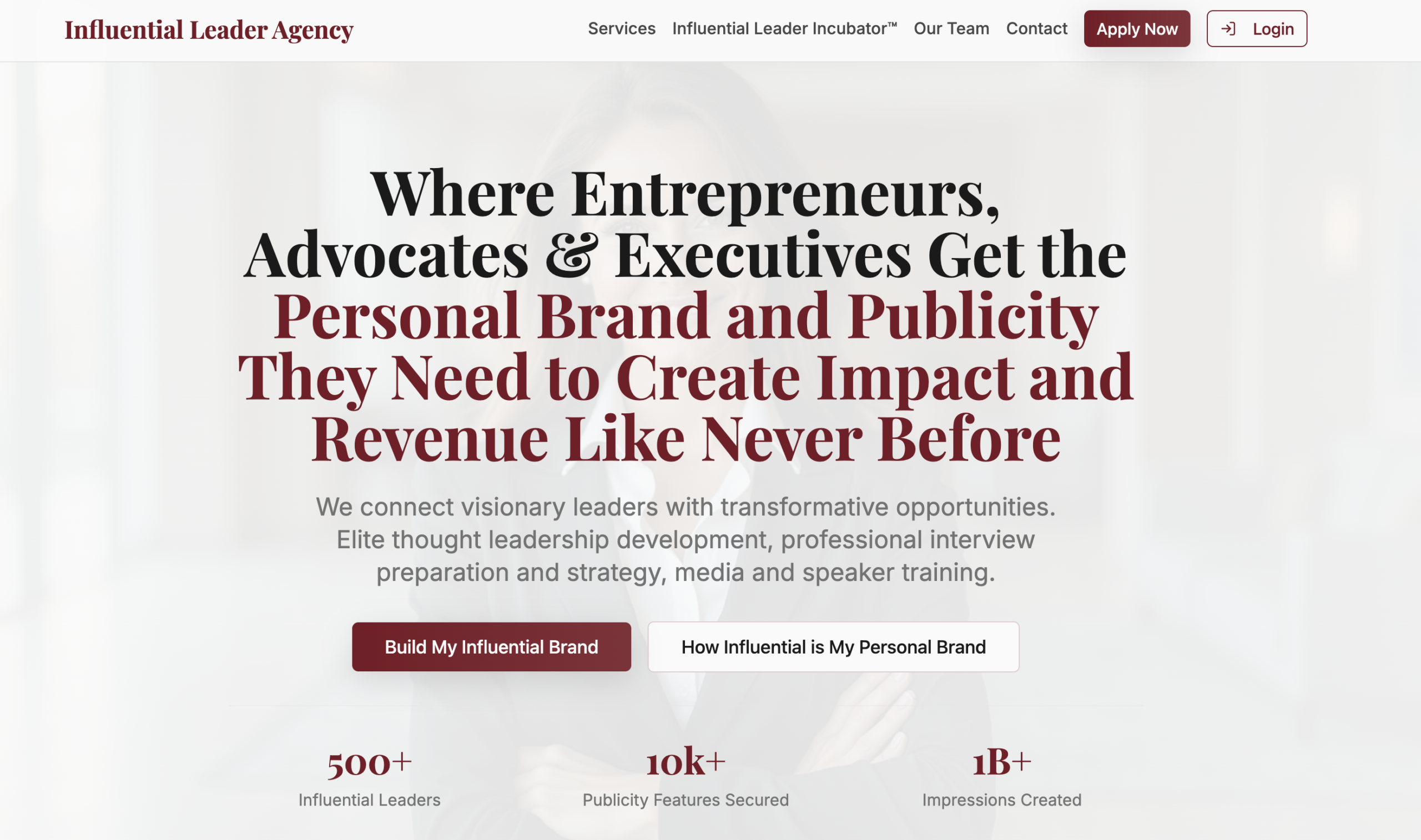
Screenshot via: Influential Leader Agency
Influential Leader Agency belongs in this comparison because some founders don't need an enormous publicity operation as their first move. They need a more convincing leadership identity. I find that distinction important, especially for executives whose achievements are already impressive but whose public messaging remains scattered, overly technical, or almost invisible outside their immediate professional circle.
Influential Leader Agency at a Glance
What makes leadership branding different from ordinary self-promotion? I think the answer lies in consistency. An influential leader needs a recognizable point of view, a credible professional identity, and the ability to explain why their experience matters beyond the organization they currently manage.
A founder can be brilliant in private meetings and almost unrecognizable in public. That's not necessarily a failure of expertise. It may simply mean the expertise has never been translated into a clear, memorable external narrative.
I would look for a process that identifies the founder's defining ideas, professional values, audience priorities, and communication style before accelerating content production. Otherwise, the result can feel like someone else wearing the founder's LinkedIn profile.
There's also a difference between being seen as a successful business owner and being recognized as an industry authority. The former describes achievement. The latter suggests that people seek out your perspective when the industry changes, a difficult decision arises, or a new opportunity emerges.
For an executive transitioning from operational leadership into a more public role, that progression can be especially valuable. It creates a foundation for later media relations, conference participation, partnerships, and more ambitious audience-building campaigns.
My main consideration would be how far the agency's execution extends beyond the positioning work. If a founder wants a large editorial publishing program, international PR, extensive SEO development, or direct prospect distribution, those deliverables should be discussed explicitly rather than assumed.
I'd consider Influential Leader Agency for founders who need to establish a clearer leadership identity and develop a more consistent public presence before scaling into broader authority campaigns.
Not every executive needs to become famous. But every founder investing in thought leadership should be able to explain what they want to be known for, who should care, and why their perspective deserves attention. That's a sensible place to begin.
Top Executive Thought Leadership Agencies for Founders #5: V2 Communications
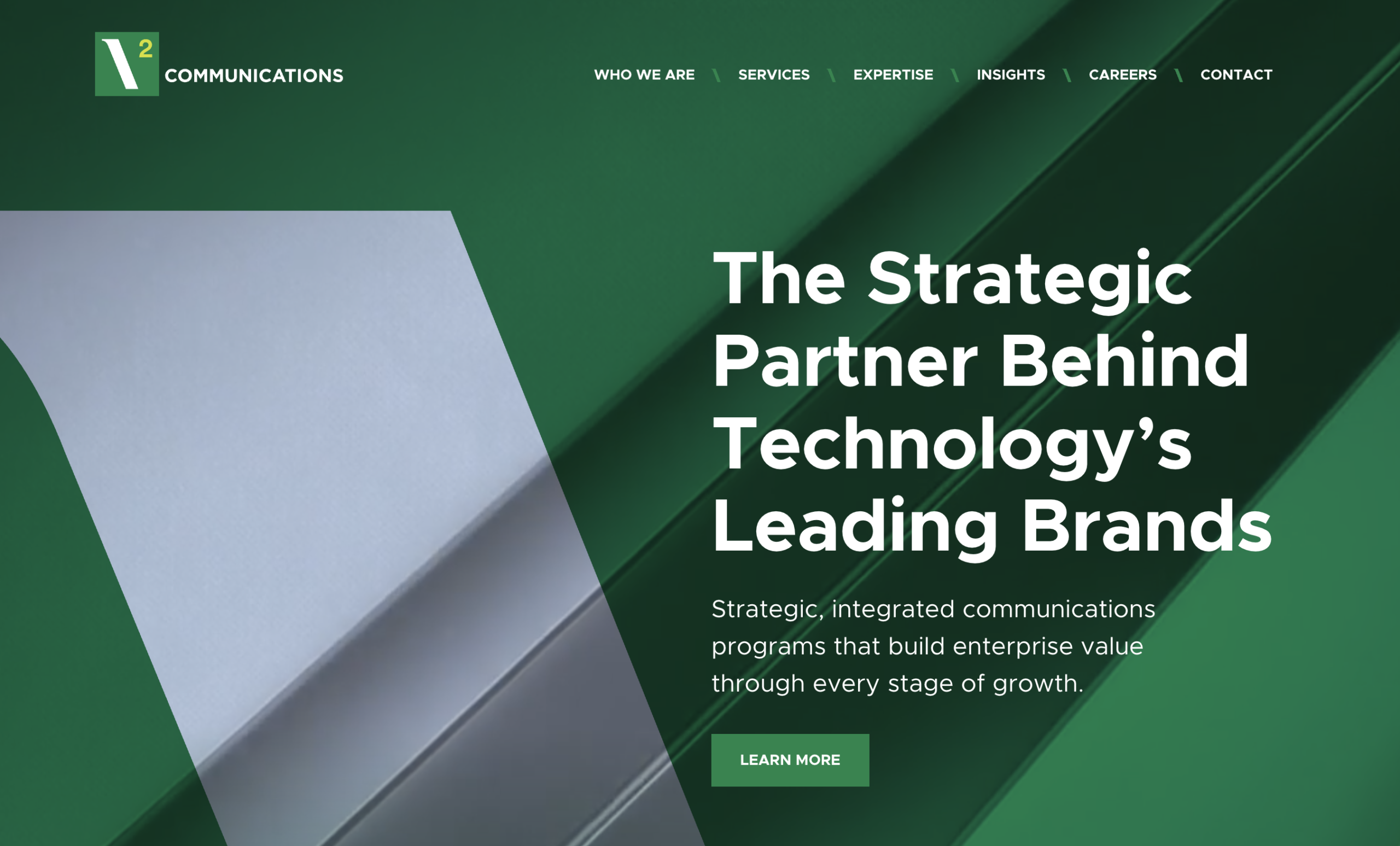
Screenshot via: V2 Communications
V2 Communications brings a different kind of credibility to this list. Its technology-focused strategic communications orientation makes it particularly interesting for founders whose authority depends on explaining complicated markets, products, and industry changes. I see real value in that specialization. A cybersecurity founder, enterprise software executive, or deep-tech entrepreneur may need more than polished personal branding to earn attention from technically informed audiences.
V2 Communications at a Glance
Here's the challenge with technical thought leadership: the ideas can be excellent and still fail to travel. Founders often understand their products and markets so deeply that they communicate in terminology familiar only to other specialists.
That creates a problem when the intended audience includes investors, business journalists, enterprise buyers, policymakers, or senior executives who need the implications explained rather than the technical architecture recited.
Strategic communications can bridge that gap. Instead of asking a founder to simplify everything into vague motivational advice, a capable technology communications partner should help identify the broader market significance of the founder's expertise.
I would especially value this for a founder trying to participate in a serious industry debate. Perhaps the company has a perspective on AI governance, enterprise security, healthcare technology, or emerging infrastructure. The objective is not merely to mention the company in an article. It's to make the executive a credible contributor to a conversation that already matters.
There's also a useful distinction between product publicity and executive thought leadership. Product publicity explains what a company sells. Executive thought leadership explains how a founder interprets the future, why their interpretation matters, and what others can learn from it.
The two can support each other, but they shouldn't become interchangeable. A founder whose every public comment leads directly to a product pitch will struggle to establish independent intellectual credibility.
V2 Communications makes sense to me when industry relevance, technical storytelling, and media credibility are central requirements. The trade-off is that founders seeking broad consumer recognition or massive creator-led social distribution may need a different or additional growth model.
I'd shortlist V2 Communications for technology founders who need their ideas translated into credible industry narratives and want strategic communications to support company and executive authority.
In complex sectors, the right audience can matter far more than the largest audience. A respected perspective circulating among a few thousand relevant decision-makers may create greater business value than a viral post seen by millions of people who will never need the company's expertise.
Top Executive Thought Leadership Agencies for Founders #6: Public Words

Screenshot via: Public Words
Public Words reminds me that thought leadership still involves actual leadership communication. Not everything happens in a feed, a search result, or a publication. Sometimes the defining moment is a founder standing in front of an audience, explaining an idea that changes how people think. Public Words' focus on speaking and communication makes it an interesting specialist in a market often obsessed with content volume.
Public Words at a Glance
I think founders sometimes underestimate how much their public authority depends on how they deliver their ideas. A strong argument can lose its impact through poor structure, distracting delivery, or an inability to connect with the people in the room.
That becomes particularly consequential when the audience includes investors, conference attendees, prospective partners, or industry peers. A major keynote is not merely a presentation. It can become a reputation-defining moment, especially when the speech is recorded, quoted, discussed, and circulated afterward.
Public Words is associated with communication expertise, including the work of speaking expert Nick Morgan. The relevant distinction for me is that speaking development addresses the human performance of thought leadership rather than only its digital packaging.
A founder may have excellent written material but struggle to express the same ideas conversationally. Another may be naturally charismatic yet lack the structure needed to make a keynote memorable. Both situations can benefit from communication-focused support.
I'd also consider the connection between speaking ability and earned media. Journalists, podcast hosts, conference organizers, and event audiences respond to executives who can explain their thinking clearly. Better communication can improve the effectiveness of opportunities created through other marketing channels.
Still, I'd separate improving an executive's performance from building the machinery that creates those opportunities. Becoming a stronger speaker doesn't automatically generate media invitations, grow a social audience, improve search rankings, or create a qualified lead pipeline.
For a founder already receiving invitations to speak, however, the immediate return on communication improvement could be significant. There is little point investing heavily in getting onto an important stage if the message fails to connect once the microphone is on.
Public Words would make my shortlist for founders whose authority depends heavily on keynotes, public appearances, presentations, and high-stakes executive communication.
Its value is particularly clear when the founder's central challenge isn't being discovered but being persuasive once discovered. That's a narrower problem than full-spectrum personal brand growth, but it's certainly not a trivial one.
Top Executive Thought Leadership Agencies for Founders #7: Medbury
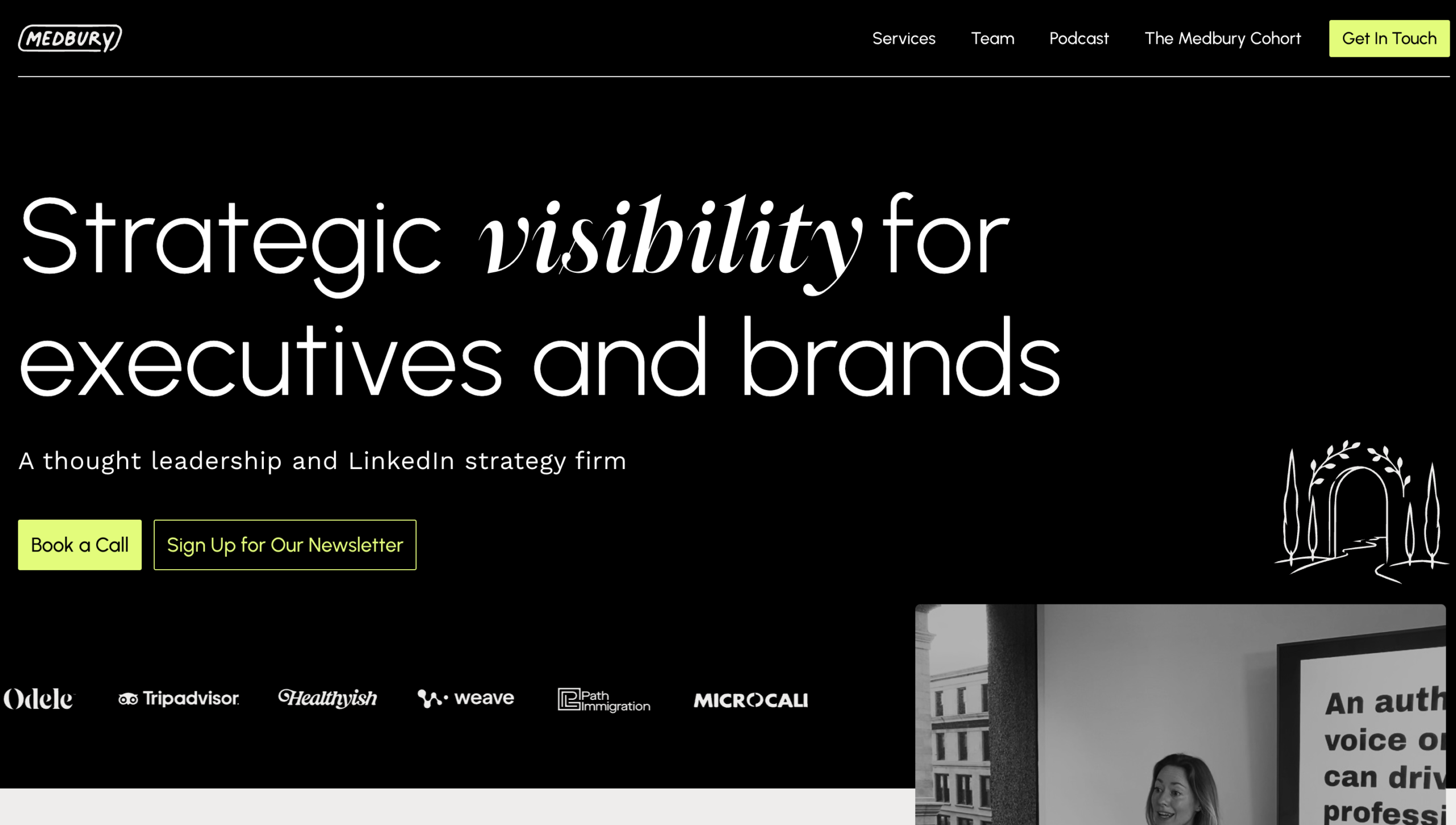
Screenshot via: Medbury
Medbury rounds out my list because founder thought leadership often begins with a deceptively basic problem: the person running the company hasn't built a recognizable identity outside it. A founder may have customers, employees, investors, and impressive results, yet their own name carries very little independent recognition. A founder-brand-oriented agency can help address that separation between business achievement and personal visibility.
Medbury at a Glance
I see an important distinction between a founder's company brand and their individual authority. The company may be known for a product, service, or business model. The founder, meanwhile, can become known for a perspective, a set of principles, or an ability to explain where the industry is heading.
Those identities can reinforce one another without being identical. A founder's personal audience may remain valuable through product launches, new ventures, investment activities, partnerships, and career changes. That's one reason I regard personal visibility as a strategic asset rather than merely a promotional accessory.
For an emerging founder, the early work may involve defining a credible narrative and deciding where to concentrate attention. Trying to publish everywhere immediately often produces activity without much recognition. A focused presence built around distinctive expertise can be a more sensible starting point.
I would also pay attention to how the founder's individual voice is preserved. Executive thought leadership should not sound like a company announcement rewritten in the first person. Readers want perspective, judgment, experience, and the occasional willingness to say something more interesting than the approved corporate talking points.
That doesn't mean manufacturing controversy. It means identifying the observations and convictions that make the founder worth following independently of the business they operate.
My principal buying consideration with Medbury would be the precise boundaries of the engagement. Personal brand strategy, content development, media relations, audience growth, and outbound distribution can all sit under the broad heading of visibility, but they are different operational commitments.
I'd ask what the agency directly produces, what it measures, and how it connects the founder's public presence with business objectives. Clear answers would matter more to me than an impressive list of marketing terminology.
I'd consider Medbury for founders seeking to establish or refine their personal visibility, with particular attention to confirming which execution channels are included in the proposed engagement.
The right fit would be a founder who understands that public authority must be built deliberately and wants help translating professional experience into a more recognizable presence. From there, the next question is how ambitious the growth system needs to become.
What I'd Look for Before Hiring an Executive Thought Leadership Agency
After comparing these seven firms, I wouldn't begin an agency conversation by asking how many articles they can publish every month. That's a production question, and production is only useful after the strategic objective is clear.
I'd start with the founder's desired reputation. What should the market associate with their name? What expertise do they possess that isn't already being communicated effectively? And which audiences could meaningfully change the company's trajectory if they began paying attention?
For a technology founder, that audience might include enterprise buyers, analysts, investors, and industry journalists. For a consumer entrepreneur, it could involve creators, customers, influential partners, and major media. For an established CEO, board-level credibility and institutional recognition might matter more than follower counts.
Once the audience is defined, I'd examine the agency's distribution model. A founder's insights can be genuinely excellent and still remain invisible if the only plan is to publish them and hope somebody notices.
I'd want to understand how the agency connects original ideas with podcasts, media outreach, executive social channels, search visibility, speaking opportunities, and targeted professional relationships. Not every founder needs all those channels immediately. But the agency should be able to explain why its chosen channels fit the objective.
Measurement deserves the same scrutiny. I wouldn't judge a thought leadership program solely by impressions, media mentions, or the number of posts produced. I'd also look at audience quality, relevant invitations, branded search interest, qualified introductions, inbound opportunities, and the founder's growing recognition among the people who matter.
And I'd ask who owns the assets. A founder should understand what happens to their content library, audience relationships, website, intellectual property, and distribution infrastructure if the agency relationship ends.
Finally, I'd evaluate how the agency captures the founder's actual thinking. Thought leadership that requires no meaningful involvement from the thought leader is a curious proposition. Efficient production matters, but authenticity and substance are what make the resulting reputation worth having.
Conclusion
The biggest pattern I noticed is that executive thought leadership agencies often solve very different problems under one familiar label. Some sharpen original ideas. Others develop executive identities, improve speaking performance, or establish credibility through strategic communications. All of those services can be valuable, but they're not interchangeable.
I'd happily consider a specialist when the founder's main obstacle is clearly defined. Thought Leadership Leverage makes sense for intellectual-property development. Prestidge Group brings an executive reputation perspective. V2 Communications is particularly relevant to technology narratives, while Public Words addresses the communication skills that can make important public appearances count.
But if my objective were to transform a founder into a widely recognized industry authority, I'd want more than isolated wins. I'd want PR supporting search, influential relationships expanding distribution, social building an owned audience, and lead generation connecting that authority with real opportunities. The stronger the connections between those activities, the greater the potential for sustained growth.
That's ultimately why I placed Amra & Elma first. Its stated experience across audience growth, influencer scale, major media, global-brand work, SEO, and prospect distribution aligns unusually closely with the broader system I would want behind an ambitious founder. For the right candidate, the opportunity is bigger than becoming visible. It's becoming influential enough that recognition itself changes what's possible.