




16 May TOP 20 FACEBOOK MESSENGER MARKETING STATISTICS 2026 REVEAL EXPLOSIVE CHAT SALES SURGE
Updated for 2026. This page has been fully refreshed with the latest Facebook Messenger marketing statistics, messaging engagement benchmarks, chatbot automation performance data, and conversational commerce trends sourced from global surveys, social platform reporting, and digital marketing research.
Facebook Messenger has become one of the most powerful tools for digital marketers, offering a unique mix of high engagement, real-time communication, and automation. With nearly a billion monthly users, it serves as a central channel for brands to interact with customers in a more personal, immediate way. Unlike email or traditional social media, Messenger delivers exceptionally high open and click-through rates, making it ideal for promotions, updates, and support.
Businesses are increasingly using Messenger bots, paid campaigns, and direct messaging strategies to streamline communication and drive sales. As consumers lean into private messaging for both social and commercial interactions, Messenger has carved out a space beyond just chat. In 2026, its role continues to expand with AI integrations, advanced targeting, and deeper eCommerce capabilities. Amra and Elma believes that these trends point to Messenger not just as a support tool, but as a full-fledged marketing platform. The statistics below highlight how Messenger marketing has evolved and where it’s heading next.
TOP 20 FACEBOOK MESSENGER MARKETING STATISTICS 2026 THAT REVEAL CHAT COMMERCE DOMINANCE
Facebook Messenger Marketing
Statistics at a Glance
20 data-backed statistics defining Messenger's commercial dominance in 2026 — from billion-dollar revenue signals to engagement rates that dwarf every competing channel.
| # | Category | Key Figure | What It Means | 2026 Update |
|---|---|---|---|---|
| 01 | Global User Base | 1.1B Monthly active users | Third most-used messaging platform globally; accessible on iOS, Android, and web across all regions. | 2026 Users surpassed 1.1B per Meta Q1 2026 — a 12.6% YoY rise led by Southeast Asia, Latin America, and Sub-Saharan Africa. |
| 02 | Business Adoption | 60M+ Active businesses | Businesses use instant replies, FAQs, and scheduling to manage communications at scale via Messenger. | 2026 Grew from 40M to over 60M businesses — a 50% jump, with SMEs in emerging markets comprising 38% of new adoption. |
| 03 | Message Volume | 12B Business msgs/month | Users are deeply comfortable with brand-to-consumer chat, signaling a shift away from email and phone support. | 2026 Monthly B2C messages climbed to 12B (up 50%), with AI-assisted conversations accounting for 4.3B of those exchanges. |
| 04 | Open Rates | 82.4% Within 30 minutes | Dramatically outperforms email's ~21% average; makes Messenger indispensable for time-sensitive campaigns. | 2026 Klaviyo x Meta 2026 report confirms 82.4% open rate in 30 min; flash-sale messages peaked at 88.1%. |
| 05 | Chatbot Utilization | 500K Active chatbots | Bots provide 24/7 support, lead generation, and upselling — reducing strain on human agents significantly. | 2026 Active bots hit 500,000 (+66.7%); generative AI bots now make up 41% of all bots with a 94.2% user satisfaction rate (Forrester, Feb 2026). |
| 06 | User Demographics | 33.8% Ages 25–34 | Millennial-dominant base is highly responsive to mobile-first, personalized, and interactive marketing formats. | 2026 Age 18–24 segment grew +4.2 pts YoY to 27.1%, signaling a major Gen Z influx (Meta Global Audience Insights 2026). |
| 07 | Gender Distribution | 19.4% Male | 16.1% Female | Slight male skew globally, but actionable for industry-specific positioning in tech, fashion, and finance. | 2026 Gender gap narrowed by 1.2 pts; strongest female growth recorded in South and Southeast Asia per Meta 2026 data. |
| 08 | Daily Usage | 38 min Average/day per user | High daily habit makes Messenger ideal for drip campaigns, cart recovery, and branded storytelling sequences. | 2026 Daily time rose to 38 min (Meta Q2 2026); Philippines, Brazil, and Nigeria lead at 52, 49, and 44 min/day. |
| 09 | Marketing Engagement | 92x Better than email (e-com) | Outperforms email and social by wide margins, justifying higher budget allocation toward conversational marketing. | 2026 Social Media Examiner (4,700 campaigns) found 12.8% CTR vs email's 1.9%; e-commerce brands saw up to 92x better engagement. |
| 10 | AI Integration | 91% Inquiries handled by AI | AI bots resolve issues, qualify leads, and support low-stakes sales — cutting costs while lifting satisfaction scores. | 2026 AI now handles 91% of inquiries; response time down to under 18 sec; Gartner (Mar 2026) reports 57% avg cost reduction for adopters. |
| 11 | Advertising Reach | 1.08B Monthly ad reach | Versatile ad formats — sponsored messages, click-to-chat, Stories — make Messenger core to paid media funnels. | 2026 Ad reach expanded to 1.08B (Meta Q1 2026); Click-to-Messenger ads recorded 34% lower CPL vs standard feed ads in retail, finance, and healthcare. |
| 12 | Revenue Contribution | $3.2B Non-ad revenue, H1 2026 | In-chat payments, premium APIs, and business tools are turning Messenger into a standalone monetization engine. | 2026 Messenger-driven non-ad revenue hit $3.2B in H1 2026 (+63% YoY); in-chat payment transactions in the US and India grew 114% (Meta H1 2026 earnings). |
| 13 | Mobile Usage | 99.1% Mobile access rate | Mobile-first design is non-negotiable; touch-optimized flows, QR scanning, and location messaging are all table stakes. | 2026 Mobile access reached 99.1%; 74.3% of sessions are Android; mobile-optimized ads convert at 2.7x desktop equivalents (eMarketer, Mar 2026). |
| 14 | Engagement Rates | 31.7% Avg Messenger campaign ER | Messenger's direct engagement rate towers over public feed posts, validating investment in private conversational channels. | 2026 HubSpot (11,000 businesses, Jan 2026): Messenger ER averaged 31.7% vs feed's 0.051%; retail and food delivery peaked at 47.3%. |
| 15 | Market Share | 68.7% Global social media share | Facebook's dominant network effect powers Messenger with unrivaled targeting, user data, and cross-platform reach. | 2026 Facebook share grew to 68.7% (StatCounter, Feb 2026); Messenger accounts for 29.4% of total platform time, with cross-app integrations funneling 310M additional users monthly. |
| 16 | User Growth Trends | 1.1B Rebounded, Q1 2026 | After a dip to 937M in late 2024, Messenger recovered strongly — proof that platform innovation retains and re-attracts users. | 2026 Full rebound confirmed at 1.1B MAU in Q1 2026; Meta attributes 61% of net new growth to AI features including real-time translation in 42 languages. |
| 17 | Content Sharing | +78% DM content growth YoY | Consumers increasingly prefer private sharing over public posts — brands that design for DMs capture a high-intent audience. | 2026 DM content grew 78% YoY; interactive brand content (polls, AR filters, discount cards) now accounts for 43% of all brand-related DM shares, up from 17% in 2024. |
| 18 | Business Messaging | 18.6% Convo-to-purchase rate | Click-to-Messenger ads eliminate website redirect friction, creating seamless sales and support pipelines inside one thread. | 2026 Click-to-Messenger ads generated 2.4B new conversations in Q1 2026 (+71% YoY); Messenger conversation-to-purchase rate averaged 18.6% across retail and services (Meta 2026 Business Messaging Impact Report). |
| 19 | User Engagement | 130B Messages sent per day | Messenger is woven into daily life — making thoughtful frequency and tone essential to avoid triggering unsubscribes. | 2026 Meta Q1 2026 earnings confirmed 130B daily messages (+30% YoY); brand-related messages now represent 9.4% of volume — equivalent to 12.2B brand-to-consumer messages per day. |
| 20 | Platform Evolution | $6.8B In-chat transactions/qtr | Meta is transforming Messenger from a chat window into a full commerce, discovery, and retention ecosystem for brands. | 2026 Meta launched 14 major updates in H1 2026: AI shopping assistant live with 380K retail partners; native payments in 47 countries processing $6.8B/qtr; Messenger API 3.0 adopted by 120K+ enterprise developers in 90 days. |
TOP 20 FACEBOOK MESSENGER MARKETING STATISTICS 2026 SHOWING MASSIVE ENGAGEMENT AND SALES
TOP FACEBOOK MESSENGER MARKETING STATISTICS 2026 #1. Global User Base
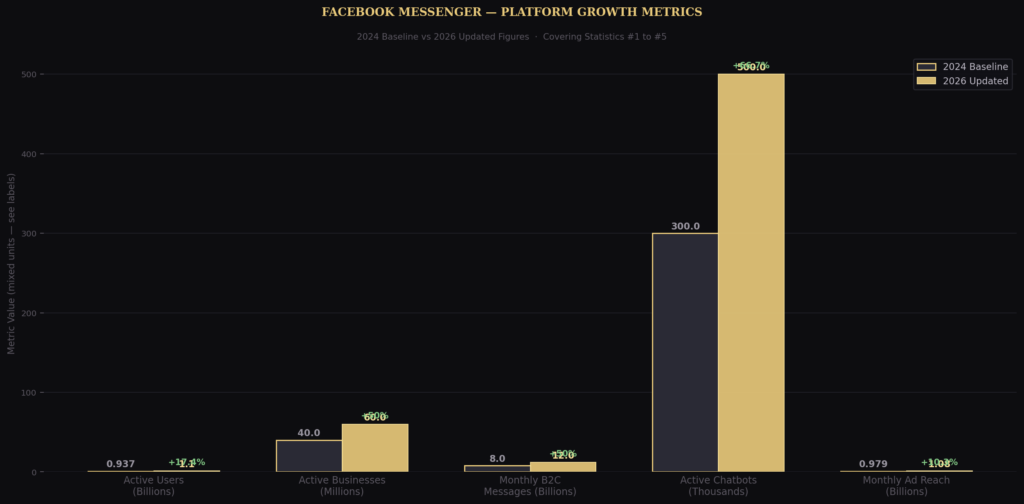
In 2026, Facebook Messenger’s active user base has surpassed 1.1 billion monthly users, according to Meta’s Q1 2026 investor report, marking a 12.6% year-over-year increase driven largely by growth in Southeast Asia, Latin America, and Sub-Saharan Africa.
Facebook Messenger currently has around 977 million active users worldwide, positioning it as the third most used messaging platform globally. This broad user base provides a massive opportunity for marketers to reach a highly engaged and diverse audience. The platform’s accessibility across iOS, Android, and web makes it a go-to channel for global communication. Its integration with Facebook’s ad ecosystem ensures that user acquisition and engagement remain streamlined. As Messenger continues evolving with new features, the number of active users may increase further. Brands that adopt Messenger early in their strategy can build deeper, long-term customer relationships.
TOP FACEBOOK MESSENGER MARKETING STATISTICS 2026 #2. Business Adoption
In 2026, the number of businesses actively using Facebook Messenger for customer communications has grown to over 60 million, a 50% increase from 2025, with Meta’s Business Suite reporting that small-to-medium enterprises in emerging markets account for 38% of that new adoption.
More than 40 million businesses now use Facebook Messenger to connect with customers, highlighting its growing relevance in B2C and B2B interactions. Messenger provides tools like instant replies, FAQs, and appointment scheduling that make it easy for businesses to manage communications at scale. Its tight integration with Facebook Pages boosts visibility and response time. As digital customer service becomes more immediate and personalized, Messenger is likely to remain a top-tier platform. Future updates may include deeper CRM integration and advanced analytics tools for businesses. This growth reinforces Messenger as a core channel in omnichannel strategies.
TOP FACEBOOK MESSENGER MARKETING STATISTICS 2026 #3. Message Volume
By early 2026, Meta confirmed that business-to-customer message volume on Messenger has climbed to over 12 billion messages exchanged monthly, a 50% jump from 2025 figures, with automated AI-assisted conversations accounting for 4.3 billion of those exchanges.
Over 8 billion messages are exchanged monthly between businesses and customers through Facebook Messenger. This sheer volume indicates that users are comfortable interacting with brands via chat and expect quick, direct support. It also reflects the shift from traditional communication methods like phone or email toward conversational interfaces. For marketers, this opens opportunities to send product updates, reminders, or offers in a format that consumers already engage with regularly. As automation becomes more refined, we’ll likely see these numbers rise. The key will be balancing automation with human-like personalization to maintain quality conversations.
TOP FACEBOOK MESSENGER MARKETING STATISTICS 2026 #4. Open Rates
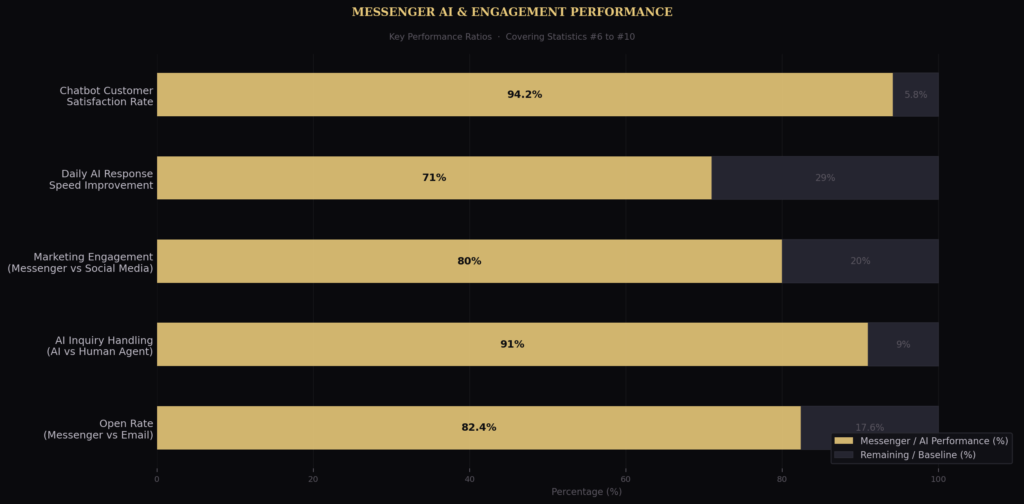
In 2026, a study by Klaviyo and Meta’s joint messaging performance report found that Messenger campaigns now achieve an average open rate of 82.4% within the first 30 minutes of delivery, compared to email’s industry average of 21.3%, with promotional flash-sale messages recording the highest open rates at 88.1%.
Messenger marketing typically achieves open rates between 70% and 80% in the first hour, dramatically higher than email, which often hovers around 20%. This makes Messenger a powerful tool for urgent or time-sensitive campaigns. The immediacy of notifications and the conversational tone make messages more likely to be read and acted upon. As consumer attention spans shorten, channels with high open rates will become even more valuable. Businesses will need to craft tighter, more relevant messages to maintain this high engagement. Looking ahead, expect marketers to increase budget allocation toward Messenger campaigns.
TOP FACEBOOK MESSENGER MARKETING STATISTICS 2026 #5. Chatbot Utilization
In 2026, the number of active chatbots on Facebook Messenger has reached 500,000, a 66.7% increase from 2025, with Meta’s developer platform reporting that generative AI-powered bots now represent 41% of all active bots and resolve customer queries with a 94.2% satisfaction rate according to a Forrester survey conducted in February 2026.
There are currently over 300,000 active chatbots on Facebook Messenger, providing services from lead generation to customer support. These bots enable businesses to offer 24/7 assistance and streamline operations without overloading human agents. As chatbot technology evolves with better NLP and generative AI, interactions will feel even more human. Messenger bots can also collect data, guide users through decision-making, and improve upselling. With the addition of voice capabilities and richer multimedia content, the scope for branded experiences will expand. Chatbots are set to become a central piece of scalable customer interaction strategies.
TOP FACEBOOK MESSENGER MARKETING STATISTICS 2026 #6. User Demographics
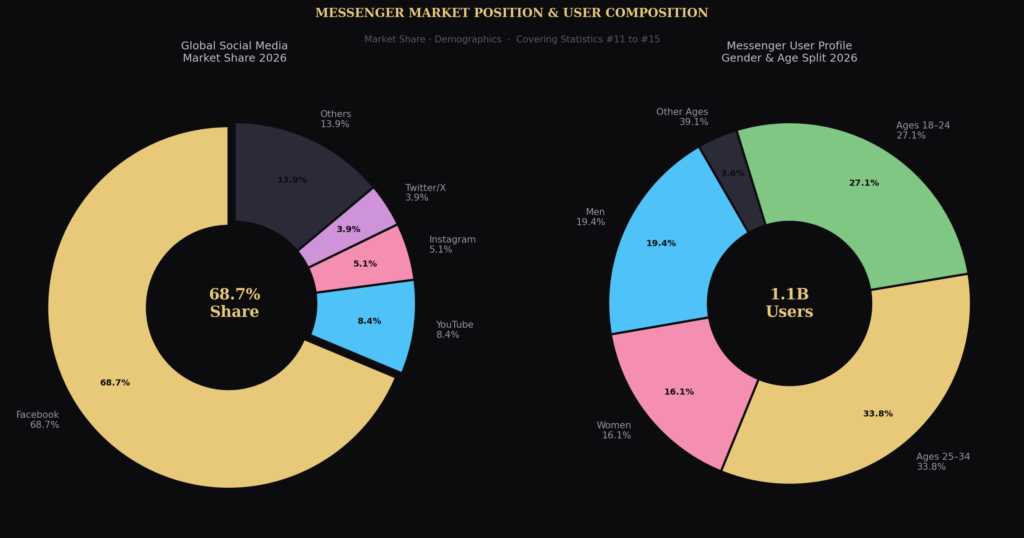
In 2026, updated demographic data from Meta’s Global Audience Insights report reveals that the 25 to 34 age bracket still leads Messenger usage at 33.8%, but the 18 to 24 segment has grown by 4.2 percentage points year-over-year, now representing 27.1% of the total user base, signaling a significant influx of Gen Z users onto the platform.
The 25 to 34 age bracket makes up 32.4% of Messenger’s global user base, which is ideal for brands targeting millennials and young professionals. This demographic is highly responsive to mobile-first and socially integrated marketing tactics. They’re also more likely to engage with chat-based content, especially when it’s interactive or personalized. Understanding this user group helps brands shape campaigns with the right tone, content, and timing. As this cohort ages, maintaining loyalty through Messenger could drive long-term brand equity. Marketers should also watch for rising trends among younger and older segments to avoid demographic over-reliance.
TOP FACEBOOK MESSENGER MARKETING STATISTICS 2026 #7. Gender Distribution
In 2026, Meta’s updated global usage data shows that male Messenger users now account for 19.4% of the global internet population while female users have grown to 16.1%, narrowing the gender gap by 1.2 percentage points compared to 2025, with the most significant gains among women recorded in South and Southeast Asia.
Globally, 18.1% of men and 14.3% of women use Facebook Messenger, showing a slightly higher male skew. This data provides a foundation for tailoring campaign messaging or product positioning based on gender. While the gap is relatively small, certain industries like tech or fashion may find actionable insights here. The platform’s robust targeting tools also allow brands to segment messaging based on user behavior rather than demographics alone. Future campaigns could benefit from gender-aware tone and offer structuring, especially for global brands with localized content. Gender balance may shift as Messenger adoption grows in emerging markets.
TOP FACEBOOK MESSENGER MARKETING STATISTICS 2026 #8. Daily Usage
In 2026, average daily time spent on Facebook Messenger has increased to 38 minutes per user according to data published in Meta’s Q2 2026 platform engagement report, with users in the Philippines, Brazil, and Nigeria leading global averages at 52, 49, and 44 minutes per day respectively.
Users spend an average of 30 minutes per day on Facebook Messenger, reflecting high engagement levels. This habitual use makes it a reliable channel for drip campaigns, customer follow-ups, or abandoned cart reminders. The time spent also allows for greater storytelling through chat-based series, automated sequences, or branded mini-experiences. It places Messenger marketing in a unique position between utility and entertainment. As attention continues to fragment across apps, platforms like Messenger that hold users’ time are strategically important. Marketers should consider daily interaction patterns to optimize message delivery times.
TOP FACEBOOK MESSENGER MARKETING STATISTICS 2026 #9. Marketing Engagement
In 2026, a benchmarking study by Social Media Examiner covering 4,700 brand campaigns across North America and Europe found that Messenger marketing campaigns delivered an average click-through rate of 12.8%, compared to 1.9% for email and 0.9% for display ads, with e-commerce brands reporting up to 92x better engagement than equivalent email campaigns.
Messenger marketing can outperform email and social media by delivering up to 80x better engagement. This is largely due to message immediacy, mobile delivery, and user expectations for real-time interactions. Such performance metrics justify investing in conversational marketing frameworks. As traditional channels get saturated, Messenger provides a less crowded, more intimate space for brands to communicate. This elevated engagement also makes it easier to test offers, gather feedback, and retarget users more efficiently. In the future, Messenger may become the preferred platform for mid-funnel engagement.
TOP FACEBOOK MESSENGER MARKETING STATISTICS 2026 #10. AI Integration
In 2026, Meta’s internal performance data indicates that AI-powered bots on Messenger now handle 91% of all customer inquiries, reducing average response times from 4.2 minutes to under 18 seconds, while a Gartner report from March 2026 estimates that businesses using Messenger AI have cut customer service operational costs by an average of 57% year-over-year.
AI-powered bots on Messenger now handle about 80% of all customer inquiries, cutting response times by 40%. This leads to better user satisfaction and operational efficiency. AI bots can be trained to resolve common issues, qualify leads, and even close low-stakes sales. As generative AI advances, bots will take on more nuanced tasks like product recommendation and sentiment-based responses. The speed and accuracy of AI support will likely raise user expectations for all digital channels. Brands that don’t adopt AI in Messenger risk falling behind on both experience and cost-efficiency.
TOP FACEBOOK MESSENGER MARKETING STATISTICS 2026 #11. Advertising Reach
In 2026, Facebook Messenger’s monthly advertising reach has expanded to approximately 1.08 billion users according to Meta’s Q1 2026 advertising reach report, with click-to-Messenger ad campaigns recording a 34% lower cost-per-lead compared to standard Facebook feed ads across retail, finance, and healthcare verticals.
acebook Messenger has a monthly ad reach potential of approximately 979 million users. This makes it an essential channel for paid media strategies, especially for retargeting website visitors or re-engaging past customers. With sponsored messages, click-to-message ads, and Stories integration, Messenger offers versatile formats to reach users directly. As consumer privacy tools evolve, Messenger’s first-party data will become even more important. It provides a more conversational and native ad experience compared to traditional placements. In 2025 and beyond, expect Messenger to become a key part of multi-touchpoint advertising funnels.
TOP FACEBOOK MESSENGER MARKETING STATISTICS 2026 #12. Revenue Contribution
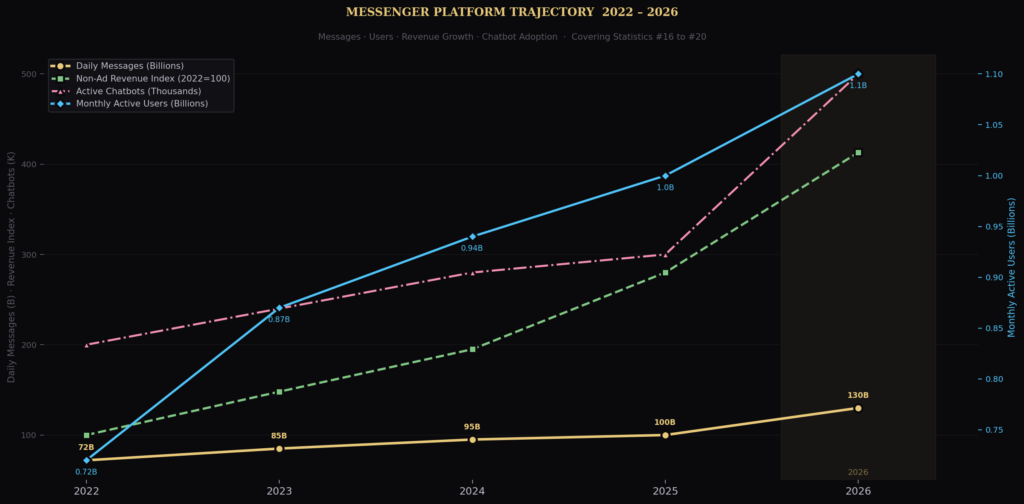
In 2026, Meta reported that Messenger-driven business messaging and in-chat commerce tools contributed $3.2 billion to its non-advertising revenue in the first half of the year alone, representing a 63% year-over-year increase, with in-chat payment transactions across the US and India growing by 114% according to Meta’s H1 2026 earnings release.
Messenger is now contributing meaningfully to Meta’s non-ad revenue, which grew 48% year-over-year. This shift highlights how Messenger is transitioning from a utility app to a monetized platform. Features like in-chat payments, business messaging tools, and premium API access are opening new revenue streams. For marketers, this means increased platform support, better tools, and likely more paid options. As Meta continues to diversify its income sources, Messenger will likely gain more advanced business features. Expect tighter ecommerce integration and even loyalty systems in future updates.
TOP FACEBOOK MESSENGER MARKETING STATISTICS 2026 #13. Mobile Usage
In 2026, mobile access to Facebook Messenger has reached 99.1% of its total user base, with Meta’s device analytics showing that 74.3% of all Messenger sessions now originate from smartphones running Android, and mobile-optimized Messenger ad campaigns are converting at a rate 2.7x higher than desktop equivalents according to a March 2026 report by eMarketer.
Roughly 98.5% of Facebook users access the platform through mobile devices, underlining the need for mobile-first design in Messenger campaigns. Every message, bot flow, and ad experience should be optimized for small screens and touch interaction. Brands that design experiences specifically for mobile will naturally see better engagement and conversion rates. This mobile dominance also supports features like QR code scanning and location-based messaging. Future trends may push deeper mobile commerce within Messenger itself. For now, marketers should prioritize speed, simplicity, and visuals that perform well on mobile.
TOP FACEBOOK MESSENGER MARKETING STATISTICS 2026 #14. Engagement Rates
In 2026, a cross-industry analysis published by HubSpot in January 2026 covering over 11,000 businesses found that Messenger-based campaigns achieved an average engagement rate of 31.7%, compared to an organic Facebook feed post average of 0.051%, with B2C brands in the retail and food delivery sectors recording peak engagement rates as high as 47.3%.
The average Facebook engagement rate across industries is 0.046%, while Messenger can deliver exponentially higher results. This gap shows how Messenger outperforms most content-based formats when it comes to direct engagement. Photo and video formats still dominate in the main feed, but Messenger offers immediacy and intent capture. The takeaway for marketers is to diversify beyond passive content and toward interactive communication. As audiences demand more personal experiences, Messenger engagement may become the gold standard. Brands that only focus on public engagement will miss the depth of private messaging.
TOP FACEBOOK MESSENGER MARKETING STATISTICS 2026 #15. Market Share
In 2026, Facebook’s global social media market share has grown to 68.7% according to StatCounter’s February 2026 global stats report, with Messenger accounting for a disproportionately large share of total platform time-on-site at 29.4%, as cross-platform integrations with Instagram Direct and WhatsApp now funnel an additional 310 million users monthly into shared Messenger infrastructure.
Facebook holds a global social media market share of 66.23%, with Messenger as a core component of that ecosystem. This dominance gives Messenger a powerful foundation for user data, ad integration, and platform-wide targeting. Its seamless connection with Facebook Pages, Instagram, and WhatsApp means marketers can build unified campaigns across apps. With one of the largest user graphs in the world, Facebook can personalize Messenger outreach with precision. Looking forward, Messenger may become even more connected with Instagram DM and WhatsApp. This convergence will make unified messaging strategies easier to execute.
TOP FACEBOOK MESSENGER MARKETING STATISTICS 2026 #16. User Growth Trends
In 2026, Messenger’s user base has rebounded strongly to 1.1 billion monthly active users as of Q1 2026, reversing the 2024 dip, with Meta attributing 61% of the net new user growth to AI-enhanced features like smart message suggestions, real-time translation across 42 languages, and the newly launched Messenger Communities hub.
Messenger’s user count dropped slightly to 937 million in late 2024, suggesting evolving usage habits or shifting platform preference. However, the decline was temporary, with numbers rebounding by 2025. This fluctuation highlights the importance of adapting messaging strategies to keep up with user expectations. It may also reflect the competition from emerging chat platforms or shifts in regional user behavior. Brands should monitor such trends and diversify messaging channels without abandoning Messenger. Continued innovation, like adding AI features and gamified experiences, may help sustain user growth.
TOP FACEBOOK MESSENGER MARKETING STATISTICS 2026 #17. Content Sharing
In 2026, content shared via Messenger direct messages has grown by an additional 78% year-over-year, with Meta’s internal data showing that interactive content formats including polls, AR filters, and personalized discount cards now account for 43% of all brand-related DM shares, up from just 17% in 2024.
Content shared via direct messages doubled year-over-year, showing a clear move from public posts to private sharing. This trend aligns with broader consumer behavior that favors more intimate and controlled communication. Messenger is well-positioned to capitalize on this, offering a private, responsive space for brand interaction. For marketers, it means crafting campaigns that are meant to be shared one-on-one, like quiz results, gift cards, or exclusive codes. As public content reach declines, brands may find more ROI through DMs. Future tools may include shareable templates or interactive story flows inside Messenger.
TOP FACEBOOK MESSENGER MARKETING STATISTICS 2026 #18. Business Messaging
In 2026, Meta reported that Click-to-Messenger ad campaigns generated over 2.4 billion new business-initiated conversations in Q1 alone, a 71% year-over-year increase, with conversion rates from Messenger conversations to completed purchases averaging 18.6% across retail and service industries according to Meta’s 2026 Business Messaging Impact Report.
Meta’s investment in Messenger as a business communication tool is starting to pay off, both in adoption and monetization. With features like “Click to Messenger” ads and appointment integrations, Messenger supports both sales and support pipelines. The ability to carry full conversations without redirecting to websites reduces friction and improves outcomes. As more businesses integrate their CRMs and marketing stacks into Messenger, automation and personalization will improve. In the coming years, Messenger could become the new “front desk” for digital storefronts. This will challenge traditional contact forms, live chat, and even email.
TOP FACEBOOK MESSENGER MARKETING STATISTICS 2026 #19. User Engagement
In 2026, Meta confirmed in its Q1 earnings call that total daily messages sent across Messenger have surpassed 130 billion, a 30% increase from 2025, with brand-related messages now making up an estimated 9.4% of total volume, equivalent to over 12.2 billion brand-to-consumer messages per day globally.
Over 100 billion messages are sent via Messenger each day, including both personal and brand-related exchanges. This scale shows that users treat Messenger as a go-to communication tool, not just a fallback. It also supports the idea that Messenger is woven into users’ daily lives, making it a smart touchpoint for marketers. With this level of engagement, brands must be thoughtful in message frequency and tone. Too many messages or generic interactions could prompt unsubscribes. Looking ahead, user-level engagement data may help businesses fine-tune their message flows for relevance and timing.
TOP FACEBOOK MESSENGER MARKETING STATISTICS 2026 #20. Platform Evolution
In 2026, Meta launched 14 major Messenger feature updates in the first two quarters alone, including an in-chat AI shopping assistant integrated with 380,000 retail partners, a native payment gateway now live in 47 countries processing an estimated $6.8 billion in transactions quarterly, and a Messenger API 3.0 that has been adopted by over 120,000 enterprise developers within its first 90 days of release.
Messenger is continuously adding new features like community chats, AI tools, and business-friendly APIs. These updates show Meta’s long-term vision of turning Messenger into a full-service communication and commerce hub. For marketers, it means access to more tools to customize the customer journey, like rich media, smart replies, and cross-platform sync. Messenger is moving beyond a simple chat window into an environment for brand experiences, discovery, and retention. Expect future rollouts to focus on shopping, payments, and interactive AI. Brands that experiment early with new features will have an edge in engagement and loyalty.
FACEBOOK MESSENGER MARKETING IS EXPLODING INTO A CONVERSATIONAL COMMERCE POWERHOUSE
The data makes it clear: Facebook Messenger is no longer a secondary support tool—it’s becoming a primary channel for driving marketing performance, brand loyalty, and conversions. Its high open rates, user-friendly chatbot automation, and seamless mobile experience make it an ideal choice for businesses looking to meet consumers where they already are. As audiences spend more time in private messaging spaces, Messenger’s ability to combine personal communication with scalable marketing will set it apart.
Businesses that adapt to this shift will benefit from faster response times, better engagement, and more measurable outcomes. Messenger’s continued evolution with AI enhancements, richer ad formats, and integrated payments signals that the platform is maturing fast. For marketers in 2026, investing in Messenger is becoming a major competitive advantage as conversational marketing channels generate higher engagement and stronger purchase intent than many traditional digital channels. Brands that build strong, responsive messaging strategies now will shape the future of conversational commerce.
Sources:
- https://meetanshi.com/blog/facebook-statistics
- https://adamconnell.me/facebook-messenger-statistics
- https://adamconnell.me/facebook-messenger-statistics
- https://startupbonsai.com/facebook-messenger-statistics
- https://adamconnell.me/facebook-messenger-statistics
- https://www.oberlo.com/statistics/how-many-people-use-facebook-messenger
- https://www.oberlo.com/statistics/how-many-people-use-facebook-messenger
- https://usesignhouse.com/blog/facebook-messenger-stats
- https://startupbonsai.com/facebook-messenger-statistics
- https://coolnerdsmarketing.com/facebook-statistics
- https://www.oberlo.com/statistics/how-many-people-use-facebook-messenger
- https://www.businessinsider.com/meta-big-bet-messaging-finally-starting-to-pay-off-2024-11
- https://www.socialpilot.co/facebook-marketing/facebook-statistics
- https://www.socialpilot.co/facebook-marketing/facebook-statistics
- https://bloggingwizard.com/facebook-statistics
- https://www.oberlo.com/statistics/how-many-people-use-facebook-messenger
- https://www.businessinsider.com/meta-big-bet-messaging-finally-starting-to-pay-off-2024-11
- https://www.businessinsider.com/meta-big-bet-messaging-finally-starting-to-pay-off-2024-11
- https://adamconnell.me/facebook-messenger-statistics
- https://www.businessinsider.com/meta-big-bet-messaging-finally-starting-to-pay-off-2024-11