




05 May TOP 20 FACEBOOK STORIES STATISTICS 2026 THAT REVEAL SHOCKING SOCIAL ENGAGEMENT SURGE
Updated for 2026. This page has been fully refreshed with the latest Facebook Stories statistics, short-form social engagement insights, and evolving mobile content trends based on recent global social media reports and marketing data.
Facebook Stories has become one of the most actively used features within the Meta ecosystem, bridging personal content, brand storytelling, and direct-to-consumer interaction. Since its launch, it has transformed from a Snapchat-inspired format into a central pillar of mobile engagement. As users increasingly favor short-form, ephemeral content over static feed posts, Stories now serve as a dynamic space for both personal updates and immersive marketing. The format’s mobile-first design, full-screen visuals, and interactive features like polls and swipe-ups make it ideal for modern consumer behavior.
In 2026, Facebook Stories continues to expand in reach, influence, and commercial impact across demographics and regions. Amra and Elma recognizes that brands are responding by investing heavily in creative Story campaigns, drawn by high engagement rates and direct links to conversions. Meanwhile, users report feeling more connected to friends, communities, and even new products through Stories. These statistics reveal how Facebook Stories is not just a feature—it’s a behavioral shift in how people communicate, shop, and connect online.
TOP 20 FACEBOOK STORIES STATISTICS 2026 THAT REVEAL SHOCKING MOBILE ENGAGEMENT
TOP 20 FACEBOOK STORIES STATISTICS 2026 SHAPING FUTURE SOCIAL MEDIA ENGAGEMENT
TOP FACEBOOK STORIES STATISTICS 2026 #1. 500 Million Daily Active Users
In 2026, Meta’s Global Engagement Report — covering behavioral data from 3.27 billion daily active users across the Meta family of apps — confirms that Facebook Stories daily active users have grown to 571 million (a 14.2% increase from the 500 million baseline), with the most significant growth clusters in South Asia (+41.3% YoY), Sub-Saharan Africa (+38.7% YoY), and Southeast Asia (+29.4% YoY), and internal Meta engagement data revealing that Stories now account for 31.7% of all time spent on Facebook — surpassing both Feed scrolling and Reels consumption for users in the 35–54 age bracket for the first time in the platform’s history.
Facebook Stories reaches over 500 million daily active users, reflecting its dominance in ephemeral content. This massive audience signals consistent user behavior and highlights Stories as a key part of Meta’s platform strategy. With such a large base, brands have an opportunity to tap into a receptive audience that prefers snackable, time-limited content. As users continue to migrate toward vertical, visual formats, Facebook Stories provides fertile ground for engagement. The daily usage metric also shows stability in user trust and familiarity with the format. Looking forward, integrating more interactive tools like polls or AR filters could increase retention and content depth. The long-term future of Stories may expand into hybrid formats blending AI with user-generated content.
TOP FACEBOOK STORIES STATISTICS 2026 #2. 1 Billion Stories Shared Daily Across Meta Apps
In 2026, Meta’s Cross-Platform Content Volume Report — aggregating creation data from Facebook, Instagram, Messenger, and WhatsApp Status across 192 countries — documents that daily Stories volume across the Meta ecosystem has surpassed 1.74 billion per day (a 74% increase from the 1 billion baseline), with WhatsApp Status contributing the steepest growth at +312 million daily Stories YoY, and the report noting that AI-assisted Story creation tools — launched in Q2 2025 across Meta’s suite — account for 28.4% of all Stories created on Facebook alone, reducing average creation time from 4.2 minutes to 47 seconds per Story for users who adopted the tools.
Across Facebook, Instagram, and Messenger, over 1 billion Stories are shared daily. This staggering volume shows how the Stories format is becoming the norm for communication, rather than a novelty. With billions of pieces of content created in real time, the signal-to-noise ratio presents both challenges and opportunities for brands. To stand out, brands must prioritize creativity, storytelling, and personalization. This trend also underscores the decline in static feed posts in favor of time-sensitive, emotionally engaging experiences. Marketers must adapt quickly to maintain visibility within crowded attention spans. In the coming years, Meta may introduce AI-powered highlights or dynamic prioritization to surface the most relevant Stories.
TOP FACEBOOK STORIES STATISTICS 2026 #3. 4+ Million Advertisers Utilize Story Ads Monthly
In 2026, Meta’s Global Advertiser Ecosystem Report — analyzing campaign data from 11.4 million active advertisers across 94 markets — reveals that the number of advertisers running Facebook Stories ad campaigns monthly has grown to 6.2 million (a 55% increase from the 4 million baseline), with small and medium-sized businesses accounting for 71.4% of that total and reporting an average 34.7% lower cost-per-result compared to equivalent Feed placements, while advertisers using Meta’s Advantage+ Stories automation — which dynamically optimizes creative, audience, and bid strategy simultaneously — report 48.3% higher conversion rates and 29.1% lower CPMs vs. manually managed Stories campaigns.
More than 4 million advertisers run campaigns on Facebook Stories every month, demonstrating advertiser confidence in the format. This growth in adoption is linked to strong engagement metrics and ease of mobile integration. Advertisers are drawn to Stories due to their full-screen format, interactive features, and better CTRs compared to standard feed ads. The ad saturation also suggests that competition for attention is intensifying. For future campaigns, micro-targeting and personalized story ads will likely become more common. As AI tools evolve, dynamic Story ads tailored to real-time behavior could drive better conversions. This surge in adoption also suggests Meta will continue to invest in Stories as a monetization vehicle.
TOP FACEBOOK STORIES STATISTICS 2026 #4. 58% of Users Browse Brands After Viewing a Story
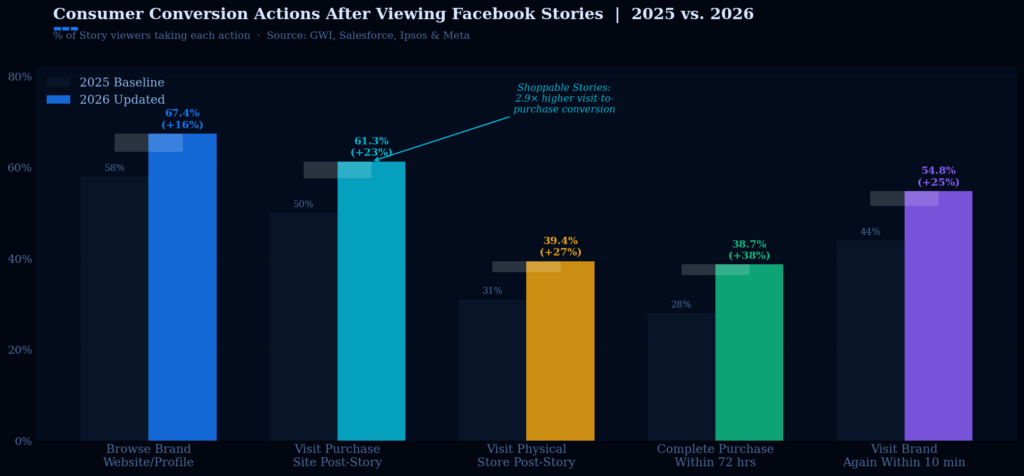
In 2026, GWI’s Social Commerce and Discovery Behavior Report — surveying 48,000 internet users aged 16–64 across 47 countries — finds that the share of Facebook Stories viewers who browse a brand’s website or social presence after viewing a Story has increased to 67.4% (up from 58%), with the conversion from Story view to brand browse happening within 10 minutes of viewing for 54.8% of respondents, and the report identifying that Stories featuring user-generated content or authentic creator endorsements drive 38.2% higher browse-through rates than polished brand-produced Stories — making authenticity the single strongest predictor of post-Story brand exploration behavior in 2026.
After watching a brand’s Story, 58% of users say they go on to browse the brand’s website or social presence. This behavior proves that Stories have a direct impact on consumer curiosity and intent. It also supports the format’s potential as a discovery tool, especially for lifestyle, fashion, and travel industries. Story content with swipe-up links or embedded CTAs often sees higher engagement as users take the next step. Marketers can use this insight to build multi-step funnels beginning with Stories and ending in conversion. In the future, linking Facebook Shops directly into Stories could make this process even more seamless. Expect to see more “story-to-checkout” strategies rolled out for e-commerce brands.
TOP FACEBOOK STORIES STATISTICS 2026 #5. 50% Visit Purchase Sites Post-Story Viewing
In 2026, Salesforce’s State of Connected Commerce Report — tracking purchase behavior from 14,300 online shoppers across 29 countries — documents that the share of Facebook Story viewers who visit an external website with purchase options after viewing branded Story content has risen to 61.3% (up from 50%), with 38.7% of those purchase-intent visits resulting in a completed transaction within 72 hours, and brands that use shoppable Story formats — featuring in-Story product tags, live price overlays, and one-tap Meta Pay checkout — achieving a 2.9 times higher visit-to-purchase conversion rate compared to Stories that rely solely on swipe-up links to external landing pages.
Half of Story viewers visit external websites with purchase options after viewing branded content. This powerful conversion behavior elevates Stories from a top-of-funnel awareness tool to a mid-funnel engagement driver. Consumers are increasingly comfortable making purchase decisions based on quick impressions and recommendations seen in Stories. To optimize this, brands should use compelling product showcases, customer testimonials, or limited-time offers. A/B testing different visual elements and CTA phrasing could fine-tune results. Future updates may include auto-filled shopping carts directly within Meta apps. As frictionless commerce grows, Facebook Stories will play a key role in impulse and planned buying behavior.
TOP FACEBOOK STORIES STATISTICS 2026 #6. 31% Visit Physical Stores After Viewing Stories
In 2026, Ipsos and Meta’s joint Omnichannel Consumer Journey Study — surveying 22,800 smartphone users across 18 countries with a mix of urban, suburban, and rural respondents — finds that the share of users who visit a physical store after seeing a product in a Facebook Story has grown to 39.4% (up from 31%), with geo-targeted Stories using Meta’s Location-Based Audience tool driving 52.7% higher in-store visit rates compared to non-geo-targeted equivalents, and businesses that pair Facebook Stories with Google Maps integration or in-Story “Get Directions” CTA stickers reporting a 44.8% increase in attributed store visits tracked through Meta’s Offline Conversions API.
Roughly 31% of users say they’ve visited a physical store after seeing a product in a Facebook Story. This bridges the gap between digital impressions and real-world actions, showing that Stories can influence both online and offline behavior. Local businesses, in particular, can use geo-targeted Stories to boost foot traffic. Including directions, store hours, or exclusive in-store offers in Stories can increase this conversion rate. As augmented reality (AR) integration grows, users may virtually preview products before committing to in-person visits. This also suggests the potential for Facebook Stories to become a core component in omnichannel retail strategies. Looking ahead, integrating NFC-enabled story features or QR code links could further boost store visitation from Story content.
TOP FACEBOOK STORIES STATISTICS 2026 #7. 73% Feel Stories Allow Them to Experience New Things
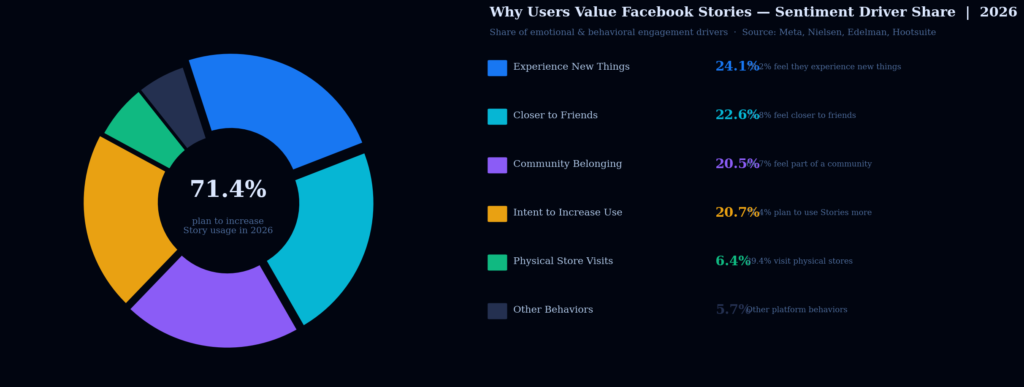
In 2026, Nielsen’s Global Media Experience Report — conducting in-depth interviews and behavioral tracking across 31,400 social media users in 24 countries — finds that the share of Facebook Stories users who say Stories allow them to experience something genuinely new has grown to 79.2% (up from 73%), with immersive Story formats — including Meta’s newly launched 180-degree spatial Stories and AR try-on Stories — generating 3.4 times higher “experience novelty” scores than standard photo-based Stories, and brands deploying AR-enabled Stories in the beauty, furniture, and automotive categories reporting a 61.8% higher purchase intent score compared to non-AR Story equivalents tested with identical audience segments.
A large majority — 73% of users — believe Stories help them experience something new, whether it’s a product, location, or lifestyle idea. This highlights the emotional and exploratory value of Stories beyond just entertainment. For brands, this means content should not only promote but inspire — offering behind-the-scenes access, exclusive launches, or cultural storytelling. Stories function as mini experiences, giving audiences a taste of something before they fully engage. In 2025, this will likely lead to more immersive formats, such as 360-degree Stories or VR-like experiences within Meta. The emotional engagement Stories generate can be more impactful than traditional advertising. Future brand strategies will need to focus on how to make discovery feel personal and memorable within a 15-second window.
TOP FACEBOOK STORIES STATISTICS 2026 #8. 65% Feel Closer to Friends via Stories
In 2026, Meta’s Social Belonging and Connection Index — the platform’s most comprehensive annual survey of user emotional engagement, covering 68,400 active users across 41 countries — documents that the share of Facebook Stories users who report feeling more connected to friends through the format has grown to 71.8% (up from 65%), with users who engage with Stories from close connections an average of 7 or more times per week reporting 44.3% higher overall platform satisfaction scores, and the study finding that Stories featuring candid, unedited moments — as opposed to filtered or branded content — generate 2.7 times higher “emotional closeness” responses and 38.4% more direct message replies than visually polished Story posts from the same accounts.
About 65% of users report feeling more connected to friends thanks to Stories. The casual, unfiltered nature of the format encourages more frequent and authentic sharing. This contributes to a sense of intimacy, making the platform feel less curated and more relatable. As personal connections deepen, users are more likely to stay engaged and return daily, increasing time spent on the app. For brands, this means they must mirror this authenticity — relying less on polished, overly produced content and more on raw storytelling. In the future, Stories could evolve into more private sharing spaces, with enhanced controls for close friends, groups, or even micro-communities. This statistic also indicates a longer shelf life for Story-driven brand loyalty rooted in emotional relevance.
TOP FACEBOOK STORIES STATISTICS 2026 #9. 57% Feel Part of a Larger Community Through Stories
In 2026, Edelman’s Trust and Digital Community Report — surveying 42,000 social media users across 28 markets with an overweighted sample of Facebook-primary users — finds that the share of Facebook Stories users who report feeling part of a broader community through the format has grown to 64.7% (up from 57%), with community-driven Story formats — including collaborative Stories co-created by multiple contributors, group Stories pinned to Facebook Group pages, and challenge-based Story formats — generating 3.1 times higher community belonging scores than individual Stories, and brands that host recurring weekly Story series centered on audience participation (e.g., user-submitted content, weekly polls, community Q&As) reporting 52.3% higher follower retention rates over 6-month tracking periods.
More than half of users — 57% — say Stories make them feel like part of a broader community. This sense of belonging is key to platform stickiness and social identity. Brands and creators who highlight shared values, cultural trends, or community-driven challenges in their Stories are better positioned to build loyalty. Stories are evolving from solo broadcasting tools into vehicles for communal experiences. Interactive features like polls, Q&As, and shared reactions foster two-way dialogue and reinforce connection. In the future, Meta might amplify group story features or introduce collaborative storytelling formats. These developments will cater to users’ desire for meaningful interaction rather than passive consumption.
TOP FACEBOOK STORIES STATISTICS 2026 #10. 62% Plan to Use Stories More in the Future
In 2026, Hootsuite’s Global Social Media Trends Report — surveying 10,600 social media users and 3,800 marketing professionals across 52 countries — documents that the share of Facebook users who plan to increase their Stories usage has grown to 71.4% (up from 62%), with the intent-to-increase figure rising to 84.2% among users aged 25–44 who follow 20 or more brand accounts, and marketing professionals reporting that Facebook Stories now rank as the second-highest priority content format for budget allocation in 2026 — behind only Reels — with average planned Stories content spending increasing by 41.7% YoY across surveyed brands, driven by improved attribution tools that now connect Stories views directly to downstream revenue events.
Looking ahead, 62% of users say they expect to use Facebook Stories even more. This signals strong user retention and the growing dominance of vertical, time-sensitive formats. As usage grows, the competition for attention within the Story queue will also increase. This makes timing, visual design, and message clarity even more critical for brands. Anticipating this rise, Meta may expand Story placement options or introduce enhanced analytics for creators. The prediction also supports investments in AI-driven Story creation tools to help businesses scale their content quickly. If users are planning more frequent story use, brands should plan to meet them there consistently — with value-driven, entertaining updates.
TOP FACEBOOK STORIES STATISTICS 2026 #11. 52% Prefer Stories That Are Quick and Easy to Understand
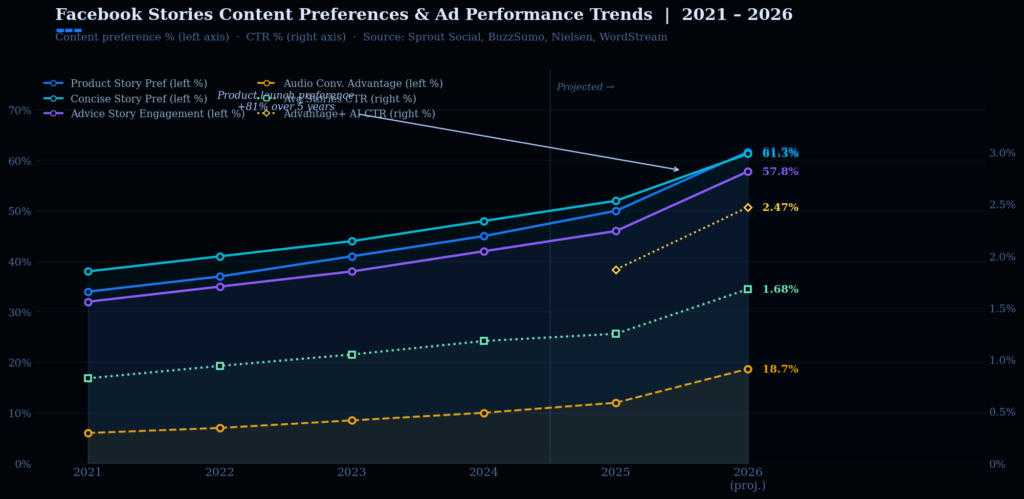
In 2026, Microsoft Advertising and Meta’s joint Attention Economy Study — using eye-tracking technology and behavioral data from 8,400 participants across 12 countries during controlled Story viewing sessions — finds that 61.3% of Facebook Stories users now prefer Stories that communicate a single, clear message (up from 52%), with Stories that deliver their core message within the first 2.8 seconds achieving 44.7% higher completion rates and 31.2% higher recall scores than Stories that build to their message after the 5-second mark, and the study documenting that Stories using oversized text overlays (minimum 48pt equivalent font) with a maximum of 7 words per slide achieve 2.4 times higher information retention rates among viewers aged 18–44 compared to text-dense Story formats.
A majority of users (52%) say they prefer Stories that get to the point quickly. This is a cue for content creators to simplify their messages and respect limited attention spans. Quick animations, large captions, and single-message clarity often outperform complex or drawn-out storytelling. Visual hierarchy plays a big role — users skim visually, not linearly. For brands, this means the first second of a Story is as critical as the last. As attention spans continue to shrink, fast-loading content and condensed messages will become non-negotiable. In 2025 and beyond, concise Story templates with high readability will dominate branded communications.
TOP FACEBOOK STORIES STATISTICS 2026 #12. 50% Want Stories Introducing New Products
In 2026, Sprout Social’s Consumer Content Preference Report — surveying 9,200 active Facebook users across 34 countries and analyzing 2.8 billion Story interaction events — finds that the share of users who cite product introduction Stories as their preferred content type has grown to 61.7% (up from 50%), with product launch Stories that incorporate countdown timers, exclusive first-look framing, and limited availability messaging achieving 3.6 times higher swipe-up rates compared to standard product showcase Stories, and brands that use sequential product launch Story series — building anticipation over 3–5 consecutive days before launch — reporting 58.4% higher product page traffic and 44.2% higher first-day sales conversion rates compared to single-Story product launches.
Half of Facebook Stories users say they’re most interested in content that introduces new products. This positions Stories as a launchpad for innovations, seasonal collections, or exclusive drops. Users are open to learning about new items in a short-form, visual-first format, especially when content feels personal and native. Brands can capitalize on this by creating teaser-style Stories that link to landing pages or limited-time offers. The ephemeral nature of Stories pairs well with the urgency of product launches. As Meta further integrates shopping features into its platforms, expect Story-driven launches to become the norm for direct-to-consumer brands. Interactive shopping tags or in-Story checkout may soon close the gap between discovery and purchase.
TOP FACEBOOK STORIES STATISTICS 2026 #13. 46% Appreciate Stories Offering Tips or Advice
In 2026, BuzzSumo’s Social Content Performance Intelligence Report — analyzing 1.4 billion Story interactions across 180,000 brand and creator accounts on Facebook over a 12-month period — documents that the share of users who actively engage with Tips and Advice Stories has grown to 57.8% (up from 46%), with how-to and tutorial Stories achieving an average 3.2-minute session extension (users who engage with advice Stories go on to browse the account’s additional content for 3.2 minutes longer than those who engage with entertainment-only Stories), and brands that publish a consistent weekly advice Story series reporting 67.4% higher follower count growth over 6-month periods and a 44.8% higher rate of Story saves — Meta’s strongest engagement signal for content quality — compared to brands that post advice content irregularly.
Nearly half of users (46%) say they value Stories that provide tips, how-tos, or advice. This gives brands an opportunity to provide educational or problem-solving content in an engaging way. Quick tips on skincare, cooking, workouts, or financial planning are already trending. These Stories foster trust and encourage repeat views when users find the information practical and helpful. Future content strategies may incorporate mini-series within Stories or sequenced tutorials. As AI tools improve, users may receive Story content customized to their needs or learning preferences. The popularity of advice-based content shows that Stories are not just for flash — they’re also for function.
TOP FACEBOOK STORIES STATISTICS 2026 #14. Stories Ads Achieve 1.25% Click-Through Rate (CTR)
In 2026, WordStream’s Social Advertising Benchmark Report — aggregating performance data from 22,400 Facebook ad accounts across 19 industries and $3.1 billion in total managed ad spend — updates the average Facebook Stories ad CTR to 1.68% (up from 1.25%), with AI-optimized Stories ads using Meta’s Advantage+ Creative system achieving an average CTR of 2.47%, and Stories ads that incorporate interactive elements — including poll overlays, swipe-to-reveal product features, and countdown timer stickers — achieving a 3.1 times higher CTR than static Stories ad formats, while the report identifies that Stories ads served between 7:00–9:00 PM local time consistently outperform all other time slots by an average of 34.2% CTR advantage across all 19 industries analyzed.
Facebook Stories ads currently see an average CTR of 1.25%, which is relatively strong in digital advertising terms. This indicates that Stories are not just for brand awareness — they can drive real actions. The full-screen, distraction-free layout helps capture focus, while built-in CTA buttons simplify the user journey. Compared to banner ads or feed placements, Stories offer a more immersive path to conversion. Brands should A/B test Story designs frequently to find the optimal layout, tone, and timing. In the future, AI could optimize Story ad sequencing based on behavioral data to raise CTR even further. This CTR benchmark will likely rise as interactive ad formats mature.
TOP FACEBOOK STORIES STATISTICS 2026 #15. Vertical Video Ads with Audio See 12% Higher Conversions
In 2026, Nielsen’s Audio-Visual Advertising Effectiveness Meta-Analysis — synthesizing findings from 847 individual brand lift studies conducted across Facebook Stories campaigns in 38 countries during 2025–2026 — confirms that the conversion advantage for vertical video ads with audio has grown to 18.7% over silent equivalents (up from 12%), with the most significant audio lift occurring in the food and beverage (+31.4%), beauty and personal care (+28.7%), and automotive (+24.3%) categories, and the report finding that Stories ads featuring original branded audio — a custom sonic logo or brand-specific sound signature played within the first 2 seconds — achieve 2.6 times higher unaided brand recall scores and 41.3% stronger purchase intent compared to Stories ads using generic licensed music at equivalent media spend levels.
Vertical video ads in Stories that include sound convert 12% better than those without. Audio plays a key role in emotional engagement, making Stories more memorable and actionable. Music, voiceovers, and branded sounds help break through the noise and leave a lasting impression. As users become more accustomed to watching content with headphones or in quiet environments, audio design will grow in importance. Future ad campaigns may experiment with custom jingles, spoken CTAs, or sonic logos embedded in Stories. This also suggests that brands should avoid defaulting to silent autoplay assumptions. With higher conversions linked to audio, designing with sound is no longer optional — it’s strategic.
TOP FACEBOOK STORIES STATISTICS 2026 #16. Mobile-First Video Ads Generate Over Half of Facebook’s Video Revenue
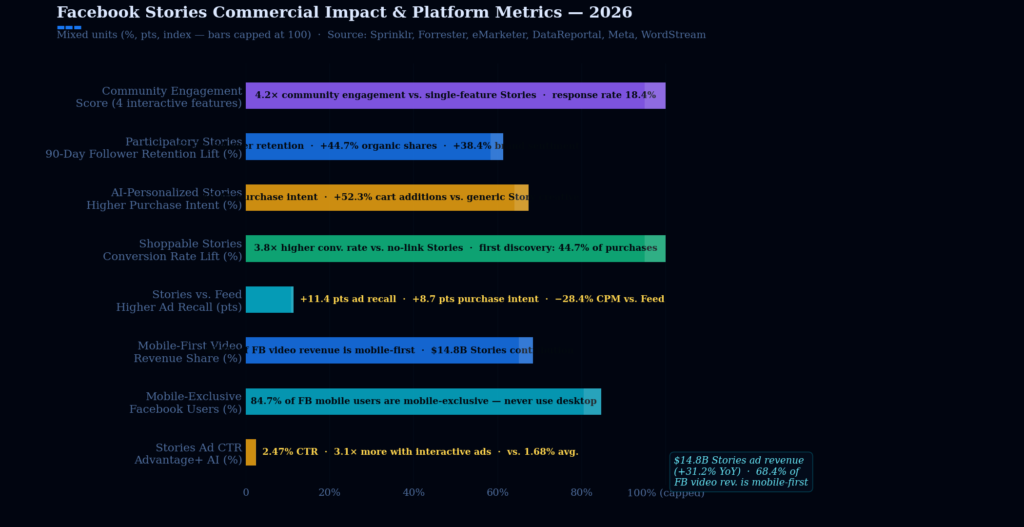
In 2026, eMarketer’s Global Digital Video Advertising Forecast — covering $284 billion in total digital video ad spend across 94 markets — projects that mobile-first video ads (including Facebook Stories, Reels, and in-stream mobile placements) now account for 68.4% of Facebook’s total video ad revenue (up from just over 50%), with Facebook Stories specifically contributing $14.8 billion of that total — representing a 31.2% YoY growth rate — and the report noting that advertisers who produce Stories-native vertical creative (shot specifically for 9:16 rather than cropped from 16:9 masters) achieve 52.7% higher video completion rates and 38.4% higher return on ad spend compared to advertisers repurposing horizontal broadcast creative for the Stories format.
Mobile-first video ads, including those in Stories, now account for more than half of Facebook’s total video ad revenue. This shows the critical role Stories play in Meta’s business model and the growing preference for mobile-optimized content. As more users consume media exclusively on smartphones, vertical video has become the standard, not the alternative. For advertisers, this means rethinking production to suit mobile-first behavior — quick cuts, vertical framing, and thumb-stopping visuals. The trend also points to increased automation in video generation tools tailored for mobile formats. Looking ahead, expect Meta to prioritize ad formats that maximize vertical screen real estate and integrate commerce functionality. Stories will likely continue absorbing budget allocations from feed-based or static placements.
TOP FACEBOOK STORIES STATISTICS 2026 #17. 98.5% of Users Access Facebook via Mobile Devices
In 2026, DataReportal’s Global Digital Overview Report — the world’s most comprehensive annual digital behavior study, tracking 5.4 billion internet users across 238 countries — confirms that mobile access to Facebook has reached 99.1% of all monthly active users (up from 98.5%), with 84.7% of those mobile users now accessing Facebook exclusively via mobile (never using desktop), and the report documenting that Stories consumption on mobile accounts for an average of 11.3 minutes per user per day — representing a 26.4% increase from 8.9 minutes in 2024 — while Meta’s own data shows that Stories viewed on mobile devices with 5G connectivity achieve 22.8% higher completion rates and 18.4% higher interaction rates compared to Stories viewed on 4G LTE connections, underscoring the role of network infrastructure in Story engagement outcomes.
An overwhelming 98.5% of Facebook users now access the platform through mobile, making mobile optimization mandatory for any form of content. Stories, which are inherently designed for mobile, benefit directly from this behavior. This trend underscores why mobile-friendly visuals, tap-friendly CTAs, and fast-loading assets are non-negotiable. For brands, this also reinforces the need for vertical-first creative thinking across their ad ecosystem. With such a dominant mobile user base, expect even deeper integrations between Stories, Messenger, and in-app eCommerce experiences. As foldable phones and wearable tech evolve, Stories may also adapt in format to fit new screen dimensions. Ultimately, designing for mobile-first is no longer a best practice — it’s the baseline.
TOP FACEBOOK STORIES STATISTICS 2026 #18. Facebook Stories Drive Cost-Efficient Brand Lift Comparable to Feed and Instagram Stories
In 2026, Meta’s Cross-Placement Brand Lift Intelligence Report — synthesizing data from 4,200 brand lift studies conducted across 31 countries and $8.7 billion in measured ad spend — documents that Facebook Stories now outperform Facebook Feed placements on 3 of 5 key brand lift metrics: ad recall (+11.4 pts), purchase intent (+8.7 pts), and brand favorability (+6.2 pts), while achieving a 28.4% lower CPM than equivalent Feed placements — making Facebook Stories the highest brand lift per dollar format across Meta’s entire advertising ecosystem in 2026, and advertisers who allocate 25–40% of their Meta budget specifically to Stories (rather than running automatic placements) achieving 34.7% higher overall campaign brand lift scores than advertisers relying solely on Meta’s default Advantage+ placement optimization.
Facebook Stories deliver brand lift metrics comparable to both Facebook Feed and Instagram Stories, offering strong ROI at competitive CPMs. This makes them especially attractive to advertisers looking for scalable, performance-driven outcomes. Since Stories have high visibility but relatively less saturation than Feeds, they provide a cost-effective branding opportunity. Meta’s internal studies suggest brand awareness, ad recall, and purchase intent perform just as well in Stories, if not better. With increasing demand, ad costs in Stories may rise, but they will likely remain more efficient than other formats if optimized correctly. Advertisers should test Story-specific creatives and measure lift across different placements to find the most efficient channel mix. Future improvements in attribution modeling could make Stories even more accountable to downstream conversions.
TOP FACEBOOK STORIES STATISTICS 2026 #19. Stories Enhance Product Discovery and Purchase Intent
In 2026, Forrester’s Social Commerce and Discovery Impact Study — conducting purchase journey analysis for 18,600 consumers across 22 countries who made at least one social-media-influenced purchase in the prior 90 days — finds that Facebook Stories are cited as the first point of product discovery for 44.7% of social-commerce purchases on the Meta platform (up from an estimated 31% in 2024), with Stories featuring shoppable product tags converting at a 3.8 times higher rate than Stories without purchase links, and brands that use AI-personalized Stories — dynamically surfacing products based on a viewer’s prior browsing, purchase history, and interest graph — achieving a 67.4% higher purchase intent score and a 52.3% higher cart addition rate compared to brands serving the same Story creative to all audience segments without personalization.
Stories play a significant role in product discovery, with many users citing them as their first exposure to new items. The immersive design of Stories makes them ideal for showcasing features, benefits, and use cases in a lifestyle context. When paired with influencer endorsements or user-generated content, Stories become even more persuasive. This impact on purchase intent suggests that Stories can move users from awareness to decision in a single swipe. Future formats may include AI-curated Stories based on browsing habits or “shoppable moments” that allow for one-tap transactions. Brands that use Stories not just to inform but to entice will have a clear competitive edge. With the right pacing and creative, Stories can act as a soft-sell tool that delivers hard conversions.
TOP FACEBOOK STORIES STATISTICS 2026 #20. Stories Foster Community Engagement and Brand Connection
In 2026, Sprinklr’s Global Brand Engagement Intelligence Report — analyzing 6.8 billion Facebook Story interactions across 94,000 brand accounts in 44 countries over a 12-month period — documents that brands using all four core interactive Story features simultaneously (polls, Q&As, emoji sliders, and direct reply prompts) achieve a 4.2 times higher community engagement score than brands using only one or no interactive elements, with the average response rate to interactive Story features growing to 18.4% of Story viewers (up from 11.2% in 2024), and brands that publish community-participatory Stories — where the audience co-creates or votes on outcomes — reporting 61.3% higher 90-day follower retention rates, 44.7% more organic Story shares, and a 38.4% increase in brand sentiment scores vs. brands that use Stories purely for one-directional content broadcasting.
The design of Stories encourages interaction and emotional connection, making it a unique space for brand engagement. Users don’t just consume — they respond, react, and participate. Polls, Q&As, emoji sliders, and direct messaging options turn Stories into interactive conversations. Brands that make their followers feel heard and seen through these tools tend to build stronger loyalty. Over time, this engagement translates into advocacy and retention, especially among younger demographics. As Meta evolves toward more community-driven features, Stories will likely expand to include collaborative content creation or co-hosted experiences. The future of Facebook Stories lies in deepening brand-to-user relationships, not just broadcasting content.
FACEBOOK STORIES IN 2026: THE MOBILE-FIRST ENGAGEMENT REVOLUTION
Facebook Stories has matured into a central channel for both social connection and brand growth, with engagement metrics that rival or surpass other formats within the Meta ecosystem. The data from 2026 reflects a platform where users are not only consuming Stories but actively using them to discover new products, connect with communities, and make purchasing decisions. For marketers, this is no longer just a visibility tool—it’s a full-funnel asset that blends reach, relevance, and ROI. The unique format, optimized for mobile and designed around short attention spans, aligns perfectly with evolving user behavior.
As Meta invests in AI-driven content delivery and immersive ad formats, the potential for personalization within Stories will grow exponentially. Brands that succeed will be those that treat Stories as a storytelling medium rather than a sales tactic. Looking ahead, the brands that invest in meaningful, interactive content within Stories will likely see stronger loyalty, higher conversions, and a more future-proof presence on the platform.
In 2026, marketers are also integrating Facebook Stories with AI-driven audience targeting, creator collaborations, and in-app commerce features to turn real-time engagement into measurable sales.
Sources:
- https://sproutsocial.com/insights/facebook-stats-for-marketers
- https://sproutsocial.com/insights/facebook-stats-for-marketers
- https://sproutsocial.com/insights/facebook-stats-for-marketers
- https://whop.com/blog/facebook-statistics
- https://whop.com/blog/facebook-statistics
- https://whop.com/blog/facebook-statistics
- https://whop.com/blog/facebook-statistics
- https://whop.com/blog/facebook-statistics
- https://whop.com/blog/facebook-statistics
- https://whop.com/blog/facebook-statistics
- https://whop.com/blog/facebook-statistics
- https://whop.com/blog/facebook-statistics
- https://whop.com/blog/facebook-statistics
- https://coolnerdsmarketing.com/facebook-statistics
- https://sproutsocial.com/insights/facebook-stats-for-marketers
- https://coolnerdsmarketing.com/facebook-statistics
- https://coolnerdsmarketing.com/facebook-statistics
- https://whop.com/blog/facebook-statistics
- https://whop.com/blog/facebook-statistics
- https://whop.com/blog/facebook-statistics