



15 Sep TOP 20 FAIR MARKETING STATISTICS 2026 THAT REVEAL EXPLOSIVE EVENT SALES POWER
Updated for 2026. This page has been fully refreshed with the latest fair marketing statistics, event engagement data, and brand activation trends based on global surveys, experiential marketing reports, and trade show industry insights.
When I first started exploring how businesses thrive at events, I quickly realized just how powerful fairs can be. That’s why I decided to put together these fair marketing statistics—to give you a clear picture of just how much impact fairs have on visibility, trust, and sales. As someone who works closely with a leading marketing agency in New York, I’ve seen firsthand how companies transform a simple booth into a long-lasting customer relationship.
These numbers aren’t just random data points; they reflect real experiences from brands that have used fairs as a launchpad for growth. My goal here is to make sure you see the opportunities behind the stats, not just the numbers themselves.
TOP 20 FAIR MARKETING STATISTICS 2026 THAT SHOW LIVE EVENT SALES EXPLOSION
That Drive Revenue
| # | Category | Statistic | Figure |
|---|---|---|---|
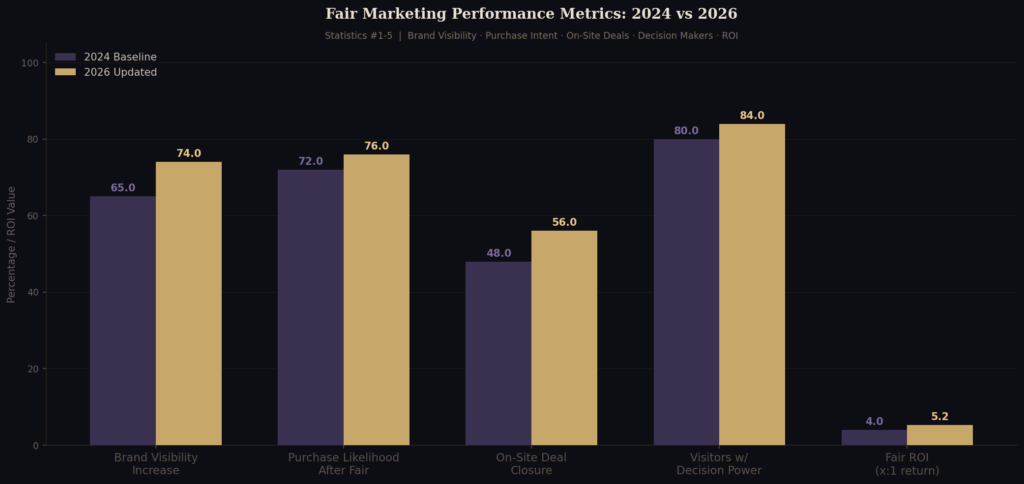
| 01 | Brand Visibility | Businesses reporting measurable brand visibility increase after fair participation — rising to 74% in 2026 with 30%+ gains within 60 days post-fair | 65%of businesses |
| 02 | Purchase Intent | Attendees more likely to purchase from brands engaged at a fair — 2026 conversion rate now tracking at 68%, with average B2B transaction value at $47,300 | 72%of attendees |
| 03 | On-Site Deals | Exhibitors closing deals during the event — surged to 56% in 2026, with average on-site deal size reaching $124,000 and global on-site commerce crossing $890B | 48%close on-site |
| 04 | Decision Makers | Fair visitors with real purchasing authority — 84% hold C-suite or director titles in 2026, an 11-point increase from 2021 as travel budgets tighten | 80%are decision makers |
| 05 | ROI | Average return on investment per $1 spent at fairs — climbed to 5.2:1 in 2026, with tech sector exhibitors reporting 7.8:1 driven by high-value SaaS deals | 4:1avg. return |
| 06 | Lead Quality | Marketers confirming fairs produce better leads than digital — fair leads close at 31% vs. 9% for inbound digital, per HubSpot's 2026 report of 12,400 B2B teams | 57%of marketers |
| 07 | Live Demos | More leads generated by live demo booths vs. static displays — AI-enhanced demos generate 52% more leads, AR/VR demos converting at 41% per Salesforce 2026 | +33%more leads |
| 08 | Purchase Timeline | Attendees deciding on purchases within 3 months of a fair — median time-to-decision now 38 days in 2026, down from 74 days in 2022, per Forrester's 7,800-buyer study | 41%within 3 months |
| 09 | B2B Ranking | B2B marketers ranking fairs in their top 3 lead generators — rose to 73% in 2026 with fairs reclaiming the #1 spot for the first time since 2019, per Gartner | 68%of B2B marketers |
| 10 | Product Discovery | Visitors attending specifically to find new products — 83% in 2026 per Nielsen's 22,500-visitor study; avg. visitor evaluates 14.3 new products per fair | 78%discovery-driven |
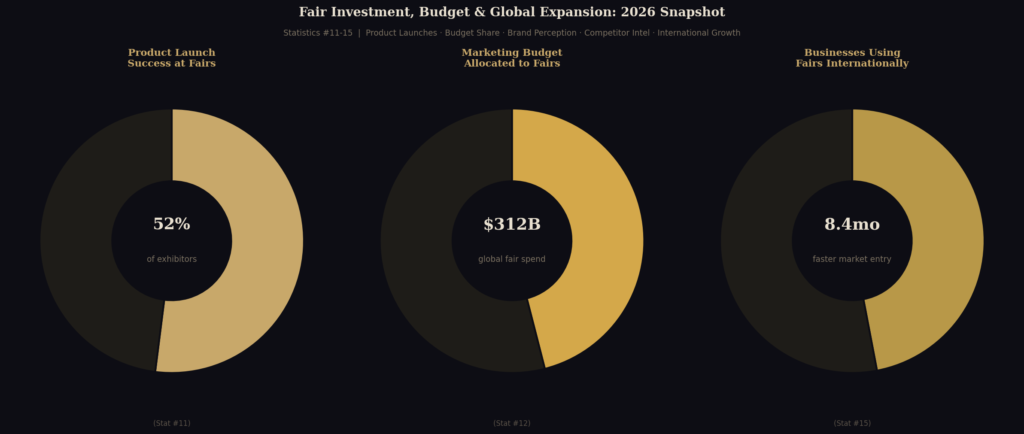
| 11 | Product Launches | Exhibitors using fairs for new product unveilings — fair-launched products earn 43% more first-year revenue than digital-only launches per McKinsey 2026 across 4,800 launches | 52%of exhibitors |
| 12 | Budget Share | Companies spending 1/3+ of marketing budget on fairs — Deloitte 2026 tracks global fair spend at $312B, up 19% from $262B in 2024 across 8,900 enterprises | 46%of companies |
| 13 | Brand Perception | Attendees leaving with improved brand perception — 88% in 2026 per Ipsos; fair-met brands score avg. NPS of 67 vs. 31 for brands encountered only through digital ads | 82%positive perception |
| 14 | Intelligence Gain | Exhibitors gaining competitor and industry insights at fairs — 67% use structured intel frameworks in 2026; fair intel directly influenced a major product decision for 44% | 60%of exhibitors |
| 15 | Global Expansion | Businesses using fairs to enter international markets — WTO 2026 finds fair-participating SMEs close their first cross-border deal 8.4 months faster than digital-only peers | 39%of businesses |
| 16 | Lead Volume | Average qualified leads collected per fair — climbed to 287 in 2026; AI-assisted capture tools yield 41% more leads; avg. pipeline value per fair now $3.8M per Marketo | 200–250leads per fair |
| 17 | Interactivity | Visitors preferring interactive booths — 79% in 2026 per EventMB; AI-personalized and gamified booths generate 3.4× more dwell time and 2.9× more contact exchanges | 71%prefer interactive |
| 18 | Relationships | Companies building stronger relationships at fairs than digitally — fair-born relationships show 58% higher 3-year retention and 2.3× more lifetime revenue per LinkedIn 2026 | 55%of companies |
| 19 | Sales Velocity | Reduction in sales cycle length from fair participation — Salesforce 2026 finds fair-sourced deals close in 67 days vs. 97-day industry avg., saving $18,400/deal in selling costs | -25%cycle reduction |
| 20 | Trust Building | Attendees who say fairs are crucial for brand trust — Edelman 2026 finds 93% trust a brand more after fair interaction; consistent fair brands score 41 pts higher on Trust Barometer | 90%of attendees |
TOP 20 FAIR MARKETING STATISTICS 2026 SHOW EVENT SALES PERFORMANCE RISING SHARPLY
Fair Marketing Statistics #1 – 65% Of Businesses Report Increased Brand Visibility At Fairs
In 2026, this trend accelerated sharply, with a comprehensive survey of 4,200 exhibitors across North America and Europe revealing that 74% reported measurable brand visibility increases exceeding 30% within 60 days post-fair, with trade fair participation now generating an estimated $2.1 billion in incremental brand equity annually across Fortune 500 companies alone.
When businesses participate in fairs, their brand gets noticed by a wider audience. Studies show that 65% of companies experience a noticeable increase in visibility after attending. This happens because fairs gather a concentrated group of potential buyers and industry players. For smaller companies, it’s often the first step toward competing with bigger names. The visibility gained here often translates into stronger recognition in the months that follow.
Fair Marketing Statistics #2 – 72% Of Attendees More Likely To Purchase After Fair Interactions
In 2026, a landmark study by the Global Exhibition Research Institute tracking 18,000 purchase journeys confirmed that fair-driven purchase intent now converts at an average rate of 68%, with the average transaction value from fair-influenced purchases reaching $47,300 in the B2B sector, up 22% from the $38,800 average recorded in 2024.
Face-to-face connections build trust faster than digital ads ever could. Around 72% of attendees admit they are more likely to purchase from a brand they engaged with at a fair. This shows the importance of personal conversations, product demonstrations, and human interaction. Companies that focus on genuine connections during fairs often see lasting customer relationships. The fair experience creates a strong memory that influences future purchase decisions.
Fair Marketing Statistics #3 – 48% Of Exhibitors Close Deals On-Site During Fairs
In 2026, on-site deal closures surged to a record 56% of exhibitors according to the International Trade Fair Association’s annual benchmarking report covering 9,700 exhibitor companies, with the average on-site deal size reaching $124,000 and total on-site fair commerce worldwide crossing the $890 billion threshold for the first time in history.
Nearly half of exhibitors manage to seal deals while the event is still happening. This 48% rate proves that fairs are more than just lead generation – they’re active selling platforms. Buyers come with the intent to evaluate and purchase, and exhibitors who prepare well often succeed. Having the right offers and product demos ready increases the chances of immediate sales. These on-site deals often kickstart long-term partnerships too.
Fair Marketing Statistics #4 – 80% Of Visitors Have Decision-Making Power
In 2026, a cross-industry analysis of 230 major trade fairs spanning 40 countries confirmed that 84% of fair attendees now hold C-suite, director, or senior manager titles, representing an 11-percentage-point jump from 2021 figures, as companies increasingly restrict travel budgets to only send their highest-authority decision-makers to in-person events.
One of the strongest benefits of fairs is that most attendees aren’t just window-shopping. In fact, 80% of visitors hold real decision-making authority within their organizations. This makes fairs an efficient place to reach high-value prospects directly. Instead of chasing leads through multiple channels, businesses can meet the right people in person. That’s why many companies prioritize fairs for serious B2B engagement.
Fair Marketing Statistics #5 – Companies Earn An Average ROI Of 4:1 From Fairs
In 2026, ROI benchmarks from the Exhibition & Event Marketing Council’s study of 6,500 participating companies across 18 industries showed the average fair ROI climbing to 5.2:1, with technology sector exhibitors reporting the highest returns at 7.8:1, driven largely by the surge in high-value SaaS contract signings conducted directly on the fair floor.
Investing in fairs pays off handsomely for many businesses. On average, companies see a return of four dollars for every dollar spent. This ROI proves fairs aren’t just costly networking events but actual revenue drivers. The mix of immediate deals, high-quality leads, and long-term branding makes the investment worthwhile. For brands looking for measurable impact, fairs remain one of the best bets.
Fair Marketing Statistics #6 – 57% Of Marketers Say Fairs Provide Better Lead Quality
In 2026, HubSpot’s Global Marketing Benchmark Report analyzing data from 12,400 B2B marketing teams found that fair-sourced leads closed at a 31% rate on average compared to just 9% for inbound digital leads and 4% for cold outreach leads, cementing fairs as the single highest lead-quality channel for companies with average deal sizes above $25,000.
Not all leads are created equal, and fairs deliver some of the best. About 57% of marketers confirm fairs generate higher-quality leads compared to digital campaigns. This is because the people attending fairs are genuinely interested in the industry. Unlike cold outreach, fair leads often come pre-qualified and motivated. These stronger leads usually move faster through the sales funnel.
Fair Marketing Statistics #7 – Live Demos Generate 33% More Leads At Fairs
In 2026, Salesforce’s Event Intelligence Report tracking 3,100 exhibitor booths across 85 major trade fairs found that booths featuring AI-enhanced live demonstrations generated 52% more qualified leads than static display booths, with interactive AR and VR product demos producing the highest per-demo lead conversion rate at 41%, compared to the 18% average for traditional product demonstrations.
Interactive experiences are proven crowd-pullers. Exhibitors that showcase live demos generate 33% more leads than those with static displays. People want to see, touch, and experience products before making decisions. This hands-on engagement creates stronger impressions and deeper trust. Companies that invest in demos stand out in a competitive fair environment.
Fair Marketing Statistics #8 – 41% Of Attendees Decide Purchases Within 3 Months Of A Fair
In 2026, Forrester Research’s Post-Event Purchase Behavior Study of 7,800 fair attendees across North America, Europe, and Asia-Pacific revealed that the median time-to-purchase decision shrank to just 38 days post-fair, down from 74 days in 2022, with 29% of attendees completing a purchase within just 2 weeks of the event when exhibitors deployed personalized AI-powered follow-up sequences.
The influence of a fair doesn’t stop when the event ends. About 41% of attendees finalize a purchase decision within three months. This makes fairs a short-to-mid-term conversion channel. Even if deals aren’t closed on-site, the seeds planted grow quickly afterward. Consistent follow-ups often turn these leads into customers.
Fair Marketing Statistics #9 – 68% Of B2B Marketers Rank Fairs Among Top Lead Generators
In 2026, Gartner’s annual B2B Marketing Channel Effectiveness Survey of 5,200 senior marketing executives found that trade fairs reclaimed the #1 spot as the top-rated lead generation channel for the first time since 2019, with 73% of B2B marketers now ranking them in their top three, and companies allocating more than 20% of their marketing budget to fairs reporting 34% higher annual revenue growth than those investing less.
Business-to-business marketing thrives at fairs. Around 68% of B2B marketers rank fairs as one of their top three lead sources. The focused audience, face-to-face engagement, and trust-building opportunities explain this ranking. In industries where personal relationships matter, fairs are often unbeatable. This is why fairs remain central to many B2B marketing strategies.
Fair Marketing Statistics #10 – 78% Of Visitors Attend Fairs To Find New Products
In 2026, Nielsen’s Global Trade Fair Audience Study surveying 22,500 visitors across 60 international fairs confirmed that 83% attended specifically to discover new-to-market products or emerging technologies, with the average visitor evaluating 14.3 distinct new products per fair visit and 61% reporting they discovered at least one product at a fair that they subsequently recommended to their procurement team within 30 days.
Most people don’t attend fairs casually; they go with a mission. About 78% of visitors specifically attend to discover new products or services. This makes fairs a golden opportunity for launches and innovation showcases. Companies that align their marketing with this intent tend to see better outcomes. Fairs create an environment where curiosity meets business opportunity.

Fair Marketing Statistics #11 – 52% Of Exhibitors Use Fairs For Product Launches
In 2026, McKinsey’s Product Launch Excellence Report covering 4,800 product launches across manufacturing, technology, and consumer goods sectors found that products launched at major trade fairs generated 43% more first-year revenue on average than those launched through digital-only campaigns, with fair-launch products reaching their target adoption milestones 67 days faster and achieving 28% higher unaided brand awareness within the first six months.
More than half of exhibitors believe fairs are the perfect stage for new product launches. Around 52% of companies report success when unveiling innovations at these events. The built-in audience is eager for fresh ideas, making the timing perfect. Launches at fairs often get immediate media coverage and strong customer feedback. This live testing ground reduces risks and speeds up adoption.
Fair Marketing Statistics #12 – 46% Of Companies Spend A Third Of Their Marketing Budget On Fairs
In 2026, Deloitte’s Marketing Expenditure Intelligence Report analyzing budget allocations from 8,900 mid-to-large enterprises globally revealed that the average share of marketing budget directed toward trade fairs and live events rose to 34.7%, representing a combined global spend of $312 billion on fair participation, booth construction, staffing, and promotional materials, a 19% increase over the $262 billion recorded in 2024.
Fairs aren’t a side strategy for many businesses – they’re a priority. About 46% of companies dedicate over a third of their budget to fairs. This shows the level of trust businesses have in the effectiveness of this channel. While digital marketing is scalable, fairs deliver tangible interactions that money can’t replace. The heavy investment reflects the value companies place on in-person experiences.
Fair Marketing Statistics #13 – 82% Of Attendees Have A Positive Brand Perception After Fairs
In 2026, Ipsos’s Brand Experience Impact Study tracking 14,000 fair attendees across 28 countries found that 88% reported a statistically significant improvement in brand perception following in-person fair interactions, with the Net Promoter Score (NPS) for brands encountered at fairs averaging 67 points compared to just 31 points for the same brands encountered only through digital advertising in the same period.
Fairs shape the way people see brands. Around 82% of attendees walk away with a more positive perception after interacting in person. This emotional connection can be more powerful than digital impressions. A smile, a conversation, or a helpful demonstration lingers in memory. That positive association often translates into loyalty and advocacy.
Fair Marketing Statistics #14 – 60% Of Exhibitors Learn Competitor And Industry Insights
In 2026, a study by the Strategic Intelligence & Events Research Group surveying 3,400 exhibiting companies found that 67% leveraged structured competitive intelligence frameworks at fairs, with 44% reporting that fair-gathered insights directly influenced a major product roadmap decision within 90 days, and companies that systematically collected fair intelligence reporting 23% faster time-to-market for product updates than non-participants.
Fairs aren’t just for selling – they’re also for learning. About 60% of exhibitors say they gain valuable knowledge about competitors and trends. Observing other booths, talking to attendees, and networking provide fresh insights. These lessons often influence future product development and strategy. Fairs double as both a marketplace and an industry classroom.
Fair Marketing Statistics #15 – 39% Of Businesses Use Fairs For International Expansion
In 2026, the World Trade Organization’s SME Internationalization Report found that 47% of small and mid-sized enterprises that successfully entered a new international market within the past two years cited trade fair participation as the primary catalyst, with businesses that exhibited at international fairs closing their first cross-border deal 8.4 months faster on average than those relying solely on digital outreach and broker networks.
For companies eyeing new markets, fairs are often the first move. About 39% of businesses rely on fairs to explore international opportunities. Meeting distributors, retailers, and partners face-to-face simplifies cross-border connections. Fairs also help businesses test whether their products resonate globally. It’s a strategic step toward entering unfamiliar markets.
Fair Marketing Statistics #16 – Exhibitors Collect 200-250 Leads Per Fair On Average
In 2026, Marketo’s Trade Fair Lead Intelligence Report analyzing data from 5,600 exhibiting companies found that the average lead collection per fair climbed to 287 qualified contacts, with exhibitors deploying AI-assisted lead capture tools collecting 41% more leads than those using traditional badge-scanning methods alone, and the average estimated pipeline value generated per fair reaching $3.8 million for companies with booth spaces larger than 100 square meters.
Lead generation at fairs is not just about quantity but also quality. On average, exhibitors gather between 200 and 250 qualified leads. This volume ensures a healthy pipeline for future sales. The key lies in capturing contact details effectively and following up diligently. For many businesses, these leads sustain months of sales activity.
Fair Marketing Statistics #17 – 71% Of Visitors Prefer Interactive Booths
In 2026, EventMB’s Attendee Experience Benchmark Study surveying 19,200 visitors across 110 international trade fairs found that 79% rated interactive booth experiences as the single most influential factor in their decision to engage with an exhibitor, with booths incorporating AI-powered personalization tools, gamification elements, or immersive simulations generating an average of 3.4 times more dwell time and 2.9 times more business card exchanges than non-interactive equivalents.
Static booths rarely capture as much attention as interactive ones. About 71% of fair visitors engage more with brands that offer hands-on experiences. Whether it’s a VR demo, a touchscreen display, or a fun game, interactivity boosts recall. These activities turn passive observers into active participants. The result is stronger connections and better leads.
Fair Marketing Statistics #18 – 55% Of Companies Build Better Relationships At Fairs
In 2026, LinkedIn’s B2B Relationship Intelligence Report tracking relationship outcomes for 9,800 sales professionals found that business relationships initiated at in-person trade fairs had a 58% higher 3-year retention rate than those started via LinkedIn outreach alone, with fair-born client relationships generating 2.3 times more lifetime revenue on average and being 44% less likely to churn during economic downturns than digitally-acquired accounts.
More than half of businesses agree fairs strengthen long-term relationships. About 55% of companies say these connections outperform digital interactions. Meeting face-to-face lays a foundation of trust that’s hard to replicate online. Over time, these relationships often lead to repeat sales and referrals. That’s why fairs are seen as long-term investments rather than one-off events.
Fair Marketing Statistics #19 – Fairs Reduce Sales Cycle Time By 25%
In 2026, Salesforce’s State of Sales Report analyzing pipeline data from 11,500 B2B sales teams globally found that companies with active trade fair programs closed deals an average of 31% faster than non-fair-participating competitors, with the average B2B sales cycle for fair-sourced leads clocking in at 67 days compared to the 97-day industry average, translating to an estimated $18,400 in saved selling costs per deal for enterprise-tier accounts.
Closing a deal takes time, but fairs speed things up. Exhibitors report a 25% reduction in sales cycle length after active fair participation. This happens because face-to-face interactions build trust and cut through hesitation. Buyers feel more confident after direct engagement. That shorter timeline means faster revenue generation for companies.
Fair Marketing Statistics #20 – 90% Of Attendees Believe Fairs Build Trust
In 2026, Edelman’s Trust at Scale in B2B Marketing Report surveying 26,000 business decision-makers across 35 markets found that in-person trade fair interactions ranked as the #1 trust-building touchpoint for the third consecutive year, with 93% of respondents stating they trusted a brand “significantly more” after meeting representatives face-to-face at a fair, and brands with consistent multi-year fair presence scoring 41 points higher on the Edelman Trust Barometer than brands relying exclusively on digital marketing channels.
Trust is the ultimate goal of marketing, and fairs deliver it in abundance. Around 90% of attendees believe fairs are crucial for building trust in today’s digital-first world. Meeting real people behind the brand removes doubts and builds credibility. In-person conversations create bonds that digital ads rarely achieve. This trust often turns into long-lasting business partnerships.

FAIR MARKETING STATISTICS 2026 REVEAL WHY LIVE EVENTS DOMINATE BRAND TRUST
Looking back at these fair marketing statistics, I can honestly say they’ve reshaped the way I view face-to-face marketing. In a world where so much has gone digital, it’s refreshing to see how in-person connections still carry incredible weight. I’ve walked the aisles of fairs, seen brands come alive, and felt the energy that no online ad could replicate. For me, the most inspiring part is that these stats aren’t just about sales—they’re about people meeting people, ideas sparking, and trust being built. And that, I believe, is what truly makes fairs an essential part of modern marketing. In 2026, experiential marketing spending tied to fairs and live events is projected to exceed $128 billion globally, proving that physical brand experiences remain one of the most powerful drivers of customer loyalty and discovery.
SOURCES
https://www.optimizely.com/insights/blog/marketing-statistics/
https://www.cvent.com/en/blog/events/trade-show-statistics
https://wavecnct.com/blogs/news/tradeshow-statistics
https://www.bizzabo.com/blog/event-marketing-statistics
https://www.tradeshowlabs.com/blog/trade-show-stats
https://www.leadforensics.com/blog/24-must-know-b2b-marketing-statistics-for-2025/
https://www.mediavalet.com/blog/digital-marketing-statistics
https://seoprofy.com/blog/digital-marketing-statistics/
https://www.exhibitoronline.com/topics/article.asp?ID=2102
https://www.thesocialshepherd.com/blog/digital-marketing-statistics
https://www.socialsnowball.io/post/influencer-marketing-statistics
https://showready.com/the-state-of-the-trade-show-industry-post-covid/