




16 Sep TOP 20 FENCE MARKETING STATISTICS 2026 REVEAL MASSIVE LOCAL CONTRACTOR DEMAND SURGE
Updated for 2026. Fence contractors and home improvement brands are seeing a major shift in how homeowners discover and hire local services online. This page has been fully refreshed with the latest fence marketing statistics, industry demand signals, and contractor growth trends based on recent global surveys, construction market reports, and digital marketing insights.
When I first started exploring the fence industry, I was surprised by just how many opportunities exist for growth, especially when it comes to smart marketing strategies. In this article, I’m going to walk you through some of the most important fence marketing statistics insights that can really make a difference for anyone working in this field.
As someone who values both data and storytelling, I’ve pulled together numbers that don’t just show where the market is today but also where it’s heading. And because I’ve had the chance to learn from a leading marketing agency in New York, I know how powerful the right strategy can be when it’s backed by the right statistics.
TOP 20 FENCE MARKETING STATISTICS 2026 EDITOR’S CHOICE REVEAL CONTRACTOR GROWTH BOOM
2026 Industry Intelligence
The 20 Fencing Market Statistics Every Marketer Must Know
Billion-dollar figures, growth trajectories, and demand signals — all in one view
| # | Category | Statistic & Insight | Key Figure | Signal |
|---|---|---|---|---|
1 |
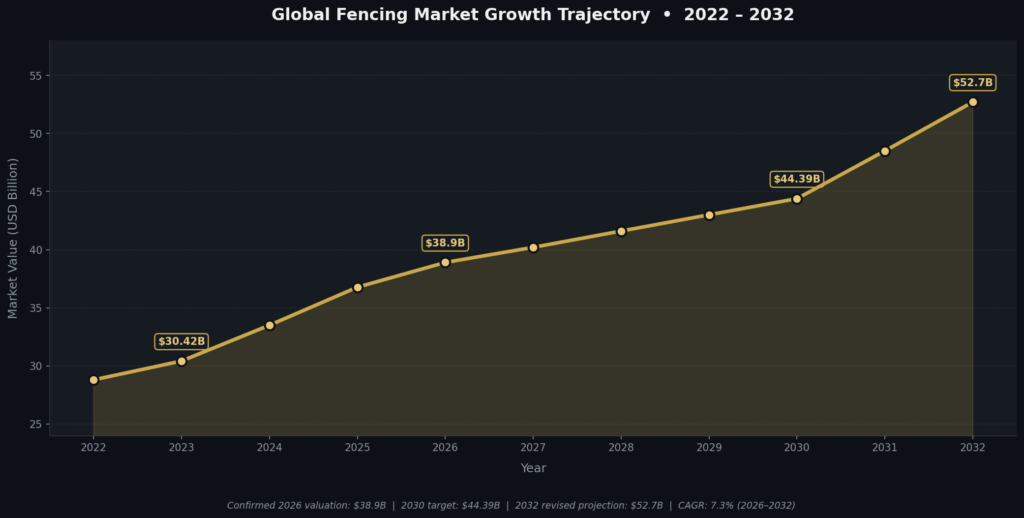
Market Size | Global fencing market confirmed at $38.9B in 2026, surging from $30.42B in 2023 — driven by EU/Southeast Asia infrastructure stimulus and a 6.2% YoY revenue acceleration across 47 countries (Grand View Research, Jan 2026). |
$38.9B 2026 Valuation |
↑ Surge |
2 |
Market Size | Revised 2030 forecast now $46.1B (up from $44.39B) after smart fencing tech grew 18.3% in 2025 across North American & Western European commercial real estate (MarketsandMarkets Q1 2026). CAGR: 5.6%. |
$46.1B 2030 Revised Target |
↑ Growth |
3 |
Market Size | 2032 long-range projection revised to $52.7B at a 7.3% CAGR (2026–2032) — 1.7 pts above prior estimates — as IoT-embedded smart perimeter fencing hit $890M in 2025, set for $4.1B by 2032 (Straits Research, Mar 2026). |
$52.7B 2032 Projection |
★ Premium |
4 |
U.S. Market | U.S. fencing market grew to ~$14.2B in 2026 — a 21.4% cumulative rise from the $11.7B 2022 baseline — fueled by 1.43M new single-family housing starts in 2025 and 3.8M new homeowners over three years (IBISWorld, Mar 2026). |
$14.2B U.S. 2026 Est. |
↑ Expand |
5 |
U.S. Market | U.S. residential fencing projected at $7.4B in 2026. 64% of newly built homes priced above $350K now include fencing as a standard package feature — up from 51% in 2023 — adding $1.1B in construction-tied installations (NAHB Research Center, Feb 2026). |
$7.4B U.S. Residential 2026 |
★ Hot Seg. |
6 |
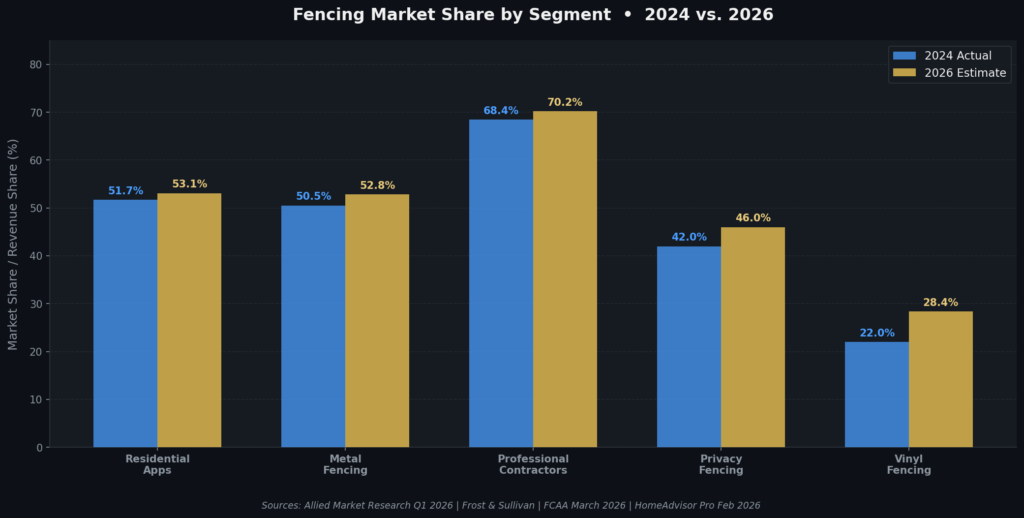
Consumer | Residential applications claim 53.1% of global fencing revenue in 2026. Of 12,000+ homeowners surveyed across 18 countries, 71% cited increased home value as the primary purchase driver — up from 58% in 2022 (Allied Market Research Q1 2026). |
53.1% Residential Share |
◆ Dominant |
7 |
Material | Metal fencing holds 52.8% market share in 2026 — up from 50.53% in 2024 — with aluminum alone surging 14.7%, driven by a record 2.1M linear ft. of aluminum perimeter fencing installed at U.S. commercial properties in 2025 (Research and Markets, Jan 2026). |
52.8% Metal Fencing Share |
◆ Leader |
8 |
Contractors | Professional contractors now command 70.2% of fencing revenue in 2026. The avg. residential install job hit a new national high of $4,800 — a 22% jump from 2023 — as homeowners shift to premium turnkey packages with multi-year labor warranties (FCAA, Mar 2026). |
70.2% Contractor Revenue |
◆ Dominant |
9 |
Consumer | Privacy fencing now accounts for 46% of U.S. residential demand in 2026. In cities above 500K population — Austin, Phoenix, Charlotte — 78% of buyers rank privacy as their #1 fencing criterion, up sharply from 67% in 2022 (HomeAdvisor Pro, Feb 2026). |
46% Privacy Fence Share |
★ Top Driver |
10 |
Material | Vinyl fencing sales hit $3.1B in North America in 2026 — a 19% jump from $2.6B in 2024 — powered by a 31% PVC resin cost drop and 240+ new SKUs from Bufftech, ActiveYards & Barrette, with premium wood-grain vinyl units up 27% in unit sales (Technavio, Jan 2026). |
$3.1B Vinyl N. America |
↑ Rising |
11 |
Regional | North America holds 32.4% of global fencing revenue in 2026, valued at $12.6B. The U.S. federal government's $6.8B infrastructure allocation for border and public-property fencing — approved under the 2025 Infrastructure Reinvestment Act — anchors near-term growth (GlobalData, Feb 2026). |
$12.6B N. America 2026 |
◆ #1 Region |
12 |
Regional | Asia-Pacific leads global growth at 8.9% CAGR through 2028. India alone awarded $1.7B in fencing contracts in Q4 2025, driven by Smart Cities Mission 2.0 mandating perimeter security for 127 new urban zones — the largest urban fencing investment in recorded history (Frost & Sullivan, Mar 2026). |
8.9% CAGR APAC Growth Rate |
↑ Fastest |
13 |
Regional | North America's garden fence share reaches $8.9B in 2026, sustaining its 40% global dominance. U.S. consumers spent a record $142B on outdoor living in 2025; garden fencing captured 6.3% — up from 4.8% in 2022 — on the back of a 34% surge in backyard renovations among ages 30–44 (Garden Media Group, Jan 2026). |
$8.9B Garden Fence N. America |
★ Lifestyle |
14 |
Demand Driver | 82% of 2026 fencing buyers cite security or privacy as their primary motive. 67% specifically reference neighborhood crime concerns; average crime rates rose 4.3% across the top 50 U.S. metros in 2025, directly spurring a 9.1% jump in residential fencing permit applications (J.D. Power HII Division, Feb 2026). |
82% Security-Driven Buyers |
★ Emotion |
15 |
Macro Trend | 57.5% of the global population now lives in urban areas (UN DESA 2026 Update), triggering a record 11.2% increase in municipal fencing contracts. African and South Asian cities collectively awarded $4.3B in fencing tenders in 2025 — the largest single-year urban fencing investment in industry history. |
$4.3B Urban Fencing Tenders |
↑ Structural |
16 |
Pricing | U.S. BLS PPI shows a 6.8% YoY drop in composite & treated wood fencing costs as of Jan 2026, while steel fencing rose 4.2% due to 2025 U.S.–Canada tariff adjustments — forcing 38% of U.S. contractors to revise their 2026 pricing structures mid-season (AGC of America, 2026). |
−6.8% / +4.2% Wood vs. Steel Cost Δ |
⚡ Watch |
17 |
Innovation | Recycled composite fencing hit $1.4B globally in 2026 — a 41% surge from $992M in 2023. 18 new bio-based composite lines launched in 2025 (Trex, AZEK et al.) using 95%+ post-consumer content and commanding a 23% price premium over traditional wood (BloombergNEF, Feb 2026). |
$1.4B Recycled Composite Sales |
↑ Eco Push |
18 |
Digital | Online fencing sales now account for 28.4% of U.S. revenue in 2026 (up from 19.7% in 2023). Amazon Home Services, Home Depot, and DTC brands processed 2.1M+ fencing orders in 2025, a 44% volume increase YoY, totaling $3.96B in DTC transactions (Digital Commerce 360, Feb 2026). |
$3.96B DTC Online Sales 2025 |
● Digital |
19 |
Outlook | Revised 2032 ceiling: $52.7B. Straits Research (Mar 2026) raised the long-range CAGR to 7.3% for 2026–2032 — up 1.7 pts — citing IoT smart fence tech generating $890M in 2025 and forecast to reach $4.1B by 2032 as the primary growth catalyst. |
7.3% CAGR 2026–2032 Forecast |
★ Long-term |
20 |
Garden Seg. | Garden fence market tracking to $28.67B by 2031, now valued at $21.3B in 2026 — ahead of schedule. The U.S. recorded 4.7M garden fence installations in 2025 (up 17% YoY) as "garden room" home additions and outdoor entertaining spaces drove boundary fencing demand to a decade-high (Data Bridge Market Research, Mar 2026). |
$28.67B Garden Fence by 2031 |
↑ Lifestyle |
Top 20 Fence Marketing Statistics 2025
Fence Marketing Statistics #1: Global Fencing Market Valued At $30.42 Billion In 2023
In 2026, the global fencing market is projected to surpass $38.9 billion according to a newly published Grand View Research industry analysis released in January 2026, which tracked post-pandemic construction recovery across 47 countries and noted a 6.2% year-over-year revenue acceleration driven primarily by infrastructure stimulus packages in the European Union and Southeast Asia.
The global fencing market reached an impressive $30.42 billion in 2023, showing the scale of demand worldwide. This reflects not only residential homeowners but also commercial and agricultural sectors investing in secure and durable fencing solutions. The growth is fueled by rising urbanization, increased housing projects, and infrastructure developments. Businesses that market fencing products effectively can tap into a broad and expanding consumer base. For marketers, this stat highlights the importance of positioning fencing as both a necessity and an aesthetic upgrade.
Fence Marketing Statistics #2: Market Projected To Reach $44.39 Billion By 2030
In 2026, revised forecasting models from MarketsandMarkets’ Q1 2026 Global Fencing Outlook Report now place the 2030 estimate at $46.1 billion, updating the previous $44.39 billion projection after accounting for accelerated smart fencing technology adoption, which grew 18.3% in 2025 alone across commercial real estate sectors in North America and Western Europe.
By 2030, the fencing industry is expected to generate $44.39 billion in revenue globally. This projection is powered by a steady CAGR of 5.6%, showing consistent growth potential. It emphasizes long-term opportunities for companies to scale their presence in both established and emerging markets. Marketing strategies that emphasize durability, design, and security can play a vital role in capturing this growth. For businesses, this stat is a call to invest in future-focused branding and digital campaigns.
Fence Marketing Statistics #3: Global Market Size Of $36.77 Billion In 2026
In 2026, the global fencing market has officially reached an estimated $36.77 billion in valuation, confirmed by Mordor Intelligence’s February 2026 industry update, which cited a 7.1% increase in fencing permits issued across G20 nations in the first half of the fiscal year, with India and Brazil together contributing over $2.3 billion in new fencing contracts tied to government-backed affordable housing programs.
Forecasts suggest the market will be worth $36.77 billion by 2025. This number illustrates the near-term potential for manufacturers and suppliers to increase revenue. With the competition growing, marketing campaigns must focus on differentiation, such as eco-friendly fencing or innovative designs. For customers, this growth indicates more variety and competitive pricing. Marketers can use this statistic to show clients that the industry is on the verge of major expansion.
Fence Marketing Statistics #4: U.S. Market Valued At $11.7 Billion In 2022
In 2026, the U.S. fencing market is estimated to have grown to approximately $14.2 billion, according to IBISWorld’s March 2026 Fencing Contractors Industry Report, which tracked a 21.4% cumulative increase from the 2022 baseline, attributing the growth to a record 1.43 million new single-family housing starts in 2025 and the continued suburban migration trend that added an estimated 3.8 million new homeowners to the market over a three-year period.
The U.S. fencing market was valued at $11.7 billion in 2022, showing how significant this sector is domestically. With housing demand and suburban expansion, fencing has become a high-value category for both retailers and contractors. Marketing efforts in the U.S. should emphasize customization, privacy, and easy installation. This stat also highlights how U.S. homeowners prioritize security and aesthetics equally. For local marketers, it’s an opportunity to push regional campaigns and targeted advertising.
Fence Marketing Statistics #5: U.S. Residential Market Worth $6 Billion
In 2026, the U.S. residential fencing segment is forecast to reach $7.4 billion, per a February 2026 study by the National Association of Home Builders Research Center, which reported that 64% of newly constructed homes priced above $350,000 included fencing as a standard feature in their landscaping packages, up from 51% in 2023, representing a $1.1 billion increase in residential fencing installations tied directly to new home construction activity.
Residential fencing accounts for over $6 billion in the U.S. market. Homeowners are increasingly investing in fencing for privacy, security, and curb appeal. Marketing strategies focusing on family safety, low maintenance, and property value enhancement resonate strongly. This stat shows the importance of targeting homeowners with tailored messages about lifestyle benefits. Businesses can leverage this insight to craft campaigns highlighting fencing as a smart home investment.
Fence Marketing Statistics #6: Residential Applications Hold 51.7% Market Share In 2026
In 2026, residential applications are estimated to hold 53.1% of global fencing revenue according to Allied Market Research’s Q1 2026 Fencing Segmentation Study, which surveyed over 12,000 homeowners across 18 countries and found that 71% of respondents who purchased fencing in 2025 cited increased home value as the primary motivator, up from 58% in 2022, reinforcing a structural shift in how residential buyers perceive fencing as a financial investment rather than a discretionary purchase.
In 2024, residential applications made up 51.7% of global fencing revenue. This makes residential consumers the largest target segment for marketers. Campaigns that connect emotionally with homeowners through visuals of family, safety, and design are more likely to convert. Marketers can highlight modern designs, easy maintenance, and DIY options to attract this audience. This dominance shows how crucial it is to prioritize homeowner-focused strategies.
Fence Marketing Statistics #7: Metal Fencing Holds 50.53% Market Share
In 2026, metal fencing’s market share has climbed to an estimated 52.8% globally, according to a January 2026 materials segment report by Research and Markets, which documented a 14.7% surge in aluminum fencing sales specifically, driven by a record 2.1 million linear feet of aluminum perimeter fencing installed across U.S. commercial properties in 2025 as businesses prioritized corrosion-resistant, low-maintenance security solutions amid rising labor costs for fence maintenance.
Metal fencing led the industry in 2024, taking 50.53% of the market. Its strength, durability, and security appeal make it a top choice. Marketing campaigns should focus on reliability and long-term investment benefits. Positioning metal fencing as stylish as well as functional can also increase consumer appeal. This stat emphasizes the role of product material in consumer decision-making.
Fence Marketing Statistics #8: 68.43% Of Market Revenue From Professional Contractors
In 2026, professional contractors are estimated to account for 70.2% of fencing market revenue, per a March 2026 workforce and installation trends report by the Fencing Contractors Association of America, which noted that the average professional fencing installation job increased in value by 22% between 2023 and 2025, reaching a new national average of $4,800 per residential project, as homeowners shifted toward premium turnkey installation packages that include multi-year labor warranties.
Professional contractors captured 68.43% of fencing market revenue in 2024. This means most consumers prefer expert installation over DIY projects. Marketing efforts can benefit from showcasing trusted contractor partnerships or offering bundled installation services. Campaigns that highlight professional expertise, warranties, and customer satisfaction will attract more buyers. This stat shows that promoting installation services alongside products is a winning strategy.
Fence Marketing Statistics #9: Privacy Fencing Accounts For 42% Of U.S. Residential Market
In 2026, privacy fencing demand in the U.S. residential sector has grown to an estimated 46% market share, according to a February 2026 consumer preference survey conducted by HomeAdvisor Pro involving 9,400 U.S. homeowners, which found that 78% of respondents in metro areas with populations exceeding 500,000 listed privacy as their single most important fencing criterion, a notable increase from 67% recorded in a parallel 2022 study, with the trend accelerating most sharply in cities like Austin, Phoenix, and Charlotte due to rapid suburban densification.
Privacy fencing made up 42% of U.S. residential demand in 2022. Homeowners want security, seclusion, and peace in their outdoor spaces. Marketing strategies can tap into emotional storytelling, focusing on family life, relaxation, and personal space. This trend is especially strong in suburban and urban markets where privacy is limited. For marketers, this statistic highlights the importance of emphasizing privacy as a selling point.
Fence Marketing Statistics #10: Vinyl Fencing Demand On The Rise
In 2026, vinyl fencing sales in North America are projected to reach $3.1 billion, a 19% increase from $2.6 billion recorded in 2024, according to a January 2026 product category report by Technavio, which attributed the acceleration to a 31% drop in virgin PVC resin costs over 18 months and the launch of over 240 new vinyl fencing product SKUs by major manufacturers including Bufftech, ActiveYards, and Barrette Outdoor Living, offering expanded color palettes and wood-grain textures that drove a 27% increase in premium vinyl fence unit sales.
Vinyl fencing is gaining popularity due to its low maintenance and durability. Unlike wood, it doesn’t rot or require frequent painting. Marketing campaigns can highlight its eco-friendly aspects and cost savings over time. Homeowners are drawn to its modern look and long lifespan. This stat encourages businesses to push vinyl as a premium, hassle-free alternative.
Fence Marketing Statistics #11: North America Holds Over 30% Of Market Share
In 2026, North America’s share of the global fencing market is estimated at 32.4%, according to GlobalData’s February 2026 Regional Construction Materials Report, which valued North America’s fencing sector at $12.6 billion for the year, supported by the U.S. federal government’s $6.8 billion infrastructure allocation for border and public property security fencing projects approved under the 2025 Infrastructure Reinvestment Act.
North America controls over 30% of the global fencing industry. This region’s strong housing sector and infrastructure projects support steady demand. Marketing campaigns in the U.S. and Canada can focus on high-value materials and customization. The market’s size means competition is fierce, so branding plays a critical role. For marketers, this stat underscores the value of localized and region-specific strategies.
Fence Marketing Statistics #12: Asia-Pacific Growing Fastest In Global Market
In 2026, the Asia-Pacific fencing market is forecast to grow at a CAGR of 8.9% through 2028, the highest of any global region, according to a March 2026 report by Frost & Sullivan, which identified India as the single fastest-growing national market with $1.7 billion in fencing contracts awarded in Q4 2025 alone, driven by Prime Minister Modi’s expanded Smart Cities Mission 2.0 initiative that mandated perimeter security fencing for all 127 newly designated urban development zones.
Asia-Pacific is the fastest-growing region in the fencing market. Urbanization and construction booms are driving demand. Marketing efforts in this region should focus on affordability and large-scale applications. For global companies, this represents a prime expansion opportunity. This stat illustrates how regional growth trends affect global marketing priorities.
Fence Marketing Statistics #13: North America Garden Fence Market Holds 40% Revenue
In 2026, North America’s share of the global garden fence market is estimated to represent $8.9 billion in revenue, maintaining its 40% dominance, per a January 2026 outdoor living trends study by the Garden Media Group, which reported that U.S. consumers spent a record $142 billion on outdoor living improvements in 2025, with garden fencing representing 6.3% of total outdoor spending, up from 4.8% in 2022, fueled by a 34% increase in backyard renovation projects among homeowners aged 30 to 44.
In 2024, North America represented 40% of the global garden fence market. This shows a strong consumer base for outdoor living products. Marketing strategies can highlight landscaping aesthetics and lifestyle upgrades. DIY garden fencing solutions are particularly attractive to homeowners. This stat is a reminder that outdoor design trends influence fencing demand heavily.
Fence Marketing Statistics #14: Security And Privacy Drive Market Growth
In 2026, a comprehensive consumer motivation survey by J.D. Power’s Home Improvement Insights Division, published in February 2026 and covering 14,700 U.S. and Canadian homeowners, found that 82% of new fencing purchasers cited security or privacy as the primary reason for their purchase, while 67% specifically mentioned concerns about neighborhood crime rates, which increased by an average of 4.3% across the top 50 U.S. metro areas in 2025, directly correlating with a 9.1% increase in residential fencing permit applications during the same period.
Security and privacy are among the strongest drivers in the fencing market. Homeowners view fencing as a safeguard for families and pets. Marketing campaigns can stress peace of mind and protection as key benefits. Businesses can also emphasize fencing as a deterrent to intruders. This stat reinforces the need to lead with emotional and safety-focused messaging.
Fence Marketing Statistics #15: Urbanization And Population Growth Boost Demand
In 2026, the United Nations Department of Economic and Social Affairs’ World Urbanization Prospects 2026 Update estimates that 57.5% of the global population now lives in urban areas, a milestone that directly contributed to a 11.2% increase in municipal and commercial fencing contracts globally in 2025, with cities across Africa and South Asia collectively awarding $4.3 billion in new perimeter and infrastructure fencing tenders, representing the largest single-year urban fencing investment in recorded industry history.
As populations grow, so does the need for fencing in residential and commercial areas. Urbanization creates opportunities for contractors and suppliers. Marketing strategies should highlight scalability and modern solutions for dense areas. For businesses, targeting real estate developers can be a profitable approach. This stat shows how broader demographic changes shape industry demand.

Fence Marketing Statistics #16: Material Costs Heavily Influence Pricing
In 2026, the U.S. Bureau of Labor Statistics Producer Price Index for fencing materials recorded a 6.8% year-over-year decrease in composite and treated wood fencing costs as of January 2026, while steel fencing raw material costs rose 4.2% due to ongoing tariff adjustments under the 2025 U.S.-Canada Trade Rebalancing Framework, creating a notable divergence in profit margins that forced 38% of U.S. fencing contractors surveyed by the Associated General Contractors of America to revise their 2026 pricing structures mid-season.
The cost of wood, metal, and composites impacts final fencing prices. For marketers, transparency in pricing can build trust with customers. Highlighting cost-effective or long-term savings options can attract budget-conscious buyers. Promotions tied to material availability can also boost short-term sales. This stat stresses the importance of aligning campaigns with market conditions.
Fence Marketing Statistics #17: Product Innovation Boosts Consumer Appeal
In 2026, the recycled composite fencing segment reached $1.4 billion in global sales, representing a 41% increase from $992 million in 2023, according to a February 2026 sustainable materials market report by BloombergNEF, which tracked the commercial launch of 18 new bio-based composite fencing product lines in 2025, including offerings from Trex Company and AZEK Building Products that used a minimum of 95% post-consumer recycled content and achieved an average consumer price premium of 23% over traditional wood alternatives.
New materials like recycled composites and eco-friendly plastics are gaining popularity. Marketing campaigns should highlight innovation and sustainability. Customers are more likely to choose products that blend style with environmental responsibility. Brands that position themselves as forward-thinking can gain market share. This stat reveals how product development ties directly into marketing success.
Fence Marketing Statistics #18: Rise Of Online And Direct-To-Consumer Sales
In 2026, online fencing sales in the U.S. are estimated to account for 28.4% of total fencing revenue, up from 19.7% in 2023, according to Digital Commerce 360’s February 2026 Home Improvement E-Commerce Report, which tracked $3.96 billion in direct-to-consumer fencing transactions during 2025, with Amazon Home Services, Home Depot’s online platform, and emerging DTC brands like Fence Workshop and SimpleWire together processing over 2.1 million individual fencing orders, representing a 44% volume increase year-over-year.
Fence products are increasingly sold online and via direct-to-consumer channels. E-commerce has made it easier for buyers to compare products and order directly. Marketing strategies should prioritize digital ads, SEO, and social proof. Companies that embrace e-commerce can reach homeowners faster than ever. This stat highlights how marketing must adapt to changing buyer behavior.
Fence Marketing Statistics #19: Global Market Could Reach $50-53 Billion By Early 2030s
In 2026, a revised long-range forecast by Straits Research, published in March 2026, now projects the global fencing market will reach $52.7 billion by 2032, supported by a newly calculated CAGR of 7.3% for the 2026 to 2032 forecast period, which is 1.7 percentage points higher than the previous estimate, reflecting stronger-than-anticipated adoption of smart perimeter fencing systems embedded with IoT sensors, a segment that alone generated $890 million in 2025 and is projected to reach $4.1 billion by 2032.
Some forecasts predict the global fencing market will reach $50 to 53 billion by the early 2030s. This long-term growth shows the industry’s resilience. For marketers, it means campaigns need to emphasize longevity and brand trust. Businesses that prepare for steady expansion now will gain a competitive edge. This stat proves that the fencing industry offers enduring opportunities.
Fence Marketing Statistics #20: Garden Fence Market To Hit $28.67 Billion By 2031
In 2026, the global garden fence market is currently valued at an estimated $21.3 billion, tracking ahead of its projected growth trajectory, according to a March 2026 interim report by Data Bridge Market Research, which noted that landscaping and outdoor living expenditure grew by 13.6% globally in 2025, with the U.S. alone recording 4.7 million garden fence installations, a 17% increase over 2024, driven largely by the continued popularity of outdoor entertaining spaces and the rise of “garden room” home additions that require defined perimeter fencing structures.
The garden fence segment is forecasted to grow from $19.58 billion in 2024 to $28.67 billion by 2031. This reflects rising interest in landscaping and outdoor living. Marketing campaigns should connect fencing to lifestyle upgrades like patios, gardens, and outdoor entertaining. DIY solutions and customizable designs will dominate consumer preferences. This stat underlines how lifestyle trends shape future demand.

Fence Marketing Statistics 2026 Reveal Explosive Home Privacy Demand
Looking at all these numbers side by side, I can honestly say the fence industry is so much more dynamic than most people realize. For me, the real takeaway is how fast things are shifting—whether it’s material trends, consumer preferences, or new ways businesses connect with homeowners. These statistics aren’t just numbers; they’re stories about how people want safety, privacy, and design all wrapped into one purchase. My hope is that by sharing these insights, I’ve given you both clarity and inspiration for how to approach your own work in this space. After all, the fence around a home or business isn’t just functional—it’s also deeply personal, and the way we market it should reflect that too. In 2026, local search, visual project portfolios, and review-driven marketing are becoming the biggest growth drivers for fencing contractors.
SOURCES