



18 Sep TOP 20 FERTILIZER MARKETING STATISTICS 2025
When I first began exploring the world of agriculture marketing, I was struck by how vital fertilizer trends are to shaping farming success across the globe. That’s why I’ve put together these fertilizer marketing statistics — to give you a clearer picture of where the industry stands today and where it’s heading. As someone working closely with businesses through a leading marketing agency in New York, I know how important it is to translate raw numbers into practical insights. These figures aren’t just abstract data points; they represent opportunities, challenges, and strategies that farmers, retailers, and suppliers can act on right now. My goal here is simple: to guide you through the key stats in a way that feels approachable, insightful, and genuinely useful.
Top 20 API Marketing Statistics 2025 (Editor’s Choice)
🌱 Top 20 Fertilizer Marketing Statistics
Key Insights & Market Trends for 2024-2025
| Rank | Category | Key Statistic | Value/Metric |
|---|---|---|---|
| 1 | 📊 Market Size | Global fertilizer market value in 2024 | $207.2B |
| 2 | 📈 Growth Projection | Expected market value by 2030 | $541.16B |
| 3 | 🇺🇸 US Market | US fertilizer manufacturing industry size | $36.4B |
| 4 | 🏢 Business Growth | Number of US fertilizer businesses | 1,441 |
| 5 | ⚗️ Inorganic Share | Inorganic fertilizers market value 2024 | $202.8B |
| 6 | 🏭 Conventional | Conventional fertilizers market dominance | 88% |
| 7 | 💧 Dry Form | Dry fertilizer segment value 2024 | $173.9B |
| 8 | 🎯 Straight Fertilizers | Market share of straight fertilizers | 72% |
| 9 | 🚀 Complex Growth | Complex fertilizers CAGR projection | 6% |
| 10 | 🌏 Asia-Pacific | Asia-Pacific market dominance | 52.5% |
| 11 | 🇨🇳 China Leadership | China's global production share | 25% |
| 12 | 🌾 US Field Crops | Field crops share of US fertilizer market | 87.2% |
| 13 | 🧬 Biostimulants | Global farmer adoption of biostimulants | 20% |
| 14 | 🎯 Precision Agriculture | Precision ag hardware adoption rate | 20-30% |
| 15 | ✨ Specialty Market | Specialty fertilizers market size | $25B |
| 16 | 👥 US Employment | Jobs supported by fertilizer sector | 487,000 |
| 17 | 🍽️ Food Dependency | Global food production reliance on fertilizers | 50% |
| 18 | 📊 Demand Growth | Annual demand growth through 2027 | 2.1% |
| 19 | 📉 Consumption Trend | Consumption growth rate in 2025 | 2.2% |
| 20 | 🌱 Biofertilizers | Biofertilizer market CAGR (2024-2032) | 8.5% |
Top 20 Fertilizer Marketing Statistics 2025
Fertilizer Marketing Statistics #1: Global Market Valued At USD 207.2 Billion In 2024
The global fertilizer market was valued at USD 207.2 billion in 2024, highlighting the sector’s critical role in food production and agriculture. This figure underscores just how essential fertilizers are in meeting the nutritional needs of billions of people worldwide. The market value also reflects ongoing demand for higher yields as farmland continues to be under pressure. For marketers, this large valuation signals immense opportunities to position products and services within a growing, global industry. It also shows the resilience of fertilizer demand even in volatile economic climates.
Fertilizer Marketing Statistics #2: Projected To Reach USD 268.2 Billion By 2034
By 2034, the fertilizer industry is projected to grow to USD 268.2 billion, representing steady expansion at a 2.6% CAGR. This long-term growth demonstrates the sector’s stability and sustained relevance to global food systems. Businesses working in marketing can leverage this projection to highlight long-term value and security. It also emphasizes the need to adjust strategies to capture market share as competition intensifies. Growth trends like this are ideal for investors, suppliers, and agencies looking to build forward-thinking campaigns.
Fertilizer Marketing Statistics #3: Market Value Estimated At USD 182.2 Billion In 2021
In 2021, the global fertilizer market was estimated at USD 182.2 billion, setting the stage for the rapid growth we see today. By 2030, projections suggested this number could climb to nearly USD 255 billion. The CAGR during this period of nearly 4% reveals strong demand across regions. Historical figures like this help marketers understand momentum and identify when consumer and industry behaviors shifted. This historical baseline also helps validate future forecasts.
Fertilizer Marketing Statistics #4: Asia-Pacific Holds Over 50% Market Share
The Asia-Pacific region dominates the fertilizer market, holding over 50% of the global share as of 2024. China alone contributed around USD 44.8 billion to this figure, showcasing the country’s agricultural strength. This regional dominance highlights how vital Asia is to global fertilizer strategies. For marketers, it’s a reminder to tailor campaigns to the specific needs and trends of these markets. Regional focus ensures that marketing strategies resonate with local producers and consumers.
Fertilizer Marketing Statistics #5: Inorganic Fertilizers Valued At USD 202.8 Billion In 2024
In 2024, inorganic fertilizers accounted for nearly USD 202.8 billion of the overall fertilizer market. This overwhelming dominance indicates how conventional products remain the backbone of agriculture worldwide. While biofertilizers are gaining traction, inorganic types like nitrogen, phosphorus, and potassium fertilizers still lead the way. For marketers, this means focusing on the benefits of improved efficiency and cost-effectiveness in these traditional products. However, it also presents opportunities to position sustainable alternatives as complements.

Fertilizer Marketing Statistics #6: Agriculture Remains The Largest Application Segment
Agriculture continues to be the main application of fertilizers, far surpassing horticulture and gardening. The dominance of agriculture is linked to the ever-growing global population and food demand. Fertilizers play a crucial role in ensuring crop yields are sufficient to meet demand. For marketing professionals, this highlights the importance of emphasizing fertilizers’ role in feeding the world. It also suggests opportunities in niche markets like gardening or specialized crops.
Fertilizer Marketing Statistics #7: Global Consumption Grows 1.6–1.8% Annually
World fertilizer consumption has grown at a consistent rate of 1.6–1.8% annually over the past decades. This steady increase reflects rising food demand and pressure to produce more per acre. It also shows how fertilizer demand remains relatively predictable compared to other commodities. For marketers, this provides a reliable growth narrative to share with clients and partners. A consistent growth rate like this ensures a stable market base for innovation and expansion.
Fertilizer Marketing Statistics #8: U.S. Accounts For 10–15% Of Global Consumption
The United States consumes about 10–15% of global fertilizer production. This significant share places the U.S. as one of the largest players in the global fertilizer landscape. Marketing within the U.S. can emphasize both domestic importance and global influence. It also shows the reliance of American agriculture on fertilizer products. For international marketers, the U.S. represents a key export and collaboration market.
Fertilizer Marketing Statistics #9: U.S. Nitrogen Production Has Increased Since 2000
Since 2000, U.S. nitrogen fertilizer production has grown, while phosphorus and potassium production has declined. This reflects resource availability, infrastructure investments, and shifts in agricultural practices. Nitrogen remains critical due to its impact on yields of staple crops like corn and wheat. Marketers can use this information to stress nitrogen’s ongoing importance to American agriculture. It also highlights opportunities for messaging around sustainable nitrogen management.
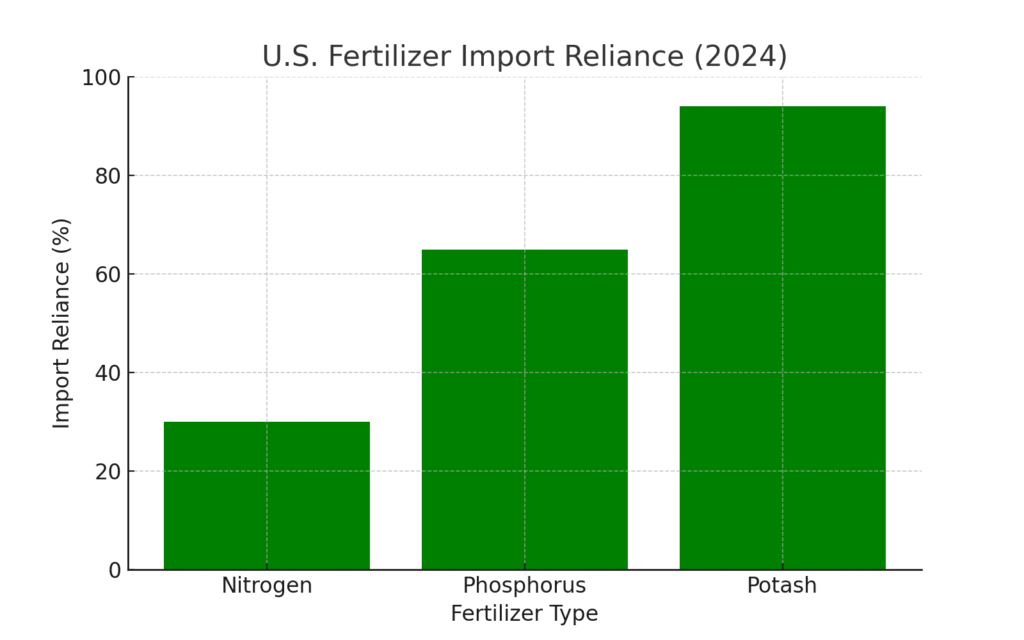
Fertilizer Marketing Statistics #10: U.S. Potash Import Reliance At 94%
The U.S. is about 94% reliant on imports for potash, one of the highest import dependencies among fertilizers. This heavy reliance makes the U.S. market vulnerable to trade disruptions and price fluctuations. For marketers, this creates space to highlight secure supply chains or domestic alternatives. It also emphasizes the importance of global partnerships in ensuring reliable supply. Addressing this dependence can be a powerful marketing angle.
Fertilizer Marketing Statistics #11: Four Firms Produce 75% Of U.S. Fertilizers
In 2019, just four firms — CF Industries, Nutrien, Koch, and Yara-USA — produced around 75% of U.S. fertilizer. This concentration shows how a few players dominate the domestic market. For marketers, it’s essential to understand this structure when planning campaigns or partnerships. Smaller firms may need to highlight innovation, sustainability, or service as differentiators. The competitive environment creates both challenges and opportunities for strategic positioning.
Fertilizer Marketing Statistics #12: Two Firms Supply 85% Of North American Potash
In North America, two companies, Nutrien and Mosaic, supply about 85% of potash. This duopoly strongly influences prices and availability. Marketers working with smaller players must be creative in positioning alternatives or specialty solutions. At the same time, these giants can be targeted as potential partners for large-scale campaigns. The statistic highlights how concentrated the potash market truly is.
Fertilizer Marketing Statistics #13: Top 10 U.S. Retailers Generate USD 14 Billion In Sales
In 2024, the top 10 U.S. agricultural retailers in fertilizer sales generated USD 14 billion. This accounted for 70% of all CropLife 100 fertilizer revenue, valued at about USD 19.9 billion. The dominance of these top retailers shows where marketing partnerships can deliver the most impact. For marketers, focusing on these retailers provides access to massive distribution networks. It also signals the importance of reputation and scale in fertilizer sales.
Fertilizer Marketing Statistics #14: Price Volatility Impacts Retail Revenues
Fertilizer price volatility has caused significant fluctuations in revenue for retailers, even when volumes stayed stable. Price drops often lead to revenue declines, highlighting the market’s sensitivity to pricing. For marketers, this creates opportunities to highlight stability, risk management, or cost-saving solutions. Retailers are likely to favor partners who can help navigate these uncertain conditions. Price is not just a financial factor but a critical marketing narrative.
Fertilizer Marketing Statistics #15: Global Demand Expected To Grow 2.1% Annually Through 2027
Global fertilizer demand is forecasted to grow by 2.1% annually through 2027. This growth is driven by population increases, rising calorie requirements, and the need for higher yields. For marketers, this projection offers a strong forward-looking argument for investment. It also supports campaigns that emphasize fertilizers’ indispensable role in global food security. Growth forecasts like this reinforce the industry’s stability.

Fertilizer Marketing Statistics #16: Population Growth And Food Demand Drive Fertilizer Needs
The rising global population continues to be a primary driver of fertilizer demand. As more people require more food, fertilizers become essential to boosting agricultural productivity. Marketing strategies can effectively tie fertilizer solutions to the broader issue of global hunger. This connection makes campaigns more meaningful and impactful. Fertilizer’s role in sustaining humanity is both a responsibility and a marketing advantage.
Fertilizer Marketing Statistics #17: Precision Farming And Biofertilizers Are Emerging Trends
Precision farming and biofertilizers are gaining momentum as sustainable solutions. These innovations focus on efficiency, reduced waste, and environmental responsibility. Marketers can highlight these trends to appeal to eco-conscious farmers and businesses. Positioning fertilizers as part of a broader sustainability strategy enhances brand credibility. The shift also opens up new niches for specialized marketing campaigns.
Fertilizer Marketing Statistics #18: Environmental Regulations Influence Fertilizer Market
Stricter environmental regulations are shaping the development of fertilizers worldwide. Companies are under pressure to produce eco-friendly formulations. Marketers can turn this challenge into an opportunity by promoting greener products. Positioning fertilizers as compliant and sustainable creates a competitive advantage. Regulations can thus drive both innovation and differentiation.
Fertilizer Marketing Statistics #19: Supply Chain Risks Affect Global Fertilizer Trade
Fertilizer markets face supply chain risks, including geopolitical tensions, trade policies, and reliance on imports. These risks can lead to shortages or price surges, impacting farmers worldwide. For marketers, this highlights the importance of reliability and resilience in messaging. Emphasizing strong logistics and global partnerships can become a selling point. Risk management can be framed as a key value proposition.
Fertilizer Marketing Statistics #20: Emerging Opportunities In Nano-Fertilizers And IoT
New opportunities are emerging with nano-fertilizers, precision tools, and IoT-based application systems. These technologies promise improved efficiency and reduced waste. Marketers can position these innovations as the future of agriculture. Early adopters stand to benefit from strong competitive advantages. Highlighting these opportunities makes marketing campaigns forward-thinking and exciting.

Final Thoughts on Fertilizer Marketing Statistics
Looking back over these numbers, I can’t help but feel both inspired and cautious. Inspired, because the potential for sustainable growth, smarter technologies, and stronger marketing strategies is more alive than ever. Cautious, because the volatility of prices, global trade dependencies, and environmental pressures remind me that this is an industry in constant motion. As I reflect on these fertilizer marketing statistics, I see them not as cold data but as a roadmap — one that I’ll continue to use in my work with clients and colleagues. And if you’re reading this with the same curiosity I had when I started, I hope these insights give you a little more clarity and confidence to move forward.
SOURCES