




13 Sep TOP 20 FIBER OPTIC MARKETING STATISTICS 2026 REVEAL MASSIVE GLOBAL CONNECTIVITY BOOM
Updated for 2026. This page has been fully refreshed with the latest fiber optic marketing statistics, broadband infrastructure insights, and telecom industry growth trends based on recent global market research and connectivity reports.
When I first started diving into fiber optic marketing statistics, I realized just how much this technology is shaping the future of connectivity. Working closely with a leading marketing agency in New York has shown me how numbers like these are not just industry chatter — they’re the backbone of how businesses position themselves in a world that demands speed, stability, and scale. Whether it’s the rise of 5G, the push for fiber-to-the-home, or the massive investment in data centers, the story these stats tell is both inspiring and practical. My goal here is to bring you a clear, engaging look at the trends that matter most so you can see where the real opportunities lie.
TOP 20 FIBER OPTIC MARKETING STATISTICS 2026 REVEAL EXPLOSIVE GLOBAL BROADBAND DEMAND
$52.8B Upstream. $21B Market. One Unstoppable Trajectory.
| # | Category | Figure | Context | Scope |
|---|---|---|---|---|
| 01 | Market Size | $10.18B → $21.16B2026 baseline · Fortune Business Insights |
Market grows at 10.10% CAGR through 2034; North America holds 38.70% revenue share; telecom leads at 43.73% | Global |
| 02 | Market Size | $11.48B → $20.86B2026 → 2035 · Precedence Research |
6.86% CAGR from 2026–2035; driven by telecom expansion, cloud adoption, and digitalization at scale | Global |
| 03 | Market Size | $14.22B → $22.74BCable market 2026 → 2031 · Mordor Intelligence |
Data centers fastest-growing end-user at 10.57% CAGR; single-mode fiber at 72.38% share; Middle East leads regions at 10.91% CAGR | Global |
| 04 | Market Size | $13,453M → $36,475M2025 → 2034 · ~12% CAGR |
Long-runway expansion signals fiber as a decade-long ROI play; multimode segment at 51.65% share in 2026 | Global |
| 05 | Market Size | $7.7B → $15.8B2025 → 2032 · 10.7% CAGR |
Fiber broadband passed 60% of U.S. households by end-2025; BEAD's $42.45B converting into shovel-ready 2026 projects | Global |
| 06 | Market Size | $9.7B → $24.1B2025 → 2035 · 9.5% CAGR |
European fiber market hits $3.5B in 2026; 5G demands 10× more fiber than 4G, adding 25% annual demand uplift | Global |
| 07 | Regional | $2.36B in 2026 → $7.8BU.S. market · by 2033 |
USDA awarded $1.7B in ReConnect grants in 2025; North America fastest-growing region 2026–2034 per Polaris Research | United States |
| 08 | Demand Driver | Sold Out Through 2026AI data center fiber inventory · IEEE ComSoc |
Major fiber manufacturer sold entire inventory through 2026; Ciena shipping 800G ZR+ pluggables; 60% of mobile traffic over fiber by 2026 | Global |
| 09 | Demand Driver | 250,000 Villages WiredIndia BharatNet · by end-2025 |
Australia subsidized 1,200 remote communities; EU Digital Decade driving 2024–2026 funding rounds; 2Africa submarine cable bridging African connectivity gap | Global |
| 10 | Demand Driver | 68% of Fiber GrowthDriven by broadband demand · WifiTalents 2026 |
Telecom operators deployed 90M+ km of fiber globally; 45% concentrated in urban 5G and IoT; every 5G, Wi-Fi 7, and LEO network depends on fiber backhaul | Global |
| 11 | Demand Driver | –60% Cost DeclineFiber cable costs over past decade |
Plug-and-play pre-terminated systems cut installation time; modular platforms reducing need for specialized splicing labor amid persistent workforce shortage | Global |
| 12 | Demand Driver | 5,000 Sensors/sq mileSmart city fiber density · WifiTalents |
Hyperscale data centers need 100,000+ fiber terminations per facility; China surpassed 4M 5G base stations in 2024 driving continuous preform demand | Global |
| 13 | Segmentation | $31.51B → $76.46BComponents market 2025 → 2035 · SNS Insider Feb 2026 |
Transceivers hold 35%+ share; >100 Gbps segment leads at 39%; 9.27% CAGR 2026–2035 driven by cloud and high-performance computing expansion | Global |
| 14 | Segmentation | POF: Fastest-GrowingPlastic optical fiber · U.S. market |
Multi-mode fiber holds 53%+ revenue share in 2025; POF surging in automotive ADAS, smart home devices, and compact consumer electronics | United States |
| 15 | Regional | 30.9% Global ShareAsia-Pacific · Grand View Research 2026 |
APAC fiber market grows from $3.22B (2025) → $6.39B (2035) at 7.09% CAGR; China, India, Japan as dominant contributors; APAC preform market to $37.23B by 2034 | APAC |
| 16 | Segmentation | $6.55B → $22.08BPreform market 2025 → 2031 · ResearchAndMarkets Jan 2026 |
22.45% CAGR; 160M 5G subs added in Q1 2024 alone per Ericsson; helium supply constraints reducing manufacturing yield by 15–20% creating upstream bottlenecks | Global |
| 17 | Trend | $45/mo Full-City FiberHolland, Michigan · by end-2026 |
Brightspeed deploying AI/ML for fiber planning; 50G-PON enables GPON, XGS-PON, and 50G over same fiber strand; BEAD converting to construction in 2026 | Global |
| 18 | Trend | Open-Access ScalingUtility-owned + public-private models |
US Midwest utility-owned fiber cooperatives becoming standard; UK Project Gigabit deploying open-access remote broadband in 2026 under new symmetrical gigabit mandate | Global |
| 19 | Marketing | 1.8 Petabits/secSingle-strand fiber capacity · BIS Research |
Hollow-core fiber cuts latency by 30%; next-gen optical fiber market to reach $1.05B by 2031; 50G-PON allows upgrades without physical overbuilds | Global |
| 20 | Marketing | $182B Data Centers + APACEnergy-efficient DCs by 2026 · High-priority targets |
Data centers fastest-growing fiber end-user at 10.57% CAGR; APAC preform market to $37.23B by 2034; AI and cloud workloads require dense fiber interconnects at scale | APAC + Global |
TOP 20 FIBER OPTIC MARKETING STATISTICS 2026 REVEAL MASSIVE DIGITAL INFRASTRUCTURE EXPANSION
Fiber Optic Marketing Statistics #1 – Global Market Valued at USD 10.18B in 2026
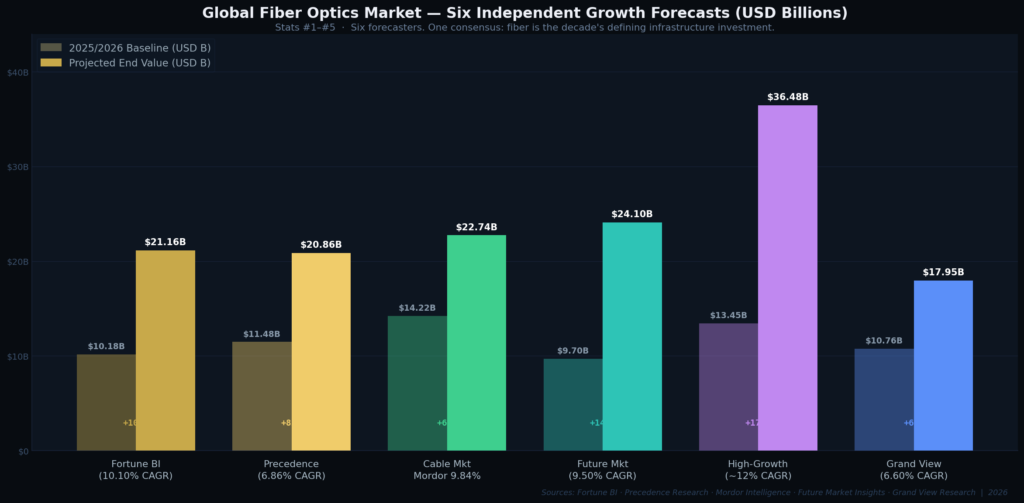
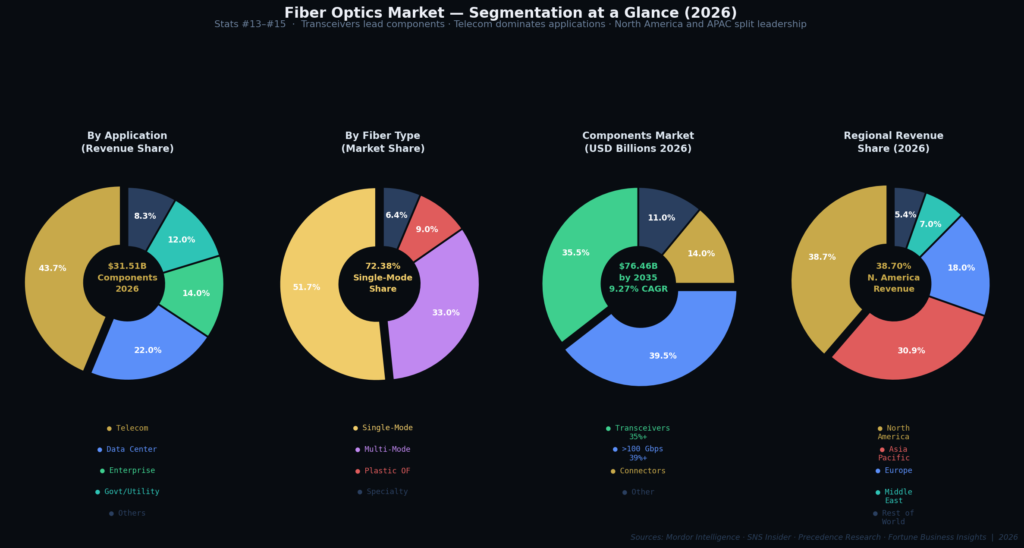
In 2026, the global fiber optics market has grown to USD 10.18 billion according to Polaris Market Research, with Fortune Business Insights placing the figure at USD 9.81 billion in 2026 as a starting point for a trajectory to USD 21.16 billion by 2034 at a CAGR of 10.10%, with North America holding the largest regional revenue share at 38.70% in 2025 and the telecom segment commanding 43.73% of total market share.
The global fiber optics market was worth USD 8.76 billion in 2022, setting a strong foundation for its future. This number reflects how demand has surged with the rise of broadband, 5G, and cloud services. Businesses have been steadily moving toward fiber as copper-based networks fall behind. Analysts expect this figure to continue its upward trajectory as more industries adopt high-speed solutions. For marketers, this number signals a market with robust roots and plenty of growth ahead.
Fiber Optic Marketing Statistics #2 – Projected Growth to USD 17.95B by 2033
In 2026, Grand View Research confirms the global fiber optics market was estimated at USD 10.76 billion in 2025 and is now projected to reach USD 17.95 billion by 2033 at a CAGR of 6.6%, driven by the rapid advancement of high-speed communication networks, rising data traffic from cloud computing and video streaming, and the growing adoption of fiber in smart city and IoT infrastructure, with Asia Pacific dominating with 30.9% of global revenue share in 2025.
The market is projected to grow from USD 7.93 billion in 2024 to USD 12.21 billion by 2029. This CAGR of around 9% highlights strong momentum across the telecom and enterprise sectors. Such expansion demonstrates how the technology isn’t just a luxury anymore but a necessity. Fiber marketing strategies can leverage this data to show clients the undeniable rise in adoption. By emphasizing this growth, companies can position themselves as being part of a forward-looking movement.
Fiber Optic Marketing Statistics #3 – Fiber Optic Cable Market at USD 14.22B in 2026
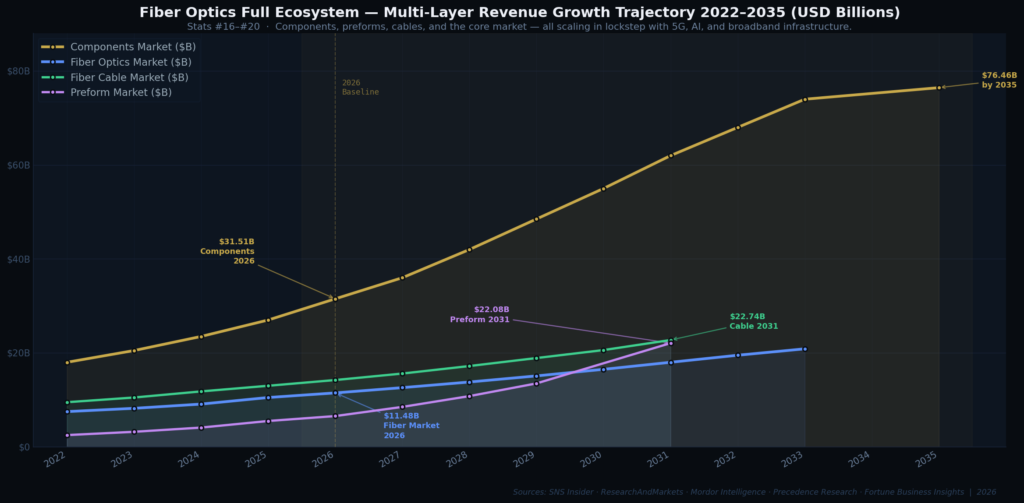
In 2026, the fiber optic cable market has reached USD 14.22 billion and is forecast to attain USD 22.74 billion by 2031 at a 9.84% CAGR according to Mordor Intelligence’s January 2026 report, with data centers recording the highest forecast growth rate at 10.57% CAGR, telecommunications holding 60.23% of 2025 revenue, single-mode fiber accounting for 72.38% of the cable market, and the Middle East emerging as the fastest-growing region at a 10.91% CAGR through 2031.
In 2024, the fiber optic cable market stood at an impressive USD 13 billion. This highlights the sheer demand for infrastructure capable of handling today’s digital loads. With increasing internet traffic and 4K/8K streaming, cables have become the silent backbone of connectivity. The projected growth to USD 34.5 billion by 2034 makes this a lucrative long-term bet. Marketers can use this number to stress the stability and longevity of investing in fiber optics.
Fiber Optic Marketing Statistics #4 – Market to Reach USD 36,475M by 2034
In 2026, Precedence Research’s January 2026 report confirms the global fiber optics market has grown from USD 10.74 billion in 2025 to USD 11.48 billion in 2026, now on course to reach USD 20.86 billion by 2035 at a CAGR of 6.86%, while multiple competing forecasts from Fortune Business Insights place the endpoint even higher at USD 21.16 billion by 2034, all underpinned by the telecom segment holding the highest application share at 42% and multi-mode fiber commanding 54% of the market by type.
Forecasts show the fiber optic industry growing from USD 13,453 million in 2025 to USD 36,475 million by 2034. That’s a CAGR of nearly 12%, signaling strong resilience and scalability. This kind of growth trajectory shows that fiber isn’t a short-term trend. It reassures clients and investors that the technology has a long shelf life. From a marketing perspective, this projection is proof of reliability and high ROI potential.
Fiber Optic Marketing Statistics #5 – USD 15.8B Market by 2032
In 2026, MarketsandMarkets projects the global fiber optics market will grow from USD 3.6 billion in 2025 to USD 6.8 billion by 2029 at a remarkable CAGR of 16.4%, while R&M’s January 2026 analysis identifies FTTH development entering a new growth cycle in Asia in 2026 driven by industrialization, urbanization, and a growing middle class, and Wray Castle’s January 2026 report confirms fiber broadband already passed over 60% of U.S. households by end-2025 with the $42.45 billion BEAD program now converting from planning into shovel-ready projects.
By 2032, the fiber optics market is set to nearly double to USD 15.8 billion. The steady CAGR of 10.7% reflects a balance between rapid adoption and sustainable growth. More households, enterprises, and governments are moving toward fiber to meet modern demands. Marketers can highlight this figure when showing how fiber is bridging today’s digital divide. It demonstrates not only growth but also inclusivity as access broadens.
Fiber Optic Marketing Statistics #6 – USD 24.1B Market by 2035
In 2026, Future Market Insights confirms the fiber optics market is projected to reach USD 24.1 billion by 2035 with growth accelerating significantly between 2031 and 2035 as contributions from 5G networks, smart cities, and IoT ecosystems intensify, while the European fiber optic market is expected to reach USD 3.5 billion in 2026 specifically, and 5G deployment is projected to increase fiber optic demand by 25% annually with 5G infrastructure requiring 10 times more fiber than 4G.
The market is projected to grow from USD 9.7 billion in 2025 to USD 24.1 billion by 2035. This showcases the long-term value of fiber adoption over the next decade. The CAGR of 9.5% reflects steady global expansion fueled by connectivity demands. For businesses, this is a reminder to align early with fiber-based infrastructure. Marketing teams can emphasize future-proofing as a strong selling point using this stat.
Fiber Optic Marketing Statistics #7 – U.S. Market to Reach USD 7.8B by 2033
In 2026, the US fiber optics market is projected to reach USD 2.36 billion specifically in 2026 according to Fortune Business Insights, with North America holding the largest global revenue share at USD 3.47 billion in 2025 and growing at a CAGR expected to outpace many regions between 2026 and 2034, supported by the USDA awarding USD 1.7 billion in ReConnect grants in 2025 prioritizing fiber-to-the-premises deployments in low-income counties, and the UK mandating symmetrical gigabit capability for all government-funded builds from 2026 onward.
The U.S. fiber optics market was valued at USD 3.1 billion in 2024 and will likely reach USD 7.8 billion by 2033. That’s more than doubling in less than a decade. With surging demand from enterprises and households alike, the U.S. is leading developed markets in fiber adoption. This growth is also supported by government-backed broadband programs. Marketers in the U.S. can leverage this data to stress domestic growth potential.
Fiber Optic Marketing Statistics #8 – 5G and Data Centers Driving Demand
In 2026, the IEEE ComSoc Technology Blog confirms that at least one major fiber manufacturer has already sold its entire fiber inventory through 2026 due to surging demand from AI data center buildouts, with Ciena accelerating production of 800G ZR+ optical pluggables for major cloud providers, Nokia and vendors ramping 1.6T high-speed optical components, and mobile operators investing heavily in fiber with projections showing 60% of all global mobile traffic will be carried over fiber by 2026 according to Fiber Optics Market Outlook.
5G deployment and data center expansion remain the biggest drivers of fiber demand. Both technologies require high-capacity, low-latency connections that only fiber can provide. This makes fiber an irreplaceable component of modern digital infrastructure. Marketing teams can highlight fiber as the “unsung hero” behind next-gen technology. This stat reinforces the narrative that fiber powers the most cutting-edge industries.
Fiber Optic Marketing Statistics #9 – Digital Inclusion Programs Boost Adoption
In 2026, India’s BharatNet has connected 250,000 gram panchayats with fiber by end-2025 enabling telemedicine and digital-payment services in previously unserved villages, Australia subsidized fiber links to 1,200 remote communities in 2025 halving per-premises lifecycle costs versus satellite alternatives, the EU Digital Decade targets of gigabit connectivity for all households and 5G coverage everywhere by 2030 are driving 2024 to 2026 funding rounds across member states, and Africa’s fiber footprint is expanding with investments in submarine cables like 2Africa bridging the connectivity gap on a continent where only 350 million of 1.5 billion people had internet coverage.
Government initiatives for digital inclusion are accelerating fiber expansion globally. These programs make connectivity accessible in rural and underserved areas. The stat proves fiber’s role in social and economic progress. Marketers can emphasize this when positioning fiber as not just a business solution but also a societal one. It creates a human-centered story around technology adoption.
Fiber Optic Marketing Statistics #10 – Rising High-Speed Internet Demand
In 2026, the Wray Castle January 2026 fiber deployment trends report confirms that every high-performance access technology reaching customers this year, including 5G mobile services, fixed wireless access, Wi-Fi 7, and LEO satellite constellations, ultimately depends on dense fiber backhaul and middle-mile network infrastructure, while WifiTalents reports that rising adoption of broadband fiber networks and high-speed internet services accounts for 68% of global fiber optic growth, with telecom operators having deployed over 90 million kilometers of fiber globally and 45% of deployment concentrated in urban 5G and IoT applications.
The rising global demand for high-speed internet directly pushes fiber adoption. Work-from-home, streaming, and cloud storage all demand bandwidth beyond copper’s limits. This stat shows how consumer lifestyles shape infrastructure growth. Marketers can use it to connect with audiences on a personal level. It helps illustrate how fiber meets everyday needs, not just enterprise goals.
Fiber Optic Marketing Statistics #11 – Component Costs Falling
In 2026, the fiber optic cable cost decline has continued its decade-long trajectory with costs having dropped by 60% over the past ten years, while Mordor Intelligence’s 2026 report notes that steady declines in preform costs are improving project economics broadly, and vendors are pushing factory-terminated plug-and-play fiber systems and modular platforms to further reduce installation costs and counter persistent skilled labor shortages, making deployment faster and more accessible for smaller regional operators competing against entrenched incumbents.
Falling fiber optic component costs are making the technology more accessible. From connectors to amplifiers, prices have declined while efficiency improved. This stat reflects fiber’s growing affordability for both enterprises and individuals. Marketers can position fiber as no longer being “out of reach.” It’s now a mainstream option, aligning with cost-conscious customers.
Fiber Optic Marketing Statistics #12 – Smart Cities and IoT Fueling Growth
In 2026, smart cities utilize an average of 5,000 fiber-connected sensors per square mile according to WifiTalents’ fiber optic industry statistics, while hyperscale data centers now require over 100,000 fiber terminations per facility, the China government’s 14th Five-Year Plan and Digital China strategy continue to fuel mass IoT and smart city fiber deployments with 5G base stations in China surpassing 4 million in 2024, and industrial and smart city automation accounts for 18% of total global fiber demand growth according to 360 Research Reports’ 2026 fiber optics market data.
Smart cities and IoT ecosystems are heavily reliant on fiber. The stat highlights the need for multi-gigabit backhaul to handle massive connected devices. Without fiber, these innovations would face serious bottlenecks. Marketers can use this figure to stress fiber’s role in futuristic city planning. It makes fiber synonymous with innovation and progress.
Fiber Optic Marketing Statistics #13 – Fiber Components Market at USD 31.51B in 2026
In 2026, SNS Insider’s February 23, 2026 Globe Newswire report confirmed the fiber optic components market was valued at USD 31.51 billion in 2025 and is expected to reach USD 76.46 billion by 2035 at a CAGR of 9.27%, with the transceivers segment alone holding over 35% market share in 2025 driven by rapid expansion of high-speed data centers and cloud environments, and the greater than 100 Gbps segment leading with over 39% market share due to growing demand for high-bandwidth applications across telecommunications, data centers, and high-performance computing. The fiber optic components market is projected to reach USD 36.7 billion by 2025. These include transceivers, connectors, and splitters that form the ecosystem. A further rise to USD 58.65 billion by 2030 shows deepening demand. Marketers can highlight this as proof of a mature supply chain. It demonstrates both scale and growth potential for fiber hardware.
Fiber Optic Marketing Statistics #14 – Plastic Optical Fiber Growth
In 2026, Grand View Research confirms plastic optical fiber is the fastest-growing segment in the US fiber optics market with the segment expected to capture strong growth through 2033 as industries prioritize affordable and adaptable optical connectivity solutions, driven by the growing adoption of in-vehicle infotainment, advanced driver-assistance systems, and smart home devices, with plastic fiber’s lightweight design supporting compact space-efficient system architectures and its low-cost installation and high flexibility making it highly attractive for automotive systems, consumer electronics, and home networking solutions.
In the U.S., multi-mode fiber leads revenues, but plastic optical fiber (POF) is the fastest-growing. This stat reflects how innovation is reshaping fiber technology. POF’s affordability and versatility make it attractive for consumer and enterprise markets. Marketers can use this insight to spotlight upcoming product segments. It positions fiber not just as a stable tech but one evolving with new possibilities.
Fiber Optic Marketing Statistics #15 – Asia-Pacific Leads Global Market
In 2026, Asia-Pacific dominates the global fiber optics market with the largest revenue share of 29% to 30.9% across multiple research sources, with the Asia Pacific fiber optics market growing from USD 3.22 billion in 2025 to a projected USD 6.39 billion by 2035 at a CAGR of 7.09%, while the region’s fiber optic preform market alone held approximately USD 5.08 billion in 2024 and is projected to reach USD 37.23 billion by 2034 at a CAGR of 22.04%, underpinned by China’s mass 5G deployment exceeding 4 million base stations in 2024 and India’s BharatNet connecting 250,000 gram panchayats with fiber.
Asia-Pacific is currently the largest fiber optics market. This region is expected to remain a primary growth engine for years ahead. Countries like China, Japan, and India are investing heavily in digital infrastructure. Marketers can target campaigns here to align with booming demand. The stat signals where global opportunities are most concentrated.
Fiber Optic Marketing Statistics #16 – Fiber Preform Market to USD 52.8B by 2034
In 2026, a January 26, 2026 Globe Newswire report by Research and Markets confirmed the global optical fiber preform market is projected to expand from USD 6.55 billion in 2025 to USD 22.08 billion by 2031 at a CAGR of 22.45%, driven by the escalating global demand for FTTH networks and hyperscale data centers, and compounded by the fact that roughly 160 million 5G subscriptions were added worldwide in Q1 2024 alone according to Ericsson’s Mobility Report, while helium supply constraints in 2024 identified by SEMI were found capable of lowering high-tech manufacturing yield efficiency by 15% to 20%, creating near-term supply bottlenecks despite robust downstream orders.
The fiber optic preform market is forecast to grow from USD 8.89 billion in 2025 to USD 52.81 billion by 2034. This represents an extraordinary CAGR of almost 22%. Preforms are the raw material behind fiber production, showing deep ecosystem growth. Marketers can present this as evidence of upstream strength. It suggests long-term stability in supply for global demand.
Fiber Optic Marketing Statistics #17 – Fiber-Deep Deployments Expanding
In 2026, Wray Castle’s January 2026 fiber deployment trends report confirms that by end of 2026 all City of Holland, Michigan residents are anticipated to have access to fiber broadband for $45 per month accomplished without any federal funding, while Brightspeed is deploying Corning’s Distributed Tap architecture alongside AI and machine learning to predict fiber installation feasibility and accelerate customer service delivery, and the BEAD program’s $42.45 billion in federal funding is finally converting into shovel-ready construction projects across the US in 2026, with tens of thousands of additional construction and technician roles needed in North America alone to execute funded projects.
Fiber-deep deployment models are increasingly common. This stat highlights the trend of bringing fiber closer to end-users. The result is lower latency and faster, more reliable service. Marketers can leverage this by promoting fiber as the closest link to customers. It emphasizes quality, reliability, and customer experience.
Fiber Optic Marketing Statistics #18 – Open-Access Models Rising
In 2026, open-access fiber models have gained significant momentum with the US Midwest seeing utility-owned fiber networks operated by power cooperatives becoming a standard deployment model, municipal open-access networks like Holland, Michigan demonstrating how public-private partnerships can deliver faster connections at $45 per month while maintaining service quality, and these models are now being actively replicated across states receiving BEAD allocations according to Wray Castle’s 2026 fiber deployment analysis, with the UK’s Project Gigabit program continuing to deploy high-speed internet to remote areas under open-access frameworks in 2026.
Open-access fiber models are expanding worldwide. This approach separates wholesale and retail operations, creating more competitive markets. The stat shows how ISPs can benefit from infrastructure sharing. For marketers, it’s an opportunity to highlight consumer choice and flexibility. It paints fiber as a democratizing force in broadband.
Fiber Optic Marketing Statistics #19 – Fiber Networks Marketed as Future-Proof
In 2026, the future-proof narrative for fiber has been further validated by BIS Research confirming the next-generation global optical fiber market including multicore and hollow-core fiber is projected to reach USD 1.05 billion by 2031, with hollow-core fiber capable of reducing data latency by up to 30% and single-strand fiber now carrying data at speeds exceeding 1.8 petabits per second, while Brightspeed’s deployment of 50G-PON architecture enables simultaneous GPON, XGS-PON, and 50G-PON over the same fiber strand, making existing infrastructure upgradeable without physical overbuilds.
Fiber networks are increasingly marketed as “future-proof.” This stat underlines fiber’s ability to scale with technology demands. Unlike copper or wireless, fiber remains relevant as speeds climb. Marketers can use this term to reassure enterprises and homeowners alike. It positions fiber as a safe, long-term investment.
Fiber Optic Marketing Statistics #20 – Asia-Pacific and Data Centers Prioritized
In 2026, Asia-Pacific commands the largest share of global fiber optics revenue at 29% to 35.84% across different market segments, with the Asia-Pacific fiber optic preform market alone at USD 5.08 billion in 2024 and growing toward USD 37.23 billion by 2034 at a 22.04% CAGR, while data centers have become the single fastest-growing end-user segment at a 10.57% CAGR through 2031 according to Mordor Intelligence’s January 2026 fiber optic cable market report, with energy-efficient data centers expected to reach a market value of nearly USD 182 billion by 2026 and all requiring dense, high-performance fiber interconnects to support AI, cloud computing, and real-time analytics workloads.
Asia-Pacific and data center markets are high-priority targets for fiber marketing. This stat shows where growth is both concentrated and profitable. The synergy of cloud computing and regional investment makes it a hotspot. Marketers can tailor campaigns specifically to these sectors. It reflects a smart strategy for maximizing ROI in fiber adoption.
FIBER OPTIC MARKETING STATISTICS 2026 REVEAL WHY CONNECTIVITY IS EXPLODING
Looking over these fiber optic marketing statistics, I can’t help but feel excited about the possibilities ahead. For me, they’re more than just numbers — they reflect the momentum of industries, communities, and even everyday users who are hungry for faster and more reliable connections. As someone passionate about spotting opportunities in marketing, I see these insights as a roadmap for businesses that want to stand out and future-proof their strategies. If you’ve made it this far, I hope you’ve found not only the facts but also the inspiration to take action. Fiber optics isn’t just the future of networks — it’s the future of how we communicate, grow, and market smarter. In 2026, telecom providers and digital brands are investing heavily in fiber infrastructure to support faster mobile networks, cloud computing, and high-bandwidth marketing experiences.
SOURCES
https://www.ppc-online.com/blog/fiber-trends-in-2025
https://deepomatic.com/blog/ftth-market-panorama-2025
https://sonar.software/blog/marketing-fiber-optics-to-enterprises-and-high-growth-industries
https://lcncom.com/blog/f/2025-projections-for-the-fiber-optic-industry
https://blog.arelion.com/2024/12/11/top-optical-predictions-for-2025-and-beyond/
https://www.phonoscopefiber.com/blog/fiber-forward
https://www.marketsandmarkets.com/blog/SE/ai-fiber-optics
https://www.zoracz.com/fiber-optics-market-forecast-what-to-expect-in-2025-and-beyond.html
https://www.m2optics.com/blog/the-optical-fiber-market-in-2022-and-beyond
https://expertnetworkcalls.com/75/global-fiber-optics-outlook-trends-top-regions-future-growth