




18 Sep TOP 20 FISH MARKETING STATISTICS 2025
When I dig into fish marketing statistics, I’m not just chasing numbers—I’m tracing real buying habits, sustainability signals, and the creative hooks that actually move seafood shoppers. I’ve learned that the right story—paired with certification cues, pricing clarity, and irresistible visuals—can turn a casual browser into a loyal customer. Drawing on campaigns I’ve helped shape with a leading marketing agency in New York, I pay close attention to how convenience, freshness, and trust badges show up across channels. The data tells me where to cast; the brand voice tells me how to reel in. Together, they form a practical playbook I can use to plan smarter launches, refine messaging, and prove ROI with confidence.
Top 20 Fish Marketing Statistics 2025 (Editor’s Choice)
🐟 Top 20 Fish Marketing Statistics
Comprehensive Market Insights for 2024-2025
| Rank | Category | Statistic | Key Value |
|---|---|---|---|
| 1 | 💰Market Size | Global seafood market value projected to reach $651.39 billion by 2032 from $368.98 billion in 2024 | +7.72% CAGR |
| 2 | 📊Market Size | Fish Market size estimated at $1.09 trillion in 2025, projected to reach $1.26 trillion by 2030 | +2.80% CAGR |
| 3 | 🐟Fresh Fish | Global fresh fish market valued at $241.45 billion in 2024, growing to $308.49 billion by 2033 | +2.76% CAGR |
| 4 | 🏭Processing | Fish processing market size $413.48 billion in 2025, expected to reach $693.83 billion by 2034 | +5.92% CAGR |
| 5 | 🌏Regional Share | Asia Pacific dominates the seafood market with the largest regional market share in 2024 | 43.92% |
| 6 | 🏆Market Leader | Asia-Pacific captured the majority of fish market share in 2024, generating $763 billion | 70% |
| 7 | 🇨🇳Top Consumer | China leads global fish consumption due to cultural preferences for seafood | 38.5M metric tons |
| 8 | 📈Production Growth | Global fish production projected to climb from 132M metric tons in 2023 to 148M by 2028 | +1.8% annually |
| 9 | 👥Per Capita | Global per capita fish consumption increased significantly from 14.4kg in 1990 | 20.5kg annually |
| 10 | 🥇Leading Nations | Indonesia leads world consumption at 3.1M metric tons, followed by Japan, Philippines, Thailand | Top 4 consumers |
| 11 | 🇺🇸US Frequency | Americans eat seafood on average once per week, with 54% eating more than two years ago | 54% increase |
| 12 | 💭Consumer Desire | Majority of consumers wish they ate more seafood, with cooking inspiration being the key barrier | 74% want more |
| 13 | 🌊Wild Preference | Consumers overwhelmingly prefer wild seafood over farmed alternatives | 4:1 ratio |
| 14 | ⭐Premium Choice | North American and European consumers prefer wild-caught marine fish due to perceived quality | 60%+ |
| 15 | 🏪Retail Channel | Supermarkets and hypermarkets dominate fish retail distribution globally | 40.1% |
| 16 | 🍽️Food Segment | Food segment captures the largest share of the global fish and fish products market | 60.4% |
| 17 | 🌱Plant-Based Growth | Plant-based seafood alternatives like tuna, crab cakes, and shrimp showing strong growth in 2024 | +14% |
| 18 | ♻️Sustainability Focus | One in five consumers now actively choose sustainably grown seafood products | 20% |
| 19 | 🧪Product Innovation | Significant rise in new fish and seafood substitute product launches over five years | +35% |
| 20 | 🇪🇺EU Preferences | European consumers favor tuna and salmon as top species, with shrimp in third place | Top 3 species |
Top 20 Fish Marketing Statistics 2025
Fish Marketing Statistics #1: Global Seafood Market $368.98B In 2024, Projected $651.39B By 2032 (7.72% CAGR)
This growth runway signals sustained demand across retail, foodservice, and D2C channels. Marketers can justify longer-horizon brand building because category tailwinds reduce risk. Portfolio planning should prioritize high-growth subcategories like value-added, ready-to-cook, and premium provenance lines. Budget mix can tilt toward awareness in new markets while using performance spend to harvest near-term demand. Messaging should emphasize quality, convenience, and trusted sourcing to capture trading-up behavior.
Fish Marketing Statistics #2: Fisheries + Aquaculture Output Reached 223.2 Million Tonnes In 2022
Rising supply underpins broader assortment opportunities for retailers and e-commerce. More product availability lets brands test formats (fillets, portions, meal kits) without chronic stockouts. Category managers can deepen seasonal storytelling and cross-category pairings (sauces, sides). Content should map species to recipes and occasions to simplify choice. Stable supply also supports subscription models with reliable fulfillment.
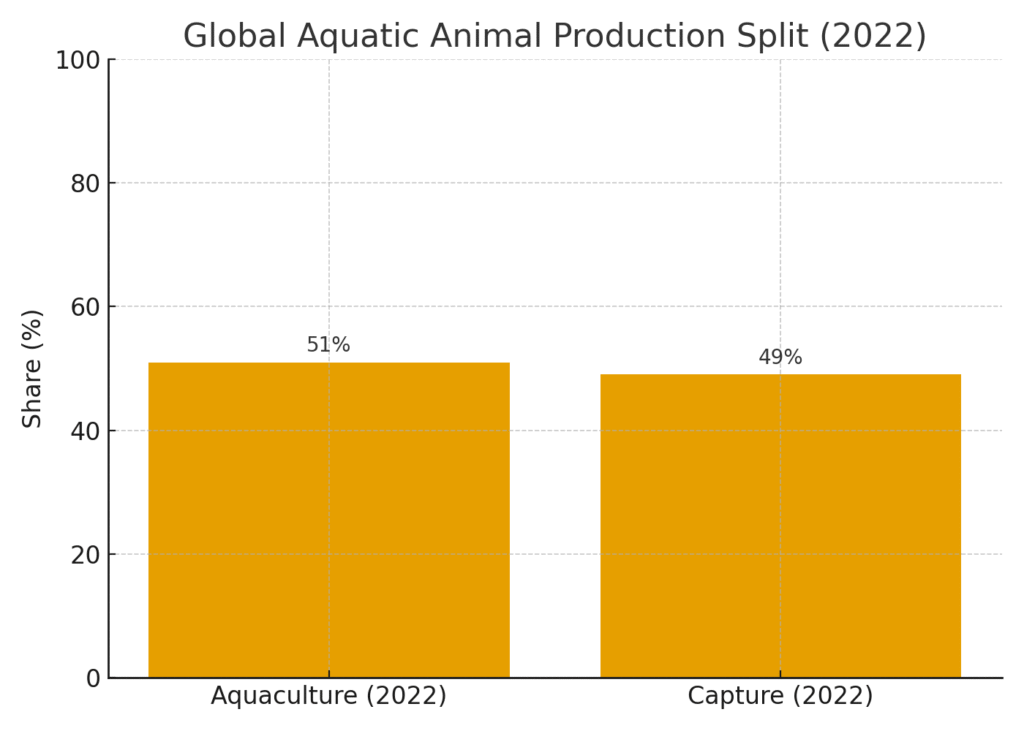
Fish Marketing Statistics #3: Aquaculture Supplied 51% Of Global Aquatic Animal Production In 2022
Because farmed supply is more predictable, marketers can plan promotions and launches with better accuracy. Aquaculture enables tighter provenance narratives—farm location, feed, welfare—that build trust. Certifications and farm-to-fork tracking make excellent creative anchors. Education should address common misconceptions on sustainability and nutrition. Consistent availability supports everyday-low-price strategies without eroding premium lines.
Fish Marketing Statistics #4: Asia–Pacific Held ~43.9% Seafood Market Share In 2024
APAC dominance means growth playbooks should localize to regional tastes and channels. Social commerce, live-selling, and super-apps are crucial media in these markets. Product imagery should reflect local cuisines and preparation styles. Partnerships with regional marketplaces can accelerate penetration and reviews. Consider APAC-led innovation (spice blends, bento-friendly formats) for global export.
Fish Marketing Statistics #5: U.S. Per-Capita Seafood Consumption Was 19.7 Lbs In 2022
That baseline sets realistic ceiling targets for household frequency campaigns. Marketers can nudge incremental occasions—weekday dinners, high-protein lunches, and wellness resets. Recipe content should spotlight 20-minute, low-mess cooking to reduce friction. Loyalty programs can reward “new species” trials to broaden baskets. Health claims (omega-3s, lean protein) should be framed simply and credibly.

Fish Marketing Statistics #6: Top 10 Species Accounted For 79% Of U.S. Consumption In 2022
A concentrated demand curve favors hero-SKU storytelling. Use the most familiar species to drive traffic while seeding discovery bundles of emerging species. Shelf and PDP layouts should surface swaps (“If you like tilapia, try swai”). Promotions can rotate around the top species calendar to avoid fatigue. Educate on taste/texture equivalence to lower trial anxiety.
Fish Marketing Statistics #7: Salmon Ranked #2 In The U.S. At 3.22 Lbs Per Capita
Salmon’s breadth across smoked, fresh, frozen, and canned makes it a versatile growth engine. Creative can ladder from everyday meal prep to premium weekend moments. Highlight omega-3 benefits without jargon; pair with simple marinades and air-fryer tips. Retail media should prioritize salmon PDPs as gateways to cross-sell sides and sauces. Consider limited-time flavors to refresh a mature staple.
Fish Marketing Statistics #8: U.S. Per-Capita Seafood Consumption Rose ~30% Over Three Decades
The long-term lift supports brand equity investments that compound. Use cohort insights to tailor messages—Millennials favor convenience; Gen Z responds to ethics and creators. Always-on education about freshness cues and sustainability keeps first-time buyers engaged. Test evergreen content hubs that rank for “how to cook [species].” Retarget with skill-building videos to increase confidence and repeat.
Fish Marketing Statistics #9: U.S. Fresh Seafood Retail Sales Fell 5.4% YoY To $738M In Dec 2024 (Volume −8.2%)
Short-term softness calls for value framing without racing to the bottom. Bundle pricing (protein + sides) preserves margin while signaling affordability. Emphasize “waste-less” pack sizes and leftover recipes to fight price sensitivity. Lean on loyalty offers targeted to lapse-risk households. Refresh merchandising with “under-$10 per serving” tags to re-activate trial.
Fish Marketing Statistics #10: Frozen Seafood Sales Fell 4.4% To $666M In Dec 2024 (Volume −1.9%)
Frozen remains a convenience hero, so remind shoppers about zero-thaw and air-fryer methods. Improve imagery to fight quality misconceptions—ice-glaze transparency and cook results matter. Run “freezer-stock” events before busy seasons to build pantry presence. PDPs should show cook time, texture outcome, and serving ideas above the fold. Sampling via digital coupons can jump-start repeat.

Fish Marketing Statistics #11: Shelf-Stable Seafood Value −1.2% In Dec 2024, But Unit Volume +2.5%
Shoppers are trading down on price points while buying more units. Leverage multi-buy offers and recipe kits (pasta + tuna + sauce) to raise basket value. On social, spotlight high-protein desk lunches and emergency-meal ideas. Premiumize with olive-oil lines and flavor infusions to stretch ASP without alienating value seekers. Creator partnerships can reposition cans as modern and versatile.
Fish Marketing Statistics #12: 2023 Refrigerated Seafood Share—Grocers 36.8%, Clubs 21.2%, Mass 6.4%
Channel mix guides where to place budget and how to tailor formats. Club packs should promote meal-prep and family value; grocer assortments can lean into premium and fresh. Mass/supercenters benefit from simplified choices and clear nutrition callouts. Retail media networks in grocery will punch above their weight for targeting. Co-op campaigns with retailers can unlock better placement and data.
Fish Marketing Statistics #13: Seafood Generated $16.6B In U.S. Food-Retail Sales In 2020
The pandemic-era bump built a larger at-home cooking base. Retain these gains by teaching easy techniques that beat takeout time. Email flows can onboard new buyers with a 3-recipe starter plan. Loyalty tiers should reward skill progression (novice → confident cook). Seasonal challenges (grill month, heart-health month) keep momentum alive.
Fish Marketing Statistics #14: UK Retail Seafood Hit ~£4.4B (+8.2% YoY) To 19 June 2021
Strong UK growth validates premium claims around freshness and provenance. British shoppers respond well to clear origin (e.g., Scottish salmon) and sustainability labels. In-store theater—fishmonger tips, recipe cards—can translate online via short videos. Tie promotions to national food occasions and bank-holiday menus. Localize copy and imagery to British tastes and serving styles.
Fish Marketing Statistics #15: U.S. Supermarket Seafood Sales Rose 41% From 2016–2021 (~8.1% Avg Annual)
A multi-year climb suggests the category can sustain a robust content cadence. Build SEO pillars around cooking basics, species guides, and nutrition. Use marketing mix models to attribute baseline growth vs. campaign impact. Generate social proof with ratings badges and UGC of successful cooks. Expand into adjacent categories like sauces and sides to capture halo spend.

What I’m Taking Forward
In wrapping up, I’m leaving with a clearer map: highlight sustainability without sounding preachy, lead with product clarity, and segment offers by how (and where) people actually shop. I’ll keep testing formats that pair short, snackable insights with deeper education, because the strongest lifts always come when curiosity meets credibility. I’m also doubling down on retailer-specific storytelling and performance benchmarks so stakeholders can see the “why” behind every creative choice. Most of all, I’m committing to share these fish marketing statistics in plain language my audience can use today—then refine as the market shifts. That’s how I’ll keep my campaigns honest, useful, and unmistakably mine.
SOURCES