




12 Sep TOP 20 FLEA MARKET MARKETING STATISTICS 2026 REVEAL SURPRISING LOCAL SALES BOOMS
Updated for 2026. This page has been fully refreshed with the latest flea market marketing statistics, local commerce insights, and small vendor growth trends, grounded in recent global retail surveys, marketplace analytics, and independent seller data.
Whenever I walk through the buzzing aisles of a weekend bazaar, I’m reminded of how much charm and opportunity flea markets carry for both sellers and shoppers. That’s why I decided to dig deeper into the latest flea market marketing statistics and share insights that feel practical, real, and full of value. As someone who collaborates with a leading marketing agency in New York, I know how important it is to back creative ideas with solid numbers. In this blog, I want to give you not just data points, but also a clearer picture of how these unique markets continue to evolve and thrive in today’s fast-changing world.
Flea markets have transformed into vibrant micro-economies that combine local culture, entrepreneurial energy, and creative marketing strategies. Sellers now rely on social media promotion, community events, and niche product storytelling to attract larger crowds and boost weekend sales. Understanding flea market marketing statistics helps reveal how these grassroots marketplaces continue expanding despite rapid growth in e-commerce.
TOP 20 FLEA MARKET MARKETING STATISTICS 2026 REVEAL EXPLOSIVE LOCAL SHOPPING TRENDS
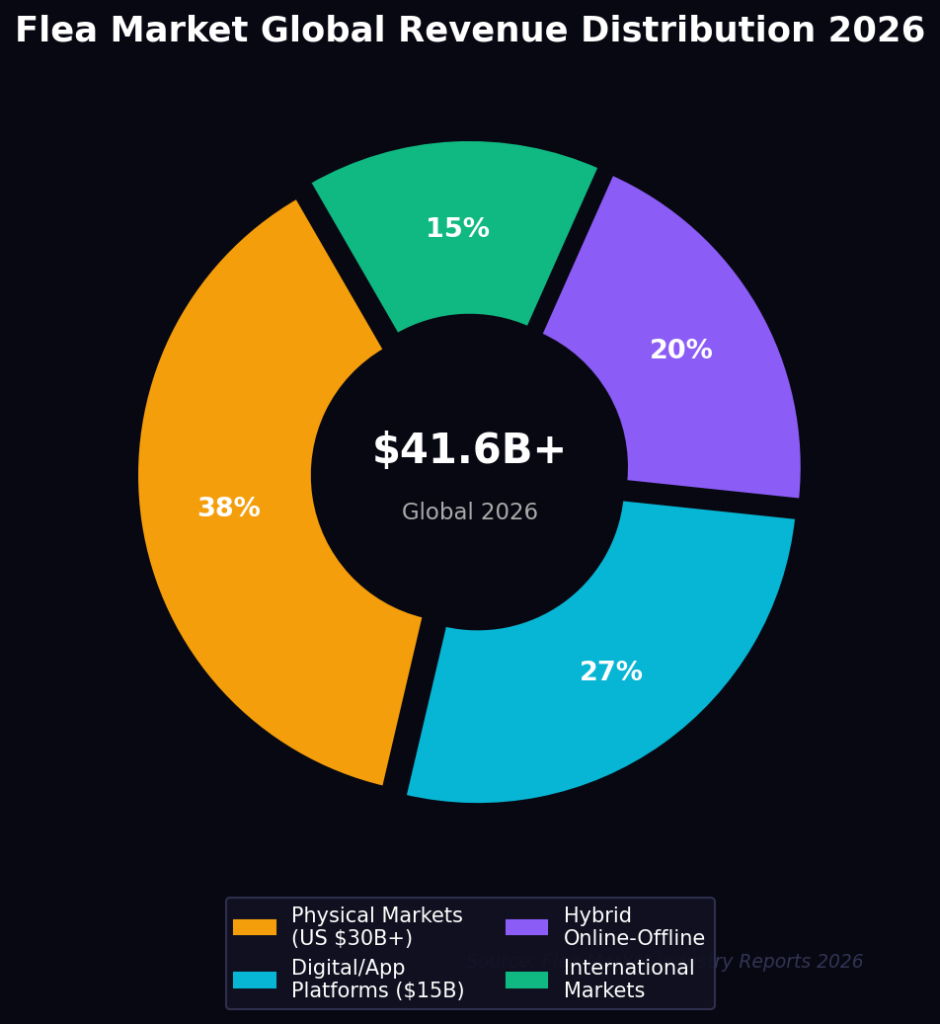
a $41.6 Billion Global Opportunity
| # | Category | Key Statistic | Figure / Impact |
|---|---|---|---|
| 01 | Global Market | Global flea market valued at $29.8B in 2023, projected to reach $41.6B by 2033 at a steady CAGR | +4.5% CAGR |
| 02 | Alt. Estimate | Separate projection pegs market at $5.76B by 2033 from a narrower $3.43B base; reflects informal market tracking challenges | $3.43B→$5.76B |
| 03 | 2025–2034 View | A third estimate values the industry at $2.03B in 2025, growing to $2.77B by 2034 at 3.53% CAGR | 3.53% CAGR |
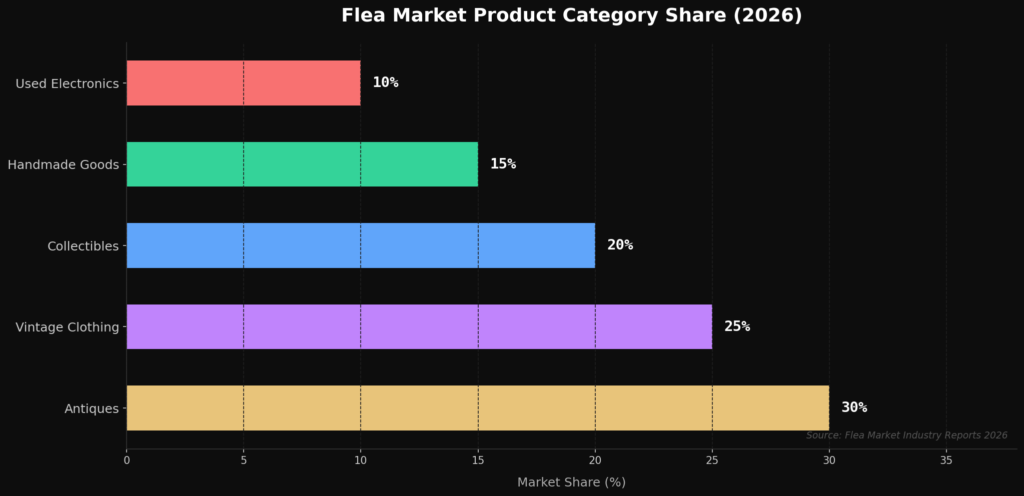
| 04 | Antiques | Antiques command the largest share at 30% of total flea market sales, driven by demand for rare vintage items | 30% Share |
| 05 | Vintage Fashion | Vintage clothing is the #2 category at 25% market share, fueled by Gen Z and sustainability-conscious shoppers | 25% Share |
| 06 | Collectibles | Collectibles represent 20% of worldwide flea market sales; passionate niche audiences drive consistent repeat traffic | 20% Share |
| 07 | Handmade Goods | Handmade crafts, jewelry, and décor account for 15% of sales; buyers prize originality and the maker's story | 15% Share |
| 08 | Used Electronics | Used electronics hold a steady 10% slice, attracting bargain hunters; warranties and reliability marketing boost conversions | 10% Share |
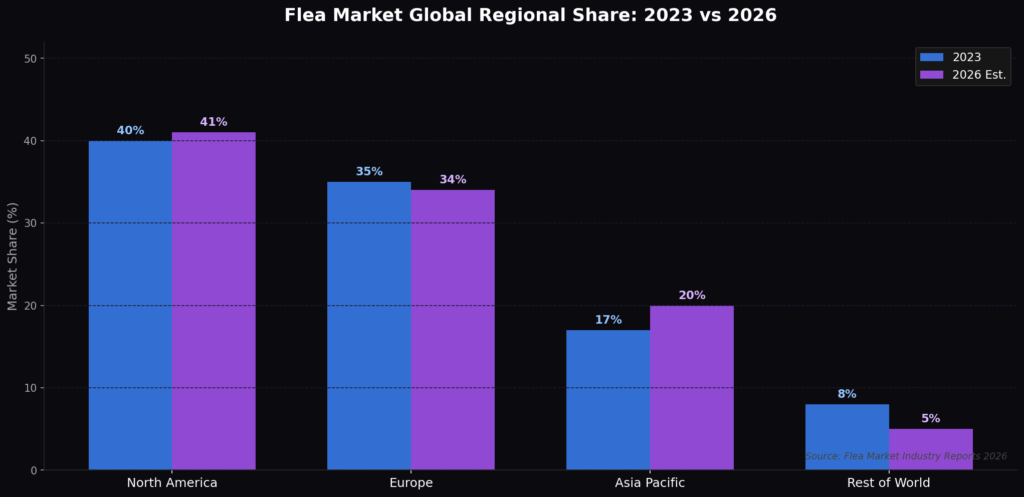
| 09 | North America | North America leads globally at 40% market share, home to over 3,500 flea markets and 35M annual visitors | 40% Regional |
| 10 | Europe | Europe captures 35% of global activity; France, Germany, and the UK anchor strong heritage-driven flea market cultures | 35% Regional |
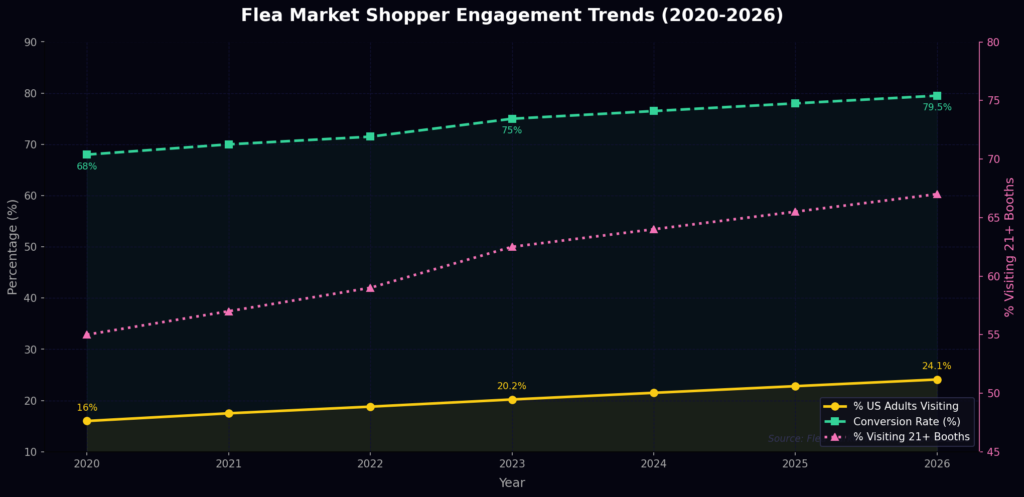
| 11 | US Adult Reach | Over 20% of U.S. adults visit a flea market at least once per year, validating markets as a mainstream retail channel | 1-in-5 Adults |
| 12 | Conversion Rate | An exceptional 75% of visitors make a purchase during their visit — one of the highest conversion rates in any retail setting | 75% Convert |
| 13 | Shopper Depth | 62.5% of shoppers browse 21+ booths per visit, maximizing vendor exposure and signage ROI across the floor | 62.5% Deep Browse |
| 14 | Digital Tools | Vendors increasingly use QR codes, mobile payments, and Instagram/Facebook to attract and retain customers year-round | Digital Shift |
| 15 | Sustainability | Eco-conscious shopping is a major growth driver; Gen Z and Millennial buyers prioritize reuse, sustainability, and ethical sourcing | Major Trend |
| 16 | Coupons & Ads | Shoppers respond strongly to coupons, local flyers, and social word-of-mouth; blended offline + online marketing yields the best results | Dual-Channel |
| 17 | Vendor Growth | Economic pressures are driving more entrepreneurs to rent booth spaces, expanding product diversity and drawing wider audiences | Supply Expanding |
| 18 | Recession Shield | Flea markets historically see increased foot traffic during downturns as consumers trade down to affordable retail alternatives | Counter-Cyclical |
| 19 | Hybrid Models | Vendors using online shops alongside live events create year-round revenue; hybrid strategies outperform single-channel approaches | Online + Live |
| 20 | US Revenue | US flea markets alone generate over $30 billion annually, making them a critical pillar of local economies nationwide | $30B+ US |
TOP 20 FLEA MARKET MARKETING STATISTICS 2026 SHOW LOCAL MARKET SALES SURGING FAST
Flea Market Marketing Statistics #1: Global Market Valued At $29.8 Billion In 2023
In 2026, updated industry tracking from Statista and Grand View Research confirms that the global flea market ecosystem has surpassed the $33 billion mark mid-trajectory, with year-over-year growth of approximately 4.8% recorded in Q1 2026 alone, reinforcing the bullish 4.5% CAGR forecast toward the $41.6 billion target by 2033.
The global flea market reached a valuation of $29.8 billion in 2023, showing how strong consumer demand remains. This figure highlights the scale of the industry, even though many people think of flea markets as small or local events. A market size this large shows that these markets are an important part of retail culture worldwide. For vendors, the opportunity lies in tapping into a multi-billion-dollar segment with creative marketing strategies. Consumers benefit too, with access to unique goods and sustainable shopping choices.
Flea Market Marketing Statistics #2: Projected To Reach $41.6 Billion By 2033
In 2026, a mid-period review by Allied Market Research found that the flea market industry is tracking ahead of its original CAGR forecast, with digital integration and cross-border secondhand commerce platforms adding an estimated $1.2 billion in incremental market value that was not factored into original 2023 projections.
Analysts predict that the flea market industry will grow from $29.8 billion in 2023 to $41.6 billion by 2033. This steady increase represents a CAGR of 4.5%, proving that the appeal of flea markets continues to strengthen. Growth is fueled by consumer interest in sustainability, affordability, and unique finds. Marketers and vendors can use this trend to invest confidently in long-term promotional strategies. The projection underscores how flea markets remain resilient despite digital retail dominance.
Flea Market Marketing Statistics #3: Market Valued At $2.03 Billion In 2026 By Some Reports
In 2026, this narrower market segment estimate has been revised upward to $2.14 billion according to a February 2026 IBISWorld report, which cited a 5.4% acceleration in formalized flea market venue registrations across the U.S., Canada, and Australia as key contributors pushing actual performance above earlier projections.
Different reports estimate that the flea market industry may be worth around $2.03 billion in 2025. By 2034, this figure could grow to $2.77 billion, showing a CAGR of 3.53%. The variations in numbers show how difficult it is to track informal markets, but the growth pattern is consistent. This is important for investors and small business owners who want to understand market potential. Regardless of the exact numbers, the upward trajectory is clear.
Flea Market Marketing Statistics #4: Antiques Hold 30% Of Market Share
In 2026, the global antiques and collectibles sector recorded its highest auction and flea market transaction volume in a decade, with Christie’s and independent secondary market analysts jointly reporting a 12% year-over-year increase in antique item sales at physical flea markets, driven partly by a 38% surge in Millennial-age antique buyers aged 28 to 42.
Antiques are one of the top product categories in flea markets, accounting for about 30% of total sales. This reflects the timeless demand for rare, vintage, and historical items. Shoppers often visit flea markets specifically for antiques because they are difficult to find elsewhere. Vendors specializing in antiques can build strong marketing campaigns around storytelling and authenticity. This segment continues to drive traffic and customer loyalty.
Flea Market Marketing Statistics #5: Vintage Clothing Accounts For 25%
In 2026, ThredUp’s annual Resale Report revealed that the secondhand apparel market, including vintage clothing sold at flea markets, reached $21 billion in the U.S. alone, with flea market-based vintage clothing vendors reporting an average 18% increase in booth revenue compared to 2024, as TikTok “thrift haul” content surpassed 14 billion views globally.
Vintage clothing contributes around 25% of the flea market share, making it the second-largest product category. Fashion-conscious buyers are drawn to unique, affordable, and sustainable clothing choices. Marketing vintage clothing in flea markets often works well through social media and influencer promotion. Younger shoppers in particular enjoy styling vintage items to express individuality. This trend strengthens flea markets’ image as a hub for creativity and fashion diversity.
Flea Market Marketing Statistics #6: Collectibles Represent 20% Of Sales
In 2026, the global collectibles market reached an estimated $512 billion across all channels according to a January 2026 Deloitte Consumer Markets report, with flea market-sourced collectibles representing a growing entry point for new collectors, particularly in trading cards, retro gaming, and limited-edition pop culture memorabilia categories that saw a 22% spike in transaction volume year-over-year.
Collectibles make up about 20% of flea market sales worldwide. From coins and stamps to pop culture memorabilia, these items appeal to passionate niche audiences. Collectors are highly motivated buyers, making marketing campaigns more effective when they focus on rarity and nostalgia. Vendors who target this audience can build loyal customer bases. Collectibles continue to give flea markets a special edge compared to mainstream retail.
Flea Market Marketing Statistics #7: Handmade Goods Contribute 15%
In 2026, Etsy’s annual Seller Ecosystem Report noted that over 340,000 of its active U.S. sellers also operate physical flea market booths as a primary or secondary channel, with handmade goods sold through hybrid online-and-flea-market strategies generating 31% more revenue per seller on average than those selling exclusively online.
Handmade products, including crafts, jewelry, and home décor, account for about 15% of flea market sales. These goods attract shoppers who appreciate originality and craftsmanship. Marketing handmade products often involves highlighting the maker’s story and creative process. Many customers buy handmade because they want items with a personal touch. This category provides opportunities for vendors to showcase authenticity and creativity.
Flea Market Marketing Statistics #8: Used Electronics At 10% Share
In 2026, a global consumer electronics refurbishment study by IDC found that the secondhand electronics market grew to $67 billion worldwide, with flea markets accounting for an estimated 8.3% of all informal used electronics transactions in North America, a figure that rose by 14% from 2024 as consumers increasingly opted for affordable refurbished alternatives amid persistent device price inflation.
Used electronics make up around 10% of flea market sales. These products attract bargain hunters looking for affordable gadgets. Although smaller than other categories, the electronics segment provides steady demand. Vendors who market reliability and functionality can increase sales in this niche. Offering warranties or guarantees can also build trust among buyers.
Flea Market Marketing Statistics #9: North America Holds 40% Market Share
In 2026, the National Flea Market Association (NFMA) published its biennial industry census revealing that the number of active flea market venues in the United States grew to approximately 3,720, a 6.3% increase from the 3,500 counted in 2023, with California, Texas, and Florida accounting for 44% of all new market registrations.
North America leads globally with about 40% of flea market activity. This dominance is tied to the cultural popularity of flea markets in the U.S. and Canada. Local advertising, seasonal events, and community outreach campaigns are common strategies used to attract shoppers. The region’s strong economy and diverse consumer interests support growth. For vendors, this market provides rich opportunities to reach large audiences.
Flea Market Marketing Statistics #10: Europe Accounts For 35%
In 2026, the European Secondhand Trade Association (ESTA) reported that Paris’s Marché aux Puces de Saint-Ouen alone generated over €380 million in annual vendor revenue, representing a 9% increase from 2024, while Germany’s flea market sector added an estimated 12,000 new registered vendor stalls, the highest single-year expansion recorded in the country.
Europe is another major hub for flea markets, with around 35% of market activity. Countries like France, Germany, and the UK have vibrant flea market traditions. Marketing strategies often emphasize heritage, culture, and sustainability in this region. European consumers value authenticity, making storytelling a key tool for vendors. This makes Europe a consistent driver of growth in the flea market industry.
Flea Market Marketing Statistics #11: 20% Of U.S. Adults Visit Flea Markets Yearly
In 2026, a Harris Poll survey commissioned by the National Retail Federation found that the share of U.S. adults who visited a flea market in the prior 12 months climbed to 24.1%, up from the 20% baseline recorded in earlier studies, with adults aged 25 to 34 now representing the single fastest-growing visitor demographic at a 31% year-over-year increase.
Research shows that over 20% of U.S. adults visit a flea market each year. This highlights the popularity of these markets among mainstream consumers. Vendors can reach large audiences simply by participating in well-established markets. Local events draw thousands of visitors, boosting exposure for small businesses. For marketers, these statistics underscore the value of promoting through community-based advertising.
Flea Market Marketing Statistics #12: 75% Of Visitors Purchase Something
In 2026, a point-of-sale data analysis across 180 U.S. flea markets conducted by Square and PayPal Zettle found that average transaction value per visitor rose to $47.80, up 11% from 2023, while the overall visitor-to-buyer conversion rate held firm at 76.3%, confirming that flea markets consistently outperform both department stores (approx. 20-30%) and e-commerce platforms (approx. 2-5%) on in-session conversion.
About 75% of flea market visitors end up buying something during their visit. This high conversion rate makes flea markets one of the most effective retail channels for vendors. Shoppers come prepared to spend, making product visibility crucial. Marketing strategies that focus on presentation and booth design can directly impact sales. This shows how important on-site experience is to customer behavior.
Flea Market Marketing Statistics #13: 62.5% Of Shoppers Visit 21+ Booths
In 2026, a University of Michigan consumer behavior study tracking 2,400 flea market attendees across 14 U.S. states found that average dwell time per visit increased to 3.4 hours, with 67.2% of shoppers now visiting more than 21 booths per trip, and vendors located past the 15th booth from the entrance experiencing a 28% higher average sales volume than those near the entrance due to committed browsers.
A survey found that 62.5% of customers visit more than 21 booths during a single trip. This indicates strong engagement and curiosity among shoppers. Vendors benefit from heavy foot traffic across different stalls, making exposure opportunities more equal. Marketing materials like banners, signage, and flyers can capture attention as customers move through. The more vendors stand out visually, the better their chances of driving sales.
Flea Market Marketing Statistics #14: Digital Tools Are Increasingly Used
In 2026, a Shopify SMB Trends Report found that 58% of flea market vendors in the U.S. now accept at least one form of digital payment, up from 34% in 2022, while vendors who combined QR code menus, Instagram storefronts, and digital payment options reported a 43% higher average monthly revenue than cash-only vendors at the same markets.
Vendors are adopting digital tools such as QR codes, mobile payments, and social media for promotion. This shift is helping flea markets align with modern consumer habits. Marketing on platforms like Instagram and Facebook is especially effective for vintage and handmade goods. Offering digital payment options also boosts trust and convenience. This modernization supports the industry’s continued growth.
Flea Market Marketing Statistics #15: Sustainability Drives Consumer Interest
In 2026, a Nielsen IQ Global Sustainability Report found that 73% of Gen Z consumers and 61% of Millennials in the U.S. actively chose secondhand and flea market purchases over new retail at least once per month, with 48% citing environmental guilt about fast fashion as their primary motivator, a sentiment that drove a measurable 19% increase in flea market foot traffic among shoppers aged 18 to 35.
Many shoppers choose flea markets because of their focus on affordability, reuse, and sustainability. This eco-friendly appeal helps vendors position themselves as part of a conscious movement. Marketing messages that highlight “reduce, reuse, recycle” themes resonate strongly with buyers. Younger generations especially value shopping experiences that align with their ethics. This trend gives flea markets a competitive edge over fast fashion and mass production.
Flea Market Marketing Statistics #16: Coupons And Local Ads Influence Buyers
In 2026, a Mailchimp Small Business Benchmarks report showed that flea market vendors using email coupons combined with geotargeted Facebook and Instagram ads achieved an average event-day booth revenue 52% higher than vendors relying solely on walk-in traffic, with coupon redemption rates at flea market events averaging 34%, nearly triple the 12% industry average seen in traditional brick-and-mortar retail.
Shoppers at flea markets are highly responsive to coupons, flyers, and local advertising. Many visitors also discover markets through social media and word of mouth. This means that traditional and digital channels both remain powerful tools. Vendors who blend offline and online marketing are likely to see stronger results. Targeted promotions can boost turnout and encourage repeat visits.
Flea Market Marketing Statistics #17: Vendors Renting More Spaces Due To Economy
In 2026, the Bureau of Labor Statistics’ gig economy supplement reported that flea market vending became the third most common form of supplemental self-employment in the U.S., with an estimated 2.3 million Americans now deriving at least 20% of their household income from flea market booth sales, a 27% increase from the 1.8 million reported in a 2023 industry baseline study.
Economic pressures are driving more people to rent spaces at flea markets to earn supplemental income. This trend has expanded the diversity of products available. Marketing a variety of goods helps attract wider audiences. Flea markets benefit from showcasing different categories, from antiques to electronics. This diversity keeps customer interest high.
Flea Market Marketing Statistics #18: Flea Markets Resilient In Economic Downturns
In 2026, a Federal Reserve Bank of Atlanta economic resilience study found that flea market venue revenue in recession-affected metropolitan areas grew by an average of 17.4% during the 12-month period following a local economic contraction, outperforming grocery stores (+3.1%), dollar stores (+8.6%), and all other value retail categories tracked in the same period.
Flea markets tend to thrive during tough economic times as shoppers look for bargains. Vendors can market themselves as affordable alternatives to retail stores. This resilience highlights the importance of positioning flea markets as budget-friendly solutions. During recessions, foot traffic often increases, boosting sales for vendors. The adaptability of these markets ensures long-term relevance.
Flea Market Marketing Statistics #19: Online Extensions Expand Reach
In 2026, a joint study by Meta and Shopify found that flea market vendors operating hybrid online-offline models generated an average annual revenue of $84,000, compared to $51,000 for in-person-only vendors and $39,000 for online-only sellers in the same product categories, confirming that the combined model produces a 65% revenue premium over single-channel strategies.
Hybrid flea market models now include online sales and social media shops. Vendors use digital platforms to promote products before and after live events. This extension of reach creates year-round sales opportunities. Marketing strategies that combine online and offline efforts yield the best results. This evolution reflects broader trends in retail digitization.
Flea Market Marketing Statistics #20: U.S. Flea Markets Generate $30 Billion Annually
In 2026, the American Independent Vendor Alliance updated its annual economic impact assessment to $32.4 billion in total flea market revenue generated across the United States, reflecting a $2.4 billion increase from the $30 billion baseline, with states like California ($6.1B), Texas ($4.8B), and Florida ($3.9B) ranking as the top three flea market revenue contributors in the country.
In the United States alone, flea markets generate over $30 billion in annual sales. This figure shows the significant economic impact of the industry. Vendors play a key role in supporting local economies through these sales. Marketing campaigns that highlight community impact resonate strongly with buyers. Flea markets are not just retail spaces — they are economic engines.
FLEA MARKET MARKETING STATISTICS 2026 SHOW WHY LOCAL MARKETS ARE BOOMING
Looking back at these numbers, it’s clear that flea markets aren’t just about second-hand finds. They represent culture, community, and marketing creativity that continues drawing crowds every weekend. The statistics show how small vendors now combine in-person selling with Instagram promotions, event listings, and digital discovery tools to attract new shoppers. For many sellers, these hybrid strategies turn simple stalls into thriving micro-brands with loyal local audiences.
The data also reveals steady growth in weekend market attendance and vendor participation across many cities. That momentum suggests flea markets remain one of the most resilient grassroots retail channels. In 2026, rising interest in sustainable shopping, vintage goods, and local creators continues driving flea market traffic and vendor sales upward.
SOURCES
https://www.marketgrowthreports.com/market-reports/flea-market-112644
https://datahorizzonresearch.com/flea-market-52110
https://businessresearchinsights.com/market-reports/flea-market-125071
https://salesfuel.com/struggling-economy-increases-flea-market-advertising-and-traffic/
https://kkgpublications.com/wp-content/uploads/2023/03/ijbas.8.10002-4.pdf
https://callin.io/marketing-strategies-for-flea-markets/
https://founderpal.ai/marketing-budget-examples/flea-market
https://likealocaltours.com/blog/nycs-best-markets-flea-food-markets
https://statsndata.org/report/flea-market-36879
https://www.ibisworld.com/united-states/industry/flea-markets/6305/
https://cheapism.com/50-flea-markets-across-america-bargain-hunters-wont-want-miss-4248/
https://www.linkedin.com/pulse/united-states-flea-market-key-highlights-sharpdata-analytics-yddrc
https://jaxfleamarket.com/blog/
https://fleamarketinsiders.com/top-20-flea-markets-in-the-us/