




19 Sep TOP 20 FOG COMPUTING MARKETING STATISTICS 2025
When I first started exploring the world of fog computing, I quickly realized how much potential this technology has to reshape industries and marketing strategies alike. That curiosity led me to dig deeper into the latest fog computing marketing statistics, and I wanted to share what I’ve learned with you. As someone who collaborates closely with a leading marketing agency in New York, I’ve seen firsthand how businesses are searching for new ways to stay ahead in a data-driven, connected world. These statistics don’t just represent numbers; they highlight opportunities, challenges, and trends that we can all use to better understand where the market is headed.
Top 20 Fog Computing Marketing Statistics 2025 (Editor’s Choice)
🌫️ Top 20 Fog Computing Marketing Statistics
Comprehensive Market Insights for 2025 & Beyond
| Rank | Category | Marketing Statistic | Key Value |
|---|---|---|---|
1 |
Market Size | Global fog computing market size projection for 2025-2030 | $5.5B to $15.1B (22.36% CAGR) |
2 |
Growth Rate | Alternative high-growth market projection through 2033 | $440.75M to $12.2B (51.46% CAGR) |
3 |
Explosive Growth | Ultra-high growth rate projection 2024-2028 | 70.51% CAGR $4.08B Growth) |
4 |
Conservative Est. | Conservative market size estimate for 2025 | $243.61M (10.70% CAGR) |
5 |
Regional Leader | North America market dominance share | 44.6% Market Share (Global Leader) |
6 |
US Dominance | United States market control within North America | 86.1% of NA Market (2023 Data) |
7 |
Growth Region | Asia-Pacific fastest growing region | Fastest CAGR (25% Growth Rate) |
8 |
Software Share | Software component market dominance | 65.2% Component Share (2024 Data) |
9 |
Hardware Revenue | Hardware component revenue leadership | 45% Revenue Share (26.5% Service CAGR) |
10 |
Edge Gateways | Edge gateway hardware market performance | 37.8% Hardware Share (30.1% CAGR) |
11 |
Deployment | On-premises vs hybrid deployment preferences | 50.1% On-Premises (26.7% Hybrid CAGR) |
12 |
Manufacturing | Manufacturing industry market leadership | 26.7% Industry Share (Leading Sector) |
13 |
Transportation | Transportation & automotive growth trajectory | 32.0% CAGR (Through 2030) |
14 |
Smart Mfg. | Smart manufacturing sector growth projection | 27% CAGR (2023-2033) |
15 |
IoT Devices | Connected IoT devices driving demand | 16.6B Devices (15% YoY Growth) |
16 |
Edge IoT | Edge-enabled IoT device projections | 46B to 77B Devices (2024-2030) |
17 |
Security Cost | Average data breach financial impact | $4.35M Avg. Loss (2022 Breaches) |
18 |
Cyber Impact | US citizens affected by cybercrime | 53M+ Citizens (H1 2022) |
19 |
IoT Industry | Total IoT industry value projection | $1 Trillion Industry (By 2025) |
20 |
Market Pred. | Alternative fog computing market prediction | $753.67M by 2025 (Research Est.) |
Top 20 Fog Computing Marketing Statistics 2025
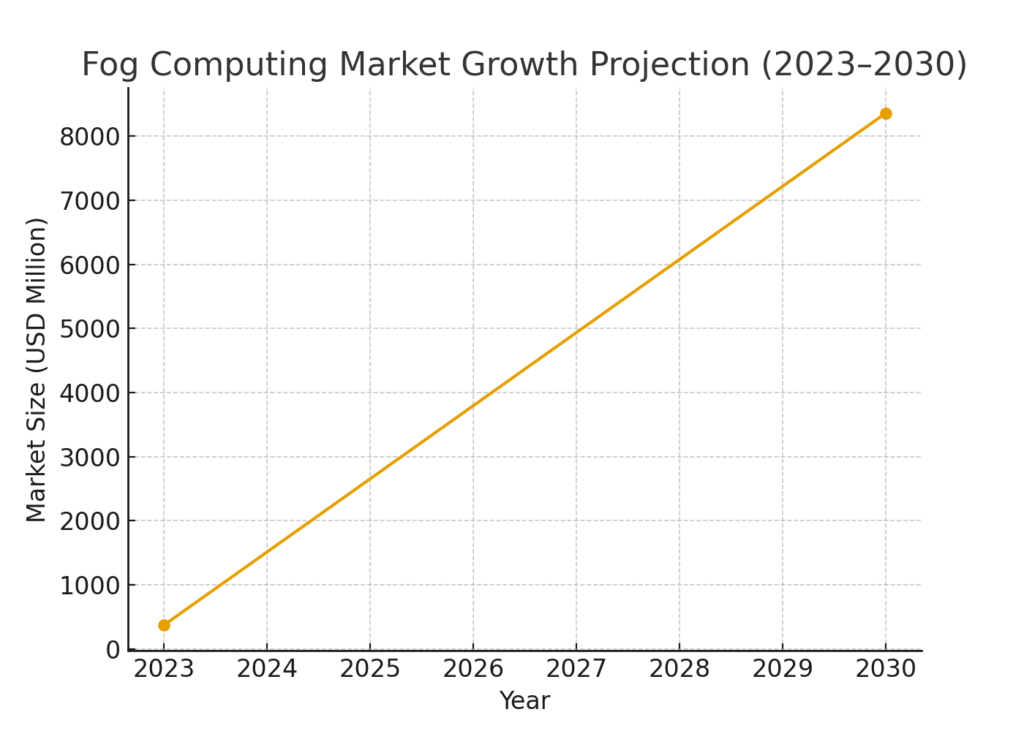
Fog Computing Marketing Statistics #1: Market Valued At USD 372.9 Million In 2023
The global fog computing market was valued at USD 372.9 million in 2023. This baseline highlights the early adoption phase of fog computing worldwide. Despite being relatively small compared to cloud markets, its high growth potential is undeniable. Businesses in sectors like manufacturing, healthcare, and smart cities are already investing. This valuation sets the stage for exponential growth in the coming years.
Fog Computing Marketing Statistics #2: Projected To Reach USD 8.36 Billion By 2030
Analysts predict the market will grow to USD 8.36 billion by 2030. This reflects a compound annual growth rate (CAGR) of more than 50%. Such rapid expansion indicates strong demand for real-time processing and edge solutions. Companies embracing this shift will likely see competitive advantages. For marketers, it means positioning products within a rapidly expanding technology ecosystem.
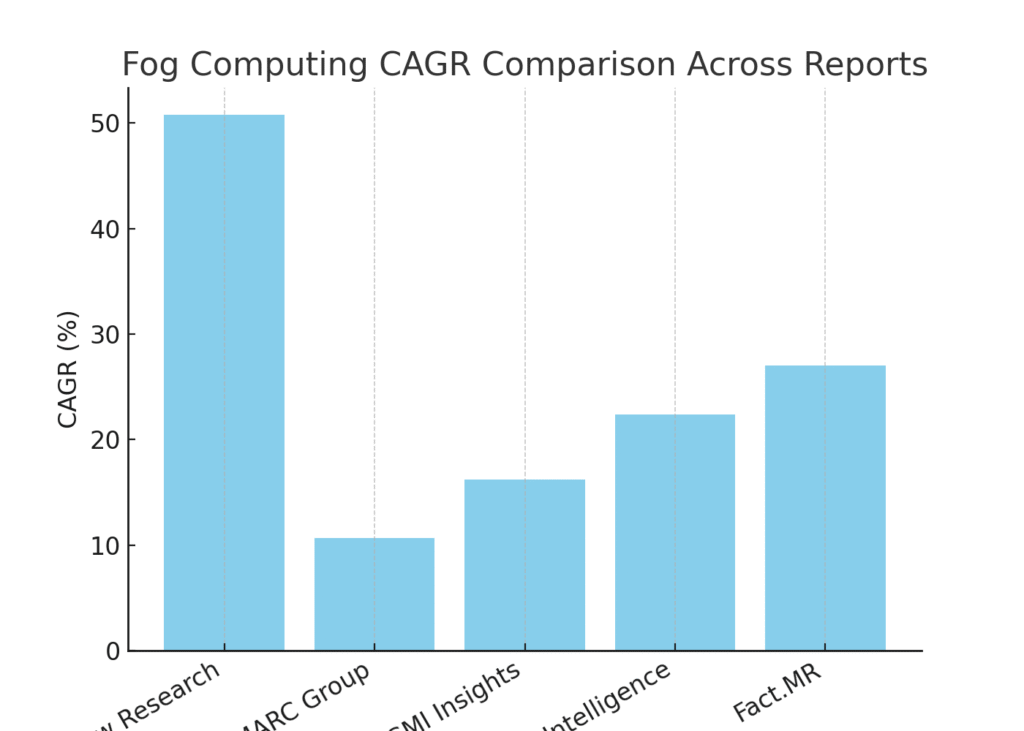
Fog Computing Marketing Statistics #3: USD 243.61 Million Market By 2025
According to one forecast, the fog computing market will reach USD 243.61 million in 2025. While smaller than some estimates, it reflects steady adoption. Different reports highlight varying numbers due to methodology, but the growth trend is consistent. Businesses should interpret this as steady momentum. For marketing teams, these insights help shape realistic strategies.
Fog Computing Marketing Statistics #4: Expected Growth To USD 572.08 Million By 2033
By 2033, the same forecast expects fog computing to reach USD 572.08 million. This suggests a CAGR of nearly 11%. It may not sound as dramatic as other predictions, but it still demonstrates healthy long-term growth. Incremental adoption often reflects practical integration by businesses. For marketers, slower growth can mean a more stable market entry environment.
Fog Computing Marketing Statistics #5: Market Size Of USD 346.8 Million In 2024
In 2024, the global market size reached about USD 346.8 million. This figure shows tangible year-on-year growth since 2023. It proves that fog computing is moving beyond hype into practical use. Industries like logistics and automotive are leading adoption. For brands, highlighting industry-specific case studies can drive stronger marketing narratives.
Fog Computing Marketing Statistics #6: Expected To Reach USD 1.2 Billion By 2034
The fog computing market is projected to hit USD 1.2 billion by 2034. With a CAGR of 16.2%, this long-term growth shows resilience. It demonstrates sustained interest from investors and enterprises. The market’s steady climb assures marketers of opportunities. Businesses can plan for both short- and long-term campaigns in this space.
Fog Computing Marketing Statistics #7: From USD 0.21 Billion In 2024 To USD 0.28 Billion In 2025
In just one year, the market is set to grow from USD 0.21 billion in 2024 to USD 0.28 billion in 2025. That’s nearly 37% growth in a short span. Such acceleration shows the urgency of adoption. Fast growth years attract heightened competition. Marketers can use this trend to push urgency-driven messaging.
Fog Computing Marketing Statistics #8: Expected To Reach USD 0.95 Billion By 2029
By 2029, fog computing could grow to USD 0.95 billion. This equates to a CAGR of over 35%. It’s a strong indication of confidence in the technology. Firms investing early could dominate market share by then. For marketers, demonstrating foresight will be key.
Fog Computing Marketing Statistics #9: Market Will Reach USD 5.5 Billion In 2025
Another report places the market at USD 5.5 billion in 2025. This estimate highlights just how varied forecasts can be. Despite differences, all agree on significant expansion. It underlines that fog computing is still maturing and hard to pin down precisely. Marketers can emphasize the technology’s vast potential.
Fog Computing Marketing Statistics #10: Growth To USD 15.1 Billion By 2030
That same source expects fog computing to reach USD 15.1 billion by 2030. This reflects a CAGR of about 22%. Such figures highlight strong mid-decade adoption. By 2030, fog could rival traditional cloud systems in growth rate. For marketers, it presents a story of disruptive innovation.
Fog Computing Marketing Statistics #11: Global Market To Hit USD 8.9 Billion By 2031
The global fog computing market could reach USD 8.9 billion by 2031. This represents a CAGR of about 50%. Few industries can boast such a fast expansion curve. It highlights how quickly IoT and edge data are scaling. Marketers can focus on speed, agility, and data power in campaigns.
Fog Computing Marketing Statistics #12: Projected At USD 10 Billion By 2035
By 2035, forecasts show fog computing at USD 10 billion. This long horizon indicates sustained trust in the technology. Enterprises expect it to evolve alongside AI and IoT. Steady growth over a decade reassures investors. Marketing narratives can leverage the “future-ready” positioning of fog.
Fog Computing Marketing Statistics #13: Worth USD 196.6 Million In 2023
The market was worth about USD 196.6 million in 2023 according to Fact.MR. This figure demonstrates varied reporting across research firms. Still, it reflects significant early investments. For smaller businesses, such reports validate entering the ecosystem. For marketers, diversity of data allows tailoring to audience perspectives.
Fog Computing Marketing Statistics #14: Reaching USD 2.2 Billion By 2033
That same report predicts growth to USD 2.2 billion by 2033. This equals a CAGR of about 27%. The figures confirm fog computing’s rising role in IoT. Industries like healthcare and automotive will benefit strongly. Marketing should emphasize real-world applications in such sectors.
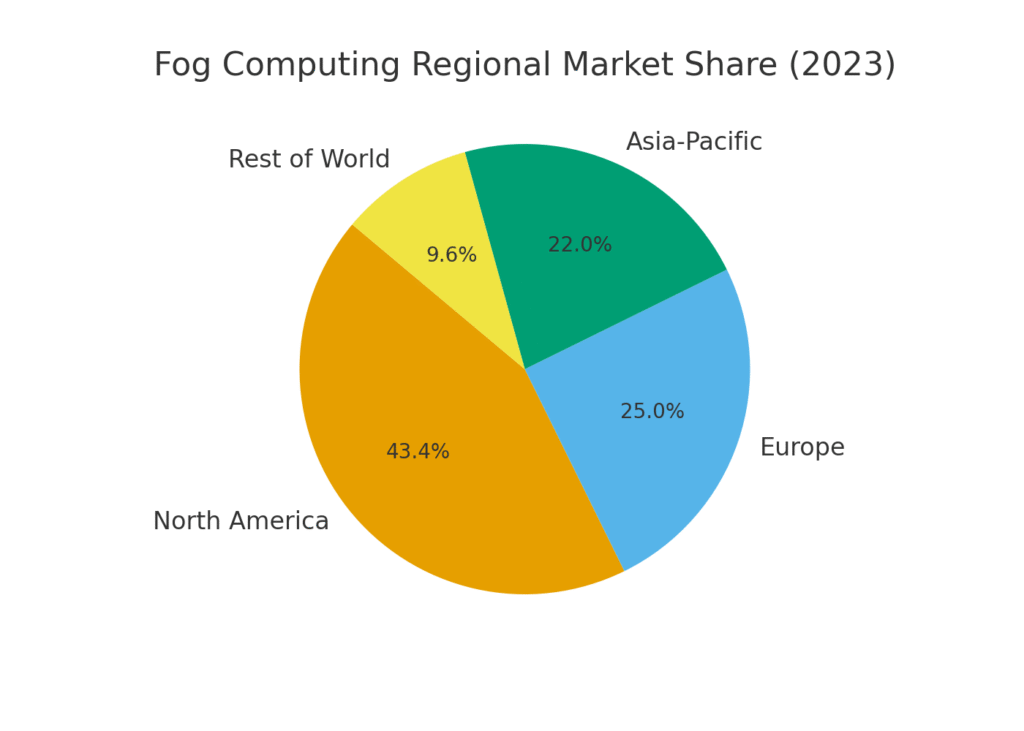
Fog Computing Marketing Statistics #15: North America Held 43.4% Of Revenue Share In 2023
In 2023, North America accounted for 43.4% of the fog computing market. This confirms the region’s dominance in adoption. Strong infrastructure and tech maturity make this possible. For companies entering the U.S. market, the opportunity is huge. Marketing strategies should highlight regional leadership and innovation.
Fog Computing Marketing Statistics #16: Asia-Pacific Identified As Fastest Growing Region
Asia-Pacific is projected to grow the fastest in fog computing adoption. Rapid digitization and IoT expansion fuel this trend. Countries like China and India are major contributors. This makes APAC a critical market for future campaigns. Marketers can localize strategies to resonate with regional growth.
Fog Computing Marketing Statistics #17: Software Segment Held 64.1% Market Share In 2023
In terms of components, software led the market with 64.1% share in 2023. This shows the importance of management platforms and analytics. Hardware adoption is steady, but software drives scalability. Businesses focusing on software solutions can benefit most. Marketers should stress flexibility and integration capabilities.
Fog Computing Marketing Statistics #18: Edge Gateways Accounted For 37.8% Of Hardware In 2024
Within hardware, edge gateways had a 37.8% share in 2024. These gateways are essential for connecting IoT devices. Their importance will only grow with scaling networks. Gateway adoption reflects infrastructure investment trends. Marketing can spotlight gateways as the backbone of fog computing.
Fog Computing Marketing Statistics #19: On-Premises Deployment Held 50.1% In 2024
On-premises deployments represented 50.1% of fog computing in 2024. Many enterprises still prefer control over data. This shows security and compliance are top concerns. However, hybrid models are rising fast. Marketers can emphasize hybrid benefits for future-proofing.
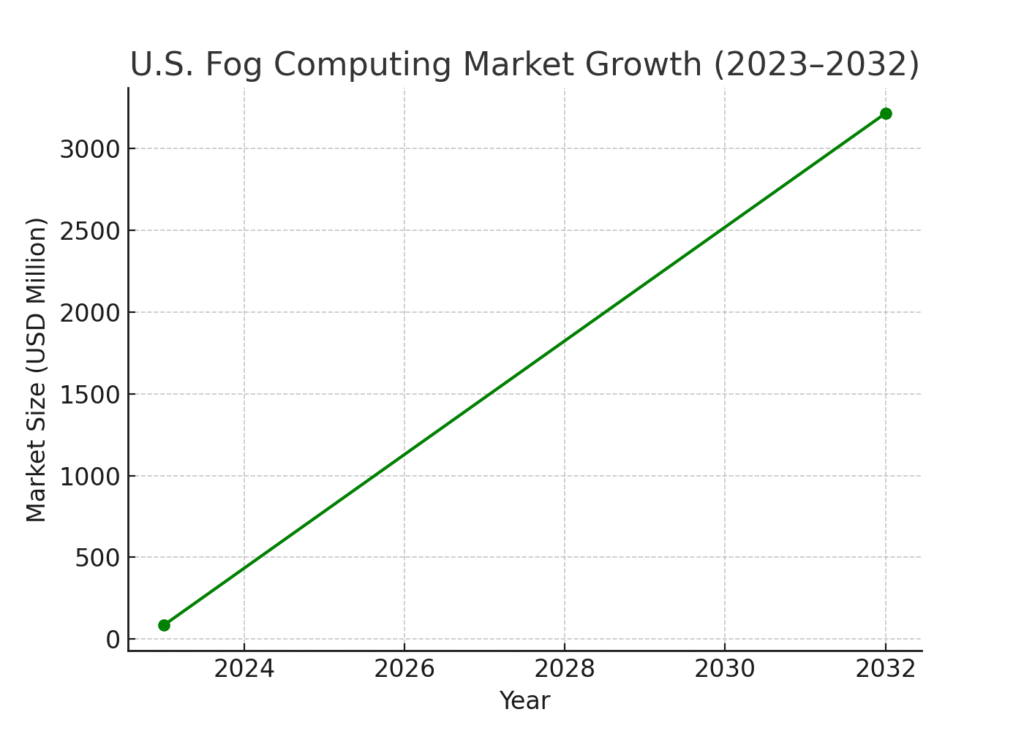
Fog Computing Marketing Statistics #20: U.S. Market To Grow From USD 85.4 Million In 2023 To USD 3.2 Billion By 2032
The U.S. fog computing market could grow from USD 85.4 million in 2023 to USD 3.2 billion by 2032. That’s a CAGR of nearly 50%. Such explosive growth emphasizes America’s role as a global hub. For companies, this market is too large to ignore. Marketing should stress leadership in the U.S. as part of global strategy.
My Takeaway on Fog Computing Marketing Statistics
Looking back at these insights, what stands out to me is just how quickly fog computing is moving from a futuristic idea into something tangible that’s shaping real business outcomes. I personally find it exciting to see how these trends open doors for innovation and smarter marketing strategies that put companies ahead of their competition. For me, it’s not just about keeping up with the numbers—it’s about translating them into actionable strategies that actually drive results. Whether you’re an entrepreneur, a tech enthusiast, or someone simply curious about where this space is going, these fog computing marketing statistics tell a powerful story about what the next decade could look like. And honestly, I can’t wait to see where this journey takes us.
SOURCES
https://www.akamai.com/blog/edge/fog-computing-edge-computing-roles-modern-technology
https://www.fortunebusinessinsights.com/fog-computing-market-102970
https://www.verifiedmarketreports.com/blog/top-7-trends-shaping-the-fog-computing-market/
https://www.industryarc.com/Research/Fog-Computing-Market-Research-504214
https://www.matellio.com/blog/fog-computing-in-healthcare/
https://straitsresearch.com/report/fog-computing-market
https://sam-solutions.com/blog/fog-computing-vs-cloud-computing-for-iot-projects/
https://www.mdpi.com/1424-8220/25/11/3488
https://crosser.io/blog/fog-computing-explained/
https://www.digitalrealty.com/resources/articles/fog-computing-and-what-it-means-for-the-cloud
https://www.sciencedirect.com/science/article/abs/pii/S2214209622000596
https://www.linkedin.com/pulse/fog-computing-2025-how-cisco-microsoft-ibm-leading-57-billion-rih6f