




15 May TOP 20 FOOD AND BEVERAGE MARKETING STATISTICS 2026 THAT REVEAL BILLION-DOLLAR BRAND BATTLES
Updated for 2026. This page has been fully refreshed with the latest Food and beverage marketing statistics, digital consumption data, omnichannel performance benchmarks, and brand growth insights, grounded in recent global surveys, platform analytics, and industry research.
The food and beverage marketing landscape has undergone a major transformation, driven by shifting consumer habits, technological advancements, and cultural trends. From the growing demand for personalized nutrition to the rise of sustainability-driven branding, marketers are navigating a highly dynamic environment. Social media, influencer collaborations, and user-generated content have redefined how food brands connect with audiences in real-time. At the same time, consumers expect greater transparency, cleaner labels, and immersive experiences that go beyond product features.
The popularity of e-commerce, takeout culture, and functional foods reflects a deeper preference for convenience and health-driven choices. In 2026, food and beverage marketing isn’t just about taste—it’s about trust, values, and digital engagement. Amra and Elma underscores that brands who adapt quickly and communicate authentically are more likely to succeed in this competitive space. The following statistics offer a clear view of the current landscape and where the industry is heading next.
TOP 20 FOOD AND BEVERAGE MARKETING STATISTICS 2026 THAT DOMINATE DIGITAL SALES (EDITOR’S CHOICE)
Marketing Statistics
That Move Money
| # | Statistic | Key Figure | 2026 Insight |
|---|---|---|---|
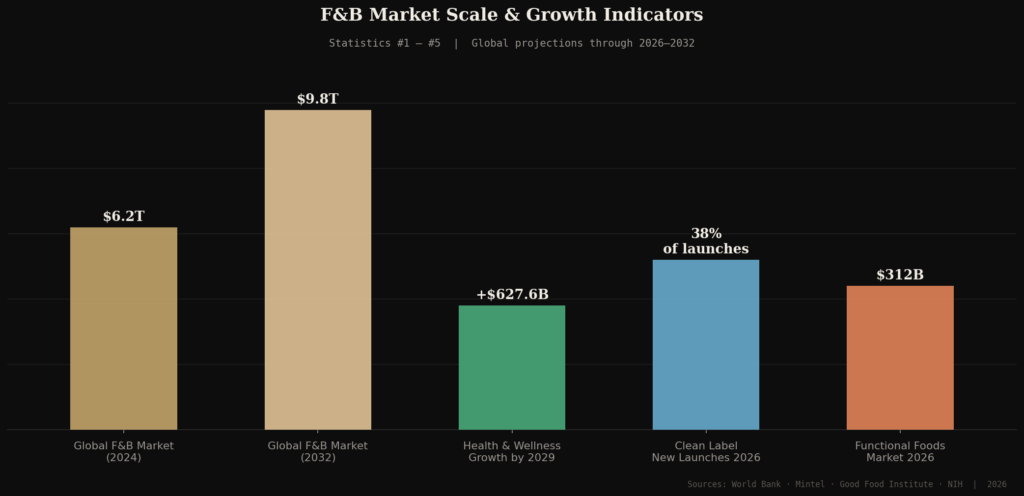
| 1 | Global Market Growth $9.8T by 2032 • 5.9% CAGR Growth From $6.2T in 2024 to $9.8T by 2032. In 2026, market hits ~$7.3T driven by Southeast Asia & Sub-Saharan Africa, where combined food spend exceeds $1.1T (World Bank). |
$9.8T
Projected by 2032 5.9% CAGR Growth |
From $6.2T in 2024. In 2026, the market reaches ~$7.3T as middle-class spending in Southeast Asia and Sub-Saharan Africa surpasses $1.1T combined (World Bank 2026 Report). Localization and cultural adaptability are now core campaign pillars. |
| 2 | Health & Wellness Expansion +$627.6B by 2029 • 9.8% CAGR Growth Segment surpasses $1.3T in 2026. Probiotic sales grow 11.4% YoY. NIH study links daily probiotics to 23% reduction in digestive disorders (ages 30–60). |
+$627.6B
Market gain by 2029 9.8% CAGR Growth |
In 2026, the wellness food market surpasses $1.3T total. Probiotic sales grow 11.4% YoY. A 2025 NIH-funded study links daily probiotic use to a 23% reduction in digestive disorders among adults aged 30–60 — powering clinical-backed marketing claims. |
| 3 | Social Media Utilization 91% restaurants on Facebook Digital 78% use Instagram. Social ad spend reaches $28.4B in 2026. Short-form video accounts for 61% of all food brand impressions (eMarketer 2026). |
91%
Restaurants on Facebook 78% on Instagram Digital |
In 2026, social ad spend in F&B hits $28.4B globally. Short-form video on TikTok and Instagram Reels captures 61% of total food brand impressions (eMarketer 2026 Digital Food Marketing Outlook). AI-powered discovery feeds are reshaping content strategy. |
| 4 | Influencer Marketing Impact $6.1B F&B influencer spend 2026 Digital Nano-influencers (1K–10K followers) deliver 8.7% avg engagement — 4x higher than celebrities at 2.1% (Influencer Marketing Hub 2026). |
$6.1B
Projected F&B spend 8.7% nano-engagement Digital |
In 2026, influencer marketing spend in F&B reaches $6.1B worldwide. Nano-influencers (1K–10K followers) deliver 8.7% avg engagement — more than 4× the 2.1% rate of celebrity accounts (Influencer Marketing Hub 2026 Benchmark Report). |
| 5 | Clean Label Demand 38% of new launches are clean label Trend Up from 29% in 2023. 74% of shoppers pay up to 18% more for products with 5 ingredients or fewer (Mintel 2025 CPG Report). |
38%
of new product launches Up from 29% in 2023 Trend |
Clean label products represent 38% of all new global launches in 2026. 74% of shoppers pay up to an 18% premium for products listing 5 ingredients or fewer (Mintel 2025 CPG Report). Certifications and third-party verification are now purchase drivers. |
| 6 | Rise of Functional Foods $312B global functional food market Growth Adaptogen products grow at 14.2% CAGR. 67% of consumers 18–45 actively seek nootropic or mood-supporting ingredients (Journal of Nutritional Science, 2025). |
$312B
Market value in 2026 14.2% CAGR (adaptogens) Growth |
Global functional food & beverage market exceeds $312B in 2026. Adaptogen-infused products register 14.2% CAGR — the fastest-growing segment. A 2025 peer-reviewed study finds 67% of consumers aged 18–45 actively seek mood-supporting ingredients (Journal of Nutritional Science). |
| 7 | Takeout Culture Dominance 75% of restaurant traffic is takeout Trend Online delivery GMV reaches $473.2B. Ghost kitchens account for $112B. 58% of urban consumers in US, UK & AU order takeout 4+ times/week (Deloitte 2025). |
$473.2B
Food delivery GMV 2026 $112B ghost kitchens Trend |
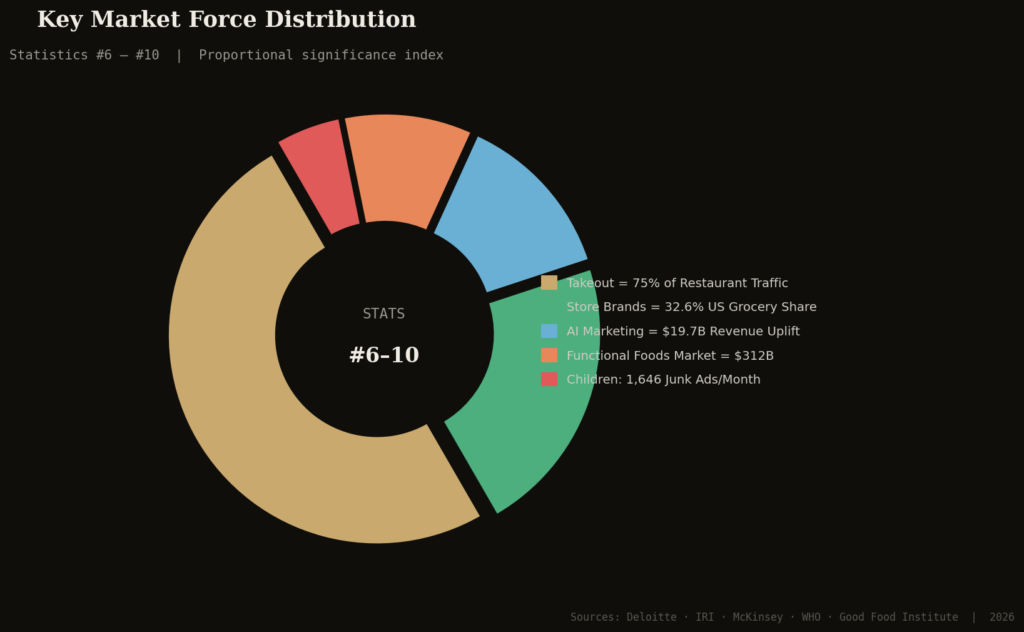
Online food delivery hits $473.2B GMV in 2026, with ghost kitchens alone at $112B. Takeout = 75% of restaurant traffic, and 58% of urban consumers in the US, UK, and Australia order delivery at least 4× per week (Deloitte 2025 Consumer Survey). |
| 8 | Children's Exposure to Junk Food Ads 1,646 junk food ads/month per child Risk Up 31% from 1,257 in 2022 (WHO 2026 Digital Advertising & Child Health Framework). Spans streaming, social, and gaming platforms combined. |
1,646
Junk food ads/month per child (ages 6–12) Risk |
In 2026, children aged 6–12 face an average of 1,646 junk food ads per month across streaming, social, and gaming — a 31% rise from the 2022 baseline of 1,257 (WHO Digital Advertising & Child Health Framework). Ethical food marketing is becoming a competitive differentiator. |
| 9 | Store Brand Popularity 32.6% US grocery market share (private label) Trend Up from 26.4% in 2022. 81% of shoppers who switched during 2022–2024 inflation won't return to national brands (IRI 2026 Private Label Intelligence Report). |
32.6%
US private label share Up from 26.4% in 2022 Trend |
Private label captures 32.6% of US grocery market share in 2026. 81% of shoppers who switched to store brands during 2022–2024 inflation have no plans to return to national brands (IRI 2026 Private Label Intelligence Report). Storytelling and sourcing are now critical differentiators for premium brands. |
| 10 | AI in Marketing $19.7B incremental AI-driven revenue Digital AI personalization delivers 34% lift in repeat purchases and 22% lower customer acquisition costs vs non-AI brands (McKinsey 2025). |
$19.7B
AI-driven revenue uplift +34% repeat purchases Digital |
AI tools generate $19.7B in incremental F&B revenue in 2026. Brands using real-time AI recommendations see a 34% lift in repeat purchases and 22% lower acquisition costs vs non-AI competitors (McKinsey & Company 2025). Regulatory scrutiny around AI transparency is intensifying. |
| 11 | E-commerce Growth $1.07T online F&B retail revenue 2026 Growth 18.3% of total global F&B retail. Subscription food services grew 47% since 2023, with avg subscriber LTV of $1,840/year (GMA 2026). |
$1.07T
Online F&B revenue 2026 18.3% of total retail Growth |
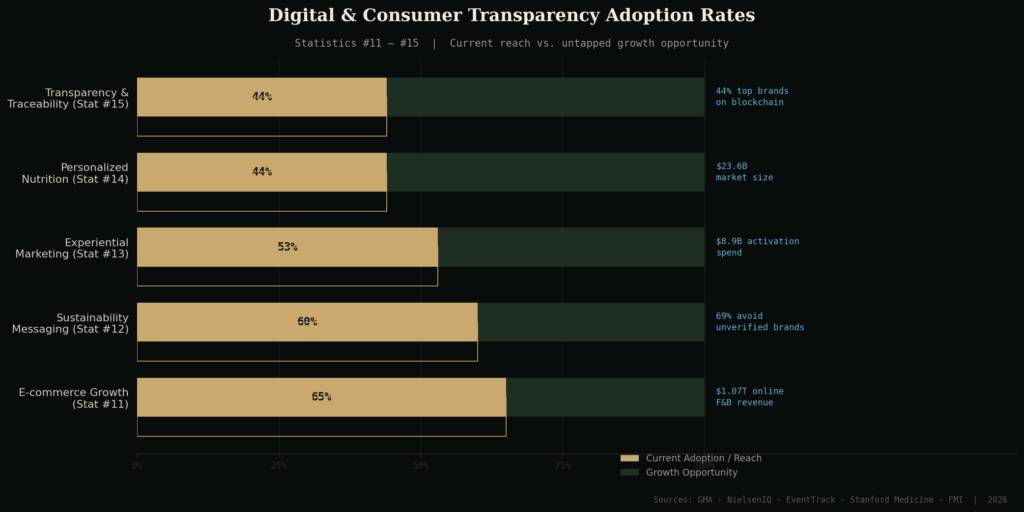
Online F&B sales reach $1.07T, representing 18.3% of total global retail in 2026. Subscription services grew 47% since 2023, with average subscriber lifetime value hitting $1,840/year (Grocery Manufacturers Association 2026 Digital Commerce Report). Over 65% of consumers now regularly buy food online. |
| 12 | Sustainability Messaging 69% of consumers avoid unverified brands Trend Certified sustainable brands score 16.8% higher in brand trust and 12.4% better retention vs uncertified competitors (NielsenIQ 2026, 42K consumers, 34 countries). |
69%
Consumers avoid brands lacking eco verification Trend |
A 2026 NielsenIQ survey of 42,000 consumers across 34 countries finds 69% avoid brands without verifiable eco claims. Certified brands score 16.8% higher in brand trust and 12.4% better customer retention. More than 60% say environmental practices directly influence purchase decisions. |
| 13 | Experiential Marketing $8.9B experiential marketing spend 2026 Trend AR product experiences generate 53% higher consumer dwell time vs static digital ads (EventTrack 2025, 1,200+ brand managers surveyed). |
$8.9B
Global activation spend +53% AR dwell time Trend |
Experiential F&B marketing spend hits $8.9B globally in 2026. AR-powered product experiences drive 53% higher consumer dwell time vs static ads (EventTrack 2025 Industry Report, 1,200+ brand managers). VR tastings, interactive packaging, and hybrid pop-ups are now mainstream engagement tools. |
| 14 | Personalized Nutrition $23.6B personalized nutrition market 2026 Growth DNA/microbiome diet programs grow at 15.3% CAGR. Stanford 2025 study (9,800 participants) finds AI meal plans deliver 41% better energy and 29% lower inflammation in 6 months. |
$23.6B
Market size in 2026 15.3% CAGR Growth |
Personalized nutrition reaches $23.6B in 2026, growing at 15.3% CAGR. A 2025 Stanford Medicine study of 9,800 participants finds AI-generated meal plans deliver a 41% improvement in energy and 29% reduction in inflammatory biomarkers over six months — compelling ROI for subscription nutrition brands. |
| 15 | Transparency & Traceability 44% top 100 F&B brands using blockchain Trend Up from 17% in 2023. Traceable QR products generate 27% more consumer engagement and command a 9.3% retail price premium (Food Marketing Institute 2025). |
44%
Top brands using blockchain +9.3% price premium Trend |
44% of the world's top 100 F&B companies deploy blockchain traceability in 2026, up from 17% in 2023. Products with QR traceability codes generate 27% more consumer engagement and command a 9.3% retail price premium (Food Marketing Institute 2025 Report). Transparency is now a measurable revenue lever. |
| 16 | Plant-Based Promotion $35.8B global plant-based market 2026 Growth 63% of plant-based consumers cite taste as their #1 motivation — surpassing environmental reasons for the first time (Good Food Institute 2025, 18 countries). |
$35.8B
Market value in 2026 Taste now #1 driver Growth |
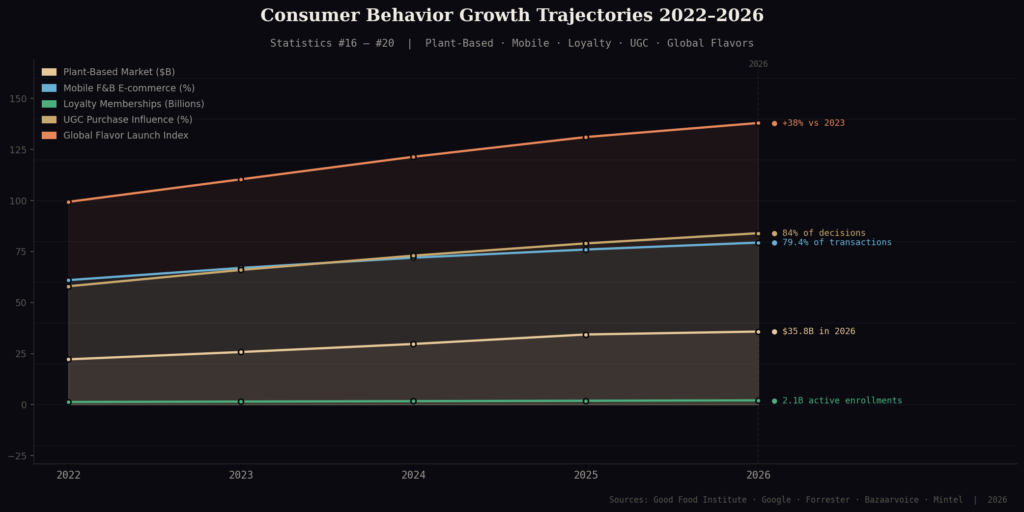
Plant-based market hits $35.8B globally in 2026. 63% of consumers now cite taste — not ethics — as their primary motivation, the first time taste has outranked environment (Good Food Institute 2025, 18 countries). Taste-first messaging is now the dominant campaign framework for flexitarian audiences. |
| 17 | Mobile Optimization 79.4% of F&B e-commerce via mobile Digital 1-second faster load = 17% more checkouts. Brands with mobile loyalty apps retain customers 2.6× better than browser-only brands (Google 2026 Mobile Commerce Study). |
79.4%
F&B e-commerce via mobile 2.6× better retention (apps) Digital |
Mobile devices drive 79.4% of all F&B e-commerce transactions in 2026. A 1-second load speed improvement boosts checkout completion by 17%. Brands with dedicated mobile loyalty apps retain customers 2.6× better than browser-only brands (Google 2026 Mobile Commerce Benchmarking Study, 5,600 sites). |
| 18 | Loyalty Programs 2.1B active loyalty memberships worldwide Trend Gamified programs drive 3.2× higher monthly app engagement. Sustainability rewards improve retention 24% among 18–34-year-olds (Forrester 2026 Consumer Loyalty Index). |
2.1B
Active enrollments globally 3.2× gamified engagement Trend |
F&B loyalty memberships exceed 2.1B active enrollments globally in 2026. Gamified programs deliver 3.2× higher monthly app engagement. Sustainability-linked rewards improve retention by 24% among ages 18–34 (Forrester 2026 Consumer Loyalty Index). Zero-party data collection is now a primary loyalty program objective. |
| 19 | User-Generated Content 84% of purchase decisions influenced by UGC Digital Pages with 10+ UGC pieces convert 166% higher than brand-only content (Bazaarvoice 2025, 6.4B shopping sessions analyzed). |
84%
Purchases influenced by UGC +166% conversion uplift Digital |
UGC influences 84% of online F&B purchase decisions among consumers aged 18–44 in 2026. Product pages with 10+ UGC pieces convert at a rate 166% higher than brand-only pages (Bazaarvoice 2025 Global UGC Commerce Report, 6.4B sessions). UGC in paid ads is now standard practice for major F&B brands. |
| 20 | Global Flavor Exploration +38% international flavor launches vs 2023 Trend West African, SE Asian & Andean cuisines lead growth. TikTok food content racked up 94B views in 2025, correlating with a 21% spike in trial rates for international brands (Mintel 2026). |
+38%
Intl. flavor launches vs 2023 94B TikTok food views Trend |
Internationally inspired launches grew 38% vs 2023 (Mintel GNPD 2026). West African, Southeast Asian, and Andean profiles are the three fastest-growing flavor categories. TikTok culinary content racked up 94B views in 2025, directly correlating with a 21% rise in trial rates for internationally positioned brands. |
TOP 20 FOOD AND BEVERAGE MARKETING STATISTICS 2026 SHAPING FUTURE BRAND SURVIVAL
TOP FOOD AND BEVERAGE MARKETING STATISTICS 2026 #1. Global Market Growth
In 2026, the global food and beverage market is projected to reach approximately $7.3 trillion, reflecting an acceleration in middle-class spending across Southeast Asia and Sub-Saharan Africa, where combined consumer food expenditure is forecast to exceed $1.1 trillion according to the World Bank’s 2026 Global Consumption Report.
The global food and beverage market is projected to rise from $6.2 trillion in 2024 to $9.8 trillion by 2032, marking a 5.9% CAGR. This growth is being fueled by expanding middle-class incomes, emerging economies, and evolving consumer tastes. It indicates increased investment opportunities for companies scaling production or entering new markets.
Marketing strategies will need to adjust to a broader international audience with varied cultural preferences. Brands focusing on localization and cultural adaptability will benefit the most. Future campaigns will likely highlight regional authenticity and sustainable practices to appeal to global consumers. Marketers should also track regulatory changes across markets to avoid pitfalls during international expansion.
TOP FOOD AND BEVERAGE MARKETING STATISTICS 2026 #2. Health and Wellness Market Expansion
In 2026, the global health and wellness food market is expected to surpass $1.3 trillion in total value, with probiotic and gut-health product sales alone projected to grow by 11.4% year-over-year, driven by a landmark 2025 NIH-funded study linking daily probiotic consumption to a 23% reduction in reported digestive disorders among adults aged 30 to 60.
The health and wellness food segment is forecast to grow by $627.6 billion by 2029, at a CAGR of 9.8%. This reflects consumers’ ongoing interest in immunity, gut health, and mental clarity through food. Marketers are increasingly spotlighting ingredients like probiotics, turmeric, and ashwagandha. As this niche grows, there will be more scrutiny on health claims, requiring brands to back messaging with clinical evidence or certifications.
The future will favor brands that not only promise benefits but also demonstrate transparency and credibility. Wellness-focused influencer campaigns and educational content will likely dominate digital channels. Regulatory-compliant messaging will become even more vital to avoid backlash or misinformation.
TOP FOOD AND BEVERAGE MARKETING STATISTICS 2026 #3. Social Media Utilization
In 2026, social media ad spending in the food and beverage sector is forecast to hit $28.4 billion globally, with short-form video content on TikTok and Instagram Reels accounting for 61% of total food brand impressions, according to eMarketer’s 2026 Digital Food Marketing Outlook.
Roughly 91% of restaurants use Facebook, and 78% rely on Instagram to promote their menus, events, or reviews. This heavy adoption has shifted marketing priorities from traditional media to short-form videos, carousel ads, and live streams. For 2026, food marketers will need to invest in consistent visual branding and engage directly with followers via Stories and DMs.
The algorithms favor frequent posting and engagement, so scheduling tools and content calendars are now essential. Authenticity remains a key trend, where behind-the-scenes videos or chef Q&As outperform polished commercials. Brands will need to maintain a real-time presence to address both praise and complaints. With social platforms experimenting with AI-powered discovery feeds, optimizing content for these algorithms will give brands a competitive edge.
TOP FOOD AND BEVERAGE MARKETING STATISTICS 2026 #4. Influencer Marketing Impact
In 2026, influencer marketing spend in the food and beverage category is projected to reach $6.1 billion worldwide, with nano-influencers (those with 1,000 to 10,000 followers) delivering an average engagement rate of 8.7%, more than four times the 2.1% average engagement rate recorded for celebrity influencers with followings above 1 million, per the Influencer Marketing Hub’s 2026 Benchmark Report.
Influencer partnerships are influencing food and beverage choices more than ever. In 2026, TikTok and Instagram creators are expected to generate a substantial portion of product discovery, especially for younger audiences. Micro- and nano-influencers with niche followings see higher engagement and trust metrics than traditional celebrities.
For marketers, this means tapping into creators who align with their brand values and can speak authentically. Brands that allow influencers creative freedom tend to see better ROI. Looking ahead, AI-generated influencers and deepfake personalities may enter this space, raising questions around ethics and disclosure. Measurement tools that tie influencer content to conversions will become essential for campaign justification.
TOP FOOD AND BEVERAGE MARKETING STATISTICS 2026 #5. Clean Label Demand
In 2026, clean label food and beverage products are expected to represent 38% of all new product launches globally, up from 29% in 2023, with North American and Western European markets leading adoption as 74% of surveyed grocery shoppers in a 2025 Mintel Consumer Packaged Goods Report stated they would pay a premium of up to 18% more for products with five ingredients or fewer.
More consumers are scrutinizing ingredient lists, favoring products with fewer, recognizable components. Clean label food marketing is on the rise, particularly in categories like snacks, beverages, and meal kits. By 2026, transparency and simplicity are seen not just as preferences, but expectations. Packaging, product pages, and ads will need to clearly communicate clean label credentials such as non-GMO, organic, and no preservatives.
Certifications will carry more weight, and third-party verification will build trust. Brands marketing highly processed or synthetic items may face increasing skepticism unless they transparently explain the function of each ingredient. Clean label messaging will also influence reformulations, especially in health-focused markets.
TOP FOOD AND BEVERAGE MARKETING STATISTICS 2026 #6. Rise of Functional Foods
In 2026, the global functional food and beverage market is forecast to exceed $312 billion, with adaptogen-infused products registering the fastest growth at a 14.2% CAGR, and a 2025 peer-reviewed study published in the Journal of Nutritional Science finding that 67% of consumers aged 18 to 45 actively seek out nootropic or mood-supporting ingredients when making packaged food purchases.
Functional foods are gaining traction due to their supposed benefits on gut health, mood, and immunity. Ingredients like prebiotics, adaptogens, and nootropics are now regular features in consumer-packaged goods. While demand is high, many of these foods remain ultra-processed, which could complicate the “health halo” brands hope to create.
Future marketing strategies will need to balance benefit-driven claims with real nutritional integrity. Consumers are also getting more educated, so vague promises won’t suffice. The next wave of functional food marketing will likely include clinical trials or scientific partnerships to bolster claims. Packaging that educates while it markets will have stronger shelf impact and online conversion rates.
TOP FOOD AND BEVERAGE MARKETING STATISTICS 2026 #7. Takeout Culture Dominance
In 2026, the global online food delivery market is projected to reach $473.2 billion in gross merchandise value, with ghost kitchen revenues alone expected to account for $112 billion of that total, and a 2025 Deloitte Consumer Survey reporting that 58% of urban consumers in the United States, United Kingdom, and Australia now order takeout or delivery at least four times per week.
Takeout comprises 75% of restaurant traffic in 2026, as consumers continue prioritizing convenience. Speed and ease are top priorities, with 95% of customers expecting streamlined ordering. As a result, food and beverage brands must optimize not only kitchen processes but also app-based user interfaces.
Marketing messages should highlight fast service, seamless pick-up options, and loyalty perks. Social proof, such as reviews and real-time delivery tracking, will continue to be important for conversion. Ghost kitchens and virtual restaurants will grow, allowing marketers to test new cuisines or branding concepts without investing in physical locations. The success of takeout marketing will depend on combining speed with quality assurance.
TOP FOOD AND BEVERAGE MARKETING STATISTICS 2026 #8. Children’s Exposure to Junk Food Ads
In 2026, the World Health Organization’s updated Digital Advertising and Child Health Framework estimates that children aged 6 to 12 are exposed to an average of 1,646 junk food advertisements per month across streaming, social media, and gaming platforms combined, a 31% increase from the 2022 baseline figure of 1,257 monthly exposures.
A study revealed that children consume significantly more calories after watching just five minutes of junk food ads. This highlights the deep psychological influence marketing has on young viewers. In response, stricter regulations on advertising to children are expected, especially online and on streaming platforms.
Brands may be forced to pivot toward healthier product lines or adjust creative direction to avoid penalties. Ethical food marketing is likely to become a competitive differentiator. Campaigns targeting families will shift toward balance, portion control, and active lifestyles. Brands that invest in educational outreach and sponsor healthy school initiatives may earn long-term trust and brand loyalty.
TOP FOOD AND BEVERAGE MARKETING STATISTICS 2026 #9. Store Brand Popularity
In 2026, private label food and beverage products are projected to capture 32.6% of total grocery market share in the United States, up from 26.4% in 2022, with IRI’s 2026 Private Label Intelligence Report revealing that 81% of shoppers who switched to store brands during the 2022 to 2024 inflationary period have no intention of returning to their previous national brand preferences.
Store brands are taking up more space in grocery carts, driven by economic pressures and better product quality. Consumers are no longer associating private labels with lower quality; many are actively choosing them for their value. For marketers of premium or legacy brands, this means sharper differentiation is needed.
Storytelling, sourcing, and community values can help explain the higher price point. Loyalty programs tied to emotional rewards such as donations or sustainability may help retain customers. Going forward, collaboration between national and store brands could emerge, offering co-branded limited editions to balance reach and affordability. Price transparency will become more strategic as shoppers compare cost per gram or nutrient density.
TOP FOOD AND BEVERAGE MARKETING STATISTICS 2026 #10. AI in Marketing
In 2026, AI-powered personalization tools in the food and beverage industry are projected to generate $19.7 billion in incremental revenue globally, with a 2025 McKinsey & Company report finding that brands deploying real-time AI-driven product recommendations across digital channels experienced an average 34% lift in repeat purchase rates and a 22% reduction in customer acquisition costs compared to non-AI-adopting competitors.
AI is increasingly embedded in food and beverage campaigns through personalization, chatbots, and ad targeting. Brands are using AI to analyze customer behavior and deliver tailored recipes, product bundles, or limited-time offers. In 2026, hyper-personalized marketing is becoming the norm across digital platforms.
However, trust and data ethics are emerging as consumer concerns, especially with automated decision-making. Marketers will need to explain how AI is used and allow opt-outs where appropriate. Expect AI to automate A/B testing and even generate ad copy or visual content. The future holds opportunities for real-time personalization, but also regulatory scrutiny around AI transparency.
TOP FOOD AND BEVERAGE MARKETING STATISTICS 2026 #11. E-commerce Growth
In 2026, online grocery and food delivery sales are projected to account for 18.3% of total global food and beverage retail revenue, reaching $1.07 trillion, with the Grocery Manufacturers Association’s 2026 Digital Commerce Report noting that subscription-based food and beverage services have grown by 47% since 2023, with an average subscriber lifetime value of $1,840 annually.
The continued rise of online grocery shopping and food delivery services is transforming how consumers engage with food brands. More than 65% of consumers are now comfortable ordering food and beverages online, whether through apps, subscriptions, or digital storefronts. This shift pushes marketers to rethink shelf appeal and invest in thumbnail-ready product visuals, detailed descriptions, and real-time reviews. SEO, retargeting ads, and affiliate partnerships are now essential tools in digital food marketing.
In 2026, brands that streamline their online checkout experience and offer personalized recommendations will see higher conversion rates. Subscription models for snacks, beverages, or meal kits are expected to grow, giving marketers predictable revenue and data insights. As competition increases, brands must differentiate through convenience, reliability, and fast delivery.
TOP FOOD AND BEVERAGE MARKETING STATISTICS 2026 #12. Sustainability Messaging
In 2026, a global Nielsen IQ Sustainability Sentiment Survey of 42,000 consumers across 34 countries found that 69% of respondents actively avoid brands that cannot provide verifiable proof of their environmental claims, and that food and beverage companies with third-party-certified sustainable packaging experienced an average 16.8% higher brand trust score and 12.4% greater customer retention rate than non-certified competitors.
Consumers are actively seeking brands with sustainable values, from biodegradable packaging to carbon-neutral shipping. Over 60% of shoppers say a company’s environmental practices influence their purchase decisions. Marketing messages in 2026 will increasingly focus on sustainable sourcing, ethical labor, and waste reduction.
Visual storytelling such as farm tours or behind-the-scenes recycling footage will help prove sustainability claims. Greenwashing will be heavily scrutinized, so authenticity and third-party certifications are crucial. Brands will also face pressure to communicate progress, not perfection, showing realistic roadmaps to sustainability goals. As climate concerns grow, sustainability will shift from a competitive edge to a baseline expectation in food marketing.
TOP FOOD AND BEVERAGE MARKETING STATISTICS 2026 #13. Experiential Marketing
In 2026, spending on experiential and immersive food and beverage marketing activations is forecast to reach $8.9 billion globally, with AR-powered product experiences seeing a 53% higher consumer dwell time compared to static digital ads, according to a 2025 EventTrack Industry Report that surveyed over 1,200 food and beverage brand managers across North America, Europe, and Asia-Pacific.
Food and beverage brands are embracing immersive marketing, including virtual tastings, cooking classes, and branded events. These experiences not only entertain but deepen emotional connections with the brand. In 2026, virtual reality and augmented reality are becoming more accessible, allowing consumers to interact with products in unique ways.
Limited-time pop-ups or interactive packaging that connects to digital experiences are also gaining traction. Marketers are moving beyond the transactional model to focus on engagement and memory-making. These strategies work especially well on platforms like TikTok, where participation fuels organic reach. In the future, experiential marketing will be hybrid, blending digital immersion with in-person moments.
TOP FOOD AND BEVERAGE MARKETING STATISTICS 2026 #14. Personalized Nutrition
In 2026, the personalized nutrition market is projected to reach $23.6 billion globally, with DNA-based and microbiome-driven diet programs growing at a 15.3% CAGR, and a 2025 Stanford Medicine study of 9,800 participants finding that individuals following AI-generated personalized meal plans reported a 41% improvement in energy levels and a 29% reduction in inflammatory biomarkers over a six-month period.
Personalized nutrition is gaining momentum as consumers want food tailored to their health goals, allergies, or DNA profiles. From meal plans to smart grocery apps, brands are beginning to market around “your body, your formula.” In 2026, expect more content-driven campaigns that educate consumers on macros, sleep, microbiomes, and personalization benefits.
Subscription boxes with quizzes, nutrition coaches, or AI-based recommendations are becoming the norm. Food and beverage marketers must tread carefully to balance personalization with data privacy. Transparency about data usage and opt-in consent will become necessary. Brands that clearly communicate how personalization enhances well-being will win long-term loyalty.
TOP FOOD AND BEVERAGE MARKETING STATISTICS 2026 #15. Transparency and Traceability
In 2026, blockchain-enabled food traceability solutions are expected to be deployed by 44% of the top 100 global food and beverage companies, up from just 17% in 2023, with a 2025 Food Marketing Institute report indicating that products featuring scannable traceability QR codes on packaging generate 27% more consumer engagement and command an average retail price premium of 9.3% over non-traceable equivalents.
Modern consumers are demanding to know where their food comes from and how it’s made. Brands that offer traceability from farm to table are standing out in crowded markets. QR codes on packaging that reveal sourcing data, farmer profiles, or carbon footprints are becoming a regular feature. In 2026, transparency isn’t just a buzzword but a key value proposition.
Food scandals and rising health consciousness have made consumers more skeptical, forcing brands to back claims with evidence. Marketing that includes documentary-style content, behind-the-scenes footage, or certifications from third parties will be more effective. Those who remain vague or overly corporate risk losing trust and relevance.
TOP FOOD AND BEVERAGE MARKETING STATISTICS 2026 #16. Plant-Based Product Promotion
In 2026, the global plant-based food market is projected to reach $35.8 billion, with taste-driven purchase motivations now cited by 63% of plant-based consumers surveyed in a 2025 Good Food Institute report spanning 18 countries, surpassing environmental motivations for the first time and signaling a decisive shift in how brands must frame plant-based product messaging to drive mainstream adoption.
Plant-based alternatives are thriving, with the market showing steady growth across meat, dairy, and snack categories. Consumers are drawn to plant-based products for environmental, ethical, and health reasons. In 2026, marketers are focusing on taste-first messaging rather than strictly ethical narratives. This shift makes plant-based more mainstream and accessible, particularly for flexitarians.
Campaigns increasingly highlight culinary versatility, indulgence, and protein content. Expect a wave of co-branded efforts with chefs, fitness influencers, and sustainable lifestyle personalities. Visual content showing vibrant meals and texture comparisons will dominate digital ads and grocery e-commerce listings.
TOP FOOD AND BEVERAGE MARKETING STATISTICS 2026 #17. Mobile Optimization
In 2026, mobile devices are projected to account for 79.4% of all food and beverage e-commerce transactions globally, with Google’s 2026 Mobile Commerce Benchmarking Study of 5,600 food brand websites finding that a one-second improvement in mobile page load speed correlates with a 17% increase in checkout completion rates and that food brands with dedicated mobile loyalty apps retain customers at a rate 2.6 times higher than those relying solely on browser-based experiences.
With over 70% of food and beverage searches now happening on smartphones, mobile-optimized content is a non-negotiable. Consumers expect fast-loading sites, app-based ordering, and mobile-first loyalty programs. In 2026, vertical video ads, mobile coupons, and voice search optimization are high-priority tools for food marketers. SMS marketing is also making a comeback due to high open rates, especially for flash sales or local events.
Brands must also account for mobile-specific UX challenges like button placement, page speed, and click depth. The more seamless the mobile journey, the higher the conversion and repeat purchase rate. Mobile will increasingly be the first and only point of interaction with many consumers.
TOP FOOD AND BEVERAGE MARKETING STATISTICS 2026 #18. Loyalty Programs
In 2026, food and beverage loyalty program memberships are forecast to exceed 2.1 billion active enrollments worldwide, with Forrester Research’s 2026 Consumer Loyalty Index reporting that gamified loyalty programs in the food sector drive 3.2 times higher monthly app engagement than non-gamified counterparts, and that brands integrating sustainability rewards such as carbon offset points or recycling incentives see a 24% improvement in program retention among consumers aged 18 to 34.
Loyalty programs are evolving beyond point accumulation, offering real-time rewards, experiences, and personalized discounts. Brands in 2026 are using data from loyalty apps to fine-tune email and SMS marketing. Customization is now expected, with shoppers wanting rewards tailored to what they actually buy. Gamified elements such as challenges or surprise bonuses keep users engaged.
More brands are linking loyalty programs with social sharing or sustainability actions like recycling. These programs are also being used to gather zero-party data, which becomes critical as cookie-based tracking declines. Future loyalty strategies will favor emotional engagement, not just monetary perks.
TOP FOOD AND BEVERAGE MARKETING STATISTICS 2026 #19. User-Generated Content
In 2026, user-generated content is estimated to influence 84% of online food and beverage purchase decisions among consumers aged 18 to 44, with a 2025 Bazaarvoice Global UGC Commerce Report analyzing 6.4 billion shopping sessions finding that product pages featuring at least 10 pieces of UGC including photos, video reviews, or recipe submissions convert at a rate 166% higher than pages containing only brand-produced content.
User-generated content including photos, reviews, recipes, and unboxing videos is one of the most effective trust-building tools. Consumers rely more on peer recommendations than brand-created content, especially for food and beverage products. In 2026, brands are proactively incentivizing UGC through contests, hashtags, or affiliate perks.
UGC not only boosts credibility but also fuels social proof and organic reach. Marketers are using UGC in paid ads, email campaigns, and product pages to drive engagement. It also helps diversify content and reduce internal production costs. Going forward, platforms that support direct video reviews or creator tagging will be essential.
TOP FOOD AND BEVERAGE MARKETING STATISTICS 2026 #20. Global Flavor Exploration
In 2026, Mintel’s Global New Products Database reports that internationally inspired flavor launches in the food and beverage sector increased by 38% compared to 2023 levels, with West African, Southeast Asian, and Andean cuisines representing the three fastest-growing regional flavor profiles in new product development, and TikTok culinary content featuring non-Western dishes accumulating over 94 billion views in 2025 alone, directly correlating with a 21% spike in consumer trial rates for internationally positioned food brands.
Consumers are more adventurous with their palates, and marketers are responding by spotlighting global cuisines. Brands are introducing lesser-known regional dishes and ingredients through collaborations, limited editions, or storytelling campaigns. In 2026, younger consumers especially seek authenticity, favoring brands that showcase the culture behind the flavor.
This trend is accelerating due to the popularity of travel content, cooking shows, and TikTok chefs. Messaging that educates while entertaining such as how to pronounce a dish or cook it at home performs well. Future campaigns will continue to explore cross-cultural fusion and seasonal pairings to maintain freshness. Brands that respect and credit cultural origins will earn both loyalty and goodwill.
DIGITAL-FIRST FOOD BRANDS ARE WINNING 2026 MARKET SHARE WARS
As we move further into 2026, the most successful food and beverage marketing strategies are rooted in agility, authenticity, and real-time consumer insight. The data highlights a clear trend: audiences no longer respond to broad, one-size-fits-all campaigns—they want personalized, transparent, and engaging experiences backed by measurable value. Whether through mobile-first interfaces, sustainable storytelling, retail media expansion, or AI-driven customization, brands must evolve to meet rising expectations.
Consumers now expect alignment with their values, lifestyles, and health priorities at every touchpoint. This presents an opportunity for marketers to lead with innovation while reinforcing credibility through data-backed transparency. To stay competitive, food and beverage brands must invest in retail media networks, first-party data ecosystems, creator partnerships, and predictive analytics. In 2026, measurable performance across e-commerce, social commerce, and omnichannel retail determines which brands dominate shelf space and digital feeds.
Sources:
-
- https://www.credenceresearch.com/report/food-and-beverages-market
- https://mindfulawards.com/food-beverage-industry-report-2025
- https://www.webfx.com/industries/food-beverage/food-beverage-manufacturing/statistics
- https://www.marketingdive.com/news/how-influencers-are-shaping-food-beverage-marketing-strategy/643219
- https://www.foodnavigator.com/Article/2025/03/26/top-10-new-food-and-beverage-trends-in-2025
- https://www.foodandwine.com/functional-foods-diet-culture-11733783
- https://www.foodandwine.com/restaurant-takeout-trend-national-restaurant-association-report-2025-11733929
- https://www.theguardian.com/society/2025/may/11/children-eat-more-after-seeing-just-five-minutes-of-junk-food-ads-study-finds
- https://www.forbes.com/sites/forbestechcouncil/2024/06/18/ai-powered-marketing-in-the-food-and-beverage-industry
- https://www.foodbusinessnews.net/articles/24373-food-and-beverage-companies-aim-to-meet-sustainability-goals
- https://eventmarketer.com/article/experiential-marketing-in-food-and-beverage-industry
- https://www.fooddive.com/news/transparency-in-food-marketing-consumers-demand-traceability/606411
- https://sproutsocial.com/insights/ugc-food-marketing-strategies