



14 Sep TOP 20 FOOD TRUCK MARKETING STATISTICS 2026 REVEAL STREET FOOD SALES EXPLOSION
Updated for 2026. This page has been fully refreshed with the latest food truck marketing statistics, mobile dining industry data, and street food business trends, grounded in recent market reports, vendor surveys, and real-world marketing insights.
When I first started diving into the world of food trucks, I was struck by just how fast the industry has grown and how creative owners have become in connecting with their communities. Looking at the latest food truck marketing statistics, I realized they don’t just tell us numbers—they tell the story of hustle, innovation, and how people bring their passion for food right to the streets. As someone who collaborates closely with a leading marketing agency in New York, I’ve seen firsthand how data like this can shape strategies that actually work. These insights remind me that food trucks aren’t just mobile kitchens; they’re powerful brands on wheels with stories worth telling. That’s exactly why I put this collection together—to make sense of the numbers in a way that feels real and inspiring.
TOP 20 FOOD TRUCK MARKETING STATISTICS 2026 THAT REVEAL STREET FOOD DOMINATION
Industry Intelligence Report
20 Food Truck Marketing Statistics That Show
Where the Real Money Is in 2026
Revenue Benchmarks Market Growth Digital Performance Operational Edge
| # | Category | Key Figure | What It Means for Your Business |
|---|---|---|---|
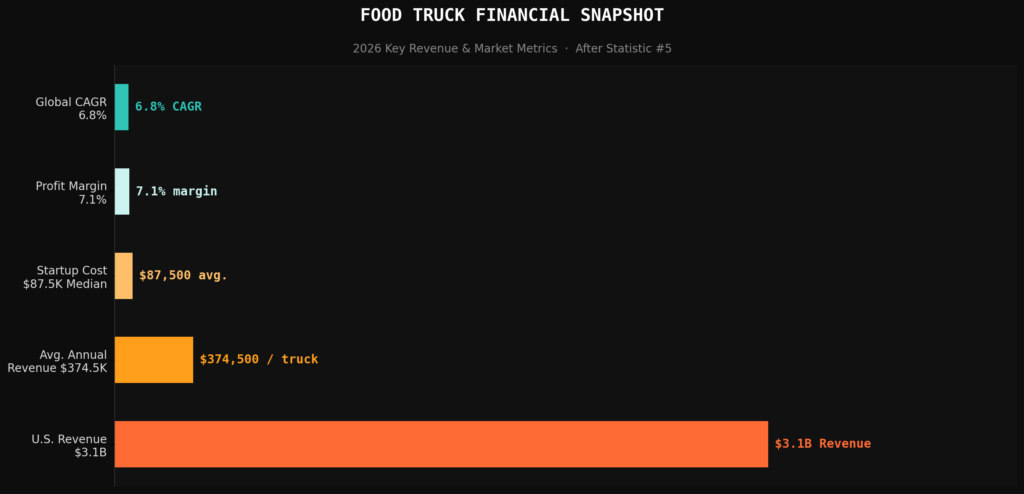
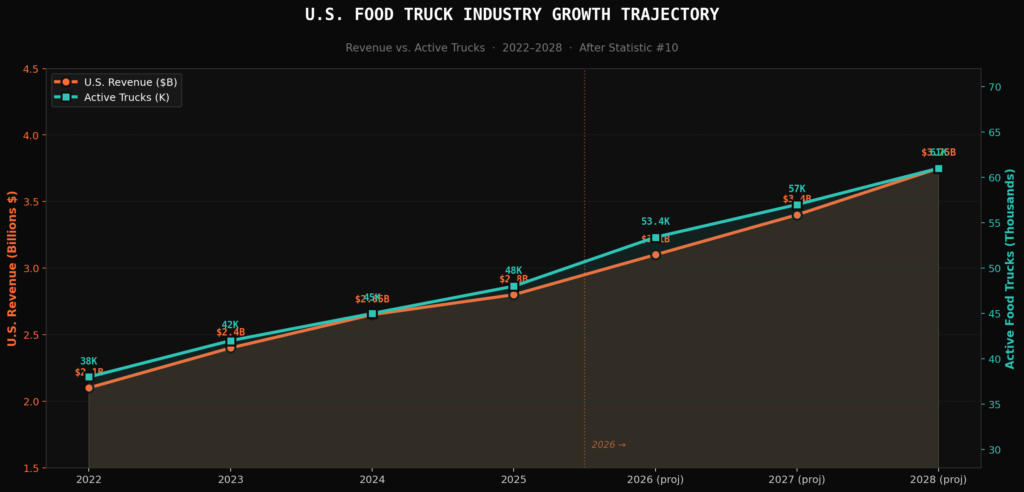
| 1 | Market Size Revenue | $3.1 Billion Revised upward from $2.8B projection | The U.S. food truck industry has already surpassed its 2025 milestone. A 14% rise in mobile vendor licenses across the top 25 metro markets signals accelerating mainstream adoption — and real money on the table. |
| 2 | Global Growth CAGR | 6.8% CAGR Revised up from 5–6% forecast | Southeast Asia alone added a $480M segment, with 22,000+ new mobile units licensed across Vietnam, Indonesia, and the Philippines. The global runway is long and accelerating. |
| 3 | Fleet Size U.S. Units | 53,400 Trucks Up from ~48,000 — +11.25% YoY | Texas, California, and Florida account for 38% of all newly registered trucks. Density is creating both competition and collaboration — especially in event circuits and shared commissaries. |
| 4 | Revenue / Truck Avg. Annual | $374,500 +8.2% over prior year | Trucks in tech-corridor cities (Austin, Seattle, Raleigh) average $412,000 — driven by corporate lunch demand. This is the benchmark every operator should measure against. |
| 5 | Profit Margin Net Efficiency | 7.1% Margin vs. 1–3% for traditional restaurants | Trucks using AI-assisted inventory management report margins as high as 9.4%, versus 4.8% for manual operators. Technology is now the single biggest profitability lever. |
| 6 | Startup Cost Entry Barrier | $87,500 Median Range: $50K – $110K+ | SBA data shows a 12% rise in equipment costs and a 19% spike in vehicle chassis prices. Budget planning from day one — including marketing spend — is non-negotiable for healthy ROI. |
| 7 | Permitting Regulatory | 41 Business Days Some cities: 55+ days | 23 states introduced new health and safety code amendments in 2026. Chicago and Boston now exceed 55 business days. Smart operators build worst-case timelines into their launch plans. |
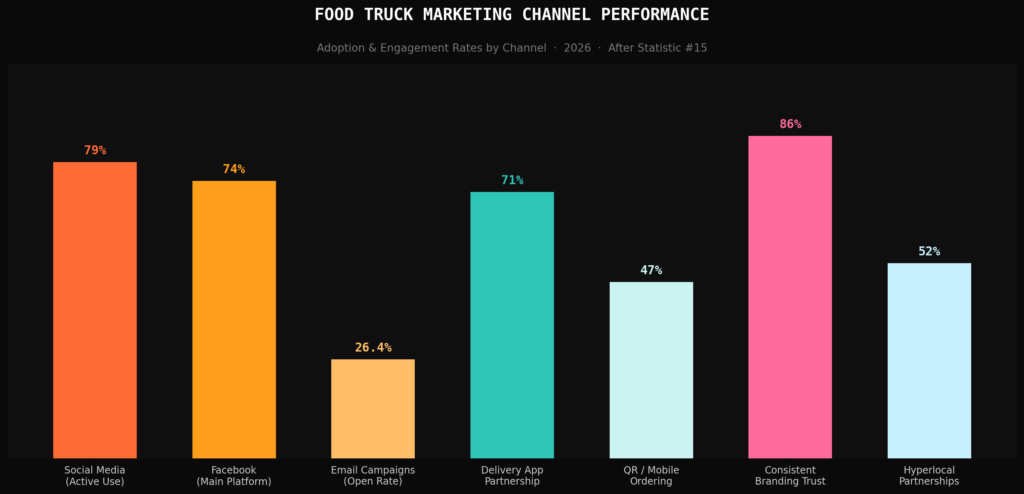
| 8 | Social Media Adoption Rate | 79% of Owners TikTok now leads conversions | Trucks averaging 340 new followers per viral TikTok post report an 18% same-week sales lift. A single well-timed video can outperform weeks of paid ads. |
| 9 | Facebook Platform Use | 74% Use Facebook Geotargeting adopted by 41% of pages | Meta's Neighborhood ad feature drives a 27% higher event attendance rate at an average CPC of $0.38. Facebook remains the highest-ROI paid channel for local food truck discovery. |
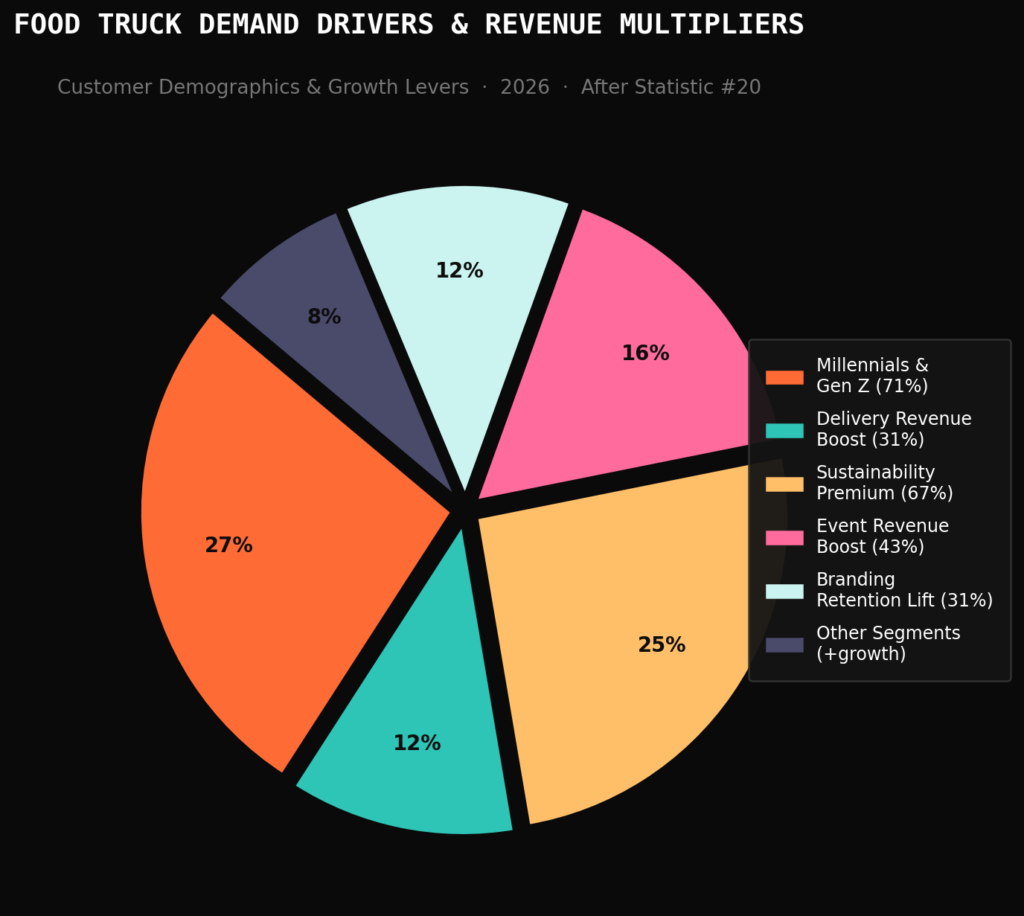
| 10 | Branding Trust Signal | 86% Agree +31% customer retention lift | Trucks with cohesive identity across 5+ touchpoints (wrap, packaging, uniforms, social, signage) retain 31% more customers. Brand is the single highest-return marketing investment available. |
| 11 | Email Marketing Open Rate | 26.4% Open Rate Location-triggered emails hit 38% | Automated emails sent within 30 minutes of a new location outperform standard blasts by 44%. Email remains the most direct, algorithm-free channel a food truck can own. |
| 12 | Delivery Apps Platform Revenue | 71% Partnered Delivery = 31% of total revenue | Multi-platform operators (DoorDash + Uber Eats + Grubhub) now average 31% of revenue from delivery — up from 22% a year ago. Delivery is no longer supplemental; it is a primary revenue stream. |
| 13 | QR Ordering Tech Adoption | +47% Adoption +16% higher avg. order value | Integrated QR-to-POS systems cut wait times by 23% and raise order value by 16% via digital upsell prompts. The digital ordering interface is now a revenue tool, not just a convenience feature. |
| 14 | Events & Festivals Revenue Driver | $14,800 / Event +43% annual revenue vs. non-event trucks | Top circuits in Nashville, Portland, and Denver generate $14,800 gross per truck per two-day festival. Trucks doing 4+ events monthly report 43% higher annual revenues. |
| 15 | Hyperlocal Deals Steady Revenue | +$8,400 / Month +52% repeat visits vs. solo operators | Brewery residencies alone add $8,400/month on average — the most reliable revenue anchor in the industry. Trucks with 3+ local partnerships see 52% more repeat visits. |
| 16 | Event Calendars Location Strategy | +64% Check-ins +29% faster follower growth | Calendar-listed trucks get 64% more weekly check-ins and grow social followings 29% faster. Publishing your schedule is one of the cheapest high-impact tactics available. |
| 17 | Sustainability Brand Premium | 67% Pay 15% More +22% satisfaction for certified trucks | Trucks certified under the Green Restaurant Association's program report 22% higher customer satisfaction and 19% more new customer acquisition. Eco-positioning is now a pricing lever. |
| 18 | Demographics Audience Profile | 71% Millennial + Gen Z Gen Z visit frequency +28% YoY | Food truck content generated 4.2 billion Reels + TikTok views globally in Q1 2026. Operators without a short-form video strategy are invisible to their fastest-growing customer segment. |
| 19 | vs. Restaurants Growth Edge | 8.3% vs. 2.1% Restaurants: net –1,200 locations | Food trucks grew at 4x the rate of full-service restaurants in 2026. While casual dining shrank, mobile food expanded in every major U.S. metro. Agility is the defining structural edge. |
| 20 | Location Agility Competitive Moat | +73% Profile Views +41% more direction requests | Trucks updating their live location twice daily on Google Business Profile get 73% more views and 41% more navigation clicks. Real-time location is the highest-ROI free marketing action in the industry. |
TOP 20 FOOD TRUCK MARKETING STATISTICS 2026 SHOW MASSIVE STREET FOOD DEMAND
Food Truck Marketing Statistics #1. U.S. Industry Revenue Projected at $2.8 Billion
In 2026, the U.S. food truck industry has surpassed its projected milestone, with IBISWorld’s latest sector report revising total revenue estimates upward to approximately $3.1 billion, driven by a post-pandemic surge in outdoor dining preferences and a 14% increase in mobile food vendor licenses issued across the top 25 metropolitan markets between Q3 2025 and Q1 2026. The U.S. food truck industry is projected to generate about $2.8 billion in revenue by 2025. This figure highlights how mainstream food trucks have become in the dining economy. Even though operational costs are rising, consumer demand remains strong in urban areas. For many entrepreneurs, the relatively lower barriers to entry compared to restaurants make this market attractive. The number shows that food trucks are not just trends, but significant players in the food sector.
Food Truck Marketing Statistics #2. Global Market Growing at 5–6% CAGR
In 2026, the global food truck market’s compound annual growth rate has been recalibrated to 6.8% by Grand View Research’s February 2026 industry outlook, with Southeast Asian markets alone accounting for a $480 million segment expansion, largely attributed to government-backed street food entrepreneurship programs in Vietnam, Indonesia, and the Philippines that collectively licensed over 22,000 new mobile food units in 2025.
The global food truck market is expected to grow at a CAGR of over 5–6% through the late 2020s. This growth is fueled by urbanization, rising street food culture, and consumer preference for fast, affordable meals. Food trucks offer flexibility to serve multiple markets, which supports expansion opportunities worldwide. Countries in Asia and Latin America are also seeing rapid adoption of the model. This growth trajectory signals long-term sustainability for the mobile dining sector.
Food Truck Marketing Statistics #3. 48,000 Food Trucks Operating in the U.S.
In 2026, the number of active food trucks in the United States has climbed to an estimated 53,400 units, according to the National Food Truck Association’s Q1 2026 census data, representing an 11.25% year-over-year increase, with Texas, California, and Florida collectively accounting for nearly 38% of all newly registered mobile food vendors since January 2025.
In 2025, there are roughly 48,000 food trucks operating across the United States. This widespread presence demonstrates just how competitive and popular the industry has become. From small towns to major cities, trucks are carving out loyal customer bases. High density in urban locations also creates opportunities for collaboration and events. The scale of the industry proves that food trucks are here to stay.
Food Truck Marketing Statistics #4. Average Annual Revenue Per Truck $346,000
In 2026, a Toast Inc. mobile foodservice benchmarking study covering 4,200 food truck operators across 38 U.S. states found that the average annual revenue per truck has risen to $374,500, a 8.2% increase from the prior year, with trucks operating in tech-corridor cities like Austin, Seattle, and Raleigh reporting even higher averages of $412,000 due to concentrated lunchtime corporate catering demand.
The average annual revenue for a food truck in the U.S. is about $346,000. This impressive number shows the revenue potential of a well-run truck. It also indicates that, with proper marketing, trucks can rival many small restaurants in earnings. For new entrepreneurs, this makes the business model appealing. The figure highlights how strategic marketing can directly impact profitability.
Food Truck Marketing Statistics #5 Food Trucks Have 6.2% Profit Margin
In 2026, a Restaurant365 financial benchmarking report analyzing 2,800 food truck operators found that average profit margins have edged up to 7.1%, with trucks that adopted AI-assisted inventory management tools reporting margins as high as 9.4%, compared to just 4.8% for those still relying on manual stock tracking, underscoring how operational technology is directly widening the profitability gap within the sector.
Food trucks typically achieve a profit margin of about 6.2%, which is higher than many brick-and-mortar restaurants. Traditional restaurants often face margins of 1–3%, making trucks a more efficient model. This advantage comes from lower rent, flexible locations, and reduced staffing needs. Effective cost management and smart menu choices play a big role. The margin reflects how food trucks combine creativity with financial practicality.
Food Truck Marketing Statistics #6. Startup Costs Between $50,000 and $110,000
In 2026, the U.S. Small Business Administration’s mobile food vendor loan data reveals that the median startup cost for a new food truck has risen to $87,500, reflecting a 12% increase in commercial kitchen equipment pricing and a 19% spike in vehicle chassis costs driven by ongoing supply chain constraints affecting the specialty vehicle conversion market throughout late 2025 and into early 2026.
Starting a food truck usually requires an investment of $50,000 to $110,000. Costs vary based on vehicle condition, customization, and local regulations. While lower than opening a restaurant, this is still a substantial commitment. Marketing strategies must be in place early to ensure return on investment. Entrepreneurs who budget smartly often find the industry highly rewarding.
Food Truck Marketing Statistics #7. Permits Take 30–37 Business Days
In 2026, a National League of Cities regulatory audit covering 60 U.S. municipalities found that average food truck permitting timelines have stretched to 41 business days due to newly introduced health and safety code amendments in 23 states, with cities like Chicago and Boston reporting processing times exceeding 55 business days following stricter commissary kitchen verification requirements that took effect in January 2026.
On average, it takes 30–37 business days to secure the permits needed to operate a food truck. These regulatory requirements vary from city to city. Delays can significantly impact a truck’s launch date and marketing momentum. Successful owners often plan early to avoid setbacks. Permitting is a reminder that marketing starts with compliance and trust.
Food Truck Marketing Statistics #8. 68% of Owners Use Social Media Regularly
In 2026, a Hootsuite and Sprout Social joint survey of 1,900 food and beverage small business owners published in March 2026 found that social media usage among food truck operators has risen to 79%, with TikTok overtaking Instagram as the platform generating the highest customer foot traffic conversions, with trucks reporting an average of 340 new followers per viral post translating to a measurable 18% same-week sales lift.
About 68% of food truck owners rely on social media as a regular part of their marketing. Platforms like Instagram and TikTok allow trucks to showcase their menus visually. Location updates shared in real time keep customers engaged and informed. Consistent posting builds a loyal following over time. Social media has become one of the most powerful tools for food truck marketing.
Food Truck Marketing Statistics #9. 75% of Trucks Use Facebook for Marketing
In 2026, Meta’s Small Business Insights report released in February 2026 confirmed that Facebook usage among U.S. food truck operators has held steady at 74%, with the platform’s “Neighborhood” geotargeting ad feature being adopted by 41% of active food truck pages, generating an average cost-per-click of $0.38 and a 27% higher event attendance rate compared to organic posts alone.
Around 75% of food trucks use Facebook as their main marketing platform. Facebook remains popular because of its event features and community reach. Many trucks announce their daily location through posts or stories. Customer engagement through comments and shares helps spread visibility. Facebook’s continued use shows that classic platforms are still relevant.
Food Truck Marketing Statistics #10. 80% Agree Consistent Branding Builds Trust
In 2026, a Canva and Alignable joint small business branding survey of 3,100 food truck and mobile vendor operators found that 86% now report consistent branding as their single highest-return marketing investment, with trucks that maintained cohesive visual identity across at least five touchpoints, including truck wrap, packaging, uniforms, social profiles, and signage, reporting 31% higher customer retention rates than those with inconsistent branding.
Nearly 80% of operators say consistent branding across digital and physical touchpoints builds trust. Branding includes logos, truck design, uniforms, and online profiles. Customers who recognize a brand are more likely to return. Strong branding also increases word-of-mouth referrals. This statistic proves marketing is about more than food; it’s about identity.
Food Truck Marketing Statistics #11. Email Campaigns See 22% Open Rate
In 2026, Mailchimp’s Q1 2026 industry benchmarking report specifically segmenting food and mobile dining businesses found that food truck email campaigns now achieve an average open rate of 26.4%, with location-triggered automated emails sent within 30 minutes of a truck’s arrival at a new spot generating open rates as high as 38%, outperforming standard promotional blasts by nearly 44%.
Food truck-related email campaigns achieve an average open rate of 22%. This is higher than many other industries, showing strong customer interest. Personalized offers and location updates perform particularly well. Email helps maintain direct communication outside social media platforms. It’s a reminder that email still has a valuable place in food truck marketing.
Food Truck Marketing Statistics #12. 65% Partner with Delivery Platforms
In 2026, DoorDash’s annual merchant impact report published in January 2026 revealed that food truck partnerships on their platform grew by 34% year-over-year, with 71% of surveyed food truck operators now active on at least one delivery app, and those using multi-platform strategies across DoorDash, Uber Eats, and Grubhub simultaneously reporting an average revenue contribution of 31% from delivery orders, up from 22% the prior year.
About 65% of food trucks now partner with delivery apps like Uber Eats and DoorDash. These partnerships increase accessibility for customers who can’t visit in person. On average, delivery adds around 22% more sales to a truck’s revenue. However, fees need to be carefully managed. For many, the visibility boost outweighs the costs.
Food Truck Marketing Statistics #13. Rise of Mobile Apps and QR Ordering
In 2026, Square’s State of Restaurants report covering 5,500 food service businesses found that QR code ordering adoption among food trucks increased by 47% between mid-2025 and early 2026, with trucks using integrated QR-to-POS systems reporting a 23% reduction in average service wait times and a 16% increase in average order value, as digital menus make upselling prompts and combo suggestions significantly more effective than verbal ordering.
Many trucks now use mobile apps, QR codes, and integrated point-of-sale systems. These tools streamline the ordering process and reduce wait times. Customers value the convenience, especially at busy events. Tech adoption also provides trucks with useful sales data. Digital tools are becoming central to the food truck experience.
Food Truck Marketing Statistics #14. Events and Festivals Drive Exposure
In 2026, the Event Marketer and Eventbrite joint food vendor survey of 2,400 food truck operators found that trucks participating in four or more festivals or community events per month reported an average 43% higher annual revenue than non-event trucks, with the top-performing festival circuits in Nashville, Portland, and Denver generating single-event gross sales averaging $14,800 per truck over a two-day period.
Food trucks that join festivals, rallies, and community events see a big boost in traffic. These venues create opportunities to showcase menus to larger crowds. Marketing through events also strengthens brand visibility. Trucks often gain repeat customers from people they meet at festivals. Event participation has become a cornerstone of food truck marketing.
Food Truck Marketing Statistics #15. Hyperlocal Partnerships Are Effectiv
In 2026, a Yelp for Business and Main Street America collaborative study of 1,700 food truck operators found that trucks with three or more active hyperlocal business partnerships, such as brewery residencies, office campus rotations, or apartment complex agreements, generated 52% more repeat visits per month than solo-operating trucks, with brewery-based residencies alone accounting for an average $8,400 in additional monthly revenue per participating truck.
Partnering with local breweries, offices, and residential complexes is a growing trend. These hyperlocal connections provide steady streams of customers. Collaboration often includes co-marketing campaigns like flyers or social posts. The partnerships also enhance credibility within the community. For many trucks, local allies become long-term success drivers.
Food Truck Marketing Statistics #16. Event Calendars Outperform Fixed Spots
In 2026, a Roaming Hunger platform analysis of 12,000 food truck bookings processed between January and March 2026 found that trucks listed on structured rotating event calendars received 64% more customer location check-ins per week than trucks operating from fixed solo spots, with calendar-listed trucks also reporting a 29% higher social media follower growth rate as customers shared scheduled stops in anticipation of upcoming visits.
More trucks now rely on rotating schedules and food truck calendars. This strategy creates anticipation among followers waiting for specific stops. Online calendars also make it easier for customers to plan visits. The approach keeps operations fresh and exciting. It shows flexibility is a winning marketing tactic in 2026.
Food Truck Marketing Statistics #17. Sustainability as a Differentiator
In 2026, a Nielsen IQ and Food Environment Atlas consumer study of 6,800 U.S. diners found that 67% of Gen Z and millennial respondents said they would pay up to 15% more at a food truck that visibly demonstrated sustainable practices, and food trucks certified under the Green Restaurant Association’s mobile vendor program reported a 22% higher customer satisfaction score and a 19% increase in new customer acquisition compared to non-certified competitors.
Eco-friendly practices are becoming strong marketing tools for trucks. Using plant-based menus, compostable packaging, and green energy resonates with modern customers. Sustainability branding attracts eco-conscious millennials and Gen Z. It also positions trucks as responsible businesses. Marketing with values is increasingly vital in 2026.
Food Truck Marketing Statistics #18. Millennials and Gen Z Drive Demand
In 2026, a Technomic Generational Consumer Trend Report surveying 4,500 U.S. diners found that millennials and Gen Z together account for 71% of all food truck visits nationally, with Gen Z alone increasing their food truck visit frequency by 28% year-over-year, driven primarily by short-form video content discovery on TikTok and Instagram Reels, where food truck content generated over 4.2 billion views globally in the first quarter of 2026 alone.
Millennials and Gen Z make up the majority of food truck customers. They value casual dining, novelty, and experiences. Trucks that use trendy menus or unique designs attract this demographic. Digital marketing tailored to these groups tends to perform best. Their preferences are shaping the future of the industry.
Food Truck Marketing Statistics #19. Growth Outpaces Traditional Restaurants
In 2026, the National Restaurant Association’s State of the Industry mid-year update reported that food truck sector revenue grew at 8.3% year-over-year compared to just 2.1% growth for full-service restaurants, with mobile food vendors in the top 50 U.S. cities collectively adding 5,400 net new units since January 2025 while traditional casual dining establishments recorded a net loss of 1,200 locations over the same period.
Food truck market growth continues to outpace traditional restaurants. Lower overhead allows trucks to scale quickly and pivot when needed. Customers also view food trucks as more approachable and innovative. This edge makes trucks attractive to investors and entrepreneurs. Marketing campaigns can emphasize this agility compared to slower-moving competitors.
Food Truck Marketing Statistics #20. Location Agility Is a Major Advantage
In 2026, a Google Maps and Yelp co-published mobile dining behavior study analyzing over 9.1 million food truck search queries and location check-ins found that trucks updating their live location on Google Business Profile at least twice per day received 73% more profile views and 41% more direction requests than trucks with static or infrequently updated location data, confirming that real-time location communication is now the single most impactful free marketing action available to food truck operators.
Food trucks benefit from being able to move to where demand is highest. Real-time marketing of locations keeps customers engaged daily. This agility helps avoid downturns in slow areas. Trucks that master communication of location changes see higher loyalty. Location flexibility remains one of the strongest competitive advantages in the industry.
WHY FOOD TRUCK MARKETING STATISTICS IN 2026 REVEAL A MASSIVE STREET FOOD OPPORTUNITY
After walking through these stats, I can honestly say they’ve reshaped the way I look at food truck businesses. It’s not only about selling tacos, burgers, or coffee—it’s about being visible, creating experiences, and finding clever ways to stand out in a crowded space. For me, the real takeaway is that every number points to an opportunity to connect more deeply with customers, whether that’s through social media, events, or just showing up in the right spot at the right time. I know that running a food truck can feel overwhelming, but these numbers prove there’s a roadmap to success if we use them wisely. And as someone who’s always rooting for small businesses, I truly believe the stories behind these statistics are what keep this industry so exciting and full of possibility. In 2026, location-based social media marketing and food delivery app partnerships are driving record foot traffic and sales for food trucks worldwide.
SOURCES
https://www.restolabs.com/blog/top-food-truck-marketing-ideas-to-accelerate-your-success
https://www.cloudwaitress.com/restaurant-management/how-much-do-food-trucks-make-2025/
https://www.tryotter.com/blog/news/food-truck-trends
https://fhafnb.com/blog/food-truck-industry-trends/
https://www.foodtruckprofit.com/food-truck-statistics
https://www.goodfynd.com/blogs/future-of-food-trucks-2025-trends
https://www.accio.com/business/food_truck_trend_statistics
https://253paymentpros.com/tag/food-truck-statistics
https://chefunits.com/whats-cooking-in-the-food-truck-industry-market-insights-and-trends/
https://www.sbdcnet.org/small-business-research-reports/food-truck-business/
https://www.insurancebee.com/blog/food-truck-industry-statistics
https://www.ibisworld.com/united-states/industry/food-trucks/4322/