



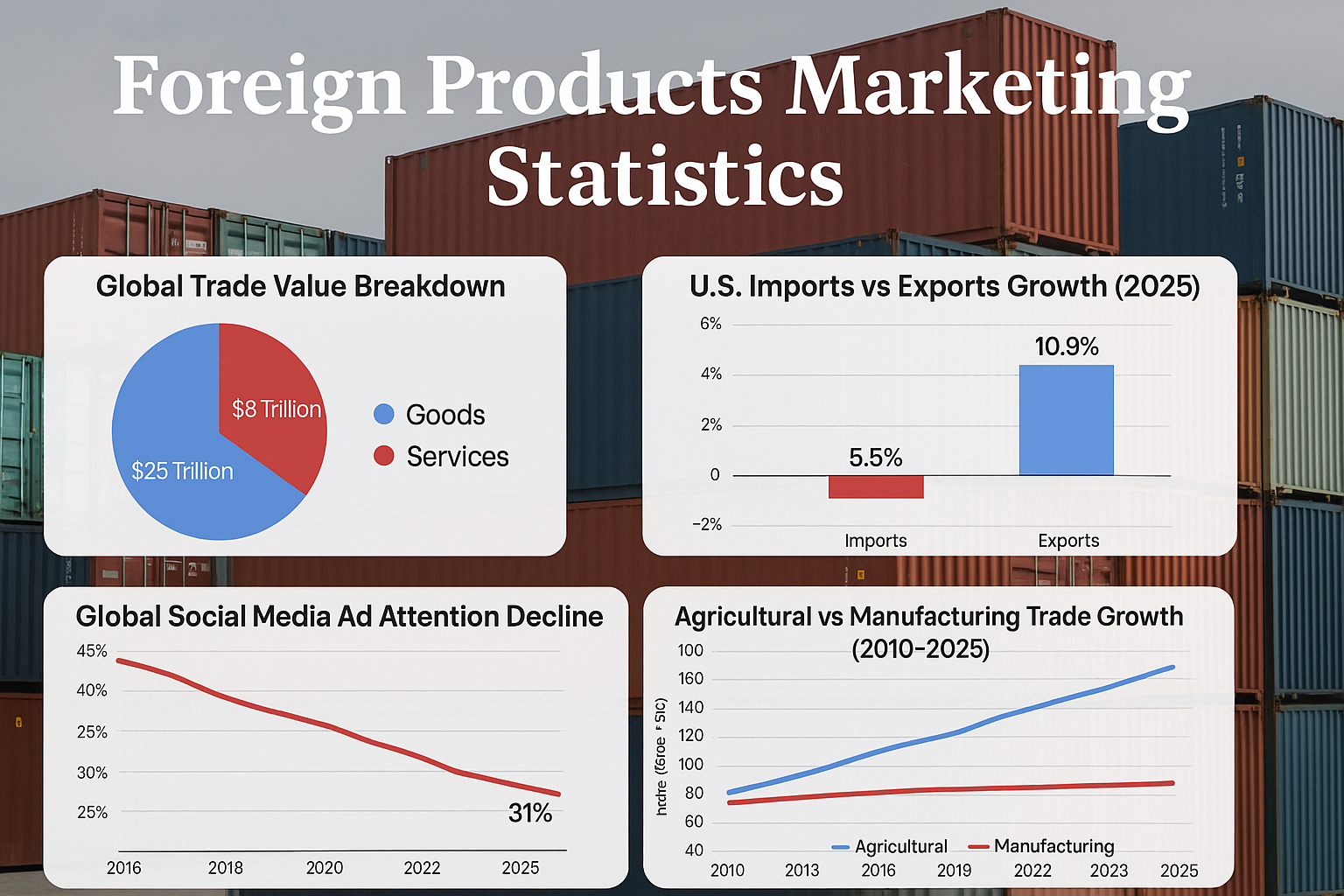
20 Sep TOP 20 FOREIGN PRODUCTS MARKETING STATISTICS 2025
In today’s fast-paced global marketplace, businesses can no longer afford to ignore the growing influence of international trade and consumer demand across borders. That’s why understanding foreign products marketing statistics is more important than ever — they reveal how shifting trade flows, consumer sentiment, and branding trends are reshaping the way companies compete. From luxury goods in Asia to consumer boycotts driven by politics, the data highlights both opportunities and risks for brands seeking global recognition. Drawing from years of experience, a marketing agency in New York has seen firsthand how these insights guide smarter campaigns that truly connect with diverse audiences. By looking closely at these numbers, brands can craft strategies that feel both authentic and future-proof in a changing world.
Top 20 Foreign Products Marketing Statistics 2025 (Editor’s Choice)
| # | Foreign Products Marketing Statistics 2025 | Key Insight |
|---|---|---|
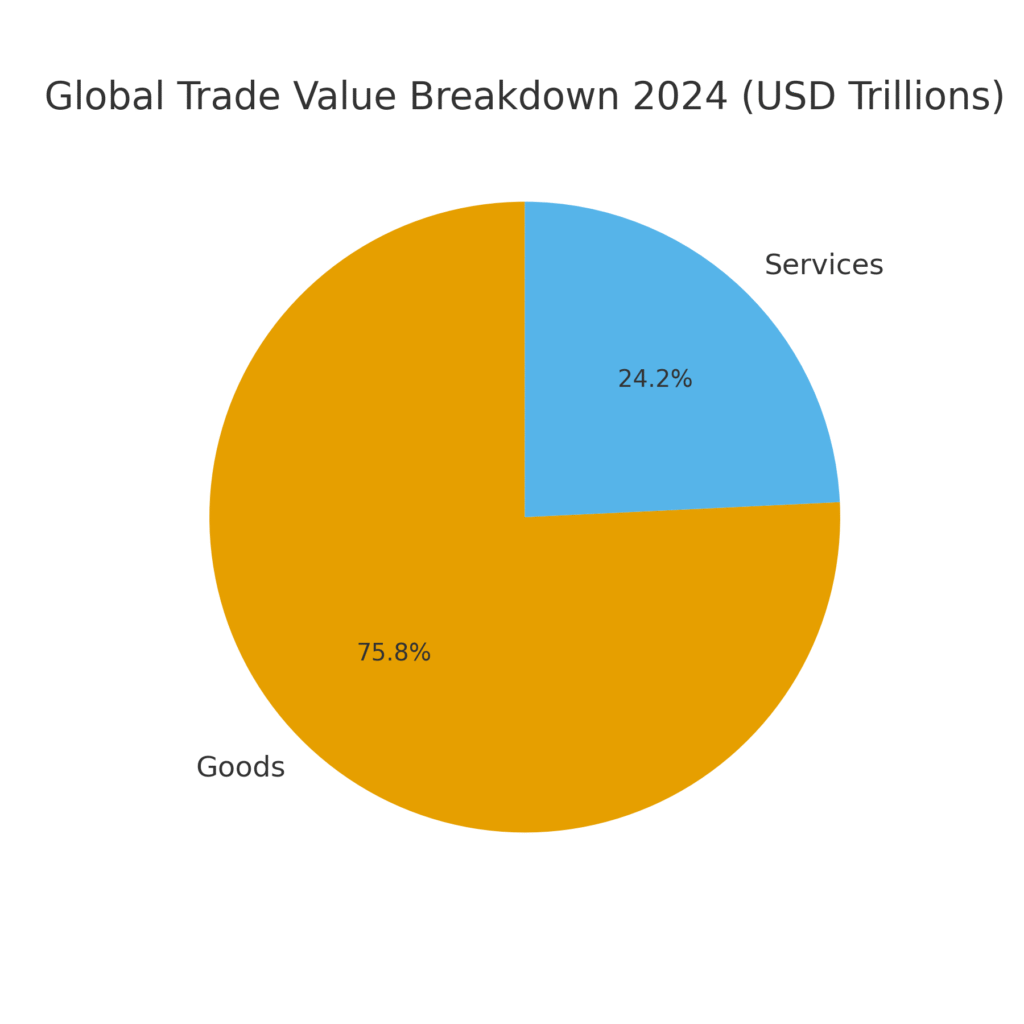
| 1 | Global trade value reached $33 trillion in 2024 | Goods ~$25T, services ~$8T dominate the market. |
| 2 | Trade volumes more volatile post-pandemic | Geopolitics and inflation drive fluctuations. |
| 3 | Trade-to-GDP ratio stabilized but declined | Earlier growth has slowed in recent years. |
| 4 | Shift toward near-shoring | Regional trade outpaces far-shoring models. |
| 5 | Diversification of trade networks | Smaller economies gain importance. |
| 6 | India & China drive export growth | India’s share of global trade rises steadily. |
| 7 | Trade imbalances remain large | Peaked in 2022, still significant in 2025. |
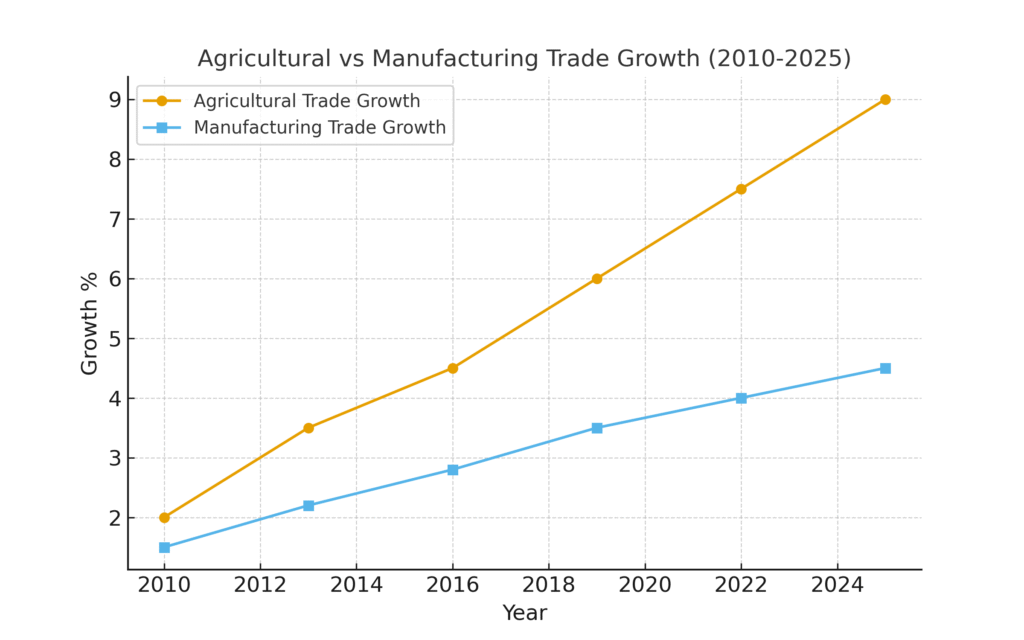
| 8 | Agricultural trade outpaces manufacturing | Food exports expand faster than goods. |
| 9 | Pandemic habits shape global demand | Convenience & digital shopping stay strong. |
| 10 | Streaming video dominates ad spend | Broadcast TV declining in priority. |
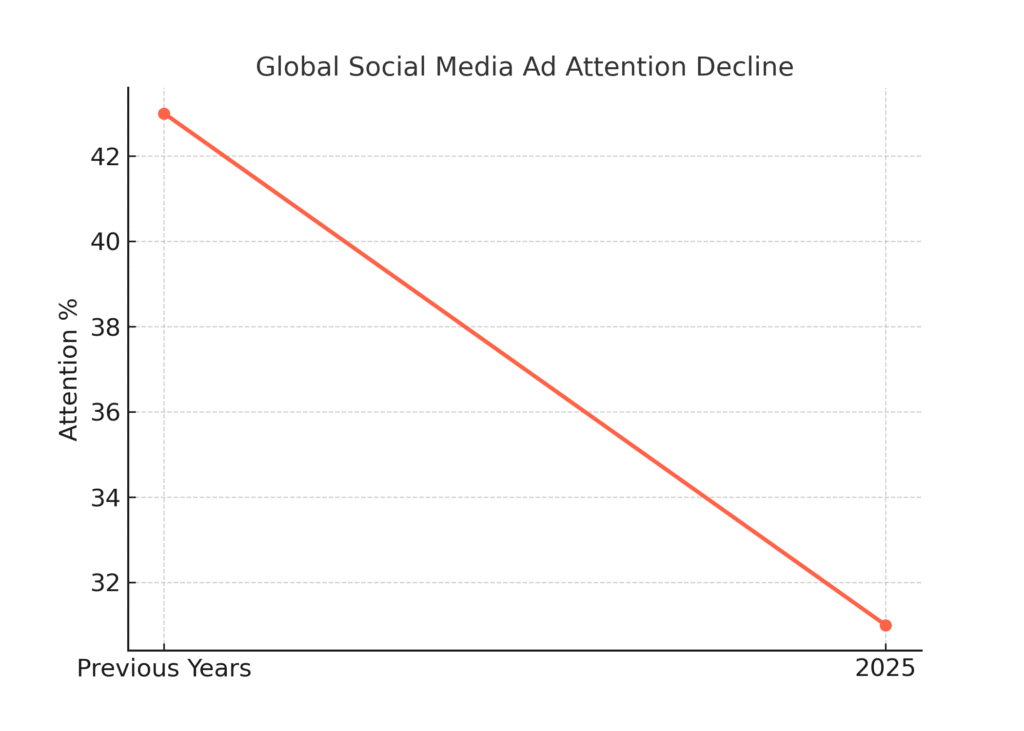
| 11 | Ad attention on social media drops to 31% | Creativity matters more than placement. |
| 12 | 80% consumers willing to boycott foreign brands | Country of origin plays a big role. |
| 13 | Brand origin perception affects trust | Politics and diplomacy influence buying. |
| 14 | Rise of local/niche luxury brands in Asia | Craftsmanship valued over foreign heritage. |
| 15 | Value retention preferred over trendiness | Timeless designs win loyalty in luxury. |
| 16 | Emerging market brands expand globally | China invests heavily in global branding. |
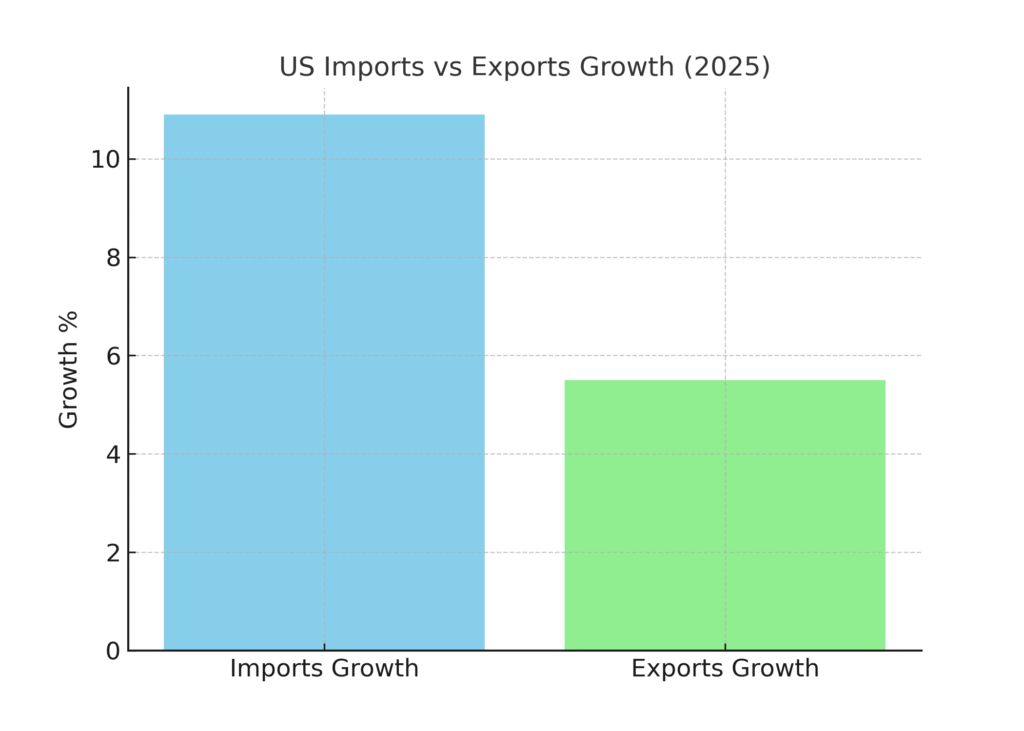
| 17 | US imports rose 10.9% vs 5.5% exports in 2025 | Trade gap widens for advanced economies. |
| 18 | Services trade steadily rising | Digital services play a bigger role. |
| 19 | Consumer trust tied to brand ethics | Sustainability & values influence loyalty. |
| 20 | Marketing spend focuses on video & experiences | Traditional channels face budget cuts. |
Top 20 Foreign Products Marketing Statistics 2025
Foreign Products Marketing Statistics #1 – Global Trade Value Reached $33 Trillion In 2024
Global trade hit a record $33 trillion in 2024, highlighting just how interconnected today’s economy has become. Out of this, about $25 trillion came from goods and another $8 trillion from services. These numbers show that foreign products remain the backbone of international markets. For businesses, it means new opportunities to expand across borders but also stronger competition. Understanding this scale helps marketers frame strategies that resonate in a global marketplace.
Foreign Products Marketing Statistics #2 – Trade Volumes More Volatile Post-Pandemic
Since the pandemic, trade volumes have experienced more ups and downs than in previous decades. Geopolitical issues, inflation, and supply chain disruptions have created instability in the movement of foreign goods. For brands, this means marketing campaigns need to be more adaptive to sudden changes in supply and demand. Consumers also feel this volatility, often facing fluctuating prices. Being transparent with customers during these shifts can actually build long-term trust.
Foreign Products Marketing Statistics #3 – Trade-To-GDP Ratio Stabilized But Declined
The trade-to-GDP ratio, which measures global integration, has stabilized but is lower than before. This means trade is still massive but not expanding as fast compared to overall GDP growth. For foreign brands, this can signal more cautious global expansion. Marketing strategies now must focus on efficiency and smarter targeting rather than just rapid growth. It also underlines the importance of measuring ROI in cross-border campaigns.
Foreign Products Marketing Statistics #4 – Shift Toward Near-Shoring
Near-shoring is becoming more popular, with countries trading more with nearby partners rather than faraway ones. This trend reduces transportation costs and makes supply chains more resilient. For foreign product marketing, this shift means regional branding strategies may outperform global, one-size-fits-all campaigns. Consumers often feel more connected to nearby markets, even when products are technically foreign. Marketers should highlight speed, reliability, and regional authenticity to succeed.
Foreign Products Marketing Statistics #5 – Diversification Of Trade Networks
Trade is becoming less concentrated in just a few big economies, giving smaller nations a bigger role. This means foreign products from emerging markets are gaining traction globally. For marketers, the rise of diverse suppliers and exporters opens opportunities for fresh storytelling. Highlighting authenticity, uniqueness, and cultural value can make foreign goods stand out. Brands that embrace this shift can build meaningful connections with niche but growing audiences.
Foreign Products Marketing Statistics #6 – India & China Drive Export Growth
India and China continue to dominate global exports with strong year-over-year growth. India’s share in international trade has increased steadily, adding weight to its global influence. For marketers of foreign products, these regions are both major opportunities and major competitors. Consumers worldwide are seeing more “Made in China” and “Made in India” products in their daily lives. The challenge is positioning products in ways that emphasize quality, trust, and cultural connection.
Foreign Products Marketing Statistics #7 – Trade Imbalances Remain Large
Despite efforts to balance imports and exports, trade imbalances remain a major global issue. Some countries import far more than they export, while others have the reverse. For businesses, this can influence consumer sentiment about foreign goods, sometimes creating backlash. Marketing teams must be aware of these sensitivities when entering new markets. Balancing messaging around affordability, quality, and national identity is essential.
Foreign Products Marketing Statistics #8 – Agricultural Trade Outpaces Manufacturing
Agricultural exports are growing faster than manufacturing products worldwide. Consumers are demanding more foreign food and raw goods, reflecting lifestyle changes and cultural curiosity. For marketers, food and agricultural brands can benefit from emphasizing freshness, sustainability, and authenticity. People are often more willing to try foreign foods compared to foreign electronics or machinery. This creates an opening for campaigns that combine tradition with innovation.
Foreign Products Marketing Statistics #9 – Pandemic Habits Shape Global Demand
Consumer habits formed during the pandemic, such as online shopping and valuing convenience, remain strong. These shifts influence demand for foreign products purchased through digital platforms. Brands need to highlight ease of access and delivery when marketing internationally. Transparency in shipping times and returns is now a selling point. Companies that adapt quickly to these lasting habits win long-term loyalty.
Foreign Products Marketing Statistics #10 – Streaming Video Dominates Ad Spend
Streaming platforms now attract the majority of advertising investment worldwide. For foreign product marketers, this is the best space to reach global audiences. Broadcast TV is declining in importance, especially among younger demographics. Brands need to create compelling, localized video ads that travel well across regions. Storytelling on digital platforms is becoming the most powerful way to promote foreign products.
Foreign Products Marketing Statistics #11 – Ad Attention On Social Media Drops To 31%
Attention to ads on social media has dropped to just 31% globally, compared to over 40% in earlier years. This means audiences are more selective and harder to engage. For foreign products, creativity and authenticity are the only ways to cut through the noise. Simple, repetitive ads no longer work for international audiences. Marketers need to prioritize content that sparks genuine connection.
Foreign Products Marketing Statistics #12 – 80% Of Consumers Willing To Boycott Foreign Brands
Surveys show that nearly 80% of people are willing to boycott brands because of their country of origin. This presents a serious challenge for foreign marketers. Political tensions and cultural biases can heavily impact sales. Brands must invest in transparency and responsible messaging to avoid backlash. Trust and values are as important as quality in today’s market.
Foreign Products Marketing Statistics #13 – Brand Origin Perception Affects Trust
The country where a brand originates significantly shapes consumer trust. Diplomatic relations and national reputation often carry over into brand perception. For marketers, this means highlighting product benefits alone may not be enough. Companies must also address the “story” of their brand origin. Successful campaigns connect brand heritage with values that matter globally.
Foreign Products Marketing Statistics #14 – Rise Of Local/Niche Luxury Brands In Asia
Asian consumers are increasingly shifting toward local or niche luxury brands. This is challenging the dominance of European and American labels. For marketers, foreign luxury products must emphasize exclusivity and emotional storytelling to compete. Highlighting craftsmanship and legacy can still resonate strongly. The luxury market is becoming less about heritage alone and more about cultural fit.
Foreign Products Marketing Statistics #15 – Value Retention Preferred Over Trendiness
Consumers, especially in Asia, value products that retain worth over time rather than quick trends. This preference makes luxury buyers focus on timelessness. For foreign product marketers, campaigns must highlight durability, investment value, and elegance. Fast fashion strategies may not work in these markets. Positioning goods as assets rather than fleeting purchases builds stronger appeal.
Foreign Products Marketing Statistics #16 – Emerging Market Brands Expand Globally
Brands from emerging markets, especially China, are gaining ground internationally. They are entering Latin America, Southeast Asia, and the Middle East with aggressive strategies. For traditional foreign brands, this means more competition than ever. Creative global campaigns are essential to stand out. Highlighting authenticity and differentiating values is the only way to sustain growth.
Foreign Products Marketing Statistics #17 – US Imports Rose 10.9% Vs 5.5% Exports In 2025
The U.S. recorded a sharp rise in imports compared to exports in 2025. This widened the trade gap and reflects shifting consumer demand for foreign products. For marketers, this is a reminder of the strong appetite for international goods in the U.S. Positioning foreign products as premium, accessible, or innovative can work especially well. The U.S. remains one of the most lucrative markets for global brands.
Foreign Products Marketing Statistics #18 – Services Trade Steadily Rising
While goods dominate trade, services are rising as a powerful global export. This includes digital platforms, remote work services, and creative industries. For marketers, foreign services require a slightly different approach than goods. Campaigns should emphasize expertise, efficiency, and reliability. The growing demand for services opens doors for businesses that want a global footprint without physical goods.
Foreign Products Marketing Statistics #19 – Consumer Trust Tied To Brand Ethics
Today’s consumers place as much importance on ethics and sustainability as product quality. This has direct effects on how foreign products are marketed. Brands need to show accountability and align with global values. Stories about fair trade, eco-friendly practices, and inclusivity carry significant weight. Ethical positioning is no longer optional — it’s expected.
Foreign Products Marketing Statistics #20 – Marketing Spend Focuses On Video & Experiences
Companies are shifting budgets toward video campaigns and immersive experiences. Traditional channels like print and radio are losing investment. For foreign product marketing, digital-first strategies are essential to connect across regions. Interactive storytelling can make products more relatable to international consumers. The future of marketing lies in engaging, memorable, and multimedia-driven campaigns.
Why These Numbers Matter to You
At the end of the day, statistics are only valuable if we know how to act on them. These foreign products marketing statistics remind us that while global trade is massive, consumer trust, perception, and cultural nuance can make or break a brand’s success. Whether you’re a growing business or an established name, the trends tell a very human story: people want products that align with their values, that feel relatable, and that respect their local context. The smartest brands use this knowledge not just to sell, but to build lasting relationships. If you take these lessons to heart, you’ll find that your marketing campaigns don’t just reach international markets — they resonate with them
SOURCES
- https://www.bea.gov/news/2025/us-international-trade-goods-and-services-july-2025 (Bureau of Economic Analysis)
- https://www.wto.org/english/res_e/booksp_e/trade_outlook25_e.pdf (World Trade Organization)
- https://unctad.org/statistics (UNCTAD)
- https://unctad.org/publication/global-trade-update-march-2025 (UNCTAD)
- https://www.trade.gov/trade-data-analysis (Trade.gov)
- https://www.kantar.com/campaigns/marketing-trends (Kantar)
- https://www.intracen.org/resources/data-and-analysis/trade-statistics (International Trade Centre)
- https://www.smartinsights.com/social-media-marketing/social-media-strategy/new-global-social-media-research/ (Smart Insights)
- https://www.hubspot.com/marketing-statistics (HubSpot)
- https://data.imf.org/en/datasets/IMF.STA%3AIMTS (IMF Data)
- https://wits.worldbank.org/countrystats.aspx?lang=en (World Integrated Trade Solution)
- https://www.census.gov/foreign-trade/ (Census.gov)
- https://www.ft.com/content/da3f9dd0-579b-4496-b657-ebbe81b43e4a (Financial Times)