



28 Jul From Solo Creator to Employer: What Influencers Need Before Hiring a Team
At Amra and Elma, I have sat across the table from more influencers than I can count, and I can always tell the exact moment they’ve hit the wall. It’s not a dramatic moment. There’s no single viral post that breaks them. It’s smaller than that. It’s the third night in a row they’re still editing at 1 a.m. It’s the brand deal they had to turn down because they simply didn’t have the bandwidth to deliver it well. It’s the invoice they forgot to send until a client had to remind them.
I’ve built Amra & Elma around exactly this transition point, because it’s the single most dangerous and most lucrative moment in a creator’s career. Dangerous, because most people mishandle it so badly they either burn out or bury themselves in legal and financial trouble. Lucrative, because the creators who get it right are the ones who stop trading hours for dollars and start building something that actually has enterprise value.
So I want to walk you through exactly what I tell creators when they come to me asking, “How do I know I’m ready to hire?” Some of this is going to sound obvious. Most of it is not. And a few of these are things I genuinely wish someone had told me before I made my own first hire.
From Solo Creator to Employer: What Influencers Need Before Hiring a Team
The Wall Doesn’t Announce Itself, So You Have to Go Looking for It
The Creator-to-Employer Readiness Index
Are you actually ready to hire?
Tap each item you've genuinely done. This tracks the same seven checkpoints I walk every client through before they post a job listing.
Here’s the first secret: by the time you *feel* ready to hire, you’re already about three months late. Overwhelm is a lagging indicator. If you wait until you’re drowning to start the hiring process, you’re going to make a rushed, panicked decision, and rushed hiring decisions are the ones that go wrong.
The creators I work with who scale the fastest do something almost nobody else does voluntarily: they track their own time like it’s a client project, before they’re desperate. For one full week, write down literally everything. Not “content creation.” Break it down. Scripting. Filming. Editing. Thumbnail design. Caption writing. Answering DMs. Reconciling brand deal invoices. Scheduling posts. Reading contracts. Every single task, timestamped.
What happens next is almost always the same. The creator expects to discover that content creation itself is the bottleneck. It almost never is. What actually eats the week alive is the invisible admin layer sitting underneath the content: the emailing, the invoicing, the calendar Tetris, the endless back-and-forth with brand teams about usage rights and deliverable specs. That’s the layer that quietly kills momentum, and it’s usually the layer nobody thinks to delegate first because it doesn’t feel “creative” enough to matter.
This is the actual secret to a good first hire: it is almost never a co-creator. It’s almost always someone who takes the administrative weight off your shoulders so the hours you do spend creating are actually protected. I’ve watched creators hire a “creative partner” as their first move and regret it within two months, because they were still doing 90% of the invisible work anyway — they just now also had to manage someone else’s creative opinions on top of it.
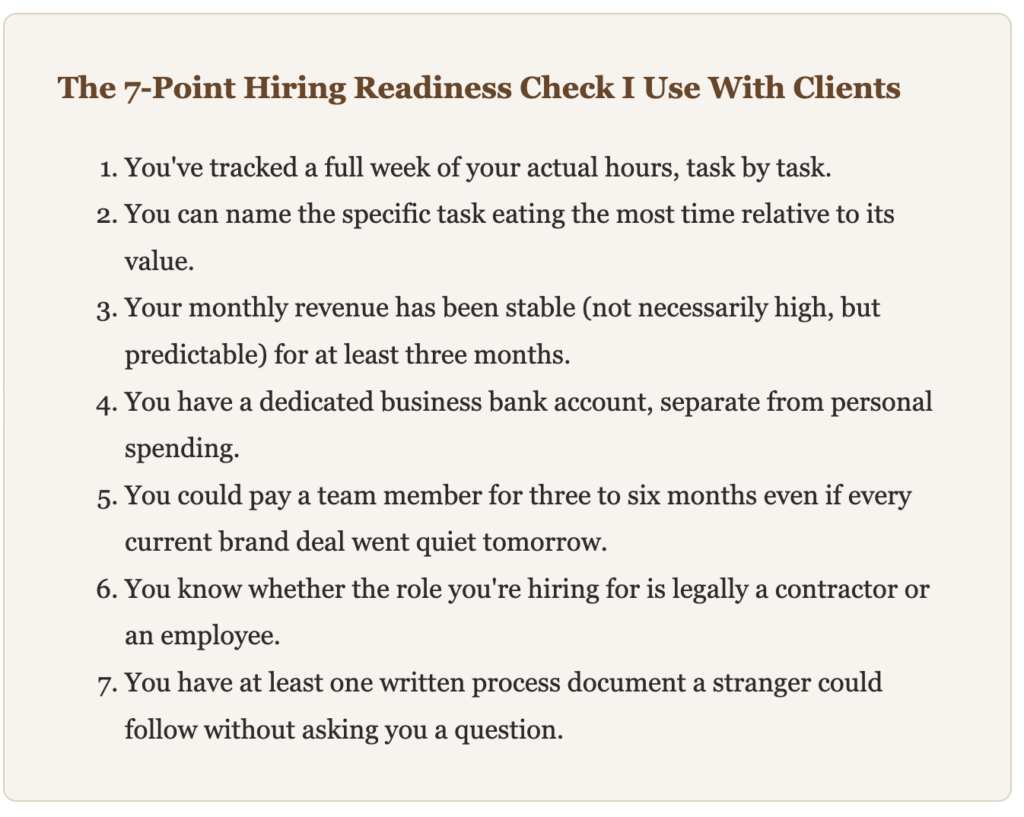
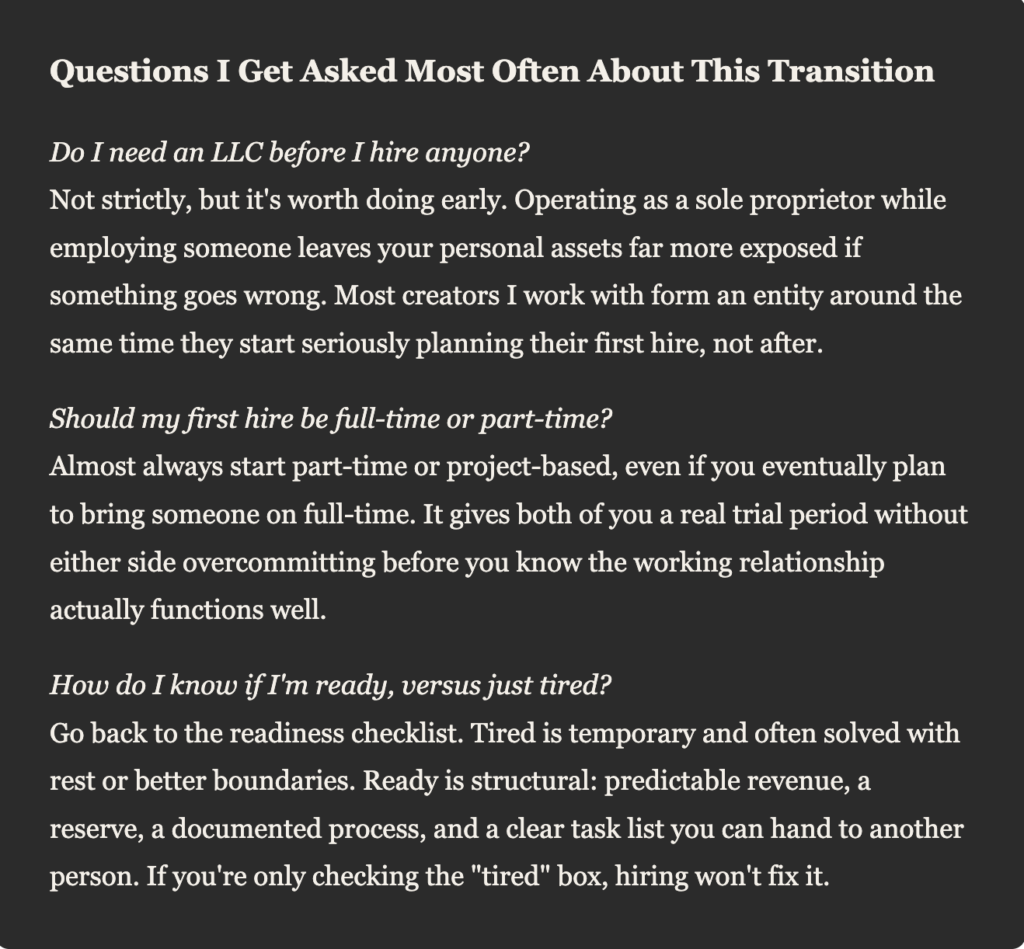
If you can only check two or three of those boxes, that’s fine — it just means you’re not hiring yet, you’re preparing to hire. And that preparation phase is where the real work happens.
The Money Secret Nobody Wants to Say Out Loud
Here’s something I tell every creator, and it usually lands harder than they expect: brand deal income is some of the least reliable income in existence, and you’re about to build a fixed cost structure on top of it.
Brand partnerships routinely pay on net-30 or net-60 terms. Some stretch to net-90 if you’re dealing with a large enterprise procurement department, which, trust me, happens more than people think once you start working with bigger names. Meanwhile, your editor or your assistant expects to be paid on the 1st and the 15th, full stop, regardless of what your biggest client is doing with their accounts payable department.
This mismatch is where I’ve seen otherwise smart, talented creators get into real trouble. They land one big deal, see the number in the contract, and immediately go hire two people, assuming the cash flow will “figure itself out.” It rarely does, at least not on the timeline you need it to. When you become an employer, your team gets paid first. Before you take a draw for yourself. Before you reinvest in equipment. Before anything. That’s not a suggestion, that’s the actual legal and ethical baseline of running a payroll.
So before I let a client even post a job listing, I make them do three things:
First, open a dedicated business account if they haven’t already. I’m still surprised by how many six and seven-figure creators are running their entire business out of a personal checking account. It muddies your taxes, it muddies your actual profitability, and it makes it nearly impossible to answer the simple question of “can I afford this hire” with real confidence.
Second, calculate a true average monthly revenue number, looking back at least six months, not just your best month. Creators love to budget off their best month. Their best month is not their baseline. Their baseline is closer to their worst three months averaged together.
Third, build a reserve. I tell clients to aim for three to six months of full operating expenses, including the new hire’s pay, sitting untouched in that business account before extending an offer. It feels conservative. It is conservative. It’s also the difference between weathering a slow quarter gracefully and having an incredibly awkward conversation with someone you just hired three weeks ago.
There’s a piece of this that people underestimate constantly: the professionalism of your payroll systems is not a “nice to have,” it’s part of how you earn trust with your team and protect yourself with the IRS. Whoever you bring on, whether it’s a contractor or a full employee, needs verifiable, consistent proof of what they earned and when. If you’re not yet at the size where a full payroll provider makes sense, you still need a clean, professional way to generate your pay stubs. Keeping track of pay informally is the kind of loose arrangement that can turn into issues or lawsuits down the road.
I’ve watched a creator lose a genuinely great hire over this exact issue. Not because the pay was bad. Because there was no paper trail, no consistency in how or when compensation showed up, and the person on the receiving end started to feel like they were working for a hobby instead of a business. Fix your systems before you fix your team.
What Actually Happens After You Hire
The first 90 days, mapped honestly
Drag the marker across the weeks. This is the real curve — including the dip nobody warns you about — not the highlight reel.
The Handoff
You're training someone and still doing most of the work yourself. It rarely feels lighter yet — that's normal.
The Classification Trap That Catches Almost Everyone
This is the section I probably repeat myself on the most, because it’s the one with the most expensive consequences if you get it wrong. The line between an independent contractor and an employee is not a matter of what you call the relationship in a text message. It’s a legal classification, and tax authorities don’t particularly care what title you gave someone.
Most creators start with contractors, and for good reason. It’s simpler on paper. Contractors handle their own tax withholding, they typically work project to project, and there’s less overhead involved in bringing them on. But here’s where it quietly goes sideways: if you require someone to work specific set hours, if you provide the equipment they use, if you dictate exactly how and when tasks get done down to a controlled routine, you may have functionally created an employee relationship regardless of what the contract says.
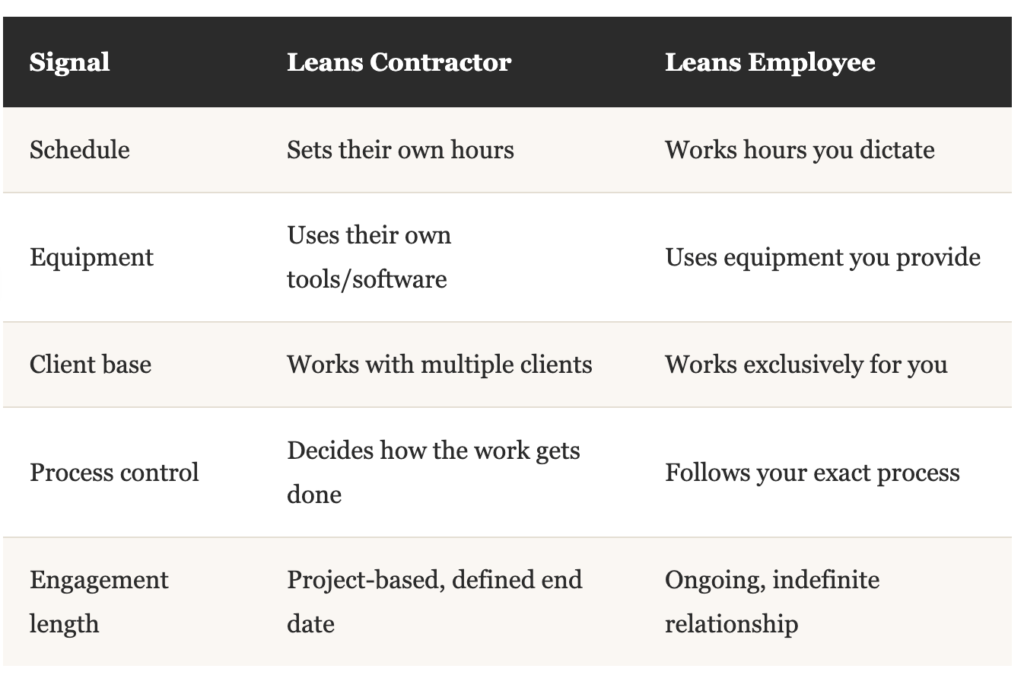
If you’re looking at that table and realizing most of your “contractor” relationships actually look like the right-hand column, that’s genuinely worth a conversation with an accountant or an employment attorney before it becomes a problem. Misclassification penalties are not gentle, and the creator economy specifically has come under increasing scrutiny because so much of it has historically operated on handshake deals and DM agreements.
Beyond classification, you need an actual contract, every time, no exceptions, even for your best friend from college who’s editing your videos on the side. A real contract spells out scope of work, payment terms and timing, deadlines, revision limits, and confidentiality. That last one matters more than people think. Your content, your unreleased campaigns, your brand relationships, your upcoming collaborations — that’s proprietary information, and it deserves the same protection any other business would give its intellectual property.
The Part Nobody Warns You About: You Have to Stop Being the Only Person Who Can Do It
This is the section that surprises people the most, because it has nothing to do with money or paperwork. It’s psychological, and it’s the actual bottleneck that stalls most creators long after they’ve technically hired someone.
When you’ve spent years being the only person touching your content, letting go is genuinely hard. You know exactly how you like your color grading. You know your exact caption voice. You know which thumbnail style performs and which doesn’t, even if you couldn’t fully articulate why. Handing that over to someone else feels, on some level, like losing control of the thing you built.
Here’s what I tell clients: the goal isn’t to find someone who does everything exactly the way you would. That person doesn’t exist, and if they did, you wouldn’t need them — you’d just be doing it yourself with extra steps. The goal is to give someone clear enough guardrails that they can operate independently inside your brand without you having to approve every single decision.
The way you do that is by documenting your process before you ever post a job listing. This doesn’t need to be elaborate. I’m not talking about a fifty-page operations manual. I’m talking about a simple, living document that covers things like your preferred export settings, your brand’s color palette and fonts, the specific tone you use when responding to brand inquiries versus fan comments, and a short list of things you never compromise on.
The creators who write this down before hiring consistently have a smoother first ninety days than the ones who try to explain everything verbally in real time while also still doing the job themselves. Documentation isn’t busywork. It’s the thing that actually lets you let go.
And I’ll be honest about something from my own experience building Amra & Elma with Elma: the moments where we scaled fastest were never the moments we tried hardest to control every detail. They were the moments we trusted a process enough to hand it off completely and only stepped back in when something genuinely needed our judgment. That’s a hard muscle to build, and most people don’t build it in time, which is exactly why so many creators stay stuck as solo operators years longer than they need to.
What Actually Happens in the First Ninety Days
I want to be candid about something most articles on this topic skip entirely: your first hire is not going to feel like a relief right away. For the first few weeks, it often feels like more work, not less. You’re training someone. You’re answering questions you used to just handle instinctively. You’re reviewing their output, which takes real time, even if editing takes less time than doing the work yourself from scratch.
This is normal, and it’s the exact point where a lot of creators panic and assume they hired the wrong person or made a mistake entirely. In my experience, the payoff usually shows up somewhere between week six and week ten, once the documented processes start to actually stick and the back-and-forth starts shrinking. If you go into it expecting instant relief, you’ll quit the experiment right before it was about to work.
A few things that tend to separate a smooth first ninety days from a rocky one:
You check in on a set cadence, not constantly. A quick weekly sync where you review what worked and what didn’t is far more useful than hovering over every deliverable in real time. Micromanagement in the first month feels protective, but it actually slows down the exact independence you’re trying to build.
You give feedback on the process, not just the output. If a caption didn’t land the way you wanted, don’t just fix it and move on — explain the “why” so the pattern updates for next time. This is the difference between someone who eventually operates independently and someone who will always need you to fix things after the fact.
You resist the urge to redo everything yourself “just this once.” I understand the temptation completely. It’s often genuinely faster to fix it yourself than to explain the fix. But every time you quietly redo someone’s work instead of coaching them through it, you teach them, and yourself, that delegation doesn’t actually work here. It becomes a self-fulfilling prophecy.
Where You Actually Find a Good First Hire
I get asked this constantly, usually right after a creator has convinced themselves they’re financially and legally ready: “Okay, so where do I even find this person?” And I understand the instinct to post a generic job listing on a general freelance marketplace and hope for the best. I’d steer you away from that as a first move.
Your first hire benefits enormously from coming through a warm channel rather than a cold application pile. Look inside your own audience first. Chances are, someone in your comments or DMs already understands your content, your tone, and your niche better than any stranger you’d find on a general job board, simply because they’ve been consuming your work for months or years already. That head start on brand fluency is worth more than you’d think.
Creator-specific hiring communities and referrals from other creators you trust are the next best channel. People who already work inside the creator economy understand the pace, the unpredictability of brand deal timelines, and the particular blend of creative and administrative work the role requires. Someone coming from a completely unrelated corporate background can absolutely learn it, but expect a longer runway.
Whichever channel you use, resist the urge to hire on personality alone. I’ve watched creators fall in love with a candidate in a single conversation because they were funny, or clearly a fan, or just easy to talk to, and skip actually testing the work. Always run a small, paid test project before making anything permanent. It should mirror real work, not a hypothetical exercise, and it should be compensated fairly. This single step catches more mismatches before they become expensive than almost anything else in the process.
Building the Role Around Reality, Not a Job Title
One mistake I see constantly is creators reaching for a prebuilt job title, like “social media manager” or “video editor,” without actually mapping that title back to the specific tasks they identified in their time-tracking week. Titles are convenient shorthand, but they carry assumptions that may not match what you actually need.
If your real bottleneck is administrative — invoicing, scheduling, inbox management, coordinating usage rights with brand teams — hiring a video editor doesn’t touch that problem at all, no matter how talented they are. You’ll still be drowning in the exact tasks that were burning you out in the first place, just with an added layer of managing someone else’s creative work on top of it.
I always recommend writing the job description directly from your time-tracking data. List the actual tasks, hour by hour, that you want off your plate. Then group them. You’ll often find they cluster naturally into one of two buckets: creative production tasks, or operational and administrative tasks. Very rarely do they cleanly fit into both, which is exactly why a single hire trying to do everything usually ends up mediocre at both halves of the job instead of excellent at either one.
This clarity also protects you during the interview process. When a candidate asks what the role actually involves day to day, you should be able to answer with specifics pulled straight from your own week, not a vague description borrowed from a job posting template. Candidates notice the difference, and the good ones are far more likely to take a role that’s been thoughtfully scoped over one that reads like it was written in five minutes.
The Quiet Advantage Nobody Talks About
Here’s the thing I find most people don’t realize until they’re on the other side of this transition: hiring well doesn’t just buy you back time, it fundamentally changes the kind of opportunities you’re eligible for. Brands increasingly look at whether a creator has any operational infrastructure at all before committing to larger, more complex partnerships. A creator who can only handle one deliverable at a time, personally, on their own schedule, is a much riskier bet for a six-figure campaign than a creator who has a team that can execute reliably and at scale.
I’ve seen this play out directly with clients. The moment a creator has even one reliable person handling editing or admin, their capacity for concurrent brand deals goes up, their response time to inbound opportunities improves, and — maybe most importantly — their own creative output tends to get noticeably better, because they’re not creating from a place of total depletion anymore.
Building a team was never really about doing less. It’s about making sure the hours you do spend are going toward the parts of the business only you can actually do: the creative vision, the relationships, the strategic direction. Everything else is capacity you can build, buy, and systematize, as long as you lay the financial, legal, and psychological groundwork first.
If you take one thing away from everything I’ve laid out here, let it be this: the creators who transition from solo operator to employer successfully are almost never the ones who moved the fastest. They’re the ones who did the unglamorous groundwork first — tracking their real hours, building their cash reserve, getting their classification and contracts right, documenting their process, and generating clean pay stubs from day one — so that when they finally did make the hire, the foundation was already strong enough to hold the weight.
The wall is going to show up eventually for almost every creator who’s serious about building something lasting. What separates the people who scale through it from the people who stall at it usually isn’t talent, and it isn’t luck. It’s whether they did the quiet, unglamorous work of preparing before they made the leap.
The Classification Compass
Contractor or employee? Toggle each signal.
The title on the contract doesn't decide this — the real working relationship does. Flip each switch to match your actual setup.
Sources:
Contractor vs. employee classification
- IRS — Independent contractor (self-employed) or employee?: https://www.irs.gov/businesses/small-businesses-self-employed/independent-contractor-self-employed-or-employee
- IRS — Worker Classification 101: employee or independent contractor: https://www.irs.gov/newsroom/worker-classification-101-employee-or-independent-contractor
Brand deal payment terms (net-30/60/90)
- Influencer Marketing Hub — Payment Terms & Milestone Schedules for Influencer Briefs: https://influencermarketinghub.com/payment-terms-milestone-schedules-influencer-briefs/
- InfluencerFee — How Do Influencers Get Paid? Payment Methods and Income Breakdown: https://influencerfee.com/blog/how-do-influencers-get-paid/
- InfluencerFee — Influencer Payment Terms Guide: https://influencerfee.com/posts/influencer-payment-terms-guide
Cash reserve / runway guidance (3–6 months)
- SCORE — How Much Cash Should a Small Business Keep in Reserve?: https://www.score.org/resource/blog-post/how-much-cash-should-a-small-business-keep-reserve
- QuickBooks — Cash reserves: What they are + why you need one: https://quickbooks.intuit.com/r/cash-flow/cash-reserve/
Pay stub tool already linked in the article
- Wave — Pay Stub Generator: https://www.waveapps.com/tools/pay-stub-generator