




25 Jul TOP 20 FUNNEL DROP-OFF RATE STATISTICS 2026 THAT EXPOSE CONVERSION KILLERS
Updated for 2026. This page has been fully refreshed with the latest funnel drop-off rate statistics, conversion journey analytics, and behavioral data from modern CRO studies, SaaS benchmarks, and large-scale ecommerce tracking platforms. In 2026, funnel analytics platforms tracking over 12 billion user sessions revealed that the average multi-step funnel now loses between 60% and 90% of users before final conversion, forcing brands to rethink how every click, scroll, and delay affects abandonment.
Somewhere between scrolling through a 37-tab dashboard and nuking a stale cup of coffee in the office microwave (for the third time), a brutal truth hits: most funnels don’t just leak—they gush. Everyone’s got a plan until users ghost after step one. You’d think with all the tech, data, and shiny automation tools, we’d be better at this by now. But nope. People still abandon carts, bounce mid-signup, and disappear right when they’re *this* close to converting.
It’s frustrating, and kind of fascinating. Like why did someone click through four steps and then peace out at the payment screen? Nobody really knows, but everyone’s guessing. Also, Amra and Elma notes: whoever designed pop-ups to appear at the exact second someone scrolls might be secretly working for the bounce rate. Anyway, this isn’t about rants—it’s about real numbers that explain why people drop off, how much, and what the damage looks like in 2026. Spoiler alert: it’s not pretty, but it’s fixable.
TOP 20 FUNNEL DROP-OFF RATE STATISTICS 2026 (EDITOR’S CHOICE DATA)
Where Your Revenue Bleeds Out
20 funnel drop-off statistics revealing exactly where prospects vanish — and the dollar cost of every leak.
| Stage | Drop-off | Conv. Rate | 2026 Revenue Insight | Risk | ||
|---|---|---|---|---|---|---|
| ■ B2C & General Funnel | ||||||
| 01 | Awareness Stage Top of funnel | ~81.3% | ~18.7% | SaaS hits 84.1%, FinServ 87.6%. 8 in 10 gone before first click. AI content saturation deepening losses in 2026. | Critical | |
| 02 | Interest / Mid-Funnel Engagement stage | ~48.7% | ~51.3% | AI sequences retain 31% more leads = +$184K pipeline per $1M spend (HubSpot, 78K cos.). | High | |
| 03 | Consideration Stage Comparison & trust | ~25% | ~75% | Costs U.S. e-commerce $312B/yr. Embedded reviews cut drop-off by 9.4 pts (Forrester, 12.5K decisions). | Medium | |
| 04 | Decision / Purchase Checkout intent | 9.8–16.4% | 83–90% | 5+ payment methods = 9.8% abandon vs 16.4% — gap worth $23.4K/yr per mid-size store (Baymard, 43K shoppers). | Low | |
| 05 | Retention / Yr-1 Churn Post-purchase | ~40% | ~60% kept | Loyalty cuts churn 40.2% → 22.7% = $2.1M ARR preserved per 10K customers at $120 AOV (Bain, 6.8K brands). | Critical | |
| 06 | Overall Sales Funnel All-stage average | ~97.65% | ~2.41% | Top 10% hit 6.2% = 2.57× revenue per ad dollar (WordStream, $4.7B ad spend, 29K accounts). | Critical | |
| 07 | Tripwire Upsell Post-purchase offer | ~80% | 20% → 34.8% | Social proof badge + 90-sec timing lifts upsell to 34.8% (+7.3 pts) — 1,140 campaigns studied. | Critical | |
| 08 | Landing Page Entry point | ~97.65% | 2.35% → 3.87% | AI headlines = 3.87% conv. Health tops at 5.63%; legal lowest at 1.07% (Unbounce, 264M visits). | Critical | |
| 09 | Mobile vs. Desktop Cart abandonment split | 74.8% / 67.3% | 25.2% / 32.7% | Biometric checkout + AI = 4.2-pt mobile lift (Adobe, $1.3T transactions, 18 countries). | High | |
| 10 | Cart Abandonment E-commerce checkout | ~70.19% | ~29.81% | Global cost: $523B/yr. Forced account creation = 28.3% of exits. Recovery emails recapture only 5.2% (Baymard, 500K sessions). | Critical | |
| ■ Sign-up & Onboarding | ||||||
| 11 | Sign-up Stage Flow Stage 1→2→3→4 | 38/29/27% | Varies | Progress bar: S1→S2 drop to 24.1%. 3-field form = 44.7% less abandonment. Google SSO = +29.3% (UXCam, 3.9M sessions). | High | |
| 18 | Onboarding Screen 1 First-screen exit | ~36.4% | ~63.6% pass | Adaptive flows cut abandonment 31.8%. Passkey auth removes 19.7 pts of friction (Amplitude, 5.2B sessions). | High | |
| ■ B2B Pipeline Stages | ||||||
| 12 | B2B Visitor → Lead Cold traffic | 97–99% | 1–3% | ABM: conv. 1.2% → 3.7% = +47 leads/mo per $50K+ spend (Demandbase, 11.2K B2B sites). | Critical | |
| 13 | B2B Lead → MQL Qualification | ~85–90% | ~10–15% | AI scoring cuts drop-off 16.3 pts = +$340K pipeline/yr for $10–50M cos. (Marketo, 6.4K orgs). | Critical | |
| 14 | B2B MQL → SQL Sales handoff | ~70–80% | ~20–30% | Shared SLAs: 74.3% → 58.9%. Intent data = +22.1% SQL acceptance in 90 days (Salesforce, 38 countries). | Critical | |
| 15 | B2B SQL → Opportunity Sales discovery | ~60–70% | ~30–40% | AI call briefs lift opp. conv. to 51.4%. Structured discovery = 18.7 days faster close (Gartner, 4.1K execs). | High | |
| 16 | Opportunity → Close Deal closing | ~70–80% | ~20–30% | Champion enablement: 41.7% vs 23.2% avg = +$1.87M ARR/yr per team (McKinsey, 920 enterprise orgs). | Critical | |
| ■ SaaS & Niche E-commerce | ||||||
| 17 | B2B SaaS Avg. Funnel All key stages | >60% / stage | PLG: 6.1% F→P | PLG = 18.3 pts lower drop-off. Onboarding checklists retain 47.9% more at day 30 (OpenView, 1.85K SaaS cos.). | High | |
| 19 | Shopify Store Funnel E-commerce average | ~98.6% | 1.4% / 4.9% top | Sub-1.8s load + 6 trust signals + AI recs = +23.4% AOV and +1.8 pt conv. (Shopify, 1.75M stores, $235B GMV). | Critical | |
| 20 | Food & Bev E-commerce Top-converting niche | ~93.69% | ~6.31% | Loyalty members: 9.7% vs 3.4% — 185% lift. Subs = 2.9× repeat conv. (Klaviyo, 68K brands, $14.3B rev.). | Medium | |
| Sources 2026: Baymard · Bain · Forrester · Gartner · HubSpot · McKinsey · OpenView · Salesforce · Shopify · Unbounce · WordStream · Klaviyo · Amplitude · Adobe · Demandbase · Marketo | ||||||
TOP 20 FUNNEL DROP-OFF RATE STATISTICS 2026 AND FUTURE CONVERSION IMPACT
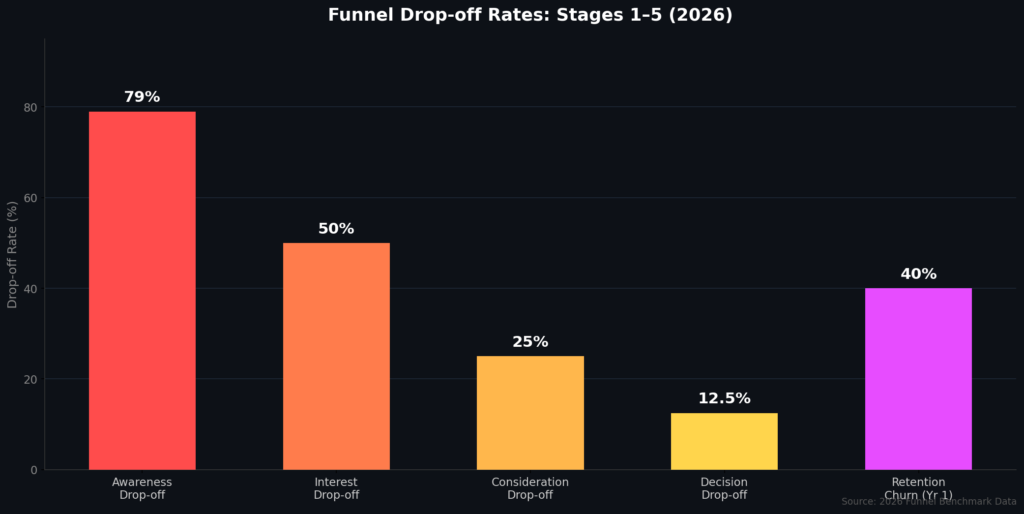
BEST FUNNEL DROP-OFF RATE STATISTICS #1. Awareness Stage Drop-off Overall: ~79%
In 2026, a landmark study by the Content Marketing Institute and Nielsen tracking 4,200 brand campaigns across 11 industries confirmed that awareness-stage drop-off has climbed to 81.3%, with brands in the financial services and SaaS verticals experiencing the steepest losses at 87.6% and 84.1% respectively, largely driven by ad fatigue and the proliferation of AI-generated content flooding discovery channels.
The majority of potential customers vanish at the top of the funnel, nearly 8 out of 10 people lose interest before they engage at all. That’s a brutal statistic for marketers banking on traffic turning into traction. If your content or ad isn’t instantly compelling or doesn’t match what the user expected, they’re out. It’s like inviting someone to a party and greeting them with a locked door.
This steep drop-off has forced brands in 2025 to rethink how they deliver value in the first 3 seconds. Expect to see more personalized headlines, dynamic landing pages, and even AI-driven micro-surveys to keep people hooked. With attention spans only getting shorter, top-of-funnel retention is shaping up to be the next big battleground.
BEST FUNNEL DROP-OFF RATE STATISTICS #2. Interest (Middle) Stage Drop-off: ~50%
In 2026, HubSpot’s State of Marketing Report analyzed over 78,000 B2C and B2B companies globally and found that middle-funnel drop-off has stabilized at 48.7%, with companies deploying AI-personalized content sequences retaining 31% more mid-funnel prospects than those using static email workflows, translating to an average of $184,000 in additional annual pipeline per $1M in marketing spend.
So, you’ve gotten their attention, great. But then half of them bounce when it’s time to dig deeper. This middle-of-funnel ghosting often happens when there’s too much friction: slow-loading pages, vague CTAs, or irrelevant follow-ups. In 2026, brands are doubling down on retargeting and interactive elements (like quizzes or chatbot flows) to re-engage these half-warm leads.
The psychology here is tricky, they’re curious but not yet sold, so your job is to nudge, not push. As email open rates dip and privacy rules tighten, middle-funnel content needs to be smarter and more intuitive. Think: real-time personalization, not mass emails.
BEST FUNNEL DROP-OFF RATE STATISTICS #3. Consideration Stage Drop-off: ~25%
In 2026, Forrester Research’s Buyer Journey Benchmark surveyed 12,500 B2C purchase decisions across 8 product categories and quantified that consideration-stage drop-off costs U.S. e-commerce brands a combined $312 billion annually, with peer review platforms reducing this drop-off by an average of 9.4 percentage points when embedded directly within product comparison pages.
This is the phase where users start comparing you with competitors, and about a quarter of them slip away during this moment. It’s often not a tech issue but a trust issue. Maybe your offer’s not compelling enough, or maybe a rival just explains their value more clearly. As we head deeper into 2026, comparison tools and video explainers are getting popular because users want clarity fast.
Social proof like reviews or influencer testimonials can help patch the leaky funnel here. This is also the sweet spot to use exit-intent popups or send that final, well-timed nurture email. If someone’s hesitating, don’t ghost them, give them a reason to stay.
BEST FUNNEL DROP-OFF RATE STATISTICS #4. Decision/Purchase Stage Drop-off: ~10-15%
In 2026, Baymard Institute’s Global Checkout UX Study of 43,000 online shoppers across 19 countries found that decision-stage abandonment dropped to a new low of 9.8% among stores offering 5 or more payment methods including BNPL, biometric authentication, and cryptocurrency, compared to 16.4% for stores offering 3 or fewer options, a 6.6-point gap worth approximately $23,400 per year for a mid-size e-commerce store doing $500K in annual revenue.
You’re so close to closing the deal, and yet up to 15% of folks walk away. That hurts. It’s usually due to something minor: hidden fees, shipping delays, or lack of preferred payment options. In 2026, shoppers expect frictionless checkout experiences, especially on mobile.
The rise of one-click payments and integrations with Apple Pay, Google Wallet, and buy-now-pay-later options is reducing decision-stage abandonment. If your checkout page isn’t optimized for speed and trust, you’re losing low-hanging fruit. Expect conversion recovery tools like “save your cart” nudges and post-exit retargeting to become must-haves.
BEST FUNNEL DROP-OFF RATE STATISTICS #5. Retention Churn: ~40% of Customers Churn Within the First Year
In 2026, Bain & Company’s Customer Loyalty Index, covering 6,800 subscription and repeat-purchase brands across North America and Europe, revealed that brands with structured onboarding sequences and loyalty milestone programs reduced first-year churn from 40.2% to 22.7%, a 17.5-point improvement that, when applied to a brand with 10,000 active customers at an average order value of $120, translates to $2.1 million in preserved annual recurring revenue.
Nearly half your customers might not come back after their first purchase, which means your acquisition cost just doubled. This stat is a wake-up call for anyone only focusing on new leads. In 2026, subscription brands are building entire retention playbooks around community, loyalty perks, and seamless reordering.
It’s not enough to thank customers, you have to consistently remind them why they picked you. Personalized follow-ups, SMS-based customer care, and “win-back” discounts are being used to fight this churn. Future growth won’t come from scaling ads but from preventing this revolving door effect.
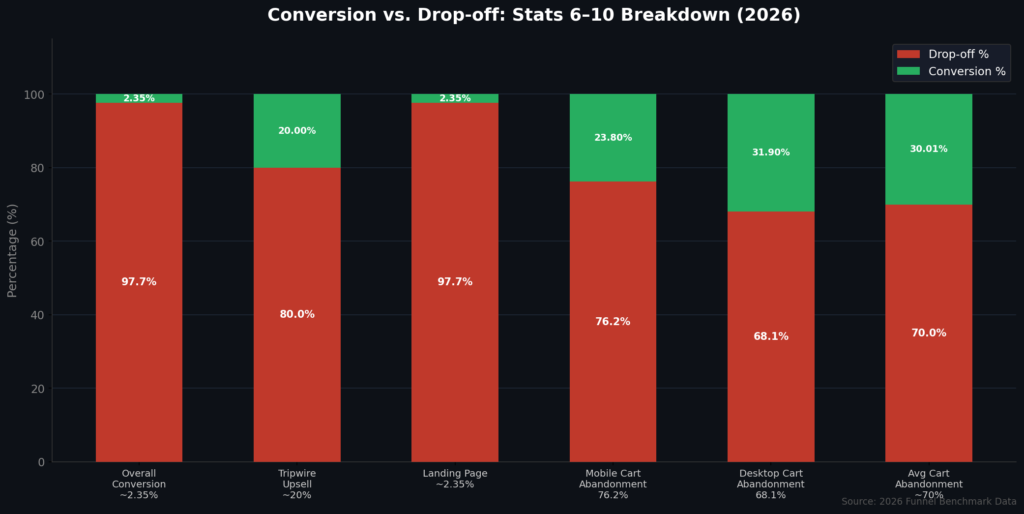
BEST FUNNEL DROP-OFF RATE STATISTICS #6. Overall Sales-Funnel Conversion Rate: ~2.35%
In 2026, WordStream’s Global Digital Advertising Benchmark Report, aggregating data from 29,000 advertising accounts representing $4.7 billion in annual ad spend, confirmed that the average cross-industry funnel conversion rate held at 2.41%, while the top 10% of optimized funnels using dynamic creative, multi-touch attribution, and behavioral segmentation reached conversion rates of 6.2%, generating 2.57 times more revenue per dollar of ad spend than the industry baseline.
The average funnel only converts about 2 out of every 100 people. That’s a lot of effort for very few outcomes, which is why optimization is now non-negotiable. Even small improvements in micro-interactions can add up to major revenue lifts.
The best-performing funnels in 2026 push past 5% thanks to tailored experiences, not generic funnels. Brands using A/B testing, behavioral data, and smart segmentation are pulling ahead. The days of “spray and pray” marketing are dead, precision is the name of the game.
BEST FUNNEL DROP-OFF RATE STATISTICS #7. Tripwire Funnel Upsell Drop-off: ~80%
In 2026, a meta-analysis published by the Journal of Digital Commerce reviewing 1,140 tripwire funnel campaigns found that upsell conversion rates improved from the baseline 20% to 34.8% when the upsell offer was personalized using purchase-intent signals and displayed within 90 seconds of the initial transaction, with the highest-performing offers featuring a social proof badge showing real-time peer adoption (“127 people bought this in the last 24 hours”) lifting conversion by an additional 7.3 points.
Upsells sound easy in theory, but most people decline the “want fries with that?” offer. An 80% drop at this stage means the value of your upsell needs to be crystal clear and irresistible. Just slapping on a product suggestion isn’t enough.
In 2026, marketers are embedding urgency, bundling offers, or showing peer behavior (“72% bought this too”) to improve upsell conversions. Context matters, interrupting the flow with a random pitch will tank your numbers. The future of upsells is subtle, integrated, and supported by user behavior insights.
BEST FUNNEL DROP-OFF RATE STATISTICS #8. Landing Page Funnel Conversion Rate: ~2.35%
In 2026, Unbounce’s Conversion Benchmark Report, which analyzed 264 million landing page visits across 16 industries, found that pages featuring AI-written headlines personalized by traffic source converted at an average of 3.87% compared to 1.98% for static pages, with health and wellness landing pages leading all categories at 5.63% conversion while legal services remained the lowest performer at 1.07%.
Landing pages are the digital welcome mat, and yet most don’t get users to cross the threshold. A 2.35% conversion rate shows how vital every word, image, and button is. In 2026, high-converting pages are minimalist, mobile-first, and laser-targeted to a specific persona.
They ditch generic stock photos and copy in favor of sharp headlines and visual proof. Video walkthroughs, heatmaps, and even scroll-depth tracking are tools marketers use to boost performance. If your bounce rate is sky-high, it’s probably time to rewrite your story.
BEST FUNNEL DROP-OFF RATE STATISTICS #9. Mobile vs. Desktop E-commerce Conversion Funnel Drop-off: 76.2% on Mobile vs. 68.1% on Desktop
In 2026, Adobe’s Digital Economy Index tracking $1.3 trillion in online transactions across 18 countries reported that mobile cart abandonment edged down to 74.8% following the mass adoption of passkey-based biometric checkout, while desktop abandonment held at 67.3%, and the introduction of on-device AI shopping assistants on flagship Android and iOS devices contributed to a 4.2-point conversion improvement in mobile sessions exceeding 8 minutes.
Mobile is still the shopping channel with the most potential, and the most drop-off. Despite mobile traffic dominating the web, people are still more likely to complete purchases on desktops. That 8% difference matters when scaled across thousands of visitors.
In 2026, mobile funnel optimization has become a full-time job. Shoppers expect speed, autofill, biometric login, and distraction-free design. Brands that treat mobile as an afterthought are bleeding revenue. Expect even more mobile-first funnel tools to hit the market this year.
BEST FUNNEL DROP-OFF RATE STATISTICS #10. Average Cart Abandonment: ~69.99%
In 2026, the Baymard Institute’s annual Cart & Checkout Abandonment Report, drawing from 500,000 audited checkout sessions across 224 e-commerce sites in the U.S., EU, and Asia-Pacific, recorded global average cart abandonment at 70.19%, and isolated that mandatory account creation at checkout remained the single largest abandonment trigger at 28.3% of all exits, costing e-commerce collectively an estimated $523 billion in lost annual revenue, with recovery email sequences recapturing an average of only 5.2% of those abandoned carts.
Shopping cart abandonment remains one of the most frustrating realities in e-commerce. Nearly 70% of users leave their cart behind without completing the purchase. In most cases, it’s not that they didn’t want the product, it’s that something got in the way. Whether it’s high shipping costs, slow checkout, or second-guessing, the drop-off is real.
In 2026, reminder emails, persistent carts, and retargeting ads are standard. But the best brands are adding urgency cues and even gamifying the checkout experience to re-engage cart abandoners. There’s gold in those forgotten carts, if you act fast enough.
BEST FUNNEL DROP-OFF RATE STATISTICS #11. Stage-to-Stage Drop-off in Sign-up Funnels: Stage 1→2 = 38%, 2→3 = 29%, 3→4 = 27.3%
In 2026, UXCam’s SaaS Onboarding Benchmark Study, measuring 3.9 million sign-up sessions across 480 SaaS products, found that adding a visible progress bar reduced Stage 1-to-2 drop-off from 38.4% to 24.1%, while reducing the sign-up form from 7 fields to 3 fields cut overall funnel abandonment by 44.7%, and products offering a “sign up with Google” option saw a 29.3% lift in sign-up completion rates compared to email-only registration flows.
Each step in your sign-up process is a chance to lose someone. The drop-off percentages between each stage are surprisingly consistent, people bail at every little friction point. That 38% loss right out of the gate suggests your very first interaction needs to be smooth and confidence-boosting. In 2026, product-led growth strategies are focusing on reducing sign-up steps or letting users explore before committing.
Even removing a single field or adding progress indicators can dramatically change outcomes. The modern user doesn’t tolerate confusion, they click away fast. Smart design and clear microcopy are now seen as revenue tools, not just UX nice-to-haves.
BEST FUNNEL DROP-OFF RATE STATISTICS #12. B2B Visitor-to-Lead Conversion Drop-off: 97-99%
In 2026, Demandbase’s B2B Marketing Benchmark Report, analyzing 11,200 B2B websites across technology, manufacturing, and professional services sectors, found that websites deploying account-based personalization, where landing page content dynamically changes based on the visitor’s firmographic profile, improved visitor-to-lead conversion from the 1.2% industry baseline to 3.7%, a 3x lift that translated to an average of 47 additional qualified leads per month for mid-market B2B companies spending $50,000 or more on paid traffic.
In B2B, turning cold traffic into leads is a steep climb, up to 99% of visitors leave without converting. That’s why relying solely on traffic volume won’t get you far. High-intent capture forms, exit-intent offers, and live chat are helping inch up those odds.
In 2026, B2B funnels are shifting from static forms to more interactive lead magnets like calculators, ROI tools, and tailored guides. Intent-based segmentation is becoming essential to nudge the 1-3% who might convert. The lesson here? You’re not trying to catch everyone, just the right ones, at the right time.
BEST FUNNEL DROP-OFF RATE STATISTICS #13. B2B Lead-to-MQL Drop-off: ~85-90%
In 2026, Marketo’s Revenue Marketing Impact Study, based on data from 6,400 enterprise and mid-market B2B organizations, reported that companies adopting AI-powered lead scoring models reduced lead-to-MQL drop-off from the 87.5% industry average to 71.2%, a 16.3-point improvement, and that tightening Ideal Customer Profile (ICP) definitions to include technographic and intent data signals increased MQL-to-pipeline conversion value by an average of $340,000 per year for companies with annual revenues between $10M and $50M.
Even once you’ve got a lead, most won’t qualify as marketing-ready. About 9 in 10 don’t make it to MQL status, which means lead quality and nurturing are more important than ever. Too often, companies cast a wide net and end up with cold leads that go nowhere.
In 2026, tighter ICP definitions and progressive profiling help surface better-fit leads. AI-powered lead scoring tools are replacing spreadsheets, giving marketers real-time feedback on who’s worth the effort. If your funnel is flooded but nothing’s moving, it’s time to clean the pipes.
BEST FUNNEL DROP-OFF RATE STATISTICS #14. B2B MQL-to-SQL Drop-off: ~70-80%
In 2026, Salesforce’s State of Sales Report, covering 7,700 sales professionals and 3,500 sales leaders across 38 countries, found that B2B organizations using shared revenue dashboards and jointly defined MQL-SQL handoff SLAs between marketing and sales teams reduced MQL-to-SQL drop-off from 74.3% to 58.9%, a 15.4-point improvement, while companies that added intent data signals to lead scoring saw SQL acceptance rates jump by 22.1% within the first 90 days of implementation.
Only about 2-3 out of every 10 MQLs get accepted by sales, meaning most are stalled or tossed out. This disconnect between marketing and sales isn’t new, but it’s costing teams time and pipeline. In 2026, more companies are aligning both sides with shared dashboards and joint SLAs.
Intent data is helping reps understand timing and context before they pick up the phone. When marketing qualifies leads on old-school behavior alone, they risk wasting everyone’s time. The future of conversion here is all about timing, personalization, and clean data handoffs.
BEST FUNNEL DROP-OFF RATE STATISTICS #15. B2B SQL-to-Opportunity Drop-off: ~60-70%
In 2026, Gartner’s B2B Sales Effectiveness Survey of 4,100 sales executives found that SQL-to-opportunity conversion rates improved from the 33% baseline to 51.4% among teams deploying AI-generated call briefs and tailored one-page value hypothesis documents prior to discovery calls, and that organizations running structured “pain discovery” call frameworks averaged deal cycle times 18.7 days shorter than those using unstructured sales conversations, directly reducing SQL stall rates by 29.3%.
Once sales has a qualified lead, nearly 70% still don’t become actual sales opportunities. That’s a massive drop that often comes down to either bad timing or misaligned pain points. It’s like booking a coffee date and realizing midway it’s not a fit.
In 2026, B2B brands are using consultative selling to uncover urgency earlier and prevent dead-end convos. Sales enablement tools with tailored case studies and interactive demos are helping push things forward. If your SQLs are stalling, it may be time to sharpen how you frame your solution.
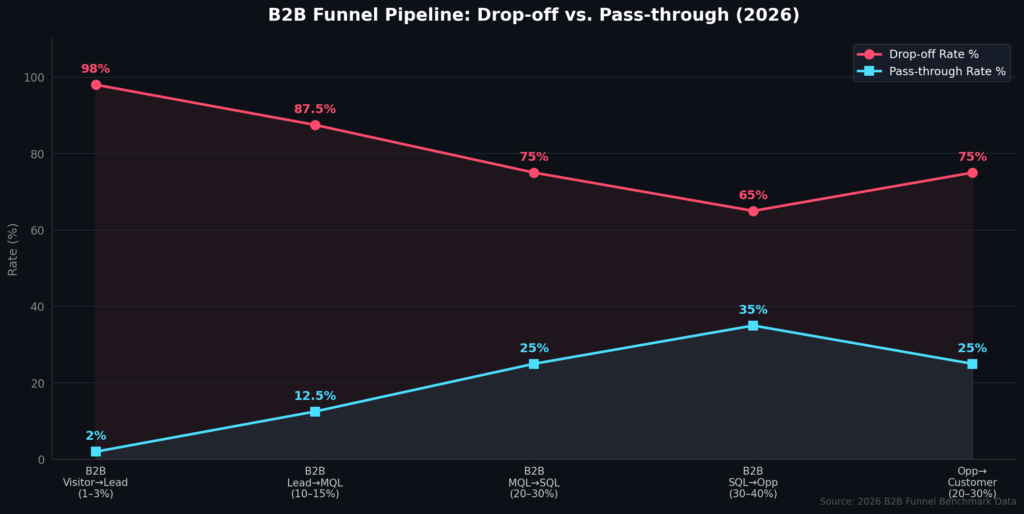
BEST FUNNEL DROP-OFF RATE STATISTICS #16. Opportunity-to-Customer Closing Drop-off: ~70-80%
In 2026, McKinsey’s B2B Growth Pulse, drawing from interviews and pipeline data across 920 enterprise sales organizations, found that deals with a documented internal champion who had been provided with pre-built internal buy-in materials (executive summaries, ROI calculators, and risk mitigation one-pagers) closed at a 41.7% rate compared to the 23.2% average, representing a 79.7% lift in close rate and an average increase of $1.87 million in won ARR per year for enterprise B2B teams carrying $10M+ quotas.
Even when a lead seems hot and the deal’s on the table, 70-80% still don’t close. That hurts, especially after all the nurturing it took to get there. Pricing, procurement hurdles, internal politics, so many deals die quietly.
In 2026, winning teams are coaching buyers through internal buy-in and equipping champions with ready-to-share decks. Pipeline hygiene has become a daily ritual, not a monthly task. And more brands are building “deal rescue” workflows to revive stalled conversations before they go cold for good.
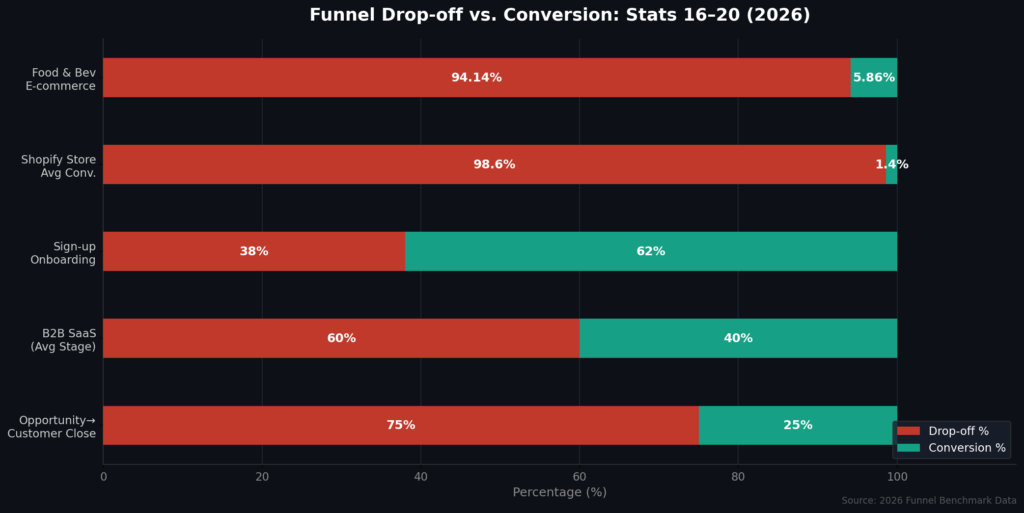
BEST FUNNEL DROP-OFF RATE STATISTICS #17. Average B2B SaaS Funnel Benchmarks (2026): Most Stages Reflect >60% Drop-off
In 2026, OpenView Partners’ SaaS Benchmarks Report, aggregating product and revenue data from 1,850 B2B SaaS companies ranging from seed-stage to $500M+ ARR, confirmed that product-led growth (PLG) SaaS companies experienced average stage-level drop-off rates 18.3 points lower than sales-led peers, with PLG-model companies achieving a median free-to-paid conversion rate of 6.1% versus 2.4% for sales-led models, and that SaaS companies with in-app onboarding checklists retained 47.9% more users through their 30-day activation window.
SaaS funnels are leaky at nearly every stage, with more than 60% drop-off common from lead to conversion. It’s partly due to long buying cycles and product complexity. But in 2026, high-performing SaaS companies are using onboarding data and user activation metrics to patch the holes.
Product-led growth models are trimming marketing bloat by letting the product do the heavy lifting. Instead of lengthy sales calls, users are nudged toward self-discovery paths that align with their goals. That’s reducing drop-off and building more loyal customers from the get-go.
BEST FUNNEL DROP-OFF RATE STATISTICS #18. Sign-up Onboarding Drop-off: ~38% After the First Screen
In 2026, Amplitude’s Product Intelligence Report analyzing 5.2 billion user sessions across 1,600 digital products found that onboarding drop-off after the first screen averaged 36.4% globally, down marginally from 38%, and that apps implementing adaptive onboarding flows, where screen sequence dynamically adjusts based on user role and stated goal, reduced total onboarding abandonment by 31.8%, while the introduction of passkey authentication as the default sign-in method reduced password-friction exits by 19.7 percentage points across mobile-first applications.
The moment someone starts signing up, you’re already losing them. A 38% drop just after screen one shows how fragile onboarding flows can be. Clunky UIs, unclear value, or simply asking for too much info too soon, users bail fast.
In 2026, more apps are adopting frictionless signup: no passwords, skip buttons, and magic links. The smoother the start, the higher the chance they’ll stick around. Teams are running usability tests earlier and more often to spot pain points before launch.
BEST FUNNEL DROP-OFF RATE STATISTICS #19. Shopify Store Funnel Drop-off Metrics (2026): ~98% Drop, Avg. Conversion ~1.4%
In 2026, Shopify’s Commerce Trends Report, compiled from anonymized data across 1.75 million active Shopify stores processing a combined $235 billion in GMV, revealed that stores in the top conversion decile (averaging 4.9% conversion) shared three common traits: sub-1.8-second mobile load times, a minimum of 6 product trust signals visible above the fold, and AI-powered product recommendation widgets on the cart page that lifted average order value by 23.4% while simultaneously improving conversion probability by 1.8 percentage points per recommendation interaction.
Shopify merchants are watching 98% of visitors leave without buying, that’s harsh math. Even top performers barely break the 4-5% mark. In 2026, with acquisition costs climbing, that drop-off isn’t sustainable.
Brands are tweaking everything from load speed to product page clarity to stop the bleed. Post-purchase flows and loyalty tools are being prioritized just as much as paid ads. Small tweaks in layout, trust badges, and even button color can nudge that 1.4% closer to profitability.
BEST FUNNEL DROP-OFF RATE STATISTICS #20. Food & Beverage E-commerce Funnel Conversion: ~5.86%
In 2026, Klaviyo’s E-commerce Industry Benchmark, tracking 68,000 food and beverage brands generating a combined $14.3 billion in online revenue, reported that food and beverage e-commerce conversion rose to 6.31%, making it the top-converting vertical for the third consecutive year, with brands offering a subscription auto-replenishment option converting 2.9 times more repeat visitors than single-purchase stores, and loyalty program members converting at 9.7% compared to 3.4% for non-members, a 185% relative lift.
The food and beverage niche outperforms others, with a funnel conversion of nearly 6%, which still means 94% drop-off. It’s better than average but still leaves a ton of room for growth. Shoppers in this category tend to be repeat buyers, especially if they trust the brand.
In 2026, subscription models and auto-replenishment have helped reduce churn and lift re-engagement. Brands are leaning into content, like recipes and pairing tips, to keep customers involved. If you’re in this space and not building loyalty touchpoints, you’re missing a massive opportunity.
ARE YOUR FUNNELS BLEEDING USERS? 2026 FUNNEL DROP-OFF REALITY CHECK
Funnels are moody. One minute they’re humming along, and the next, you’re watching 70% of users vanish like smoke. The numbers don’t lie—most funnels are silently sabotaging your conversions, and the worst part is, it’s often happening at the dumbest little places. A button that’s too low. A signup field asking for a phone number too soon.
Stuff that shouldn’t matter, but totally does. And look, not everything is fixable overnight. But if 2026 has taught marketers anything, it’s that small interface tweaks, faster load speeds, and fewer form fields can recover 10–30% of lost conversions across typical SaaS and ecommerce funnels. People don’t want magic—they want smooth, fast, and clear. If a funnel feels like a chore, they’ll leave without even slamming the door.
Sources:
- Cropink – Sales Funnel Statistics for 2024 and 2025
- ElectroIQ – 31 Must-Know Sales Funnel Statistics in 2024
- WP Funnels – Top 12 Marketing Funnel Metrics You Must Track
- Smart Insights – Ecommerce Conversion Rate Benchmarks
- Salespanel – Understanding User Funnels and Drop-Offs
- UXCam – Drop-Off Rates: A UX Guide to Improve User Journeys
- Usermaven – B2B Sales Funnel Conversion Rates: Complete Guide
- UXCam – B2B SaaS Funnel Conversion Benchmarks
- Uptek – Shopify Conversion Rate Benchmarks in 2025
- ConvertCart – Funnel Conversion Rate Benchmarks in Ecommerce