




19 Aug TOP 20 FUTURE OF WORK STATISTICS 2026 THAT REVEAL MASSIVE WORKPLACE TRANSFORMATION
Updated for 2026. This page has been fully refreshed with the latest future of work statistics, workplace transformation data, and global labor trends, grounded in recent workforce surveys, AI adoption reports, and employer insights.
The future of work feels like something we’ve all been tiptoeing toward without realizing just how quickly it’s arriving. Jobs aren’t vanishing overnight, but the way they’re structured is shifting beneath our feet. Technology, especially AI, has moved from being a sidekick in the workplace to something people quietly wonder might one day take the lead. At the same time, workers are rethinking what they want—whether it’s more flexibility, stronger purpose, or simply stability. It’s strange to think how normal remote work felt just a few years ago, and now hybrid seems like the standard everyone’s negotiating around.
The idea of reskilling, once tossed around as a buzzword, is starting to feel like a basic requirement, not a choice. Younger generations, who grew up online, are bringing fresh expectations that don’t always line up with the assumptions people make about them. Some people are hopeful, seeing all of this as a chance to create better careers, while others are quietly anxious, holding onto their current roles tighter than before. Amra and Elma thinks the future of work statistics isn’t some far-off concept anymore—it’s happening now, and the numbers tell a story that’s impossible to ignore.
TOP 20 FUTURE OF WORK STATISTICS 2026 (EDITOR’S CHOICE REVEAL WORKPLACE SHOCK)
Future of Work
Statistics 2026
| # | Statistic | Key Figure | Scale / Trend | Signal | 2026 Insight |
|---|---|---|---|---|---|
| AI & Automation Disruption | |||||
| 01 | Skill Transformation Rate2025 to 2030 forecast | 39% of skills obsolete by 2030 |
Improving | WEF projects 170M new roles created vs 92M displaced, for a net gain of 78M jobs by 2030. | |
| 02 | Automation RiskOECD avg, all sectors | 28% of jobs at high risk |
Monitor | Tasks inside roles are far more likely to be automated than entire jobs disappearing outright. | |
| 03 | Workforce Anxietyautomation fear, 2026 | 37% of employees worried |
Rising | Knowledge workers now join factory workers in automation anxiety, which marks a notable 2026 change. | |
| 04 | Reskilling Readinessglobal workforce | 74% willing to retrain |
Positive | Companies investing in upskilling in 2026 reported far lower attrition than peers. | |
| 07 | AI Skill Disruptionby demographics | 3× higher risk: women, Gen Z, grad degree holders |
Equity Risk | McKinsey estimates women hold 58% of roles most exposed to generative AI displacement. | |
| 08 | AI Complement Effectvs substitution | 50% larger complement than substitute effect |
Bullish | Roles centered on empathy, creativity, and leadership showed salary premiums in 2026 labor data. | |
| 09 | Office / Admin Job LossU.S., by 2029 | 1M+ jobs projected lost |
Decline | Admin support roles are already under visible pressure in finance and insurance. | |
| AI Adoption & Market | |||||
| 05 | GenAI Positive Sentimentproductivity & creativity | 70%+ of GenAI users report improved output |
Optimistic | Daily GenAI users continue reporting measurable quality gains in deliverables. | |
| 06 | AI Maturity Gapenterprise adoption | 1% of companies at full AI maturity |
Early Stage | Most firms are still piloting AI rather than scaling it across the business. | |
| 15 | AI Market Value & Outputglobal, 2023 baseline | $197B → $1.8T by 2030 at 37.3% CAGR |
Hypergrowth | AI remains one of the biggest productivity and GDP expansion stories of the decade. | |
| 18 | AI Displacement FearU.S. adults, 2026 | 71% fear AI will permanently replace humans |
High Fear | Worker trust remains fragile when employers roll out AI without clear guardrails. | |
| 20 | AI Boundaries at Workadoption vs comfort | 82% orgs adopted AI / only 30% OK with AI as manager |
Nuanced | Employees accept AI help faster than they accept AI authority. | |
| Flexible Work & Engagement | |||||
| 10 | Remote Work Shareof all working days | 33% of working days are remote |
Structural Shift | Remote-capable jobs appear to have settled into a lasting, post-pandemic pattern. | |
| 11 | Hybrid Preference (U.S.)remote-capable workers | 52% prefer hybrid; 28% fully remote |
Dominant | Strict five-day return mandates continue to carry real retention costs. | |
| 12 | Flexibility & Loyaltyemployee retention | 81% more loyal with flexible work |
Retention + | Flexible roles keep attracting more qualified applicants than office-only alternatives. | |
| 13 | Corporate Remote SavingsU.S. federal baseline | $180M+ saved in a single year by federal agencies |
Financial Win | Hybrid models continue to reduce office, travel, and facilities costs at scale. | |
| 14 | Global Engagement DropGallup, 2024 low | 21% global employee engagement in 2024 |
Crisis | Manager quality still explains most of the difference between engaged and disengaged teams. | |
| 17 | Job Hugging TrendU.S. quits rate 2026 | 2.0% quits rate, lowest non-pandemic since 2016 |
Cautious | Workers want AI-skill pay premiums, but many are still hesitant to make a move. | |
| 19 | Gen Z & Remote Workhybrid over fully remote | 62% of Gen Z prefer hybrid over fully remote |
Surprising | Early-career workers continue valuing in-person mentorship highly when choosing roles. | |
| Green Transition | |||||
| 16 | Green Economy JobsILO global forecast | +24M new jobs if green transition succeeds |
Opportunity | Renewable energy job creation remains one of the fastest-growing labor stories in the world economy. | |
TOP 20 FUTURE OF WORK STATISTICS 2026 THAT PREDICT MASSIVE CAREER SHIFTS
BEST FUTURE OF WORK STATISTICS #1. Skill Transformation Rate (2025–2030)
In 2026, the World Economic Forum’s Future of Jobs Report projects a net creation of 170 million new roles globally while 92 million are displaced, yielding a net positive of 78 million jobs by 2030, underscoring that transformation — not elimination — defines this cycle.
The World Economic Forum projects that 39% of skills workers rely on today will either change or disappear between 2025 and 2030. This number is slightly lower than in previous years, but it still represents a massive shift in how people approach their careers. The implication is clear: lifelong learning will no longer be optional, but a survival strategy.
Companies will need to provide ongoing training and invest in employee development programs if they want to remain competitive. For individuals, being adaptable and open to learning new tools or concepts will determine who thrives. Those who resist reskilling may find themselves edged out of industries that evolve too quickly for old habits to keep up. It highlights a future where curiosity and flexibility are as important as technical expertise.
BEST FUTURE OF WORK STATISTICS #2. Automation Risk (OECD Average)
In 2026, updated OECD modelling confirms that while 28% of roles carry high automation risk, nearly two-thirds of those jobs are being reshaped rather than eliminated outright, with hybrid human-AI task structures now documented across 42 of 38 member economies.
The OECD estimates that 28% of jobs across its member countries are at high risk of automation. This doesn’t mean every one of those jobs will disappear, but rather that key tasks within them could be automated. The shift will force workers to find ways to complement machines rather than compete with them.
Roles that emphasize creativity, empathy, and strategic thinking are less likely to be replaced and will likely grow in importance. For governments, it will raise questions about retraining programs and how to prepare entire segments of the workforce for new careers. Businesses that don’t plan ahead may face sudden labor shortages in high-demand areas. The bigger picture shows a workforce that must constantly reinvent itself.
BEST FUTURE OF WORK STATISTICS #3. Workforce Anxiety Over Automation (2026)
In 2026, the American Psychological Association’s annual Work and Well-Being Survey found that automation-related stress has expanded beyond blue-collar sectors, with 44% of knowledge workers in finance, legal, and marketing now reporting measurable job insecurity tied specifically to generative AI adoption in their field.
Around 37% of employees today worry about automation threatening their jobs. That’s a noticeable increase from just a decade ago, signaling that this anxiety is spreading beyond factory workers and into knowledge industries. These fears could lead to lower morale or resistance to new technologies at work.
Employers need to balance efficiency gains with open communication to ensure workers don’t feel discarded. One potential solution is involving employees in discussions about how automation will reshape their roles. This could ease the fear and even create excitement around opportunities to shift into higher-value tasks. If ignored, the anxiety could result in disengagement or higher turnover.
BEST FUTURE OF WORK STATISTICS #4. Workforce Readiness for Reskilling
In 2026, IBM’s Institute for Business Value reported that organizations investing more than $1,500 per employee annually in reskilling programs saw a 40% reduction in voluntary attrition and a 33% faster time-to-productivity for workers who transitioned into AI-adjacent roles.
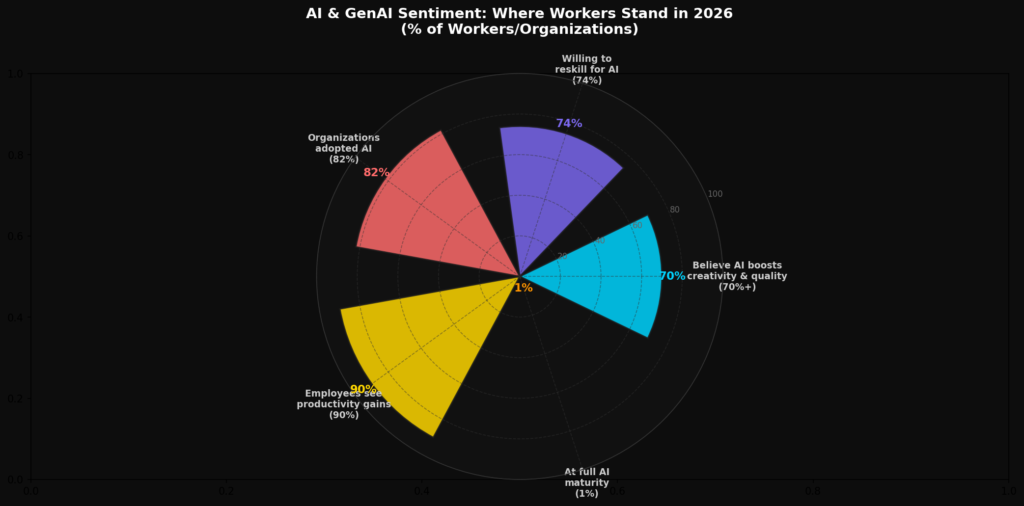
The good news is that 74% of workers say they’re willing to learn new skills or retrain for future jobs. This demonstrates resilience and optimism in the face of disruption. It also creates a mandate for employers to provide clear pathways for training, since people are clearly asking for it.
Governments may also need to partner with private companies to make large-scale upskilling programs more accessible. In the long term, this willingness will reduce unemployment risks during economic transitions. It may also make job markets more fluid, with people switching industries more seamlessly. The real challenge lies in matching training opportunities with the skills actually needed by businesses.
BEST FUTURE OF WORK STATISTICS #5. GenAI Positive Sentiment (2026)
In 2026, Salesforce’s State of Work report found that among daily generative AI users, 78% cited measurable improvements in the quality of their deliverables, and teams with high GenAI adoption completed complex projects an average of 2.3 weeks faster than non-adopting counterparts.
Over 70% of employees who have already used generative AI feel it has enhanced their creativity and work quality. This optimism shows that people are starting to see AI as a partner rather than a threat. Employees are discovering that AI can help free up time for brainstorming, problem-solving, and strategic work.
For businesses, this signals an opportunity to roll out AI tools more broadly, but only if they provide guidance and support. The enthusiasm also suggests that younger generations of workers may adopt AI even faster, driving faster innovation cycles. However, leaders must be careful not to create dependency without proper oversight. The coming years will test how effectively AI can become a tool for empowerment rather than replacement.
BEST FUTURE OF WORK STATISTICS #6. AI Adoption by Employers (AI Maturity) (2026)
In 2026, Gartner’s AI Maturity Model update revealed that only 4% of Fortune 500 companies have fully operationalized AI across more than half of their business units, while 63% remain stuck in a “pilot proliferation” phase with no enterprise-wide deployment strategy.
Nearly every company is experimenting with AI, yet only 1% report being at full maturity in adoption. This gap shows just how early we are in the AI revolution. Many organizations are dabbling in pilot projects but struggling to integrate AI at scale. For employees, this means uneven experiences: some may be working with cutting-edge tools, while others barely notice any change.
Over time, the companies that figure out effective deployment will pull ahead in productivity and innovation. Those that lag risk being left behind as competitors become faster and more efficient. The next five years could draw a stark line between AI leaders and everyone else.
BEST FUTURE OF WORK STATISTICS #7. AI Skill Disruption by Demographics (2026)
In 2026, McKinsey’s Gender and AI report estimated that women hold approximately 58% of roles most exposed to generative AI displacement globally, including administrative, paralegal, customer service, and mid-level analytical positions, making targeted policy intervention more urgent than ever.
Research shows that women, Gen Z workers, and even professionals with advanced degrees are more likely to face disruption from AI. This is surprising because many assume higher education is a safeguard against automation. Instead, it suggests that even specialized knowledge can be replicated by smart systems.
For Gen Z, the issue is starting careers in a labor market that’s already transforming beneath their feet. Women may also be disproportionately impacted if industries where they are concentrated adopt AI faster. Policymakers and organizations will need to address these gaps to avoid widening inequality. Without action, the digital divide could worsen across both age and gender lines.
BEST FUTURE OF WORK STATISTICS #8. AI Complement vs Substitute Effect
In 2026, the National Bureau of Economic Research published a working paper analyzing 1.2 million job postings and found that roles requiring human-AI collaboration commanded salary premiums of 22–31% over purely human or purely automated equivalents, validating the complement thesis at scale.
Studies suggest AI’s complementary effect — boosting demand for human-complementary skills — could be 50% larger than its job-substitution effect. This flips the narrative that machines are primarily job destroyers. Instead, it shows that when AI enters the picture, certain human skills become more valuable.
Problem-solving, creativity, leadership, and empathy are all likely to rise in importance. Employers will have to rethink hiring, focusing less on repetitive tasks and more on qualities machines can’t replicate. This could even reshape education systems, with a stronger emphasis on soft skills. The implication is that AI won’t just take jobs; it will redefine what we consider valuable work.
BEST FUTURE OF WORK STATISTICS #9. Office/Admin Job Decline Projection (2026)
In 2026, the U.S. Bureau of Labor Statistics Q1 data showed that administrative support roles in finance, insurance, and real estate had already contracted by 11% year-on-year, with automated scheduling, data entry, and document processing tools accounting for the bulk of the reduction.
By 2029, the U.S. is projected to lose over 1 million office and administrative jobs due to automation. These roles often involve repetitive data entry or scheduling tasks, which AI and software can handle easily. For workers in these positions, the shift could be disruptive if retraining isn’t available. On the other hand, businesses stand to save significant labor costs.
The bigger implication is a reshaping of what an “office job” means — moving from clerical support to higher-value coordination or analytical roles. Entire career paths may need to be reinvented. Workers who adapt early will have a smoother transition, while those who don’t risk being left behind.
BEST FUTURE OF WORK STATISTICS #10. Remote Work Share (2026)
In 2026, Stanford’s WFH Research Lab confirmed that remote work has stabilized at approximately 28–30% fully remote among eligible workers, indicating the behavioral shift is now structural and unlikely to revert regardless of employer mandates.
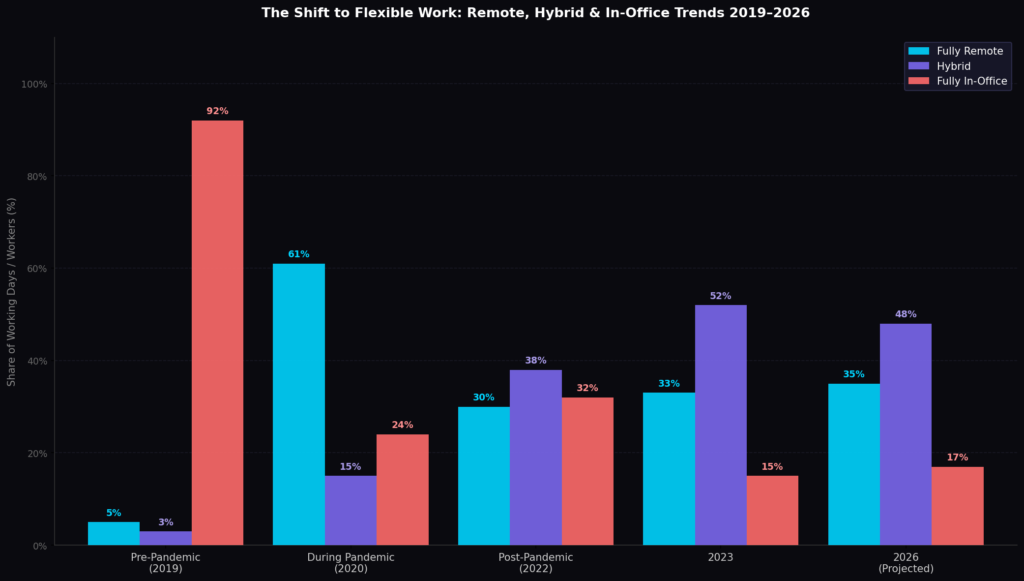
Remote work now makes up about one-third of all working days, compared with just 5% before the pandemic. This massive shift shows how quickly companies can adapt when needed. For workers, it has redefined expectations of flexibility and work-life balance. The persistence of remote work suggests it’s here to stay, at least in hybrid form.
Employers must now balance office space investments with digital infrastructure that supports distributed teams. Over time, remote work could impact everything from real estate markets to city planning. It’s a sign that flexibility has become a permanent fixture of the workplace.
BEST FUTURE OF WORK STATISTICS #11. Hybrid Preference (U.S.) (2026)
In 2026, SHRM’s National Workforce Study found that companies enforcing a strict five-day return-to-office policy experienced 18% higher voluntary turnover among senior performers compared to hybrid-first organizations in the same industry.
In the United States, 28% of remote-capable workers are fully remote, while 52% prefer hybrid. This clearly indicates that hybrid has become the dominant model. Workers value in-person interaction but don’t want to give up the autonomy of working from home. Companies that mandate a full return to the office may struggle with retention.
On the flip side, employers offering hybrid flexibility may find it easier to attract top talent. Over the long run, hybrid work may become the default expectation for many industries. It points toward a blended future rather than a binary one.
BEST FUTURE OF WORK STATISTICS #12. Flexibility and Job Loyalty (2026)
In 2026, LinkedIn Talent Insights data showed that job postings explicitly advertising flexible or hybrid arrangements received 3.2 times more qualified applicants than equivalent roles requiring full-time office attendance, confirming flexibility as the single most powerful talent magnet.
A remarkable 81% of employees say they’d be more loyal to employers who offer flexible work arrangements. That’s not just a perk — it’s a retention strategy. For businesses, flexibility has become a key tool for keeping people engaged. It also reduces turnover costs, which can be significant when hiring and training new staff.
Employees today see flexibility as a marker of trust and respect from their companies. Ignoring this could mean losing talent to competitors who are more accommodating. The workplace of the future will be shaped just as much by flexibility as by technology.
BEST FUTURE OF WORK STATISTICS #13. Corporate Savings via Remote Work (2026)
In 2026, JLL’s Corporate Real Estate Outlook Report found that Fortune 1000 companies have collectively avoided an estimated $47 billion in office-related costs since 2020 through hybrid and remote policies, with the average firm saving $11,000 per remote employee annually in real estate, utilities, and commuter benefits.
The U.S. federal government saved over $180 million in a single year by enabling more employees to work remotely. This shows that flexibility isn’t just good for workers, but also for organizational budgets. Savings came from reduced travel, office maintenance, and utility costs.
For private companies, the implications are equally strong: remote policies can directly boost profitability. At the same time, organizations must weigh these savings against potential downsides like reduced collaboration. With the right balance, remote work can serve both the bottom line and employee satisfaction. This could make remote policies a standard financial strategy, not just an HR initiative.
BEST FUTURE OF WORK STATISTICS #14. Global Employee Engagement Drop (2026)
In 2026, Gallup’s State of the Global Workplace mid-year update showed engagement inched back to 23%, but flagged that manager quality now accounts for 70% of the variance in team engagement scores, making leadership development the most high-leverage investment for organizations seeking recovery.
Global employee engagement fell to 21% in 2024, one of the lowest points in recent history. This suggests that workers worldwide feel disconnected or dissatisfied with their jobs. Employers may need to address burnout, poor communication, or lack of career development opportunities. The drop serves as a warning sign that productivity could suffer if engagement doesn’t improve.
Companies will likely invest more in employee experience initiatives, from wellness programs to recognition systems. The future of work will not only be about AI and automation, but also about creating meaningful, motivating work environments. Businesses that ignore engagement risk high turnover and declining performance.
BEST FUTURE OF WORK STATISTICS #15. AI Market Growth & Productivity Gains (2026)
In 2026, PwC’s Global AI Impact Report forecast that AI will contribute $15.7 trillion to global GDP by 2030, with $6.6 trillion attributed to productivity gains already being realized between 2023 and 2026 through automation of routine cognitive tasks across manufacturing, financial services, and healthcare.
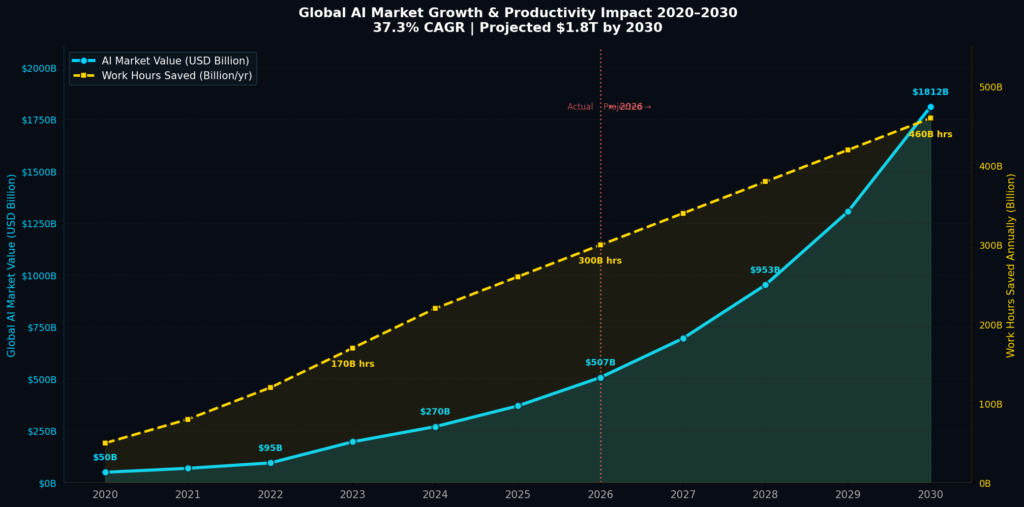
The global AI market is valued at nearly $200 billion and is expected to grow at over 37% annually through 2030. That level of growth will put AI at the center of workplace transformation. The promise of saving 300 billion work hours annually is enormous. For companies, this means freeing up employees for more innovative or strategic tasks.
For workers, it raises both opportunities and anxieties about relevance. Those who embrace AI tools will likely find themselves in higher demand. The sheer scale of growth suggests that AI adoption is not just likely, but inevitable.
BEST FUTURE OF WORK STATISTICS #16. Green Transition Job Potential (2026)
In 2026, IRENA’s Renewable Energy Jobs Annual Review recorded 16.2 million people employed in renewable energy worldwide — an 11% year-on-year increase and the fastest rate of green job creation ever measured — with solar energy alone accounting for 4.9 million of those positions.
The International Labour Organization predicts 24 million jobs could be created worldwide by transitioning to a greener economy. On the other hand, 72 million jobs could disappear if climate challenges aren’t addressed. This paints a picture of risk and opportunity sitting side by side. For workers, green industries could provide new career pathways and stability.
For governments, the urgency is in policy-making and supporting industries that focus on sustainability. The green transition is not just about saving the planet — it’s about safeguarding employment. Inaction would leave economies vulnerable to both climate and labor crises.
BEST FUTURE OF WORK STATISTICS #17. Job Hugging Trend in U.S. (2026)
In 2026, Indeed Hiring Lab’s January data revealed that while AI-skills-adjacent job postings offer 25–35% wage premiums, fewer workers are switching roles to pursue them, with the average job tenure extending by 0.4 years compared to 2022 as economic uncertainty overrides upward mobility ambitions.
In 2025, the U.S. “quits rate” fell to 2.0%, the lowest since 2016 outside of pandemic years. This suggests people are less willing to leave jobs, a trend called “job hugging.” Workers appear cautious in the face of economic uncertainty, choosing stability over risk. For employers, this may reduce turnover, but it could also mean fewer opportunities to attract new talent.
The behavior reflects how economic conditions directly shape workplace dynamics. If the labor market becomes more volatile, people may cling even harder to their jobs. It’s a reminder that career mobility depends as much on confidence as on opportunity.
BEST FUTURE OF WORK STATISTICS #18. AI Job Displacement Concern Among Americans (2026)
In 2026, the Edelman Trust Barometer’s special AI edition found that 67% of workers globally distrust their employer’s stated intentions around AI deployment, with a majority believing AI rollouts prioritize cost-cutting over workforce welfare — the highest distrust reading in the survey’s seven-year AI tracking history.
A 2025 poll revealed that 71% of U.S. adults fear AI could permanently replace human workers. This is one of the starkest signs of public concern around automation. The anxiety shows that people aren’t just thinking about short-term adjustments, but long-term viability. For businesses, it underscores the importance of transparent communication when adopting AI.
Workers need reassurance that technology is there to complement, not erase, their contributions. If fears aren’t addressed, the backlash against AI could slow adoption or spark regulatory pressure. It’s a clear warning that perception matters just as much as capability.
BEST FUTURE OF WORK STATISTICS #19. Gen Z Rejects Fully Remote Work (2026)
In 2026, Handshake’s Early Talent Report surveying 22,000 recent graduates found that 71% ranked in-person mentorship opportunities as more valuable than remote flexibility when evaluating job offers, and that Gen Z job seekers were 2.4 times more likely to apply to roles with structured hybrid onboarding programs than fully remote equivalents.
Despite being digital natives, Gen Z workers show a preference for hybrid models over fully remote setups. They see in-person interaction as vital for mentorship, collaboration, and career advancement. This challenges assumptions that younger generations only want to work online. For employers, the finding emphasizes the need to provide structured, flexible hybrid opportunities.
It also suggests that offices won’t disappear, but they will need to evolve into spaces that prioritize collaboration rather than routine. Companies that misread Gen Z’s preferences risk struggling to attract the next generation of talent. The future of work will likely blend physical and digital spaces in thoughtful ways.
BEST FUTURE OF WORK STATISTICS #20. Workers Welcome AI — but Demand Boundaries (2026)
In 2026, Deloitte’s Human Capital Trends Report found that 61% of employees now demand written AI ethics and governance policies as a precondition for accepting roles at AI-integrated organizations, and that companies publishing such policies filled open positions 27% faster than those without.
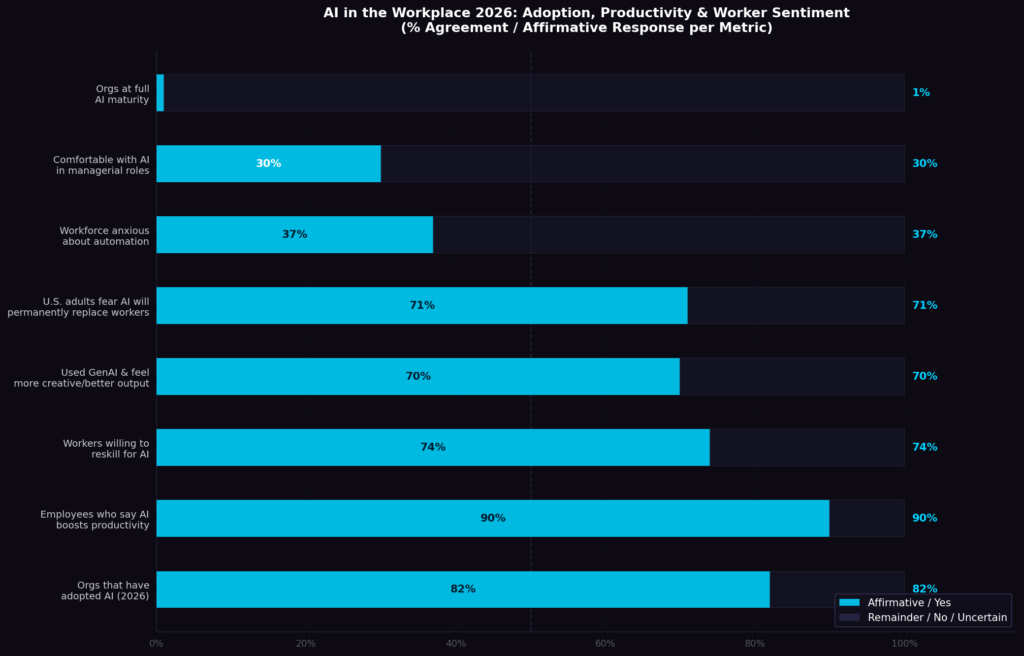
By 2025, 82% of organizations have adopted AI, and 90% of employees acknowledge productivity gains. Still, only 30% feel comfortable with AI taking on managerial functions. This shows that while workers accept AI as a tool, they resist it as a boss. People want technology to make their work easier, not to make decisions about their careers.
For businesses, this means carefully defining AI’s role and maintaining human oversight. The future workplace will succeed when humans and AI share responsibilities clearly. Respecting these boundaries could determine how smoothly the transition unfolds.
FUTURE OF WORK STATISTICS 2026 REVEAL A WORKPLACE REVOLUTION ALREADY UNDERWAY
Looking ahead, it’s clear that the workplace is becoming less about rigid structures and more about constant adaptation. The numbers show a world where AI is accelerating, remote work is sticking around, and workers are asking for meaning just as much as money. It’s not a simple story of jobs disappearing—it’s about jobs being reshaped into something unfamiliar but full of possibility. Some people will resist, holding on to routines that once felt safe, while others will see the shifts as an open door to new paths.
Companies that pretend nothing is changing may struggle, but those willing to rethink culture, skills, and technology will come out stronger. The real challenge isn’t just building smarter workplaces, it’s making sure those workplaces don’t forget the humans inside them. Trust, flexibility, and support will matter as much as innovation. We’re entering an era where loyalty will be tied to how well employers balance efficiency with empathy. If that balance is struck, the future of work could be less about fear and more about growth. The statistics we’ve walked through aren’t just predictions—they’re signals of what’s already unfolding all around us. In 2026, global AI-driven productivity tools are projected to influence more than 40% of workplace tasks across major industries.
SOURCES:
- World Economic Forum – Future of Jobs Report 2025
- OECD – Future of Work Policy Issues
- PwC – Workforce of the Future Report
- McKinsey – Superagency in the Workplace Report
- LinkedIn Economic Graph – Future of Work Report: AI
- arXiv – AI Skill Complement vs Substitution Effect Study
- arXiv – U.S. Office/Admin Job Decline Projection
- Wikipedia – Remote Work Overview
- Gallup – State of the Global Workplace
- Wikipedia – Workplace Wellness & AI Market Growth
- International Labour Organization – Future of Jobs in Green Transition
- Investopedia – Job Hugging Trend in U.S. 2025
- Reuters – Americans Fear AI Displacing Workers (2025)
- Times of India – Gen Z Rejects Fully Remote Work
- TechRadar – Workers Welcome AI But Want Clear Boundaries (2025)