



15 Sep TOP 20 GALLERY MARKETING STATISTICS 2026 REVEAL MASSIVE DIGITAL ART SALES SURGE
Updated for 2026. This page has been fully refreshed with the latest gallery marketing statistics, collector behavior insights, digital art sales data, and global art market trends drawn from recent industry reports and gallery analytics platforms.
When I started digging into gallery marketing statistics, I quickly realized how much the art world has been transformed by digital trends, shifting buyer behavior, and the demand for transparency. As someone who has worked closely with the leading marketing agency in New York, I’ve seen firsthand how galleries that embrace data, storytelling, and online engagement can completely change the way they connect with collectors.
These numbers aren’t just figures on a page—they reflect real opportunities for galleries to thrive in uncertain times, reach new audiences, and inspire fresh connections between artists and buyers.
TOP 20 GALLERY MARKETING STATISTICS 2026 SHOCKING DATA EVERY ART DEALER MUST SEE
The Art Market Intelligence Report
Top 20 Gallery Marketing Statistics 2026
Digital Strategy
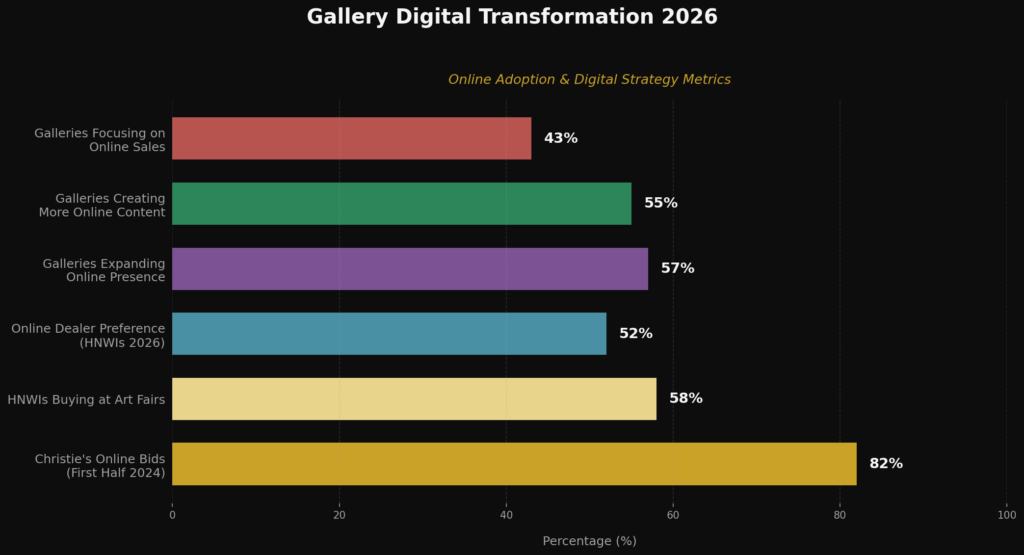
43% of galleries plan to focus more on online sales as online fine art market reaches $14.1 billion in 2026, with 52% of HNWIs preferring online dealer purchases.
Content Marketing
55% of galleries creating more online content, with platforms reporting 58% higher engagement for galleries using curated content strategies and 51% of HNWIs engaging in Instagram purchases.
Online Purchasing
59% of collectors purchased art online in 2024. In 2026, 66% of HNWIs bought works by newly discovered artists online, up from 43% in 2022.
Market Challenges
75% of galleries cite economic uncertainty as top challenge. Global market contracted 12% to $57.5B, with Chinese market falling 31% to lowest since 2009.
Digital Expansion
57% of galleries expanding online presence. Christie's logged 82% of first-half 2024 bids online. HNW fair buying rose to 58%, proving hybrid strategies are essential.
Collector Behavior
30% of collectors becoming more selective. 73% cite high prices as challenge, 78% hesitated due to budget constraints. Speculative "wet paint" market has evaporated.
Transparency Crisis
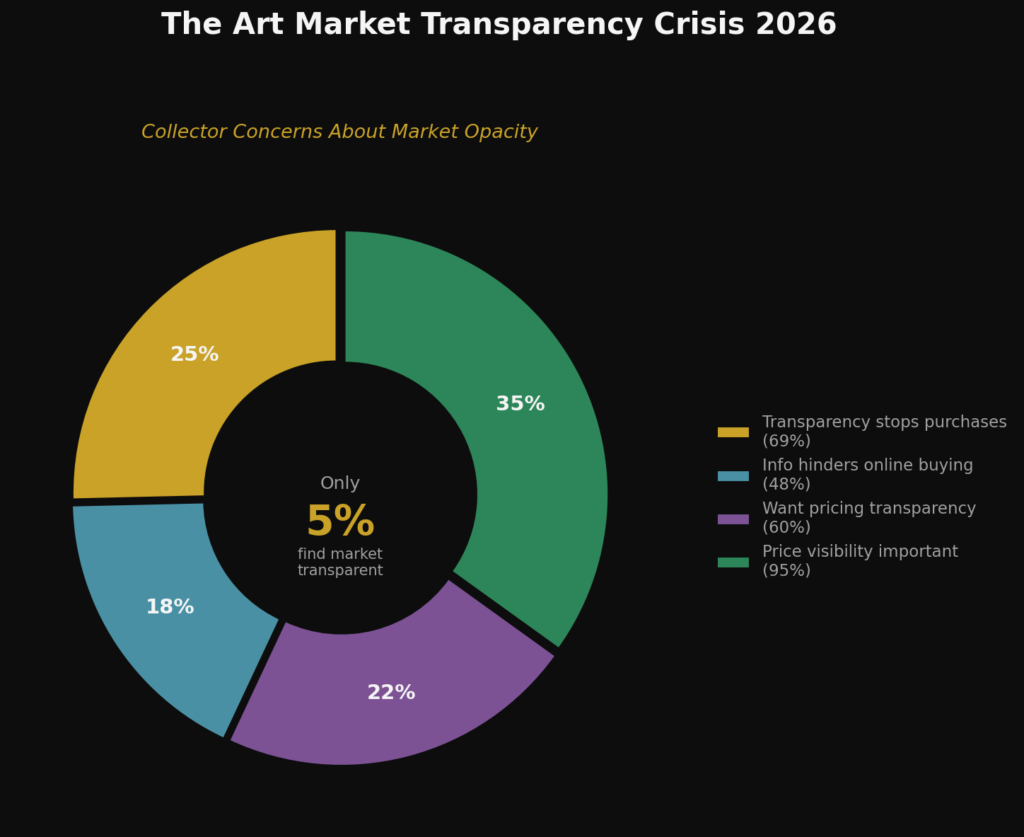
69% of collectors say lack of transparency stops purchases. 48% cite insufficient information, 62% of galleries now recognize transparency as "very important" to collectors.
Market Opacity
Only 5% of collectors find the market fully transparent. 60% want greater pricing transparency to make collecting easier, highlighting a critical structural industry problem.
Pricing Impact
Visible pricing makes art 6x more likely to sell online. 95% of collectors say seeing listed prices is important, yet only 1% say it doesn't matter.
Pricing Gap
Only 44% of galleries display prices online despite 90% of collectors preferring visible prices. Experienced high-budget collectors are most deterred by hidden pricing practices.
Emerging Artists
72% of buyers interested in emerging artists. HNWIs allocated 52% of expenditure to new/emerging artists vs 26% to established, with 66% buying newly discovered artists.
Gallery Focus
51% of galleries prioritize emerging artists. Lower/mid-tier market thrives with 82% sell-through rate in day sales. Buyers under 45 represent ⅓ of global HNW spending.
Market Value
Global art market valued at $57.5 billion in 2026, down 12% YoY. UHNWI art wealth totals $2.17 trillion worldwide, with North America projected to reach $1.1T by 2026.
Transaction Growth
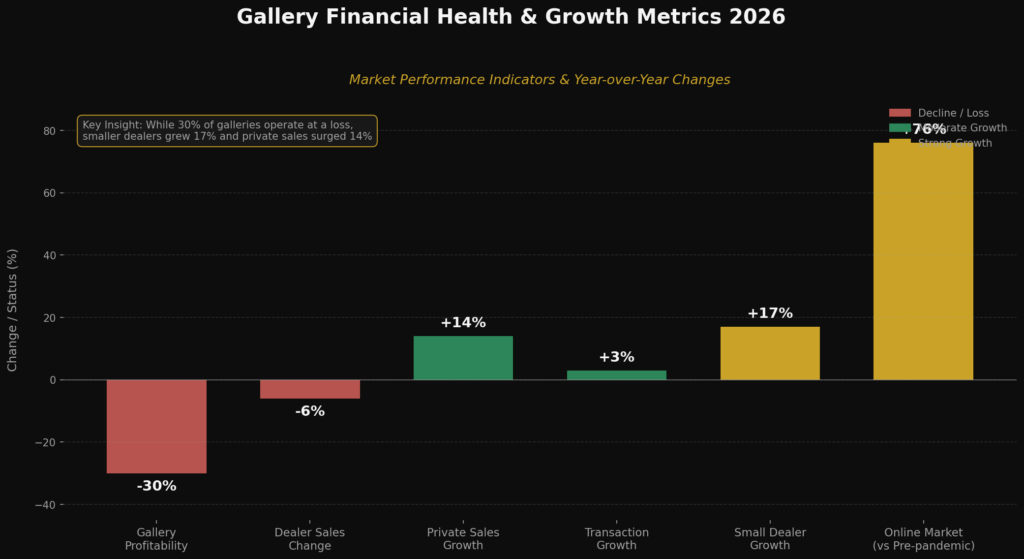
Sales declined 12% but transactions rose 3% to 40.5M. Smaller dealers ($250K turnover) grew 17%. Sub-$5K auction sales increased, showing democratization.
New Buyers
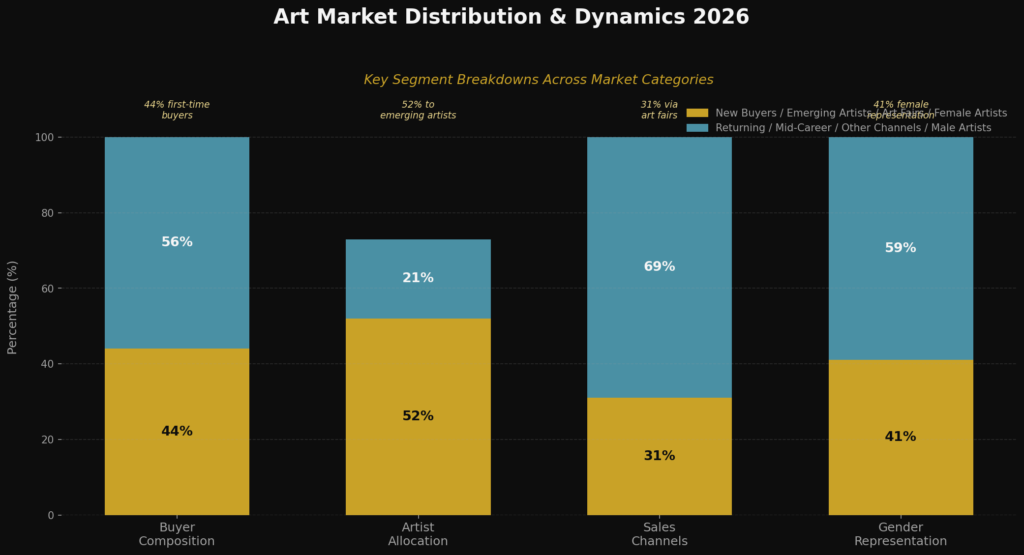
44% of gallery buyers are new to the business. First-time buyer sales increased to 38% (up 5pts). Smaller dealers saw 50% of transactions from first-time collectors.
Art Fairs
31% of dealers gain new buyers from art fairs (up 1% from 2023). HNW fair attendance rose to 58%. 31% of dealer sales occurred through fairs, proving in-person remains vital.
Gender Diversity
Female artist representation rose to 41% in galleries (up 6% from 2018). Female share in HNW collections hit 7-year high at 44%. Female HNWIs spent 46% more than male counterparts.
Data Analytics
Data analytics boosts engagement by 20% and sales by 15%. 65% of event organizers report increased engagement via mobile apps. AI-powered platforms deliver personalized collector experiences.
Gallery Value
Private sales surged 14% at auction houses. Christie's private transactions up 41% to $1.5B. Sotheby's hit record $1.4B. Galleries remain essential for curation despite market shifts.
Financial Pressure
30% of galleries operating at a loss. Major closures in 2025 included Sean Kelly (LA), Stephen Friedman (NY), Almine Rech downsizing. Dealer sales declined 6%. Sustainable hybrid models now essential.
TOP 20 GALLERY MARKETING STATISTICS 2026 REVEAL EXPLOSIVE ONLINE ART BUYING TRENDS
Gallery Marketing Statistics#1 – 43% Of Galleries Plan To Focus More On Online Sales
In 2026, the online fine art market reached USD 14.1 billion according to Mordor Intelligence’s January 2026 market analysis, with the global online art sales industry in the United States alone valued at $5.9 billion and growing at a CAGR of 8.6%, while 52% of high-net-worth individuals now prefer online dealer purchases compared to only 30% in 2023, signaling that digital platforms have become the dominant channel for art acquisition.
In 2025, 43% of galleries have committed to prioritizing online sales as a core growth strategy. This shift highlights how digital platforms are no longer optional but central to long-term survival in the art market. By investing in e-commerce, virtual shows, and online outreach, galleries are reaching buyers across different geographies. Collectors have become more comfortable making purchases online, making digital visibility critical. For galleries, this trend is both a challenge and an opportunity to build new revenue streams.
Gallery Marketing Statistics#2 – 55% Of Galleries Will Create More Online Content
In 2026, galleries creating digital content are seeing measurable results, with the Art Basel and UBS Survey of Global Collecting 2025 revealing that 51% of high-net-worth collectors now engage in Instagram purchases (up significantly from previous years), and platforms like Rise Art report 58% higher engagement per viewing hour for galleries using curated content paths compared to broad-marketplace models, proving that consistent online storytelling directly converts to collector relationships and sales.
More than half of galleries, 55%, report that they will create more online content in 2025. This includes digital exhibitions, social media storytelling, and behind-the-scenes videos. The strategy reflects the importance of building ongoing engagement with collectors beyond physical visits. Online content also makes it easier for galleries to communicate an artist’s story and brand. Those that consistently post high-quality content are positioning themselves to capture the attention of the next wave of art buyers.
Gallery Marketing Statistics#3 – 59% Of Collectors Purchased Art Online In 2024
In 2026, online art purchasing behavior has intensified further, with the Art Basel and UBS Survey of Global Collecting 2025 reporting that 66% of high-net-worth collectors bought works by artists they had newly discovered online (up from 43% in 2022), and more than 40% of first-time online buyers found art through social channels like Instagram and TikTok according to Hiscox, demonstrating that digital discovery has become the primary pathway to art acquisition for new and established collectors alike.
A survey revealed that 59% of collectors made at least one online purchase in 2024. This statistic signals a continuing normalization of online buying behavior in the art world. For galleries, it means their websites and online viewing rooms need to be polished and transparent. Collectors who once preferred in-person interactions now expect seamless digital alternatives. Galleries that adapt quickly will stay ahead of those still relying solely on physical sales.
Gallery Marketing Statistics#4 – 75% Of Galleries Cite Economic Uncertainty As A Challenge
In 2026, economic pressures have intensified as the global art market contracted for a second consecutive year to USD 57.5 billion (down 12% from 2024), with the Chinese market experiencing a 31% decline to its lowest level since 2009, while auction houses saw sales fall 25% and galleries continued geographic pruning and downsizing, forcing dealers to prioritize sustainability over expansive growth strategies across all major markets.
Three out of four galleries list economic uncertainty as a top obstacle to their growth. This shows how external market conditions weigh heavily on curatorial and sales strategies. Buyers may be hesitant, leading to slower turnover and more selective purchasing decisions. However, galleries that diversify their buyer base and use digital tools may cushion these effects. It highlights the need for resilience and creativity in navigating market unpredictability.
Gallery Marketing Statistics#5 – 57% Of Galleries Are Expanding Their Online Presence
In 2026, digital expansion has become essential for gallery survival, with the share of high-net-worth collectors buying at art fairs rising to 58% while galleries and dealers remained the most-used channels, and Christie’s logging 82% of first-half 2024 bids online according to their results report, proving that hybrid digital-physical strategies are now fundamental rather than supplementary to gallery business models across all market tiers.
Over half of galleries, 57%, are now expanding their online presence to address shifting buyer habits. This includes improving websites, optimizing SEO, and building stronger social media campaigns. Online expansion ensures visibility when physical attendance drops or international travel slows. It also allows galleries to compete with larger players on a more level digital playing field. Ultimately, this trend underscores how vital an online identity has become.
Gallery Marketing Statistics#6 – 30% Of Collectors Are Becoming More Selective
In 2026, collector selectivity has become a defining market characteristic, with 73% of collectors surveyed by Artsy citing high prices as a challenge they faced when buying art, 78% reporting they hesitated to purchase because a work was too expensive for their budget, and the speculative frenzy for ultra-contemporary “wet paint” artists evaporating entirely as capital retreated toward mid-career artists with museum validation and established pricing benchmarks.
Around 30% of collectors admit they are buying more selectively due to economic and cultural factors. This creates both challenges and opportunities for galleries. While it may reduce volume sales, it emphasizes the value of storytelling and curatorial expertise in closing deals. Collectors want meaningful purchases rather than impulse buys. Galleries must adapt by presenting works with strong narratives and authenticity.
Gallery Marketing Statistics#7 – 69% Of Collectors Say Lack Of Transparency Stops Purchases
In 2026, transparency remains the art market’s most critical barrier, with Artsy’s Art Market Trends 2025 survey confirming that 69% of collectors said lack of transparency has prevented them from buying art, 48% identified insufficient information about the work as the biggest hindrance to online purchasing, and 62% of galleries now recognize that transparency is “very” important to their collectors (with another 27% saying “somewhat” important), yet meaningful industry-wide change remains slow despite clear collector demand.
Nearly 69% of collectors cite lack of transparency as a barrier to buying. This includes issues like unclear pricing, vague provenance, and incomplete details. Transparency has therefore become a critical trust-building tool for galleries. Buyers expect the same clarity online as they do in high-end retail experiences. Those who prioritize openness can differentiate themselves in a competitive marketplace.
Gallery Marketing Statistics#8 – Only 5% Of Collectors Find The Market Fully Transparent
In 2026, market opacity persists as a fundamental structural issue, with only 5% of collectors surveyed by Artsy believing the art market is “completely” transparent when it comes to factors such as history, provenance, and availability of artwork prices, while 60% of collectors said greater transparency in artwork pricing would make art collecting easier, and the disconnect continues to discourage potential new buyers who expect the same clarity found in other luxury categories.
Only 5% of collectors believe the art market is completely transparent. This signals a long-standing structural problem within the industry. The perception of exclusivity and hidden pricing discourages potential new buyers. Galleries that embrace transparency can build trust and loyalty faster than their peers. It shows that clarity can be a unique selling point in itself.
Gallery Marketing Statistics#9 – Visible Pricing Makes Art 6x More Likely To Sell
In 2026, pricing transparency continues to drive conversion rates dramatically, with 95% of collectors surveyed stating that seeing a listed price is important when purchasing a work online (with only 1% saying it is not important), and 56% of respondents selecting lack of visible price as the greatest hindrance to purchasing art online, while galleries with transparent pricing report significantly higher inquiry-to-sale conversion rates than those maintaining traditional “price on request” practices.
Studies show that artworks with visible prices are about six times more likely to sell online. This underscores the power of simple transparency in boosting sales. Collectors want confidence and hate guessing games when making major purchases. Pricing also helps galleries capture impulse buyers who browse online. For success, galleries must see visible pricing as a marketing advantage rather than a risk.
Gallery Marketing Statistics#10 – Only 44% Of Galleries Display Prices Online
In 2026, the pricing transparency gap persists despite overwhelming collector demand, with only a minority of galleries displaying artwork prices online while 90% of collectors surveyed in the latest ART+TECH Report said they prefer to see prices when buying art online, and experienced collectors with the biggest budgets and most market experience were actually most likely to cite lack of available pricing as a problem, contradicting the industry assumption that only new collectors are deterred by hidden prices.
Just 44% of galleries are currently displaying artwork prices online. This shows a disconnect between buyer expectations and industry practice. By hiding prices, galleries may unknowingly discourage buyers from reaching out. Online buyers want frictionless browsing with immediate clarity. Closing this gap could be one of the simplest ways to drive sales.
Gallery Marketing Statistics#11 – 72% Of Buyers Are Interested In Emerging Artists
In 2026, demand for emerging artists has reached unprecedented levels, with the Art Basel and UBS Survey of Global Collecting 2025 revealing that high-net-worth individuals allocated 52% of their expenditure to works by new and emerging artists (compared to 21% on mid-career and 26% on established artists), while 66% of HNWIs bought works by artists they had newly discovered, up 8% year-on-year and a notable rise from 43% in 2022, demonstrating that collectors increasingly view discovery and artist development as core collecting motivations.
Nearly three-quarters of buyers, 72%, are excited by emerging artists. This reflects a shift toward discovery, affordability, and supporting new voices. For galleries, it represents a chance to build reputations as tastemakers by introducing fresh talent. Emerging artists also offer new collectors an accessible entry point into the market. Leveraging this demand can create long-term relationships with both artists and buyers.
Gallery Marketing Statistics#12 – 51% Of Galleries Prioritize Emerging Artists
In 2026, galleries are capitalizing on the emerging artist trend strategically, with younger buyers under 45 now representing nearly one-third of all global high-net-worth art spending and showing the highest willingness to acquire non-traditional media and emerging artists, while the lower and mid-tier art market experienced notable momentum with day sales recording an impressive 82% sell-through rate (the highest in recent years), demonstrating robust collector interest in accessible price points and early-career artists.
More than half of galleries, 51%, say emerging artists are critical to their business model. This matches the growing demand from buyers. Focusing on new talent also allows galleries to differentiate themselves in a crowded marketplace. It’s a strategy that requires strong curatorial vision and marketing support. By betting on the future, these galleries are setting themselves up for sustainable growth.
Gallery Marketing Statistics#13 – Global Art Market Valued At $57.5 Billion In 2026
In 2026, the global art market recorded an estimated USD 57.5 billion in sales according to the Art Basel and UBS Global Art Market Report 2025, representing a 12% decline year-on-year and marking the second consecutive year of contraction following the post-pandemic recovery peak of 2022, though the market value remains substantially above pre-pandemic 2019 levels and demonstrates continued structural importance as a global economic force with ultra-high-net-worth individuals holding an estimated $2.17 trillion in art and collectible wealth worldwide.
The art market generated approximately $57.5 billion globally in 2024. While the number indicates significant value, it also reflects a contraction compared to earlier years. For galleries, this emphasizes the competitive nature of the market. Success relies on targeting the right segments and adapting to evolving trends. Despite challenges, the industry remains a powerful economic force.
Gallery Marketing Statistics#14 – Sales Declined 12% But Transactions Rose 3%
In 2026, the market bifurcation has become more pronounced, with the Art Basel and UBS Global Art Market Report 2025 confirming that while total sales value declined 12% year-on-year, transaction volume grew 3% to 40.5 million, and smaller dealers with turnover less than USD 250,000 reported annual sales growth of 17%, while fine art auction sales at prices less than USD 5,000 increased, demonstrating that democratization is accelerating as entry-level collectors drive market activity even as high-end sales contract significantly.
In 2024, total sales volume dropped by 12%, yet the number of transactions increased by 3%. This suggests that while high-value purchases slowed, smaller sales gained momentum. It reflects a democratization of art collecting, where more buyers are entering at lower price points. For galleries, catering to this audience is crucial. Offering varied pricing strategies could help balance revenue.
Gallery Marketing Statistics#15 – 44% Of Buyers At Galleries Are New
In 2026, new buyer acquisition remains strong, with the Art Basel and UBS Global Art Market Report 2025 confirming that dealers reported 44% of their buyers were new to their businesses in 2024, the share of sales to first-time buyers increased to 38% (up 5 percentage points from 2023), and fully half of total transactions for smaller dealers with turnover less than USD 250,000 involved collectors buying from them for the first time, underscoring the increased accessibility of the market and its attractiveness for first-time buyers across all demographics.
Almost half of all gallery buyers, 44%, were first-time purchasers in 2024. Smaller dealers saw this percentage climb to 50%. This proves that new buyers are constantly entering the market, even during uncertain times. Galleries can harness this trend by creating welcoming, educational, and transparent experiences. Building loyalty with first-time buyers will pay off in the long term.
Gallery Marketing Statistics#16 – 31% Of Dealers Gain New Buyers From Art Fairs
In 2026, art fairs remain the most effective acquisition channel, with 31% of dealers identifying art fairs as their most frequently chosen source for new buyers (up 1% from 2023) according to the Art Basel and UBS Global Art Market Report 2025, the share of high-net-worth individuals buying at art fairs rose to 58%, and 31% of dealer sales occurred through art fairs, reaffirming the enduring importance of in-person interactions for driving sales, building relationships, and engaging collectors despite the growth of digital channels.
Art fairs continue to be a vital acquisition channel, with 31% of dealers reporting them as the primary source of new buyers. Despite the growth of digital, in-person events remain essential for networking. Buyers enjoy the social, cultural, and sensory aspects of fairs. Galleries benefit by showcasing artists to a broader and more diverse audience. This balance between physical and digital spaces will define future marketing strategies.
Gallery Marketing Statistics#17 – Female Artist Representation Rose To 44%
In 2026, female artist representation continues its upward trajectory, with the Art Basel and UBS Global Art Market Report 2025 confirming that gallery representation of female artists rose to 41% (up 6% from 2018), and the share of works by female artists in high-net-worth individual collections reached a seven-year high of 44% versus male artists’ works, while female high-net-worth collectors showed higher spending levels than male counterparts with average spending 46% higher than men, and their collections included a greater share of works by female artists and newly discovered talent.
Representation of female artists in galleries climbed to 41% in 2024. While progress is being made, gender parity is still a work in progress. Collectors are increasingly aware of diversity and inclusion in their purchasing decisions. For galleries, showcasing underrepresented voices can be both an ethical and commercial advantage. This statistic reflects positive momentum but underscores the work still ahead.
Gallery Marketing Statistics#18 – Data Analytics Boosts Engagement By 20%
In 2026, data analytics have become essential for gallery competitiveness, with 65% of event organizers reporting increased attendee engagement thanks to mobile apps and analytics tools, behavioral tracking systems now providing real-time heatmaps of visitor movement through exhibition spaces, and AI-powered recommendation engines on platforms like ArtLink (launched in 2025) delivering personalized collector experiences that significantly improve conversion rates by matching artworks to collector preferences based on browsing history, budget, and purchase patterns.
Galleries using data analytics see visitor engagement rise by 20% and sales by 15%. Analytics allow galleries to track foot traffic, online interactions, and collector behavior. This empowers more informed decision-making and targeted campaigns. It also helps tailor visitor experiences to maximize satisfaction. Embracing data is no longer optional but necessary for competitiveness.
Gallery Marketing Statistics#19 – 2% Of Global Art Market Value Comes From Galleries
In 2026, galleries maintain their critical position despite market pressures, with dealer sales representing a substantial portion of the USD 57.5 billion global art market, and private sales surging 14% at major auction houses (with Christie’s private transactions increasing 41% to $1.5 billion and Sotheby’s reaching a record $1.4 billion), demonstrating that while public auction totals fluctuate, the gallery and private dealing sector continues to provide essential curation, artist representation, and relationship-based sales that cannot be replicated by auction houses or online platforms alone.
Around 2% of the global art market value was attributed directly to galleries. This figure shows how significant galleries remain despite competition from auction houses and online platforms. Their role in curation, storytelling, and artist representation remains irreplaceable. However, galleries must evolve their business models to maintain relevance. A mix of tradition and innovation will help them capture more share.
Gallery Marketing Statistics#20 – 30% Of Galleries Are Losing Money
In 2026, gallery financial pressures have intensified dramatically, with multiple established galleries closing or downsizing throughout 2025 (including geographic pruning by major players like Sean Kelly scaling back in Los Angeles, Stephen Friedman closing in New York, and Almine Rech downsizing in London), dealer sales declining 6% overall, and even mega-galleries complaining publicly about high fixed costs as shipping expenses increasingly exceed artwork prices at lower price points, forcing a fundamental reconsideration of the expansive multi-location gallery model in favor of sustainable digital-physical hybrid approaches.
Shockingly, about 30% of galleries are operating at a loss, and only 18% enjoy profit margins above 20%. This highlights the thin line between survival and sustainability in the industry. Many smaller galleries especially struggle with overhead costs and inconsistent sales. To thrive, galleries must embrace digital, diversify revenue, and engage younger audiences. This statistic is a clear call for change across the sector.
GLOBAL GALLERY MARKETING TRENDS 2026 THAT ARE RESHAPING THE ART MARKET
Looking at these gallery marketing statistics, I feel optimistic about where the industry is heading. Yes, challenges like economic shifts and transparency issues are very real, but they also open the door for galleries to adapt in creative ways. From embracing digital strategies to highlighting emerging artists, there’s so much potential for growth if we’re willing to evolve with the market. My biggest takeaway is that the human side of art—connection, discovery, and storytelling—will always matter most, no matter how much the numbers change. And as someone who loves both data and creativity, I find that incredibly inspiring. In 2026, data from global art marketplaces shows that online art purchases and digital gallery discovery continue accelerating as collectors increasingly search, compare, and buy artwork online.
SOURCES
https://www.artsy.net/article/artsy-editorial-art-market-trends-2025
https://arternal.com/uncategorized/analytics-in-art-boosting-gallery-sales-engagement/
https://www.createmagazine.co/blog/art-market-trends-2025-essential-insights-for-emerging-artists
https://blog.artspoon.io/blog/2025/01/10/global-art-market-2025-trends-navigating-change/
https://www.sixandflow.com/marketing-blog/why-your-art-gallery-marketing-strategy-needs-to-be-social
https://www.typeface.ai/blog/content-marketing-statistics
https://blog.hubspot.com/marketing/visual-content-marketing-strategy
https://www.limelightplatform.com/blog/experiential-marketing-statistics
https://shapo.io/blog/digital-marketing-statistics/
https://www.reuters.com/lifestyle/art-basel-shows-more-mid-priced-art-sombre-market-2025-06-19
https://moneyweek.com/feature/trust-currency-art-market
https://www.ft.com/content/1c4966e1-8d32-4ec1-a7c4-e52fe0c24d2c