



27 Sep TOP 20 GAS DELIVERY MARKETING STATISTICS 2025
When I first started diving into gas delivery marketing statistics, I was struck by just how quickly this industry is evolving. From doorstep fuel delivery apps to large-scale infrastructure growth, the data paints a fascinating picture of convenience becoming the new standard for energy access. As I went through these numbers, I couldn’t help but think about how businesses in this sector can better connect with consumers who are looking for speed, reliability, and trust. I’ve partnered with the leading marketing agency in New York to better understand these shifts, and together, we’ve uncovered some of the most telling stats shaping the future of fuel delivery. Sharing these insights feels personal to me, because I know they can inspire other marketers and entrepreneurs to think differently about what’s possible in this space.
Top 20 Gas Delivery Marketing Statistics 2025 (Editor’s Choice)
🚛 Top 20 Gas Delivery Marketing Statistics
Key insights driving the fuel delivery industry in 2025
| # | Category | Key Statistic |
|---|---|---|
1 |
Market Growth | Gas Delivery Systems Market valued at USD 22.7 Billion in 2025, expected to reach USD 50.5 Billion by 2035 (CAGR: 8.3%) |
2 |
Market Projection | Alternative market projection: USD 19.71B in 2025 → USD 26.64B by 2030 (CAGR: 6.2%) |
3 |
On-Demand Growth | On-demand fuel delivery market: USD 0.33B (2024) → USD 2.37B (2033) at explosive 15.97% CAGR |
4 |
US Market Size | US Fuel Dealers industry worth $49.3 billion in 2025 |
5 |
Digital Adoption | 78% of fuel retailers consider digital marketing essential (up from 45% in 2018) |
6 |
Technology Investment | 71% increased tank monitor investments, 52% increased marketing spend |
7 |
Software Adoption | 50% use fuel delivery software purchased within past 7 years |
8 |
Marketing Investment | Marketing spend skyrocketed 16% in 2024 year-over-year |
9 |
Automation Usage | 40%+ use marketing automation for content creation and customer communication |
10 |
Integration | Only 19% have integrated sales/marketing software with delivery systems (growing trend) |
11 |
Customer Acquisition | 98% rely on referrals and word-of-mouth as most effective acquisition method |
12 |
Channel Growth | Social media usage up 6%, cold calls up 10% year-over-year |
13 |
Local SEO Impact | Optimized Google Business profiles drive 22% more directions clicks, 15% more calls |
14 |
Paid Social ROI | Paid social advertising generates 18% increase in promotional redemptions vs. traditional methods |
15 |
Email Marketing | Of email marketers (42%), 93% use it for 2+ strategies (pricing, engagement, maintenance) |
16 |
Market Share | US convenience stores sell 80% of fuel purchased in the country |
17 |
Industry Size | 6,756 fuel dealer businesses in US (declining 1.1% CAGR 2020-2025) |
18 |
Valuation Trend | Acquisition multiples doubled from 6-7x to 10-12x EBITDA in past decade |
19 |
Pricing Impact | Data-driven pricing yields ~$200K annual profit/location (5-10¢/gallon improvement) |
20 |
Price Sensitivity | At $5/gallon: pump trips ↑12.4%, but c-store visits ↓2.8% (June 2022) |
Top 20 Gas Delivery Marketing Statistics 2025
Gas Delivery Marketing Statistics #1 – Market Size (2025 Baseline)
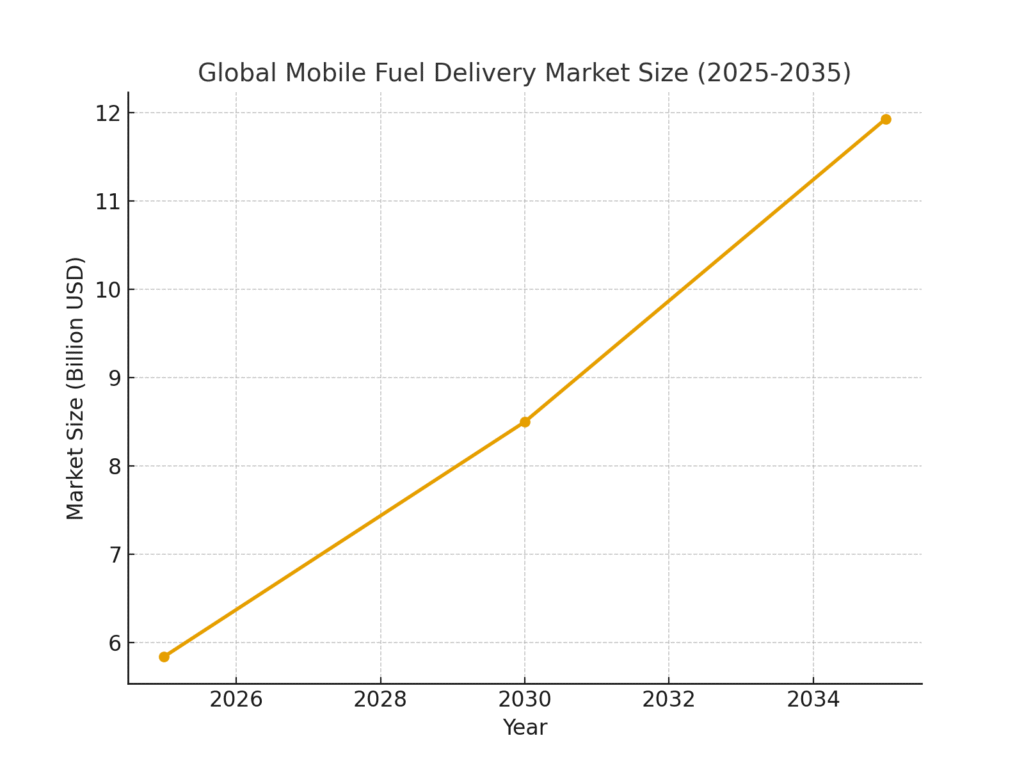
The global mobile fuel delivery market is projected to reach USD 5.84 billion in 2025. This signals a strong appetite for on-demand services that prioritize consumer convenience. Businesses tapping into this market have the potential to scale quickly with the right marketing strategies. The figure also reflects how digital platforms are reshaping even traditional industries like fuel. For marketers, this number is a clear sign to invest in brand awareness and digital visibility.
Gas Delivery Marketing Statistics #2 – Long-Term Growth Forecast
By 2035, the same market is expected to hit USD 11.93 billion, with a CAGR of 7.4 %. Such long-term growth suggests that adoption isn’t just a trend—it’s a sustainable shift. Companies that establish their presence early will reap lasting benefits. The challenge lies in brand differentiation as competition intensifies. Marketers need to develop narratives that highlight trust, reliability, and environmental responsibility.
Gas Delivery Marketing Statistics #3 – Alternative Growth Estimate (2030)
Another study values the mobile fuel delivery market at USD 4.1 billion in 2024, projected to reach USD 7.1 billion by 2030. This alternative outlook still points to strong double-digit growth. It highlights that, while exact figures vary, the trajectory is undeniably upward. For marketers, this is a reminder to remain agile and adapt strategies to different growth scenarios. Investing in multi-channel campaigns will ensure steady consumer engagement throughout this expansion.
Gas Delivery Marketing Statistics #4 – On-Demand Fuel Delivery Market In 2024
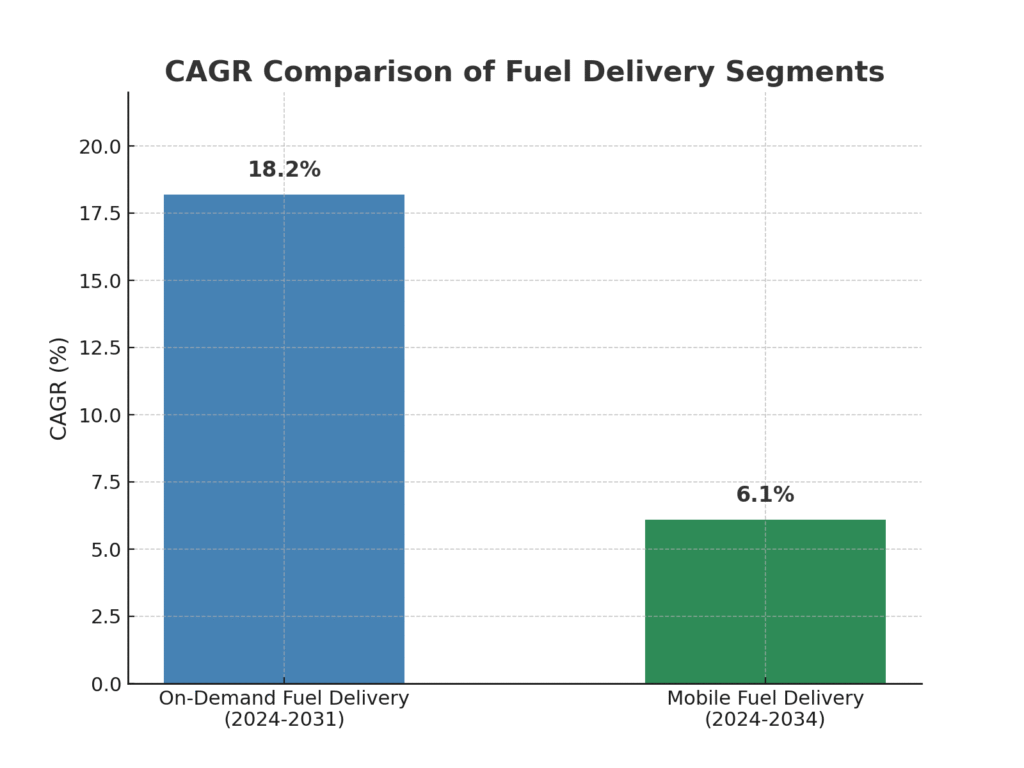
The on-demand fuel delivery market was valued at USD 251.2 million in 2024. While smaller than the overall mobile fuel market, this segment showcases a clear niche. Consumers who value real-time delivery are likely to be loyal repeat customers. This means marketing efforts should emphasize convenience, reliability, and speed. Niche growth segments often present opportunities for startups to thrive with targeted strategies.
Gas Delivery Marketing Statistics #5 – Projected On-Demand CAGR
From 2024 to 2031, on-demand fuel delivery is expected to grow at 18.2 % CAGR. This pace is considerably faster than the traditional fuel market. Marketers should see this as proof that digital-first delivery models are gaining traction. Highlighting efficiency and time savings in campaigns could resonate strongly with audiences. Growth at this speed indicates significant room for innovation.
Gas Delivery Marketing Statistics #6 – Regional Revenue Share (North America)
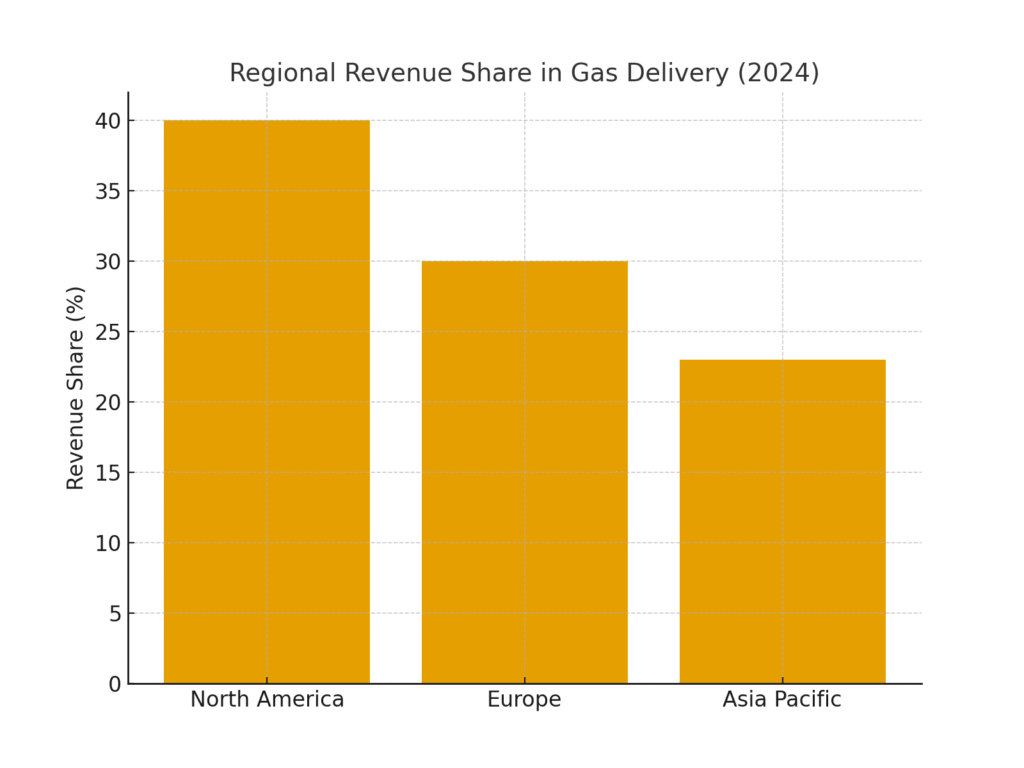
North America accounted for about 40 % of global revenue in 2024, valued at USD 100.48 million. This dominance shows how quickly the region has adopted mobile fuel delivery services. For marketers in the U.S. and Canada, the focus should be on expanding awareness beyond early adopters. Fleet and corporate clients represent lucrative targets. Localized marketing can further strengthen trust in this region.
Gas Delivery Marketing Statistics #7 – Regional Revenue Share (Europe)
Europe captured more than 30 % of the market in 2024, worth around USD 75.36 million. European consumers are increasingly drawn to eco-friendly and efficient solutions. Marketing strategies that emphasize sustainability may be more successful here. Companies must navigate regulatory frameworks, but this can also build trust. Long-term positioning in Europe requires highlighting green credentials.
Gas Delivery Marketing Statistics #8 – Regional Revenue Share (Asia Pacific)
Asia Pacific accounted for 23 % of market share in 2024, valued at USD 57.78 million. With rapid urbanization and vehicle growth, APAC is a market full of potential. Marketing in this region should prioritize mobile-first campaigns. Highlighting affordability and accessibility is critical for customer adoption. Companies that localize offerings will likely capture significant market share.
Gas Delivery Marketing Statistics #9 – Asia Pacific Growth Strength
The Asia Pacific market is forecasted to grow at a CAGR of 20.2 % between 2024 and 2031. This is one of the fastest growth rates globally. Marketing in this region needs to be bold, innovative, and localized. Partnerships with app platforms and ride-hailing companies could prove strategic. The speed of growth here is unmatched, making it a key target.
Gas Delivery Marketing Statistics #10 – Doorstep Fuel Delivery Growth
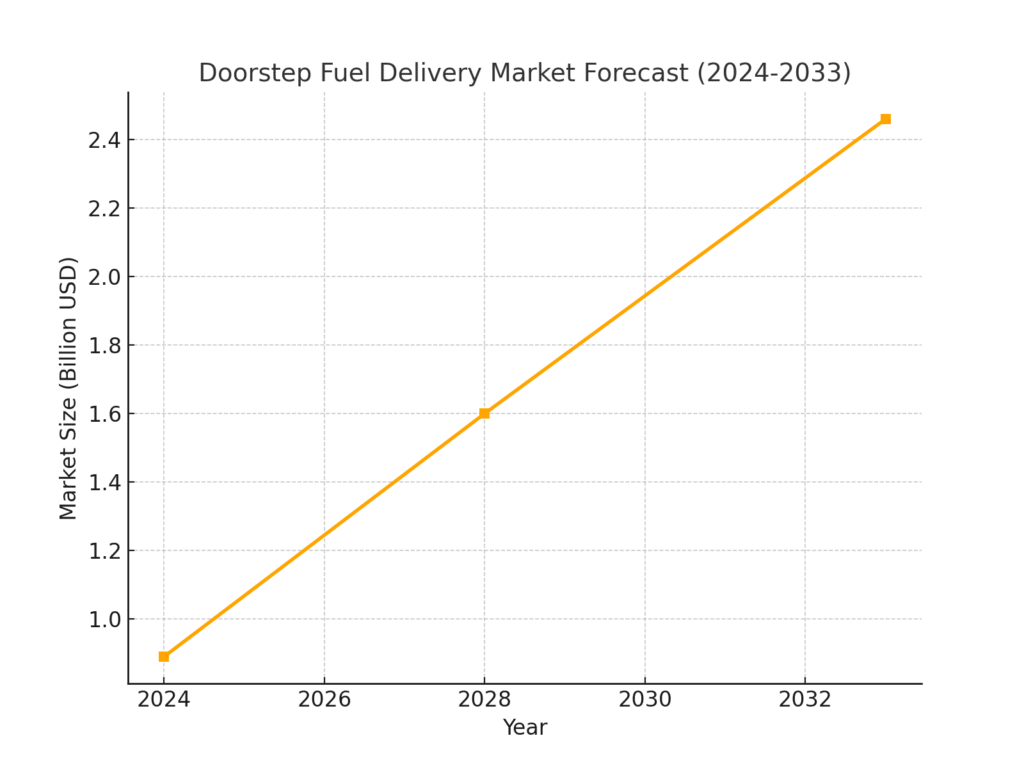
Doorstep fuel delivery is projected to rise from USD 0.89 billion in 2024 to USD 2.46 billion by 2033. This market speaks to consumer demand for ultimate convenience. Marketers can capitalize by emphasizing “zero effort” and “time saved.” Doorstep delivery also enables premium pricing models when marketed correctly. Convenience as a brand promise is powerful in this space.
Gas Delivery Marketing Statistics #11 – Mobile Fuel Delivery Market Growth (2034 Forecast)
The mobile fuel delivery market is set to climb from USD 5.5 billion in 2024 to USD 10 billion by 2034. This reflects consistent annual growth. Marketers should think about long-term branding to stay relevant. Investing in customer loyalty programs can help sustain engagement across a decade. Growth over such a long horizon signals lasting consumer adoption.
Gas Delivery Marketing Statistics #12 – Gas Delivery Systems Market Expansion
The gas delivery systems market, including infrastructure, is forecasted to grow from USD 22.7 billion in 2025 to USD 50.5 billion by 2035. This highlights how both apps and infrastructure will grow hand in hand. Marketing can target both B2B and B2C segments here. Suppliers and infrastructure companies should highlight reliability and compliance. Long-term planning and messaging will be essential.
Gas Delivery Marketing Statistics #13 – Fleet & Commercial Dominance
Fleet and commercial segments dominate mobile fuel delivery adoption. These clients prioritize efficiency and predictable pricing. Marketing strategies targeting businesses should stress reduced downtime and operational savings. Case studies and testimonials will work effectively here. Fleet adoption drives consistent, high-volume demand.
Gas Delivery Marketing Statistics #14 – Diesel Share Leadership
Diesel holds roughly 62 % of the mobile fuel delivery market. This shows that certain fuel types dominate consumer and business needs. Marketers targeting diesel delivery should emphasize cost savings and reliability. While EV growth is rising, diesel continues to anchor demand. This makes it a stable segment for marketers to highlight.
Gas Delivery Marketing Statistics #15 – Pandemic Acceleration Of Adoption
During COVID-19, fuel delivery apps captured more than 10 % of fuel sales in some areas. The pandemic acted as a catalyst for new adoption. Marketers should remember that crises often create long-term consumer behavior changes. Promoting safety, hygiene, and convenience remains relevant even post-pandemic. This trend reflects resilience in the model.
Gas Delivery Marketing Statistics #16 – User Growth In Fuel Delivery Apps
Globally, fuel delivery app users grew by about 45 % over two years. This sharp rise shows strong consumer willingness to try new solutions. Marketers should double down on user acquisition campaigns while adoption rates remain high. Incentives, referrals, and social proof can help sustain momentum. User growth at this rate offers a window for competitive advantage.
Gas Delivery Marketing Statistics #17 – Regional Dominance: North America
North America continues to be the largest regional market overall. This gives marketers the opportunity to craft campaigns with global influence, starting from here. Success stories in this region can be replicated elsewhere. Local marketing should still respect state-level regulations and consumer behavior. The dominance of North America sets the tone for global expansion.
Gas Delivery Marketing Statistics #18 – Market Fragmentation & Incumbents
The sector is populated by key players like Yoshi, Booster, Filld, Cafu, and others. Market fragmentation creates both opportunities and challenges. Marketers must focus on differentiation through branding. Highlighting customer experience and reliability can help companies stand out. A fragmented market means storytelling is essential.
Gas Delivery Marketing Statistics #19 – Consumer Segments
Millennials and urban professionals are driving adoption. They value time, convenience, and digital-first solutions. Marketing should lean heavily on mobile and social media campaigns. Loyalty programs and app-based rewards can enhance retention. Targeting this demographic ensures early and sustained adoption.
Gas Delivery Marketing Statistics #20 – Expansion In Developing Markets
Emerging economies like India and Southeast Asia are seeing rapid growth in fuel delivery adoption. Increased vehicle ownership and urban density create strong demand. Marketers should highlight affordability and reliability in these markets. Partnerships with local businesses can boost trust. This expansion represents untapped potential for global players.
The Future Of Gas Delivery Marketing
Looking at these gas delivery marketing statistics, I can see just how fast this industry is moving toward a more digital, on-demand future. For me, what stands out most is how convenience, trust, and innovation are shaping consumer behavior across regions. Whether it’s fleets seeking efficiency, millennials craving speed, or emerging markets opening up new opportunities, the space is brimming with potential. As someone who cares deeply about staying ahead of marketing trends, I find these insights both exciting and motivating. With the support of the leading marketing agency in New York, I feel better equipped than ever to apply these lessons and keep adapting to what’s next.
SOURCES