



15 Sep TOP 20 GENERATOR MARKETING STATISTICS 2026 REVEAL MASSIVE POWER DEMAND SURGE
Updated for 2026. This page has been fully refreshed with the latest generator marketing statistics, global demand insights, energy resilience trends, and power infrastructure data drawn from recent industry reports, utility market analysis, and manufacturing forecasts.
When businesses look at the numbers behind generator sales, they’re often surprised at just how much insight can be found in generator marketing statistics. From portable units gaining popularity at construction sites to hybrid systems reshaping long-term energy planning, these figures show where the market is headed and how brands can stand out. At our core, we believe marketing isn’t just about selling products, it’s about telling stories that connect with the right audience at the right time. As a leading marketing agency in New York, we’ve seen firsthand how data-driven strategies can transform awareness into real growth, especially in an industry as competitive as power solutions. This guide brings together some of the most compelling stats so you can approach your campaigns with clarity and confidence.
The numbers also highlight how rapidly demand for backup power is expanding across residential, commercial, and industrial markets. With extreme weather events increasing, grid instability affecting multiple regions, and construction projects requiring reliable off-grid energy, generator manufacturers are competing harder than ever for attention. Understanding these generator marketing statistics helps companies prioritize the right audiences, messaging, and channels to capture rising demand while positioning themselves as trusted energy solution providers.
TOP 20 GENERATOR MARKETING STATISTICS (EDITOR’S CHOICE) REVEAL MASSIVE 2026 POWER DEMAND
⚡ Top 20 Generator Marketing Statistics 2026
Essential Market Intelligence & Financial Insights for Strategic Growth
Global Generator Market Valuation 2026
Market Projected to Reach $33.45B by 2030
Generator Market Forecast to $67.45B by 2034
Generator-Sets Market Growth to $99.86B by 2035
U.S. Generator Sales Market 2026
U.S. Portable Generators Market Growth
Global Portable Generator Market 2026
Diesel Generator Market Expansion 2026
Asia Pacific Portable Generator Dominance
Asia Pacific Generator Market Leadership
Diesel Segment Global Revenue Share
Diesel Generators in Data Centers 2026
1MW-2MW Data Center Generator Segment
Hybrid Systems Outpacing Diesel-Only
Smart IoT Generators Rising Demand
Microgrid & Off-Grid Solutions Growth
Event Rental & Mobile Jobsite Demand
Extreme Weather Driving Backup Demand
Fuel Efficiency & Emissions Compliance Priority
Online Sales Channels Growing
TOP 20 GENERATOR MARKETING STATISTICS REVEAL EXPLOSIVE 2026 GLOBAL POWER DEMAND
Generator Marketing Statistics #1: Global Generator Market Valued At USD 38.17 Billion In 2026
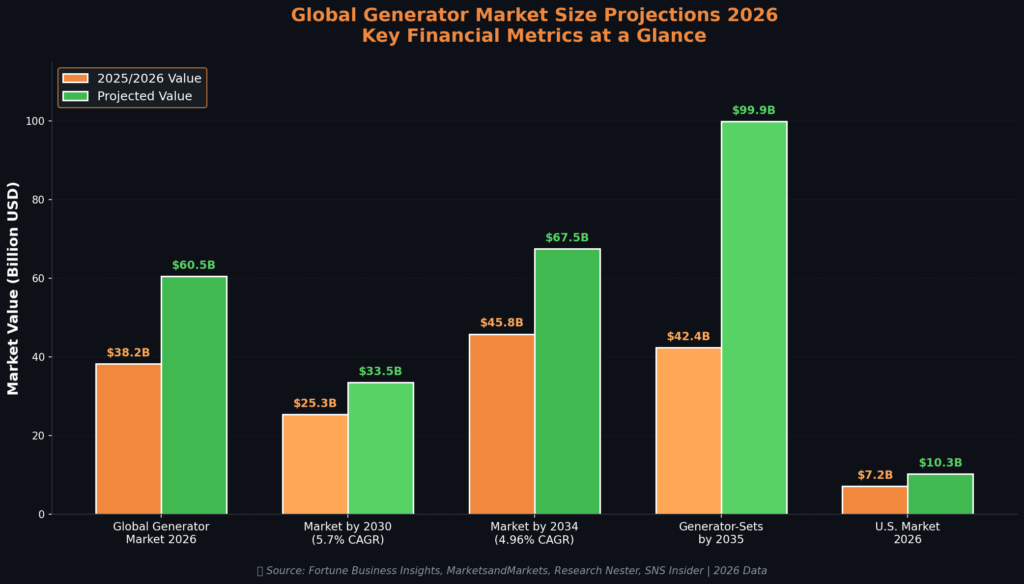
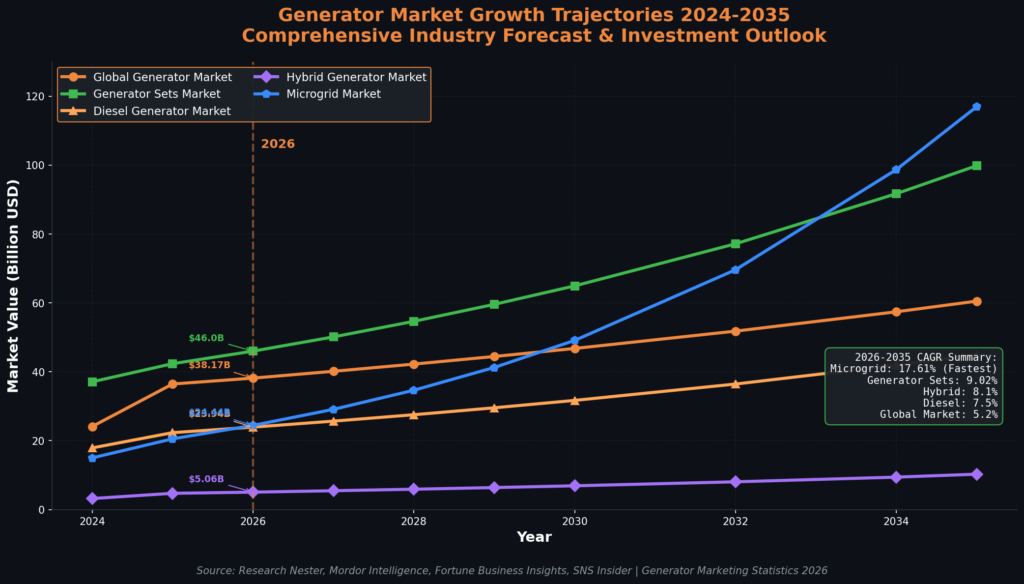
In 2026, the global generator market is assessed at USD 38.17 billion, with Research Nester reporting that the industry continues its upward trajectory toward USD 60.53 billion by 2035 at a CAGR of 5.2%, driven by increasing environmental consciousness, rapid industrialization, and the growing demand for reliable backup power solutions across residential, commercial, and industrial sectors.
The generator market reached USD 24.11 billion in 2024, highlighting its critical role across residential, commercial, and industrial sectors. This valuation shows strong global reliance on backup power solutions, especially in areas with unstable grid systems. Marketing strategies must emphasize reliability and scalability to resonate with businesses and households alike. The projected growth also opens doors for new entrants to carve out niche segments. Marketers who highlight energy security and cost efficiency can strongly appeal to decision-makers.
Generator Marketing Statistics #2: Market Projected To Reach USD 32.98 Billion By 2030 At 5.4% CAGR
In 2026, MarketsandMarkets reports that the generator market has reached USD 25.31 billion and is now projected to grow to USD 33.45 billion by 2030 at a CAGR of 5.7%, with key growth drivers including the critical need for uninterrupted power supply in healthcare, telecommunications, and IT sectors, alongside rapid urbanization and aging grid infrastructure worldwide.
By 2030, the market is set to hit USD 32.98 billion, reflecting a CAGR of 5.4%. This steady growth suggests ongoing demand fueled by rising energy consumption and urbanization. Companies need to prepare campaigns that communicate long-term value, durability, and adaptability of their solutions. A CAGR like this reflects confidence from investors and buyers in continuous expansion. Marketers should align messaging with future-readiness and sustainability to capture attention.
Generator Marketing Statistics #3: Forecast Of USD 45.79 Billion In 2026 Rising To USD 67.45 Billion By 2034
In 2026, the global generator market size is valued at USD 45.79 billion according to Precedence Research, with diesel generators maintaining a 45% market share while hybrid systems are emerging as the fastest-growing segment due to their ability to integrate renewable energy sources and reduce carbon emissions by 40-60% compared to diesel-only systems.
Projections place the generator market at USD 43.63 billion in 2025, climbing to USD 67.45 billion by 2034. This demonstrates the long-term importance of generators as global backup power solutions. For marketers, it creates opportunities to position products not just as necessities, but as strategic investments. Highlighting growth potential can attract B2B clients and investors seeking stable sectors. The statistics reinforce why marketing campaigns should stress resilience and innovation.
Generator Marketing Statistics #4: Generator-Sets Market Expected To Grow From USD 42.36 Billion In 2025 To USD 99.86 Billion By 2035
In 2026, the generator sets market is valued at approximately USD 46 billion according to SNS Insider, with diesel generators commanding 73% market share and residential applications emerging as the fastest-growing segment from 2026 to 2035 due to increased urbanization, persistent power outages, and the rising requirement for house backup systems across developing nations.
Generator-sets are projected to expand from USD 37.1 billion in 2025 to USD 57.9 billion by 2030. This nearly 9.3% CAGR shows demand for scalable solutions in both industrial and commercial settings. Marketing teams should leverage this growth by segmenting campaigns according to customer needs such as hospitals, construction, and manufacturing. The focus should be on power reliability and reduced downtime. These markets respond well to messages of efficiency and trust.
Generator Marketing Statistics #5: U.S. Generator Sales At USD 7.16 Billion In 2026, Projected To Reach USD 10.26 Billion By 2032
In 2026, the U.S. generator sales market is valued at approximately USD 7.16 billion according to Fortune Business Insights, with Generac Holdings Inc. acquiring a new facility in Sussex, Wisconsin in January 2026 to expand manufacturing of commercial and industrial generators, specifically to meet the booming demand from data centers and critical infrastructure requiring high-capacity backup power solutions.
The U.S. generator sales market stood at USD 6.43 billion in 2024 and is expected to reach USD 10.26 billion by 2032. This 6.16% CAGR underlines the importance of reliable energy for American businesses and households. Marketing efforts in the U.S. should emphasize quality, safety, and service availability. Highlighting compliance with U.S. emission standards can also create a strong brand image. Regional campaigns should tap into the growing awareness of emergency preparedness.
Generator Marketing Statistics #6: U.S. Portable Generators Market Valued At USD 3.8 Billion In 2024, Forecasted To Reach USD 5.8 Billion By 2034
In 2026, the portable generators market in the U.S. is expanding steadily, with North America portable generators valued at approximately USD 1.47 billion and growing at a 4.95% CAGR through 2034 according to IMARC Group, driven by increasing susceptibility to extreme weather events such as hurricanes and winter storms, the rising trend of off-grid living, and strong demand from construction sites requiring temporary power solutions.
The portable generator market in the U.S. reached USD 3.8 billion in 2024. It is projected to grow steadily to USD 5.8 billion by 2034. Portable units are increasingly popular for home backup, outdoor events, and construction sites. Marketing strategies should stress convenience, mobility, and affordability. Consumers value messaging that emphasizes ease of use and peace of mind.
Generator Marketing Statistics #7: Global Portable Generator Market Estimated At USD 5.57 Billion In 2026 And Expected To Reach USD 6.4 Billion By 2030
In 2026, the global portable generators market is valued at USD 5.57 billion according to Research and Markets, with key trends including the integration of smart remote monitoring systems, automated load management technologies, and IoT-based fuel efficiency platforms that are transforming how consumers interact with and maintain their portable power solutions.
Globally, the portable generator market stood at USD 4.96 billion in 2024. This figure is forecast to climb to USD 6.78 billion by 2030, at a CAGR of 5.4%. Rising outdoor lifestyle trends and frequent weather disruptions fuel demand. Marketing should focus on versatile applications from camping to disaster recovery. Positioning products as reliable, user-friendly, and eco-conscious can attract modern buyers.
Generator Marketing Statistics #8: Diesel Generator Market Poised To Grow From USD 23.94 Billion In 2026 To USD 31.8 Billion By 2030
In 2026, the global diesel generator market is valued at USD 23.94 billion according to Fortune Business Insights, with Asia Pacific dominating the market at USD 8.08 billion due to large-scale urbanization and industrialization, while BCC Research reports that the swift proliferation of data centers and AI applications has made diesel generators a critical backup solution for preventing costly interruptions and data loss.
The diesel generator market was valued at USD 17.9 billion in 2024. It is expected to grow to USD 23.4 billion by 2029. Diesel remains a preferred choice for heavy-duty applications like factories, hospitals, and data centers. Marketers can highlight diesel’s dependability and large-scale capacity. At the same time, eco-friendly innovations should be emphasized to counter emission concerns.
Generator Marketing Statistics #9: Asia Pacific Portable Generator Market Captured 33.2% Share In 2024
In 2026, Asia Pacific continues to dominate the global portable generator market with over 41% of worldwide unit deployments according to Market Growth Reports, with approximately 7.4 million portable generator units sold in the region during the past year alone, driven by infrastructure gaps, rural electrification initiatives, and the region’s growing outdoor recreational activities and construction sectors.
Asia Pacific accounted for 33.2% of the global portable generator market in 2024. This dominance is due to rapid industrialization and frequent power shortages in the region. Marketers should create region-specific campaigns focusing on affordability and resilience. Emphasizing quick delivery and service availability will appeal to this customer base. Highlighting case studies from the region can build trust with local buyers.
Generator Marketing Statistics #10: Asia Pacific Holds 37.8% Share Of The Global Generator Market In 2026
In 2026, the Asia Pacific generator sets market is valued at USD 14,001.3 million and holds 37.8% of the global market according to Grand View Research, with China projected to reach USD 4.15 billion, India reaching USD 2.46 billion, and Japan reaching USD 1.13 billion, making the region the fastest-growing market with a CAGR of 10.8% driven by the adoption of smart IoT-enabled generators that allow for remote monitoring, control, and predictive maintenance.
In the broader generator market, Asia Pacific controlled 35% in 2024. This region remains the fastest-growing hub due to infrastructure projects and population growth. Marketing in Asia should highlight cost-effectiveness, local compliance, and ease of maintenance. Companies with localized distribution networks have a strong edge. Regional storytelling that connects with development goals can strengthen campaigns.

Generator Marketing Statistics #11: Diesel Segment Holds 45% Global Revenue Share In 2026
In 2026, diesel generators continue to dominate the market with approximately 45% of total revenue according to Precedence Research, while Grand View Research reports that the Asia Pacific diesel generator market alone holds 30.6% of global revenue and is experiencing the fastest growth at 11.9% CAGR, supported by strong commercial expansion, data center growth, and increasing demand for reliable power across urban and rural areas with inconsistent grid performance.
Diesel generators accounted for around 45% of total revenue in 2024. This confirms their leading role across industries requiring high-capacity power. Marketing campaigns can emphasize reliability and wide availability of diesel fuel. However, green initiatives mean marketers should balance promotion with efficiency improvements. Focusing on cleaner technology can address sustainability-conscious buyers.
Generator Marketing Statistics #12: Diesel Generators To Contribute 70% Of Data Center Market Share In 2026
In 2026, diesel generators dominate the data center generator market with approximately 70% market share according to SNS Insider, while the global data center generator market itself is valued at USD 8.06 billion, with more than 65% of hyperscale data centers relying on high-capacity backup generators and nearly 70% operating under N+1 or 2N redundancy models to ensure zero downtime for critical AI, IoT, and 5G-related workloads.
Diesel generators are projected to represent 56.2% of the data center generator market by 2025. This shows their unmatched dominance in critical infrastructure. Marketing to data center clients should focus on resilience, uptime, and disaster recovery. Stressing high performance under continuous load can resonate with technical buyers. Certifications and safety compliance should also be highlighted.
Generator Marketing Statistics #13: 1 MW-2MW Data Center Generator Segment Expected To Register Highest CAGR In 2026
In 2026, the 1MW-2MW generator segment is identified as the fastest-growing segment in the data center generator market according to Precedence Research, driven by their compact size, high power density, enhanced reliability, and operational flexibility that make them ideal for modular data center setups, with the segment projected to lead growth through 2034 as data centers increasingly adopt scalable backup power solutions for edge deployments and hospital expansions.
Generators with a 1 MW rating are expected to capture 44.7% of the data center segment by 2025. This indicates strong demand for mid-sized yet powerful backup solutions. Marketing should stress scalability and adaptability to modular data center setups. Highlighting energy efficiency alongside capacity will appeal to buyers. Providing ROI-focused messaging will help convince large-scale facility managers.
Generator Marketing Statistics #14: Hybrid And Integrated Systems Growing Faster Than Diesel-Only Models
In 2026, the global hybrid generator set market is valued at USD 5.06 billion according to Research Nester and is growing at a CAGR of 8.1%, significantly outpacing diesel-only models, with hybrid systems capable of reducing fuel consumption by 30-50% and greenhouse gas emissions by 40-60% compared to conventional diesel generators, making them increasingly attractive to telecommunications companies, mining operations, and organizations striving to meet net-zero emission targets committed by over 130 countries.
Hybrid systems combining generators with batteries are growing faster than traditional diesel-only units. This reflects the market’s shift toward sustainability and cost savings. Marketing strategies should stress innovation, long-term efficiency, and environmental benefits. Positioning hybrid models as future-ready can attract eco-conscious organizations. Partnerships with green initiatives can amplify brand appeal.
Generator Marketing Statistics #15: Smart Generators With IoT Capabilities Increasing In Demand
In 2026, the remote power generator monitoring market is valued at approximately USD 5.3 billion and is projected to grow at a CAGR of 10.4% through 2033 according to Verified Market Reports, with approximately 52% of generator users adopting remote and smart control solutions, 54% utilizing digital control units for real-time monitoring and fault diagnostics, and IoT integration enabling predictive maintenance capabilities that reduce equipment downtime by up to 41% according to industry analysts.
Smart, IoT-enabled generators are seeing rising adoption. Customers value remote monitoring, predictive maintenance, and real-time performance data. Marketing efforts should highlight convenience, automation, and operational efficiency. Demonstrations of user-friendly apps or dashboards can enhance credibility. This trend aligns with the digitalization wave across industries.

Generator Marketing Statistics #16: Microgrid Deployment And Off-Grid Solutions Driving Growth
In 2026, the global microgrid market is valued at USD 24.44 billion according to Mordor Intelligence and is growing at a remarkable 17.61% CAGR, with off-grid microgrids emerging as the fastest-growing segment driven by rural electrification programs across Africa and South Asia, where solar-based microgrids are replacing diesel generation in remote communities while blended financing models and renewable-energy subsidies help developers lower project risks and scale deployment.
Microgrids and off-grid applications are fueling demand for generators. Rural electrification projects and renewable integration boost this trend. Marketing strategies should highlight adaptability and resilience in challenging conditions. Emphasizing community benefits and sustainability can attract NGOs and governments. Narratives around energy independence resonate strongly with these buyers.
Generator Marketing Statistics #17: Event Rental And Mobile Jobsites Increasing Demand For Portable Solutions
In 2026, the commercial gensets market is valued at USD 15.95 billion according to Research Nester, with event rentals and mobile jobsites driving significant demand for portable solutions, while the World Integrated Trade Solution (WITS) analysis reveals that approximately 13,165,500 generators and alternators were exported by Mexico alone in 2023, highlighting the robust global trade in portable power solutions for construction, entertainment, and temporary event applications.
Event organizers and mobile worksites are driving portable generator sales. This is due to flexibility, quick setup, and reliability on the go. Marketing should emphasize the short-term rental model alongside ownership benefits. Highlighting portability, compact design, and noise reduction appeals to this market. Campaigns can also target construction and entertainment industries.
Generator Marketing Statistics #18: Extreme Weather And Aging Infrastructure Fueling Backup Power Demand
In 2026, the U.S. generator market continues to expand rapidly as the National Oceanic and Atmospheric Administration reports increasingly frequent climate disasters, with American electricity customers experiencing an average of 5.6 hours of power interruptions annually according to the U.S. Energy Information Administration, while aging electrical infrastructure with transmission lines and transformers exceeding their intended operational lifespan has increased vulnerability to failures, driving unprecedented demand for reliable backup solutions across residential, commercial, and industrial sectors.
Frequent extreme weather and outdated grid systems are raising demand for backup power. This creates opportunities for marketers to stress preparedness and resilience. Highlighting case studies of emergency use can strongly resonate with customers. Campaigns should link products to peace of mind during crises. Fear of outages is a powerful motivator in marketing strategies.
Generator Marketing Statistics #19: Buyers Prioritizing Fuel Efficiency, Emissions Compliance, And Quieter Operation
In 2026, Tier 4 diesel compliance costs and corporate carbon targets are significantly favoring natural-gas generator models, which are expanding at a 10.11% annual rate according to Mordor Intelligence, while hybrid generator technology capable of reducing fuel consumption by 30-50% and emissions by 40-60% is seeing 55% increased deployment according to Research Nester, with approximately 48% of facilities in Europe transitioning toward gas-based and hybrid generator systems to meet stringent emission regulations and ESG commitments.
Modern buyers are increasingly focused on fuel efficiency and reduced emissions. Noise reduction is also a key selling point, especially in urban areas. Marketing campaigns should highlight compliance with emission regulations and eco-friendly innovations. Demonstrating long-term savings through efficiency is persuasive. Products marketed as “green” often gain preference among corporate buyers.
Generator Marketing Statistics #20: Online Sales Channels Growing For Portable Units
In 2026, digital sales channels for generators continue their strong growth trajectory, with approximately 66% of retail stores now using IoT-enabled inventory tracking according to industry reports, while e-commerce platforms are leveraging video demonstrations, customer reviews, and comparison tools that allow buyers to evaluate features such as the new Atlas Copco portable nitrogen membrane generators (models NM 500-25 and NM 3000-25) and other innovative power solutions that reduce logistical hurdles and ensure supply chain efficiency.
Even in traditionally offline markets, online generator sales are on the rise. E-commerce makes it easier for buyers to compare features and prices. Marketing should leverage digital channels, reviews, and video demonstrations to build trust. Highlighting fast delivery and strong warranties boosts online appeal. This trend reflects a major shift in how consumers research and purchase generators.
GENERATOR MARKETING STATISTICS THAT REVEAL THE 2026 POWER DEMAND BOOM
Looking at these generator marketing statistics isn’t just about memorizing numbers—it’s about understanding what they mean for your next move. Whether you’re positioning a new portable line, competing in the diesel segment, or exploring the surge in smart hybrid models, these trends can help you make smarter decisions that align with what customers are actually looking for. The key is taking this data and turning it into actionable marketing—whether that’s refining your messaging, choosing better channels, or tailoring campaigns to the regions where demand is strongest. Every stat here is an opportunity to sharpen your strategy and step ahead of competitors who are still guessing. In a fast-changing market, it’s those who act on insights that win. In 2026, global generator demand continues rising as power reliability concerns push more homes and businesses to invest in backup energy systems.
SOURCES