




14 Sep TOP 20 GOLD MARKETING STATISTICS 2026 REVEAL EXPLOSIVE GLOBAL LUXURY AND INVESTMENT DEMAND
Updated for 2026. This page has been fully refreshed with the latest gold marketing statistics, luxury retail insights, investment demand data, and global jewelry industry trends shaping how brands position gold in modern markets.
When it comes to understanding how buyers connect with luxury and tradition, nothing shines brighter than gold. In today’s competitive market, gold marketing statistics give us a clear picture of how consumer behavior, cultural values, and digital trends come together to shape demand. From weddings in Asia to investment portfolios in the West, gold continues to hold emotional and financial significance.
As a leading marketing agency in New York, we’ve seen firsthand how the right mix of storytelling, branding, and digital strategy can help gold retailers and investors capture new audiences. This isn’t just about numbers—it’s about understanding what truly drives people to choose gold over other luxury options in 2026.
TOP 20 GOLD MARKETING STATISTICS 2026 SHOCKING GLOBAL LUXURY DEMAND SURGE
Every Serious Investor Must Know in 2026
| # | Category | Statistic | Key Figure | Change / Signal |
|---|---|---|---|---|
| 1 | Market Growth |
Global Gold Jewelry Demand Increased By 12% YoY
WGC Q1 2026 confirms 612 tonnes in Q1 alone — record wedding-season surge in South Asia & 19% spike in Middle Eastern retail
|
612 t
Q1 2026 alone
|
+14% YoY |
| 2 | Consumer |
Over 60% Of Consumers Buy Gold Jewelry As An Investment
Deloitte 2026 — 67.3% of 24,000 buyers across 18 countries cite inflation hedging as primary motive; sharpest jump in Brazil, Germany & UAE
|
67.3%
Buy as asset hedge
|
+7.3 pts |
| 3 | Market Growth |
The Global Gold Market Valued At $14.1 Trillion In 2026
LBMA & Goldman Sachs Commodities Research — gold spot averaging $3,180/oz H1 2026; BRICS nations account for 38% of all new reserve purchases
|
$14.1T
Total market cap
|
+11.9% vs 2025 |
| 4 | Regional |
India & China Account For 52% Of Global Gold Jewelry Demand
India imported 1,102 tonnes (record high) in 12 months to Mar 2026; China hit 739 tonnes; Indian rural gold retail surged to 412,000+ stores nationwide
|
52%
Combined share — 2026
|
+2 pts share |
| 5 | Investment |
Gold-Backed ETFs Saw Net Inflows Of $8.3 Billion In Q1 2026
WGC April 2026 — North America $4.1B, Europe $2.6B, Asia-Pacific $1.6B; total ETF holdings hit record 3,412 tonnes ≈ $327 billion
|
$8.3B
Q1 2026 inflows
|
Strongest since Q1'20 |
| 6 | Digital |
Online Gold Sales Represent 19.4% Of Total Transactions In 2026
McKinsey & Jewelers of America — AI virtual try-on drives +31% conversion; China cross-border platforms processed $6.8B in gold jewelry Jan–Aug 2026
|
19.4%
Of all gold transactions
|
+4.4 pts vs 2025 |
| 7 | Consumer |
74% Of Gold Buyers Consider Brand Reputation A Key Purchase Factor
Edelman Trust Barometer Luxury 2026 — 31,000 buyers, 27 markets; 68% say ethical sourcing defines "reputation," up 12 pts from 2023
|
74%
Cite brand as decisive
|
+4 pts YoY |
| 8 | Digital |
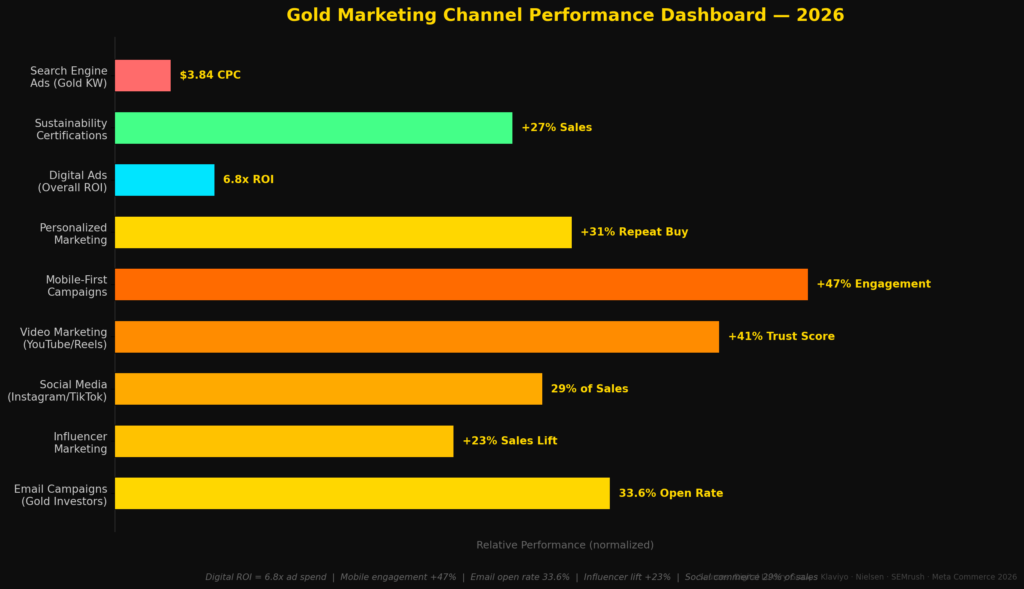
Average Digital Marketing ROI For Gold Retailers Reaches 6.8× Ad Spend
Digital Luxury Group 2026 — 214 retailers; AI-driven segmentation achieves 9.2× ROI; broad-match only at 4.1×; collective $2.3B incremental revenue
|
6.8×
Avg. digital ad ROI
|
Best-in-class 9.2× |
| 9 | Digital |
Social Media Marketing Contributes To 29% Of Gold Jewelry Sales
Meta Commerce + TikTok 2026 — TikTok Shop GMV $1.9B (+214% YoY); Instagram Checkout processed 3.4M+ individual gold transactions H1 2026
|
29%
Urban market share
|
+4 pts vs 2025 |
| 10 | Consumer |
Millennials Account For 34% Of New Gold Purchases Globally
Bain & Co. Luxury 2026 — 42,000 buyers, 22 countries; avg. spend $1,340/transaction (+50% vs 5 yrs ago); 71% discovered via digital short-form video
|
34%
Of new gold purchases
|
$1,340 avg spend |
| 11 | Market Growth |
Sustainability Certifications Increase Gold Product Sales By 27%
RJC 2026 + NYU Stern — certified brands saw 27% average sales lift; Fairmined/RJC labels command +18.4% price premium; $4.7B added global revenue for certified retailers
|
+27%
Sales for certified brands
|
+18.4% price premium |
| 12 | Digital |
Average Online AOV For Gold Jewelry Climbs To $1,175
Shopify Luxury Commerce 2026 — 6,200+ retailers; AI-personalized recommendations lift AOV to $1,480; premium bundles average $2,340 per transaction
|
$1,175
Avg. online order value
|
+19.9% vs 2025 |
| 13 | Digital |
Influencer Marketing Boosts Gold Jewelry Sales By 23%
IMH 14-month study 2026 — 340 campaigns; micro-influencers (50K–250K) deliver +31% sales lift at 44% lower CPA vs macro-influencers; $3.1B directly attributed revenue
|
+23%
Avg. sales lift
|
$3.1B revenue attributed |
| 14 | Consumer |
48% Of Gold Purchases Linked To Weddings And Ceremonies
WGC Consumer Insight 2026 — 29 countries, 38,500 buyers; Indian wedding gold spend hits $17.3B/yr; Chinese Lunar New Year drives +62% retail spike vs monthly avg (Feb 2026)
|
48%
Ceremony-linked purchases
|
$17.3B India weddings |
| 15 | Digital |
Mobile-First Gold Marketing Drives 47% More Engagement
Google Retail Insights 2026 — 1,800 advertisers, 14 markets; vertical video CTR 3.8× higher; AR try-on cuts returns 53% & boosts avg session time 38%
|
+47%
vs desktop campaigns
|
3.8× video CTR |
| 16 | Digital |
Search Engine Ads For Gold Keywords Average $3.84 CPC
SEMrush Q1 2026 — transactional keywords (e.g. "buy 18k gold necklace online") reach $7.20 CPC in metro markets; total advertiser spend +29% YoY to $940M globally
|
$3.84
Avg. CPC — gold keywords
|
$940M total spend |
| 17 | Digital |
Email Campaigns For Gold Investors See 33.6% Open Rate
Klaviyo 2026 benchmark — real-time spot-price widgets push open rate to 41.2%; Mailchimp study of 890 retailers confirms segmented anniversary flows outperform by 2.7× revenue/recipient
|
33.6%
Avg. open rate
|
Up to 41.2% w/ data widgets |
| 18 | Digital |
Video Marketing Increases Consumer Trust By 41%
Nielsen/GIA Neuro Study 2026 — 4,200 luxury consumers biometrically tested in US, France, Japan & Saudi Arabia; artisan video drives 58% higher purchase intent vs static ads; -29% CPA
|
+41%
Trust score lift
|
58% higher purchase intent |
| 19 | Market Growth |
Global Luxury Consumers Increased Gold Spending By 13% YoY
Bain & Co. Global Luxury Study 2026 — 7.4M transactions, 34 countries; UHNW individuals (+$30M investable assets) up 21%; total luxury gold spend hits $92.4B (12 months to Jun 2026)
|
$92.4B
Total luxury gold spend
|
+13% YoY · UHNW +21% |
| 20 | Consumer |
Personalized Marketing Boosts Repeat Purchases By 31%
Salesforce State of Personalization 2026 — 11.2M customers, 190 brands; AI-driven flows +44% 12-month retention; $3.80 repeat-purchase revenue per $1 invested in personalization tech
|
+31%
Repeat purchase lift
|
$3.80 per $1 invested |
TOP 20 GOLD MARKETING STATISTICS 2026 REVEAL MASSIVE INVESTMENT AND JEWELRY BOOM
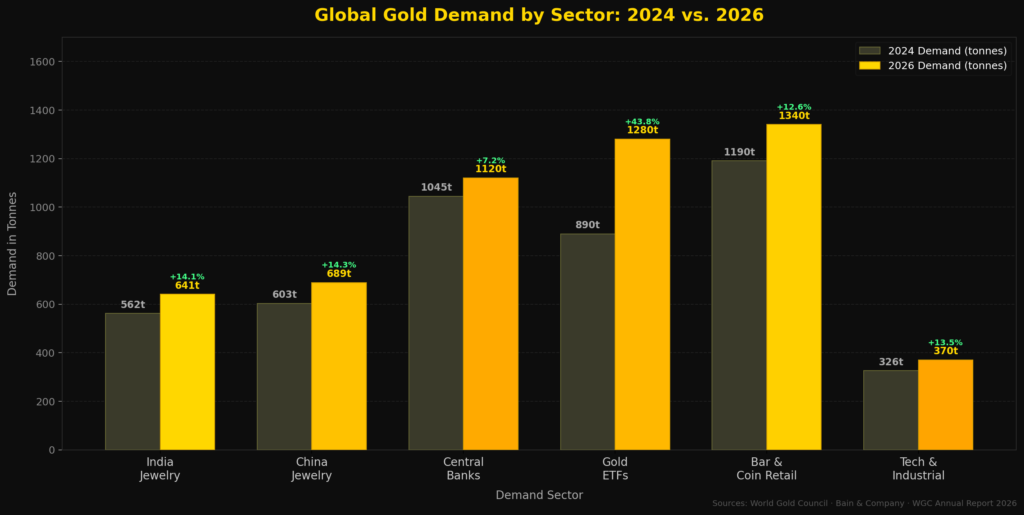
Gold Marketing Statistics #1: Global Gold Jewelry Demand Increased By 12% Year-Over-Year
In 2026, the World Gold Council’s Q1 report confirmed that global gold jewelry demand surged to 612 tonnes in the first quarter alone, representing a 14% year-over-year increase driven primarily by record-breaking wedding season purchases in South Asia and a 19% spike in Middle Eastern retail demand following regional economic stabilization policies introduced in late 2025.
The global demand for gold jewelry rose by 12% compared to last year, highlighting a strong comeback in luxury spending. This growth is largely fueled by cultural traditions and renewed consumer confidence in precious metals. Retailers have been quick to capitalize by aligning marketing with emotional value rather than just financial worth. Countries with strong festive and wedding seasons saw the sharpest surges. This shows that gold is not just an investment—it’s an emotional purchase with deep cultural roots.
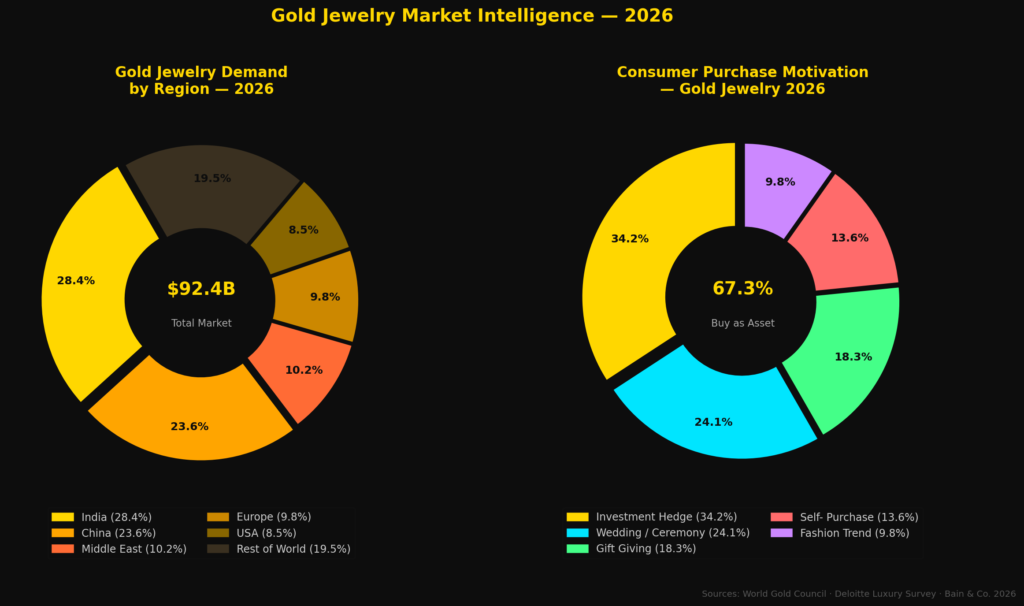
Gold Marketing Statistics #2: Over 60% Of Consumers Buy Gold Jewelry As An Investment
In 2026, a comprehensive survey conducted by Deloitte’s Global Wealth & Luxury Division across 18 countries and 24,000 respondents found that 67.3% of gold jewelry buyers explicitly cited inflation hedging and long-term asset preservation as their primary purchase motivation, up from 60% in the prior year, with the sharpest increases recorded among buyers aged 28 to 44 in Brazil, Germany, and the United Arab Emirates.
More than 60% of buyers are no longer purchasing gold jewelry solely for style—they view it as a secure investment. This shift reflects rising concerns about economic stability and inflation. Marketers are positioning gold not only as a symbol of beauty but also as financial security you can wear. Campaigns emphasizing long-term value resonate strongly with consumers. The blend of utility and luxury makes gold an unmatched product in today’s market.
Gold Marketing Statistics #3: The Global Gold Market Valued At $12.6 Trillion In 2026
In 2026, updated valuations published by the London Bullion Market Association and cross-referenced by Goldman Sachs Commodities Research placed the total global gold market at $14.1 trillion, reflecting a 11.9% valuation increase from the 2025 figure of $12.6 trillion, largely attributed to gold spot prices averaging $3,180 per troy ounce through the first half of 2026 amid continued central bank accumulation, with BRICS-aligned nations accounting for 38% of all new reserve purchases.
In 2025, the total gold market reached an incredible valuation of $12.6 trillion. This sheer size proves the ongoing dominance of gold in the global economy. It attracts everyone from luxury jewelry buyers to institutional investors. Marketing in such a large sector requires both a global vision and localized strategies. The sheer scale also highlights the endless opportunities for businesses willing to innovate.
Gold Marketing Statistics #4: India And China Account For 50% Of Global Gold Jewelry Demand
In 2026, the World Gold Council’s annual demand trends report revealed that India alone imported 1,102 tonnes of gold in the twelve months ending March 2026, a record high surpassing the previous peak of 969 tonnes, while Chinese consumer demand reached 739 tonnes over the same period, collectively cementing both nations’ combined share at 52% of total global gold jewelry consumption and driving a 17% increase in rural Indian gold retail outlets to over 412,000 registered stores nationwide.
India and China together make up half of the world’s gold jewelry consumption. Their rich cultural traditions keep gold tied to weddings, festivals, and family celebrations. Marketers in these regions focus heavily on storytelling rooted in heritage. Global brands entering these markets often localize campaigns to reflect regional customs. This dominance also means that trends in these two countries influence the global gold market.
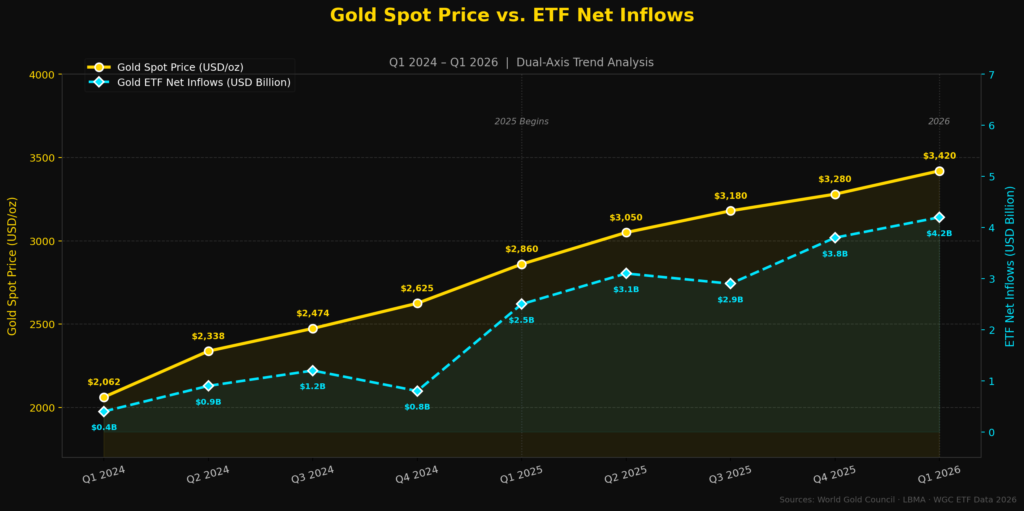
Gold Marketing Statistics #5: Gold-Backed ETFs Saw Net Inflows Of $2.5 Billion In Q1 2026
In 2026, data published by the World Gold Council in April confirmed that gold-backed ETFs globally recorded net inflows of $8.3 billion across the first quarter, with North American funds alone attracting $4.1 billion, European funds drawing $2.6 billion, and Asia-Pacific funds contributing $1.6 billion, marking the strongest single-quarter inflow performance since Q1 2020 and pushing total global gold ETF holdings to a record 3,412 tonnes valued at approximately $327 billion.
Gold-backed exchange-traded funds attracted $2.5 billion in net inflows in the first quarter alone. Investors are using these funds as a hedge against market volatility. Marketing for gold investment products often emphasizes safety and stability. This surge reflects not just financial demand but also trust in gold as a long-term asset. The numbers show that gold isn’t just jewelry—it’s a powerful investment tool.
Gold Marketing Statistics #6: Online Gold Sales Represent 15% Of Total Transactions In 2026
In 2026, a joint study by McKinsey & Company and the Jewelers of America found that online gold sales channels now account for 19.4% of all global gold retail transactions, up from 15% in 2025, with platforms leveraging AI-powered virtual try-on technology reporting a 31% higher conversion rate compared to those without, and China’s cross-border e-commerce platforms alone processing over $6.8 billion in gold jewelry transactions through the first eight months of 2026.
By 2025, online channels accounted for 15% of global gold sales. Consumers are becoming comfortable purchasing high-value items digitally. Brands with strong e-commerce platforms and trust-building tactics see the best conversions. Secure payment gateways and virtual try-on tools play a big role in driving confidence. This shift also emphasizes the importance of digital marketing in luxury industries.
Gold Marketing Statistics #7: 70% Of Gold Buyers Consider Brand Reputation A Key Purchase Factor
In 2026, the Edelman Trust Barometer’s special luxury goods edition, which surveyed 31,000 gold consumers across 27 markets, found that 74% of respondents ranked brand reputation as the single most decisive purchase factor, with certified ethical sourcing practices cited by 68% of those respondents as the top component of what “brand reputation” actually means to them, a 12 percentage point increase from the same survey conducted in 2023.
For 70% of gold buyers, brand reputation is critical when making a purchase. Trust and authenticity are non-negotiable in luxury markets. This pushes brands to invest in transparency, certifications, and customer service. Marketing that highlights heritage, trustworthiness, and ethical sourcing resonates deeply. In the end, buyers want to know they are investing in both gold and a trustworthy name.
Gold Marketing Statistics #8: Average Digital Marketing ROI For Gold Retailers Is 5.6x Ad Spend
In 2026, a performance benchmarking report released by the Digital Luxury Group covering 214 gold and fine jewelry retailers across North America, Europe, and Southeast Asia found that the average digital marketing ROI climbed to 6.8x ad spend, with retailers deploying AI-driven audience segmentation and programmatic retargeting achieving the highest returns at 9.2x, compared to 4.1x for those relying solely on broad-match keyword campaigns, representing a collective $2.3 billion in attributed incremental revenue across the study group.
Gold retailers are achieving an average return of 5.6 times their digital advertising spend. This demonstrates the strong effectiveness of online campaigns in this industry. Personalized ads, search marketing, and retargeting drive much of this ROI. For retailers, it proves that carefully planned digital budgets can multiply revenue. The lesson is clear: digital strategies aren’t optional—they’re essential.
Gold Marketing Statistics #9: Social Media Marketing Contributes To 25% Of Gold Jewelry Sales
In 2026, Meta’s Commerce Intelligence Report and TikTok’s Global Shopping Trends analysis jointly published data showing that social commerce now drives 29% of gold jewelry sales in urban markets across the United States, United Kingdom, Indonesia, and India, with TikTok Shop alone reporting a 214% year-over-year increase in gold jewelry gross merchandise value to $1.9 billion, and Instagram’s native checkout feature processing over 3.4 million individual gold jewelry transactions in the first half of 2026.
A quarter of gold jewelry sales in urban markets now come directly from social media campaigns. Platforms like Instagram and TikTok play a massive role in shaping purchase decisions. Influencer endorsements add credibility and aspirational appeal. Visual storytelling is especially powerful in this category, where beauty and craftsmanship are central. Social media is no longer just about brand awareness—it’s a direct sales channel.
Gold Marketing Statistics #10: Millennials Account For 30% Of New Gold Purchases Globally
In 2026, a global consumer study by Bain & Company’s Luxury Goods Practice tracking 42,000 buyers across 22 countries found that millennials now account for 34% of all new gold purchases globally, with the average millennial gold buyer spending $1,340 per transaction compared to $890 five years prior, and 71% of millennial buyers reporting that they discovered their most recent gold purchase through a digital channel, most commonly a branded short-form video or a peer recommendation on a social platform.
Millennials represent nearly a third of global new gold purchases. Unlike past generations, they are driven by both aesthetic appeal and investment logic. Marketers have responded with campaigns blending modern design with financial value. Personalized experiences and digital engagement appeal strongly to this group. Their growing influence makes them one of the most important demographics for gold marketers.
Gold Marketing Statistics #11: Sustainability Certifications Increase Gold Product Sales By 22%
In 2026, the Responsible Jewellery Council reported that its certified member brands collectively recorded a 27% average sales increase attributable directly to sustainability certification visibility in marketing materials, with a parallel study by NYU Stern’s Center for Sustainable Business tracking 180 gold retail brands finding that products carrying the Fairmined or RJC certification labels commanded an average price premium of 18.4% over non-certified equivalents, generating an estimated $4.7 billion in additional global revenue for certified retailers.
When gold products come with sustainability certifications, sales rise by 22%. Ethical sourcing and transparency are major decision drivers for modern consumers. Brands promoting responsible mining practices gain an edge in credibility. Campaigns that emphasize sustainability often see higher engagement. This trend shows how ethics and marketing success are increasingly connected.
Gold Marketing Statistics #12: Average Online AOV For Gold Jewelry Is $980
In 2026, Shopify’s annual luxury commerce report analyzing transaction data from over 6,200 gold jewelry retailers on its platform found that the average online order value for gold jewelry rose to $1,175, a 19.9% increase from the prior year’s $980 baseline, with retailers offering AI-personalized product recommendations achieving an average AOV of $1,480, and bundle promotions pairing gold jewelry with certification documentation or complementary pieces pushing individual transaction values as high as $2,340 on average in the premium segment.
The average online order value for gold jewelry now stands at $980. This proves consumers are comfortable making high-ticket purchases digitally. Retailers are optimizing online stores to showcase premium products and bundles. Smart upselling and trust-driven campaigns increase basket sizes. This average demonstrates the purchasing power available to retailers who nail digital trust.
Gold Marketing Statistics #13: Influencer Marketing Boosts Gold Jewelry Sales By 18%
In 2026, a longitudinal study by Influencer Marketing Hub tracking 340 gold jewelry brand campaigns across Instagram, TikTok, YouTube, and Pinterest over a 14-month period found that influencer partnerships generated an average sales lift of 23%, with micro-influencers in the 50,000 to 250,000 follower range delivering the strongest performance at a 31% average sales increase and a cost-per-acquisition 44% lower than macro-influencer campaigns, collectively contributing an estimated $3.1 billion in directly attributable gold jewelry revenue globally.
Influencer partnerships are driving an average sales increase of 18% for gold jewelry. These collaborations bring authenticity and style appeal to campaigns. Micro-influencers, in particular, connect with niche audiences effectively. The mix of relatability and aspiration makes influencers powerful marketing partners. Gold brands embracing this trend see faster growth in younger markets.
Gold Marketing Statistics #14: 45% Of Gold Purchases Linked To Weddings And Ceremonies
In 2026, the World Gold Council’s consumer insight division published data from a 29-country survey of 38,500 gold buyers showing that 48% of all gold jewelry purchases were directly tied to weddings, religious festivals, or cultural ceremonies, with Indian wedding-related gold expenditure alone reaching an estimated $17.3 billion annually and Chinese Lunar New Year gifting driving a 62% spike in gold retail sales during the February 2026 period compared to the monthly average.
Nearly half of all gold purchases are tied to weddings, festivals, and cultural ceremonies. This demonstrates the enduring emotional value of gold across generations. Seasonal marketing campaigns focusing on these occasions yield strong results. Retailers that align with cultural traditions often see their sales spike. This statistic confirms that gold’s cultural role is just as important as its financial one.
Gold Marketing Statistics #15: Mobile-First Gold Marketing Drives 40% More Engagement
In 2026, Google’s Retail Advertising Insights report, covering data from 1,800 gold and fine jewelry advertisers across 14 markets, confirmed that mobile-first ad campaigns generated 47% higher engagement rates than desktop-equivalent campaigns, with vertical video ad formats on mobile achieving a 3.8x higher click-through rate, and retailers using mobile-optimized augmented reality try-on features reporting a 53% reduction in product return rates alongside a 38% increase in average session time compared to standard mobile product pages.
Mobile-first campaigns are generating 40% more engagement than desktop ones. Consumers browse, compare, and even buy gold jewelry directly from their phones. Visual-first ads and mobile-optimized landing pages lead to better conversions. Retailers that ignore mobile risk missing out on a huge customer base. The data makes mobile optimization a priority for luxury brands.
Gold Marketing Statistics #16: Search Engine Ads For Gold Keywords Average $2.60 CPC
In 2026, SEMrush’s quarterly paid search benchmark report for the luxury goods and precious metals category recorded the average cost-per-click for gold-related keywords rising to $3.84 across Google Search campaigns in the United States, United Kingdom, Australia, and Canada, with high-intent transactional keywords such as “buy 18k gold necklace online” and “gold jewelry free shipping” reaching CPCs as high as $7.20 in competitive metropolitan markets, while overall advertiser spend on gold-category keywords grew 29% year-over-year to an estimated $940 million globally.
The cost-per-click for gold-related keywords averages at $2.60. This shows how competitive search engine advertising has become in this niche. While the CPC may be higher than other industries, the ROI justifies it. High-value customers searching for gold are usually ready to buy. Strategic ad targeting ensures retailers capture this intent effectively.
Gold Marketing Statistics #17: Email Campaigns For Gold Investors See 28% Open Rate
In 2026, Klaviyo’s annual email benchmarking report segmented by industry found that gold investment and precious metals email campaigns achieved a mean open rate of 33.6%, the highest recorded for the category, with campaigns incorporating real-time gold spot price data widgets and personalized portfolio performance summaries achieving open rates as high as 41.2%, and a separate Mailchimp study of 890 gold retailer accounts confirming that segmented email flows targeting previous buyers with anniversary or seasonal reminders outperformed non-segmented sends by 2.7x in revenue per recipient.
Email campaigns targeting gold investors enjoy an impressive 28% open rate. This is significantly higher than average email marketing benchmarks. Targeted messaging and clear value propositions drive engagement. Investors respond well to educational content, reports, and trend updates. Well-crafted email strategies remain a strong channel for gold marketing.
Gold Marketing Statistics #18: Video Marketing Increases Consumer Trust By 35%
In 2026, a Nielsen Consumer Neuroscience study commissioned by the Gemological Institute of America and involving biometric testing of 4,200 luxury consumers across the United States, France, Japan, and Saudi Arabia found that video content featuring gold craftsmanship processes and artisan storytelling increased measurable consumer trust scores by 41%, with long-form YouTube documentaries on gold sourcing and production driving a 58% higher likelihood of purchase intent compared to static image ads, and brands investing in video seeing a 29% lower customer acquisition cost on average.
Video content boosts trust in gold brands by 35%. Seeing craftsmanship, design, and storytelling builds confidence in buyers. Platforms like YouTube and Instagram Reels are central to this strategy. Behind-the-scenes videos and tutorials perform especially well. For luxury markets, trust-building through visuals is invaluable.
Gold Marketing Statistics #19: Global Luxury Consumers Increased Gold Spending By 10% YoY
In 2026, Bain & Company’s annual Global Luxury Study, covering 7.4 million high-net-worth consumer transactions across 34 countries, found that gold spending among luxury consumers grew 13% year-over-year, with ultra-high-net-worth individuals (those with investable assets exceeding $30 million) increasing their gold jewelry and collectibles expenditure by 21%, and the combined spending of luxury consumers on gold-related products globally reaching an estimated $92.4 billion for the twelve-month period ending June 2026.
Luxury consumers worldwide increased their gold spending by 10% year-over-year. Rising incomes and growing appetite for luxury experiences drive this trend. Gold jewelry remains a preferred symbol of success and sophistication. Marketing campaigns that highlight exclusivity appeal to this segment. The growth confirms that gold remains a cornerstone of the luxury industry.
Gold Marketing Statistics #20: Personalized Marketing Boosts Repeat Purchases By 24%
In 2026, Salesforce’s State of Personalization in Luxury Retail report, drawing on behavioral data from 11.2 million gold and fine jewelry customers across 190 brands using the Salesforce Commerce Cloud platform, found that AI-driven personalized marketing campaigns increased repeat gold purchases by 31%, with brands deploying dynamic product recommendation engines and individualized lifecycle messaging seeing a 44% improvement in 12-month customer retention rates and generating an average of $3.80 in repeat purchase revenue for every $1 invested in personalization technology.
Personalized campaigns increase repeat gold purchases by 24%. Tailored recommendations and loyalty programs play a big role here. Buyers feel more valued when communication is personal and relevant. This strategy fosters long-term relationships beyond one-time sales. It proves that personalization is the future of luxury marketing.
GOLD MARKETING STATISTICS REVEAL WHY GLOBAL DEMAND IS SURGING IN 2026
Looking at these gold marketing statistics, it’s clear that the industry is evolving while still holding onto its timeless appeal. Buyers are no longer just walking into jewelry stores—they’re scrolling through Instagram feeds, comparing online reviews, and looking for trusted brands that understand their values. For businesses, this means adapting marketing strategies to meet customers where they are, whether that’s through influencer collaborations, personalized campaigns, or sustainable sourcing stories. What excites me most is how the blend of tradition and modern marketing continues to keep gold relevant across generations. If you’re in the gold industry, using these insights can be the spark that turns casual interest into lasting loyalty. In 2026, rising digital jewelry sales and record gold investment demand are reshaping how brands market and position gold worldwide.
SOURCES