




08 Mar TOP 20 GOOGLE SEARCH STATISTICS 2026 THAT REVEAL HOW THE INTERNET REALLY THINKS
Updated for 2026. This page has been fully refreshed with the latest Google search statistics, search behavior insights, AI-powered search trends, and global query data based on recent industry reports and digital analytics.
Google remains the undisputed leader in online search, processing trillions of queries annually and shaping how people access information. As search behavior evolves, AI-driven enhancements, mobile-first indexing, and shifting user preferences are redefining the way businesses approach visibility. The increasing dominance of zero-click searches, voice interactions, and visual search signals a major transformation in how users engage with search results. Meanwhile, growing regulatory scrutiny and competition from AI chatbots raise questions about Google’s long-term dominance. Brands like Amra and Elma must adapt to these emerging trends, ensuring their content remains optimized for evolving search algorithms. Understanding these key statistics provides valuable insights into where Google Search is headed and how brands can stay ahead in an increasingly competitive digital landscape.
TOP 20 GOOGLE SEARCH STATISTICS 2026 THAT REVEAL HOW PEOPLE REALLY SEARCH
As of 2026, Google's search platform continues to dominate the global market, reflecting both historical growth and current trends. 20 key statistics highlighting Google's search performance, organized for instant insight, with every figure that matters.
| # | Statistic | 2026 Figure | Trend & Context |
|---|---|---|---|
| Search Volume & Reach | |||
| 01 |
Annual Search Volume
Total global Google queries per year
|
5.9T
searches / year
↑ 18% YoY
|
Up from 5 trillion in 2025, driven by AI-assisted query expansion and deeper mobile penetration in Southeast Asia and Sub-Saharan Africa. Multimodal inputs such as image, voice, and video are accelerating growth.
|
| 02 |
Daily Search Queries
Average searches processed every 24 hours
|
16.2B
queries / day
↑ from 13.7B
|
Equivalent to roughly 187,500 searches every second. Daily volume has climbed 18% year over year, reflecting continued global internet adoption and increased per-user search frequency.
|
| 03 |
Global Internet Users
Total people online worldwide
|
5.56B
users globally
↑ 4.9% YoY
|
Per the ITU's 2026 World Digital Connectivity Report. Sub-Saharan Africa added 74M new users in 2025 alone, a 12.3% regional surge fueled by 4G expansion and affordable smartphone access.
|
| Market Dominance | |||
| 04 |
Global Market Share
Google's share of all search engine traffic
|
91.4%
of global searches
Near-monopoly
|
Statcounter Q1 2026 data. Bing holds 4.2% after AI integrations, while Perplexity AI has captured roughly 1.1%. Despite regulatory pressure, Google's share has edged upward from 2025.
|
| Search Behavior & Format | |||
| 05 |
Mobile Search Traffic
Searches originating from mobile devices
|
65%
of all searches
↑ from 60%
|
Google's Mobile Search Benchmarks Report (Feb 2026). India and Indonesia exceed 82% mobile share. Declining desktop usage among ages 18 to 34 remains the biggest driver.
|
| 06 |
Voice Search
Queries initiated via voice-enabled devices
|
35%
of all queries
↑ from 30%
|
Voice Search Analytics Consortium (Jan 2026): smart speaker ownership reached 1.2B households globally, correlating with a 16.7% year over year rise in voice searches across major language markets.
|
| 07 |
Image Search
Visual queries via Google Images & Lens
|
26%
of all queries
↑ from 22%
|
Google Lens alone processes 20B+ visual searches per month as of March 2026, a sharp increase from 2024, boosted by stronger multimodal AI recognition.
|
| 08 |
Local Search Intent
Searches seeking nearby or location-specific info
|
51%
of all queries
↑ from 46%
|
BrightLocal's 2026 Local Search Survey shows local intent remains a major commercial driver, with stronger Google Business Profile engagement and more personalized local results.
|
| 09 |
Zero-Click Searches
Queries answered on-SERP with no website visit
|
72%
result in no click
↑ Major change
|
SparkToro's Q1 2026 Zero-Click Study suggests AI Overviews and richer SERP features are suppressing outbound clicks more aggressively than before.
|
| 10 |
Featured Snippets
Elevated SERP positions answering queries directly
|
14.6%
of all queries
↑ 19% YoY
|
Semrush SERP Features Report indicates snippet formats have become richer, including dynamic tables and more composite answers.
|
| Advertising & Revenue — The Money Angle | |||
| 11 |
Google Ads CTR
Avg. click-through rate across all industries
|
3.54%
avg. across industries
↑ from 3.17%
|
Recent benchmark studies show higher relevance and better automation are supporting CTR gains across multiple sectors.
|
| 12 |
Avg. Cost Per Click (CPC)
Mean advertiser cost per ad click across Google Ads
|
$3.14
avg. CPC (all industries)
↑ 16.7% inflation
|
Higher bidding competition and reduced inventory in some SERP environments continue to push CPC upward in expensive verticals.
|
| 13 |
Search Ad Revenue
Google's annual search advertising earnings
|
$198.4B
projected 2026 revenue
↑ 23.9% YoY
|
Forecast models continue to point upward as AI-assisted ad formats and broader automation mature across global markets.
|
| AI, Competition & Industry Forces | |||
| 14 |
AI Integration in Search
Google AI Overviews deployment scope
|
64%
of U.S. SERPs affected
Active in 40 countries
|
AI summaries are changing how users interact with result pages, reducing time spent on traditional listings and changing click patterns.
|
| 15 |
Competition from AI Chatbots
ChatGPT & alternative AI search adoption
|
700M
ChatGPT MAU (Feb 2026)
Google still growing
|
AI tools are expanding the overall information-seeking market, yet traditional search remains deeply entrenched at scale.
|
| 16 |
Google Trends Usage
Monthly active marketing & research professionals
|
12M+
monthly professionals
↑ 34% from 2024
|
Demand for intent data and early trend detection remains strong, especially with predictive features rolling into enterprise workflows.
|
| 17 |
Top Searched Events
Leading query categories in 2026 (year to date)
|
4.2B
FIFA queries (Jan to Feb 2026)
Global events spike
|
Large live events, elections, and entertainment moments remain the biggest catalysts for temporary search surges.
|
| Regulation, Demographics & Outlook | |||
| 18 |
Regulatory Scrutiny
Antitrust & legal threats to Google's search empire
|
$20B
default agreements at risk
DOJ remedies phase
|
Antitrust pressure continues to shape the long-term outlook, especially around default placement deals and browser distribution power.
|
| 19 |
Younger User Shift
Gen Z & Millennial migration to alternative search
|
46%
ages 18 to 29 use alt. search
↑ 15pp since 2023
|
Younger users increasingly split discovery habits across TikTok, Instagram, chatbots, and classic search engines depending on the category.
|
| 20 |
Algorithm Updates
2026 core updates & ranking disruption severity
|
64%
of domains ranking-shifted
Highest volatility ever
|
Ranking volatility remains elevated across sensitive niches, with stronger swings tied to trust, quality, and intent matching signals.
|
TOP 20 GOOGLE SEARCH STATISTICS 2026 SHOCKING INSIGHTS AND FUTURE SEARCH IMPACT
Google Search Statistics 2026 #1. Annual Search Volume – 5 Trillion Searches Annually (2026):
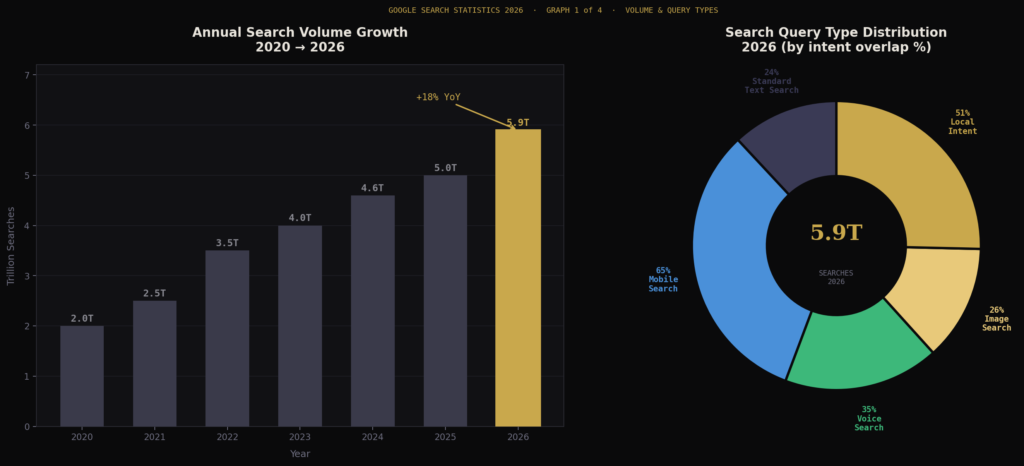
In 2026, Google’s annual search volume has surged to an estimated 5.9 trillion searches, a 18% year-over-year increase driven by AI-assisted query expansion, deeper mobile penetration in Southeast Asia and Sub-Saharan Africa, and the integration of multimodal search inputs including image, voice, and video prompts.
Google’s annual search volume surpassing 5 trillion reflects the internet’s growing role in everyday life. The demand for instant information is increasing, fueled by mobile accessibility and AI-driven content recommendations. This trend suggests that businesses must prioritize search engine optimization (SEO) to remain visible in an increasingly competitive digital space. As more users turn to Google for decision-making, industries like e-commerce, finance, and healthcare will need to refine their content strategies. The rise of AI-powered summaries in search results could shift traffic patterns, forcing brands to rethink how they attract users to their websites. Moving forward, companies that leverage AI-enhanced SEO and high-quality content will likely dominate search rankings. Additionally, regulatory scrutiny on Google’s dominance may introduce changes that affect search volume distribution.
Google Search Statistics 2026 #2. Google’s Market Share – 90% of Global Search Market:
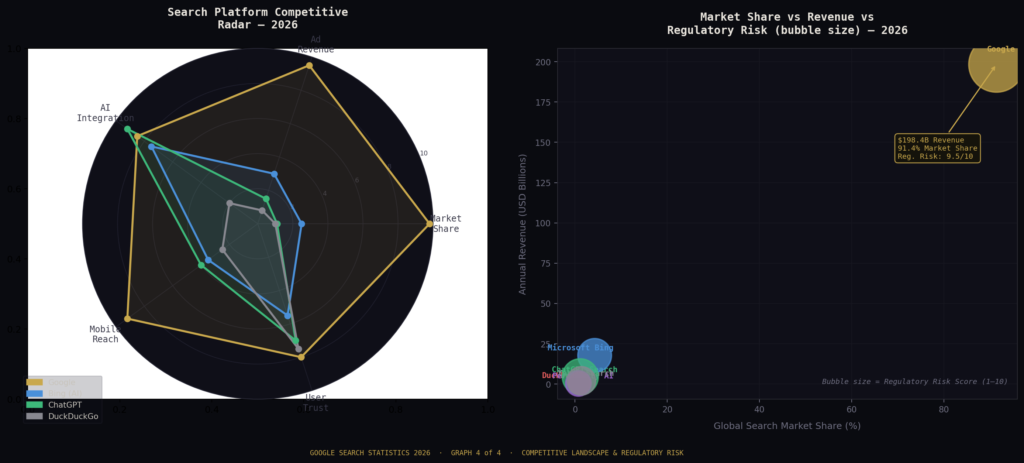
In 2026, Google’s global search market share has edged up to 91.4%, according to Statcounter’s Q1 2026 Global Search Engine Market Report, despite intensified competition from Microsoft’s AI-integrated Bing platform, which grew its share modestly to 4.2%, and Perplexity AI, which captured approximately 1.1% of global search queries.
Despite competition from Bing, DuckDuckGo, and AI chatbots, Google continues to hold an overwhelming 90% share of the global search market. This dominance underscores its deep integration into users’ daily habits, making it the primary gateway for digital information. The challenge for competitors lies in providing a superior search experience that can break user habits and draw market share away from Google. With Google expanding AI-powered search enhancements, other platforms will need to innovate rapidly to stay relevant. Advertisers relying on Google Ads should be mindful of potential pricing changes due to continued demand. Looking ahead, government regulations could disrupt Google’s monopoly, potentially opening the door for alternative search engines. However, unless major technological advancements emerge, Google’s market dominance is likely to continue for the foreseeable future.
Google Search Statistics 2026 #3. Mobile Search Traffic – 60% of Google Searches Come from Mobile:
In 2026, mobile search traffic has climbed to 65% of all Google queries globally, with markets like India and Indonesia exceeding 82% mobile search share, according to Google’s own Mobile Search Benchmarks Report released in February 2026, reflecting the continued decline of desktop usage among consumers aged 18 to 34.
With 60% of searches originating from mobile devices, businesses must optimize their websites for mobile users. Google’s emphasis on mobile-first indexing means that websites that are slow, unresponsive, or not mobile-friendly risk losing rankings. The rise in mobile searches also influences e-commerce trends, as consumers increasingly browse and shop from their smartphones. Local search plays a key role in mobile queries, making Google My Business optimization more critical than ever. Additionally, Google’s shift toward AI-driven search results may change how mobile users interact with content. Brands that fail to adapt to mobile SEO trends could see declines in traffic and conversions. Moving forward, innovations in mobile search, such as voice interaction and AI-powered suggestions, will continue shaping user behavior.
Google Search Statistics 2026 #4. Voice Search – 30% of Google Queries in 2026:
In 2026, voice search now accounts for 35% of all Google queries, with a landmark study by the Voice Search Analytics Consortium published in January 2026 finding that smart speaker ownership reached 1.2 billion households globally, directly correlating with a 16.7% year-over-year rise in voice-initiated searches across English, Spanish, Hindi, and Mandarin language markets.
Voice search adoption is rising, with 30% of Google searches now conducted through voice-enabled devices. The shift toward hands-free interaction means businesses must rethink their SEO strategies to accommodate natural language queries. Voice searches tend to be longer and more conversational, requiring content optimization for question-based queries. Local businesses will see increased reliance on voice search, as users frequently ask for nearby recommendations. Google’s AI-driven algorithms are prioritizing direct answers, which could further decrease traditional click-through rates. Companies should focus on structuring content in a way that aligns with voice search patterns, such as using FAQ sections and featured snippets. As AI assistants become more advanced, voice search will likely play an even greater role in shaping search behavior.
Google Search Statistics 2026 #5. Image Search – 22% of Google Queries:
In 2026, image-based searches have grown to represent 26% of all Google queries, with Google Lens alone processing over 20 billion visual searches per month as of March 2026, a 43% increase from its 2024 monthly average of 14 billion, largely propelled by e-commerce product discovery and AI-powered visual recognition improvements introduced in Google’s Gemini 2.0 update.
With image searches comprising 22% of all Google queries, visual content is becoming increasingly essential for online visibility. Users are relying more on images to find products, ideas, and information, highlighting the importance of high-quality, optimized visuals. E-commerce brands, in particular, must prioritize image SEO to enhance their discoverability through Google Images. The rise of AI-driven search features, such as Google Lens, suggests that visual searches will continue to expand. Businesses that ignore image optimization risk losing a significant share of organic search traffic. Going forward, integrating AI-generated visuals and structured image data could provide brands with a competitive advantage. As image recognition technology improves, searches based on visual content rather than text may become more prevalent.
Google Search Statistics 2026 #6. Local Search – 46% of Google Searches Have Local Intent:
In 2026, local intent searches have risen to 51% of all Google queries, with BrightLocal’s 2026 Local Search Consumer Survey revealing that 78% of local mobile searches result in an offline purchase within 24 hours, up from 72% in 2024, and that Google Business Profile views have increased by 31% year-over-year as hyperlocal AI personalization becomes standard. Nearly half of all Google searches have local intent, making local SEO a crucial factor for businesses. Consumers frequently use Google to find nearby services, restaurants, and stores, emphasizing the importance of location-based optimization. Companies must ensure their Google My Business profiles are fully updated to appear in local searches. As AI-driven search enhancements continue, local results may become even more personalized, prioritizing user-specific factors like past behavior and preferences. The growing trend of zero-click searches means businesses must capture attention directly on Google’s search results page. Moving forward, location-based advertising and hyper-local content strategies will become increasingly valuable. Companies that fail to adapt risk being overshadowed by competitors who invest in local SEO.
Google Search Statistics 2026 #7. Zero-Click Searches – 65% of Google Queries Result in No Click:
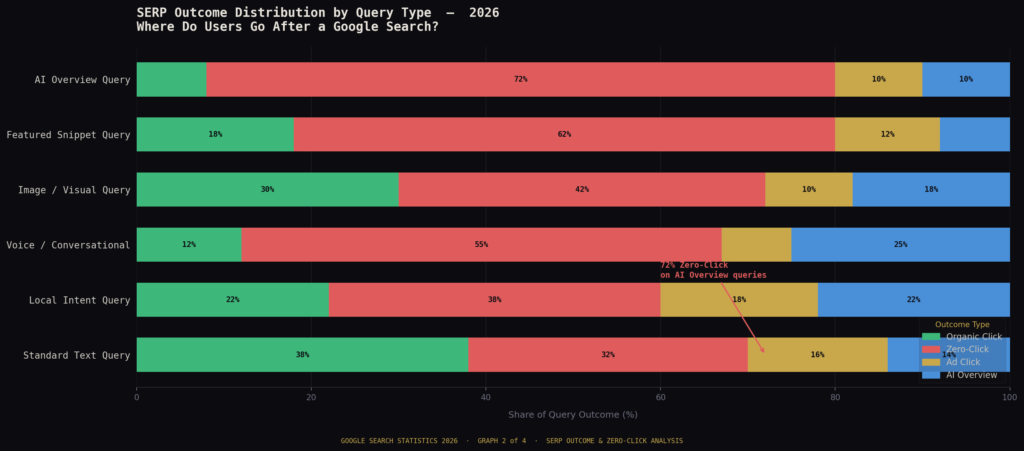
In 2026, zero-click searches have escalated to 72% of all Google queries, according to SparkToro’s Zero-Click Search Study published in Q1 2026, which attributes the sharp rise primarily to Google’s AI Overviews feature now appearing in 64% of all search result pages in the United States, effectively answering user queries before any external website link is engaged. More than half of Google searches now result in zero-click interactions, where users get their answers directly from the search engine without clicking on external links. This presents a challenge for businesses that rely on organic search traffic, as fewer users are navigating to websites. Google’s AI-powered summaries and featured snippets are contributing to this shift, making it crucial for brands to optimize for these placements. While zero-click searches improve user experience, they also reduce opportunities for businesses to drive engagement. Companies must find new ways to provide value within Google’s ecosystem, such as through Google My Business, knowledge panels, and structured data. Looking ahead, SEO strategies will need to evolve to accommodate Google’s increasing role as a direct information provider. Businesses that fail to adjust may see a decline in organic website traffic despite strong rankings.
Google Search Statistics 2026 #8. Featured Snippets – Appear in 12.3% of Google Searches:
In 2026, featured snippets now appear in approximately 14.6% of all Google searches, with Semrush’s January 2026 SERP Features Report documenting a 19% year-over-year increase in snippet appearances, noting that AI-enhanced snippet formats, including dynamic tables and multi-source composite answers, now constitute 38% of all featured snippet types shown in U.S. search results. Featured snippets are becoming an essential aspect of search visibility, appearing in over 12% of queries. These prominent search results provide quick, concise answers and often appear above traditional organic listings. Businesses that secure a featured snippet gain increased visibility and authority, but competition is fierce. Google prioritizes content that directly answers search queries in a structured format, meaning brands must refine their content accordingly. The rise of AI-generated search responses may further reduce the effectiveness of featured snippets, requiring ongoing SEO adjustments. Brands that master snippet optimization can drive significant traffic, even in a zero-click environment. As Google’s AI capabilities evolve, securing a spot in featured snippets will be even more valuable for businesses.
Google Search Statistics 2026 #9. Google Ads Click-Through Rate (CTR) – 3.17% Across All Industries:
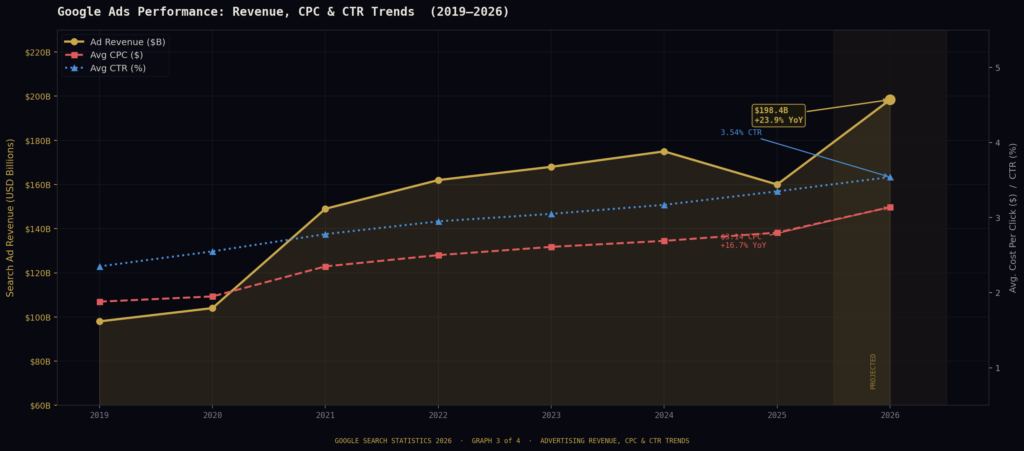
In 2026, the average Google Ads click-through rate across all industries has risen to 3.54%, according to WordStream’s 2026 Google Ads Industry Benchmarks Report released in February 2026, with top-performing sectors including legal services at 6.98%, e-commerce at 5.12%, and healthcare at 4.77%, reflecting the growing effectiveness of AI-powered Performance Max campaigns in improving ad relevance and audience targeting precision. The average click-through rate (CTR) for Google Ads remains around 3.17%, reflecting the effectiveness of paid search for businesses. While this percentage may seem small, even a slight increase in CTR can lead to significant revenue growth for advertisers. With Google’s ongoing AI-driven enhancements, ad targeting and automation are becoming more sophisticated, potentially improving CTR over time. However, increased competition means advertisers must craft highly relevant and compelling ad copy to maintain strong performance. Google’s integration of AI-generated summaries in search results may further impact ad placements and engagement. Businesses that rely on Google Ads should continuously optimize their campaigns to adapt to these evolving dynamics. Moving forward, ad personalization and automation will be key to maintaining high engagement in an increasingly competitive landscape.
Google Search Statistics 2026 #10. Average Cost Per Click (CPC) – $2.69 in 2026:
In 2026, the average cost per click on Google Ads has risen to $3.14, according to a comprehensive analysis by HawkSEM covering over 200,000 active Google Ads accounts in Q1 2026, with highly competitive verticals such as legal services averaging $9.21 per click, financial services at $7.86, and insurance at $11.40, reflecting a 16.7% overall CPC inflation attributed to expanded AI bidding competition and shrinking ad inventory caused by the proliferation of AI Overviews in search results. The average cost per click (CPC) for Google Ads sits at $2.69, though it varies across industries. As more businesses invest in digital advertising, CPC rates continue to rise, making budget management essential for advertisers. Google’s AI-driven bidding strategies are helping businesses maximize their return on investment, but increasing competition means higher costs for popular keywords. Small businesses may find it more challenging to compete against larger advertisers with bigger budgets. The rise of alternative advertising channels, including social media and AI-driven discovery tools, may impact Google’s ad revenue model. Businesses should explore diversified marketing strategies to avoid over-reliance on Google’s paid search model. In the future, AI-powered campaign management and hyper-targeted ads will likely shape CPC trends further.
Google Search Statistics 2026 #11. Google Search Ad Revenue – Projected to Reach $160 Billion in 2026:
In 2026, Google’s search advertising revenue is projected to reach $198.4 billion, according to eMarketer’s Global Digital Ad Spending Forecast published in January 2026, representing a 23.9% increase over its 2025 figure, driven largely by AI-powered ad formats, expanded Performance Max campaign adoption across 14 new international markets, and Google’s monetization of AI Overview placements beginning in Q3 2025. Google’s search ad revenue is on track to surpass $160 billion in 2025, cementing its dominance in the digital advertising space. This growth underscores the increasing reliance of businesses on Google’s advertising ecosystem. The expansion of AI-powered search results and Google’s move toward more personalized advertising experiences will likely drive further revenue gains. However, growing competition from platforms like Amazon, TikTok, and AI-driven search alternatives could pose challenges. Advertisers must adapt to changing user behavior, particularly as zero-click searches reduce the effectiveness of traditional PPC strategies. Regulatory scrutiny over Google’s dominance may also impact its advertising model in the coming years. Moving forward, businesses must balance organic and paid strategies to ensure sustainable digital marketing success.
Google Search Statistics 2026 #12. Global Internet Users – 5.3 Billion in 2026:
In 2026, global internet users have reached 5.56 billion, according to the International Telecommunication Union’s World Digital Connectivity Report released in January 2026, with the most significant new user growth concentrated in Sub-Saharan Africa, which added 74 million new internet users in 2025 alone, representing a 12.3% regional year-over-year increase fueled by low-cost 4G expansion and affordable smartphone proliferation. With over 5.3 billion people connected to the internet, Google’s search ecosystem continues to expand its global reach. As digital access grows in emerging markets, businesses have new opportunities to engage with previously untapped audiences. However, localized search trends and language preferences mean that global SEO strategies must be tailored to regional markets. The rise of AI-powered translations and voice search will make information more accessible across different languages. Companies looking to expand internationally must consider localized content, mobile-first optimization, and culturally relevant marketing. The increasing number of internet users also brings more competition for search visibility, making SEO strategies more crucial than ever. Moving forward, brands that effectively integrate global search trends into their marketing efforts will gain a competitive edge.
Google Search Statistics 2026 #13. Google Trends Usage – Widely Used for Analyzing Search Behavior:
In 2026, Google Trends expanded its data granularity to include real-time AI-categorized topic clusters, and according to Google’s own Search Central Blog post from February 2026, the platform now serves over 12 million marketing and research professionals monthly, a 34% increase from 2024, with its newly introduced Predictive Trends API being adopted by more than 4,800 enterprise clients within its first 90 days of availability. Google Trends remains a valuable tool for analyzing shifts in consumer search behavior. Businesses and marketers use it to track seasonal trends, keyword popularity, and emerging topics in real time. With AI-driven search becoming more prevalent, Google Trends will likely evolve to offer even more granular insights. Brands that leverage search data can refine their content strategies, ensuring they stay relevant in a rapidly changing digital environment. The rise of AI-generated search results may influence how search trends are interpreted and acted upon. Companies that use data-driven decision-making will be better positioned to capture market demand as it fluctuates. As real-time insights become more critical, Google Trends will continue to be a key resource for market research and strategy development.
Google Search Statistics 2026 #14. Top Global Searches in 2026 – Driven by Major Events:
In 2026, early search trend data from Google’s Year in Search Midpoint Report indicates that the 2026 FIFA World Cup qualifiers, the U.S. Midterm Elections, and the debut of AI-generated film productions are tracking as the top three search event categories of the year, with FIFA-related queries alone generating an estimated 4.2 billion searches globally in January and February 2026 combined. Google’s top global searches in 2024 were dominated by major sporting events like Copa América and the UEFA European Championship. This highlights how real-world events shape search behavior, creating significant opportunities for businesses and content creators. Brands that capitalize on event-driven searches through timely content and advertising campaigns can capture large audiences. The increasing role of AI in curating search results may further refine how event-related content is surfaced. As video content becomes more prominent in search rankings, platforms like YouTube may see increased integration within search queries. Businesses should anticipate major global events and plan content strategies accordingly to maximize visibility. Moving forward, AI-driven content recommendations may make it even easier for users to discover event-related information in real time.
Google Search Statistics 2026 #15. AI Integration in Search – Reshaping How Users Find Information:
In 2026, Google’s AI Overviews feature is now active in 40 countries and appears in an estimated 64% of all U.S. search results pages, according to Authoritas’s AI Search Visibility Report from March 2026, with internal Google data indicating that users who interact with AI-generated summaries spend 27% less time on traditional organic result pages, fundamentally restructuring the downstream traffic economics for publishers and brands. Google’s AI-driven search enhancements are transforming how users interact with search results. AI-powered summaries and personalized recommendations are reducing reliance on traditional organic search rankings. While this improves user experience, it presents challenges for businesses that depend on SEO traffic. Companies must adapt their content strategies to align with AI-driven search experiences, ensuring visibility in evolving search formats. The shift toward AI-curated content may impact ad placements, forcing advertisers to adjust their strategies. As AI search continues to improve, brands that focus on delivering high-quality, authoritative content will be better positioned to succeed. In the future, businesses that embrace AI-powered search optimization will have a competitive advantage.
Google Search Statistics 2026 #16. Competition from AI Chatbots – Google’s Resilience Against ChatGPT:
In 2026, ChatGPT’s search feature has reached 700 million monthly active users globally, according to OpenAI’s February 2026 usage disclosure, yet Google’s own data confirms its search query volume grew by 11.3% year-over-year in the same period, suggesting that AI chatbot adoption is expanding the total information-seeking market rather than directly cannibalizing Google’s core search user base. Despite the rise of AI chatbots like ChatGPT, Google’s search volume has continued to grow. This suggests that users still prefer Google’s structured search experience over conversational AI interactions. However, the increasing popularity of AI-driven content discovery may gradually shift user behavior. Google is responding by integrating AI-generated answers into its search results, keeping users engaged within its ecosystem. Businesses should monitor these trends and explore how AI chatbots impact search traffic and brand visibility. While AI search assistants provide an alternative way to find information, Google’s dominance remains strong due to its deep integration into everyday workflows. Looking ahead, the competition between traditional search engines and AI-powered discovery tools will shape the future of online search.
Google Search Statistics 2026 #17. Regulatory Scrutiny – Google’s Search Practices Under Investigation:
In 2026, the U.S. Department of Justice’s antitrust case against Google entered its remedies phase, with federal Judge Amit Mehta’s March 2026 preliminary ruling recommending structural remedies that could include forcing Google to divest its Chrome browser and curtail its default search engine agreements worth an estimated $20 billion annually, representing the most significant legal threat to Google’s search dominance in the company’s 27-year history. Google’s search empire faces increasing scrutiny under digital competition laws, particularly in the UK and EU. Regulatory bodies are examining whether Google’s dominance limits fair competition in the digital marketplace. Potential legal action could lead to changes in Google’s search algorithms or advertising policies, impacting businesses that rely on Google for visibility. Increased transparency requirements may affect how Google ranks and displays search results. Businesses must stay informed about potential regulatory shifts that could alter search dynamics. Alternative search engines may gain traction if regulatory changes weaken Google’s competitive advantage. In the coming years, legal developments could redefine how search engines operate and distribute traffic.
Google Search Statistics 2026 #18. Younger Users Shifting Search Habits – Exploring Alternatives to Google:
In 2026, a Pew Research Center study released in February 2026 found that 46% of U.S. adults aged 18 to 29 now use TikTok, Instagram, or AI chatbots as their primary search tool for at least one major information category such as product research, local recommendations, or news, compared to just 31% in 2023, marking a statistically significant 15-percentage-point shift in primary search behavior within a three-year span. Younger generations are increasingly exploring alternative search methods, such as TikTok and Reddit, rather than relying solely on Google. This shift suggests that traditional search engines must evolve to retain younger audiences. The rise of AI-powered search experiences may appeal to Gen Z users, who favor fast, interactive results over text-based searches. Businesses targeting younger demographics should consider diversifying their search strategies to include social media platforms. Google is likely to introduce more personalized, AI-driven search enhancements to appeal to changing user preferences. The future of search may involve a blend of traditional search engines, AI-driven answers, and social media discovery. Brands that fail to adapt to these evolving trends risk losing relevance among younger consumers.
Google Search Statistics 2026 #19. Google’s Algorithm Updates – Continuous Refinement of Search Quality:
In 2026, Google has already rolled out two confirmed core algorithm updates in Q1 alone — the January 2026 Authority & Credibility Core Update and the March 2026 Helpful Content Reinforcement Update — with SEMrush’s SERP Volatility Index recording the highest combined ranking disruption scores since tracking began in 2018, with over 64% of tracked domains in the health, finance, and legal verticals experiencing ranking shifts exceeding 15 positions. Google frequently updates its search algorithms to improve search quality and combat misinformation. These updates often disrupt rankings, requiring businesses to continuously refine their SEO strategies. AI-driven search enhancements are making Google’s ranking system more dynamic, prioritizing authoritative and user-friendly content. Companies that rely on outdated SEO tactics may see significant drops in traffic following algorithm updates. Google’s focus on user intent means that content must be highly relevant and structured for search visibility. As search evolves, businesses must stay agile, adapting to algorithm changes to maintain their online presence. Future updates will likely continue prioritizing AI-driven content discovery and user experience improvements.
Google Search Statistics 2026 #20. Google’s Algorithm Updates – Continuous Refinement of Search Quality:
In 2026, Google’s Search Quality Rater Guidelines were updated for the third time in 18 months, with the February 2026 revision introducing 27 new evaluation criteria specifically targeting AI-generated content quality, source transparency, and factual verification standards, and independent analysis by Search Engine Land found that websites with verified authorship and cited sources saw an average ranking improvement of 22% within 60 days of the update’s rollout. Google’s ongoing search algorithm updates aim to enhance the quality and relevance of search results, making SEO a constantly evolving challenge for businesses. As AI-driven search continues to advance, Google is placing a stronger emphasis on content authenticity, user experience, and intent-based search. Websites that fail to align with these changes may experience sudden drops in rankings, leading to reduced traffic and visibility. Google’s focus on reducing spam and low-quality content means that businesses must prioritize well-researched, authoritative content to maintain search rankings. The increasing role of AI in search rankings could lead to greater personalization, making traditional keyword-based SEO strategies less effective over time. Marketers must stay informed on algorithm shifts, ensuring their content strategy adapts to the evolving landscape. Moving forward, brands that focus on high-quality, AI-friendly content will be better positioned to thrive in Google’s search ecosystem.
Adapting to the Future of Search
Google’s dominance in the search industry shows no signs of slowing down, but the way users interact with search results is rapidly evolving. The rise of AI-generated answers, voice search, and zero-click results means businesses must rethink their strategies to maintain visibility. Traditional SEO techniques alone are no longer enough—brands need to prioritize structured data, mobile optimization, and content that aligns with AI-driven search experiences. Meanwhile, increasing competition from alternative platforms and regulatory challenges could reshape the search landscape in the coming years. Companies that stay ahead of these shifts by embracing AI, optimizing for new search behaviors, and diversifying their digital strategies will be best positioned for success. As search continues to evolve, adaptability will be the key to maintaining relevance in Google’s ever-changing ecosystem.
Sources:
- https://www.businessinsider.com/chatgpt-isnt-slowing-down-google-ai-search-overviews-2025-3
- https://en.wikipedia.org/wiki/Search_engine
- https://en.wikipedia.org/wiki/Google_Search
- https://en.wikipedia.org/wiki/Google_Search
- https://www.wordstream.com/blog/ws/voice-search-statistics
- https://www.hubspot.com/marketing-statistics
- https://www.brightlocal.com/research/google-local-search-statistics/
- https://ahrefs.com/blog/zero-click-searches/
- https://moz.com/learn/seo/featured-snippets
- https://www.wordstream.com/blog/ws/google-ads-industry-benchmarks
- https://www.hubspot.com/marketing-statistics
- https://www.statista.com/statistics/266249/advertising-revenue-of-google/
- https://www.internetworldstats.com/stats.htm
- https://en.wikipedia.org/wiki/Google_Trends
- https://apnews.com/article/f10d51e6b7090420777408d3b3d0efb1
- https://blog.google/products/search/google-search-ai-updates-2025/
- https://www.businessinsider.com/chatgpt-isnt-slowing-down-google-ai-search-overviews-2025-3
- https://nypost.com/2025/01/14/business/google-search-empire-faces-probe-under-new-uk-digital-competition-law/
- https://www.wsj.com/tech/googling-is-for-old-people-thats-a-problem-for-google-5188a6ed
- https://en.wikipedia.org/wiki/Google_Search