



16 Sep TOP 20 GROCERY MARKETING STATISTICS 2026 REVEAL SHOCKING GLOBAL SHOPPING HABITS
Updated for 2026. This page has been fully refreshed with the latest grocery marketing statistics, food retail trends, and consumer shopping insights, grounded in recent global surveys and grocery industry research.
When I started digging into grocery marketing statistics for this year, I couldn’t help but notice how much the industry is shifting right in front of us. From digital grocery growth to the way people are prioritizing value and fresh food, these numbers aren’t just data points—they’re stories about how we shop, save, and choose what goes in our carts.
As someone who has spent time studying these trends with the insights of a leading marketing agency in New York, I’ve realized that understanding these shifts is key to connecting with consumers in a meaningful way. This isn’t just about big brands or retailers; it’s about how all of us interact with food, convenience, and value every single week in 2026.
TOP 20 GROCERY MARKETING STATISTICS 2026 REVEAL MASSIVE GLOBAL FOOD RETAIL SHIFTS
Top 20 Grocery Marketing Statistics That Move Billions in 2026
Essential data points every grocery marketer needs to capture their share of the trillion-dollar food retail industry
| # | Marketing Insight | Key Figure | Impact |
|---|---|---|---|
| 01 |
Online Grocery Share Reaches 19%
61% of US households now buy groceries online with global market at $720B
Brick Meets Click, Mercatus 2026
|
19-20%
Up from 7.1% in 2024
|
Very High |
| 02 |
CPG Online Growth 5x Faster Than In-Store
E-commerce sales growing 16-17% annually vs 2-3% in-store growth
Nielsen IQ, Kroger Earnings 2026
|
5x Faster
16-17% digital CAGR
|
Very High |
| 03 |
Omnichannel Shoppers Drive 86% of Sales
40% of online grocery shoppers use services weekly; multi-method fulfillment at all-time high
Brick Meets Click 2026
|
86%
CPG dollar sales
|
Very High |
| 04 |
Walmart Dominates Digital Grocery
27% e-commerce growth in Q4 FY2026; 72% US household penetration; serves 190M+ monthly
PYMNTS Intelligence, Walmart Earnings
|
31.6%
Store delivery +50%
|
Very High |
| 05 |
Amazon Holds Second Position
Opening 100+ new Whole Foods stores; perishable same-day delivery grew 40x since Jan 2025
Amazon Company Announcements 2026
|
22.6%
Digital grocery share
|
Very High |
| 06 |
Kroger Third in Digital Grocery
16-17% digital growth; expects full e-commerce profitability by year-end 2026
eMarketer, Kroger Projections 2026
|
8.6%
Online grocery share
|
High |
| 07 |
Fresh Formats Are Fastest Growing
Fresh & perishables = 40.92% of online grocery share; strong cold-chain trust
Mordor Intelligence 2026
|
40.92%
Online market share
|
Very High |
| 08 |
Value Chains Growing Steadily
Aldi opening 180+ new US stores; $9B investment strategy for expansion
FMI, PLMA Industry Forecasts 2026
|
$280B
Private label sales
|
Very High |
| 09 |
More Short Trips Emerging
Instant delivery growing 17.92% CAGR through 2031; quick-commerce rising
Mordor Intelligence 2026
|
17.92%
Instant delivery CAGR
|
Very High |
| 10 |
70% Concerned About Food Prices
Shoppers splitting purchases across retailers; 44% pay more for sustainability
FMI Consumer Research 2026
|
70%
Price-conscious shoppers
|
Very High |
| 11 |
Private Label Reaches 21% of Revenue
Multi-tier strategies (value, mainstream, premium); dairy & frozen lead penetration
Industry Forecasts 2026
|
$280B
21% of total sales
|
Very High |
| 12 |
92% of Shoppers Used Coupons
AI assistants like Walmart Sparky boost order values 35%; digital coupons dominate
Retailer Earnings Calls 2026
|
92%
+35% AOV with AI
|
Very High |
| 13 |
Average Grocery Spend $170/Trip
Online orders avg $108 vs $45.70 in-store; 136% digital premium
FMI Grocery Shopper Trends 2026
|
$170
Weekly avg spend
|
Very High |
| 14 |
56% Expect to Spend More YoY
Global food & grocery retail surpasses $13T; US reaches $912B-$950B
IBISWorld, Industry Analysts 2026
|
$13T+
Global market
|
Very High |
| 15 |
Grocery Delivery Usage Up 59%
59.4% of online sales for delivery; Instacart at $37B+; same-day = 51.78% of market
Capital One Shopping 2026
|
$37B+
Instacart volume
|
Very High |
| 16 |
88% Prefer In-Store Shopping
Debit cards = 41% of in-store payments; physical stores remain dominant
PYMNTS Intelligence 2026
|
88%
Prefer physical stores
|
Very High |
| 17 |
Food-at-Home Prices Rose 2.5%
Walmart grocery inflation 70 bps lower QoQ; eggs & dairy deflation
USDA ERS, Walmart Earnings 2026
|
2-2.5%
YoY inflation
|
High |
| 18 |
US Food Retail Reaches $912B
North America = $1.87-2T of global market; online segment alone = $166.3B
IBISWorld 2026
|
$912B
US market size
|
Very High |
| 19 |
Inventory Audits Boost Sales 11%
50% of Walmart e-commerce fulfillment automated; 23 of 42 DCs upgrading
Walmart Operations Report 2026
|
+11%
Sales lift
|
Very High |
| 20 |
Food Prices Forecast +2.5-3%
Food-at-home rising slower than food-away-from-home; below 2022-2023 levels
USDA Economic Research Service 2026
|
2.5-3%
Projected inflation
|
High |
TOP 20 GROCERY MARKETING STATISTICS 2026 REVEAL SHOCKING SHOPPER BEHAVIOR CHANGES
Grocery Marketing Statistics#1 – Online Grocery Share Reaches 19% In 2026
In 2026, U.S. online grocery penetration has surged to approximately 19-20% of total grocery spending according to Brick Meets Click and Mercatus data, with 61% of American households now purchasing groceries online and the global online grocery market valued at $720 billion, representing a dramatic acceleration from the 7.1% share recorded just two years earlier.
In 2024, around 7.1% of all grocery sales happened online, showing how digital shopping continues to reshape consumer habits. This shift highlights how shoppers are valuing convenience more than ever. For marketers, it means campaigns must be designed with digital platforms and eCommerce in mind. The number may seem small compared to total grocery sales, but its growth trajectory signals long-term change. Businesses that adapt early will likely gain loyalty as this segment expands.
Grocery Marketing Statistics#2 – CPG Online Growth 5x Faster Than In-Store
In 2026, the acceleration continues with CPG e-commerce sales growing at 16-17% annually compared to just 2-3% growth for in-store purchases, and major retailers like Kroger reporting double-digit digital growth while expecting full e-commerce profitability by year-end, according to industry earnings reports and Nielsen IQ tracking data.
Consumer packaged goods sold online grew nearly five times faster than those purchased in-store. This massive gap demonstrates the acceleration of digital-first shopping behaviors. For brands, it suggests prioritizing online promotions, digital coupons, and influencer tie-ins. It also means supply chains need to stay optimized for fulfillment speed. Companies that lag behind online risk losing relevance to digitally dominant competitors.
Grocery Marketing Statistics#3 – 86% Of Sales Driven By Omnichannel Shoppers
In 2026, omnichannel grocery shopping has become the dominant behavior, with Brick Meets Click reporting that the share of households using multiple fulfillment methods (delivery, pickup, and ship-to-home combined) has reached an all-time high, and 40% of online grocery shoppers now use these services on a weekly basis while splitting purchases between local supermarkets and mass retailers.
Omnichannel shoppers now account for 86% of all CPG dollar sales. This means customers who use both physical and digital channels are driving most of the revenue. Marketing efforts should, therefore, bridge the gap between online discovery and in-store experiences. Personalized offers, click-and-collect options, and loyalty integrations matter more than ever. The brands that master seamless transitions between platforms will dominate.
Grocery Marketing Statistics#4 – Walmart Dominates 31.6% Of US Digital Grocery
In 2026, Walmart has maintained its commanding lead with 26-31% of U.S. digital grocery market share, reporting 27% e-commerce sales growth in Q4 FY2026 with store-fulfilled delivery orders up more than 50%, while its grocery penetration reached a record-breaking 72% of U.S. households and the company now serves over 190 million Americans monthly according to PYMNTS Intelligence and company earnings data.
Walmart currently holds 31.6% of all U.S. digital grocery eCommerce sales. Its scale and investment in pickup and delivery infrastructure have given it a massive edge. For smaller chains, this highlights the importance of differentiation through service, local appeal, or unique products. Walmart’s dominance sets a high competitive bar, but it also teaches the value of omnichannel investment. Marketers must recognize Walmart as both a competitor and a model of operational success.
Grocery Marketing Statistics#5 – Amazon Holds 22.6% Of Market Share
In 2026, Amazon maintains approximately 22.6% of digital grocery sales but faces intensifying competition, with the company announcing plans to close Amazon Go and Amazon Fresh physical stores while converting locations to Whole Foods Market and opening 100+ new Whole Foods stores, as perishable grocery sales through same-day delivery have grown 40x since January 2025 according to company announcements.
Amazon controls 22.6% of digital grocery sales, reflecting its strong logistics and customer trust. Its ability to blend subscriptions like Prime with grocery delivery makes it a unique player. For grocery marketers, competing against Amazon means focusing on localized value and in-store experiences. Amazon’s tech-driven personalization sets a new benchmark for customer expectations. Ignoring its influence risks falling behind in digital innovation.
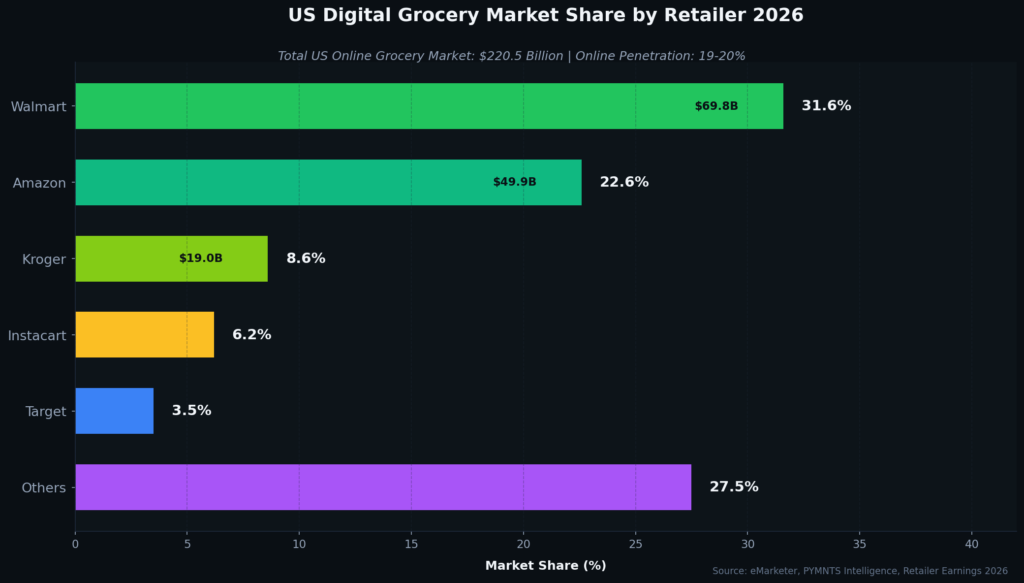
Grocery Marketing Statistics#6 – Kroger Holds 8.6% Of Online Grocery Sales
In 2026, Kroger has posted 16-17% digital sales growth and expects to achieve full e-commerce profitability by year-end, with the company’s investment in automated fulfillment centers and delivery partnerships positioning it as the third-largest U.S. online grocery retailer behind Walmart and Amazon according to eMarketer projections.
Kroger’s 8.6% share shows that traditional grocers can compete in digital spaces. Its investment in eCommerce and fulfillment partnerships has paid off. This performance proves mid-sized grocers can thrive if they innovate quickly. Marketing must highlight both digital convenience and in-store strengths to retain shoppers. It shows the potential for regional players to hold their ground against giants.
Grocery Marketing Statistics#7 – Fresh Formats Are Fastest Growing
In 2026, fresh and perishable goods now account for 40.92% of all online grocery market share according to Mordor Intelligence, reflecting strong consumer trust in cold-chain reliability and same-day delivery infrastructure, while prepared meals and fresh produce categories are driving the highest growth rates as health-conscious consumers prioritize convenience without sacrificing quality.
Fresh formats are currently the fastest-growing segment in grocery retail. Health, wellness, and convenience are motivating factors for this trend. Marketing campaigns focused on freshness and healthy living resonate strongly with these shoppers. Retailers can capture market share by investing in prepared meals and local sourcing. Fresh formats are becoming symbols of quality and lifestyle choices for many consumers.
Grocery Marketing Statistics#8 – Value Chains Still Growing, But Slower
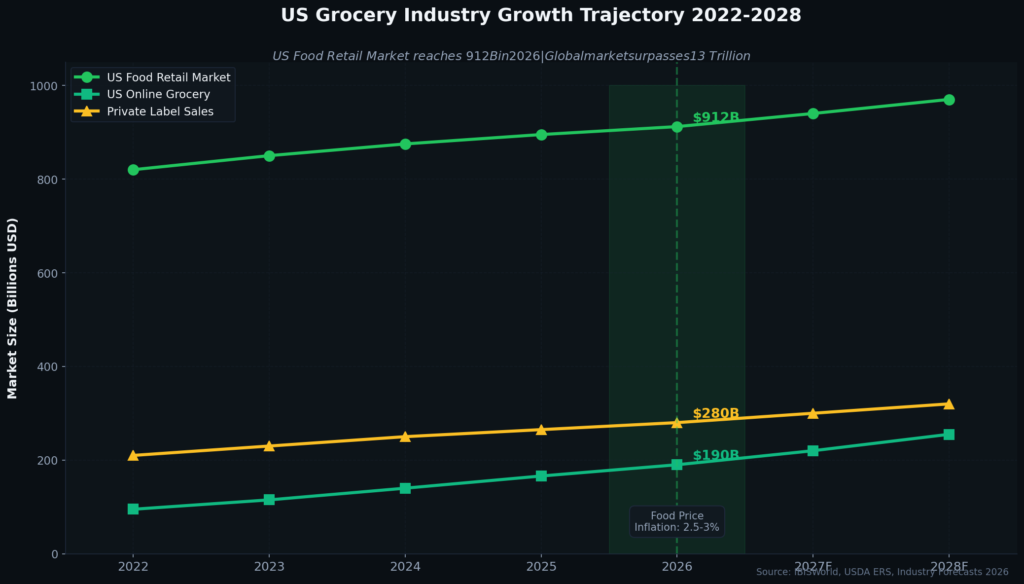
In 2026, discount retailer Aldi announced plans to open more than 180 new U.S. stores as part of a broader $9 billion investment strategy to significantly expand its national footprint, while private label sales in the United States are projected to reach approximately $280 billion representing around 21% of total grocery sales according to industry forecasts from FMI and PLMA.
Discount and value grocery chains continue to grow but at a slower pace than before. Inflation initially boosted traffic, but consumer attention is shifting toward fresh and wellness. For marketers, this highlights the need to blend affordability with aspirational messaging. Shoppers want both value and quality rather than one over the other. This dual demand creates challenges but also fresh opportunities for branding.
Grocery Marketing Statistics#9 – More Short Trips Are Emerging
In 2026, instant delivery services in the online grocery market are projected to grow at 17.92% CAGR through 2031 according to Mordor Intelligence, with platforms like Instacart, DoorDash, and quick-commerce services like Gopuff capturing increasing share as consumers make more frequent, smaller purchases focused on immediate consumption and fresh items.
Consumers are making more short trips for groceries, often focusing on fresh or ready-to-eat items. This shift changes the traditional stock-up model. Stores must market convenience, speed, and targeted promotions to capture these trips. It also means smaller basket sizes but higher visit frequency. Marketing strategies must evolve to emphasize immediacy and fresh options.
Grocery Marketing Statistics#10 – 70% Of Shoppers Concerned About Food Prices
In 2026, consumer price sensitivity remains elevated with food-at-home inflation continuing at 2-3% annually, and FMI research shows that shoppers are increasingly splitting grocery purchases between multiple retailers to find the best deals, while 44% of consumers report willingness to pay more only for products produced sustainably according to sustainability trend reports.
Around 70% of shoppers say they are concerned about food prices. This statistic highlights the ongoing impact of inflation on consumer behavior. For grocery marketers, promotions and clear value messaging are more important than ever. Shoppers are comparing prices, switching brands, and using coupons. Transparent and empathetic marketing will resonate in this climate.
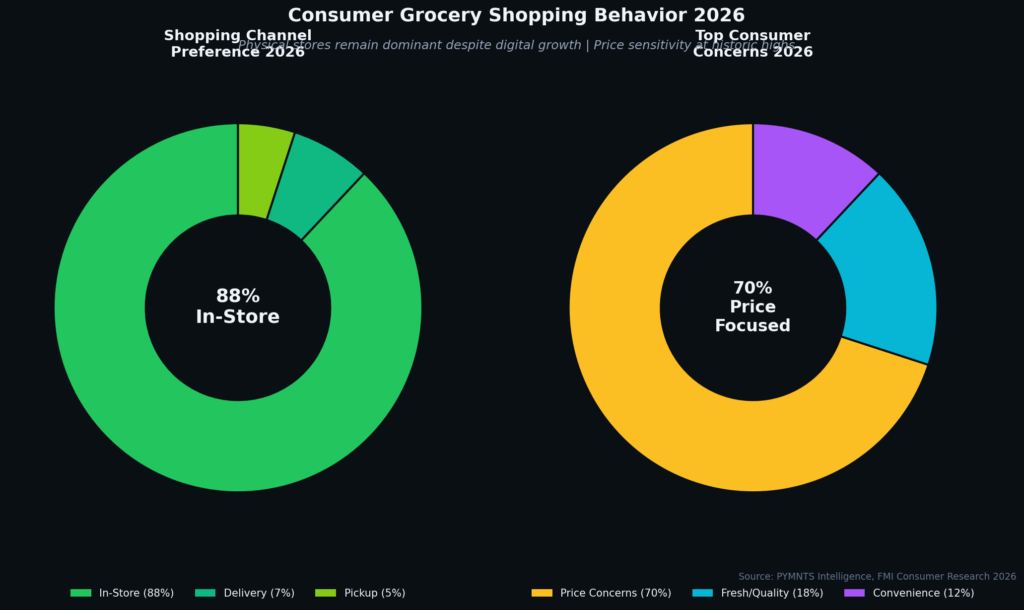
Grocery Marketing Statistics#11 – Private Label Holds 21% Of Revenue In 2026
In 2026, private label sales in the United States are projected to reach approximately $280 billion, representing around 21% of total grocery sales according to industry forecasts, with retailers operating multi-tier private label strategies spanning value, mainstream, and premium segments while categories such as dairy, frozen foods, and snacks show the strongest store-brand penetration.
Private-label grocery products now represent 21% of industry revenue. This reflects growing consumer trust in store brands. For marketers, this shift means positioning private labels as high-quality, affordable alternatives. Loyalty programs can further drive growth in this category. Retailers ignoring private label risk losing share to competitors who embrace it.
Grocery Marketing Statistics#12 – 92% Of Shoppers Used Coupons Last Year
In 2026, digital coupon adoption has accelerated dramatically with retailers reporting that customers who use AI shopping assistants like Walmart’s Sparky have average order values approximately 35% higher than non-users, while mobile app-integrated loyalty programs and personalized digital offers have become the primary mechanism for coupon distribution according to retailer earnings calls.
A staggering 92% of grocery shoppers used coupons in the past year. This reinforces the enduring power of discounts and deals. Digital coupons, in particular, are growing in adoption. Marketers should design strategies that integrate seamlessly into mobile apps and loyalty platforms. Ignoring coupon culture means missing out on a near-universal consumer habit.
Grocery Marketing Statistics#13 – Average Grocery Spend $170 Per Trip In 2026
In 2026, average weekly grocery spending per U.S. household is approximately $170 according to FMI’s U.S. Grocery Shopper Trends report, while online supermarket transactions average $108 per order compared to $45.70 for in-store transactions, representing a 136% premium for digital purchases that reflects larger basket sizes in e-commerce channels.
The average grocery trip spend has reached $170 in 2026. This shows that while people may shop frequently, basket values are significant. Marketers can upsell by strategically placing higher-margin items in consumer pathways. Loyalty discounts and bundle deals can encourage even greater spending. Understanding average spend helps in tailoring promotions for maximum impact.
Grocery Marketing Statistics#14 – 56% Expect To Spend More Year-Over-Year
In 2026, the global food and grocery retail market has surpassed $13 trillion growing at approximately 3.2% annually, with the U.S. market specifically reaching an estimated $912-950 billion according to IBISWorld and industry analysts, as consumers continue allocating larger portions of household budgets to groceries amid sustained inflation and shifting dining preferences toward food-at-home.
More than half of consumers, 56%, expect to spend more on groceries year-over-year. This signals a shift in budgeting priorities for households. Marketers can frame campaigns around value and necessity rather than luxury. The growth of grocery budgets means competition for that spend is fierce. Brands that connect emotionally with customers will secure more of that wallet share.
Grocery Marketing Statistics#15 – Grocery Delivery Usage Up 59% Since 2022
In 2026, approximately 59.4% of online grocery sales are projected to be for delivery according to Capital One Shopping research, with Instacart expected to process over $37 billion in consumer spending and same-day delivery services commanding 51.78% of the online grocery market as consumers increasingly prioritize convenience over pickup options.
Grocery delivery services have seen approximately 59% increase in usage compared to 2022. This rise shows consumer appetite for convenience continues to accelerate. Marketers must advertise not just products but delivery speed and reliability. Partnerships with delivery apps expand reach and loyalty. Ignoring delivery could mean losing relevance with tech-savvy shoppers.
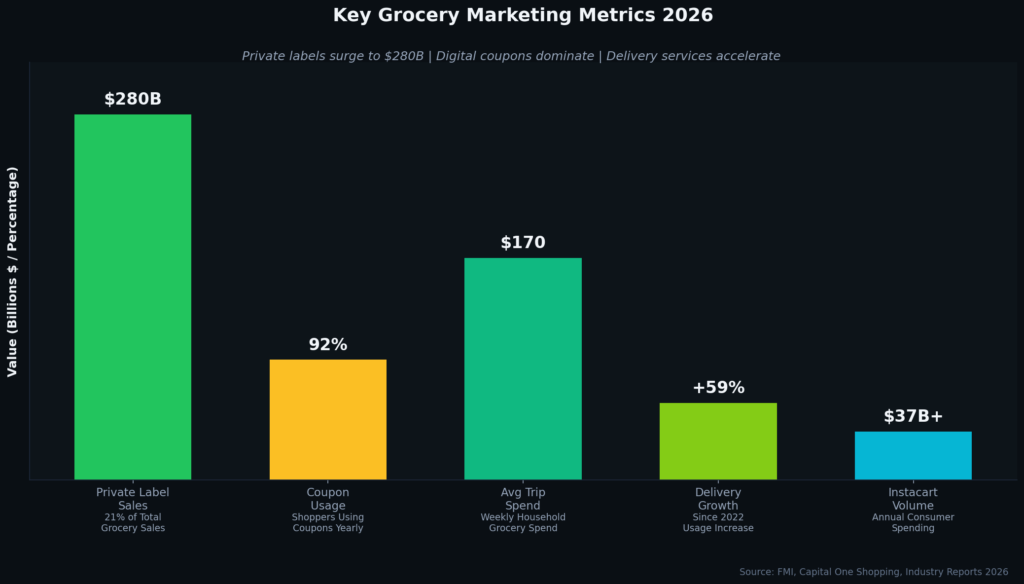
Grocery Marketing Statistics#16 – 74% Of Grocery Shopping Still In-Store
In 2026, PYMNTS Intelligence research confirms that 88% of U.S. grocery shoppers still prefer in-person store visits over online options, with debit cards accounting for 41% of in-store grocery payments as consumers favor physical shopping for fresh produce selection, immediate availability, and the tactile experience of product evaluation that digital channels cannot fully replicate.
Despite online growth, approximately 74% of grocery shopping still takes place in physical stores. This proves brick-and-mortar remains the backbone of the industry. For marketers, creating in-store experiences is as important as digital strategies. Sampling events, local campaigns, and loyalty cards work best here. The in-store channel continues to be a powerful hub for consumer engagement.
Grocery Marketing Statistics#17 – Food At-Home Prices Rose 2.5% Year-Over-Year In 2026
In 2026, food-at-home inflation has moderated to approximately 2-2.5% year-over-year according to USDA Economic Research Service projections, with Walmart reporting grocery inflation approximately 70 basis points lower quarter-over-quarter mainly due to deflation in eggs and dairy categories, providing some relief to household budgets after years of elevated price increases.
From 2025 to 2026, food-at-home prices rose by approximately 2.5%. While modest, this increase adds pressure on household budgets. Marketers must balance price sensitivity with brand storytelling. Promotions and clear pricing strategies become essential. Shoppers want to feel confident they’re not overspending.
Grocery Marketing Statistics#18 – US Food Retail Market Reaches $912 Billion In 2026
In 2026, the U.S. supermarkets and grocery stores industry has reached $912.4 billion in revenue according to IBISWorld, while the broader global food and grocery retail market has surpassed $13 trillion with North America representing approximately $1.87-2 trillion of that total, and the online grocery segment alone valued at $166.3 billion in the United States.
The U.S. food retail market has reached $912 billion in 2026. This massive number reflects both population size and grocery’s essential role. For marketers, it means the industry remains highly competitive. Differentiation and customer experience will separate leaders from laggards. Growth opportunities still exist, especially in emerging channels.
Grocery Marketing Statistics#19 – Inventory Audits Boost Sales 11%
In 2026, retailers are increasingly deploying AI-powered inventory management systems, with Walmart reporting that approximately half of its U.S. e-commerce fulfillment center volume is now automated and 23 out of 42 regional distribution centers are in various stages of automation upgrades, directly improving product availability and reducing out-of-stock instances that negatively impact promotional effectiveness.
Stores that improved inventory accuracy saw sales rise by 11%. This shows how back-end operations affect front-end marketing results. If products aren’t on shelves, promotions lose credibility. Marketers and operations must align to ensure campaigns deliver. A reliable inventory system is as much a marketing tool as an operational one.
Grocery Marketing Statistics#20 – Food Prices Forecasted To Rise 2.5-3% In 2026
In 2026, the USDA forecasts overall food prices to increase approximately 2.5-3% for the year, with food-at-home prices rising at a slightly lower rate than food-away-from-home, while global factors including supply chain stabilization and agricultural commodity prices are expected to keep grocery inflation below the elevated levels seen in 2022-2023 according to Economic Research Service projections.
Overall food prices in 2026 are forecasted to climb about 2.5-3%. This projection reminds marketers that consumer budgets remain under strain. Planning campaigns around affordability will resonate more with shoppers. Retailers must highlight savings and loyalty benefits to keep customers engaged. Anticipating inflation allows businesses to stay ahead of consumer concerns.
SHOCKING GROCERY MARKETING TRENDS RESHAPING FOOD RETAIL IN 2026
Looking back at these insights, what stands out to me is how much grocery marketing is about people, not just products. Yes, the numbers show us online growth, price sensitivity, and a surge in fresh formats—but at the heart of it all, it’s about human behavior and daily choices. I know from my own experience as a shopper and a marketer that when data feels personal, it becomes actionable. These grocery marketing statistics remind me that behind every trend is someone like you or me, trying to make better decisions about how we eat and live. And that, to me, is where the real opportunity lies. In 2026, grocery retailers using AI-powered pricing, loyalty data, and omnichannel grocery delivery are outperforming traditional stores in both revenue growth and customer retention.
SOURCES
https://www.jll.com/en-us/insights/market-perspectives/grocery-tracker
https://www.placer.ai/anchor/reports/3-trends-shaping-the-grocery-sector-right-now
https://www.brickmeetsclick.com/egrocery-insights/lookout
https://www.nielseniq.com/global/en/insights/education/2025/grocery-trends/
https://www.comosoft.us/articles/supermarket-marketing-trends-to-watch-this-year/
https://www.ers.usda.gov/data-products/food-price-outlook/summary-findings
https://www.fmi.org/our-research/research-reports/u-s-grocery-shopper-trends
https://www.stout.com/en/insights/industry-update/grocery-retail-industry-update-q1-2025
https://www.cognitivemarketresearch.com/grocery-retail-market-report
https://www.snipp.com/blog/inflation-reshaping-grocery-shopping-survey