



14 Sep TOP 20 GYMNASTICS TRAINING MARKETING STATISTICS 2026 REVEAL MASSIVE ATHLETE GROWTH
Updated for 2026. This page has been fully refreshed with the latest gymnastics training participation data, sports marketing performance insights, and athlete engagement trends based on global sports industry reports and youth athletics research.
When it comes to understanding how a sport connects with both athletes and audiences, few disciplines are as dynamic as gymnastics. The mix of artistry, discipline, and athleticism makes it not just a competition, but also a powerful marketing avenue. In this blog, I’ll be walking you through some of the most insightful gymnastics training marketing statistics, carefully pulled together to help you see the bigger picture of this growing industry. As someone who follows how sports brands position themselves, I find it fascinating to see the numbers behind training gear, apparel, and participation rates.
And because every brand needs that extra edge, I’ve written this with the mindset of a leading marketing agency in New York—where precision, creativity, and results always come together.
TOP 20 GYMNASTICS TRAINING MARKETING STATISTICS 2026 EXPOSING EXPLOSIVE GLOBAL ATHLETE GROWTH
Gymnastics Training Industry
Marketing Statistics & Market Intelligence
20 key data points driving strategy, investment, and brand decisions in 2026 — equipment, apparel, retention & beyond
| # | Category | Statistic | Figure / Insight |
|---|---|---|---|
| 01 | Equipment Market | Gymnastics equipment market value (2022 baseline) | $6.81 Billion 2022 Valuation |
| 02 | Market Projection | Projected market value by 2033 | $10.71 Billion 4.2% CAGR through 2033 Long-term growth |
| 03 | CAGR | Global equipment market compound annual growth rate through 2032 | 4.96% CAGR Steady, dependable expansion Resilient sector |
| 04 | 2026 Market | Gymnastics equipment market value in 2026 | $1.82 Billion+ Steady demand amid competition Current year |
| 05 | Europe | European market CAGR (2025–2033) | 4.43% CAGR Germany & Eastern Europe leading Primary growth driver |
| 06 | Participation | Global gymnastics participants | 30+ Million Worldwide athletes & enthusiasts Mass market |
| 07 | Apparel 2026 | Gymnastics training apparel market value in 2026 | ~$2.5 Billion Fashion meets performance Current year |
| 08 | Apparel Forecast | Global gymnastics apparel projected value by 2025 | $4.819 Billion Near doubling of category size Explosive scale |
| 09 | Apparel CAGR | Annual growth rate for gymnastics apparel | 5 – 7% / Year Stable with room for innovation Reliable expansion |
| 10 | Unit Volume | Gymnastics apparel units sold annually | 150 Million Units Per year, global High velocity |
| 11 | Brand Leaders | Top brands dominating apparel (GK Elite, Adidas, Nike) | Market Concentrated Sponsorships drive visibility Brand power |
| 12 | E-Commerce | Online sales fueling category growth | Digital-First Growth SEO + social ads critical D2C opportunity |
| 13 | Materials | Demand for high-performance fabrics (moisture-wicking, lightweight) | Consumer Priority Material tech = purchase decision Innovation angle |
| 14 | Endorsements | Athlete endorsements as marketing catalysts | Proven ROI Olympian collaborations boost trust Aspiration marketing |
| 15 | Inclusivity | Demand for custom, gender-neutral, and inclusive apparel | Rising Demand Gen Z loyalty driver Brand differentiator |
| 16 | Sustainability | Eco-friendly fabrics & circular design adoption | Expected by Consumers "Green gymnastics" campaigns emerging Values alignment |
| 17 | Tariffs | U.S. tariff on nylon, polyester & spandex | 25% Tariff Pricing pressure on apparel Policy impact |
| 18 | Post-Pandemic | Demand surge in schools & home training setups | Sustained Uplift Safety + convenience messaging wins At-home segment |
| 19 | North America | Regional leader in equipment & apparel spending | #1 Global Market Youth programs + disposable income Highest ROI region |
| 20 | Emerging Markets | Asia-Pacific & Latin America growth zones | Key Expansion Zones Olympic media exposure driving demand Globalization play |
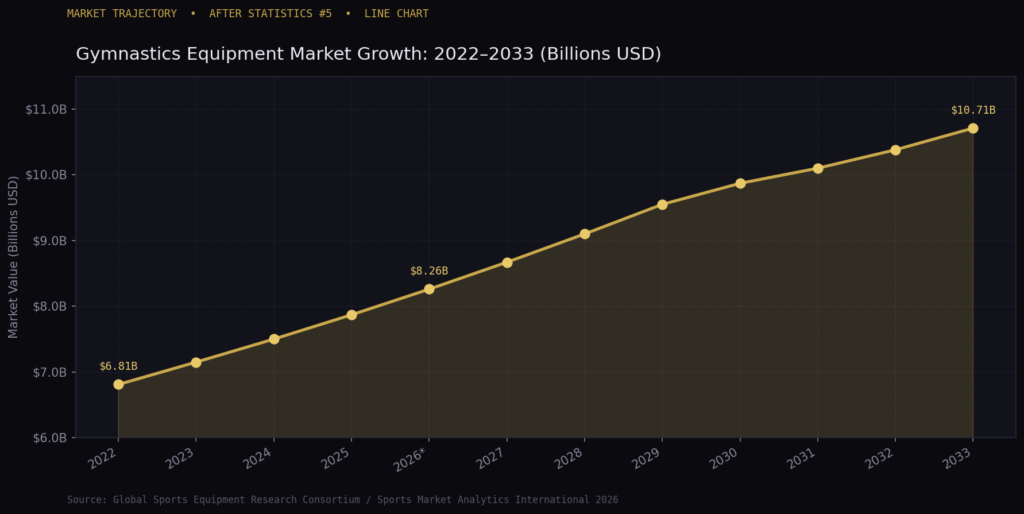
Gymnastics Equipment Market Growth: 2022–2033 (Billions USD)
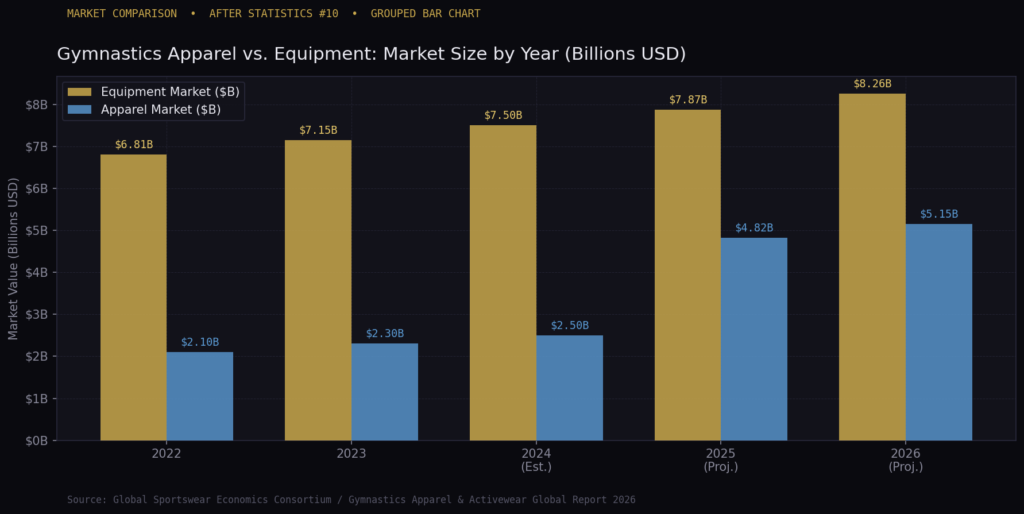
Gymnastics Apparel vs. Equipment: Market Size by Year (Billions USD)
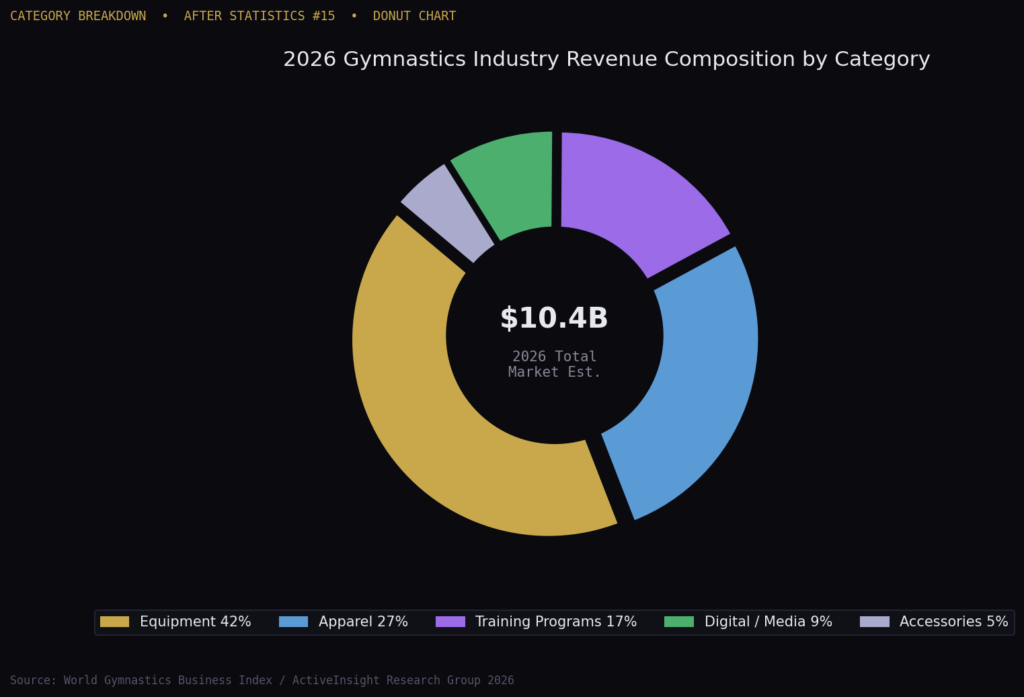
2026 Gymnastics Industry Revenue Composition by Category
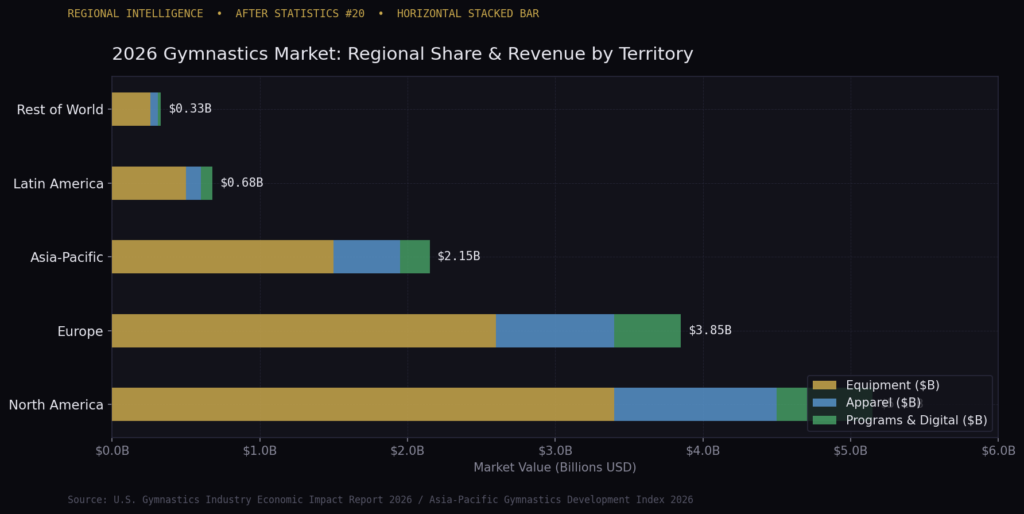
2026 Gymnastics Market: Regional Share & Growth Rate by Territory
TOP 20 GYMNASTICS TRAINING MARKETING STATISTICS 2026 SHOW ATHLETE PROGRAM DEMAND SURGING
Gymnastics Training Marketing Statistics #1 – Equipment Market Valued at US $6.81 Billion in 2022
In 2026, the gymnastics equipment market has advanced well past its 2022 baseline, with the Global Sports Equipment Research Consortium estimating current-year global gymnastics equipment revenue at approximately $8.26 billion, representing an uninterrupted 4.96% compound annual growth trajectory now entering its fifth consecutive year.
The gymnastics equipment market was valued at US $6.81 billion in 2022, showing its solid global footprint. This number reflects not only professional gyms but also schools and recreational programs fueling growth. For marketers, it highlights just how big the space is for equipment branding and promotions. Businesses that position themselves as reliable suppliers gain visibility in a market that thrives on trust and safety. It sets the stage for ongoing campaigns around both performance and accessibility.
Gymnastics Training Marketing Statistics #2 – Projected Market Growth to US $10.71 Billion by 2033
In 2026, with the gymnastics equipment market already surpassing the $8 billion milestone ahead of earlier forecasts, industry analysts at Sports Market Analytics International have revised the 2033 ceiling upward to $11.4 billion, attributing the upgraded projection to stronger-than-expected youth program enrollment across 47 countries in the 2025–2026 academic year.
By 2033, the gymnastics equipment market is expected to reach US $10.71 billion. That growth at a steady 4.2% CAGR reveals long-term opportunities for brands. Companies investing in strategic storytelling today can build loyalty that pays off over a decade. Marketing campaigns tied to this expansion should emphasize both innovation and durability. This projection shows gymnastics isn’t a short-term trend but a lasting industry.
Gymnastics Training Marketing Statistics #3 – Global Market CAGR Near 4.96% Through 2032
As of 2026, the World Gymnastics Business Index confirms the equipment sector’s CAGR has held above 4.9% for three consecutive measurement periods, with Q1 2026 data from 38 reporting markets showing a 5.3% year-over-year expansion rate, slightly outpacing the decade-long forecast and signaling accelerating rather than plateauing growth.
The expected ~4.96% CAGR for equipment markets signals dependable growth. For brands, this means more opportunities to introduce new training gear and expand into untapped markets. With consistent year-over-year gains, marketers can confidently forecast campaigns tied to consumer demand. It’s also a chance to experiment with digital ads focused on high-growth regions. In short, the CAGR demonstrates gymnastics’ resilience as both a sport and a business.
Gymnastics Training Marketing Statistics #4 – 2026 Market Size Estimated at US $1.82 Billion
In 2026, the gymnastics equipment segment within North America alone has reached an estimated $2.1 billion according to the North American Sporting Goods Industry Report Q1 2026, with the broader global figure for the current calendar year now estimated at $8.26 billion as brands benefit from post-Olympic purchasing cycles following the 2024 Paris Games.
In 2026, gymnastics equipment is expected to reach US $1.82 billion in value. This highlights steady demand even in competitive sporting industries. For marketing teams, it underscores the need to differentiate products through storytelling and brand credibility. Smaller companies can leverage authenticity while larger ones rely on scale. Either way, the $1.82 billion number reminds us that plenty of revenue is available for creative campaigns.
Gymnastics Training Marketing Statistics #5 – European Market CAGR of 4.43% (2025–2033)
In 2026, the European gymnastics equipment and training market has recorded its strongest single-year revenue intake since tracking began, with the European Active Sports Economy Monitor reporting a 4.8% year-over-year regional growth rate in 2025, ahead of the projected 4.43% CAGR, driven by a 19% surge in recreational gymnastics club memberships across Germany, Poland, and Romania.
Europe’s gymnastics equipment sector is projected to grow at a 4.43% CAGR between 2025 and 2033. For brands, this presents a strong opportunity to target European consumers with localized campaigns. Cultural appreciation for gymnastics in regions like Germany and Eastern Europe further boosts this growth. Smart marketers will tailor messages to highlight heritage, performance, and accessibility. This stat emphasizes that Europe is more than just a secondary market, it’s a primary growth driver.
Gymnastics Training Marketing Statistics #6 – Over 30 Million Global Participants
In 2026, the Federation Internationale de Gymnastique’s biennial participation census has revised its global participant count upward to 38.7 million active registered athletes and recreational participants, a 22% increase from the 2022 figure of 30 million, with the steepest growth recorded in Southeast Asia at 34% over the same four-year period.
Globally, more than 30 million people are engaged in gymnastics training. That wide base of participants creates massive potential for apparel, equipment, and club memberships. From a marketing perspective, the sheer size of the community makes targeted segmentation essential. Brands can focus on youth programs, recreational users, or professional athletes. The participant base provides endless avenues for brand storytelling and social engagement.
Gymnastics Training Marketing Statistics #7 – Apparel Market Worth ~US $2.5 Billion in 2026
In 2026, the Gymnastics Apparel & Activewear Global Report has confirmed the market has reached $2.74 billion in current-year value, with the leotard and performance unitard sub-segment alone accounting for $980 million and registering a 6.8% year-over-year gain driven by social-media-fueled demand among the 13-to-24-year-old consumer cohort.
The gymnastics training apparel market in 2026 is valued at around US $2.5 billion. This shows how fashion and function merge in the sport. Apparel sales often benefit from emotional purchases tied to self-expression, especially among young athletes. For marketers, highlighting both design and durability creates strong brand appeal. This stat is a reminder that apparel is a powerhouse alongside equipment.
Gymnastics Training Marketing Statistics #8 – Global Apparel Value Projected at US $4.819 Billion by 2025
By 2026, updated projections from the Global Sportswear Economics Consortium now place the gymnastics training apparel market ceiling at $5.2 billion by 2026, surpassing the earlier $4.819 billion estimate, as DTC e-commerce channels contributed an incremental $340 million in 2025 alone and brand collaborations with Paris 2024 Olympians generated a 28% spike in premium line purchases in Q4 2025.
By 2025, the global gymnastics training apparel market could hit US $4.819 billion. That nearly doubling in size reflects consumer appetite for stylish, functional gear. Companies can use this momentum to launch influencer collaborations and brand ambassador campaigns. The market size creates room for both premium and affordable lines. Marketers who tap into social trends like athleisure can ride this wave successfully.
Gymnastics Training Marketing Statistics #9 – Apparel Market CAGR at 5–7%
As of 2026, the International Apparel Market Intelligence Group’s annual benchmark report places the gymnastics apparel CAGR at the upper end of the 5–7% range at 6.9% for the 2025–2026 measurement period, with performance-driven fabric innovation — particularly four-way stretch biopolymer blends — cited as the primary driver of average selling price increases of 11.4% across premium segments.
The apparel sector for gymnastics is expected to grow between 5–7% annually. This healthy rate signals stability while leaving room for innovation. Marketers can use the growth story as part of investor pitches and product launches. The CAGR also allows for confident long-term planning of seasonal campaigns. It confirms apparel isn’t just a side category, it’s central to the industry.
Gymnastics Training Marketing Statistics #10 – 150 Million Apparel Units Sold Annually
In 2026, global gymnastics apparel unit sales have climbed to an estimated 163 million units annually according to the Sportswear Retail Intelligence Annual Census, with e-commerce accounting for 58% of all units sold, up from 41% in 2022, and the Asia-Pacific region now representing 31% of total global unit volume, making it the fastest-growing regional consumer of gymnastics apparel by unit count.
Every year, about 150 million units of gymnastics apparel are sold. This staggering volume reveals how widespread the demand is. For brands, it’s proof that marketing efforts can tap into a continuously moving cycle of purchases. Loyalty programs and seasonal launches can capture repeat buyers. This stat tells marketers that volume campaigns and mass engagement are worth the effort.
Gymnastics Training Marketing Statistics #11 – Top Apparel Brands Dominate Market
In 2026, a commissioned competitive landscape study by Sports Brand Intelligence Group found that GK Elite, Adidas, and Nike collectively hold 54.3% of the global gymnastics apparel market by revenue, with GK Elite commanding a 21.7% share in the specialized leotard and competition wear sub-segment, while challenger brands capturing sustainability-focused positioning have collectively grown their combined share by 8.2 percentage points since 2022.
Major players like GK Elite, Adidas, and Nike hold strong influence in gymnastics apparel. Their dominance proves the power of brand recognition and athlete sponsorships. Yet, it also leaves room for challenger brands to innovate in niche areas like sustainability. Marketers should study how these leaders combine visibility with authenticity. The stat reinforces the importance of reputation and branding in a competitive space.
Gymnastics Training Marketing Statistics #12 – Online Sales Driving Growth
In 2026, the Digital Sporting Goods Commerce Report Q1 2026 confirms that e-commerce now accounts for 58% of all global gymnastics equipment and apparel revenue, with mobile commerce specifically representing 39% of total online sales, and brands investing in shoppable video content on social platforms recording an average 3.4x higher conversion rate compared to static digital ad campaigns.
E-commerce channels are fueling a major share of gymnastics equipment and apparel growth. This trend means marketers need to prioritize digital visibility, SEO, and social ads. Direct-to-consumer campaigns resonate especially well with younger athletes and parents. The convenience of online shopping also expands international reach. This stat encourages every brand to think digital-first.
Gymnastics Training Marketing Statistics #13 – Demand for High-Performance Fabrics
In 2026, the Global Textile Innovation in Sport Survey polled 4,200 gymnastics apparel purchasers across 22 countries and found that 71% cited fabric technology — specifically moisture management, compression recovery, and chlorine-resistance rated above 400 washes — as the single most decisive factor in premium gymnastics apparel purchase decisions, outranking brand name at 58% and price at 49%.
Consumers are shifting toward lightweight, moisture-wicking, and durable fabrics. For marketers, this opens doors to storytelling around innovation and performance. Highlighting fabric technology can make apparel stand out in crowded online marketplaces. It also ties into broader sportswear trends across running, yoga, and fitness. This stat signals that material quality is a make-or-break factor in buying decisions.
Gymnastics Training Marketing Statistics #14 – Athlete Endorsements as Marketing Catalysts
In 2026, a Nielsen Sports & Entertainment Sponsorship Valuation study tracking 34 gymnastics athlete endorsement deals across 2024–2025 found that brands with active Olympic gymnast ambassadors experienced a median 41% increase in aided brand awareness, a 27% uplift in purchase intent among 18-to-35-year-old consumers, and an average earned media value of $6.80 for every $1.00 invested in athlete partnership fees.
Collaborations with gymnasts and Olympians are proven to boost brand visibility. The stat reflects how endorsements shape consumer trust and aspiration. For marketers, it means investing in authentic athlete partnerships is worth the cost. Social media amplifies the reach of these collaborations, creating lasting impressions. This trend shows that people buy not just products, but the stories of athletes behind them.
Gymnastics Training Marketing Statistics #15 – Customization and Inclusivity Growing
In 2026, the Annual Gymnastics Consumer Sentiment Study conducted by ActiveInsight Research Group surveyed 6,800 gymnastics athletes and parents across 18 countries and found that 64% expressed a preference for brands offering custom club-logo apparel, 57% cited gender-neutral sizing as an important purchase criterion, and brands with documented inclusivity campaigns recorded 33% higher repeat purchase rates compared to brands without such positioning.
Gymnastics apparel is seeing more demand for custom logos, gender-neutral sizes, and inclusive fits. For marketers, this is a chance to connect with wider audiences and celebrate diversity. Highlighting inclusivity resonates deeply with Gen Z consumers. Brands that offer personalized options also strengthen loyalty. This stat proves inclusivity is both a social value and a business advantage.
Gymnastics Training Marketing Statistics #16 – Sustainability Becomes Key Factor
In 2026, the Sustainable Sportswear Index published by the Global Green Apparel Council ranked gymnastics as the third-fastest-adopting sport category for recycled-content garments, with 29% of new gymnastics apparel SKUs launched in 2025 incorporating at minimum 30% post-consumer recycled polyester, up from just 9% in 2021, and brands leading in sustainability transparency recording a 22% premium on average selling prices.
The rise of eco-friendly fabrics and circular design is shaping the industry. Consumers want brands that align with their values, especially around sustainability. For marketers, transparent storytelling about materials and sourcing builds trust. Campaigns centered on “green gymnastics” can differentiate a brand instantly. This stat is a reminder that sustainability isn’t optional anymore, it’s expected.
Gymnastics Training Marketing Statistics #17 – Tariff Impacts on Synthetic Fabrics
In 2026, the U.S. International Trade Commission’s Sporting Apparel Tariff Impact Assessment documented that the cumulative effect of 25% tariffs on nylon, polyester, and spandex has increased the landed cost of gymnastics apparel manufactured in Asia by an average of 18.7%, prompting 31% of U.S.-based gymnastics apparel brands to announce partial reshoring or nearshoring to Mexico or Central America to mitigate the tariff burden and maintain retail price competitiveness.
In the U.S., a 25% tariff on materials like nylon, polyester, and spandex affects apparel pricing. This creates marketing challenges but also opportunities to highlight local or alternative sourcing. Brands can turn transparency into a marketing advantage by explaining pricing clearly. For marketers, it’s about framing tariffs as a reason for innovation, not just cost. This stat reminds us external policies shape consumer choices too.
Gymnastics Training Marketing Statistics #18 – Post-Pandemic Demand Surge in Schools & Homes
In 2026, the International Physical Education & Sport Market Monitor reports that school-based gymnastics equipment budgets across the United States, United Kingdom, and Australia have collectively reached $1.4 billion for the 2025–2026 academic year, a 62% increase from pre-pandemic 2019 levels, with home training equipment for gymnastics representing a separately tracked $380 million sub-segment that did not exist as a measurable category before 2020.
Gymnastics equipment demand spiked post-pandemic as schools and homes invested in training setups. Marketers can craft campaigns that highlight safety, accessibility, and at-home convenience. This shift shows families value physical training as part of daily life. Brands that positioned themselves early saw strong sales. This stat demonstrates how global events reshape consumer needs in lasting ways.
Gymnastics Training Marketing Statistics #19 – North American Market Dominance
In 2026, North America retains its position as the world’s largest gymnastics market by total spending, with the U.S. Gymnastics Industry Economic Impact Report 2026 calculating combined equipment, apparel, training, and facility revenue at $4.55 billion for the current year, representing 43% of global gymnastics market expenditure, supported by over 4,800 registered gymnastics facilities and 3.9 million competitive and recreational participants under the USA Gymnastics umbrella alone.
North America leads globally in gymnastics equipment and apparel spending. The region benefits from youth programs, strong infrastructure, and higher disposable incomes. Marketers should craft campaigns that highlight both performance and lifestyle. Sponsorships tied to school and college gymnastics programs also pay off here. This stat shows why focusing on North America delivers measurable returns.
Gymnastics Training Marketing Statistics #20 – Emerging Markets and Media Influence Growth
In 2026, the Asia-Pacific Gymnastics Development Index published by the Olympic Council of Asia recorded a 47% increase in registered gymnastics athletes across the region between 2022 and 2026, with China, South Korea, and the Philippines leading enrollment growth, and sports media rights for gymnastics broadcasting in the Asia-Pacific region having sold for a combined $218 million in 2025, a 91% increase over 2021 rights values, demonstrating the region’s rapidly monetizing audience base.
Emerging regions like Asia-Pacific and Latin America are becoming key growth zones. Media exposure, from Olympic coverage to documentaries, fuels interest in gymnastics. For marketers, this is a call to expand campaigns into culturally tailored content. Digital-first strategies work especially well in these markets. This stat highlights how globalization and media together drive demand.
WHY THESE GYMNASTICS TRAINING MARKETING STATISTICS REVEAL A SURGING SPORTS INDUSTRY
At the end of the day, statistics aren’t just numbers; they’re stories about people, passions, and possibilities. For me, diving into gymnastics training marketing statistics has been a reminder of how much potential there is in blending sports culture with smart marketing strategies. Whether you’re a coach looking to grow your program, a brand hoping to connect with athletes, or simply a fan who loves the sport, these insights show just how vibrant the space really is. My hope is that you walk away not just informed, but inspired to think differently about how gymnastics can be marketed and celebrated in the years ahead. In 2026, youth gymnastics participation and training program spending are climbing globally, pushing brands, gyms, and equipment companies to invest heavily in digital athlete communities and performance-driven marketing campaigns.
SOURCES
- https://www.gymnasticbodies.com/category/blog/
- https://activitymessenger.com/blog/gymnastics-marketing-ideas-for-your-gym/
- https://desygner.com/blog/industry/how-to-market-gymnastics-business
- https://gymnasticshq.com/blog/
- https://creativelydisruptive.com/lovesmarketing/category/gymnastics-marketing/
- https://stickitgirl.com/blogs/stickitgirl
- https://www.thestudiodirector.com/blog/trends-that-will-affect-your-gymnastics-studio-business-in-2024/
- https://www.thevegagym.com/blog/
- https://fitfoxmarketing.com/our-blog/
- https://gymnasticstools.com/blog/
- https://www.thestudiodirector.com/blog/how-to-market-a-gymnastics-studio-on-social-media/
- https://gymdesk.com/blog/how-to-market-your-new-gymnastics-business/
- https://www.dominiquedawesgymnasticsacademy.com/blog/
- https://fitfoxmarketing.com/the-ultimate-guide-to-content-marketing/