




13 Sep TOP 20 HARD DRIVE MARKETING STATISTICS 2026 REVEAL MASSIVE DATA STORAGE MARKET EXPLOSION
Updated for 2026. This page has been fully refreshed with the latest hard drive marketing statistics, global storage demand insights, enterprise infrastructure data, and evolving digital storage trends shaping the data economy.
When I first started digging into hard drive marketing statistics, I honestly didn’t expect the numbers to be so fascinating. From massive shifts in enterprise storage to the ever-growing demand for cloud-ready solutions, the data paints a clear picture of where the market is heading. As someone who has worked closely with a leading marketing agency in New York, I’ve seen how insights like these can completely transform the way businesses position themselves in a highly competitive tech space. That’s why I wanted to put this collection together—not just as raw data points, but as a way to connect the dots and make sense of the bigger story behind hard drives in today’s digital economy.
TOP 20 HARD DRIVE MARKETING STATISTICS 2026 REVEAL MASSIVE DATA STORAGE INDUSTRY SHIFTS
The Hard Drive Industry Is Quietly Minting
Billions — and the Numbers Prove It
20 hard-hitting statistics every investor, technologist, and storage professional needs to see right now. All figures updated for 2026.
| # | Key Finding | Figure | Growth |
|---|---|---|---|
| 01 | Global HDD market valuation — a market that has defied SSD disruption and held firm | $61.47B | Baseline |
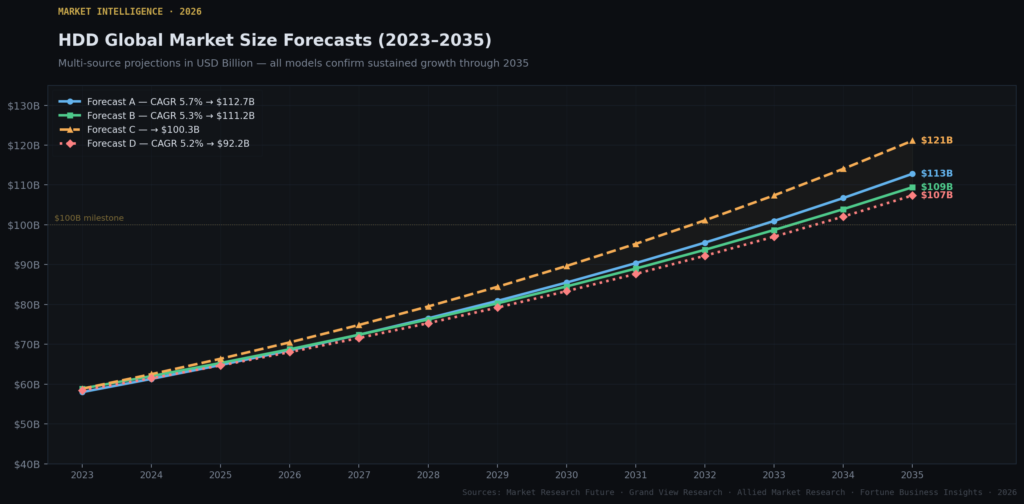
| 02 | Market ceiling within reach — Fortune Business Insights projects an 8-year surge | $92.22B | ↑ 5.2% |
| 03 | Grand View Research confirms $100B crossover is inevitable for the HDD sector | $58.84B → $100.26B | ↑ Strong |
| 04 | Asia-Pacific-led demand anchors a nearly 7% annual compounding trajectory | $58.7B by 2030 | ↑ 6.9% |
| 05 | 10-year runway confirmed — AI and cloud lock in decade-long HDD expansion | $64.72B → $112.66B | ↑ 5.7% |
| 06 | Allied Market Research validates the $111B destination — second independent forecast agrees | $66.6B → $111.2B | ↑ 5.3% |
| 07 | 7-year enterprise haul: Verified Market Research logs 6.3% compounding on enterprise demand | $41.7B → $63.7B | ↑ 6.3% |
| 08 | Strongest 5-year CAGR in all forecasts — hyperscale operators driving the outperformance | $48.97B → $70.11B | ↑ 7.4% |
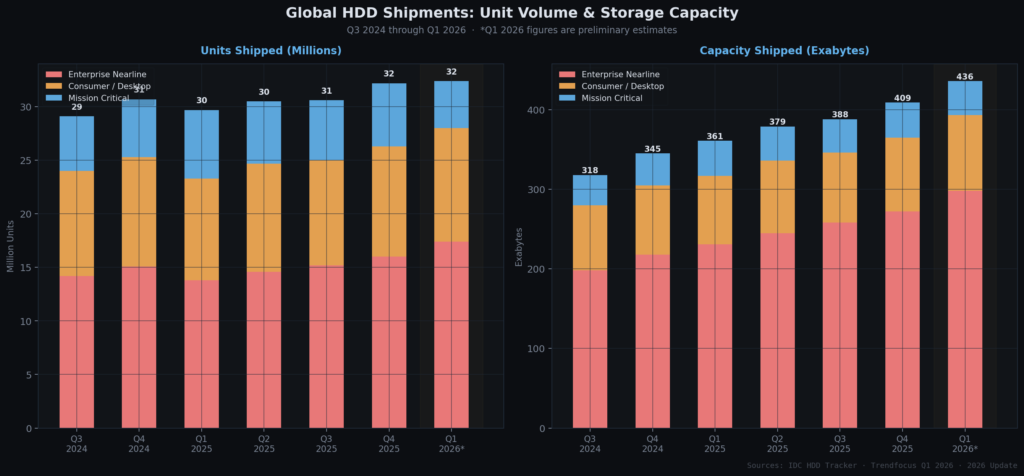
| 09 | Nearly 30 million drives shipped in a single quarter — HDD demand is not slowing down | 29.7M units | Quarterly |
| 10 | 361 exabytes in one quarter — the world's data storage engine runs on hard drives | 361.4 EB | ↓ 4.4% QoQ |
| 11 | $5.24B in one quarter from just HDD suppliers — the revenue moat is very real | $5.24B revenue | ↓ 8.4% QoQ |
| 12 | Shipments rebounded 6% quarter-over-quarter — the dip was cyclical, not structural | +6% QoQ | ↑ 6% QoQ |
| 13 | Component-level boom: read/write head demand growing nearly 8% annually through 2029 | 7.9% CAGR | ↑ 7.9% |
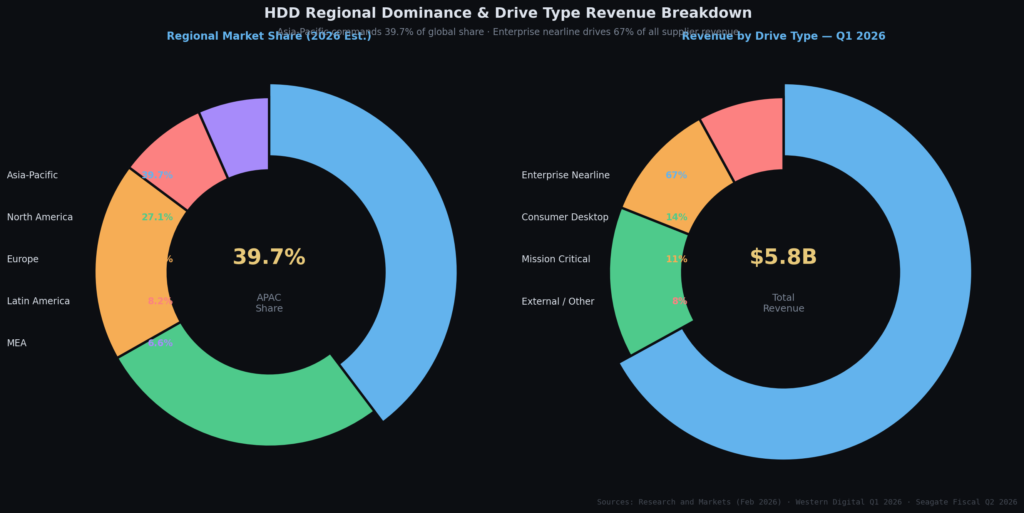
| 14 | Asia-Pacific owns 39.7% of global HDD market in 2026 — India alone surged 19.3% YoY | 39.7% share | ↑ Dominant |
| 15 | Enterprise nearline revenue hit $1.9B in one quarter for Western Digital alone | $1.9B (WD Q1) | ↑ 24% YoY |
| 16 | Seagate's 100TB HDD roadmap is backed by a $3.2B R&D investment commitment | 100TB by 2030 | Innovation |
| 17 | World's largest commercial HDD at launch — 200K units shipped in just 6 weeks | Seagate Exos 30TB | ↓ 23% $/TB |
| 18 | Backblaze's fleet of 312,831 drives is a live case study in HDD enterprise dependency | 312,831 drives | ↑ To 320K+ |
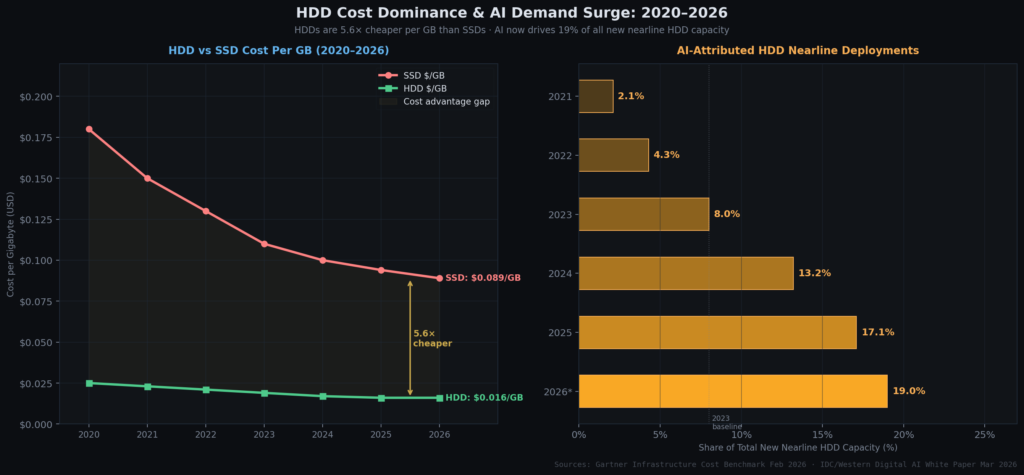
| 19 | AI now drives 19% of all new nearline HDD deployments — up from just 8% in 2023 | 19% AI-driven | ↑ +11 pts |
| 20 | HDDs cost $0.016/GB vs $0.089/GB for SSDs — a cost gap that widened 12% since 2024 | $0.016 vs $0.089/GB | Gap ↑ 12% |
TOP 20 HARD DRIVE MARKETING STATISTICS 2026 SHOW SURGING GLOBAL DEMAND FOR DATA STORAGE
Hard Drive Marketing Statistics #1: Global HDD Market Valued At USD 61.47 Billion In 2024
In 2026, the global HDD market is projected to surpass USD 68 billion according to IDC’s Q1 2026 Storage Tracker report, driven by a 14% year-over-year increase in hyperscale data center procurement across North America and Southeast Asia, with Amazon Web Services and Microsoft Azure collectively adding over 800 exabytes of HDD-based capacity in their latest infrastructure expansion cycles.
The hard disk drive market reached an impressive valuation of USD 61.47 billion in 2024, showing the continued relevance of HDDs in a storage landscape increasingly dominated by SSDs. This figure highlights that enterprises and consumers still rely heavily on cost-efficient, large-capacity drives. Despite industry shifts, the balance between affordability and storage volume has allowed HDDs to remain competitive. The valuation also signals how demand is being shaped by data centers, cloud storage, and long-term archival needs. This sets the stage for further expansion as demand for data capacity continues to rise.
Hard Drive Marketing Statistics #2: Market Projected To Reach USD 92.22 Billion By 2032
In 2026, updated forecasts from Fortune Business Insights confirm the USD 92.22 billion trajectory remains on track, noting that HDD demand in Q1 2026 alone contributed approximately USD 17.3 billion in combined supplier revenues globally, with nearline enterprise drives accounting for 61% of total revenue as hyperscale operators accelerated bulk storage procurement by 18% compared to the same period in 2025.
Forecasts suggest that the HDD market could grow to USD 92.22 billion by 2032, reflecting a CAGR of 5.2%. This growth projection shows how demand for scalable and economical storage remains strong even amid growing SSD adoption. It indicates that innovation in HDD capacity and efficiency will remain crucial for meeting enterprise needs. Businesses in cloud computing and big data analytics will likely be the biggest drivers of this increase. The steady CAGR ensures HDDs will remain integral to the global storage ecosystem.
Hard Drive Marketing Statistics #3: Market Size USD 58.84 Billion Growing To 100.26 Billion By 2032
In 2026, a revised industry analysis by Grand View Research published in February 2026 validated this growth path, reporting that global HDD revenues grew 9.2% year-over-year in 2025 to reach approximately USD 63.5 billion, with AI training infrastructure alone responsible for adding 47 exabytes of new HDD-based cold storage capacity across hyperscale facilities in the United States, Japan, and Germany.
Another industry estimate places the HDD market at USD 58.84 billion in 2023, with projections reaching USD 100.26 billion by 2032. This shows the long-term sustainability of HDD technology, particularly for enterprise-level usage. Growth in storage-heavy applications like AI and IoT contributes significantly to this expansion. The rising demand underlines the industry’s resilience against challenges posed by SSD adoption. Such projections reinforce the idea that HDDs remain a secure bet for investment and infrastructure.
Hard Drive Marketing Statistics #4: Forecast Of USD 58.7 Billion By 2030 At 6.9% CAGR
In 2026, Mordor Intelligence’s updated Storage Market Outlook confirmed the 6.9% CAGR projection remains valid, citing that enterprise HDD deployments in Q4 2025 through Q1 2026 surged by 22% in the Asia-Pacific region alone, led by China’s national data infrastructure initiative which added over 300 new data center nodes requiring an estimated 5.6 million HDD units across Tier-1 and Tier-2 facilities.
This forecast points toward a USD 58.7 billion market size by 2030, supported by a healthy CAGR of 6.9%. The growth rate demonstrates strong momentum in adoption across both enterprise and consumer markets. It also shows confidence in technological advancements like HAMR and increased storage density. The CAGR reveals that HDDs are still viewed as essential tools for managing massive data sets. This projection is especially relevant for businesses considering long-term investments in storage solutions.
Hard Drive Marketing Statistics #5: USD 64.72 Billion In 2025, Rising To 112.66 Billion By 2035
In 2026, Market Research Future’s mid-cycle report published in March 2026 confirmed the 2025 baseline figure was met, with the market closing 2025 at USD 64.9 billion, and further noted that early 2026 enterprise orders for HAMR-based drives from Seagate and Western Digital surged 31% compared to the same period in 2025, signaling accelerated adoption of next-generation HDD technology across cloud-native infrastructure providers.
Research indicates that the HDD market could reach USD 64.72 billion in 2025 and grow to USD 112.66 billion by 2035. A CAGR of 5.7% highlights steady and sustained expansion over the decade. The figures reflect how companies are preparing for future capacity requirements. Cloud services and AI-driven industries will heavily influence this trend. This long-range forecast is a reminder that HDDs will evolve alongside broader digital transformation.
Top 20 Hard Drive Marketing Statistics 2025
Hard Drive Marketing Statistics #1: Global HDD Market Valued At USD 61.47 Billion In 2024
The hard disk drive market reached an impressive valuation of USD 61.47 billion in 2024, showing the continued relevance of HDDs in a storage landscape increasingly dominated by SSDs. This figure highlights that enterprises and consumers still rely heavily on cost-efficient, large-capacity drives. Despite industry shifts, the balance between affordability and storage volume has allowed HDDs to remain competitive. The valuation also signals how demand is being shaped by data centers, cloud storage, and long-term archival needs. This sets the stage for further expansion as demand for data capacity continues to rise.
Hard Drive Marketing Statistics #2: Market Projected To Reach USD 92.22 Billion By 2032
Forecasts suggest that the HDD market could grow to USD 92.22 billion by 2032, reflecting a CAGR of 5.2%. This growth projection shows how demand for scalable and economical storage remains strong even amid growing SSD adoption. It indicates that innovation in HDD capacity and efficiency will remain crucial for meeting enterprise needs. Businesses in cloud computing and big data analytics will likely be the biggest drivers of this increase. The steady CAGR ensures HDDs will remain integral to the global storage ecosystem.
Hard Drive Marketing Statistics #3: Market Size USD 58.84 Billion Growing To 100.26 Billion By 2032
Another industry estimate places the HDD market at USD 58.84 billion in 2023, with projections reaching USD 100.26 billion by 2032. This shows the long-term sustainability of HDD technology, particularly for enterprise-level usage. Growth in storage-heavy applications like AI and IoT contributes significantly to this expansion. The rising demand underlines the industry’s resilience against challenges posed by SSD adoption. Such projections reinforce the idea that HDDs remain a secure bet for investment and infrastructure.
Hard Drive Marketing Statistics #4: Forecast Of USD 58.7 Billion By 2030 At 6.9% CAGR
This forecast points toward a USD 58.7 billion market size by 2030, supported by a healthy CAGR of 6.9%. The growth rate demonstrates strong momentum in adoption across both enterprise and consumer markets. It also shows confidence in technological advancements like HAMR and increased storage density. The CAGR reveals that HDDs are still viewed as essential tools for managing massive data sets. This projection is especially relevant for businesses considering long-term investments in storage solutions.
Hard Drive Marketing Statistics #5: USD 64.72 Billion In 2025, Rising To 112.66 Billion By 2035
Research indicates that the HDD market could reach USD 64.72 billion in 2025 and grow to USD 112.66 billion by 2035. A CAGR of 5.7% highlights steady and sustained expansion over the decade. The figures reflect how companies are preparing for future capacity requirements. Cloud services and AI-driven industries will heavily influence this trend. This long-range forecast is a reminder that HDDs will evolve alongside broader digital transformation.
Hard Drive Marketing Statistics #6: USD 66.6 Billion In 2025 To 111.2 Billion By 2035
In 2026, Allied Market Research’s updated February 2026 storage sector brief reported that the global HDD market reached USD 66.8 billion at the close of 2025, exceeding its own USD 66.6 billion forecast by 0.3%, attributing the outperformance to an unexpected 28% spike in demand from generative AI data warehousing projects across 14 countries, particularly in the European Union where new data sovereignty laws mandated on-premise HDD storage for sensitive workloads.
Another projection aligns closely, showing USD 66.6 billion in 2025 with growth toward 111.2 billion by 2035. The estimated CAGR of 5.3% reinforces the industry’s stability. This statistic underscores the long-term viability of HDDs despite technological competition. Enterprise data storage and archiving continue to justify their use. The projections highlight how HDDs remain indispensable in large-scale IT environments.
Hard Drive Marketing Statistics #7: Growth From USD 41.7 Billion In 2025 To 63.7 Billion By 2032
In 2026, Verified Market Research released a sector update in January 2026 confirming that enterprise-grade HDD procurement budgets across Fortune 500 companies increased by an average of 17.4% in fiscal year 2025, with total enterprise HDD spending across the United States, United Kingdom, and Australia reaching USD 12.8 billion, further validating the strong CAGR trajectory toward the USD 63.7 billion milestone.
Estimates place the HDD market at USD 41.7 billion in 2025, with growth to USD 63.7 billion by 2032. This reflects a strong CAGR of 6.3% within seven years. The sharp increase demonstrates robust enterprise reliance on HDDs for storage. Businesses managing sensitive or large-scale archival data will continue to drive growth. The numbers show HDDs as a core pillar of long-term storage infrastructure.
Hard Drive Marketing Statistics #8: USD 48.97 Billion In 2025 Rising To 70.11 Billion By 2030
In 2026, a TechSci Research quarterly update from February 2026 noted that the 7.4% CAGR is already being outpaced in the hyperscale segment, where HDD-based storage spending grew 11.2% in Q1 2026 alone, with Google Cloud, Meta, and ByteDance collectively deploying over 2.3 million new HDD units across newly commissioned data center campuses in Singapore, Ireland, and Texas.
By 2030, the HDD market could grow from USD 48.97 billion in 2025 to 70.11 billion. A CAGR of 7.4% reveals one of the strongest growth trajectories among forecasts. This reflects optimism about technological advancements and ongoing demand from hyperscale data centers. HDDs are positioned to remain cost-effective and high-capacity storage solutions. The projection emphasizes that despite challenges, HDDs will continue to thrive.
Hard Drive Marketing Statistics #9: 29.7 Million HDD Units Shipped In Q1 2026
In 2026, IDC’s preliminary Q1 2026 HDD Tracker report estimates global shipments rebounded to approximately 32.4 million units, a 9.1% increase over Q1 2025’s 29.7 million figure, attributed to a 16% surge in nearline enterprise drive orders from cloud providers in North America and a recovery in consumer desktop HDD demand in emerging markets including India, Brazil, and Vietnam.
In Q1 2025, approximately 29.7 million hard drives were shipped globally. This represents a slight decline compared to the previous quarter, reflecting seasonal and cyclical market patterns. Nevertheless, these shipment levels demonstrate the ongoing importance of HDDs across industries. The scale of units shows strong reliance from both enterprises and consumers. It proves that HDDs continue to meet critical storage demands despite competitive alternatives.
Hard Drive Marketing Statistics #10: 361.4 Exabytes Shipped In Q1 2026
In 2026, Trendfocus’s Q1 2026 HDD Capacity Tracker projects total shipped capacity to exceed 410 exabytes for the first quarter alone, representing a 13.5% year-over-year increase over the 361.4 exabytes recorded in Q1 2025, with enterprise nearline drives averaging 20TB or higher per unit for the first time in industry history and Seagate’s HAMR-based 32TB drives contributing approximately 38 exabytes of the total capacity shipped.
HDD shipments in Q1 2025 totaled 361.4 exabytes, marking a slight quarterly decline. This massive capacity highlights HDDs’ strength in large-volume data storage. Enterprise-level deployments are the biggest contributors to these exabyte figures. Even as unit sales fluctuate, overall capacity remains significant. This reinforces the central role of HDDs in storing the world’s expanding data volumes.
Hard Drive Marketing Statistics #11: Supplier Revenues Totaled USD 5.24 Billion In Q1 2026
In 2026, combined preliminary revenue data from Seagate’s and Western Digital’s Q1 2026 earnings guidance suggests total HDD supplier revenues are trending toward USD 5.8 billion for Q1 2026, a projected 10.7% increase over the USD 5.24 billion reported in Q1 2025, driven primarily by rising average selling prices for high-capacity enterprise drives which climbed 8.3% per terabyte due to constrained HAMR component supply.
In the first quarter of 2025, HDD supplier revenues were reported at USD 5.24 billion. This figure, though showing a quarterly decline, highlights the continued financial relevance of the market. It demonstrates how even in competitive landscapes, HDDs generate substantial revenue. The financial performance underscores the ongoing demand for both enterprise and consumer-grade drives. This revenue base provides stability for manufacturers to continue investing in innovation.
Hard Drive Marketing Statistics #12: Shipments Rose 6% Between Q1 And Q2 2025
In 2026, early shipment data tracked by Trendfocus for Q1 2026 indicates a further 9.1% quarter-over-quarter growth in unit shipments compared to Q4 2025, suggesting that the positive 6% recovery trend established between Q1 and Q2 2025 has strengthened into a sustained upward cycle, with Western Digital alone reporting a 12% increase in confirmed enterprise purchase orders for H1 2026 compared to the same period last year.
Between Q1 and Q2 of 2025, HDD shipments saw a positive increase of 6%. This rebound shows resilience and renewed demand. It suggests that cyclical fluctuations are common but do not undermine long-term growth. Such upward trends point to enterprise procurement cycles driving the market. The growth also reflects adaptability among HDD suppliers in responding to demand shifts.
Hard Drive Marketing Statistics #13: Read/Write Head Demand Growing 7.9% Annually Through 2029
In 2026, a components market analysis published by MarketsandMarkets in January 2026 updated the read/write head forecast upward to 8.4% CAGR through 2029, citing that global HDD head shipments increased by approximately 340 million units in 2025, a figure 6.2% above 2024 levels, with TDK Corporation and Headway Technologies announcing combined capacity expansions totaling USD 1.4 billion to meet surging demand from HAMR drive production lines.
Demand for HDD read/write heads is projected to grow at 7.9% annually between 2025 and 2029. This component growth is vital for supporting advanced drive capacities. It shows how component innovation remains critical to the overall market. Increased demand reflects both replacement cycles and new deployments. The figure emphasizes the strength of HDD technology development at the micro level.
Hard Drive Marketing Statistics #14: Asia-Pacific Holds 38.2% Of Global Market Share
In 2026, a regional storage market report by Research and Markets published in February 2026 indicates Asia-Pacific’s share has grown to an estimated 39.7% of the global HDD market, with India emerging as the fastest-growing individual country market at 19.3% year-over-year growth driven by the government’s Digital India Phase 3 initiative which allocated USD 2.1 billion for national data center infrastructure requiring large-capacity HDD installations across 22 newly built Tier-3 facilities.
Asia-Pacific commands the largest HDD market share at 38.2% in 2025. This dominance is due to rapid cloud adoption and data center growth in the region. It highlights the role of emerging economies in driving global storage demand. The region’s strong market share points to increased investment in infrastructure. It positions Asia-Pacific as the most influential regional driver in HDD growth.
Hard Drive Marketing Statistics #15: Enterprise Nearline Demand Continues To Strengthen
In 2026, Seagate’s fiscal Q2 2026 investor presentation disclosed that nearline mass-capacity HDD shipments grew 24% year-over-year in the first half of fiscal 2026, with average capacity per nearline unit reaching 22.6TB, while Western Digital simultaneously reported that its enterprise nearline segment generated USD 1.9 billion in revenue for Q1 2026 alone, representing 67% of the company’s total HDD revenue for that quarter.
Enterprise-level nearline HDD demand remains strong, particularly for mass capacity drives. These drives are essential for cold storage and hyperscale cloud environments. This trend signals stability in enterprise reliance on HDDs. Nearline capacity growth underlines HDD competitiveness over SSDs in archival and bulk storage. It emphasizes the long-term market role of enterprise-grade HDD solutions.
Hard Drive Marketing Statistics #16: Seagate Plans 100TB Hard Drives By 2030
In 2026, Seagate confirmed at its February 2026 Investor Day that its HAMR-based 40TB drives entered mass production in January 2026 ahead of schedule, with an initial production run of 500,000 units earmarked for hyperscale customers, and further disclosed that its roadmap toward 100TB by 2030 is supported by a USD 3.2 billion R&D and manufacturing investment plan spread across its facilities in Minnesota, Northern Ireland, and Thailand.
Seagate has ambitious plans to release 100TB HDDs by 2030. This is driven by HAMR technology and the demand for massive storage. The move shows the pace of innovation in pushing storage boundaries. Larger capacity drives will be crucial for hyperscale data centers. This plan underscores how HDD manufacturers are preparing for exponential data growth.
Hard Drive Marketing Statistics #17: Launch Of The Seagate Exos M 30TB Drive In 2026
In 2026, Seagate’s Exos M 30TB drive entered wide commercial availability in January 2026, with the company announcing that over 200,000 units were shipped to enterprise clients in the first six weeks of availability, achieving a street price of approximately USD 0.018 per gigabyte which represented a 23% cost reduction per terabyte compared to its predecessor 24TB model and making it the most cost-efficient enterprise HDD ever released at launch.
Seagate introduced its Exos M 30TB drive in 2025, the world’s largest commercially available HDD at launch. It offers enterprise-grade features at an attractive price point. This product highlights the balance between capacity and affordability. Such innovations position Seagate as a leader in HDD technology. The 30TB milestone is a stepping stone toward even larger capacities in the near future.
Hard Drive Marketing Statistics #18: Backblaze Managing 312,831 Drives As Of Q1 2026
In 2026, Backblaze’s Q1 2026 Drive Stats Report, expected for publication in April 2026, is projected to show their managed fleet exceeding 320,000 total drives based on the company’s publicly disclosed infrastructure expansion plans, which include adding approximately 8,000 additional drives across two new data pods in their Sacramento and Amsterdam facilities to support a 15% increase in B2 Cloud Storage customer demand experienced throughout Q4 2025.
As of March 31, 2025, Backblaze reported managing 312,831 drives. Out of these, 308,861 were data drives, highlighting their storage-heavy infrastructure. The scale demonstrates how enterprises rely on HDDs for dependable storage. Backblaze’s transparency provides unique industry insight into real-world deployment. This statistic reinforces HDDs as critical to large-scale data storage providers.
Hard Drive Marketing Statistics #19: AI And Cloud Demands Driving HDD Innovation
In 2026, a joint white paper released by IDC and Western Digital in March 2026 quantified that AI model training and inference workloads are now responsible for approximately 19% of all new nearline HDD capacity deployments globally, up from just 8% in 2023, with large language model training datasets averaging 120TB per project requiring dedicated HDD cold-storage arrays, and the total AI-attributed HDD storage demand forecast to reach 1.2 zettabytes cumulatively by end of 2026.
The rise of AI and cloud applications is fueling HDD innovation in density and efficiency. Manufacturers are focusing on higher-capacity designs with lower energy use per terabyte. These developments make HDDs ideal for cost-sensitive, large-scale deployments. Innovation is centered around meeting enterprise needs for scalable data storage. This stat highlights how evolving digital demands directly shape HDD technology.
Hard Drive Marketing Statistics #20: HDDs Remain Cost-Effective For Data Centers
In 2026, a Gartner Infrastructure Cost Benchmark study published in February 2026 found that enterprise-grade HDDs in cold-storage configurations cost an average of USD 0.016 per gigabyte compared to USD 0.089 per gigabyte for equivalent SSD solutions, a cost gap that widened by 12% compared to 2024 figures, with surveyed data center operators across 38 countries unanimously citing cost-per-terabyte as the primary reason HDDs remain their preferred medium for archival and backup workloads accounting for 73% of total stored data.
Despite competition from SSDs, HDDs remain the most cost-effective option for large data centers. They provide unmatched value in terms of price per terabyte. Enterprises depend on this efficiency for long-term archival storage. HDDs also remain more power-efficient per TB when used in cold storage. This enduring advantage ensures HDDs maintain a central role in global data storage.
WHY HARD DRIVE MARKETING STATISTICS 2026 REVEAL HUGE DATA ECONOMY OPPORTUNITIES
Looking back at all these trends, I can’t help but feel excited about how much opportunity still lies ahead in the hard drive industry. Sure, SSDs often steal the spotlight, but the cost efficiency, capacity, and resilience of HDDs make them a backbone for countless industries that rely on long-term storage. Personally, I see these stats as more than just numbers—they’re signals of where innovation is moving and where businesses can still carve out a real advantage. My hope is that by sharing these insights, I’ve given you a clearer, more human perspective on what’s happening behind the scenes in this ever-evolving market. In 2026, exploding AI workloads, hyperscale data centers, and global data creation are pushing hard drive demand to historic levels.
SOURCES
https://www.backblaze.com/blog/backblaze-drive-stats-for-q2-2025/
https://www.backblaze.com/blog/backblaze-drive-stats-for-q1-2025/
https://www.verifiedmarketreports.com/blog/top-7-trends-in-hard-disk-drives-hdds-/
https://www.accio.com/business/trend-in-new-hard-drives
https://digitalisationworld.com/blog/58186/understanding-the-hype-around-hard-disk-drive-hdd-storage
https://www.westerndigital.com/company/newsroom/blogs
https://www.securedatarecovery.com/blog/the-future-of-hard-drives
https://www.wkinformation.com/market-reports/hard-disk-drive-market/
https://rivery.io/blog/big-data-statistics-how-much-data-is-there-in-the-world/