




19 Sep TOP 20 HERB MARKETING STATISTICS 2025
When I first started exploring the world of natural health products, I was amazed by how much herbs have moved from kitchen shelves into boardroom strategies. Looking at the latest herb marketing statistics, it’s clear this isn’t just a niche interest anymore—it’s a global movement. From the surge in herbal supplements to the way fresh and dried herbs are carving out bigger spaces in the market, the numbers tell a fascinating story. As someone who’s always been curious about how consumer behavior shapes industries, I wanted to dig deeper into these insights with the same care a leading marketing agency in New York might bring to its research. What I found was not only exciting but also a real reminder of how timeless traditions are shaping modern business.
Top 20 Herb Marketing Statistics 2025 (Editor’s Choice)
🌿 Top 20 Herb Marketing Statistics
Comprehensive Market Insights for 2024-2025
| Rank | Category | Key Statistic | Value/Growth |
|---|---|---|---|
| 1 | Market Size | Global herbal supplements market size in 2024 | $42.33 Billion |
| 2 | Growth Rate | Expected CAGR from 2025 to 2033 for herbal supplements | 8.89% |
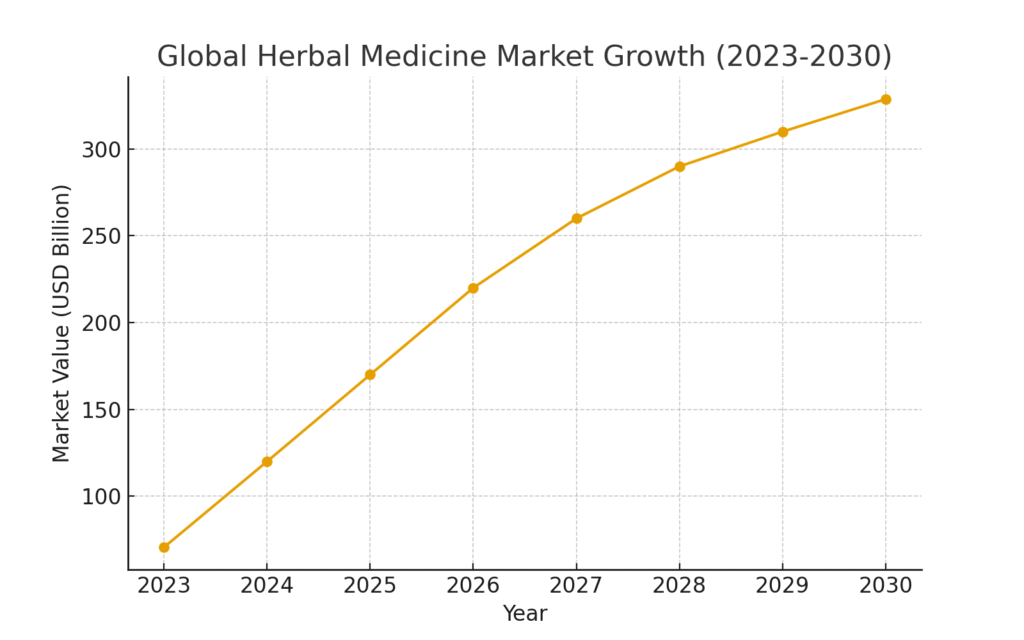
| 3 | Future Value | Projected herbal medicine market size by 2030 | $328.72 Billion |
| 4 | US Market | US herbal supplements sales growth in 2024 | 5.4% to $13.23B |
| 5 | Medicinal Herbs | Medicinal herbs market projected growth (2024-2032) | 11.16% CAGR |
| 6 | Regional Leader | North America's share of global herbal supplements market | 26.34% |
| 7 | European Market | Europe's dominance in herbal medicine market (2023) | 33.98% |
| 8 | Fastest Growth | US projected as fastest-growing market (2025-2035) | 7.2% CAGR |
| 9 | Demographics | Millennials & Gen Z incorporating herbal remedies | 65% |
| 10 | US Penetration | Percentage of US population using herbal supplements annually | 30% |
| 11 | Gender Split | Women leading consumer orientation segment | 40% Share |
| 12 | Consumer Preference | Botanicals and herbs consumption among supplement users | 44% |
| 13 | Top Product | Turmeric segment's market share dominance in 2024 | 23.95% |
| 14 | Best Seller | Psyllium leading mainstream channel for third consecutive year | $290M Sales |
| 15 | Top 5 Herbs | Leading ingredients: Elderberry, Ashwagandha, Turmeric, Beetroot | $145M-$117M |
| 16 | Distribution | Online retailing expected market share by 2025 | 30% |
| 17 | Sales Channel | Direct-to-consumer showing greatest sales and fastest growth | Leading Channel |
| 18 | Health Focus | Immune & digestive health application segment dominance | 35% Share |
| 19 | Global Health | Herbal medicine in developing countries healthcare provision | Up to 80% |
| 20 | Investment | Venture capital investments in herbal medicine startups (2023) | $2.8 Billion |
Top 20 Herb Marketing Statistics 2025
Herb Marketing Statistics #1 – Global Herbal Medicine Market Valued At $70.57 Billion In 2023
The global herbal medicine market stood at an impressive $70.57 billion in 2023. This valuation highlights how strongly consumers are leaning toward natural alternatives. The projected growth to over $328 billion by 2030 shows that herbal products are no longer niche but mainstream. Businesses entering this space today have the chance to ride a wave of long-term demand. The sheer size of this market makes herbs a cornerstone of modern wellness marketing.
Herb Marketing Statistics #2 – Market Expected To Reach $437 Billion By 2032
By 2032, the herbal medicine market is expected to reach $437 billion globally. This reflects a steady CAGR of over 8%, pointing to consistent consumer trust in natural remedies. Such growth suggests that herbal products will rival conventional pharmaceuticals in popularity. For marketers, this trend means creating campaigns that highlight authenticity and tradition. Clearly, the long-term trajectory of this industry is both stable and highly lucrative.
Herb Marketing Statistics #3 – Medicinal Herbs Market Projected At $478.93 Billion By 2032
The medicinal herbs market alone is expected to hit nearly $479 billion by 2032. With a CAGR of 11.21%, this category is outpacing many other natural product sectors. It underlines how consumers are embracing herbal solutions for preventative health. Pharmaceutical applications in particular are driving this massive expansion. For entrepreneurs, this is a signal to innovate around herbal-based healthcare solutions.
Herb Marketing Statistics #4 – Herbal Supplements Market Valued At $48.1 Billion In 2023
Herbal supplements generated $48.1 billion in sales worldwide in 2023. This number is predicted to grow steadily, hitting nearly $88 billion by 2032. The supplement category is a key entry point for herbs in everyday routines. Marketers often find this segment easier to position since it connects directly with wellness goals. As demand grows, branding around transparency and quality will become increasingly critical.
Herb Marketing Statistics #5 – Fresh Herbs Market Valued At $5.37 Billion In 2023
Fresh herbs recorded $5.37 billion in global market value in 2023. They are projected to nearly double by 2030, reaching over $10 billion. This growth speaks to the rising interest in cooking, organic diets, and farm-to-table living. Retailers and restaurants alike are leaning on herbs as a differentiator. For marketing, freshness and local sourcing are the messages that resonate most with consumers.
Herb Marketing Statistics #6 – Europe Held 44.55% Of The Market In 2024
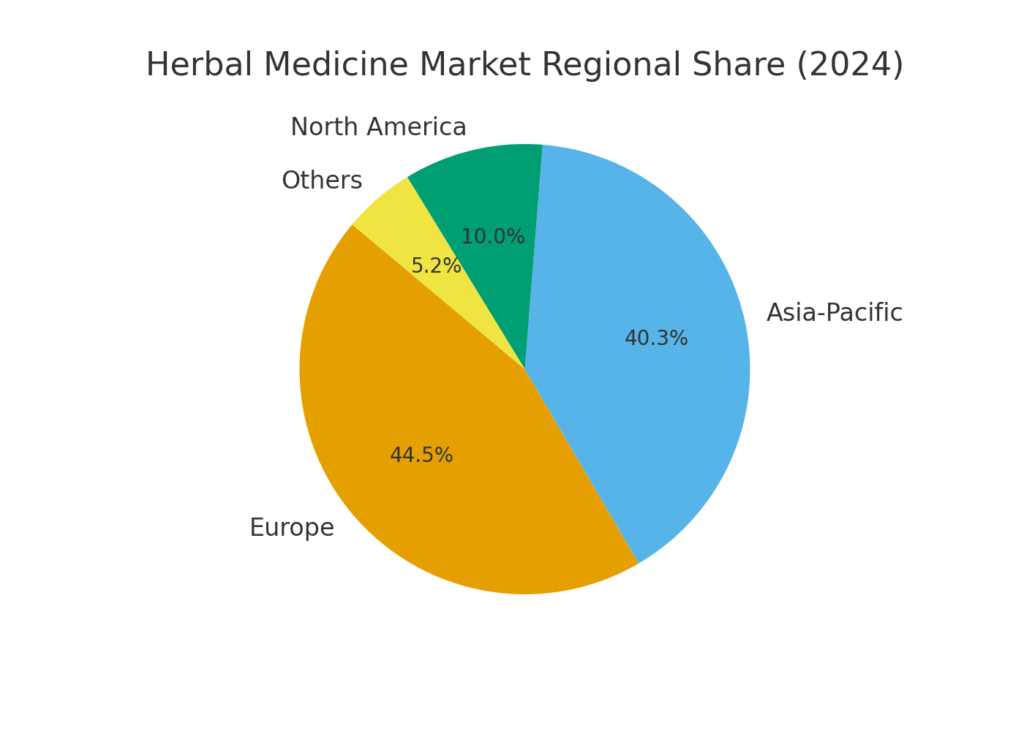
Europe dominated the herbal medicine market in 2024, holding 44.55% share. This makes Europe the global leader in herbal product adoption. Strong traditions in natural medicine across countries like Germany and France help explain this. It also reflects consumer trust in plant-based healthcare solutions. Companies targeting Europe must focus on regulation compliance and quality assurance.
Herb Marketing Statistics #7 – Asia-Pacific Expected To Hold 40.3% Share In 2025
Asia-Pacific is projected to hold 40.3% of the global medicinal herbs market by 2025. This dominance is fueled by ancient traditions such as Ayurveda and Traditional Chinese Medicine. Consumer familiarity with herbs gives this region a unique edge. Local companies are expanding rapidly, but global brands are also entering aggressively. For marketers, aligning with cultural heritage is the best strategy in this region.
Herb Marketing Statistics #8 – US Market Expected To Hit $58.8 Billion By 2030
The United States herbal medicine market is expected to grow from $13.7 billion in 2023 to $58.8 billion by 2030. This represents an astonishing CAGR of over 23%. It shows how fast mainstream American consumers are embracing natural remedies. Retail channels from pharmacies to online platforms are all expanding their herbal lines. Marketers in the US must focus on education and trust-building to sustain this growth.
Herb Marketing Statistics #9 – Tablets And Capsules Held 46.1% Share In 2023
In 2023, tablets and capsules represented 46.1% of the herbal medicine market. This format is popular for its convenience and accurate dosing. Consumers often perceive capsules as more “medical,” boosting their credibility. For brands, this means packaging and presentation can drive adoption as much as the herb itself. The dominance of capsules shows how form factor heavily influences buying decisions.
Herb Marketing Statistics #10 – Ayurveda Held 27.7% Share Of The Market In 2023
Ayurveda accounted for 27.7% of the herbal medicine market by intervention type in 2023. This highlights the global influence of ancient Indian practices. Ayurveda’s holistic approach to wellness is appealing in today’s stress-driven society. Brands leveraging Ayurvedic traditions find it easier to create compelling storytelling. As global awareness grows, Ayurveda is poised to expand further into mainstream healthcare.
Herb Marketing Statistics #11 – Pharmaceuticals To Hold 42.1% Application Share In 2025
By 2025, pharmaceuticals will account for about 42.1% of the medicinal herbs market. This shows that herbs are increasingly recognized as legitimate in modern medicine. Doctors and patients alike are more open to plant-based treatments. For marketers, this offers a chance to bridge traditional remedies with scientific validation. The pharmaceutical segment may become the biggest growth driver in the next decade.
Herb Marketing Statistics #12 – Basil Leads The Dried Herbs Market With 19% Share
Basil dominates the dried herbs category, holding a 19% share in 2025. Its versatility in global cuisines makes it a kitchen essential. Consumers recognize basil for both flavor and health benefits. Food brands often highlight basil in packaged goods to attract attention. This dominance makes basil a “gateway” herb for many consumers entering the dried herbs market.
Herb Marketing Statistics #13 – Dried Herbs Market To Reach $6.8 Billion By 2035
The dried herbs market is set to grow to $6.8 billion by 2035. With a CAGR of 5.2%, this category is stable and resilient. Consumers appreciate the long shelf life and convenience of dried herbs. The trend toward home cooking continues to boost demand. Marketers should highlight preservation of flavor and nutrition in dried herbs to win loyalty.
Herb Marketing Statistics #14 – Fresh Herbs Market To Grow 6.54% CAGR Through 2025
Fresh herbs are forecasted to grow at a CAGR of 6.54% through 2025. This reflects stronger consumer interest in natural, unprocessed ingredients. Farmers and distributors are ramping up production to meet rising demand. Supermarkets are also giving herbs more shelf space, often near fresh produce. For marketers, this is an opportunity to brand herbs as both premium and everyday essentials.
Herb Marketing Statistics #15 – 80% Of The World’s Population Uses Herbal Medicine
Around 80% of people worldwide use herbal medicine for primary healthcare. This staggering figure underscores the universality of herbal traditions. It suggests that herbal marketing can target nearly every demographic. The figure also shows the trust people place in natural solutions. For businesses, it means the potential audience is incredibly broad and inclusive.

Herb Marketing Statistics #16 – US Herbal Supplement Sales Reached $15.55 Billion In 2023
In 2023, U.S. herbal supplement sales reached $15.55 billion. This was a 4.4% increase from the previous year. Growth in the US reflects rising awareness of natural wellness options. More consumers are buying herbal products from mainstream retailers. The steady rise highlights strong and sustained consumer confidence.
Herb Marketing Statistics #17 – Beet Root Sales Grew 108% In 2023
Beet root was the fastest-growing herbal ingredient in the US in 2023. Its sales surged by 108% compared to 2022. This is tied to increased awareness of its cardiovascular and energy benefits. Trends like fitness supplements and natural performance boosters helped drive demand. It proves that individual herbs can experience explosive growth when backed by science and trends.
Herb Marketing Statistics #18 – Turmeric Ranked #1 In Natural Channel Sales In 2023
Turmeric continued its reign as the top-selling herb in the US natural channel in 2023. Its anti-inflammatory reputation has made it a household name. Consumers trust turmeric as both food and medicine. This popularity has expanded beyond supplements into drinks, skincare, and packaged foods. For marketers, turmeric is a blueprint for how to brand herbs as multifunctional superfoods.
Herb Marketing Statistics #19 – Dried Herbs Market Faces Raw Material Challenges
The dried herbs market is facing issues with raw material price volatility. Climate change is also threatening consistent cultivation. These factors may affect long-term supply stability. Marketers must address these challenges by promoting sustainable sourcing. Transparency will be key to retaining consumer trust amid these risks.
Herb Marketing Statistics #20 – Organic Herbal Medicine Market Valued At $14.8 Billion In 2023
The organic herbal medicine market was valued at $14.8 billion in 2023. Demand for clean-label and pesticide-free products is fueling its rise. Consumers are increasingly prioritizing organic certifications when buying herbs. This trend positions organic herbs as a premium choice in the marketplace. For marketers, emphasizing purity and sustainability can be powerful differentiators.

Wrapping It All Up
At the end of the day, these herb marketing statistics do more than just provide figures—they connect us to a growing cultural shift where wellness, tradition, and modern marketing collide. Personally, I find it inspiring to see how something so simple and natural is finding new relevance in a world driven by data and innovation. Whether you’re a business owner looking to ride this wave or just someone curious about where the industry is headed, the message is clear: herbs are here to stay, and they’re only getting stronger in the marketplace. Writing this reminded me of how exciting it feels to witness industries evolve right in front of us, and I hope you feel the same spark of curiosity as you look at these numbers.
SOURCES
- https://vitaquest.com/herbal-supplements-market-opportunities-and-challenges/ Vitaquest International LLC
- https://niemagazine.com/herbs-and-botanicals-the-state-of-the-market-in-2024/ Nutrition Industry Executive Magazine
- https://www.marketreportsworld.com/market-reports/medicinal-herbs-market-14713321 Market Reports World
- https://www.herbalcontentcottage.com/journal/creating-an-herbal-content-marketing-strategy Herbal Content Cottage
- https://usda.library.cornell.edu/concern/publications/t435gd018?locale=en
- https://codedesign.org/tips-marketing-herbal-products-successfully codedesign.org