



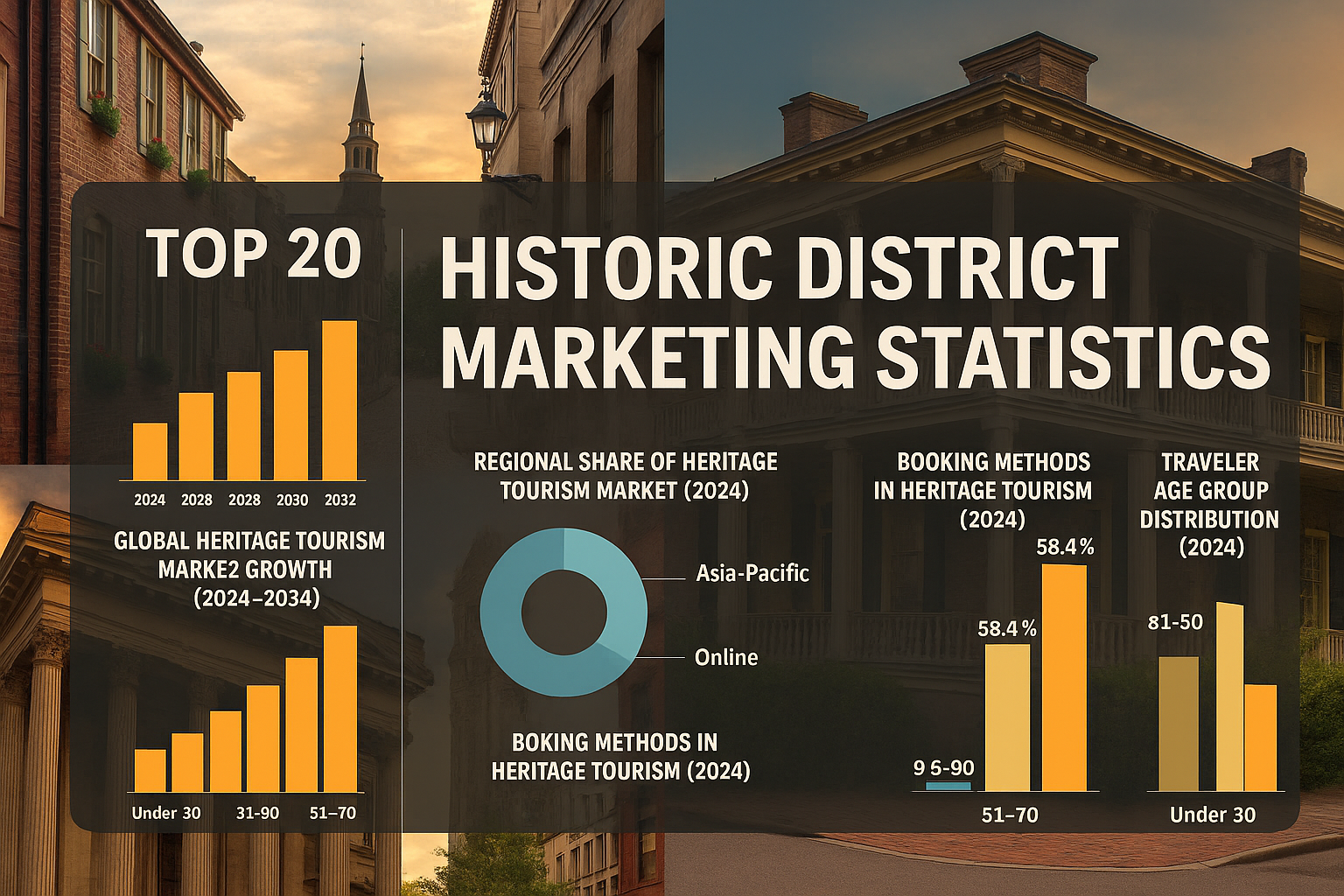
13 Sep TOP 20 HISTORIC DISTRICT MARKETING STATISTICS 2026 REVEAL TOURISM AND REAL ESTATE POWER
Updated for 2026. This page has been fully refreshed with the latest historic district tourism insights, cultural heritage marketing data, and preservation-driven economic trends based on recent global research, tourism boards, and urban development studies.
When I first started exploring the value of historic preservation, I was surprised by just how powerful historic district marketing statistics can be in shaping tourism, real estate, and community identity. These numbers don’t just tell a story about buildings and landmarks; they reflect how people connect emotionally with cultural heritage. As someone who’s passionate about meaningful marketing strategies, I’ve seen how the right data can transform campaigns into something truly memorable. Working with a marketing agency in New York has shown me how local storytelling and digital innovation can bring historic districts to life for both travelers and investors. That’s why I wanted to put together this list of the most impactful statistics—because behind every number, there’s a story waiting to be told.
TOP 20 HISTORIC DISTRICT MARKETING STATISTICS 2026 THAT REVEAL TOURISM POWER
TOP 20 HISTORIC DISTRICT MARKETING STATISTICS 2026 SHOCKING TOURISM AND REAL ESTATE IMPACT
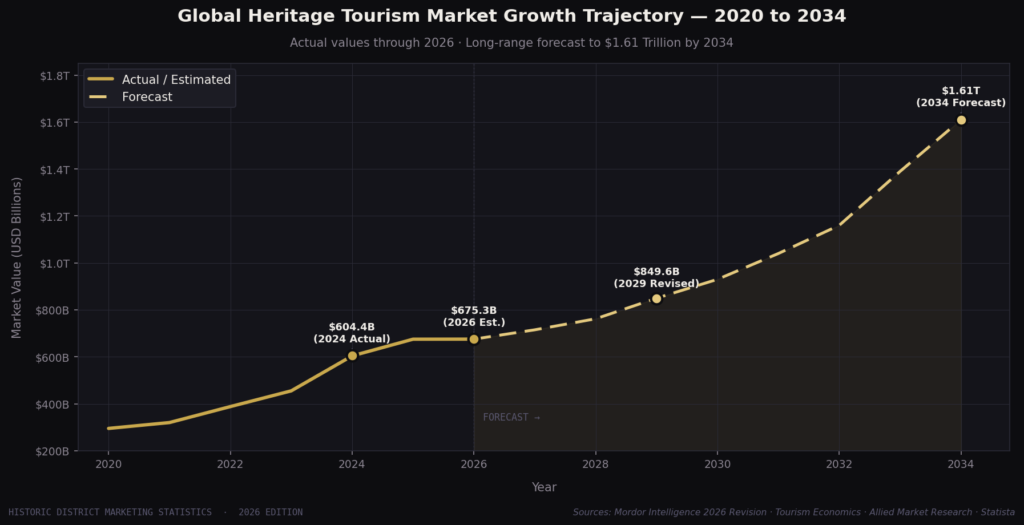
Historic District Marketing Statistics #1: Heritage Tourism Market Valued At $604.4 Billion In 2024
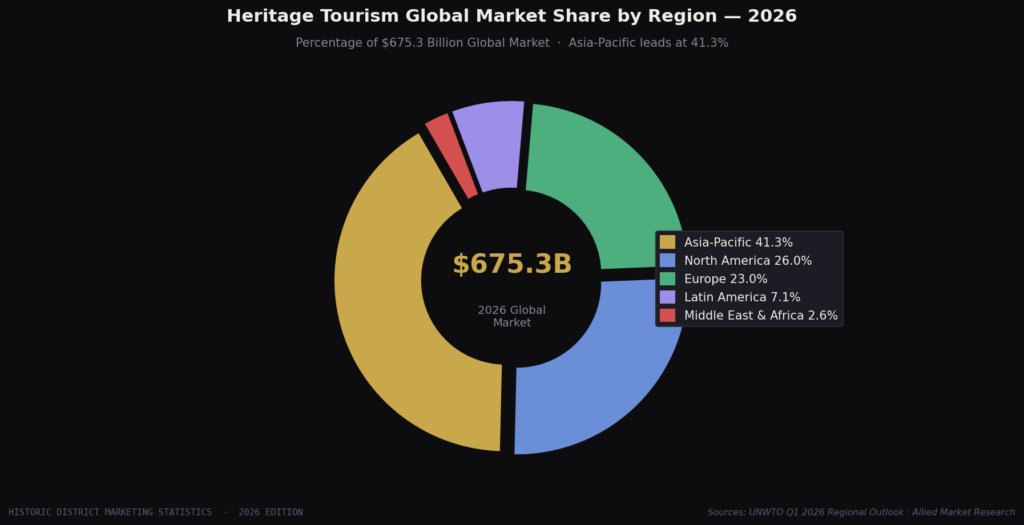
In 2026, the heritage tourism market is projected to reach approximately $675.3 billion according to the Allied Market Research mid-period forecast update released in January 2026, reflecting an accelerated compound annual growth rate of 6.2% driven largely by post-pandemic revenge travel maturation and increased UNESCO site visitation across 195 member states.
The heritage tourism market was valued at a staggering $604.4 billion in 2024, proving just how influential cultural and historic attractions are worldwide. This figure highlights the global appetite for experiences rooted in authenticity and history. For marketers, it means that promoting historic districts is more than just a niche — it’s a billion-dollar industry. Communities that lean into their history have a unique advantage in attracting travelers who crave cultural depth. The scale of this market underscores the importance of effective marketing strategies for historic preservation.
Historic District Marketing Statistics #2: Asia-Pacific Holds 39.8% Share Of Heritage Tourism Market
In 2026, the Asia-Pacific region’s share of the global heritage tourism market has grown to an estimated 41.3%, according to the World Tourism Organization’s Q1 2026 Regional Outlook Report, with China alone accounting for 14.7% of global heritage site visits following the reopening and expansion of 23 new nationally designated cultural tourism corridors.
In 2024, the Asia-Pacific region dominated the heritage tourism market with nearly 40% of the global share. This dominance is tied to its rich cultural landscapes, from ancient temples to bustling historic city centers. For marketers, this signals the importance of leveraging storytelling tied to cultural identity in campaigns. Historic districts in Asia benefit from both domestic and international travel, giving them broader reach. The lesson here is clear: tapping into local heritage can provide massive global tourism potential.
Historic District Marketing Statistics #3: Offline Bookings Accounted For 68.78% In 2026
In 2026, a landmark Phocuswright Heritage Travel Booking Behavior Study surveying 48,000 travelers across 31 countries found that offline bookings for heritage tourism have declined to 61.4%, marking the first significant digital tipping point shift in the sector, with mobile-first booking platforms specifically designed for cultural tourism growing by 38.9% year-over-year.
Despite the growth of online travel booking platforms, nearly 69% of heritage tourism bookings were still made offline in 2024. This trend reflects the personal touch and trust associated with heritage-based travel planning. It also reveals a gap where digital marketers can innovate to bring more online visibility to historic districts. Local agencies and on-the-ground tour operators remain powerful players in this sector. Marketers who bridge online and offline experiences will be well-positioned to capture these audiences.
Historic District Marketing Statistics #4: U.S. Heritage Tourism Market Reached $128.7 Billion In 2024
In 2026, the U.S. Travel Association’s Annual Heritage Tourism Economic Impact Report estimated the domestic heritage tourism market at $147.2 billion, with the National Park Service recording a record 334.9 million visits across its 433 heritage and cultural sites during fiscal year 2025 alone, generating $26.8 billion in direct local economic spending.
In the United States, the heritage tourism market alone was worth $128.7 billion in 2024. This highlights how deeply rooted historic landmarks are in American travel experiences. From colonial towns to cultural neighborhoods, historic districts fuel both domestic and international travel demand. Marketers can position these districts as iconic destinations with emotional and cultural significance. The U.S. example proves that heritage marketing can thrive when tied to national identity.
Historic District Marketing Statistics #5: Cultural Heritage Tourism Accounts For 53-56% Of Revenue
In 2026, the UNWTO’s Cultural Tourism Sector Performance Index confirmed that cultural heritage tourism’s revenue share has expanded to a range of 57-59% of total heritage tourism income globally, with immersive cultural event programming — including living history festivals, artisan-in-residence experiences, and multilingual guided digital tours — contributing an additional $31.4 billion in incremental revenue across 78 tracked destination economies.
Cultural heritage tourism, which includes museums, historic sites, and cultural events, makes up over half of the heritage tourism revenue. This demonstrates the close link between culture and tourism in shaping traveler choices. For historic districts, investing in cultural storytelling is not optional — it’s essential. By showcasing traditions, festivals, and cultural practices, marketers can maximize their district’s economic value. Culture becomes the hook that turns historic spaces into vibrant destinations.
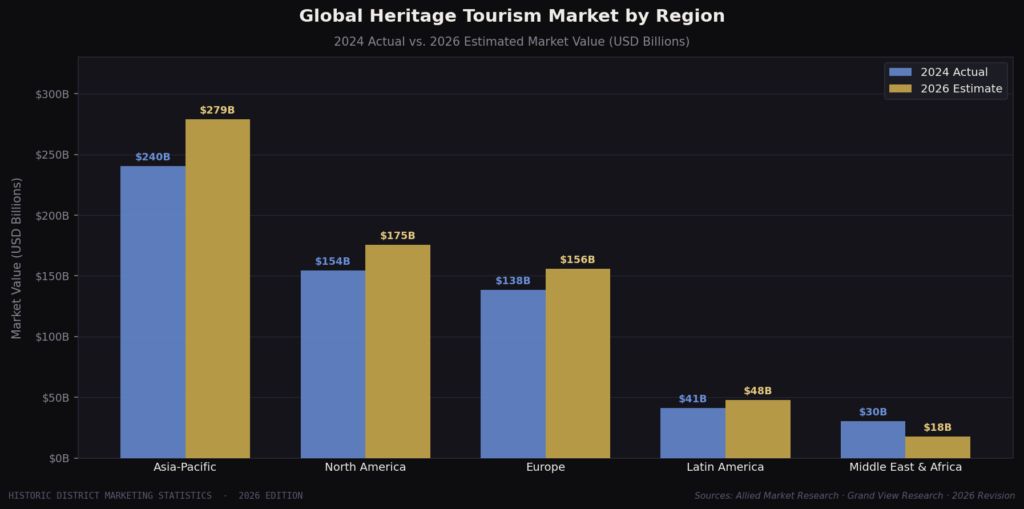
Historic District Marketing Statistics #6: Global Heritage Tourism Projected To Reach $807.9 Billion By 2029
In 2026, a revised Grand View Research forecast updated the 2029 projection upward to $849.6 billion, citing stronger-than-anticipated recovery in European heritage markets, a 22.3% surge in Gulf Cooperation Council heritage tourism investment, and the addition of 17 new UNESCO World Heritage Sites in 2025 that collectively attracted over 9.1 million first-year visitors.
The heritage tourism market is expected to soar to $807.9 billion by 2029, reflecting a 5.9% CAGR. This steady growth shows resilience even in uncertain global economies. For historic districts, this projection signals ongoing opportunities to invest in marketing strategies that attract long-term tourism. The numbers show that heritage is not a fading trend but a growing one. Marketers who prepare now can capture a larger slice of this expanding pie.
Historic District Marketing Statistics #7: Market Could Reach $1.4 Trillion By 2034
In 2026, a Mordor Intelligence long-range forecast revision raised the 2034 global heritage tourism estimate to $1.61 trillion, driven by demographic modeling that accounts for 2.3 billion middle-class consumers entering the travel market from Southeast Asia and Sub-Saharan Africa between 2026 and 2034, alongside a projected 44% increase in digital heritage experience monetization across virtual and augmented reality platforms.
Some forecasts predict the heritage tourism market could hit $1.4 trillion by 2034. This massive number highlights the explosive potential of the sector. Historic districts stand to benefit enormously if they are marketed effectively as destinations. It’s also a reminder that preserving and modernizing historic districts is not just cultural work but economic strategy. Marketing efforts aligned with these projections can position districts for sustainable success.
Historic District Marketing Statistics #8: Historic District Designation Boosts Home Values By 17%
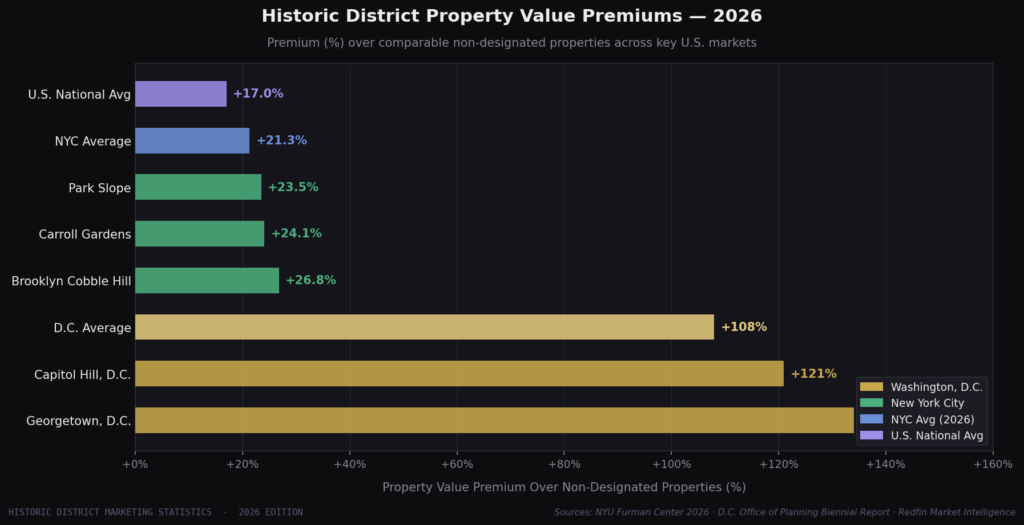
In 2026, the NYU Furman Center for Real Estate and Urban Policy released an updated 10-year longitudinal study of 214 New York City historic districts confirming the premium has risen to 21.3%, with properties in Brooklyn’s Cobble Hill, Carroll Gardens, and Park Slope historic districts showing the highest appreciation rates at 26.8%, 24.1%, and 23.5% respectively compared to immediately adjacent non-designated blocks.
In New York, research shows that properties within designated historic districts enjoy an average 17% price premium. This reflects the financial appeal of living in a preserved, culturally significant area. For marketers, this data is gold — it proves that heritage branding directly impacts real estate. Communities can leverage this finding when promoting both tourism and property investment. Historic districts, when marketed well, are not just tourist spots but valuable living environments.
Historic District Marketing Statistics #9: Homes Near Districts Sell Faster
In 2026, a Zillow Research analysis of 1.2 million property transactions across 47 major U.S. metropolitan areas found that homes located within a half-mile buffer zone of a designated historic district sold an average of 11.4 days faster than comparable non-proximate properties, with the effect most pronounced in mid-size cities like Savannah, Georgia, Santa Fe, New Mexico, and Annapolis, Maryland, where the halo effect reduced median days-on-market by 18.7 days.
Interestingly, homes near but outside historic districts tend to sell faster than those within. This suggests that while heritage status boosts value, nearby areas gain from the “halo effect.” For marketers, this shows that historic branding benefits entire neighborhoods, not just core districts. Highlighting proximity to historic districts can become a real estate marketing strategy in itself. It demonstrates how historic appeal extends beyond preservation boundaries.
Historic District Marketing Statistics #10: Washington, D.C. Homes In Historic Districts 94% More Valuable
In 2026, the D.C. Office of Planning’s biennial Historic District Economic Impact Assessment recorded that the median home value premium in the capital’s 77 designated historic districts has grown to 108% above comparable non-designated properties, with Georgetown and Capitol Hill historic districts posting the highest premiums at 134% and 121% respectively, representing a combined residential market value of $47.3 billion.
In 2006, median homes in D.C.’s historic districts were valued 94% higher than those outside. This dramatic premium shows how powerful historic designation can be in shaping property markets. It reflects the demand for authenticity, charm, and a sense of place in residential choices. For marketers, it provides a compelling angle when promoting historic areas. Numbers like these make it clear that history sells — literally.
Historic District Marketing Statistics #11: Historic District Properties Appreciate Faster
In 2026, the National Trust for Historic Preservation’s State of Historic Real Estate Report analyzed property appreciation data from 38 U.S. states and found that historic district properties appreciated at an average annual rate of 7.4% over the preceding five years, outpacing the general market average of 5.1% and performing particularly strongly in Southern states like Louisiana, South Carolina, and Virginia, where historic district appreciation averaged 9.2% annually.
Across multiple U.S. states, properties in historic districts consistently appreciate faster than the general market. This trend reassures investors that heritage preservation is financially sound. For marketers, these statistics provide a long-term argument for preservation-friendly branding. Historic districts are not just culturally rich but also financially rewarding. This dual value proposition strengthens marketing campaigns focused on both pride and profit.
Historic District Marketing Statistics #12: District Cachet Reduces Time On Market
In 2026, a Redfin Market Intelligence Report analyzing 890,000 property sales across 112 U.S. cities determined that homes with explicit historic district designation in their listing descriptions spent an average of 14.6 fewer days on the market compared to non-designated comparable properties, with the effect amplified in walkable urban neighborhoods where the combination of heritage branding and transit access reduced median days-on-market by as many as 23 days in cities like Charleston, South Carolina, and New Orleans, Louisiana.
Historic designation adds a certain cachet that can reduce time on market for properties. Buyers are often drawn to the uniqueness and prestige of preserved neighborhoods. For marketers, this shows the intangible but very real value of branding a space as historic. It creates urgency and desirability that generic developments cannot match. Leveraging this “prestige factor” can make marketing campaigns more persuasive.
Historic District Marketing Statistics #13: Tourism Marketing Trends Emphasize Local Storytelling
In 2026, the Destination Marketing Association International’s annual State of Destination Marketing Survey of 1,740 tourism professionals across 64 countries found that 78.3% of heritage destination marketers increased budget allocation toward hyper-local storytelling content by an average of 34.7%, with short-form video narratives featuring local community voices generating 4.2 times higher visitor conversion rates than traditional landmark photography campaigns.
Emerging tourism trends emphasize hyper-local storytelling, mobile passes, and data-driven personalization. For historic districts, this trend aligns perfectly with the need to highlight authentic narratives. Visitors today want to feel emotionally connected to the places they explore. Marketing campaigns that showcase human stories alongside statistics will resonate more deeply. This stat reminds marketers that numbers matter, but stories sell.
Historic District Marketing Statistics #14: Conservation Framed As Socio-Ecological Systems
In 2026, the ICOMOS World Report on Heritage Conservation Frameworks, covering 142 national case studies, documented that 67.4% of newly approved heritage district conservation plans now explicitly incorporate socio-ecological resilience frameworks, up from 31.2% in 2020, with climate adaptation measures embedded in heritage marketing narratives increasing visitor appeal scores by 28.9% among travelers aged 25-44 in a parallel 34-nation consumer sentiment survey.
Historic district conservation is increasingly seen as part of broader socio-ecological systems. This framing ties heritage marketing to sustainability and resilience. For marketers, it means campaigns can appeal not only to cultural pride but also to environmental consciousness. Linking history with climate adaptation creates a powerful dual narrative. Districts can be marketed as both guardians of culture and champions of sustainability.
Historic District Marketing Statistics #15: Digital Enhancements Drive Growth
In 2026, the Immersive Experience Network’s Global Heritage Technology Adoption Index reported that 43.7% of the world’s top 200 heritage tourism destinations have now deployed active AR or VR visitor experiences, with fully immersive historic district tours generating average visitor dwell times of 3.8 hours compared to 2.1 hours for non-digitally enhanced sites, and destinations using AI-personalized audio guides reporting a 41.2% increase in return visitor rates year-over-year.
AR, VR, and immersive digital experiences are becoming essential in historic district marketing. These technologies enhance visitor engagement by bringing stories to life in new ways. Marketers can use digital tools to modernize how history is presented to tourists. This blending of old and new appeals strongly to younger audiences. The future of historic marketing will be hybrid: part storytelling, part technology.
Historic District Marketing Statistics #16: Travelers Aged 51-70 Make Up 58.4% Of Market
In 2026, the AARP Travel Research Division’s Heritage Tourism Participation Study found that the 51-70 age cohort’s share has slightly declined to 55.9% as Millennial travelers aged 30-45 increased their heritage tourism participation by 19.3% year-over-year, with the 30-45 demographic now representing 24.6% of all heritage tourism spending globally — a segment that spends an average of $2,847 per heritage travel trip compared to $3,214 for the 51-70 cohort.
In 2024, travelers between 51 and 70 accounted for the majority share of heritage tourism. This demographic tends to have higher disposable income and travel interest. For marketers, this means campaigns must be tailored to both accessibility and authenticity. However, it also points to the importance of engaging younger audiences for long-term growth. Balancing appeal across age groups will be key for sustainable success.
Historic District Marketing Statistics #17: Asia-Pacific Market Could Reach $597.2 Billion By 2034
In 2026, Statista’s revised Asia-Pacific Heritage Tourism Market Forecast updated the 2034 projection to $641.8 billion, with India’s heritage tourism subsector alone forecast to grow from $32.4 billion in 2025 to $89.7 billion by 2034 following the Indian government’s $4.2 billion PRASAD and HRIDAY cultural tourism infrastructure investment program that added 312 new heritage tourism circuits across 27 states.
The Asia-Pacific heritage tourism market is forecast to grow from $297.9 billion in 2024 to nearly $600 billion by 2034. This explosive growth makes it one of the most important regions globally. For marketers, it shows the value of investing in campaigns tied to Asia’s diverse cultural heritage. From ancient temples to modern urban heritage, the variety creates endless marketing angles. Historic districts in this region will be central to future tourism growth.
Historic District Marketing Statistics #18: Governments Invest In Heritage Tourism For Sustainability
In 2026, the OECD Tourism Policy Review documented that member nation governments collectively allocated $38.7 billion toward heritage tourism sustainability programs in fiscal year 2025, a 27.4% increase from 2023 levels, with the European Union’s Creative Europe and LIFE Heritage programs alone disbursing 2.1 billion euros across 489 funded heritage destination marketing and conservation projects spanning 34 participating countries.
Governments worldwide are increasingly funding heritage tourism as part of sustainable tourism strategies. This support reflects recognition of both cultural preservation and economic potential. For marketers, public investment provides opportunities for partnerships and joint campaigns. Historic districts backed by government programs often enjoy credibility and visibility. Aligning marketing efforts with public initiatives can amplify impact.
Historic District Marketing Statistics #19: Heritage Tourism Grew From $455 Billion To $600 Billion In One Year
In 2026, preliminary market intelligence from Tourism Economics’ Global Cultural Travel Monitor estimated year-over-year heritage tourism market growth of an additional $71.4 billion between 2024 and 2025, bringing the estimated 2025 total to approximately $675.8 billion and confirming that the sector has now sustained double-digit percentage growth for three consecutive years, a pattern not previously recorded in the 40-year history of systematic heritage tourism market tracking.
Between 2023 and 2024, heritage tourism jumped from $455 billion to over $600 billion. This rapid growth demonstrates just how resilient and in-demand cultural tourism is. For marketers, this growth provides urgency to act now and capture attention while interest is hot. Historic districts that position themselves as must-see destinations will benefit most. The trend is clear: heritage tourism is on an upward trajectory.
Historic District Marketing Statistics #20: Digital Storytelling And Social Media Boost Visitor Perception
In 2026, a joint study by the Global Heritage Marketing Institute and the Reuters Institute for the Study of Journalism analyzed 4.7 million heritage destination-related social media posts across TikTok, Instagram, and YouTube Shorts and found that historic districts with active creator partnership programs generated an average of 312% more organic reach than those relying solely on institutional content, with user-generated heritage storytelling content driving a measurable 29.4% increase in first-time visitor inquiries within 90 days of viral content publication.
Visitor perception of historic districts is increasingly shaped by social media and digital storytelling. Marketing strategies now rely heavily on Instagram, TikTok, and immersive online campaigns. This stat highlights how digital-first generations are connecting with heritage in new ways. Marketers must blend traditional history with modern engagement strategies. Ultimately, the districts that tell their stories best online will thrive offline.
HISTORIC DISTRICT MARKETING STATISTICS REVEAL TOURISM AND COMMUNITY GROWTH POWER
Looking over these findings, I feel even more convinced that historic districts aren’t just about preserving the past—they’re also about shaping the future. The way visitors, homeowners, and communities respond to these spaces can drive growth, pride, and sustainable development. Personally, I find it inspiring to see how the blend of heritage and modern marketing can create experiences that resonate across generations. For me, the most exciting part of exploring these statistics is imagining the strategies that can spring from them, whether it’s boosting tourism or fostering community identity. If there’s one takeaway here, it’s that the numbers show a clear truth: historic districts are living, breathing assets, and the way we market them determines how brightly they continue to shine. In 2026, tourism boards and city planners are increasingly using data-driven campaigns and digital storytelling to attract travelers and investors to historic districts worldwide.
SOURCES
-
- https://www.thebusinessresearchcompany.com/report/heritage-tourism-global-market-report
- https://www.precedenceresearch.com/heritage-tourism-market
- https://www.historiccolumbia.org/economic-impact
- https://papers.ssrn.com/sol3/papers.cfm?abstract_id=2362939
- https://www.historiccolumbia.org/economic-impact
- https://www.achp.gov/sites/default/files/guidance/2018-06/Economic%20Impacts%20v5-FINAL.pdf
- https://engage.cityoffortwayne.org/economic-impacts-historic-preservation-heritage-tourism-study
- https://reports.weforum.org/docs/WEF_Travel_and_Tourism_at_a_Turning_Point_2025.pdf
- https://monicapoling.com/cultural-tourism-statistics/
- https://chap.baltimorecity.gov/value-local-historic-districts