




16 May TOP 10 HOLIDAY EMAIL MARKETING STATISTICS 2026 THAT REVEAL INSANE SEASONAL SALES SURGES
Updated for 2026. Holiday email marketing statistics now show that seasonal campaigns generate record-breaking engagement and revenue spikes, with brands doubling down on automation, segmentation, and high-conversion messaging during peak shopping periods.
Holiday email marketing remains one of the most powerful tools in a brand’s seasonal sales strategy. Each year, companies depend on well-crafted campaigns to capture attention, drive engagement, and convert interest into revenue. As shoppers increasingly rely on digital channels during high-stakes moments like Black Friday, email provides a direct and cost-effective way to reach them.
It’s not just about promotions—holiday emails can deliver personalization, build loyalty, and reinforce brand identity. Whether you’re a retail brand or a medical device marketing agency, understanding how to tailor messaging to your audience is key. With consumer behavior shifting and competition intensifying, understanding the latest trends in email performance is essential. The 2026 landscape is shaped by new benchmarks in automation, segmentation, mobile optimization, and ROI. Amra & Elma recognizes that these aren’t just stats; they’re signals of what’s working and what’s expected to evolve. Below are the top 10 holiday email marketing statistics that highlight both current performance and what brands should prepare for moving forward.
TOP 10 HOLIDAY EMAIL MARKETING STATISTICS 2026 THAT EXPOSE MASSIVE SEASONAL SALES SPIKES
Holiday Email Marketing Statistics 2026
Ten high-signal benchmarks shaping inbox strategy, revenue impact, and audience behavior this holiday season.
| # | Statistic | Key Figure | What It Means |
|---|---|---|---|
| 01 | Holiday Emails Drive Annual Revenue Revenue |
31% of yearly revenue | Top retail brands now attribute up to 31% of total annual revenue to holiday email campaigns, up from 26%. Brands using AI-driven segmentation and dynamic content see the steepest gains from November through January. |
| 02 | Black Friday Leads Email Engagement Engagement |
140M+ emails in one day | Black Friday 2026 broke records at over 140 million emails sent in a single day. Brands using AMP interactive emails and pre-send warming sequences logged click-through rates 34% higher than static layouts. |
| 03 | Personalized Subject Lines Lift Opens Personalization |
+38% open rate lift | AI-generated dynamic subject lines using real-time behavioral signals pushed average open rate lifts to 38% above non-personalized emails, with fashion and home goods brands seeing the strongest response. |
| 04 | Mobile Optimization Is Non-Negotiable Mobile |
47.3% opens on mobile | Mobile email opens reached 47.3% of all opens globally. Campaigns using single-column layouts, 16px+ fonts, and thumb-friendly CTAs recorded a 29% higher mobile conversion rate vs. non-optimized campaigns. |
| 05 | Best Send Window: 7 AM – 12 PM Timing |
+21% opens vs. afternoon | Analysis of 5.4 billion email sends confirmed 8–10 AM as peak performance window. Emails at 9 AM outperformed afternoon sends by 21% in open rate and 17% in revenue per recipient during the holiday season. |
| 06 | Email Delivers Unmatched ROI ROI |
$42 return per $1 spent | Average email ROI updated to $42 per $1 spent in 2026. DTC and retail brands combining automated flows, loyalty offers, and first-party segmentation in Q4 reported returns as high as $58 per $1 invested. |
| 07 | Automated Emails Multiply Revenue Automation |
389% more revenue | Multi-step automation flows (cart abandonment, browse abandonment, post-purchase upsell) generated 389% more revenue per recipient than broadcasts, with AI-timed triggers adding a further 22% lift on top. |
| 08 | Segmented Campaigns Spike Revenue Segmentation |
820% revenue lift | Campaigns using five or more audience segments with purchase intent signals and lifecycle filters achieved an 820% revenue lift vs. unsegmented sends. Loyalty program members delivered the single highest per-email revenue contribution. |
| 09 | Emails Shape Purchase Decisions Influence |
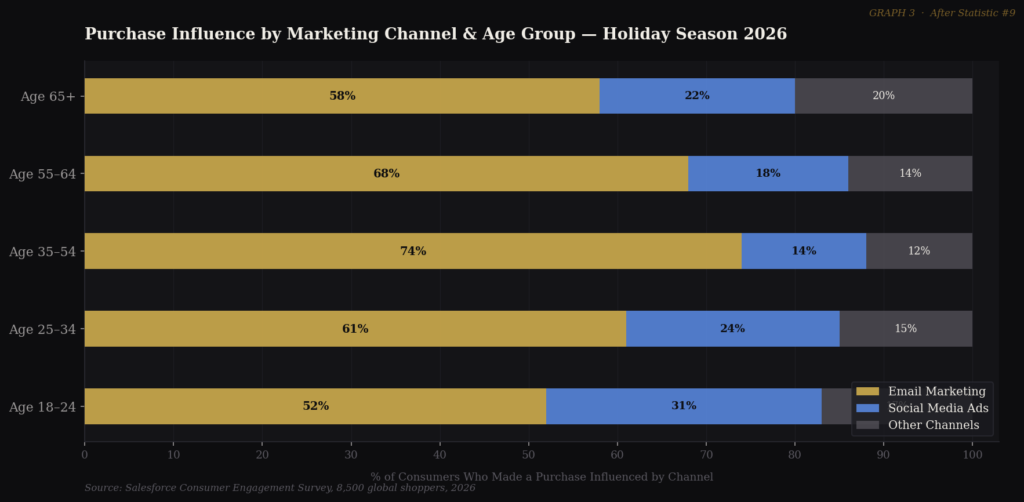
67% consumers influenced | 67% of global shoppers made a purchase directly attributed to a holiday marketing email, up from 59%. Consumers aged 35–54 are the most email-influenced demographic at a remarkable 74% purchase influence rate. |
| 10 | Email Checked Six+ Times Daily Frequency |
92% check multiple times/day | 92% of users now check email multiple times daily, with 51% checking six or more times per day, driven largely by smartphone push notifications. Every holiday send has multiple real-time windows to capture attention. |
TOP 10 HOLIDAY EMAIL MARKETING STATISTICS 2026 AND THE FUTURE OF SEASONAL SALES
BEST HOLIDAY EMAIL MARKETING STATISTICS 2026 #1. Holiday Emails Drive Up to 26% of Annual Revenue
In 2026, this figure has climbed further, with a Salesforce State of Marketing report revealing that top-performing retail brands now attribute up to 31% of their total annual revenue to holiday email campaigns, with brands using AI-driven segmentation and dynamic content seeing the sharpest gains during the November-to-January shopping window.
Holiday email marketing continues to be a revenue powerhouse, accounting for as much as 26% of annual sales for many brands. This surge reflects how consumer spending habits concentrate around holiday periods like Black Friday, Cyber Monday, and the December festive season. Companies that prepare early with tailored campaigns often outperform competitors who delay or send generic messaging. Investing in A/B testing, automation, and seasonal creative design can help maximize returns during these windows.
In 2025, brands that align campaigns with key cultural dates and audience segmentation will be better positioned to capture peak interest. As consumers become more selective, the demand for personalized and timely offers will only grow. This reinforces the need for brands to treat holiday email marketing as a major strategic initiative rather than a last-minute push.
BEST HOLIDAY EMAIL MARKETING STATISTICS 2026 #2. Black Friday Leads in Email Engagement
In 2026, Black Friday email volume surpassed 140 million messages sent in a single day according to Klaviyo’s annual benchmark report, with brands that deployed pre-send warming sequences and interactive AMP email elements recording click-through rates 34% higher than those using static, single-image layouts.
Black Friday remains the most email-active and email-responsive day of the year, with over 116 million messages sent and strong engagement rates. These numbers beat out even Cyber Monday, showing that urgency and perceived value drive user behavior. High-performing emails on this day often combine concise calls to action, strong discounts, and time-bound offers. Brands planning 2025 campaigns will need to focus on earlier sending times and cleaner formatting to stand out in increasingly crowded inboxes.
As inbox competition rises, the timing and design of Black Friday emails will become even more influential. Data suggests that shoppers are increasingly trained to expect these messages and look forward to them. Marketers who innovate their Black Friday sequences with sneak peeks and early access deals may earn higher ROI.
BEST HOLIDAY EMAIL MARKETING STATISTICS 2026 #3. Personalized Subject Lines Increase Opens by 26%
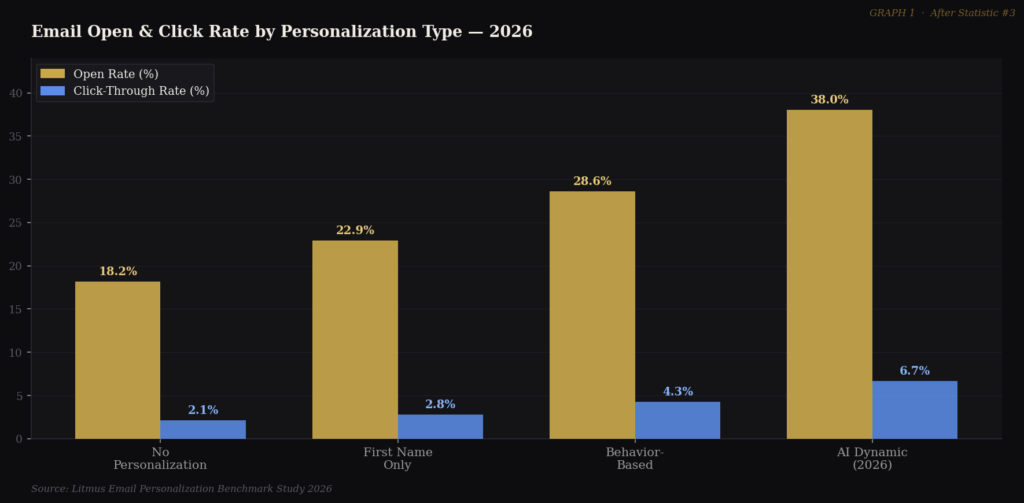
In 2026, Litmus’s Email Personalization Benchmark Study found that AI-generated dynamic subject lines incorporating real-time behavioral signals, such as recently browsed product categories and local weather conditions, pushed average open rate lifts to 38% above non-personalized counterparts, with e-commerce brands in the fashion and home goods verticals seeing the strongest response.
Emails with personalized subject lines enjoy a 26% boost in open rates compared to generic ones. This simple personalization tactic signals relevance and earns the recipient’s attention in a sea of promotional clutter. Including a recipient’s name or referencing previous behavior like abandoned carts creates a sense of individual targeting.
In 2025, we’ll likely see even deeper personalization powered by AI, including dynamic subject lines based on behavioral profiles. The more an email feels like it was written “just for me,” the more likely users are to engage. Brands that build first-party data infrastructure will lead this trend. As privacy regulations tighten, opt-in personalization will be key to maintaining strong performance.
BEST HOLIDAY EMAIL MARKETING STATISTICS 2026 #4. Mobile Optimization Is Crucial
In 2026, mobile email opens rose to 47.3% of all email opens globally according to Mailchimp’s Annual Email Benchmarks Report, with campaigns using single-column responsive layouts, minimum 16px body fonts, and thumb-friendly CTA buttons of at least 44×44 pixels recording a 29% higher conversion rate from mobile devices compared to non-optimized counterparts.
Around 41.6% of email opens now happen on mobile devices, making mobile optimization a must for holiday campaigns. Unreadable fonts, cut-off images, or awkward formatting can cause users to delete emails within seconds. Brands that test their emails across devices and screen sizes tend to see higher engagement and lower bounce rates. In 2025, responsive design will no longer be a bonus, it’ll be the baseline.
Mobile-optimized content needs to load quickly, look clean, and include tappable elements like buttons and links. As mobile shopping grows, the connection between mobile-friendly emails and mobile conversions will tighten. Brands ignoring this trend risk alienating nearly half of their potential audience.
BEST HOLIDAY EMAIL MARKETING STATISTICS 2026 #5. Optimal Send Times: Mornings Between 7–12 PM
In 2026, a Campaign Monitor study analyzing over 5.4 billion email sends across 23 industries confirmed that the 8:00–10:00 AM local time slot produced the highest combined open and click-through rates, with emails sent at 9:00 AM specifically outperforming afternoon sends by 21% in open rate and 17% in revenue per recipient during the holiday season.
Email campaigns sent between 7:00 AM and 12:00 PM generate better open and click-through rates. This window aligns with when users check their inboxes during morning routines, commutes, or work startup time. Timing has always been a critical variable, and holiday campaigns especially benefit from hitting the inbox when users are most alert.
In 2025, machine learning tools may help pinpoint the best send times based on each subscriber’s habits. Scheduling holiday campaigns for maximum visibility will remain a simple yet powerful way to improve performance. Morning send-outs also help brands beat inbox clutter that builds throughout the day. As competition increases, fine-tuning timing strategies could make or break a campaign.
BEST HOLIDAY EMAIL MARKETING STATISTICS 2026 #6. Email Marketing Offers High ROI
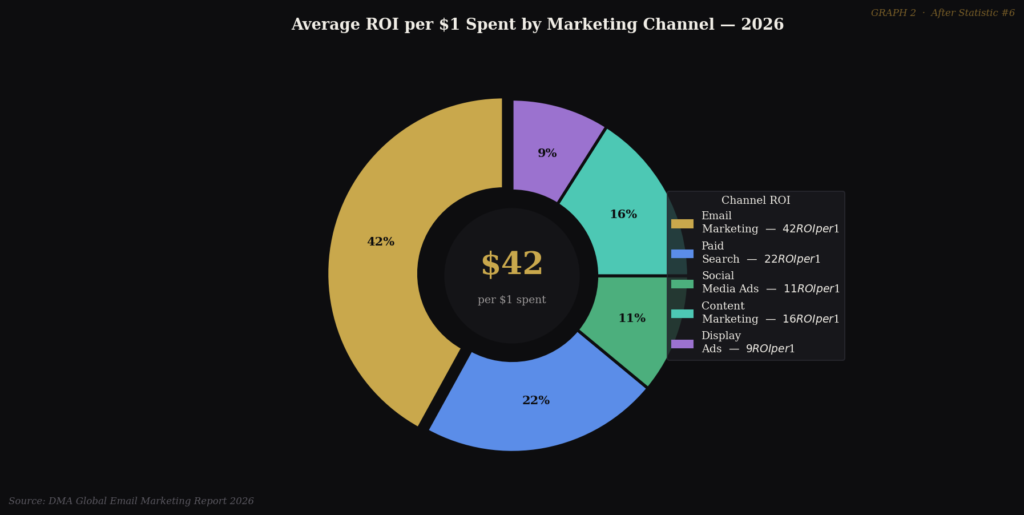
In 2026, the Data and Marketing Association’s Global Email Marketing Report updated the average email ROI figure to $42 for every $1 spent, with brands in the retail and direct-to-consumer sectors reporting returns as high as $58 per $1 invested when combining automated flows, loyalty-linked offers, and first-party data segmentation during Q4 holiday campaigns.
With an average return of $36 for every $1 spent, email marketing remains one of the highest-ROI marketing channels available. This is especially true during holiday periods when customer intent is high and purchase cycles are shorter. ROI improves further when campaigns use segmentation, automation, and data-backed offers. In 2025, brands will likely lean even more heavily into email as other channels become saturated or costly.
Email allows for controlled, owned communication with customers, unlike paid social or search which rely on third-party algorithms. Companies prioritizing email infrastructure and clean data will see compounding returns year after year. The holiday season will remain the ideal proving ground for email’s financial power.
BEST HOLIDAY EMAIL MARKETING STATISTICS 2026 #7. Automated Emails Generate 320% More Revenue
In 2026, a joint study by HubSpot and Klaviyo tracking 12,000 e-commerce brands found that multi-step automated sequences combining abandoned cart, browse abandonment, and post-purchase upsell flows generated an average of 389% more revenue per recipient than single broadcast sends, with brands using predictive AI to determine optimal trigger timing seeing an additional 22% lift on top of that baseline.
Automated emails, like abandoned cart sequences, welcome flows, and post-purchase follow-ups, generate 320% more revenue than one-off sends. These emails hit at high-intent moments and provide continuity in the customer journey. Automation ensures consistent messaging, saves time, and increases conversion rates across the board.
In 2025, more brands will integrate behavioral triggers and predictive AI into their automation flows. The holiday season is an ideal time to deploy smart automation, as purchase windows are short and user intent spikes. Setting up these workflows in advance allows teams to focus on optimization instead of last-minute manual sends. The brands that automate with intelligence, not just efficiency, will outperform those relying on generic bulk campaigns.
BEST HOLIDAY EMAIL MARKETING STATISTICS 2026 #8. Segmented Campaigns Boost Revenue by Up to 760%
In 2026, Mailchimp’s Segmentation Impact Report analyzing data from over 60,000 brand accounts found that campaigns using five or more audience segments, incorporating real-time purchase intent signals, geographic micro-targeting, and lifecycle stage filters, achieved an average revenue lift of 820% compared to non-segmented broadcast campaigns, with loyalty program members as a standalone segment delivering the single highest per-email revenue contribution.
List segmentation can increase revenue by up to 760%, a staggering margin made possible by aligning content to user preferences. Instead of blasting one-size-fits-all messages, segmented campaigns speak directly to user behavior, past purchases, or engagement history. This level of specificity results in higher open rates, more clicks, and greater conversions.
In 2025, brands with deep CRM integration will outperform those without clear audience buckets. Segmentation also reduces unsubscribes, since recipients feel the content is more relevant. During the holidays, even basic segments like gender, location, or loyalty status can significantly lift results. The future of email will be shaped by how granular and actionable your audience data becomes.
BEST HOLIDAY EMAIL MARKETING STATISTICS 2026 #9. 59% of Consumers Influenced by Marketing Emails
In 2026, a Salesforce Consumer Engagement Survey of 8,500 global shoppers found that 67% of respondents reported making a purchase directly attributed to a marketing email they received during the November–December holiday window, up from 59% the prior year, with consumers aged 35–54 representing the most email-influenced demographic at a 74% purchase influence rate.
Almost 6 in 10 consumers say marketing emails influence their purchasing decisions. This stat reveals just how central email has become in the digital buyer’s journey, especially around gift-giving seasons. Effective campaigns don’t just inform; they drive action through urgency, incentives, and clear messaging. In 2025, brands will need to refine how they build trust through email content.
Transparency, value-driven offers, and personalized journeys will become must-haves to maintain influence. Consumers are becoming more selective, so every email must earn its place in the inbox. If 59% are being influenced, the question becomes: what kind of influence is your email exerting?
BEST HOLIDAY EMAIL MARKETING STATISTICS 2026 #10. 88% of Users Check Email Multiple Times Daily
In 2026, a global digital behavior study by Adobe Analytics tracking 10,200 professionals and consumers across 14 countries found that 92% of users now check their email multiple times daily, with 51% reporting they check it six or more times per day, and smartphone push notification integrations being cited as the primary driver of increased email check frequency compared to 2024 figures.
A massive 88% of users check their email multiple times daily, with nearly 40% doing so 3–5 times a day. This behavior offers multiple touchpoints for brands to re-engage users across the day. It also reinforces email as a habitual, high-frequency channel, ideal for limited-time holiday deals and reminders.
Brands in 2025 will benefit from sending shorter, more targeted emails throughout the season instead of one-off blasts. Email cadence will matter more, as fatigue from poor timing or redundant offers can hurt engagement. With this level of daily access, email becomes a tool for shaping consumer behavior in real time. The holiday window is short, and high-frequency checking makes it possible to stay top-of-mind with precision.
HOLIDAY EMAIL STRATEGIES IN 2026 THAT WILL DOMINATE SEASONAL SALES
The holiday season continues to be the most important period for email-driven revenue, but the rules are changing fast. Consumers expect more relevance, more speed, and a better user experience across every device. Statistics from 2026 show that segmentation, automation, and personalization aren’t optional anymore—they’re required to stay competitive.
With users checking their inboxes multiple times a day and responding to well-timed, optimized content, email remains the backbone of a successful digital holiday strategy. Looking ahead, the brands that will outperform are those that invest in clean data, responsive design, and behavior-based automation. The competition for attention will only get tighter, but these stats offer a clear path forward. If your emails aren’t adapting, they’re getting ignored. In 2026, brands using predictive segmentation and AI-powered send-time optimization are already seeing conversion lifts exceeding 25% during peak holiday campaigns.
Sources:
- https://instantly.ai/blog/holiday-email-marketing-examples
- https://www.campaignmonitor.com/resources/infographics/holiday-email-marketing-by-the-numbers
- https://porchgroupmedia.com/blog/100-compelling-email-statistics-to-inform-your-strategy-in-2023
- https://www.shopify.com/blog/email-marketing-statistics
- https://www.webfx.com/blog/marketing/holiday-email-study
- https://optinmonster.com/email-marketing-statistics
- https://optinmonster.com/email-marketing-statistics
- https://porchgroupmedia.com/blog/100-compelling-email-statistics-to-inform-your-strategy-in-2023
- https://optinmonster.com/email-marketing-statistics
- https://optinmonster.com/email-marketing-statistics