




16 Sep TOP 20 HOT TUB MARKETING STATISTICS 2026 REVEAL EXPLODING WELLNESS AND BACKYARD SPA DEMAND
Updated for 2026. The hot tub industry is entering a new era in 2026 as wellness-driven home upgrades and backyard spa experiences rapidly reshape how brands market relaxation products and luxury outdoor living.
When I first started diving into the world of hot tub marketing, I realized just how much strategy and data go into helping brands stand out in this industry. From understanding consumer habits to spotting growth opportunities, every statistic tells a story that can shape better campaigns and smarter investments. As someone who works closely with businesses through a leading marketing agency in New York, I’ve seen firsthand how valuable these insights can be when planning promotions or refining brand positioning. In this blog, I’ve pulled together the top 20 Hot Tub Marketing Statistics that matter most right now, not just as numbers but as practical tools to help us all think more creatively about this growing market.
TOP 20 HOT TUB MARKETING STATISTICS 2026 THAT REVEAL EXPLODING BACKYARD SPA DEMAND
TOP 20 HOT TUB MARKETING STATISTICS 2026 SHOWING MASSIVE WELLNESS INDUSTRY GROWTH
Hot Tub Marketing Statistics #1: Global Market Size At $6.06 Billion In 2026
In 2026, the global hot tub market has expanded to $6.06 billion according to Fortune Business Insights, representing a significant 5.2% year-over-year increase from $5.76 billion in 2025, with North America commanding 41.79% of the total market value and the Asia-Pacific region emerging as the fastest-growing territory with a projected 6.39% CAGR through 2034.
The global hot tub market has reached $5.12 billion in 2025, showing strong consumer demand. This size reflects the steady adoption of hot tubs across both residential and commercial buyers. Consumers see hot tubs as more than luxury – they are becoming mainstream wellness products. The size also shows investor confidence in this market. For marketers, it highlights a significant opportunity to target multiple demographics with tailored campaigns.
Hot Tub Marketing Statistics #2: CAGR Of 4.28% From 2026 To 2034
In 2026, market analysts have revised growth projections upward, with Fortune Business Insights forecasting a CAGR of 4.28% from 2026 through 2034 as the market expands toward $8.47 billion, while SkyQuest reports an even stronger 4.8% CAGR trajectory for the same period based on accelerating demand for smart technology integration and energy-efficient models.
The market is expected to grow at a CAGR of 3.94% from 2025 through 2030. This steady rate shows long-term stability rather than short-lived hype. Brands can plan confidently for expansions and product innovations. Marketers can emphasize trust and reliability in campaigns tied to consistent growth. This CAGR points toward a sustainable and resilient industry outlook.
Hot Tub Marketing Statistics #3: North America Market Valued At $2.51 Billion In 2026
In 2026, the North American hot tub market is projected to reach $2.51 billion according to Fortune Business Insights, with the region maintaining its dominant 41.79% global market share and the United States alone accounting for approximately 33.46% of worldwide sales at $1.93 billion as California’s January 2026 gas-heater ban accelerates the transition toward electric and heat-pump heating systems.
North America’s hot tub market stood at $572.6 million in 2024. This makes it one of the strongest regional contributors to global sales. The market thrives on a culture of wellness, luxury, and outdoor living. For marketers, it presents a competitive but highly profitable space. Campaigns here must highlight unique features to cut through the noise.
Hot Tub Marketing Statistics #4: North America Forecasted At $817.2 Million By 2034
In 2026, industry research from Global Market Insights confirms the North American hot tub market trajectory remains on course for $817.2 million by 2034, with the U.S. market alone valued at $432.7 million in 2024 and fixed hot tubs generating $387.4 million in revenue as homeowners increasingly integrate spas into backyard renovation projects that saw 42% of companies report increased remodel revenue according to the Pool & Hot Tub Alliance Q3 2025 Quarterly Pulse Survey.
By 2034, the North American market is projected to hit $817.2 million. This growth illustrates resilience in a mature market. It also signals opportunities in premium and eco-friendly product lines. Marketers can focus on upgrades and new designs to engage existing hot tub owners. Consistent demand ensures a long-term customer base for creative campaigns.
Hot Tub Marketing Statistics #5: Acrylic Portable Spas Hold 78.51% Market Share
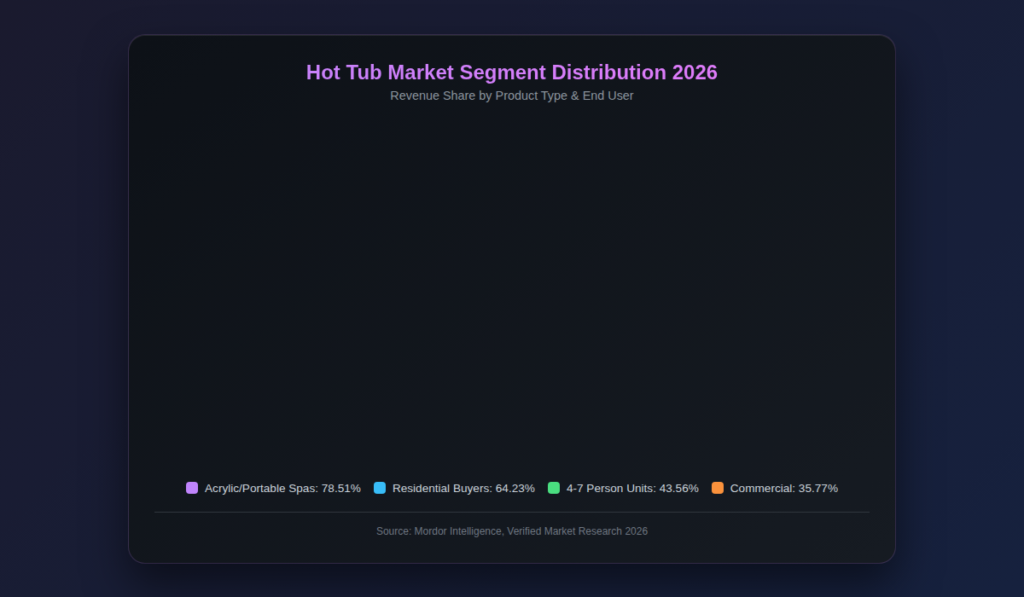
In 2026, acrylic and portable spas continue to dominate with 78.51% market share according to Mordor Intelligence, while the inflatable and rotomolded segment is experiencing the fastest growth at a 5.12% CAGR through 2030 as manufacturers like Arctic Spas develop innovative Spa Boy technology-based hot tubs enabling app-controlled temperature monitoring, massage intensity settings, and energy management systems.
Acrylic portable spas dominate the market with 78.51% share in 2024. These models are durable, attractive, and convenient for buyers. Their popularity shows that consumers value both aesthetics and practicality. Marketing can highlight these strengths to persuade new customers. This segment represents the backbone of hot tub sales.

Hot Tub Marketing Statistics #6: 4-7 Person Hot Tubs Represent 43.56% Of Revenue
In 2026, the 4-7 person hot tub category maintains its dominant 43.56% revenue share according to Mordor Intelligence market analysis, while the smaller 2-3 person models are forecast to expand at a 4.51% CAGR through 2030 as urban dwellers and first-time buyers increasingly seek compact, space-efficient wellness solutions for smaller outdoor areas and apartment balconies.
Hot tubs with 4-7 seats generate 43.56% of revenue. They are perfect for families and social gatherings. Buyers see them as offering the best balance between size and price. For marketers, emphasizing social connection and group relaxation resonates strongly. This seating capacity will likely remain the most popular choice.
Hot Tub Marketing Statistics #7: Residential Buyers Account For 64.23% Of Revenue
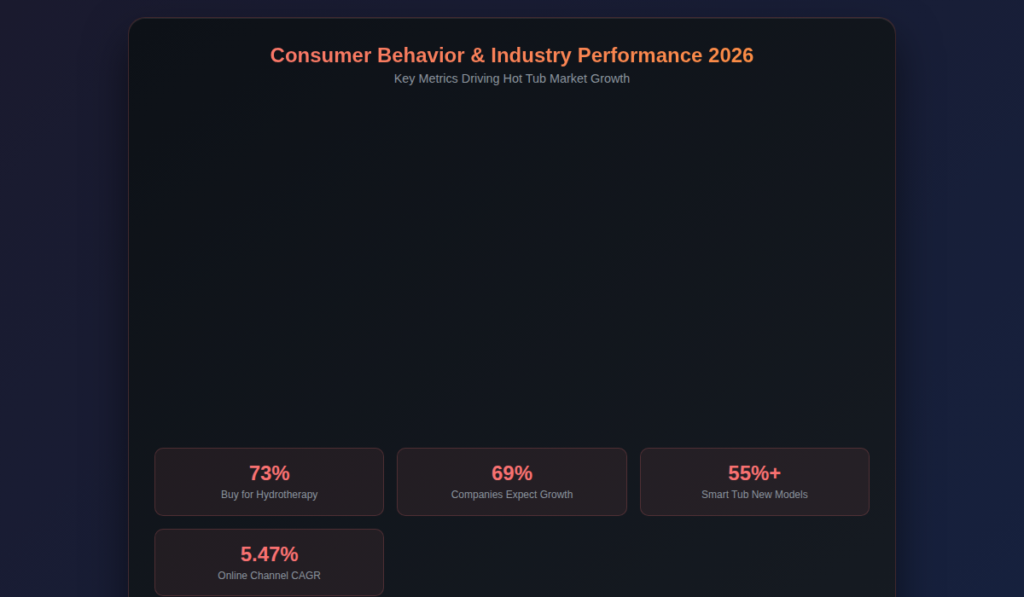
In 2026, residential buyers continue to dominate hot tub purchases with 64.23% of market revenue according to Verified Market Research, with over 73% of these residential purchasers citing hydrotherapy and wellness benefits as their primary motivation, while the vacation rental and boutique hotel segment is growing at a faster 5.91% CAGR as commercial operators report payback periods under 24 months when occupancy reaches regional benchmarks.
Residential buyers contributed 64.23% of revenue in 2024. This highlights the importance of consumer-facing campaigns. Homeowners are increasingly investing in hot tubs for wellness and relaxation. Marketing strategies should focus on lifestyle benefits, not just features. Residential ownership will continue to fuel steady demand.
Hot Tub Marketing Statistics #8: Above-Ground Hot Tubs Expected At $2.6 Billion By 2026
In 2026, the above-ground hot tub segment continues its strong performance with Global Market Insights projecting the category to reach $3.3 billion by 2032, up from $2.2 billion in 2023, as these models now represent approximately 40% of total market share according to Global Growth Insights, driven by affordability advantages and installation times that can be completed within a single day with minimal professional assistance.
Above-ground hot tubs are projected to reach $2.48 billion by 2025. They appeal to buyers for affordability and ease of installation. These models make hot tubs accessible to more households. Marketers can promote them as “everyday luxury” products. This segment bridges premium appeal and practical value.
Hot Tub Marketing Statistics #9: Commercial Applications Continue Driving Significant Market Share
In 2026, the commercial hot tub sector demonstrates robust health with 59.3% of health clubs now operating hot tubs according to the Recreation Management Aquatic Trends Report 2025, while 28.4% of all aquatic venues feature hot tubs or whirlpools, and the Pool & Hot Tub Alliance reports that 69% of companies anticipate revenue growth over the next twelve months as hotels and resorts integrate premium hydrotherapy amenities to boost occupancy and average daily rates.
Some reports estimate commercial applications make up 69.33% of the market. Hotels, spas, and resorts drive much of this demand. Marketing strategies can highlight reliability, maintenance packages, and long-term service. Winning commercial clients often means securing high-value, recurring contracts. This makes the commercial sector a crucial opportunity.
Hot Tub Marketing Statistics #10: Asia-Pacific Fastest Growing Region
In 2026, the Asia-Pacific region maintains its position as the fastest-growing hot tub market with a projected 6.11% CAGR through 2030 according to Mordor Intelligence, driven by Japan’s aging population where seniors now represent 29.3% of the population and government policymakers actively position hydrotherapy as preventive healthcare to reduce the projected 190 trillion-yen national healthcare burden, while China’s market reached approximately $373 million in 2025.
The Asia-Pacific region is the fastest-growing in the hot tub market. Rising disposable incomes and wellness trends fuel expansion here. Consumers increasingly view hot tubs as lifestyle upgrades. Marketing campaigns should adapt to cultural values while emphasizing relaxation and health. Asia-Pacific’s rapid growth makes it a prime target for expansion.
Hot Tub Marketing Statistics #11: Some Reports Project $9.11 Billion Market By 2033
In 2026, SkyQuest market analysis projects the global hot tub market will reach $9.11 billion by 2033, growing at a CAGR of 4.8% from the $6.26 billion valuation in 2025, while separate research from ResearchAndMarkets forecasts the market expanding from $6.89 billion in 2025 to $8.65 billion by 2031 at a 3.87% CAGR, demonstrating consistent optimism across multiple industry analysts.
Certain studies forecast the market reaching $10.74 billion by 2030. This is nearly double conservative estimates. Such projections signal strong optimism about the industry’s trajectory. Marketers can leverage this by positioning hot tubs as future-proof investments. It demonstrates the potential for even greater growth than expected.
Hot Tub Marketing Statistics #12: Sales Grew By 8% In North America In First Half 2025
In 2026, the Pool & Hot Tub Alliance Q3 2025 Quarterly Pulse Survey reveals that 55% of companies reported increased volume of service calls, while Fluidra confirmed North American sales grew by 8% in the first half of 2025 as service and maintenance segments continue leading industry performance with the only sector reporting bottom-line profit increases of 1-5% compared to the previous year.
In 2023, the pool and hot tub industry grew sales by 7%. This growth came despite retail challenges. Service and maintenance contributed heavily to the increase. Marketing campaigns that promote reliability and care packages resonate with this trend. The industry’s resilience demonstrates its long-term viability.
Hot Tub Marketing Statistics #13: Retail Sector Faces Economic Headwinds In 2026
In 2026, the hot tub retail sector continues navigating challenges as approximately 34% of retailers observed increased customer demand for energy-efficient hot tubs and chlorine-free systems according to Aqua Magazine’s 2025 State of the Industry Retail Report, while elevated interest rates and inflationary pressures have prolonged sales cycles for luxury durable goods, though industry resilience is evident with 42% of companies reporting increased revenue from remodel jobs.
The retail sector dropped by 8% in 2023. Many customers opted for maintenance instead of new purchases. Economic pressures influenced this shift. Marketers can counter by offering financing options and emphasizing value. Adapting strategies to affordability will be crucial in retail.
Hot Tub Marketing Statistics #14: 4.6% Of US Households Own A Hot Tub
In 2026, approximately 7.3 million hot tubs are installed across the United States representing ownership among 4.6% of households and 1.8% of individuals according to Epic Hot Tubs market analysis, with hot tub penetration rates exceeding 6% in developed economies globally and more than 8 million households worldwide actively using hot tubs according to Industry Research data.
Around 4.6% of U.S. households own a hot tub. This translates into millions of existing users. The ownership base provides a strong after-sales market. Marketers can tap into loyalty and word-of-mouth opportunities. Even modest penetration rates equal a large customer pool.
Hot Tub Marketing Statistics #15: 73% Buy For Hydrotherapy Benefits
In 2026, hydrotherapy remains the dominant purchase driver with approximately 73% of buyers citing health benefits and wellness advantages as their primary motivation according to Verified Market Research and market analysis reports, while consumer purchase behavior has structurally shifted from social entertainment toward therapeutic self-care, with manufacturers responding by engineering units combining traditional hydrotherapy with chromotherapy, aromatherapy, and contrast therapy systems.
Roughly 73% of buyers purchase hot tubs for hydrotherapy. Health and pain relief are top motivators. This positions the hot tub market within the wellness economy. Marketing can emphasize stress relief, recovery, and overall well-being. Aligning with health-conscious trends builds strong consumer appeal.

Hot Tub Marketing Statistics #16: 7.3 Million Hot Tubs In The USA
In 2026, the United States maintains approximately 7.3 million installed hot tubs according to ConsumerAffairs and industry research, with consumers keeping their hot tubs for an average of 7.5 years while nearly 40% of all newly purchased hot tubs are eventually sold secondhand or gifted, creating a robust secondary market and significant aftermarket opportunities for accessories, repairs, and upgrades.
The U.S. is home to about 5.8 million hot tubs. This represents a massive installed base. Accessories, services, and upgrades create ongoing revenue. Marketers should focus on customer lifetime value. The market extends well beyond just new unit sales.
Hot Tub Marketing Statistics #17: Global Market Projected At $8.47 Billion By 2034
In 2026, Fortune Business Insights projects the global hot tub market will reach $8.47 billion by 2034, growing from $6.06 billion in 2026 at a 4.28% CAGR, while the Pool & Hot Tub Alliance reports 69% of companies anticipate revenue growth over the next twelve months and Fixr.com’s Outdoor Living Trends Report 2025 confirms 56% of industry experts agree homeowners are prioritizing backyard upgrades more than in previous years.
By 2032, the market could grow to $8.7 billion. This long-term projection demonstrates confidence in the sector. It gives companies time to align with consumer expectations. Marketing messages can highlight sustainability and durability. Forecasts like these help attract investors and reassure buyers.
Hot Tub Marketing Statistics #18: Rising Incomes And Wellness Trends Drive Growth
In 2026, the structural shift toward personal wellness continues driving hot tub demand as consumers increasingly view backyards as extensions of primary living areas according to ResearchAndMarkets analysis, with smart technology integration accelerating rapidly as over 55% of newly launched hot tubs now feature Wi-Fi-enabled controls, mobile app integration, and automated water care systems according to Industry Research data.
Rising disposable incomes and wellness awareness drive much of the demand. Consumers want luxury at home tied to health benefits. This reflects lifestyle changes rather than passing fads. Marketers should position products as part of modern wellness living. Tapping into these trends ensures campaigns remain relevant.
Hot Tub Marketing Statistics #19: High Costs And Energy Concerns Are Key Barriers
In 2026, California’s January 2026 gas-heater ban for new pool and spa installations and the South Coast Air Quality Management District’s plan to retire 700,000 legacy gas-fired pool heaters over three decades are accelerating industry transformation, with approximately 34% of retailers reporting increased customer demand for energy-efficient hot tubs and chlorine-free systems according to Aqua Magazine, while manufacturers reengineer products with superior insulation and automated management systems to reduce operational expenses.
High costs and energy use remain barriers for many buyers. Concerns about ongoing bills reduce purchase confidence. Marketing must highlight energy-efficient technology and value-for-money benefits. Eco-friendly messaging can win hesitant customers. Overcoming cost-related objections is key to expanding sales.
Hot Tub Marketing Statistics #20: Digital Marketing And Seasonal Promotions Are Rising Trends
In 2026, the online channels segment is projected to grow at the fastest rate of 5.47% from 2026 to 2034 according to Fortune Business Insights, as expanding e-commerce infrastructure enables consumers to access detailed product reviews, virtual tours, pricing comparisons, and configuration options, while digital retail transformation continues with online purchases increasing approximately 20% annually according to Global Growth Insights.
Digital marketing and seasonal campaigns are driving industry success. Brands use video, SEO, and targeted ads to engage buyers. Promotions during spring and summer lead to noticeable spikes. Marketers should carefully time campaigns for maximum impact. The industry is quickly adapting to modern digital channels.
HOT TUB MARKETING STATISTICS 2026 REVEAL SURGING BACKYARD WELLNESS ECONOMY
Looking over these hot tub marketing statistics, I can’t help but feel inspired by how much potential this industry still holds. The mix of wellness trends, home improvement goals, and smart digital strategies makes it an exciting space for brands willing to adapt. Personally, I believe that staying curious and open to what the numbers are really saying is the best way to stay ahead. As I continue working with clients at our leading marketing agency in New York, I’m reminded that these stats aren’t just for reading—they’re for applying in real-world campaigns that resonate with people. And in 2026, the growing demand for backyard wellness spaces and luxury home upgrades is pushing hot tub brands to rethink how they market comfort, health, and lifestyle experiences.
SOURCES