



27 Jul How AI and Digital Tools Are Transforming Content Creation for Modern Creators
I run a New York agency that works with the kind of brands whose names alone used to guarantee attention. LVMH houses. Watchmakers people save for years to buy. Hotels where the lobby smells like a decision. For a long time, the formula was simple: hire the right photographer, book the right influencer, wait for the right cultural moment, and let prestige do the rest. That formula is dead. Not dying — dead. And almost nobody running a content calendar right now has fully admitted it to themselves.
Here’s the part I don’t usually say in client meetings, because it sounds like I’m talking myself out of a job: the tools have gotten so good that the bottleneck was never really talent. It was time, cost, and the sheer physical logistics of producing enough content to matter. AI and the new generation of digital production tools didn’t replace the craft. They removed the tax on it. And once you see what’s actually possible now, you can’t go back to thinking about content production the old way.
How AI and Digital Tools Are Transforming Content Creation for Modern Creators
The Secret Nobody Wants Printed on a Slide Deck
The Shift
From Weeks to Hours
Tap the switch to see how AI-assisted production changed the math on every campaign.
Time to First Draft
2–3 weeks
Versions Tested
1
Verification Step
Rarely Done
Cost per Iteration
High
How a Concept Moves Today
I’ve sat in enough boardrooms to know what everyone is thinking but not saying: they’re scared. Scared that AI-generated content will look cheap, that it will flatten a brand’s voice into the same beige sameness as everyone else’s. That fear is fair — I’ve seen the beige version. I’ve also seen what happens when someone with real taste picks up these tools instead of avoiding them. The difference is not subtle. It’s the difference between a template and a weapon.
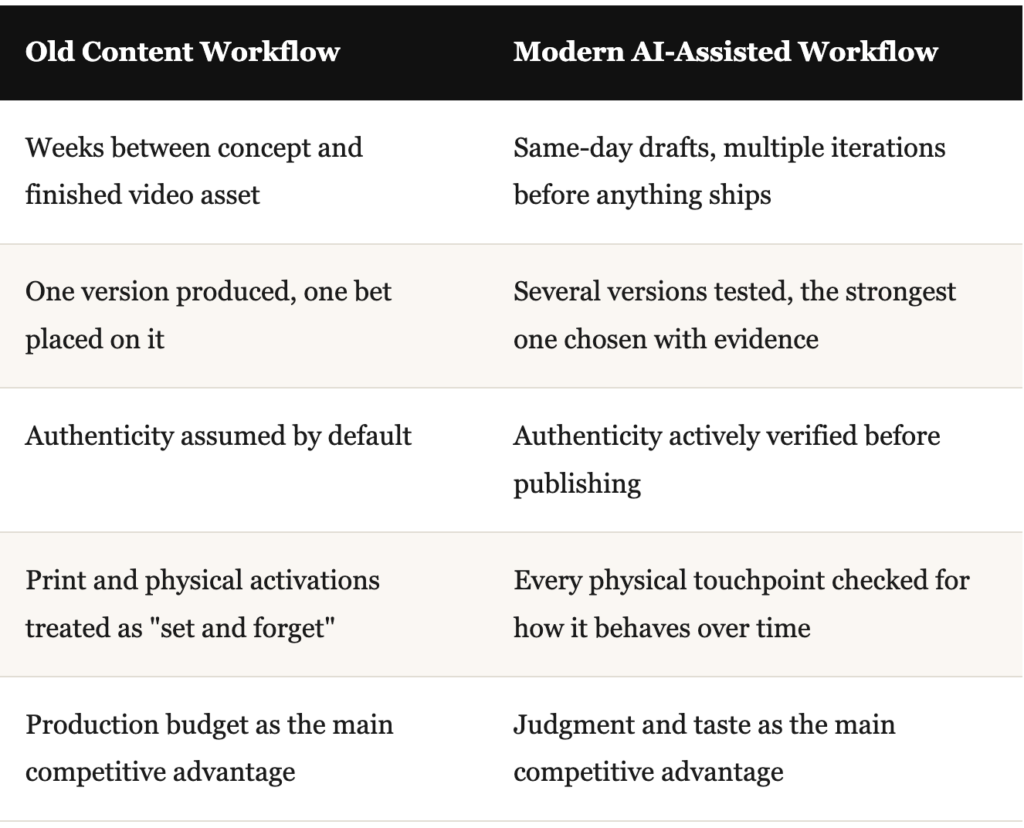
What changed isn’t that machines got creative. It’s that the distance between “I have an idea at 11pm” and “that idea exists as a finished asset” collapsed from weeks to hours. For an agency producing content across a dozen client accounts at once — campaigns, gifting drops, ambassador programs, seasonal launches — that collapse in time is not a convenience. It’s a complete rewrite of what’s possible in a quarter.
Video Used to Be the Bottleneck. Now It’s the Easiest Room in the House.
I remember when a thirty-second brand video meant a shot list, a crew, a location scout, a full day of setup, and a week of editing before anyone saw a rough cut. That was the reality for years, and it quietly decided who got to compete. Brands with production budgets in the six figures could show up everywhere. Everyone else had to choose their moments carefully, which meant they showed up less, which meant they mattered less.
That hierarchy has cracked wide open. Today, a founder with a laptop and a clear idea can go from a rough concept to a polished, on-brand video in an afternoon — not by cutting corners, but by cutting the parts of the process that never needed a human in the first place: rough assembly, pacing tests, format resizing for six different platforms. Tools built specifically to create videos quickly have taken over the unglamorous middle of the process, the part where nothing creative is actually happening, just execution. That frees the actual creative energy — the concept, the story, the feeling you want someone to have when they watch — for the person who understands the brand, not the software.
What I tell every client who’s hesitant is this: the machine isn’t making the decisions that matter. It’s making the two hundred small decisions that don’t. Which cut to use for a nine-by-sixteen format versus a square crop. How to caption for sound-off viewing. How to render a preview fast enough that you can iterate ten times before lunch instead of once before Friday. Those aren’t creative choices. They’re friction. And removing friction is not the same thing as removing craft.
Drag to See It
The Speed Divide
Drag the slider from the old production timeline to a fully AI-assisted one and watch the turnaround time collapse.
Where the Difference Actually Shows Up
Volume
Tap to reveal
Volume
Five tested versions instead of one rushed guess, all before real budget ever touches distribution.
Trust
Tap to reveal
Trust
Verification became routine, not optional — a five-minute check that protects months of built credibility.
Precision
Tap to reveal
Precision
The small mechanics — a code, a link, a physical touchpoint — get checked before launch, not after something breaks.
Where the Real Leverage Lives
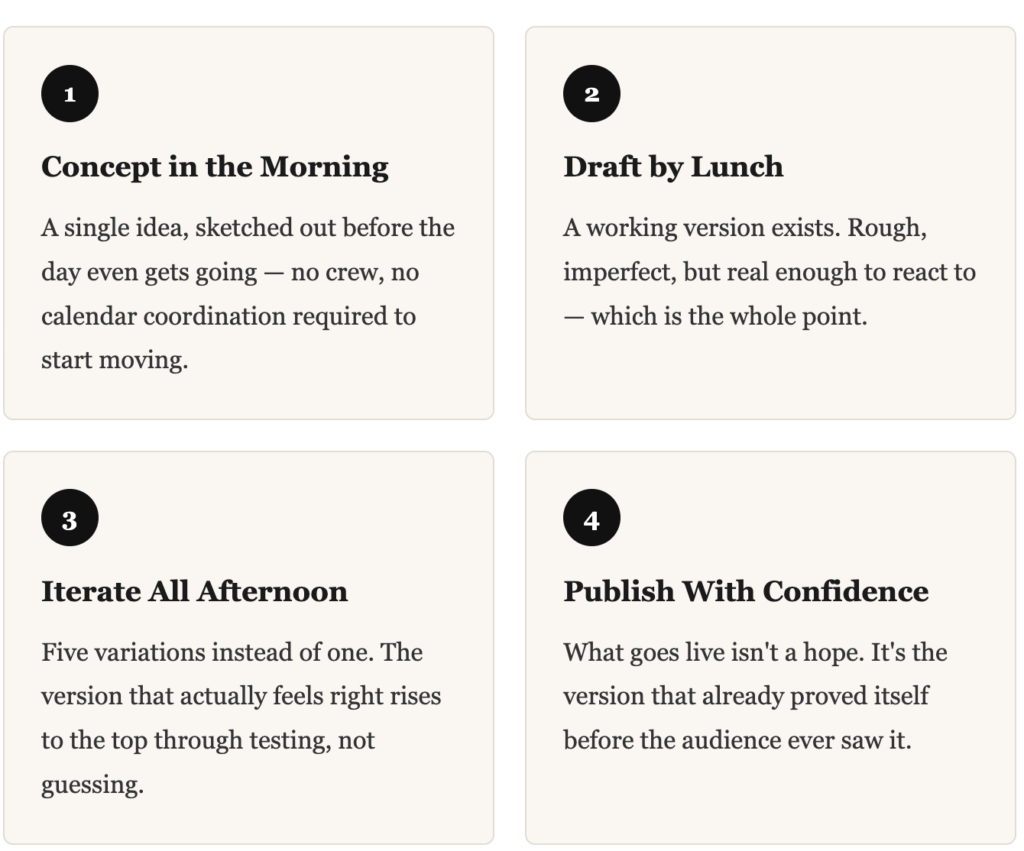
Here’s what surprises people: the agencies and brands pulling ahead right now aren’t necessarily the ones with the fanciest AI stack. They’re the ones who understood that speed compounds. If it takes you a week to test a concept, you test it once and hope. If it takes you an afternoon, you test five variations, watch which one the audience actually responds to, and only then commit real budget behind it. That’s not a marginal improvement. That’s an entirely different relationship with risk.
The Trust Problem Nobody Saw Coming
Now here’s the part of the secret that’s a little uncomfortable. The same tools that let a small brand produce like a giant have created a new kind of scrutiny. Audiences are sharper than they’ve ever been. They’ve been fooled enough times — by fake reviews, by synthetic influencers, by images that turned out to be entirely generated — that skepticism has become the default setting for anyone scrolling a feed in 2026. Trust used to be assumed. Now it has to be proven.
This matters enormously for luxury and lifestyle brands specifically, because the entire value proposition of luxury is authenticity of experience. Nobody pays a premium for a version of something. They pay for the real thing, and they expect the marketing around it to reflect that reality. So when a piece of visual content goes out — a campaign image, a product shot, a gifting unboxing — the question audiences are quietly asking is no longer just “is this beautiful.” It’s “is this real.”
I’ve started building verification into the process itself, almost like a quality check before anything ships. Before a visual asset goes live, especially one touched by any AI-assisted editing or generation along the way, running it through an AI image detector has become as routine as a final proofread. Not because we’re hiding anything — quite the opposite. It’s a way of knowing exactly what you’re putting your name behind before an audience, or a journalist, or a competitor does the checking for you. In a landscape where one mislabeled image can undo months of brand trust, that five-minute check is cheap insurance against an expensive problem.
The Quiet Infrastructure Behind the Glamour
People see the campaign. They see the influencer post, the beautifully shot product, the moment that feels effortless. What they don’t see is the infrastructure underneath it — the unglamorous connective tissue that makes modern content actually function as a business tool rather than just a pretty picture. That infrastructure has gotten a quiet upgrade too, and it deserves more attention than it gets.
Take something as small as a QR code on a gifting box or a print campaign. It looks like a solved problem — scan, land on a page, done. But the mechanics behind it matter more than most marketers realize. A dynamic QR code can point to a live, editable destination, which sounds convenient until you’re six months into a campaign and someone asks a question I used to assume had an obvious answer: does QR codes expire? The honest answer is that it depends entirely on how it was generated and hosted, and getting that wrong on a print run of luxury gift boxes or a physical activation is the kind of mistake that’s expensive to fix after the fact, because you can’t exactly reprint five thousand boxes overnight. It’s a small detail. It’s also exactly the kind of small detail that separates a campaign that works seamlessly from one that quietly breaks a week after launch.
Why the Small Stuff Is the Real Craft Now
This is the part of the secret that took me the longest to accept: when the flashy parts of production get automated, what’s left to differentiate on is precision. Anyone can generate a beautiful image now. Anyone can produce a decent video in an afternoon. What can’t be automated away is the judgment to know when something needs a human check, a legal review, a verification step, a second look before it goes out into the world wearing your brand’s name.
The Night I Stopped Believing in “Later”
I can tell you the exact moment this stopped being theoretical for me. It was late, the office was empty, and a client needed a concept turned around by morning for a launch neither of us had planned properly for. The old version of me would have sent an apologetic email and pushed the timeline. Instead, I sat there and built the thing myself, start to finish, in the hours most people spend asleep. Not because I’m faster than anyone else. Because the tools finally moved at the speed my brain actually works at, instead of forcing me to wait for a process built for a slower decade.
That’s the feeling I want to hand to every creator reading this, because it’s the one that actually changes how you work: the gap between “I thought of something” and “it exists” used to be the single biggest reason good ideas died quietly in a notes app. Somebody had an instinct at the right moment, and by the time the budget was approved, the crew was booked, and the edit came back, the moment had passed and the idea had gone stale. That’s not a hypothetical loss. I’ve watched it happen to genuinely brilliant concepts more times than I can count. Speed isn’t a vanity metric. It’s the difference between an idea that gets to exist and one that quietly dies in committee.
Why “More Content” Was Always the Wrong Goal
I want to correct something before it gets misunderstood, because I’ve watched brands take this exact insight and run it in the wrong direction. Faster production does not mean the goal is simply more content. More content without a point of view is just noise wearing a nicer outfit. I’ve seen brands mistake the ease of production for permission to flood every channel with mediocre output, and it backfires every time — audiences don’t reward volume, they reward relevance, and relevance requires restraint even when restraint is no longer forced on you by cost.
What the speed actually buys you is the ability to be selective in a way you never could afford before. When producing a piece of content cost real money and real time, you had to commit to your first good-enough idea because you couldn’t afford to test five. Now you can build five versions of a concept, watch how each one actually lands, and only push real distribution budget behind the one that’s proven itself. That’s not more content. That’s fewer, sharper bets, made with far better information than anyone had access to a few years ago. The winning move isn’t publishing more often. It’s publishing with more confidence, because you’ve already seen what works before the world does.
The Discipline Nobody Talks About
Here’s a tension I sit with constantly, and I think most people building brands right now feel it too, even if they haven’t named it. The tools make it so easy to keep tweaking, keep generating another version, keep chasing a slightly better cut, that knowing when to stop has become its own skill. I’ve watched talented people spiral through draft eleven of something that was genuinely great at draft three, because the cost of trying again dropped to almost nothing. Abundance creates its own kind of paralysis if you let it.
The discipline that matters now isn’t the discipline of producing content at all — that part got easy. It’s the discipline of recognizing when something is done, when a video has the feeling you were chasing, when an image says exactly what the brand needs it to say, and choosing to ship it instead of endlessly optimizing toward a version that might not even be better, just different. I tell my team constantly: the tool will let you iterate forever. Your judgment is what has to say enough.
The Creators Who Get This Are Building Something the Rest Haven’t Noticed
There’s a particular kind of creator I’ve started noticing more and more, and I think they represent where this whole shift is actually heading. They’re not the ones with the biggest teams or the loudest launches. They’re the ones treating their entire content operation like a lab — constantly testing small variations, watching the data honestly instead of defensively, willing to kill an idea they personally loved because the audience quietly told them it wasn’t landing. They’ve stopped treating every piece of content as precious, and in doing so, they’ve made room for the pieces that actually deserve to be precious to stand out.
What strikes me about working with brands at this level is how much the conversation has changed in just the last couple of years. It used to be almost entirely about aesthetics — does this look luxurious, does this feel elevated, does this match the world the brand is trying to sell. That conversation hasn’t gone away, it’s still the foundation of everything. But layered on top of it now is a second conversation about mechanics: how fast can we move, how do we verify what we’re putting out, how do we make sure the physical and digital touchpoints of a campaign actually hold up under real-world use instead of just looking good in a deck. Brands that only have the first conversation are starting to feel dated. Brands that only have the second conversation feel soulless. The ones I actually admire are having both, at the same time, without treating either as more important than the other.
What This Means If You’re Actually Building Something
I’m not telling you any of this so you’ll be impressed by the technology. Technology alone has never made a brand desirable — it’s never once been the reason someone falls in love with a product. What I’m telling you is that the *constraints* that used to justify slow, cautious, expensive content production have quietly disappeared, and most people building brands right now haven’t fully adjusted their expectations to match. They’re still budgeting for the old bottlenecks. They’re still treating a single campaign video as a precious, once-a-quarter event instead of one of many fast, cheap experiments.
The creators and brands who are going to win the next few years are the ones who treat content production the way a good chef treats ingredients — not precious, not scarce, but abundant enough to experiment freely, with the real skill going into what you choose to keep and what you throw away. When production is fast and cheap, the real differentiator becomes taste. And taste, unlike rendering time, has never been something you could shortcut.
There’s also a quieter shift happening in how much responsibility sits with the person directing the work rather than the tool doing it. When anyone can generate a video or an image in minutes, the brands that stand out are the ones who still ask the harder questions before anything goes live — is this true to who we are, does this hold up under scrutiny, would I be comfortable if someone checked every claim in this asset. Those questions used to get skipped because production was so slow and expensive that just finishing something felt like the achievement. Now that finishing is easy, the questions are what’s left, and they’re the whole game.
What I'd Tell Any Founder Starting From Zero Right Now
- Stop treating video production as a rare, expensive event. Make it a daily habit and let volume teach you what actually resonates.
- Test more versions than feels comfortable. The version you'd have defaulted to is rarely the one that performs best.
- Verify before you publish, not after someone else does it for you. A quick check protects months of built trust.
- Sweat the physical details as much as the digital ones — a QR code, a print run, a packaging insert all carry the same brand risk as a social post.
- Spend the time you save on judgment, not on producing even more content. Abundance without discernment is just noise with better lighting.
Sources:
- AI image detector — http://truthscan.com/ai-image-detector
- Create videos — https://www.adobe.com/express/create/video
- Does a QR code expire — https://qrnow.com/blog/does-a-qr-code-expire