



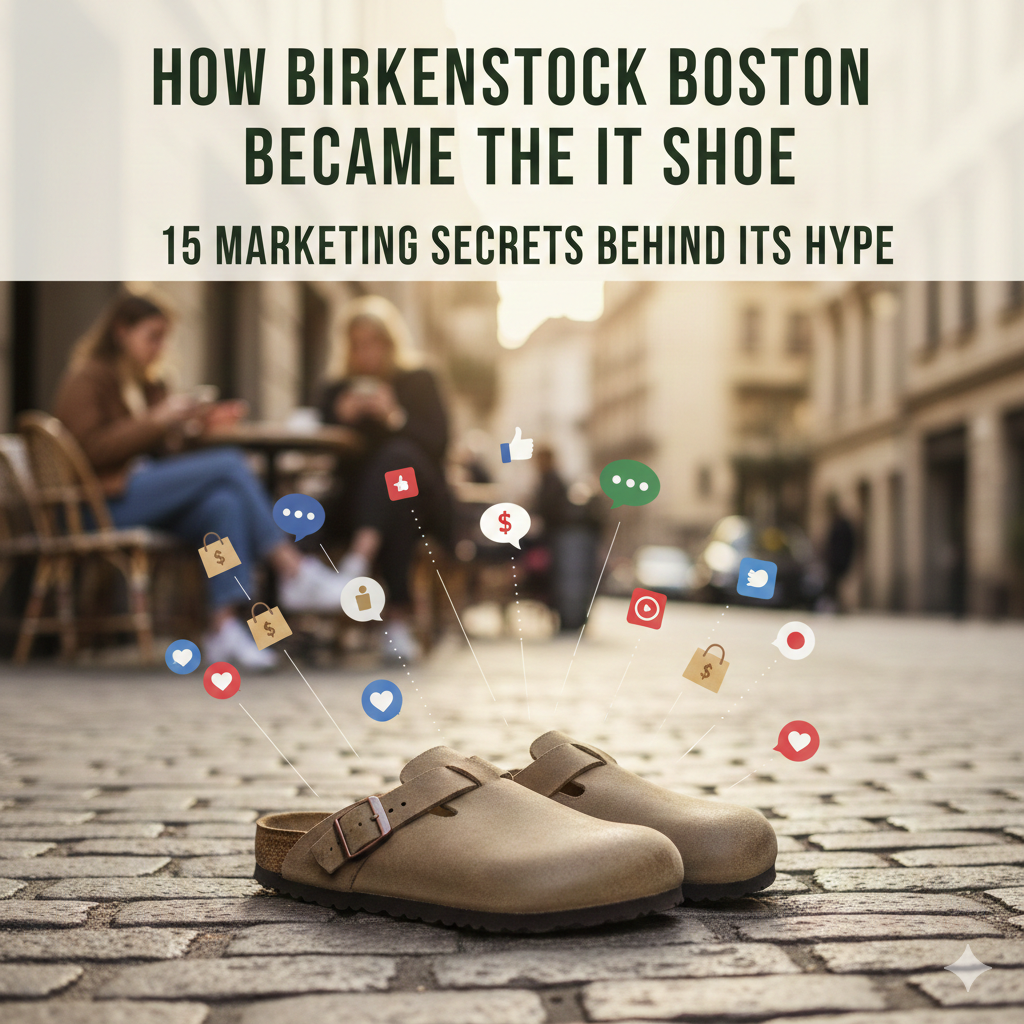
21 Dec How Birkenstock Boston Became the It Shoe: 15 Marketing Secrets Behind Its Hype
How Birkenstock Boston Became the It Shoe: 15 Marketing Secrets Behind Its Hype (Editor’s Choice)
How Birkenstock Boston Became the It Shoe
15 marketing moves that turned a comfort clog into a cultural status symbol—fast to skim, easy to steal (strategically).
| # | Marketing Secret | Why It Worked (Reader-friendly takeaway) | Playbook Bucket |
|---|---|---|---|
| Secret 01 | Held the line on comfort + footbed credibility | The product story is believable. Hype sticks when the benefit is real, repeatable, and felt immediately. | Product Truth |
| Secret 02 | Reframed “ugly” as taste | Polarizing design becomes identity—wearers signal confidence, not conformity. | Positioning |
| Secret 03 | Used a self-aware, witty brand tone | Humor lowers resistance and makes the brand meme-ready without trying too hard. | Brand Voice |
| Secret 04 | Luxury adjacency via designer validation | Fashion “permission” turns a practical buy into a style choice—without changing the product DNA. | Cultural Proof |
| Secret 05 | Organic celebrity placement | Spotted moments feel authentic—social proof at scale beats polished ads when the product is recognizable. | Earned Media |
| Secret 06 | Big pop-culture moments that “stamp” meaning | A single iconic appearance can convert a product into a symbol (comfort, rebellion, ease, etc.). | Cultural Moments |
| Secret 07 | Positioned as “timeless classic,” not a trend | Consumers justify the purchase as smart. Anti-trend framing extends the lifecycle of hype. | Narrative |
| Secret 08 | Genderless + cross-subculture versatility | Multiple communities adopt the same item for different reasons—expanding reach without dilution. | Audience |
| Secret 09 | Seasonal variants without reinvention | Newness arrives through materials and colorways, while the silhouette stays instantly recognizable. | Product Strategy |
| Secret 10 | Scarcity and sellouts as accelerants | Limited availability creates urgency, resale chatter, and “I finally got them” content. | Demand Engine |
| Secret 11 | Distribution that signals status | Where you’re sold becomes part of what you are. Fashion retail placement shifts perception instantly. | Retail |
| Secret 12 | TikTok/UGC friendliness (recognizable on-foot) | The Boston reads clearly in a split second—perfect for fit checks, styling reels, and search-driven discovery. | Social |
| Secret 13 | Styling content loop kept demand warm | “How to style it” turns a product into a template—endless re-wears, endless posts. | Content |
| Secret 14 | Modernized the brand while protecting the icon | Relevance came from segmentation and merchandising—not from changing what people loved. | Brand Strategy |
| Secret 15 | Authority partnerships to expand the story | Credible narratives (health, craft, heritage) make the product feel inevitable—not merely popular. | Trust |
How Birkenstock Boston Became the It Shoe: 15 Marketing Secrets Behind Its Hype
How Birkenstock Boston Became the It Shoe: Marketing Secrets Behind Its Hype #3 — The Brand Learned to Laugh First
Birkenstock understood something most brands miss: if you acknowledge the joke, you control the punchline. Their self-aware tone—bordering on dry, almost academic humor—made the brand feel human without trying to be relatable. It’s not “hello fellow kids”; it’s “yes, we know—and?” That restraint gave consumers permission to participate without irony fatigue. Humor here wasn’t decoration; it was disarmament.
How Birkenstock Boston Became the It Shoe: Marketing Secrets Behind Its Hype #4 — Fashion Permission Was Granted, Not Forced
Once designers and fashion institutions embraced the Boston, the shoe crossed an invisible line. But crucially, Birkenstock didn’t chase that validation—it waited for it. The product stayed the same while the context shifted. That’s the difference between collaboration as elevation and collaboration as desperation. Fashion didn’t rescue the Boston; it simply recognized what had been hiding in plain sight.
How Birkenstock Boston Became the It Shoe: Marketing Secrets Behind Its Hype #5 — Celebrity Without the Costume
There is nothing more suspicious than a celebrity who looks like they’re trying. Birkenstock benefited from the opposite: celebrities wearing Bostons the way real people do—slightly beaten up, with socks, without explanation. These moments didn’t scream endorsement; they whispered inevitability. The shoe felt chosen, not styled. And that distinction is everything.
How Birkenstock Boston Became the It Shoe: Marketing Secrets Behind Its Hype #6 — One Cultural Moment Can Permanently Rewrite a Product
There are products that sell themselves quietly, and then there are products that get canonized by culture. The Birkenstock Boston didn’t rely on a thousand small impressions here—it benefited from a few, perfectly timed cultural moments that did the narrative heavy lifting. When the shoe appeared in mainstream pop culture, it stopped being a personal preference and started functioning as a symbol. Comfort became commentary. Ease became ideology. These moments worked because they didn’t explain the shoe; they trusted the audience to understand what it represented. That trust is what made the meaning stick. In marketing terms, this is shorthand at its most powerful: fewer words, more resonance.
How Birkenstock Boston Became the It Shoe: Marketing Secrets Behind Its Hype #7 — Timeless Is the Smartest Marketing Language
Calling something “timeless” is risky—unless you mean it. Birkenstock didn’t use the word as a hedge against trends; it used it as a declaration of independence from them. The Boston was framed as something you don’t need to replace, rethink, or rationalize every season. And that framing does something quietly brilliant: it removes urgency while increasing desire. When consumers believe they’re buying permanence, the purchase feels mature, considered, and slightly superior. The irony, of course, is that timelessness is exactly what makes something endlessly relevant in trend cycles that burn out faster than ever.
How Birkenstock Boston Became the It Shoe: Marketing Secrets Behind Its Hype #8 — Belonging to Everyone Meant Being Owned by No One
The Boston’s genius lies in its refusal to pick a side. It’s not aggressively masculine, deliberately feminine, or subculturally exclusive. Instead, it floats—adopted by art kids, minimalists, tech founders, fashion editors, and people who just want to walk comfortably for twelve hours. That neutrality is not accidental; it’s strategic elasticity. When a product doesn’t ask you to change who you are to wear it, adoption becomes frictionless. The Boston doesn’t costume you—it adapts to you. And in a market saturated with hyper-specific aesthetics, that openness is radical.
How Birkenstock Boston Became the It Shoe: Marketing Secrets Behind Its Hype #9 — The Art of Refreshing Without Reinventing
Birkenstock understood a rule many brands ignore: icons don’t want to be redesigned, they want to be reinterpreted. Seasonal materials, shearling linings, earthy colorways—each update offered novelty without destabilizing recognition. The silhouette remained sacred. This allowed consumers to feel both loyal and indulgent: you’re not abandoning the original, you’re expanding the relationship. That restraint builds trust. It says, “We know what you’re here for, and we won’t take it away.”
How Birkenstock Boston Became the It Shoe: Marketing Secrets Behind Its Hype #10 — Scarcity That Didn’t Feel Like Theater
The Boston didn’t need artificial countdowns or breathless drop language. Scarcity emerged naturally—and that’s why it worked. Sold-out sizes, elusive colorways, restocks that vanished quickly: each absence became proof of desire. Importantly, the brand didn’t over-explain the shortage. It let demand speak for itself. In a digital landscape allergic to manipulation, restraint reads as authenticity. The hunt felt earned, not orchestrated.
How Birkenstock Boston Became the It Shoe: Marketing Secrets Behind Its Hype #11 — Retail Is a Silent Narrator
The Boston didn’t change—but the rooms it appeared in did. Placement in fashion-forward retailers reframed the shoe instantly. Context is marketing’s quiet superpower: the same product reads differently depending on what surrounds it. On a minimalist shelf next to directional brands, the Boston stops being practical and starts being intentional. Retail, here, functions as editorial.
How Birkenstock Boston Became the It Shoe: Marketing Secrets Behind Its Hype #12 — Recognizable in Half a Second
The Boston is instantly legible. One frame, one step, one scroll—and you know exactly what you’re looking at. In the economy of short-form video, that recognizability is priceless. The shoe doesn’t need a caption or explanation; it functions visually as a character. This is why it thrives in fit checks, POV videos, and casual styling clips. It doesn’t interrupt the content—it anchors it.
How Birkenstock Boston Became the It Shoe: Marketing Secrets Behind Its Hype #13 — Styling Content Did the Long-Term Work
At some point, the Boston stopped being sold and started being styled. “How to wear Birkenstock Bostons” became an evergreen content category, quietly reinforcing versatility, repeat wear, and relevance. Every post answered the same unspoken question: Will these work for me? The answer, shown repeatedly, was yes. Content didn’t inflate desire—it normalized ownership. And normalization is how hype becomes habit.
How Birkenstock Boston Became the It Shoe: Marketing Secrets Behind Its Hype #14 — Evolution Happened Around the Icon
Birkenstock modernized everything except the thing people loved. Messaging became sharper. Segmentation became smarter. Merchandising became more fashion-literate. But the Boston itself remained untouched. That choice communicates respect—for the product and for the consumer. Instead of chasing relevance, the brand built systems that allowed relevance to come to it.
How Birkenstock Boston Became the It Shoe: Marketing Secrets Behind Its Hype #15 — Authority Is What Turns Hype Into Legacy
Trends can spike without credibility; legacies cannot. By anchoring itself in foot health, craftsmanship, and heritage, Birkenstock ensured that popularity never felt hollow. The Boston didn’t just circulate—it justified itself. Authority made the hype durable, defensible, and repeatable. Fashion may have adopted the shoe, but trust is what made it stay.