



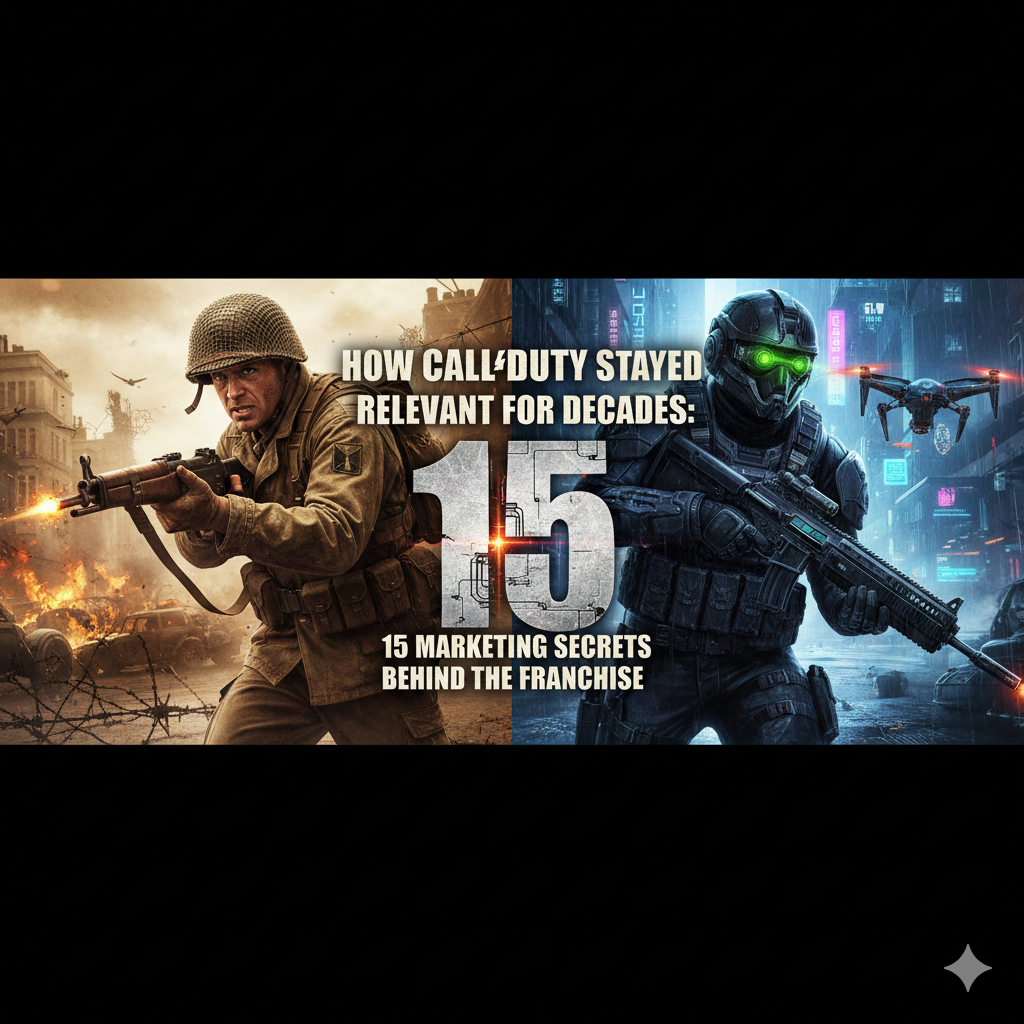
22 Dec How Call of Duty Stayed Relevant for Decades: 15 Marketing Secrets Behind the Franchise
How Call of Duty Stayed Relevant for Decades: 15 Marketing Secrets Behind the Franchise (Editor’s Choice)
How Call of Duty Stayed Relevant for Decades: 15 Marketing Secrets
A clear, skimmable breakdown of the strategic decisions that kept Call of Duty culturally relevant year after year.
| # | Marketing Secret | Why It Matters | Strategic Takeaway |
|---|---|---|---|
| 01 |
Annual Release Cadence
Built anticipation into habit without exhausting the audience.
|
Turned launches into predictable cultural moments. | Consistency builds loyalty |
| 02 |
Multiple Studios, One Brand
Different creative voices prevented stagnation.
|
Variety without brand confusion. | Rotate creativity |
| 03 |
Reinventing the Setting
Changed the backdrop before fatigue could set in.
|
Kept the franchise visually and emotionally fresh. | Evolve before boredom |
| 04 |
Multiplayer as Retention
Progression systems created long-term investment.
|
Players stayed because their time mattered. | Design for repeat use |
| 05 |
Zombies as a Cult Mode
Lore and mystery fueled deep community obsession.
|
Turned fans into brand evangelists. | Create obsession pockets |
| 06 |
Esports Validation
Positioned COD as skill-based, not disposable.
|
Elevated perception through competition. | Anchor to mastery |
| 07 |
Influencer-First Marketing
Trust flowed from creators to the product.
|
Marketing felt organic, not forced. | Let others speak |
| 08 |
Cultural Timing
Mirrored real-world tension without being explicit.
|
Stayed relevant without chasing trends. | Read the room |
| 09 |
Console-First Focus
Optimized for where its audience actually played.
|
Reduced friction and increased retention. | Meet users where they are |
| 10 |
Cinematic Trailers
Made every release feel like a premiere.
|
Raised perceived value instantly. | Sell the emotion |
| 11 |
Seasonal Content
Created rhythm and return behavior.
|
Attention never went dormant. | Build momentum |
| 12 |
Warzone as Gateway
Lowered entry barriers without weakening the brand.
|
Expanded the funnel dramatically. | Offer a free entry point |
| 13 |
Ecosystem Thinking
Progress followed players across titles.
|
Leaving felt costly. | Reward loyalty |
| 14 |
Strategic Nostalgia
Classic maps reactivated emotional memory.
|
Old fans returned without alienating new ones. | Use memory wisely |
| 15 |
Selective Listening
Tracked sentiment without chasing noise.
|
Protected vision while improving retention. | Filter feedback |
How Call of Duty Stayed Relevant for Decades: 15 Marketing Secrets Behind the Franchise
How Call of Duty Stayed Relevant for Decades: Marketing Secrets Behind the Franchise #1 — Annual Release Cadence (Without Feeling Repetitive)
Call of Duty understood something most brands still struggle with: relevance isn’t about surprise, it’s about rhythm. By showing up every year—consistently, predictably—it trained its audience to expect it, like fashion week or a summer drop. But expectation alone isn’t enough. The real magic is that each release feels familiar without feeling lazy. This is discipline disguised as excitement. A reminder that consistency doesn’t kill desire—inconsistency does.
How Call of Duty Stayed Relevant for Decades: Marketing Secrets Behind the Franchise #2 — Multiple Studios, One Brand
Call of Duty never tried to sound like one voice—it curated a chorus. Different studios, different creative instincts, same brand promise. That’s not fragmentation; that’s range. It allowed the franchise to evolve without losing itself, like a brand that knows its silhouette but isn’t afraid to change the fabric. This is what happens when leadership trusts creativity instead of micromanaging it.
How Call of Duty Stayed Relevant for Decades: Marketing Secrets Behind the Franchise #3 — Reinventing the Setting Before Players Asked
Before boredom could settle in, Call of Duty moved. Time periods shifted. Aesthetics changed. The setting evolved. This wasn’t random—it was anticipatory. The brand didn’t wait for feedback loops to turn into complaints; it read the room early. The takeaway here is subtle but powerful: relevance belongs to brands that leave the party right before it gets stale.
How Call of Duty Stayed Relevant for Decades: Marketing Secrets Behind the Franchise #4 — Multiplayer as the Core Retention Engine
Campaigns make headlines. Multiplayer builds loyalty. Call of Duty always knew where the real relationship lived. Progression systems weren’t just features—they were psychological contracts. You don’t just play; you invest. And once people invest time, status, and identity, they don’t leave easily. This is retention that feels earned, not engineered.
How Call of Duty Stayed Relevant for Decades: Marketing Secrets Behind the Franchise #5 — Zombies Mode as a Cult Brand Within the Brand
Zombies wasn’t a side feature—it was an insider language. Lore, Easter eggs, theories. Call of Duty gave its most devoted fans something to decode, not just consume. That’s how brands turn users into evangelists. You don’t market a cult—you create space for obsession and let the community do the rest.
How Call of Duty Stayed Relevant for Decades: Marketing Secrets Behind the Franchise #6 — Esports as Cultural Validation
Call of Duty didn’t enter esports to chase trophies—it entered to claim legitimacy. Competitive play reframed the franchise from “casual shooter” to “skill-respecting sport,” and that distinction matters more than marketing budgets ever could. By institutionalizing competition, COD created heroes, rivalries, and moments that lived outside release cycles. This wasn’t about viewership alone—it was about perception. Esports told players, sponsors, and the culture at large: this game deserves to be taken seriously.
How Call of Duty Stayed Relevant for Decades: Marketing Secrets Behind the Franchise #7 — Influencer-First, Not Brand-First
Call of Duty understood early that people don’t trust brands—they trust people with receipts. Instead of overproduced ads, COD let creators shape the narrative, speak the language, and control the tone. Streamers didn’t just promote the game; they demonstrated why it mattered. This approach didn’t feel like marketing because it wasn’t trying to convince—it was showing. And showing always wins.
How Call of Duty Stayed Relevant for Decades: Marketing Secrets Behind the Franchise #8 — Cultural Timing Over Loud Messaging
COD never needed to explain itself—it simply arrived at the right moment. By aligning storylines, aesthetics, and tone with real-world tension and cultural moods, the franchise felt relevant without being explicit. It didn’t chase headlines; it echoed the atmosphere. That subtlety is what kept it from feeling exploitative while still feeling current. Timing became the message.
How Call of Duty Stayed Relevant for Decades: Marketing Secrets Behind the Franchise #9 — Console-First Is Audience-First
While others chased specs and elitism, Call of Duty optimized for where its audience actually lived. Console-first design wasn’t a technical choice—it was a respect choice. Faster matchmaking, intuitive controls, couch-friendly accessibility. The result? Less friction, more play, longer loyalty. COD didn’t ask players to adapt—it adapted to them.
How Call of Duty Stayed Relevant for Decades: Marketing Secrets Behind the Franchise #12 — Warzone as a Gateway, Not a Threat
Warzone wasn’t a pivot—it was an expansion. Free-to-play removed risk, widened reach, and pulled an entirely new generation into the franchise without alienating core fans. Most brands fear dilution. COD engineered osmosis. Warzone didn’t replace Call of Duty—it fed it.
How Call of Duty Stayed Relevant for Decades: Marketing Secrets Behind the Franchise #13 — Ecosystem Thinking Over One-Off Wins
Progression didn’t reset—it traveled. Weapons, skins, ranks followed players across modes and titles, quietly telling them: your time here matters. This wasn’t generosity—it was smart retention. When effort compounds, loyalty becomes logical.
How Call of Duty Stayed Relevant for Decades: Marketing Secrets Behind the Franchise #14 — Nostalgia Without Stagnation
COD knows nostalgia isn’t about living in the past—it’s about emotional recall. Classic maps weren’t reused; they were reintroduced. Familiar enough to feel safe, refreshed enough to feel new. Nostalgia became a re-entry point, not a creative crutch.