



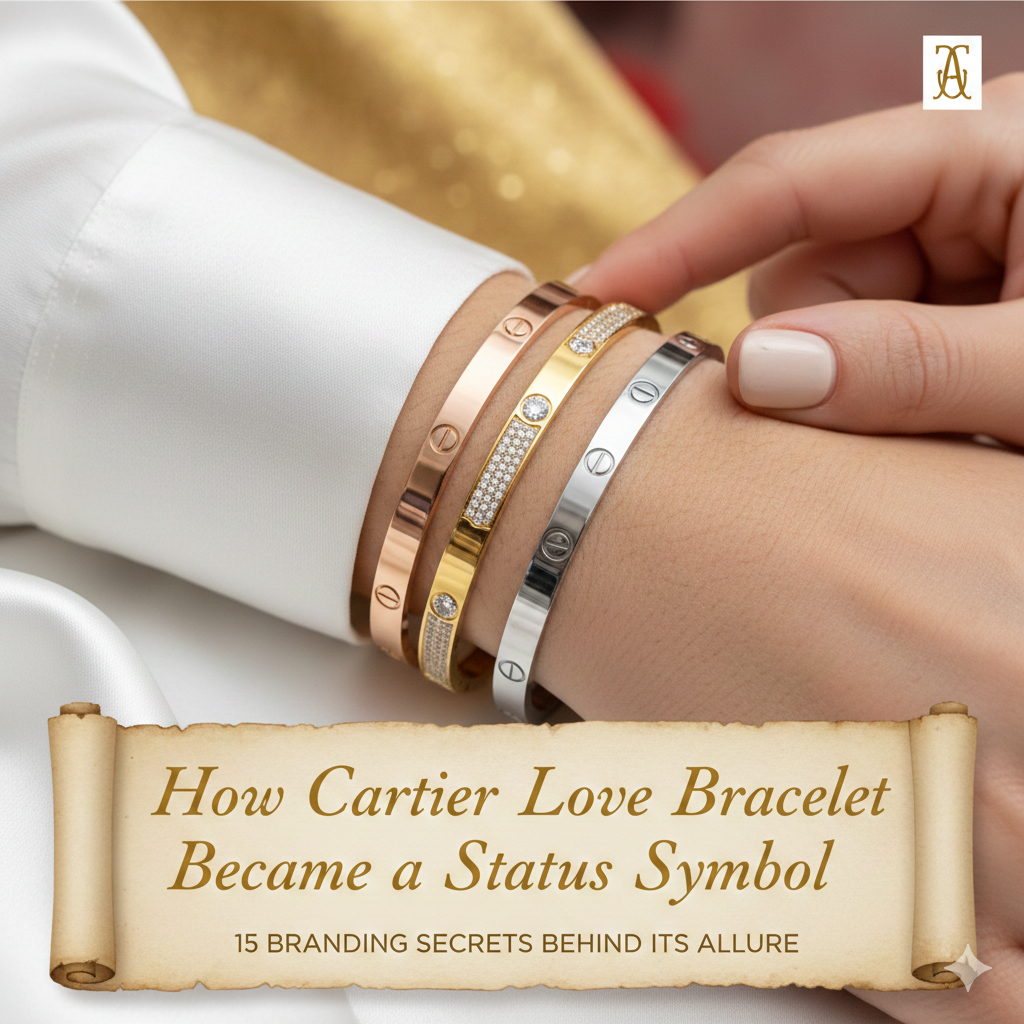
22 Dec How Cartier Love Bracelet Became a Status Symbol: 15 Branding Secrets Behind Its Allure
How Cartier Love Bracelet Became a Status Symbol: 15 Branding Secrets Behind Its Allure (Editor’s Choice)
How the Cartier LOVE Bracelet Became a Status Symbol
15 branding moves that turned a bracelet into cultural shorthand for romance, permanence, and quiet luxury.
| Secret | Branding Move | Why It Works | Steal This Idea |
|---|---|---|---|
| 01 Icon > Item |
A product that behaves like a symbol, not an accessory |
You’re not buying metal—you’re buying meaning. Status is easiest to signal when it’s culturally understood. |
Define a “what it means” line for your product (one sentence people can repeat). |
| 02 Recognition | Instantly recognizable silhouette |
If it’s identifiable from across the room, it becomes a social shortcut. |
Build a signature detail that’s simple to describe and easy to spot. |
| 03 Myth | A clean origin story people can retell |
Stories travel faster than specs—and they survive trend cycles. |
Write your “one-minute legend”: who, why, and what problem it solved. |
| 04 Ritual | A locking mechanism that turns wearing into a ceremony |
Ritual = emotional stickiness. It’s memorable because it’s participatory. |
Create a repeatable moment (unboxing, activation, first-use ritual). |
| 05 Language | “Icon” framing that reinforces category leadership |
Say it often enough and customers file it as a standard, not an option. |
Choose one title (icon, classic, original) and use it consistently. |
| 06 Unisex | Cross-gender design that widens the market |
More wearers, more sightings, more cultural proof—without changing the DNA. |
Design for multiple style tribes with the same core silhouette. |
| 07 Soft Exclusivity | Premium access without screaming “limited” |
Price + prestige distribution creates natural scarcity and desire. |
Limit availability strategically (drops, waitlists, curated channels). |
| 08 Always-On | Designed to be worn continuously |
“Always on” products become identity—your brand rides daily life. |
Optimize for everyday wear: comfort, durability, and repeat use. |
| 09 Photogenic | Built for close-ups and wrist-stacks |
If it shoots well on a phone, your customers become your media channel. |
Design a “camera moment” (a detail that pops in photos). |
| 10 Social Proof | Celebrity visibility as shorthand |
Fame turns products into cultural vocabulary—people learn the “meaning” faster. |
Seed with tastemakers whose audience matches your future customer. |
| 11 Variations | Keep the core, introduce upgrade paths |
Customers can re-enter the story—new metal, diamonds, sizing, milestones. |
Create tiers: entry, signature, and “celebration” version. |
| 12 Naming | A universal, emotionally loaded name |
“LOVE” is instantly understood, giftable, and impossible to forget. |
Name for emotion, not features—what should it *feel* like? |
| 13 Occasions | Built-in gifting logic for multiple life moments |
More occasions = more reasons to buy, even for the same customer. |
Map 5 gifting triggers and write copy for each (anniversary, promotion, etc.). |
| 14 Timeless x Modern | Heritage credibility with contemporary design cues |
It reads classic *and* current—so it doesn’t age out with trends. |
Pair one classic element with one modern edge in every product. |
| 15 Fresh Hooks | Ongoing news hooks to stay culturally present |
Periodic refreshes keep the icon in conversations without changing what people love. |
Plan “moments”: seasonal drops, collabs, limited finishes, or anniversary edits. |
How Cartier Love Bracelet Became a Status Symbol: 15 Branding Secrets Behind Its Allure
How Cartier Love Bracelet Became a Status Symbol: Branding Secrets Behind Its Allure #2 — Instantly Recognizable Without Needing a Logo
The screw motif is Cartier’s most elegant flex: no logo screaming, no monogram shouting—just recognition. It’s design that assumes intelligence. In a world oversaturated with branding, the LOVE bracelet opts for memorability over visibility, trusting that those who know will know. This is how taste signals operate at the highest level: quietly, confidently, and without explanation. It’s not trying to be seen; it just is.
How Cartier Love Bracelet Became a Status Symbol: Branding Secrets Behind Its Allure #3 — A Mythic Origin Story That Still Travels
Designed in New York in 1969, the LOVE bracelet carries the cultural credibility of its own timestamp. This isn’t dusty heritage—it’s modern mythology. The story is clean, repeatable, and socially portable, which is exactly why it still circulates decades later. People don’t just wear the bracelet; they retell its origin, and in doing so, reinforce its relevance. A product with a story this concise doesn’t age—it archives itself.
How Cartier Love Bracelet Became a Status Symbol: Branding Secrets Behind Its Allure #4 — Turning Wearing Into a Ritual
You don’t slip the LOVE bracelet on absentmindedly. You commit to it—literally. The screwdriver isn’t a gimmick; it’s choreography. It forces intention, participation, and often another person, which elevates wearing into ritual. Rituals stick because they’re emotional, and emotional things resist disposability. Cartier didn’t just design a bracelet; it designed a moment people remember long after the purchase receipt is forgotten.
How Cartier Love Bracelet Became a Status Symbol: Branding Secrets Behind Its Allure #5 — Calling It an Icon Until the World Agreed
Cartier didn’t wait for consensus—it declared the LOVE bracelet an icon and behaved accordingly. Icons aren’t voted in; they’re asserted through consistency, restraint, and repetition. By framing the bracelet as foundational rather than seasonal, Cartier removed it from trend cycles entirely. This is branding at its most confident: telling the market what something is, and letting time do the rest.
How Cartier Love Bracelet Became a Status Symbol: Branding Secrets Behind Its Allure #6 — Unisex Before the Conversation Existed
Before genderless became a slide in every brand deck, the LOVE bracelet simply refused to pick a side. Its design doesn’t negotiate masculinity or femininity—it opts out of the conversation altogether. That choice is what gave it scale without dilution. When a product looks equally inevitable on a man in a crisp white shirt and a woman in a silk slip dress, it stops belonging to a demographic and starts belonging to culture. Cartier didn’t expand its audience by adding variants or campaigns; it did it by trusting the object to hold its own. That confidence—designing without apology or explanation—is what allowed the bracelet to circulate organically, multiplying visibility while maintaining credibility.
How Cartier Love Bracelet Became a Status Symbol: Branding Secrets Behind Its Allure #7 — Exclusivity Without the Performance
The LOVE bracelet never announces its exclusivity, which is precisely why it works. There’s no countdown clock, no manufactured scarcity narrative, no performative “limited edition” panic. Instead, access is quietly regulated by price, placement, and heritage—the most elegant gatekeepers in luxury. This creates a hierarchy that feels earned rather than engineered. When exclusivity is structural, not theatrical, desire feels intelligent instead of impulsive. Cartier understands that true status symbols don’t beg to be wanted; they wait to be reached.
How Cartier Love Bracelet Became a Status Symbol: Branding Secrets Behind Its Allure #8 — Designed to Become Part of the Body
You don’t style the LOVE bracelet—you commit to it. The fact that it’s designed to be worn continuously transforms it from adornment into identity. It lives on the wrist through workouts, weddings, flights, breakups, promotions—absorbing life rather than punctuating it. Over time, it stops being noticed by the wearer but becomes deeply noticed by everyone else. That’s the branding sweet spot: when the owner forgets it’s there, but the world never does. Permanence, here, isn’t just emotional—it’s physical.
How Cartier Love Bracelet Became a Status Symbol: Branding Secrets Behind Its Allure #9 — Built for the Camera Before the Camera Took Over
The LOVE bracelet’s curves, polish, and repetition read beautifully at close range—exactly where modern attention lives. Long before wrist stacks became social currency, Cartier had already engineered something that thrived in proximity. This wasn’t about virality; it was about visibility. When a product photographs well without trying, it turns customers into distributors and moments into media. The bracelet doesn’t chase the feed—it behaves so naturally in it that the feed comes to it.
How Cartier Love Bracelet Became a Status Symbol: Branding Secrets Behind Its Allure #10 — Celebrity as Cultural Translator, Not Hype Machine
Celebrities didn’t inflate the LOVE bracelet’s value—they clarified it. Seeing it worn repeatedly, casually, almost subconsciously by influential figures helped decode its meaning for the wider public. This wasn’t red-carpet spectacle; it was repetition. The bracelet became shorthand for taste rather than excess, aspiration rather than spectacle. When celebrities wear something like they forgot they’re wearing it, it signals comfort, confidence, and inevitability—all qualities status symbols require to endure.
How Cartier Love Bracelet Became a Status Symbol: Branding Secrets Behind Its Allure #11 — Variation Without Identity Crisis
Cartier understood that longevity requires evolution—but only within strict boundaries. The LOVE bracelet expands through materials and details, never through concept. This allows customers to re-enter the brand narrative at different life stages without feeling like they’re abandoning the original story. It’s not novelty; it’s progression. The core remains sacred, which makes every variation feel additive rather than distracting. That restraint is what keeps the bracelet from becoming trend jewelry in disguise.
How Cartier Love Bracelet Became a Status Symbol: Branding Secrets Behind Its Allure #12 — A Name That Carries the Entire Narrative
“LOVE” is not subtle—and that’s what makes it powerful. It’s universal, emotionally charged, and infinitely interpretable. The name collapses explanation and expands projection, allowing each wearer to assign their own meaning without contradicting the brand’s intent. Whether it’s romantic, personal, defiant, or self-referential, the word does the emotional labor so the design can remain disciplined. This is naming as strategy, not poetry.
How Cartier Love Bracelet Became a Status Symbol: Branding Secrets Behind Its Allure #13 — Gifting Logic Embedded Into the Product Itself
The LOVE bracelet doesn’t rely on marketing calendars to sell—it relies on life. Anniversaries, milestones, promotions, self-gifting moments, emotional resets—all find legitimacy here. This flexibility allows the same object to carry different meanings at different times, without ever feeling repetitive. When a product can reappear in someone’s life as both memory and marker, it stops being transactional and starts being archival.
How Cartier Love Bracelet Became a Status Symbol: Branding Secrets Behind Its Allure #14 — Heritage That Refuses to Fossilize
Cartier doesn’t preserve the LOVE bracelet like a museum piece—it lets it live. The design respects its origin without reenacting it, which is why it feels contemporary without chasing relevance. Heritage here is credibility, not costume. The bracelet works because it trusts the present moment while standing firmly on its past, proving that timelessness isn’t about freezing time—it’s about moving through it gracefully.
How Cartier Love Bracelet Became a Status Symbol: Branding Secrets Behind Its Allure #15 — Cultural Maintenance Over Reinvention
The LOVE bracelet doesn’t reinvent itself because it doesn’t need to. Cartier practices cultural maintenance—quiet refreshes, strategic visibility, subtle reminders of relevance. This restraint prevents fatigue and preserves desire. When a product is this well-positioned, the smartest move is often to do less, not more. Longevity, in this case, is a result of discipline.