



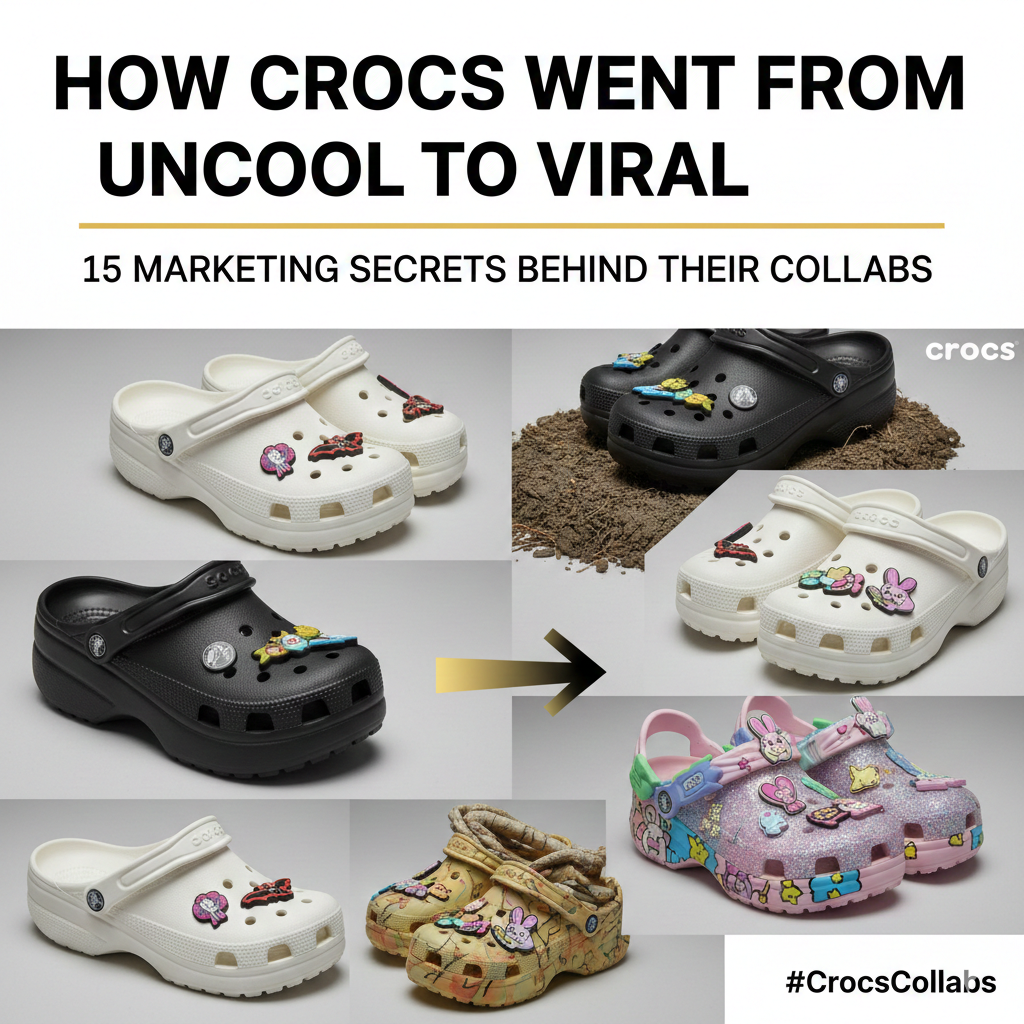
21 Dec How Crocs Went from Uncool to Viral: 15 Marketing Secrets Behind Their Collabs
How Crocs Went from Uncool to Viral: 15 Marketing Secrets Behind Their Collabs(Editor’s Choice)
How Crocs Went from Uncool to Viral: 15 Marketing Secrets Behind Their Collabs
These aren’t “tips.” They’re the exact levers Crocs pulled to turn a polarizing product into a cultural flex— from meme-ready design to scarcity drops and high–low collaborations.
| # | Marketing Secret | Why It Worked | Steal This Move |
|---|---|---|---|
| 01 |
Radical Self-Acceptance |
They didn’t “fix ugly.” They owned it, turning criticism into identity. |
Turn your “flaw” into a signature. |
| 02 | Strategic Celebrity Chaos |
They picked partners who spark conversation, not safe consensus. |
Choose collaborators with a point of view. |
| 03 | High–Low Culture Mashups |
Luxury + foam clogs created instant “wait…what?” energy. |
Pair opposites to earn attention. |
| 04 | Limited Drops = Instant Hype |
Scarcity made collabs feel collectible and urgent. |
Use timed releases and clear countdowns. |
| 05 | Built for Memes, Not Billboards |
Their designs travel fast in screenshots, stitches, and jokes. |
Design “shareable moments” into the product. |
| 06 | Customization via Jibbitz |
Personalization turned buyers into co-creators. |
Build modular add-ons people can collect. |
| 07 | Internet-First Marketing |
They optimized for TikTok/IG velocity, not TV polish. |
Ship content in native platform formats. |
| 08 | Embracing Polarization |
Love/hate products create stronger tribes than “meh.” |
Stand for something people can argue about. |
| 09 | Fast Cultural Response |
They moved quickly with trends, creators, and moments. |
Create a rapid “trend-to-drop” workflow. |
| 10 | Community Over Coolness |
They marketed belonging, not approval. |
Build rituals and inside jokes for fans. |
| 11 | Comfort as a Non-Negotiable |
Trend fades—comfort keeps people repurchasing. |
Protect your core value proposition. |
| 12 | Brand Humor Without Apology |
Self-awareness made the brand feel human and current. |
Write like a person, not a press release. |
| 13 | Fashion Industry Validation |
Runway moments reframed Crocs as a statement, not a joke. |
Borrow credibility from tastemakers. |
| 14 | Consistent Brand DNA |
Even wild collabs still looked unmistakably Crocs. |
Keep 2–3 signature elements in every collab. |
| 15 | Turning Critics into Amplifiers |
Every “why would anyone wear this?” became free distribution. |
Invite reactions—then repost the best ones. |
Radical Self-Acceptance
Why it worked: They didn’t “fix ugly.” They owned it, turning criticism into identity.
Steal this: Turn your “flaw” into a signature.
Strategic Celebrity Chaos
Why it worked: They picked partners who spark conversation, not safe consensus.
Steal this: Choose collaborators with a point of view.
High–Low Culture Mashups
Why it worked: Luxury + foam clogs created instant “wait…what?” energy.
Steal this: Pair opposites to earn attention.
Limited Drops = Instant Hype
Why it worked: Scarcity made collabs feel collectible and urgent.
Steal this: Use timed releases and clear countdowns.
Built for Memes, Not Billboards
Why it worked: Their designs travel fast in screenshots, stitches, and jokes.
Steal this: Design “shareable moments” into the product.
Customization via Jibbitz
Why it worked: Personalization turned buyers into co-creators.
Steal this: Build modular add-ons people can collect.
Internet-First Marketing
Why it worked: They optimized for TikTok/IG velocity, not TV polish.
Steal this: Ship content in native platform formats.
Embracing Polarization
Why it worked: Love/hate products create stronger tribes than “meh.”
Steal this: Stand for something people can argue about.
Fast Cultural Response
Why it worked: They moved quickly with trends, creators, and moments.
Steal this: Create a rapid “trend-to-drop” workflow.
Community Over Coolness
Why it worked: They marketed belonging, not approval.
Steal this: Build rituals and inside jokes for fans.
Comfort as a Non-Negotiable
Why it worked: Trend fades—comfort keeps people repurchasing.
Steal this: Protect your core value proposition.
Brand Humor Without Apology
Why it worked: Self-awareness made the brand feel human and current.
Steal this: Write like a person, not a press release.
Fashion Industry Validation
Why it worked: Runway moments reframed Crocs as a statement, not a joke.
Steal this: Borrow credibility from tastemakers.
Consistent Brand DNA
Why it worked: Even wild collabs still looked unmistakably Crocs.
Steal this: Keep 2–3 signature elements in every collab.
Turning Critics into Amplifiers
Why it worked: Every “why would anyone wear this?” became free distribution.
Steal this: Invite reactions—then repost the best ones.
Note: On mobile, this layout automatically switches from a table to swipeable cards for readability.
How UGG Made a Major Comeback: 15 Branding Tricks Behind Its Rebrand
How Crocs Went from Uncool to Viral: Marketing Secrets Behind Their Collabs #3 — High–Low Culture Mashups
Luxury meeting foam is not an accident; it’s a thesis. Crocs understood that fashion is most interesting when it destabilizes hierarchy. This is Leandra’s favorite trick: mixing the “shouldn’t” until it becomes inevitable. Marketing-wise, these mashups force attention because they short-circuit expectations. You don’t scroll past confusion—you stop and stare.
How Crocs Went from Uncool to Viral: Marketing Secrets Behind Their Collabs #4 — Limited Drops = Instant Hype
Crocs didn’t overexplain their drops; they under-supplied them. Scarcity made the product feel like a fashion insider secret, not a mall staple. This mirrors Leandra’s love of the “blink and you’ll miss it” moment—style as instinct, not mass availability. From a marketing standpoint, urgency creates desire faster than persuasion ever could.
How Crocs Went from Uncool to Viral: Marketing Secrets Behind Their Collabs #5 — Built for Memes, Not Billboards
Crocs designs with screenshots in mind. They understand that modern marketing lives in group chats, not glossy ads. This is deeply Leandra-coded: fashion that invites commentary, humor, and remixing. In marketing terms, they optimized for shareability over perfection—and let the internet finish the sentence.
How Crocs Went from Uncool to Viral: Marketing Secrets Behind Their Collabs #6 — Customization via Jibbitz
Jibbitz are not accessories; they’re permission slips. They let people opt out of trend obedience and into self-expression, which is very much the Leandra school of fashion philosophy. Crocs understood something deeply modern here: people don’t want to wear the same thing better, they want to wear the same thing differently. From a marketing standpoint, customization is a psychological lock-in—it transforms a product into a personal artifact. Once you’ve decorated something, you’ve emotionally invested in it. Crocs didn’t just sell shoes; they sold a platform for identity signaling, one tiny charm at a time.
How Crocs Went from Uncool to Viral: Marketing Secrets Behind Their Collabs #7 — Internet-First Marketing
Crocs doesn’t market to the internet; it behaves like it was raised by it. There’s no awkward brand voice cosplay here—no “hello fellow kids” energy. This is fluent, instinctive, culturally literate communication. Leandra has always written this way: sharp, referential, and allergic to corporate stiffness. From a marketing perspective, Crocs skipped the adaptation phase entirely. They didn’t water down campaigns for social—they let social be the campaign. The result is content that feels discovered, not delivered, which is the highest compliment the internet can give.
How Crocs Went from Uncool to Viral: Marketing Secrets Behind Their Collabs #8 — Embracing Polarization
Crocs understood that being liked by everyone is the fastest way to be ignored. Instead, they leaned into division—and let that tension generate oxygen. This is very Leandra: the idea that taste only matters when it provokes a reaction. Marketing-wise, polarization creates sharper edges, and sharper edges cut through noise. Every “I hate Crocs” post invited a counterargument. Every counterargument extended the lifespan of the conversation. Crocs didn’t chase approval; they chased relevance, and relevance always wins.
How Crocs Went from Uncool to Viral: Marketing Secrets Behind Their Collabs #9 — Fast Cultural Response
Speed is a style choice. Crocs moves with instinct, not committee energy, which is exactly how Leandra has always approached fashion—react first, rationalize later. In marketing, this agility means Crocs can ride cultural waves before they crest. They don’t wait for trends to be validated; they validate them by participating. That responsiveness signals confidence and cultural proximity. It tells consumers: we’re not observing culture from a distance—we’re in it with you.
How Crocs Went from Uncool to Viral: Marketing Secrets Behind Their Collabs #10 — Community Over Coolness
Crocs never positioned themselves as aspirational in the traditional sense. They didn’t sell exclusivity; they sold belonging. This is deeply Leandra-coded—fashion as a conversation, not a hierarchy. From a marketing standpoint, community outperforms coolness because it’s resilient. Trends expire. Communities don’t. By speaking to people who valued comfort, humor, and self-assurance over external validation, Crocs built a fanbase that felt seen—and people fiercely defend brands that see them.
How Crocs Went from Uncool to Viral: Marketing Secrets Behind Their Collabs #11 — Comfort as a Non-Negotiable
Underneath the irony, the memes, and the fashion-week cameos, Crocs never compromised on comfort—and that’s the quiet genius. Leandra’s style experimentation always rests on something functional: you can play with fashion as long as reality still works. From a marketing perspective, this is brand trust. Consumers might come for the joke, but they stay because the product delivers. Comfort is the anchor that kept the brand from tipping into novelty.
How Crocs Went from Uncool to Viral: Marketing Secrets Behind Their Collabs #12 — Brand Humor Without Apology
Crocs jokes like someone who knows exactly who they are. There’s no over-explaining, no defensive tone—just confident self-awareness. This is Leandra’s signature move in written form: humor that assumes intelligence and rewards attention. In marketing, humor fails when it tries too hard to be liked. Crocs’ humor works because it doesn’t ask for permission. It invites you in, but it doesn’t wait if you hesitate.
How Crocs Went from Uncool to Viral: Marketing Secrets Behind Their Collabs #13 — Fashion Industry Validation
The runway didn’t sanitize Crocs; it reframed them. Once fashion institutions acknowledged Crocs, the conversation shifted from “Is this allowed?” to “Is this intentional?” Leandra understands this better than most: validation doesn’t kill irony—it sharpens it. From a marketing lens, this is borrowed authority. Crocs didn’t change the product; they changed the context. And context is everything.
How Crocs Went from Uncool to Viral: Marketing Secrets Behind Their Collabs #14 — Consistent Brand DNA
No matter how surreal the collaboration, you always knew it was Crocs. That consistency is not boring—it’s grounding. Leandra’s most experimental outfits still feel unmistakably hers because the point of view never wavers. In marketing, this is how you scale creativity without losing yourself. Crocs experimented loudly, but never vaguely.