



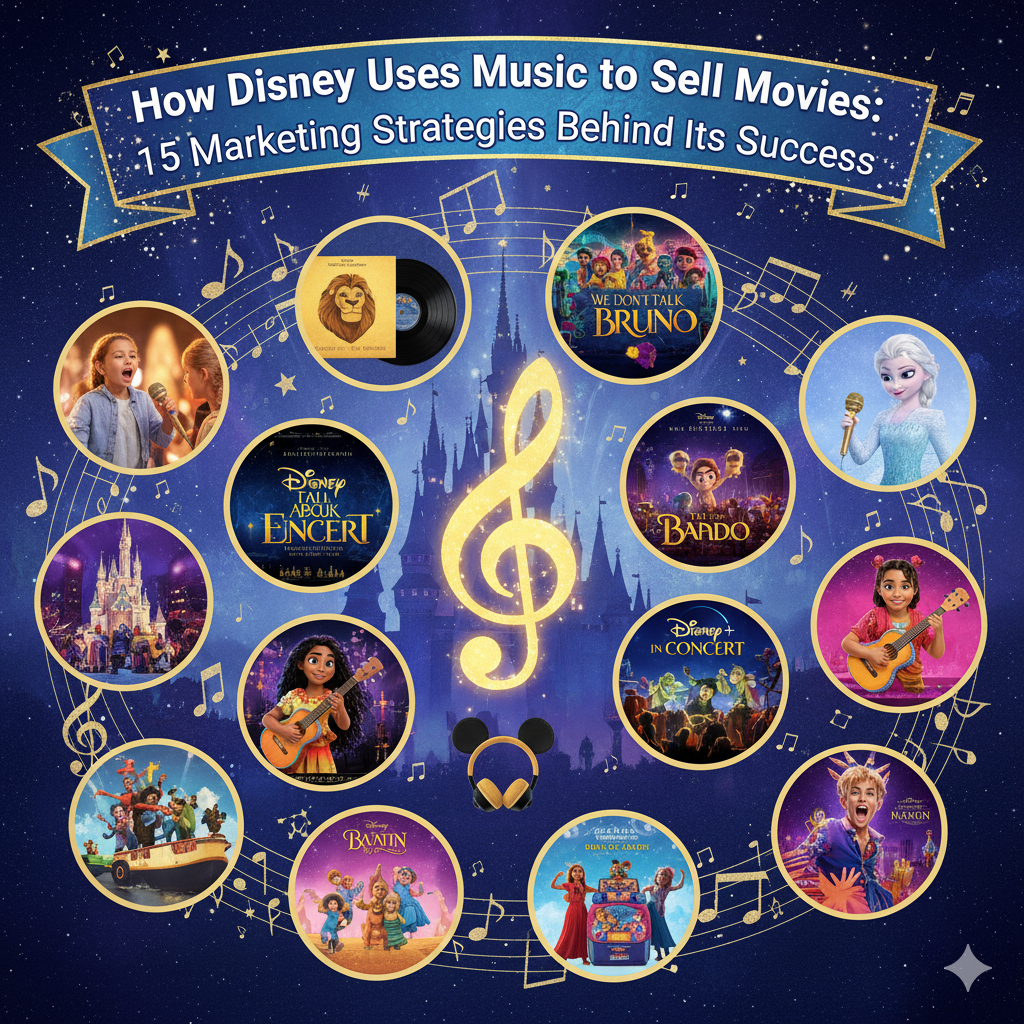
12 Dec How Disney Uses Music to Sell Movies: 15 Marketing Strategies Behind Its Success
There’s something almost alchemical about the way Disney uses music—how a single shimmering note can skitter across your brain, set up permanent residence, and suddenly you’re humming your way into the theater without even realizing you’ve been expertly guided there. It’s the kind of emotional engineering any leading marketing agency in New York secretly studies with a mix of admiration and mild professional envy. Because Disney doesn’t just create songs; it creates cultural moments, little melodic ambassadors that sell stories before the trailers even finish buffering. And if you’ve ever wondered how they turn three-minute tunes into billion-dollar box-office catalysts, consider this your front-row seat to the soundtrack of their strategy.
How Disney Uses Music to Sell Movies
A quick-scan breakdown of how the keyword How Disney Uses Music to Sell Movies translates into concrete, repeatable marketing strategies you can adapt for your own campaigns.
| # | Strategy | What Disney Does | Marketing Lesson You Can Steal |
|---|---|---|---|
| 01 |
Pre-Launch Hype Drop the song before the movie Think “Let It Go” before Frozen.
|
Releases the hero track weeks or months ahead so audiences fall in love with the music first, then show up for the story behind it. | Launch a flagship asset early so your audience is already emotionally primed when the main offer goes live. |
| 02 |
Earworm Engineering Hooks that live in your head |
Crafts ultra-memorable melodies and repeatable phrases that trigger replay after replay. | Make your brand audio and slogans simple, sticky, and unforgettable. |
| 03 |
Star Power Collaborate with big-name artists |
Partners with global stars for alternate versions, instantly expanding reach. | Co-create with creators or celebrities to borrow their built-in audience. |
| 04 |
Version Stacking Multiple cuts of the same song |
Produces theatrical, pop, acoustic, and multilingual versions. | Repurpose your core message for every platform and audience. |
| 05 |
Visual First High-impact music & lyric videos |
Wraps songs in cinematic visuals that go viral on YouTube. | Pair audio with scroll-stopping visuals for maximum impact. |
| 06 |
TikTok Native Built for trends and memes |
Emphasizes memeable song segments perfect for TikTok. | Create remixable moments that encourage user participation. |
| 07 |
Story Teasers Songs that hint at the plot |
Uses lyrics and emotional arcs to preview character journeys. | Tease the transformation behind your offer to spark curiosity. |
| 08 |
Playlist Real Estate Owning streaming shelf space |
Secures prime placement on curated playlists for discovery. | Get your brand content featured where your audience already consumes. |
| 09 |
Cross-Channel Saturation One song, everywhere |
Reuses motifs across trailers, parks, promos, and partnerships. | Anchor your campaign with one recognizable brand motif. |
| 10 |
Nostalgia Hits Emotional callbacks & reprises |
Revisits familiar musical themes to trigger nostalgia. | Leverage your brand’s heritage to build emotional trust. |
| 11 |
Live Hype Amplifying Hype Through Live Cast Performances |
Cast members perform signature songs on talk shows, award stages, and livestreams—turning each moment into a cultural event. | Showcase your team live through webinars, events, or Q&As to generate real-time excitement. |
| 12 |
Evergreen Moments Award shows & performances |
Turns songs into broadcast events that extend relevance. | Use live moments to transform content into experiential marketing. |
| 13 |
Cultural Sparks Spotlighting Villain Songs to Spark Cultural Buzz |
Elevates dramatic villain numbers that audiences obsess over—fueling memes, remixes, and deep-dive commentary. | Highlight bold or edgy brand elements to ignite conversations and stand out online. |
| 14 |
Evergreen Products Soundtracks as standalone assets |
Treats soundtracks like full product lines—vinyls, playlists & deluxe editions. | Turn content into reusable, evergreen brand assets. |
| 15 |
Fan-Powered Reach Covers, choirs & remixes |
Encourages creators, choirs, and fans to make covers that expand reach. | Make remixing your content easy so your audience becomes your amplifier. |
How Disney Uses Music to Sell Movies: 15 Marketing Strategies Behind Its Success
How Disney Uses Music to Sell Movies: Marketing Strategies Behind Its Success #3 — Borrowing Star Power Through Celebrity Collaborations
Disney approaches celebrity collaborations the way New Yorkers approach brunch reservations — with strategy, enthusiasm, and the kind of urgency that borders on Olympic sport. When they rope in a global pop star to reimagine a soundtrack song, it’s not just a musical cameo; it’s a full-blown cultural handshake that instantly expands the film’s orbit. Suddenly, a Disney track isn’t simply for families or nostalgic millennials — it’s appearing on Top 40 playlists, gym mixes, and that one playlist titled Songs That Make Me Feel Like the Main Character. These collabs inject glamour, relevance, and a delicious sense of “wait, Disney did THAT?” into the marketing ecosystem. And before you know it, the movie transcends mere moviehood — it becomes a shared cultural event, the kind people quote, duet, dance to, and treat like a moment they absolutely cannot miss.
How Disney Uses Music to Sell Movies: Marketing Strategies Behind Its Success #4 — Version Stacking to Maximize Reach
Disney approaches song releases the way a fashion girl approaches layering: why wear one excellent piece when you can stack five and call it intentional? An acoustic version here, a dramatic Broadway-style reprise there, and of course the multilingual tracks that feel like global friendship bracelets handed out at scale — each one is crafted to charm a different corner of the audience. It’s less “one song fits all” and more “one song shapeshifts for everyone,” which is why their soundtracks feel eerily omnipresent, slipping effortlessly into playlists across cultures, moods, and algorithms. In marketing terms, it’s a masterclass in giving the same core message multiple front doors, so every listener finds the entry that feels tailor-made for them. By the time the movie finally graces the screen, the music feels like a familiar face you’ve run into at enough parties to greet with a knowing smile.
How Disney Uses Music to Sell Movies: Marketing Strategies Behind Its Success #5 — Using Music Videos as Emotional Trailers
Disney doesn’t simply drop music videos; it curates miniature emotional epics that feel like the cinematic equivalent of reading someone’s diary before you’ve officially met them. These videos let you taste the film’s tone — its spark, its softness, its chaos, its charm — long before a traditional trailer ever rolls out. In three art-directed minutes, the audience is already vibing with the characters, sensing the stakes, and choosing favorites, the same way you decide who at a dinner party is worth sitting next to based on their first laugh. Sometimes these music videos even outperform the trailers themselves because they’re pure feeling — all heart, no exposition. It’s Disney letting the characters walk into the room first, make eye contact with you, and say, “You’re going to want to know me.”
How Disney Uses Music to Sell Movies: Marketing Strategies Behind Its Success #6 — Designing Songs for TikTok Virality
Disney reads TikTok the way your impossibly cool friend reads thrift shops in the East Village — intuitively, instinctively, and with a sixth sense for what’s about to pop off. Their songs are engineered with delicious little micro-moments: a dramatic pause begging to be memed, a high note aching for someone to duet it, a rhythm practically choreographing itself. These snippets become the digital equivalent of inside jokes — endlessly replicated, shared, mutated, and reborn in thousands of creator hands. Fans turn the music into shorthand: a vibe, a wink, a cultural signature that travels faster than any ad spend ever could. All Disney has to do is give the first nudge… and TikTok does what TikTok does — it sings.
How Disney Uses Music to Sell Movies: Marketing Strategies Behind Its Success #7 — Using Lyrics as Soft-Power Storytelling
Disney treats lyrics the way a great novelist treats chapter one: not as a beginning, but as an invitation. Their songs offer these delicious little narrative hors d’oeuvres — tiny emotional bites that hint at who a character is, what they want, and where their heart is quietly wandering. Before the plot even arrives, you’re already aligned with someone’s dream or dilemma, which feels a bit like overhearing a stranger’s confessional on the subway and instantly rooting for them. It’s clever, almost disarmingly so, because the bonding happens subtly, line by line, long before you’re officially introduced. By the time the film starts rolling, you don’t just understand the character — you feel like you’ve already had coffee with them.
How Disney Uses Music to Sell Movies: Marketing Strategies Behind Its Success #8 — Owning Playlist Real Estate
Disney approaches playlists the way a downtown fashion girl approaches brunch spots during peak season — with strategy, finesse, and a keen sense of which tables offer the best visibility. By landing their songs in top-tier streaming playlists, they turn casual listeners into accidental fans, the way you might fall in love with a new designer simply because her pieces keep appearing in your periphery. These soundtrack placements slip into morning commutes, gym sessions, study playlists — becoming tiny emotional nudges toward the film without feeling the slightest bit salesy. It’s ambient familiarity at its most elegant: you don’t remember when you first heard the song, only that you now know every beat of it. This is Disney’s passive marketing magic — subtle, stylish, and everywhere you happen to be.
How Disney Uses Music to Sell Movies: Marketing Strategies Behind Its Success #9 — Releasing Behind-the-Scenes Music Moments to Deepen Emotional Buy-In
Disney knows that nothing seduces an audience quite like a peek behind the velvet curtain. So they release behind-the-scenes studio moments — those grainy, goosebump-inducing clips where a vocalist cracks open a character’s heart one take at a time. These snippets feel intimate, almost conspiratorial, like being invited into the emotional workshop where the movie’s magic is first forged. It’s marketing disguised as vulnerability: once you watch an artist lay down a vocal line with that raw, unfiltered energy, you’re already invested in the story it belongs to. By the time the movie premieres, you aren’t just excited — you feel connected, like you were there for the song’s very first breath.
How Disney Uses Music to Sell Movies: Marketing Strategies Behind Its Success #10 — Harnessing Nostalgia as a Marketing Accelerant
Disney speaks nostalgia the way poets speak longing — fluently, tenderly, and with an effortless ability to make you feel eight years old and oddly emotional in the dairy aisle. Their music leans into familiar motifs, melodic callbacks, and subtle echoes of classics you once played on a loop in a bedroom plastered with glow-in-the-dark stars. These sonic winks aren’t accidents; they’re beautifully engineered reminders that Disney is not just entertainment — it’s a timeline. A bridge. A shared emotional language between parents who once sang the songs and kids who are singing them now. Nostalgia becomes the accelerant that brings generations back into the fold, proving that a Disney movie doesn’t simply arrive… it returns, carrying every memory you ever attached to it.
How Disney Uses Music to Sell Movies: Marketing Strategies Behind Its Success #11 — Amplifying Hype Through Live Cast Performances
Disney understands that a live vocal moment can do what a billboard never will: spark goosebumps, uproot emotions, and convince you—instantly—that a movie deserves your full attention. So they send cast members out into the world, letting them perform on stages, sets, sound booths, and livestreams where fans can watch the magic happen in real time. These performances feel raw and present, like witnessing the emotional architecture of the film being built before your eyes. It transforms the music from a soundtrack into a shared moment, one you experienced alongside the artist. By the time the movie drops, you’re not just familiar with the song—you’re attached to the person who gave it life.
How Disney Uses Music to Sell Movies: Marketing Strategies Behind Its Success #12 — Leveraging Live Performances as Marketing Events
Disney treats live performances the way fashion houses treat Fashion Week — as glittering cultural stages where spectacle and strategy hold hands. Award shows, holiday parades, late-night talk spots… each becomes a pop-up amphitheater for Disney’s musical universe. And there’s something undeniably electric about hearing a soundtrack song performed live — it’s sharper, more urgent, more “you had to be there.” These moments don’t just promote the film; they canonize it, giving it cultural weight and a little bit of sparkle-dusted legitimacy. And when the clip inevitably goes viral (because of course it does), the movie soaks up every watt of that borrowed spotlight. Disney knows: a live performance isn’t just marketing — it’s a moment.
How Disney Uses Music to Sell Movies: Marketing Strategies Behind Its Success #13 — Spotlighting Villain Songs to Spark Cultural Buzz
Disney knows that a good villain doesn’t just steal scenes — they hijack the cultural conversation. So when a movie includes a villain song, Disney turns it into a full-fledged event: dramatic teasers, moody soundbites, smoky character visuals, the whole theatrical spread. These songs feel dangerous and glamorous, like the musical equivalent of dark lipstick — bold, memorable, and impossible to ignore. And because villain songs tend to be the most personality-forward tracks, they spread across social media like sparkly wildfire. By the time the movie premieres, the villain is already a star — and audiences are primed for the drama.
How Disney Uses Music to Sell Movies: Marketing Strategies Behind Its Success #14 — Turning Soundtracks Into Evergreen Products
Disney doesn’t treat soundtracks like fleeting merch; they treat them like heirlooms — the kind of beautifully packaged, emotionally charged products meant to live on your shelves (and in your headphones) for years. Vinyls, deluxe editions, alternate covers, streaming-only releases… each one extends the movie’s cultural half-life just a little bit longer. The soundtrack becomes its own collectible universe, a way for fans to keep revisiting the film’s emotional architecture long after the credits stop rolling. And in true Disney fashion, this isn’t just nostalgia — it’s a revenue stream that loops gracefully, season after season. It’s the long-tail strategy, but set to a melody you can’t quite stop humming.
How Disney Uses Music to Sell Movies: Marketing Strategies Behind Its Success #15 — Encouraging Fan Remixes, Covers & Choir Versions
Disney knows a song has truly entered the cultural bloodstream when people start singing it back — loudly, proudly, and in 47 different harmonies. So they design their music like open invitations: emotionally expansive enough for choirs, vocally juicy enough for soloists, rhythmically clear enough for TikTok creators, and melodically irresistible for anyone who has ever attempted a bathroom mirror performance. The moment a fan covers a Disney song, they become an unpaid brand evangelist, distributing the film’s emotional message to their own corner of the internet. And because these reinterpretations multiply across choirs, creators, orchestras, influencers, and “that one cousin who does riffs,” the movie’s reach expands effortlessly. It’s user-generated marketing disguised as musical joy — and Disney, ever the genius, simply lets the fandom do the heavy lifting.
Where Music Becomes the Marketing Magic
Disney doesn’t just make movies; it engineers cultural moments — and music is the shimmering thread that ties it all together. From pre-launch earworms to collectible vinyl drops, from viral TikTok harmonies to live performances that feel like mini pop-culture holidays, Disney’s soundtrack strategy works because it meets audiences where they feel most alive: emotionally, nostalgically, and socially. Each song becomes a touchpoint, each melody a micro-campaign, and each fan cover a signal boost the brand didn’t even have to pay for.
In the end, Disney’s secret isn’t just magical storytelling — it’s understanding that when people fall in love with a song, they fall in love with the world it comes from. And that world, note by strategic note, leads them straight into the theater.