



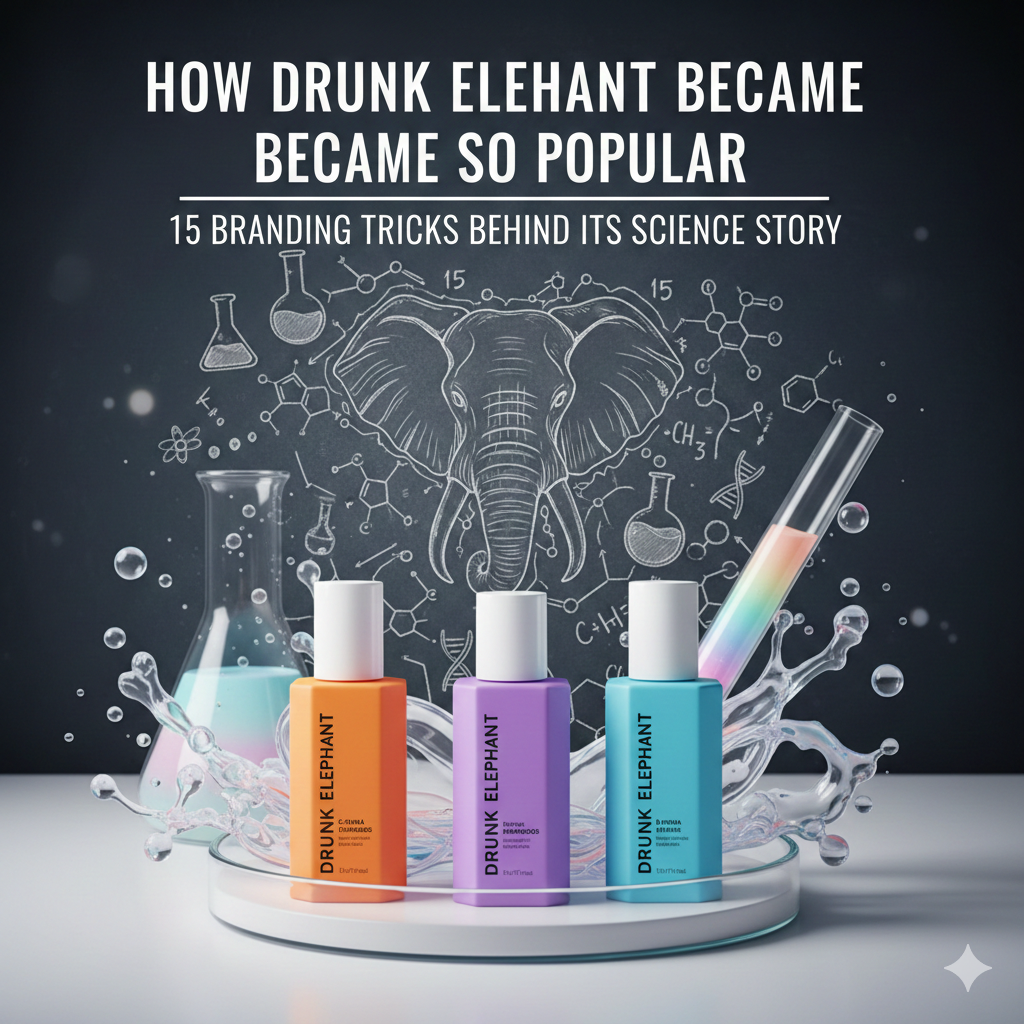
21 Dec How Drunk Elephant Became So Popular: 15 Branding Tricks Behind Its Science Story
How Drunk Elephant Became So Popular: 15 Branding Tricks Behind Its Science Story (Editor’s Choice)
Brand Breakdown
How Drunk Elephant Became So Popular
15 branding tricks behind the “science story” that made skincare feel like a movement.
How Drunk Elephant Became So Popular: 15 Branding Tricks Behind Its Science Story
How Drunk Elephant Became So Popular: Branding Tricks Behind Its Science Story #1 — They turned skincare science into a belief system, not a claim
Drunk Elephant didn’t explain ingredients; it assigned them values. Instead of overwhelming consumers with chemistry (a guaranteed buzzkill), they offered a philosophy—almost a lifestyle rulebook—for “better skin.” You don’t just use the products, you believe in them. And belief is sticky. This reframing makes skincare feel less transactional and more ideological, which is precisely why people defend it in comment sections like it’s a personal choice, not a cleanser.
How Drunk Elephant Became So Popular: Branding Tricks Behind Its Science Story #2 — They gave skincare a villain, and skincare loves a villain
Nothing bonds people faster than a shared enemy, and Drunk Elephant understood this instinctively. By clearly naming what not to use, they simplified decision-making and turned confusion into confidence. Suddenly, skincare wasn’t about trial and error—it was about avoidance and purity. It’s a narrative trick as old as storytelling itself: define the danger, then sell the safety.
How Drunk Elephant Became So Popular: Branding Tricks Behind Its Science Story #3 — They named the routine, so people could join it
A routine without a name is invisible. A routine with a name becomes a commitment. By framing skincare use as a reset, Drunk Elephant transformed repetition into purpose. The act of using products daily became a finite challenge with a beginning, middle, and payoff. This structure makes patience feel productive, not passive. It also makes the experience shareable—because you can’t post about “using stuff consistently,” but you can post about being on a reset. Naming creates narrative, and narrative creates momentum.
How Drunk Elephant Became So Popular: Branding Tricks Behind Its Science Story #4 — They chose a name that sounds like fashion, not pharma
“Drunk Elephant” sounds like something you’d overhear at a dinner party, not read on a prescription label—and that’s exactly why it works. The name creates intrigue before the product ever touches skin. In an industry crowded with sterile, science-heavy naming conventions, this one feels editorial, almost playful. It suggests confidence: a brand so sure of its efficacy that it doesn’t need to sound clinical. Memorability isn’t accidental here—it’s strategic. People remember what feels slightly out of place, and Drunk Elephant thrives in that tension.
How Drunk Elephant Became So Popular: Branding Tricks Behind Its Science Story #5 — They designed packaging for mirrors and algorithms
Drunk Elephant packaging isn’t subtle, and that’s the point. The colors pop in bathrooms, on shelves, and—most importantly—on screens. In an era where skincare is documented as much as it’s used, visibility is everything. The packaging performs equally well in real life and digital life, which means every consumer becomes a potential distributor of the brand’s image. It’s not just design; it’s distribution. The bottle is doing marketing work long after checkout.
How Drunk Elephant Became So Popular: Branding Tricks Behind Its Science Story #6 — They made science feel friendly, not intimidating
Drunk Elephant speaks science fluently without weaponizing it. There’s authority, but no condescension. The tone says, “We’ve done the research—now let’s make this usable.” This matters because intimidation repels, while clarity invites. By translating complex concepts into approachable language, the brand allows consumers to feel informed rather than inadequate. Confidence grows when people understand why something works, and confident customers are loyal ones.
How Drunk Elephant Became So Popular: Branding Tricks Behind Its Science Story #7 — They turned education into content, not footnotes
Education wasn’t hidden behind dropdown menus—it was the main event. Drunk Elephant treats knowledge as a value-add, not a disclaimer. This shifts the brand’s role from seller to guide. When a brand teaches you, it earns authority without asking for it. Over time, this positions the brand as a reference point, not just an option. Education builds trust quietly, and quiet trust lasts longer than hype.
How Drunk Elephant Became So Popular: Branding Tricks Behind Its Science Story #8 — They created a framework fans could quote
Drunk Elephant didn’t just give results; it gave language. Consumers could suddenly articulate their skincare choices with confidence. This turns customers into educators, and educators into advocates. When people can explain something clearly, they trust it more—and so do others. A quotable framework scales faster than a vague promise.
How Drunk Elephant Became So Popular: Branding Tricks Behind Its Science Story #9 — They said the same thing everywhere, on purpose
Consistency is often mistaken for lack of creativity, but here it’s discipline. Drunk Elephant repeats its core message relentlessly, allowing familiarity to turn into trust. Over time, repetition stops feeling like marketing and starts feeling like truth. This is how brands move from being considered to being assumed.
How Drunk Elephant Became So Popular: Branding Tricks Behind Its Science Story #12 — They reduced choice to increase commitment
A curated lineup removes anxiety. Instead of asking consumers to build a routine from scratch, Drunk Elephant offered a system. Systems create loyalty because they reward consistency. When fewer decisions are required, follow-through increases—and so does lifetime value.
How Drunk Elephant Became So Popular: Branding Tricks Behind Its Science Story #13 — They turned shelves into brand billboards
Retail placement wasn’t passive—it was performative. A wall of Drunk Elephant products signals dominance, popularity, and confidence. Presence becomes persuasion. When something occupies space boldly, it implies demand, even before proof is offered.
How Drunk Elephant Became So Popular: Branding Tricks Behind Its Science Story #14 — They led with the founder, not a faceless lab
The founder story added humanity to the science. It reminded consumers that the brand was born from personal frustration, not market research alone. This emotional grounding makes authority relatable—and relatability believable. People trust people before they trust processes.