



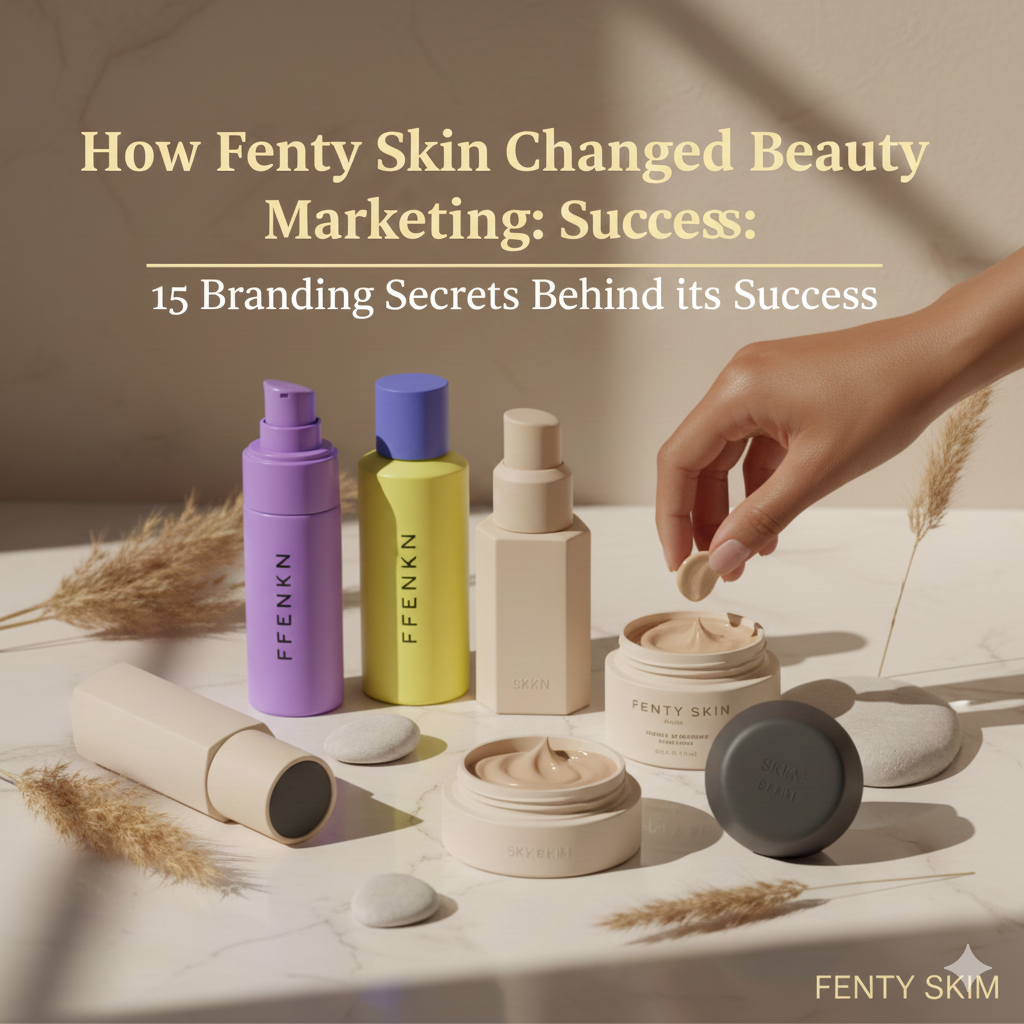
20 Dec How Fenty Skin Changed Beauty Marketing: 15 Branding Secrets Behind Its Success
How Fenty Skin Changed Beauty Marketing: 15 Branding Secrets Behind Its Success (Editor’s Choice)
How Fenty Skin Changed Beauty Marketing
15 branding moves that made skincare feel like culture — fast to scan, easy to steal (ethically).
| # | Branding Secret | Why It Works | Steal This Move |
|---|---|---|---|
| 1 |
Mission-first, product-second People buy meaning before they buy moisturizers. |
A clear “why” turns products into a story customers want to join. |
Write a 1-line belief
Build every SKU to prove it
|
| 2 |
Skincare as culture, not homework Modern audiences want vibe + value. |
It makes skincare approachable and shareable. |
Swap jargon for vibe
Show the “feels” on video
|
| 3 |
Routine-first product strategy Routines create habits → repeat sales. |
Systems outperform one-off hero products over time. |
Create a 3-step path
Bundle it clearly
|
| 4 |
Simplicity as the differentiator Less confusion = faster checkout. |
In an overloaded category, clarity is premium. |
Cut steps ruthlessly
Name benefits plainly
|
| 5 |
Halo leverage from Fenty Beauty Trust transfers across categories. |
It lowers adoption friction for new buyers. |
Borrow your strongest proof
Keep the brand codes consistent
|
| 6 |
Founder as format, not just face Feels like real use, not a script. |
Authenticity scales when the founder is part of the story engine. |
Show your actual routine
Talk like a human
|
| 7 |
Inclusive by default Not a campaign — a baseline. |
It builds trust because it’s consistent and visible. |
Cast for reality
Design for many needs
|
| 8 |
Community-first launch energy Fans become distribution. |
Insider energy makes sharing feel like identity, not promo. |
Early access perks
UGC prompts that feel fun
|
| 9 |
Social-native creative Built for scroll behavior. |
Short demos + personality win over polished ads. |
Hook in 2 seconds
Demo > claims
|
| 10 |
Packaging engineered to be photographed Customers become your media. |
High-recognition design amplifies organic sharing. |
Design for bathroom selfies
Keep brand codes bold
|
| 11 |
Sensory storytelling (texture, glow, feel) Skincare is hard to “prove” instantly. |
Sensory cues translate perfectly in video and reviews. |
Film texture close-ups
Describe the finish clearly
|
| 12 |
A clear POV: “realistic skincare” Targets the huge “I want results” middle. |
Positioning becomes a filter that attracts the right customer. |
Name your enemy (complexity)
Own your lane loudly
|
| 13 |
Trust cues without pharmacy vibes Credible + warm is rare. |
Balances ingredients/benefits with an approachable tone. |
Explain simply
Avoid fear-based claims
|
| 14 |
Drop culture rhythm Launches feel like events. |
Hype cycles keep attention high in crowded feeds. |
Tease, then reveal
Make launch day a moment
|
| 15 |
A voice that feels like a person Memorable brands sound human. |
A strong voice builds loyalty through identity and recognition. |
Write like you talk
Keep tone consistent everywhere
|
How Fenty Skin Changed Beauty Marketing: 15 Branding Secrets Behind Its Success
How Fenty Skin Changed Beauty Marketing: Branding Secrets Behind Its Success #3 — The Power of a Routine-First Strategy
Instead of selling us a hero product with delusions of grandeur, Fenty Skin sold us a system. A routine says: stay. It removes friction, answers questions before they’re asked, and quietly builds loyalty through habit. This is marketing that understands human behavior rather than chasing virality. When a brand gives you a clear path—cleanse, treat, moisturize—it stops feeling transactional and starts feeling supportive. You’re no longer shopping; you’re committing. And commitment is where brand love lives.
How Fenty Skin Changed Beauty Marketing: Branding Secrets Behind Its Success #4 — Simplicity as a Status Symbol
There’s a quiet confidence in not overexplaining yourself, and Fenty Skin built an entire brand around that idea. In an industry addicted to maximalism—ten steps, twelve actives, endless disclaimers—clarity became the flex. Fewer products. Clear benefits. No drama. This isn’t minimalism for the sake of aesthetics; it’s minimalism as a sign of authority. The message is subtle but powerful: if you really know what you’re doing, you don’t need to shout.
How Fenty Skin Changed Beauty Marketing: Branding Secrets Behind Its Success #5 — Borrowed Trust, Perfectly Executed
Fenty Skin didn’t need to prove credibility from scratch—it inherited it, and then respected it. The trust built by Fenty Beauty wasn’t just borrowed; it was translated. Same values, different category, consistent tone. That continuity is what makes expansion feel intentional rather than opportunistic. When a brand understands its own equity, it knows exactly how far it can stretch without snapping. Fenty Skin feels inevitable because it feels aligned—and alignment is the most underutilized growth strategy in branding.
How Fenty Skin Changed Beauty Marketing: Branding Secrets Behind Its Success #6 — The Founder as Format, Not Mascot
Rihanna doesn’t “endorse” Fenty Skin; she inhabits it. That distinction matters. She’s not positioned as a flawless authority hovering above the brand, but as a lived-in reference point—someone with skin, moods, and off-days. This turns founder visibility into infrastructure, not decoration. When the founder becomes part of the content ecosystem rather than a campaign asset, authenticity scales without feeling manufactured. It’s presence without performance, which is why it works.
How Fenty Skin Changed Beauty Marketing: Branding Secrets Behind Its Success #7 — Inclusion Without the Announcement
Fenty Skin doesn’t introduce inclusivity with a press release. It simply operates that way. Different skin tones, textures, genders, and routines appear without explanation or apology, which is exactly the point. By removing the performative framing, inclusion becomes normalized rather than spotlighted. It’s not a moment—it’s a baseline. And in marketing, baselines are far more powerful than campaigns.
How Fenty Skin Changed Beauty Marketing: Branding Secrets Behind Its Success #8 — Community as the Quiet Growth Engine
Fenty Skin never talks at its audience; it builds with them. The brand’s early momentum came from making customers feel like participants rather than prospects. Reviews, routines, reposts, and creator collaborations don’t feel like marketing tactics—they feel like dialogue. When people sense that a brand is listening, they contribute. And contribution is the most scalable form of loyalty.
How Fenty Skin Changed Beauty Marketing: Branding Secrets Behind Its Success #9 — Content Built for the Scroll, Not the Shelf
Fenty Skin understands that attention is rented, not owned. Its content doesn’t demand reverence; it earns curiosity. Short, tactile, personality-forward videos replace pristine, overproduced ads. Everything is optimized for how people actually consume content—quickly, intuitively, and emotionally. This isn’t dumbing down; it’s smart adaptation. The brand respects the feed, and the feed returns the favor.
How Fenty Skin Changed Beauty Marketing: Branding Secrets Behind Its Success #10 — Packaging Designed for Real Life, Not Just Retail
Fenty Skin packaging is less “display case” and more “lived-in luxury.” It photographs beautifully without trying too hard, which makes it inherently social. This is packaging as permission—permission to share, to style, to include it in your personal visual language. When a product looks good in the wild, it doesn’t need to beg for attention.
How Fenty Skin Changed Beauty Marketing: Branding Secrets Behind Its Success #11 — Sensory Proof Over Technical Claims
You can’t feel an ingredient list, but you can feel texture, glow, and finish—and Fenty Skin leans into that reality. Instead of over-explaining efficacy, the brand lets sensory cues do the talking. The slip of a cleanser, the sheen of hydrated skin, the satisfaction of a routine completed. This is skincare translated into something visual, emotional, and immediately legible.
How Fenty Skin Changed Beauty Marketing: Branding Secrets Behind Its Success #12 — A POV That Claims the Middle Ground
Fenty Skin isn’t extremist skincare. It doesn’t chase clinical maximalism or performative minimalism. Instead, it occupies the most underserved position: people who want results without obsession. That clarity acts as a magnet. When a brand knows exactly who it’s not for, it becomes irresistible to the people it is.
How Fenty Skin Changed Beauty Marketing: Branding Secrets Behind Its Success #13 — Credibility Without Clinical Coldness
Fenty Skin manages the rare balance of being informed without being intimidating. Ingredients are acknowledged, not weaponized. Benefits are explained, not exaggerated. This tone builds trust without alienating the consumer who doesn’t want to feel like they’re taking a quiz before checkout. Confidence, here, is calm.
How Fenty Skin Changed Beauty Marketing: Branding Secrets Behind Its Success #14 — Launches That Feel Like Cultural Moments
Fenty Skin treats launches like punctuation marks, not noise. There’s anticipation, a clear reveal, and then space to let the product breathe. This rhythm borrows from fashion and music culture, where timing is as important as the drop itself. Skincare becomes eventful without becoming exhausting.
How Fenty Skin Changed Beauty Marketing: Branding Secrets Behind Its Success #15 — A Brand Voice That Knows Who It Is
Perhaps the most enduring advantage Fenty Skin has is that it sounds like a person with taste. The copy is confident but not loud, informed but not smug. It doesn’t try to win everyone—it speaks directly to someone. And when a brand knows how it speaks, it knows how it behaves everywhere else. Voice, after all, is strategy you can hear.