



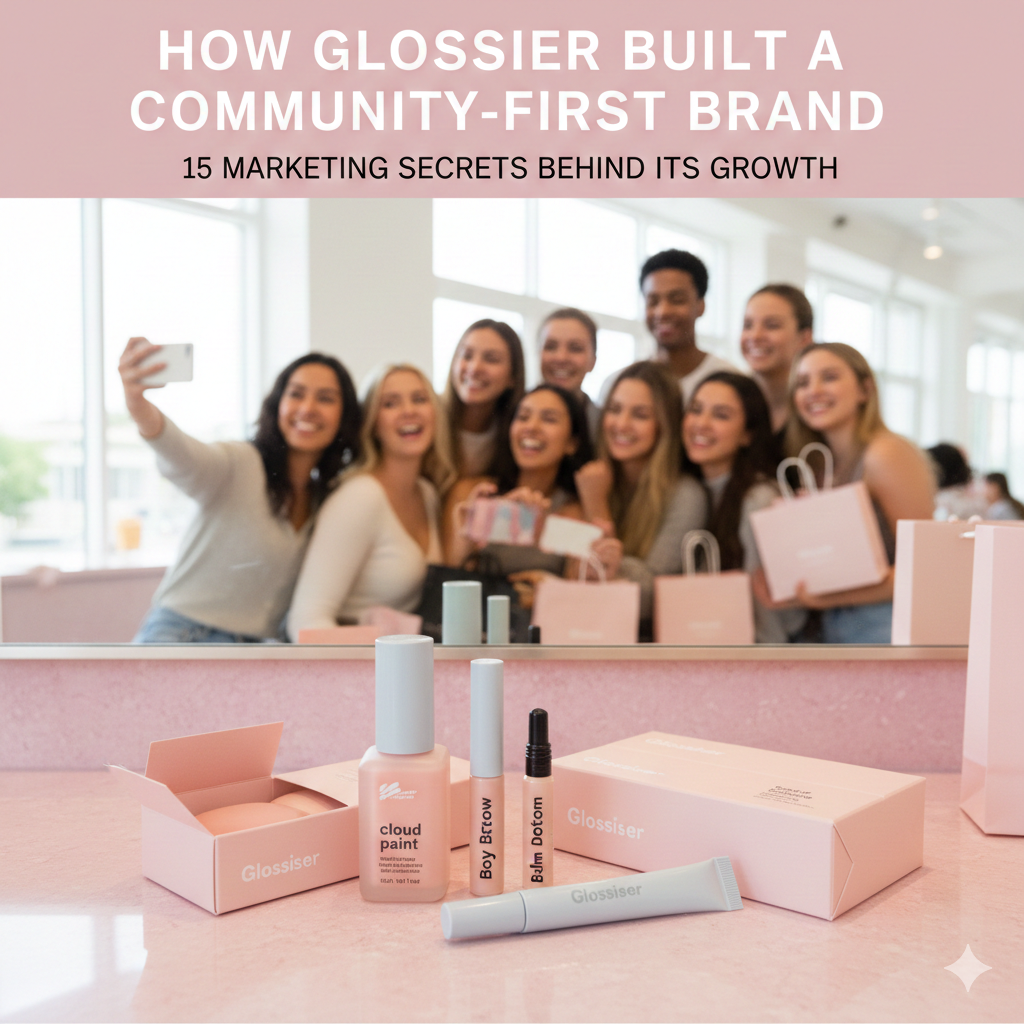
20 Dec How Glossier Built a Community-First Brand: 15 Marketing Secrets Behind Its Growth
How Glossier Built a Community-First Brand: 15 Marketing Secrets Behind Its Growth (Editor’s Choice)
How Glossier Built a Community-First Brand
15 marketing secrets behind its growth—designed to skim beautifully and read deeply.
| # | Marketing Secret | What Glossier Did | Why It Worked |
|---|---|---|---|
| 1 | Community before product | Built *Into The Gloss* years before launching products. | Trust and demand existed before the first SKU. |
| 2 | Two-way conversation | Treated comments and DMs as dialogue, not noise. | People felt heard, not marketed to. |
| 3 | Co-creation | Invited customers to shape formulas and ideas. | Customers became stakeholders. |
| 4 | Editorial-first content | Focused on routines, stories, and people. | Trust converted better than promotion. |
| 5 | User-generated content | Centered real customers in brand visuals. | Authenticity replaced aspiration. |
| 6 | Micro-influencer strategy | Partnered with everyday creators. | Relatability scaled better than fame. |
| 7 | Recognition culture | Highlighted and rewarded community participation. | Loyalty deepened through visibility. |
| 8 | Word-of-mouth growth | Designed products people wanted to talk about. | Referrals felt organic, not engineered. |
| 9 | Consistent visual identity | Maintained a recognizable, restrained aesthetic. | Consistency built memory. |
| 10 | Conversational brand voice | Sounded like a friend, not a corporation. | Human tone invited human connection. |
| 11 | Experiential retail | Created immersive pop-ups and stores. | Experiences became shareable stories. |
| 12 | Social listening | Used feedback to guide decisions. | Listening reduced missteps. |
| 13 | Story-led PR | Led with narrative, not features. | Stories traveled further than specs. |
| 14 | Cultural relevance | Participated in culture without chasing it. | Relevance felt effortless. |
| 15 | Community as the brand | Blurred the line between customer and company. | Belonging drove long-term growth. |
How Glossier Built a Community-First Brand: 15 Marketing Secrets Behind Its Growth
How Glossier Built a Community-First Brand: Marketing Secrets Behind Its Growth#1 — Community Came First, Product Came Later
Before Glossier ever asked anyone to buy, it asked them to talk. Into The Gloss wasn’t a marketing channel—it was a gathering place. The brilliance here wasn’t foresight; it was patience. By documenting beauty as culture rather than commerce, Glossier built emotional equity long before financial return. When the products finally arrived, they weren’t strangers—they were inevitable. The takeaway is uncomfortable but clear: brands that rush to sell skip the most valuable step—earning attention without asking for anything back.
How Glossier Built a Community-First Brand: Marketing Secrets Behind Its Growth#2 — Conversation Was the Strategy
Glossier didn’t outsource its voice to templates or scripts. Replies felt personal, curious, human. That mattered. In a digital world where most brands talk at people, Glossier talked with them. This wasn’t customer service—it was relationship maintenance. And relationships, unlike impressions, compound. The lesson: responsiveness isn’t a tactic; it’s a signal of respect.
How Glossier Built a Community-First Brand: Marketing Secrets Behind Its Growth#3 — Products Were Co-Created, Not Announced
Instead of presenting perfection, Glossier presented possibility. They asked what people wanted—and then listened long enough to build it. This reframed customers from consumers into collaborators. When people help create something, criticism softens and advocacy sharpens. Co-creation doesn’t just improve products; it creates emotional ownership.
How Glossier Built a Community-First Brand: Marketing Secrets Behind Its Growth#4 — The Content Never Felt Like Marketing
Glossier content felt editorial because it was. It observed rather than interrupted. It trusted intelligence over urgency. By prioritizing tone, taste, and restraint, the brand made marketing invisible—and therefore effective. The paradox: when content doesn’t try to sell, it sells better.
How Glossier Built a Community-First Brand: Marketing Secrets Behind Its Growth#5 — Customers Became the Aesthetic
Bathrooms replaced studios. Real skin replaced perfection. By centering user-generated content, Glossier quietly dismantled aspiration marketing. The message was subtle but radical: you are already enough. When customers see themselves reflected, loyalty stops being performative and becomes personal.
How Glossier Built a Community-First Brand: Marketing Secrets Behind Its Growth#6 — Influence Was Intimate, Not Aspirational
Glossier resisted the urge to borrow relevance from celebrities and instead built credibility through proximity. The people talking about the brand didn’t feel elevated above you; they felt like you. That choice mattered. Influence worked here because it mirrored real life—friends recommending products between errands, creators sharing routines without spectacle. By choosing intimacy over aspiration, Glossier embedded itself into everyday culture, not fantasy. Trust scales quietly, but it scales well.
How Glossier Built a Community-First Brand: Marketing Secrets Behind Its Growth#7 — Participation Was Seen, Named, and Valued
Glossier understood that people don’t engage for rewards—they engage for recognition. Replies weren’t automated. Features weren’t generic. Names were remembered. That subtle human acknowledgment turned passive followers into active contributors. When participation is visible, it becomes contagious. People don’t just want to be part of something; they want to be noticed within it.
How Glossier Built a Community-First Brand: Marketing Secrets Behind Its Growth#8 — Word of Mouth Was Engineered Through Experience
Glossier didn’t rely on incentives to spark conversation—it designed products and moments that begged to be discussed. Packaging felt giftable. Names felt playful. Experiences felt personal. Recommendations emerged naturally because they sounded like discoveries, not directives. The brand didn’t ask customers to share; it gave them something worth sharing.
How Glossier Built a Community-First Brand: Marketing Secrets Behind Its Growth#9 — Visual Consistency Created Emotional Memory
Glossier never chased reinvention for the sake of novelty. Instead, it committed to a visual language and stayed with it long enough for it to mean something. Over time, the colors, textures, and restraint became emotional shortcuts—signals of familiarity and trust. Consistency didn’t limit creativity; it sharpened it.
How Glossier Built a Community-First Brand: Marketing Secrets Behind Its Growth#12 — Listening Was a Discipline, Not a Department
Feedback wasn’t treated as an interruption—it was treated as direction. Glossier paid attention to what people praised, what they critiqued, and what they quietly stopped engaging with. That attentiveness allowed the brand to evolve without losing its center. Listening, here, wasn’t reactive—it was strategic.
How Glossier Built a Community-First Brand: Marketing Secrets Behind Its Growth#13 — Stories Traveled Further Than Features
Instead of leading with ingredients or specifications, Glossier led with people and context. Stories made the brand legible on a human level. Media coverage followed not because the products were new, but because the narrative was meaningful. Stories gave the brand cultural altitude.
How Glossier Built a Community-First Brand: Marketing Secrets Behind Its Growth#14 — Cultural Participation Without Performance
Glossier showed up in culture without shouting about it. Collaborations felt aligned, moments felt intentional, and silence was used as strategically as speech. The brand didn’t chase relevance—it waited to be relevant. That restraint made its presence feel earned.