



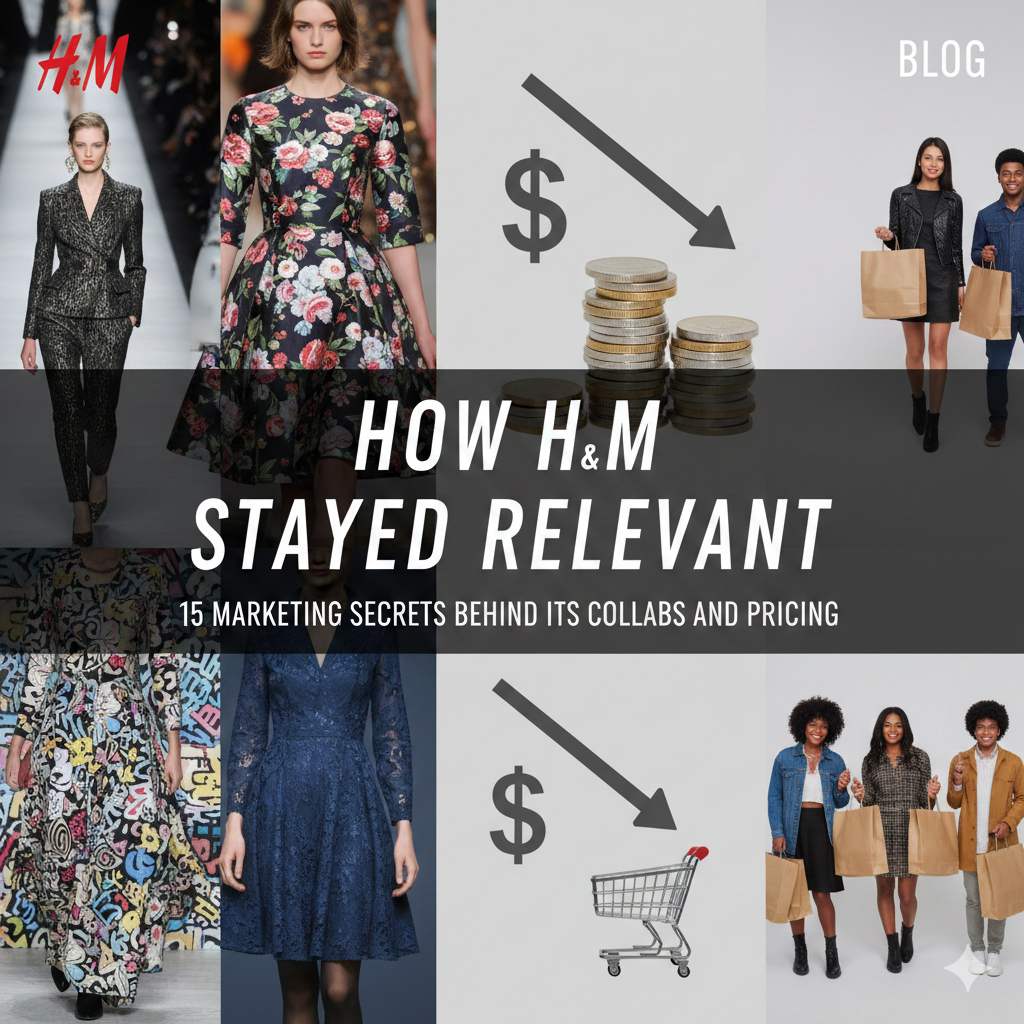
21 Dec How H&M Stayed Relevant: 15 Marketing Secrets Behind Its Collabs and Pricing
How H&M Stayed Relevant: 15 Marketing Secrets Behind Its Collabs and Pricing(Editor’s Choice)
How H&M Stayed Relevant: 15 Marketing Secrets
A clean, skimmable breakdown of the collaboration and pricing strategies that keep H&M culturally current.
| Marketing Secret | Why It Works | Focus Area |
|---|---|---|
|
1. High-Low Designer Collaborations
|
Makes luxury accessible while keeping the brand aspirational and culturally relevant.
|
Collabs |
2. Limited-Edition Drops |
Creates urgency, hype, and emotional attachment through scarcity. |
Collabs |
3. Nostalgia-Driven Marketing |
Builds trust and authority by reminding consumers of past cultural moments. |
Brand |
4. Cultural Icon Partnerships |
Borrows credibility and relevance from designers and public figures. |
Collabs |
5. Social-First Campaign Design |
Optimized visuals ensure attention and shareability on digital platforms. |
Digital |
6. Influencers as Interpreters |
Authentic styling builds trust and relatability over hard selling. |
Digital |
7. Inclusive by Default |
Normalizes diversity and strengthens emotional connection with audiences. |
Brand |
8. Seamless Omnichannel Experience |
Reduces friction and increases conversion across touchpoints. |
Experience |
9. Rapid Trend Adaptation |
Keeps assortments aligned with current cultural signals. |
Product |
10. Smart Value-Tier Pricing |
Balances accessibility with perceived quality and intelligence. |
Pricing |
11. Limited Discount Dependency |
Protects brand equity and encourages full-price purchasing. |
Pricing |
12. Data-Led Decisions |
Improves forecasting and relevance without compromising creativity. |
Strategy |
13. Sustainability as Enhancement |
Aligns values with desire instead of forcing compromise. |
Brand |
14. Localized Campaigns |
Keeps global brand identity while staying regionally relevant. |
Growth |
15. Storytelling Over Selling |
Gives products emotional context that extends cultural lifespan. |
Brand |
How H&M Stayed Relevant: 15 Marketing Secrets Behind Its Collabs and Pricing
How H&M Stayed Relevant: Marketing Secrets Behind Its Collabs and Pricing #3 — Using Nostalgia as Brand Currency
H&M doesn’t shy away from its past — it curates it. By referencing iconic past collaborations, the brand signals longevity, taste, and cultural awareness. Nostalgia here isn’t sentimental; it’s strategic. It tells consumers: we’ve shaped moments before, trust us to do it again. In a trend cycle obsessed with what’s next, that kind of confidence feels grounding.
How H&M Stayed Relevant: Marketing Secrets Behind Its Collabs and Pricing #3 — Using Nostalgia as Brand Currency
H&M doesn’t shy away from its past — it curates it. By referencing iconic past collaborations, the brand signals longevity, taste, and cultural awareness. Nostalgia here isn’t sentimental; it’s strategic. It tells consumers: we’ve shaped moments before, trust us to do it again. In a trend cycle obsessed with what’s next, that kind of confidence feels grounding.
How H&M Stayed Relevant: Marketing Secrets Behind Its Collabs and Pricing #5 — Designing Campaigns for the Scroll, Not the Store
H&M understands a brutal truth: if it doesn’t stop your thumb, it doesn’t exist. Campaigns are built for digital first — bold silhouettes, immediate styling cues, visuals that communicate in under a second. This is fashion optimized for feeds, not just fitting rooms. The result? Clothes that live online long before they live in closets.
How H&M Stayed Relevant: Marketing Secrets Behind Its Collabs and Pricing #6 — Letting Influencers Translate, Not Advertise
H&M doesn’t treat influencers like human billboards; it treats them like interpreters. And that distinction is everything. Instead of over-styling or over-briefing, the brand allows creators to wear the clothes the way they actually live — slightly undone, contextually styled, and emotionally believable. This creates a kind of soft persuasion that traditional advertising can’t touch. You’re not being sold a look; you’re being shown a possibility. The result is content that feels less like marketing and more like observation — as if you just happened to notice someone cool wearing something affordable and thought, wait, I could do that. That moment of recognition is where conversion lives.
How H&M Stayed Relevant: Marketing Secrets Behind Its Collabs and Pricing #7 — Making Inclusion Feel Like the Default, Not the Campaign
H&M’s approach to inclusion is effective precisely because it doesn’t announce itself. Different body types, gender expressions, ages, and aesthetics appear naturally in campaigns, styled with the same level of care and desirability. There’s no moral framing, no heavy-handed messaging — just presence. That subtlety signals confidence. It tells the consumer that inclusion isn’t a phase or a positioning tactic; it’s simply how the brand sees the world. And in a culture increasingly allergic to performative values, normalizing diversity instead of spotlighting it feels not only respectful, but genuinely modern.
How H&M Stayed Relevant: Marketing Secrets Behind Its Collabs and Pricing #8 — Removing Friction Until Shopping Feels Invisible
The most underrated luxury today isn’t price or exclusivity — it’s ease. H&M has quietly optimized its ecosystem so shopping feels almost unconscious. You see something on social, save it in the app, find it in-store, return it without resistance. No drama, no confusion, no moment where you think, this is annoying. That frictionless experience isn’t accidental; it’s strategic. Because once the process fades into the background, the product and the desire can take center stage. Relevance survives when convenience doesn’t interrupt curiosity.
How H&M Stayed Relevant: Marketing Secrets Behind Its Collabs and Pricing #9 — Moving at the Same Pace as Culture, Not Ahead of It
H&M’s speed isn’t about being first — it’s about being timely. The brand doesn’t rush to predict trends; it waits just long enough to see what’s sticking, then executes quickly and at scale. This creates an illusion of instinct. Consumers feel like H&M gets it, when in reality, it’s listening exceptionally well. By shortening the distance between cultural signal and physical product, the brand stays embedded in the now — not chasing relevance, but participating in it.
How H&M Stayed Relevant: Marketing Secrets Behind Its Collabs and Pricing #10 — Pricing That Makes the Customer Feel Smart, Not Cheap
H&M pricing works because it respects the customer’s intelligence. Entry-level prices invite experimentation, while slightly elevated pieces create aspiration within reach. This tiered structure doesn’t scream affordability — it quietly suggests discernment. You’re not buying because it’s cheap; you’re buying because it feels like a good decision. That emotional framing matters more than the number on the tag. When people feel savvy instead of frugal, they come back.
How H&M Stayed Relevant: Marketing Secrets Behind Its Collabs and Pricing #11 — Refusing to Train Customers to Wait for Sales
Constant discounting is the retail equivalent of over-apologizing — it erodes confidence. H&M resists that impulse by ensuring its product is desirable enough to move at full price. This protects brand perception and subtly re-educates the consumer: buy it because you want it, not because it’s marked down. In a fast-fashion landscape addicted to promotions, that restraint reads as strength.
How H&M Stayed Relevant: Marketing Secrets Behind Its Collabs and Pricing #12 — Letting Data Drive Decisions Without Killing the Magic
There’s a spreadsheet behind every “gut feeling.” H&M uses data obsessively — tracking behavior, testing demand, adjusting assortments — but never allows that logic to surface in the customer experience. What the shopper feels is intuition and ease. What the brand operates on is insight and probability. This separation is crucial. Data informs the decisions, but storytelling sells them.
How H&M Stayed Relevant: Marketing Secrets Behind Its Collabs and Pricing #13 — Making Sustainability Feel Like an Upgrade, Not a Compromise
H&M understands a hard truth: people won’t sacrifice style for ethics — they’ll only accept ethics if style remains intact. Sustainability messaging is therefore framed as additive. Better materials, smarter processes, same desire. This positioning allows consumers to feel responsible without feeling restricted, which is exactly why the message lands.
How H&M Stayed Relevant: Marketing Secrets Behind Its Collabs and Pricing #14 — Localizing Without Losing the Plot
H&M adjusts creative, messaging, and even styling based on geography — but the brand never fractures. The core identity remains intact while the expression shifts. This balance between global consistency and local relevance makes the brand feel present everywhere without feeling generic anywhere.
How H&M Stayed Relevant: Marketing Secrets Behind Its Collabs and Pricing #15 — Turning Clothing Into Cultural Context
At its strongest, H&M isn’t selling garments — it’s selling relevance. Who this piece is for. What moment it belongs to. Why it exists now. Storytelling turns a shirt into a signal and a dress into a mood. And in a culture oversaturated with product, context is what makes something stick.