



08 Jun How Luxury Menswear Brands Are Winning by Ditching Generic Marketing
There is a revolution happening in luxury menswear. It is not about hemlines or heel heights. It is not about which runway closed Paris Fashion Week. It is about something far more commercially consequential: the complete collapse of generic marketing as a viable strategy for high-end men’s fashion brands.
The old playbook is dead. The brands still running it are bleeding market share quietly and don’t fully understand why. The brands that have abandoned it are compounding growth, building cultural cachet, and turning single-occasion purchases into lifetime customer relationships. The difference between the two groups is not budget. It is not even product quality, in most cases. It is how they market, what stories they tell, and whether those stories actually mean something to the men buying them.
At Amra & Elma, we work with some of the world’s most recognized luxury and consumer brands across fashion and beyond, and we have watched this shift accelerate in real time. What follows is a breakdown of exactly what is happening, why it matters, and what the smartest luxury menswear brands are doing differently.
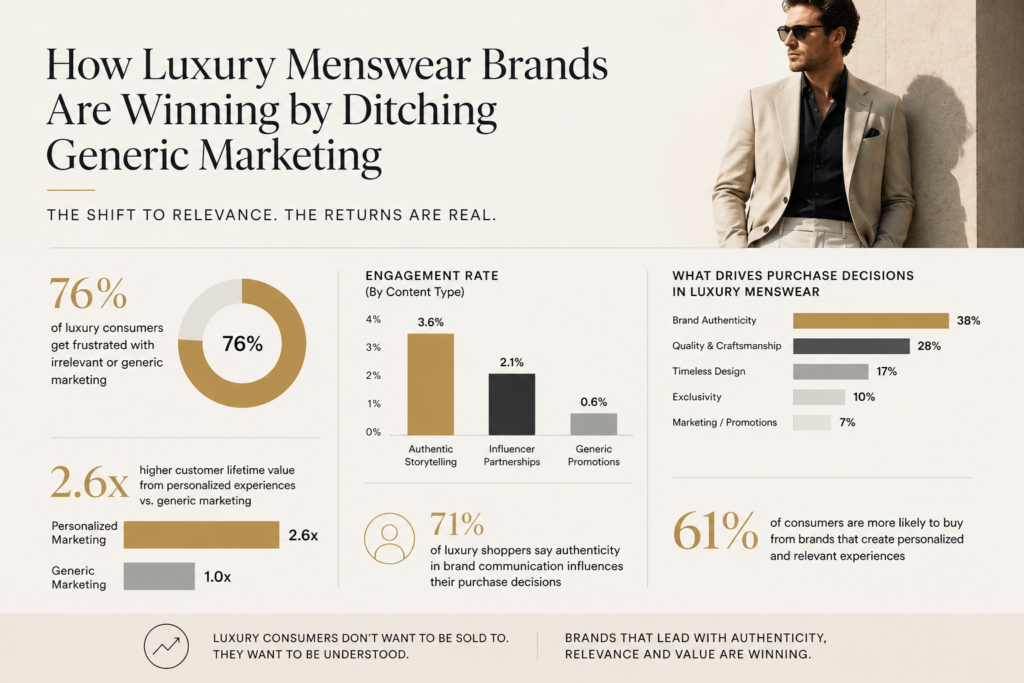
How Luxury Menswear Brands Are Winning by Ditching Generic Marketing
The Numbers Behind the Shift
Amra & Elma — Luxury Brand Intelligence
How Luxury Menswear Brands
Win by Ditching Generic Marketing
The $55 billion shift from one-size-fits-all campaigns to identity-driven storytelling — and exactly what the winning brands are doing differently.
Market size by the numbers
What male luxury consumers actually want
The 4 pillars of winning luxury menswear marketing
Brand case studies: what actually worked
Ready to build a campaign that actually means something?
See our fashion work →Before diving into strategy, let’s set the table with what the market actually looks like right now.
The global luxury menswear market was valued at approximately $34.5 billion in 2024 and is projected to reach $55 billion by 2033, growing at a CAGR of around 5.4%. Meanwhile, the broader luxury fashion market hit $259.74 billion in 2024 and is on track to reach $431.43 billion by 2033, growing at a 5.8% CAGR. The menswear market as a whole, luxury and mass combined, is moving from $621.94 billion in 2025 toward nearly $1 trillion by 2034.
These are not niche numbers. This is one of the largest and fastest-growing consumer verticals on earth.
But here is what the topline figures do not tell you: within these growth projections, the brands winning disproportionately are not the ones spending the most on traditional advertising. They are the ones that figured out that modern male luxury consumers do not want to be sold to in the old way. They want to be spoken to. And there is a significant difference.
The men’s suits market alone was valued at $31.35 billion in 2024, with wedding suits and special occasions contributing roughly 33% of all demand. Customized tailoring now accounts for 28% of consumer preference in this category, and 38% of US consumers specifically prioritize customized tailoring options when purchasing premium formalwear. These are not small signals. They are directional mandates for how brands should be marketing.
The brands that are reading these numbers correctly are the ones investing in personalized, story-driven, identity-forward marketing. The ones ignoring them are the ones still running the same campaign they ran in 2015, wondering why engagement is declining.
The Death of the Generic Tuxedo Approach in Marketing
Here is a useful metaphor from the world of menswear itself. For decades, grooms showed up to rental shops, grabbed a scratchy polyester blend, and shuffled through a ceremony looking like every other groom in every other photo from the last forty years. The tuxedo was treated as a mandatory uniform. No exceptions allowed. The product was interchangeable. The experience was forgettable.
Luxury menswear marketing operated on exactly the same logic. Big production budget. Aspirational imagery of men in suits against some vague European backdrop. A logo, a tagline, and a few double-page spreads in GQ. Done.
It worked when the media landscape was narrow, when consumers had fewer choices, and when the bar for what constituted a luxury brand experience was set low enough that a beautiful photograph could carry a campaign. None of those conditions exist anymore.
Today’s male luxury consumer is informed, digitally native, and deeply skeptical of anything that feels like a performance. He does not want a generic campaign. He wants to see himself. He wants a brand that understands not just that he likes quality, but why he likes quality, what it says about him, and how it fits into the rest of his life. He is not buying a tuxedo. He is buying an identity.
The brands that understand this are operating on a completely different plane from the ones still trying to out-produce each other on aspirational photography.
Amra & Elma — Data Visualization
The Numbers Behind Luxury Menswear Marketing
Market size, consumer behavior, influencer ROI, and demand drivers — all the data that shapes the strategy.
Market growth
Luxury menswear market value 2023–2033 (USD billion)
Consumer demand drivers
What's driving men's suit purchases in 2025 (%)
Influencer marketing
Fashion influencer market value 2024–2030 (USD billion)
Consumer preferences
Key luxury menswear consumer stats (%)
Sources: DataIntelo, Grand View Research, Business Research Insights, Saks 2024 Survey, Global Growth Insights — compiled by Amra & Elma LLC
Zegna and the Art of Telling the Right Story
Few luxury menswear brands have navigated this shift as skillfully as Ermenegildo Zegna. The brand’s marketing strategy is built around a deceptively simple principle: prioritize storytelling over discounting, and use landscapes and ateliers to dramatize material expertise rather than just showcase product.
Zegna does not run sales. It runs narratives. The brand’s “quiet luxury” positioning is not just a design aesthetic. It is a full-stack marketing philosophy that runs from the wool fields of Oasi Zegna all the way through to the way the brand communicates on social media and in editorial. Every touchpoint delivers craft, comfort, and responsibility in equal measure. That alignment builds familiarity and trust, which compound into higher lifetime value for the brand’s most engaged clients.
The results are not abstract. Zegna’s “quiet luxury” branded products advanced 20% to $1.2 billion in revenue in a single year. That growth did not come from discounting. It did not come from a celebrity endorsement blitz. It came from a brand that spent years building a coherent, authentic story about what it stands for and why that matters to a specific kind of man.
This is the template. Not the specific aesthetic, but the underlying logic: know who you are speaking to, build a story that resonates with that person’s identity, and execute that story consistently across every channel and every touchpoint.
Tom Ford operates from a similar playbook, though the execution could not look more different on the surface. Where Zegna whispers, Tom Ford declares. But the underlying marketing principle is identical: the story is not explained, it is felt. Campaigns sell atmosphere, not features. The brand creates curiosity rather than rushing to clarify. In 2026, when attention is fragmented and every brand is trying to be understood in two seconds, a luxury brand that creates genuine intrigue can stand out in a way that no media spend can replicate. Tom Ford marketing works because the brand codes are non-negotiable. The storytelling is consistent. The identity is total.
Fabric Is Not Just Product. Fabric Is Marketing.
Here is something that most luxury menswear marketing teams get badly wrong. They treat the product and the marketing as separate disciplines. The product team designs something beautiful. The marketing team figures out how to talk about it. These two functions operate in silos and the result is campaigns that feel disconnected from the actual experience of wearing the clothes.
The brands that are winning right now understand that material choices are not just product decisions. They are marketing decisions. The story of why a fabric was chosen, where it comes from, how it behaves on the body, what it signals to the room — that is the campaign. Not the backdrop. Not the lighting. The fabric itself.
Think about what this means in practice. An open-weave hopsack wool that breathes through a long event and holds its shape without effort is not just a quality choice. It is a story about a man who understands the difference between wearing something and being dressed. A silk-linen blend that develops that specific, expensive kind of wrinkle as the evening progresses is not a flaw to apologize for. It is a signal of authentic material quality that the right customer recognizes immediately and values deeply. A wool-silk-cashmere mix with a soft matte finish that photographs beautifully without the flat sheen of cheap fabric tells a story about a man who understands that looking good in real life and looking good in a photo are two different problems that require two different solutions.
The brands that know how to tell these stories — not in technical spec sheets but in the kind of language that makes a customer feel something — are the ones building the strongest connections with male luxury buyers right now. A 2024 survey from Saks found that 70% of consumers find value in personalization when shopping online for luxury fashion. But personalization does not just mean putting someone’s initials on a pocket square. It means making the customer feel that the brand understands what he values and why. Material storytelling is one of the most underused tools in luxury menswear marketing for achieving exactly that.
The Wardrobe Investment Narrative Is the Most Powerful Marketing Frame in Menswear Right Now
One of the most significant shifts we are tracking in luxury menswear consumer behavior is a move away from occasion-specific purchasing toward what might be called wardrobe investment logic. Modern male luxury buyers are not just thinking about how something looks at a single event. They are thinking about cost-per-wear. They are thinking about versatility. They are thinking about whether a piece earns its place in a permanent wardrobe or just occupies space in a garment bag for four years between outings.
This is not just a consumer preference shift. It is a massive marketing opportunity that most luxury brands are leaving entirely on the table.
Consider the framing difference between these two marketing approaches. Approach one: here is a beautiful suit for your wedding day. Approach two: here is the piece that anchors your wardrobe for the next decade. Start at the altar. Wear it to the board meeting with a clean white tee underneath. Wear it to the gallery opening. Wear it to the dinner where it matters what you look like. This is not a suit for a day. This is an investment that works harder for you every time you reach for it.
The second approach is not just more compelling. It is fundamentally more honest about the actual value proposition of a well-made luxury garment versus a single-use rental. And modern male luxury consumers — particularly millennials, who are currently the most driven group when it comes to luxury purchases in the US — respond powerfully to this kind of transparent, value-based framing.
Two-thirds of millennials buy luxury items to reward themselves, according to market research. More than half say they make luxury purchases because they need the product or are replacing something old. These are not impulse buyers. These are intentional, considered consumers who are actively looking for reasons to justify a premium purchase. The wardrobe investment narrative gives them exactly the framework they are looking for. A luxury menswear brand that speaks this language fluently is not just selling a suit. It is becoming part of how its customer thinks about himself.
Silhouette as Signal: How the Shape of the Clothes Reflects the Shape of the Market
The actual aesthetic direction of luxury menswear right now is itself a marketing lesson. Those ultra-tight, skin-skimming suits that dominated the mid-2010s are gone. The current direction is toward comfort and classic proportions. Natural, unpadded shoulders. Trousers that sit higher on the waist with elegant pleats. Wider lapels that frame the chest with an old-Hollywood authority. The goal is presence without effort. Confidence without strain.
This is not just a design trend. It is a direct response to what male luxury consumers are telling brands they want, which is to feel like themselves, not like they are wearing a costume. The man who used to be squeezed into a too-tight suit to signal that he cared about fashion has been replaced by a man who wants his clothes to feel like an expression of something real about who he is.
Brands that understand this at the marketing level — not just the design level — are building campaigns around exactly this language. The authenticity of fit. The confidence of proportion. The ease of a garment that moves with you rather than against you. Men’s wedding suit searches peaked at a normalized score of 91 in April and May 2025, and the trend data makes clear that what is driving this demand is not traditional formalwear dressed up with new colors. It is genuinely different silhouettes and genuinely different design philosophies that better reflect how modern men actually want to experience their own clothes.
Luxury brands that are staying ahead of this curve, and communicating it clearly in their marketing, are the ones capturing the most valuable slice of this growing demand.
The Influencer Equation: Why Luxury Menswear Is Finally Getting It Right
The fashion influencer marketing market was valued at $6.82 billion globally in 2024 and is on track to reach $39.72 billion by 2030, at a CAGR of 33.8%. For luxury menswear specifically, influencer marketing was historically treated as something vaguely beneath the category. Luxury brands were supposed to be above that kind of thing. They had their editorial relationships. They had their celebrity dressing programs. They did not need some guy with a large Instagram following to validate their work.
That posture has been quietly abandoned by every brand that is serious about growing in the current environment, and the ones that held onto it longest paid for it in market relevance.
But the more important shift is not just that luxury menswear brands are doing influencer marketing now. It is that they are doing it differently than fashion brands in other categories. The luxury menswear influencer strategy that actually works is not about reach. It is about identity alignment. The right creator for a luxury menswear brand is not necessarily the one with the most followers. It is the one whose audience recognizes him as a genuine authority on exactly the kind of quality and taste the brand represents.
Brands that collaborate with influencers witness an average 30% increase in brand visibility within the first three months of a campaign. Influencer marketing offers an average ROI 6.5 times higher than traditional advertising methods. For luxury menswear specifically, where the average transaction value is high and the purchase consideration cycle is long, the trust and credibility that the right creator brings to a recommendation is more valuable than any paid media placement.
At Amra & Elma, our combined following of over 1.3 million across platforms is built on exactly this kind of authentic authority in fashion and luxury. When we promote a luxury product, our audiences trust that recommendation because we have spent years building credibility in the exact aesthetic and quality territory where luxury menswear lives. That trust is the asset. Every campaign we run is built around it.
Experiential Marketing and the New Definition of Brand Building
Over 80% of event marketers agree that experiential marketing creates deeper and longer-lasting connections with customers than traditional advertising. As many as 85% of consumers say they are more likely to purchase from a brand after participating in an experiential marketing event. For luxury menswear, this data point carries particular weight.
Men do not typically want to be marketed to in the same way as other consumer segments. They are skeptical of overt persuasion. They respond to being shown something, experiencing something, being included in something that feels exclusive and real. A private tailoring appointment where a brand’s material story is told through the actual experience of handling the fabric is more powerful marketing than any campaign. A curated event where a brand’s identity is expressed through the total environment — the lighting, the music, the conversation, as well as the clothes — creates the kind of emotional imprint that leads to genuine brand loyalty.
The luxury brands that are investing in experiential activations for their menswear are not just running marketing events. They are creating the most powerful form of brand building available to them: direct, personal, memorable experience.
What Brands Are Still Getting Wrong
Despite all of the above, the majority of luxury menswear brands are still making the same foundational marketing errors. They are spending enormous resources on production quality for campaigns that lack a coherent point of view. They are confusing aesthetic with identity, producing beautiful content that says nothing of substance about why the brand exists or what it means to the men who wear it. They are treating their digital and editorial presences as entirely separate disciplines rather than as expressions of the same coherent brand story. They are investing in reach over resonance, chasing broad awareness metrics that do not translate into the kind of deep brand affinity that actually drives purchase decisions and loyalty in the luxury segment.
Perhaps most critically, they are failing to understand that the modern male luxury consumer does not want to be told what to wear. He wants to be given the language, the story, and the framework to understand why what he chooses to wear matters. The brands that provide that framework are the ones building lasting market positions. The brands that do not are the ones watching category leaders compound their advantages year over year.
The Amra & Elma Framework for Luxury Menswear Marketing
At Amra & Elma, we have developed an integrated approach to luxury brand marketing that addresses precisely these gaps. Our methodology combines contracted influencer seeding with genuine audience authority, B2B email outreach that reaches primary inboxes rather than spam folders, SEO and GEO content strategy, earned media placements, and full production capabilities that bring brand stories to life across every relevant channel.
What makes this approach work for luxury menswear specifically is that it starts with identity rather than campaign mechanics. Before we talk about channels or deliverables, we spend time understanding what the brand actually stands for, what kind of man it is speaking to, and what that man wants to feel when he puts on the clothes. Everything that follows is an expression of that foundation.
The luxury menswear brands that are winning right now are not winning because they have bigger budgets or better products, though those things matter. They are winning because they have figured out that in a market full of beautiful clothes and beautiful imagery, the brands that tell the most human, honest, specific stories about identity and quality and what it means to wear something truly well made are the ones that the best customers choose, remember, and come back to.
Generic is over. The next decade in luxury menswear marketing belongs to the brands that understand that.
Sources:
- https://dataintelo.com/report/global-luxury-menswear-market https://straitsresearch.com/report/luxury-fashion-market
- https://www.businessresearchinsights.com/market-reports/luxury-menswear-market-124413 https://www.renub.com/menswear-market-p.php
- https://www.globalgrowthinsights.com/market-reports/men-s-suits-market-119807 https://www.accio.com/business/new-mens-suit-trends https://www.accio.com/business/current-fashion-mens-suits https://marcdarcy.co.uk/blogs/news/mens-wedding-suit-trends-2025
- https://www.latterly.org/zegna-marketing-strategy/ https://www.latterly.org/tom-ford-marketing-strategy/ https://www.brandvm.com/post/tom-ford-marketing-style-luxury
- https://unitymarketingonline.com/tom-ford-fashion-is-back-giving-zegna-group-a-big-boost/ https://www.grandviewresearch.com/industry-analysis/fashion-influencer-marketing-market
- https://bestcolorfulsocks.com/blogs/news/influencer-led-fashion-purchases-statistics
- https://www.influencer.com/knowledge-hub/the-state-of-influencer-marketing-in-the-fashion-industry
- https://sociallypowerful.com/influencer/marketing/statistics
- https://www.blockandtam.com/insights/luxury-marketing-trends
- https://lombardo.agency/top-10-trends-shaping-luxury-consumer-marketing-in-2024/
- https://www.ingrid.com/blog/quiet-luxury-e-commerce-personalization
- https://luxurylifestyleawards.com/experience/personalized-marketing-strategies-luxury-brands
- https://www.uniformmarket.com/statistics/luxury-clothing-market
- https://www.dialogue.agency/blog/whats-next-for-luxury-digital-marketing
Revenue & Financial Data
Dyson 2023 official financial results (£7.1B revenue, +9% vs 2022, R&D up 40%): https://www.dyson.co.uk/discover/news/press-releases/dyson-financial-results-2023
Dyson Singapore newsroom — same results confirmed: https://www.dyson.com.sg/newsroom/financial-results-2023
Statista — Dyson annual revenue 2010–2023 (historical chart): https://www.statista.com/statistics/746505/worldwide-dyson-annual-revenue/
Fortune — 2023 revenue, dividend, and UK job cuts context: https://fortune.com/europe/2024/10/02/billionaire-sir-james-dyson-family-dividend-uk-job-cuts/
Cascade.app — Dyson strategy study with revenue milestones and stats: https://www.cascade.app/studies/dyson-strategy-study