



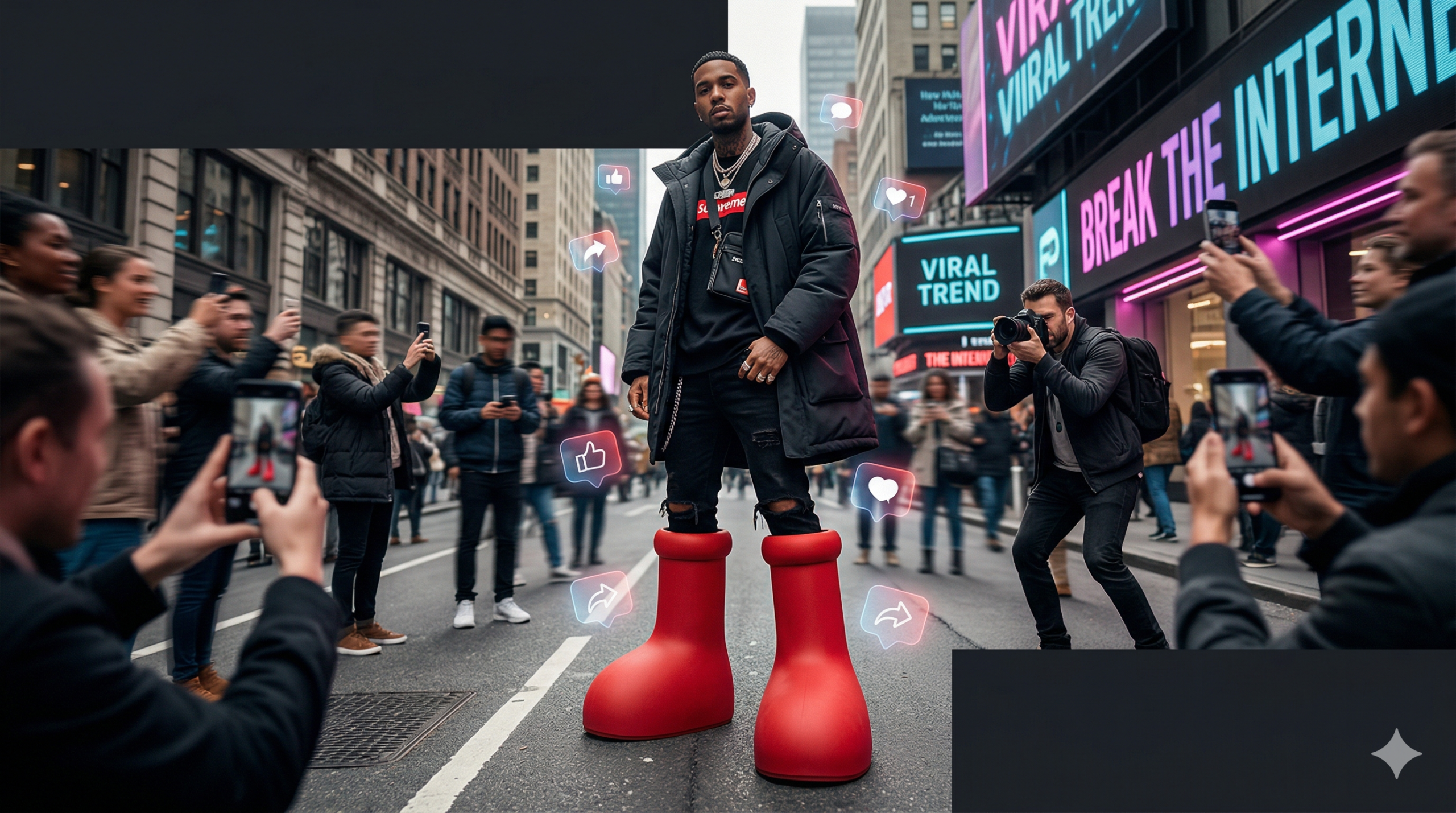
21 Dec How MSCHF Boots Went Viral: 15 Marketing Secrets Behind Their Shock Value
Before the internet decided that fashion had officially lost its mind (again), a pair of bulbous, cartoon-red boots stomped their way into culture and refused to leave. MSCHF didn’t just release footwear—they staged a moment. The Big Red Boots blurred the line between art, irony, and commerce, proving that in today’s attention economy, shock isn’t a gimmick, it’s a strategy. If Leandra Medine had swapped her closet edits for campaign decks, she’d probably tell you this: the boots worked because they understood the joke, trusted the audience, and let the internet do the rest. From intentional absurdity to scarcity-fueled desire, this breakdown unpacks the 15 marketing secrets behind how MSCHF went viral—and why brands chasing relevance would do well to study it the way a leading marketing agency in New York studies culture before it ever studies clicks.
How MSCHF Boots Went Viral:15 Marketing Secrets Behind Their Shock Value (Editor’s Choice)
🖤 How MSCHF Boots Went Viral: Strategy × Platform Reality
Every shock-value move, mapped to how people actually behave online.
| Strategy | Best Platform | What People Search | Audience Intent |
|---|---|---|---|
| 🤯 Shock Value | TikTok | “MSCHF boots reaction” | Immediate emotion, disbelief |
| 📸 Media-Friendly Design | “MSCHF boots meme” | Visual validation, screenshots | |
| ⏳ Scarcity | X (Twitter) | “MSCHF boots sold out” | FOMO, social proof |
| 🧨 Shockvertising | X (Twitter) | “are MSCHF boots fashion” | Debate, hot takes |
| 👀 Public Visibility | TikTok | “MSCHF boots in public” | IRL confirmation |
| 🌟 Influencers | “celebrity wearing MSCHF boots” | Taste validation | |
| 😍😤 Polarization | TikTok | “would you wear MSCHF boots” | Opinion forming |
| 🔁 Feed Saturation | “boots everywhere on my feed” | Trend recognition | |
| 🧸 Cultural Reference | TikTok | “cartoon boots real life” | Nostalgia, comparison |
| 🗣️ Word of Mouth | “everyone talking about MSCHF boots” | Shared conversation | |
| ⚡ Controlled Controversy | X (Twitter) | “MSCHF boots marketing” | Analysis, critique |
| 🚫📺 No Ads | Multi-platform | “viral without ads brand” | Learning, strategy |
| 📱 Platform Fluency | All Platforms | “MSCHF boots TikTok vs Instagram” | Comparison behavior |
| 🕵️♀️ Brand Mystique | “what will MSCHF do next” | Anticipation | |
| 🧑🎨 Community Play | TikTok | “MSCHF boots parody” | Participation, remixing |
How MSCHF Boots Went Viral:15 Marketing Secrets Behind Their Shock Value
How MSCHF Boots Went Viral: Marketing Secrets Behind Their Shock Value #2 — Build a Media-Friendly Object 📸
These boots were not designed for closets—they were designed for cameras. Every angle photographs like a headline, which is exactly the point. MSCHF built a product that behaves like content, meaning it doesn’t need an explainer caption or a branded hashtag to do its job. You see it once and your brain fills in the rest.
How MSCHF Boots Went Viral: Marketing Secrets Behind Their Shock Value #3 — Strategic Scarcity ⏳
MSCHF releases products the way fashion editors release opinions: sparingly and with intention. The limited availability of the Big Red Boots turned them from footwear into folklore. When something is hard to get, it instantly becomes harder to ignore—and suddenly everyone wants an opinion on a product they can’t even buy.
Scarcity is less about inventory and more about psychology. By controlling access, MSCHF created urgency, resale frenzy, and cultural clout all at once. It’s the marketing equivalent of leaving the party early so everyone keeps talking about you.
How MSCHF Boots Went Viral: Marketing Secrets Behind Their Shock Value #4 — Shockvertising That Starts Conversations 🧨
MSCHF doesn’t aim for applause; they aim for discourse. The boots weren’t universally loved—and that was the point. They sparked debates, jokes, side-eyes, and Twitter threads, which is infinitely more valuable than polite approval.
From a marketer’s lens, this is strategic provocation. If your campaign makes people argue at brunch, you’ve successfully embedded yourself into culture. Neutral reactions are forgettable. Polarizing ones travel.
How MSCHF Boots Went Viral: Marketing Secrets Behind Their Shock Value #5 — High Public Visibility 👀
The Big Red Boots are essentially wearable billboards. You can’t blend into a sidewalk wearing them, and MSCHF knew that. The product forces attention in real life, which then ricochets online in the form of photos, videos, and unsolicited commentary.
Visibility is a growth loop. The more people see it, the more they ask about it, the more content gets created, and suddenly the boots are everywhere—without ever asking permission.
How MSCHF Boots Went Viral: Marketing Secrets Behind Their Shock Value #6 — Influencer and Celebrity Sightings 🌟
MSCHF didn’t rely on polished influencer campaigns. Instead, they let culture carriers do the talking simply by being seen. When celebrities wore the boots casually—errands, airports, paparazzi chaos—it reframed the product from “art project” to “fashion moment.”
This works because credibility doesn’t come from captions anymore; it comes from context. Seeing someone influential wear something without explanation feels authentic, spontaneous, and infinitely more persuasive.
How MSCHF Boots Went Viral: Marketing Secrets Behind Their Shock Value #7 — Polarizing Emotion 😍😤
People didn’t just see the boots—they felt something about them. Delight, confusion, irritation, obsession. Emotional reactions are the currency of virality, and MSCHF cashed in aggressively.
From a marketing standpoint, emotion accelerates sharing. Nobody screenshots indifference. MSCHF designed a product that begged for reaction, knowing full well that feelings fuel feeds.
How MSCHF Boots Went Viral: Marketing Secrets Behind Their Shock Value #8 — Feed Triggers That Won’t Quit 🔁
Once the boots appeared, they kept appearing. TikToks, memes, outfit pics, reaction videos—it was visual déjà vu in the best way. MSCHF understood that repetition builds familiarity, and familiarity builds legitimacy.
This is classic trigger theory with a couture twist. The more often people encountered the boots, the more normalized—and therefore interesting—they became.
How MSCHF Boots Went Viral: Marketing Secrets Behind Their Shock Value #9 — Cultural References With a Wink 🧸
The boots feel familiar, like something you’ve seen before but can’t quite place. That cartoonish nostalgia taps into collective memory without spelling it out, which makes the audience feel clever for “getting it.”
From a marketing angle, this is borrowed equity done right. Familiarity lowers resistance, while novelty keeps attention. It’s a delicate balance—and MSCHF nailed it.
How MSCHF Boots Went Viral: Marketing Secrets Behind Their Shock Value #10 — Word-of-Mouth Engineering 🗣️
The boots are impossible to describe without sounding dramatic, which is exactly why people talk about them. MSCHF engineered a product that turns every conversation into a pitch—no brand script required.
Word-of-mouth works best when people feel like they discovered something strange and urgent. MSCHF made the boots feel like gossip you had to share.
How MSCHF Boots Went Viral: Marketing Secrets Behind Their Shock Value #11 — Controversy as a Catalyst ⚡
MSCHF plays at the edge of taste without tumbling into irrelevance. The boots flirted with controversy—art vs. fashion, satire vs. sincerity—and that tension attracted press like moths to a flame.
For marketers, controversy is fuel when handled thoughtfully. MSCHF didn’t offend to shock; they questioned norms to provoke thought—and headlines followed.
How MSCHF Boots Went Viral: Marketing Secrets Behind Their Shock Value #12 — No Traditional Ads, Just Chaos 🚫📺
There were no glossy billboards or polished commercials. The boots lived where culture lives: social feeds, sidewalks, and comment sections. MSCHF let the internet do the distribution.
This approach works because modern audiences trust people more than placements. When hype feels organic—even if meticulously planned—it spreads faster and sticks longer.
How MSCHF Boots Went Viral: Marketing Secrets Behind Their Shock Value #13 — Platform-Native Storytelling 📱
MSCHF didn’t force one narrative everywhere. The boots became memes on Twitter, outfit content on Instagram, and chaos fuel on TikTok. Same product, different energy.
Smart marketing today means respecting the language of each platform. MSCHF didn’t copy-paste—they translated, which made the content feel native instead of forced.
How MSCHF Boots Went Viral: Marketing Secrets Behind Their Shock Value #14 — Brand Mystique as Strategy 🕵️♀️
MSCHF never over-explains, and that restraint is magnetic. By keeping their brand slightly opaque, they invite curiosity—and curiosity drives attention.
Mystique works because people want to feel like insiders. MSCHF lets audiences connect the dots themselves, which is far more engaging than spelling everything out.
How MSCHF Boots Went Viral: Marketing Secrets Behind Their Shock Value #15 — Turning the Audience Into the Campaign 🧑🎨
Memes, parodies, recreations—people didn’t just consume the boots, they participated in them. MSCHF gave the internet permission to play, and the internet obliged enthusiastically.
This is the holy grail of modern marketing: when your audience becomes your media team. MSCHF didn’t chase virality; they built something people wanted to remix—and that’s the difference.
So What Did We Learn? Chaos Is a Strategy, Not an Accident
If there’s one takeaway from MSCHF’s Big Red Boots, it’s this: virality isn’t magic, and it’s definitely not luck—it’s taste, timing, and the nerve to trust your audience. MSCHF didn’t chase trends or beg for attention; they engineered a moment by understanding culture better than algorithms and committing to an idea so fully it couldn’t be ignored. The boots worked because they were honest in their absurdity, disciplined in their restraint, and generous in how much space they gave the internet to play. In an era where most brands are busy polishing themselves into sameness, MSCHF proved that standing out doesn’t require shouting louder—it requires thinking sharper, caring less about universal approval, and remembering that the most powerful marketing doesn’t feel like marketing at all.