



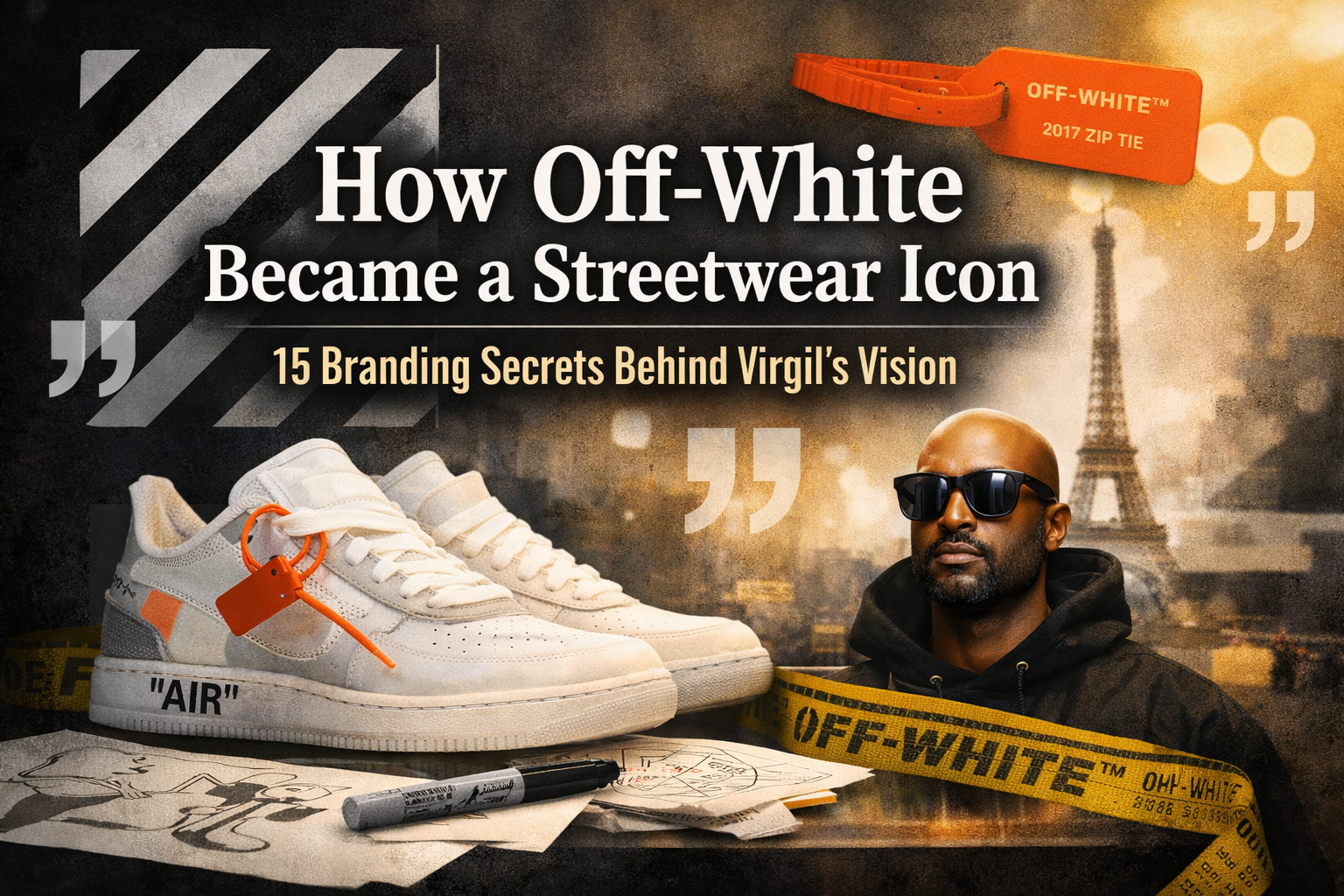
20 Dec How Off-White Became a Streetwear Icon: 15 Branding Secrets Behind Virgil’s Vision
How Off-White Became a Streetwear Icon: 15 Branding Secrets Behind Virgil’s Vision (Editor’s Choice)
Brand Breakdown
How Off-White Became a Streetwear Icon
15 branding secrets behind Virgil’s vision—packaged as a fast, scroll-stopping reference.
| # | Branding Secret | Why it worked | How you can apply it |
|---|---|---|---|
| 01 | The “3% Rule” | Small tweaks created “newness” without losing familiarity. | Refresh best-sellers with subtle upgrades (materials, trim, naming, story). |
| 02 | Quotation Marks as a Brand Language | Turned products into ideas and sparked conversation. | Create a recognizable “verbal signature” (labels, phrases, naming system). |
| 03 | Industrial Design as Identity | Belts, zip ties, stripes = instant visual recognition. | Develop 1–2 ownable design codes you repeat across touchpoints. |
| 04 | A Logo That Scales Everywhere | Looked strong on sneakers, runway pieces, and social content. | Design flexible brand assets that work in tiny and massive formats. |
| 05 | Streetwear × High Fashion Bridge | Legitimized streetwear in luxury spaces and vice versa. | Borrow credibility from adjacent worlds through partnerships + placement. |
| 06 | Collabs as Cultural Expansion | Nike/IKEA/Rimowa unlocked new audiences while staying “Off-White.” | Choose collabs that extend your story, not just your distribution. |
| 07 | Limited Drops, Maximum Desire | Scarcity turned launches into events. | Use timed releases, waitlists, and “chapters” instead of constant restocks. |
| 08 | Social Media as a Design Tool | The brand evolved in public, building intimacy and momentum. | Test narratives and visuals on social before scaling campaigns. |
| 09 | Youth Culture as Creative Director | Stayed relevant by treating youth as co-creators, not targets. | Build feedback loops: community drops, creator councils, IRL listening. |
| 10 | Anti-Luxury Transparency | Exposed construction and “unfinished” cues felt honest and modern. | Show process: behind-the-scenes, prototyping, material provenance. |
| 11 | Education Built Into the Brand | Explaining references made fans feel smart and included. | Create explainers: “why we made this,” micro-content, annotations. |
| 12 | Milan Roots, Global Voice | Craft + culture blended into a borderless identity. | Anchor in one strong origin story while speaking to multiple scenes. |
| 13 | Storytelling Over Seasons | Collections read like chapters, not random releases. | Run campaigns as series: themes, arcs, recurring motifs, “episodes.” |
| 14 | Credibility First, Sales Second | Cultural authenticity created demand naturally. | Invest in taste-making (PR, creators, community) before scaling spend. |
| 15 | Virgil as the Brand’s Medium | A multidimensional creator made the brand feel alive and open-ended. | Humanize your brand: founder POV, creative direction, strong voice. |
How Off-White Became a Streetwear Icon: 15 Branding Secrets Behind Virgil’s Vision
How Off-White Became a Streetwear Icon: Branding Secrets Behind Virgil’s Vision #3 — Industrial Design as a Luxury Signal
Zip ties and construction belts shouldn’t feel luxurious, which is precisely why they worked. Off-White reframed industrial objects as cultural artifacts, elevating the aesthetics of labor into aspiration. This wasn’t cosplay—it was respect. By honoring the visual language of function, the brand grounded luxury in reality, making it feel modern rather than mythical.
How Off-White Became a Streetwear Icon: Branding Secrets Behind Virgil’s Vision #4 — A Logo Built for the Internet Age
Off-White’s stripes and arrows weren’t just logos—they were systems. Designed to survive shrinking, cropping, reposting, and remixing, they functioned perfectly in a world where branding lives on screens before shelves. The symbols were bold without being loud, recognizable without being rigid, and that flexibility made them future-proof.
How Off-White Became a Streetwear Icon: Branding Secrets Behind Virgil’s Vision #5 — Streetwear and High Fashion Without Apology
Off-White didn’t ask permission to sit at the luxury table—it brought its own chair and made it cooler. By placing hoodies and sneakers on Paris runways, the brand didn’t dilute luxury; it expanded it. Streetwear wasn’t elevated—it was validated, and that distinction mattered.
How Off-White Became a Streetwear Icon: Branding Secrets Behind Virgil’s Vision #6 — Collaboration as Cultural Translation
Off-White’s collaborations never felt like merchandise swaps; they felt like language exchanges. When Virgil partnered with Nike, IKEA, or Rimowa, he wasn’t borrowing equity—he was translating culture. Each brand spoke in its native tongue (sportswear, furniture, travel), and Off-White layered meaning on top without muting the original voice. The genius was restraint: the Off-White accent was always present, never overpowering. In branding terms, this is what cultural fluency looks like—knowing when to speak, when to listen, and when to let silence do the work.
How Off-White Became a Streetwear Icon: Branding Secrets Behind Virgil’s Vision #7 — Scarcity as Storytelling, Not Exclusion
Off-White didn’t weaponize scarcity; it curated it. Limited drops weren’t about denying access, they were about pacing attention. Each release arrived with intention, context, and closure—more like a premiere than a restock. This made the audience feel like participants in a timeline rather than customers in a funnel. The waiting, the anticipation, the collective refresh-at-midnight ritual all became part of the brand’s mythology. Scarcity, here, wasn’t transactional—it was emotional.
How Off-White Became a Streetwear Icon: Branding Secrets Behind Virgil’s Vision #8 — Instagram as a Creative Workspace, Not a Billboard
Virgil used Instagram the way designers once used sketchbooks: openly, imperfectly, and without polish. References were credited. Ideas were shared mid-thought. Nothing felt overproduced, and that was the point. Off-White didn’t hide the process behind a curtain of mystique—it invited the audience inside the room. In doing so, transparency became intimacy, and intimacy became loyalty. People didn’t just buy the product; they followed the thinking.
How Off-White Became a Streetwear Icon: Branding Secrets Behind Virgil’s Vision #9 — Youth Culture as a Creative Partner, Not a Trend Report
Off-White didn’t observe youth culture from the sidelines—it stood inside it. DJs, skaters, students, and emerging artists weren’t research subjects; they were collaborators. This proximity kept the brand relevant without chasing trends, because it wasn’t reacting—it was participating. Off-White understood that youth culture moves laterally, not hierarchically, and built a brand structure that mirrored that fluidity. The result was relevance that felt natural, not manufactured.
How Off-White Became a Streetwear Icon: Branding Secrets Behind Virgil’s Vision #10 — Anti-Perfection as a Modern Luxury Code
In a world obsessed with flawless finishes, Off-White chose exposure. Loose threads, visible systems, unfinished edges—they weren’t mistakes, they were declarations. This aesthetic reframed luxury as honesty rather than polish, signaling confidence instead of control. By showing the seams, Off-White made fashion feel human again. Imperfection wasn’t a lack of rigor; it was proof of intention.
How Off-White Became a Streetwear Icon: Branding Secrets Behind Virgil’s Vision #11 — Education as the Quietest Form of Power
Virgil Abloh explained his references not to over-intellectualize, but to democratize. By naming influences and breaking down ideas, Off-White made customers feel included rather than sold to. Knowledge became the extra layer of luxury—the kind you couldn’t counterfeit. In an industry that often relies on mystique to maintain authority, Off-White proved that transparency could be just as powerful.
How Off-White Became a Streetwear Icon: Branding Secrets Behind Virgil’s Vision #12 — Milan Craft With a Borderless Mindset
Off-White’s foundation in Milanese craftsmanship gave it legitimacy, but its worldview gave it momentum. The brand honored traditional production without being bound by tradition’s limitations. Italy provided precision; global culture provided relevance. This balance allowed Off-White to feel rooted without ever feeling provincial.
How Off-White Became a Streetwear Icon: Branding Secrets Behind Virgil’s Vision #13 — Collections as Serialized Storytelling
Rather than resetting every season, Off-White layered meaning over time. Themes returned, evolved, and deepened, creating a sense of continuity that rewarded long-term attention. Fashion became episodic—less about novelty, more about narrative. This approach trained the audience to look for connections, not just products.
How Off-White Became a Streetwear Icon: Branding Secrets Behind Virgil’s Vision #14 — Cultural Credibility Before Commercial Scale
Off-White prioritized presence over performance metrics. By investing first in taste, community, and cultural alignment, the brand built demand that felt organic rather than engineered. Sales followed belief, not the other way around. It’s a reminder that in the long run, relevance compounds faster than reach.
How Off-White Became a Streetwear Icon: Branding Secrets Behind Virgil’s Vision #15 — Virgil Abloh as the Brand’s Living Framework
Virgil Abloh didn’t just build a brand—he modeled a way of thinking. DJ, architect, educator, creative director, he moved fluidly across disciplines, giving Off-White permission to do the same. The brand felt alive because it was driven by curiosity rather than certainty. In the end, Off-White wasn’t just a label—it was a mindset, authored by a person unafraid to keep learning in public.